April 1, 2010
Dinar and Discussion for April 2010
This is the Dinar And Discussion Page for April.
March 1, 2010
Dinar and Discussion for March 2010
This is the Dinar And Discussion Page for March.
February 1, 2010
Dinar and Discussion For February 2010
This is the Dinar And Discussion Page for February, 2010
November 1, 2009
Dinar And Discussion November, December 09 & January 10
This is the Dinar And Discussion Page for November and December 09 & January 2010
August 4, 2009
Dinar And Discussion August Sept Oct 09
This is the Dinar And Discussion Page for August, September and October 2009
May 1, 2009
Dinar and Discussion May, June & July 2009
Dinar and Discussion for May, June & July 2009
March 1, 2009
Dinar and Discussion March & April 2009
Dinar and Discussion for March & April 2009
February 1, 2009
Dinar and Discussion for February 2009
Dinar and Discussion for February 2009
January 1, 2009
Dinar Discussion January 2009
Dinar and Discussion for January
December 1, 2008
Dinar Discussion December 2008
This is the Dinar Discussion for December.
November 5, 2008
Dinar Discussion November 2008
This is the Dinar discussion for November.
October 1, 2008
Iraq Dinar Discussion October 2008
This is the new page for October.
September 1, 2008
Dinar Discussion for Sept 2008
This is the page for Dinar Discussion for September 2008.
August 1, 2008
Dinar Discussion AUGUST 2008
This is the Discussion page for August.
July 1, 2008
Iraq Dinar Discussion JULY 2008
This is the Dinar Discussion for July 2008.
June 1, 2008
Dinar Discussion JUNE 2008
This is the Dinar Discussion for June 2008.
April 30, 2008
Dinar Discussion MAY 2008
Dinar Discussion MAY 2008
April 1, 2008
Dinar Discussion APRIL 2008
Dinar Discussion starting April 2008.
March 3, 2008
Dinar Discussion MARCH 2008
Dinar Discussion starting March 2008
January 28, 2008
Iraqi Dinar Discussion 1/28/2008 to ...
New page for comments as of January 2008
March 6, 2007
Iraqi Dinar Discussion: March 6, 2007 to August 20, 2007
As of August 20, 2007, this thread is closed,
click here to comment at the new thread.
The DinarAdmin moderator is still in place.
Here are all the posts in sequence:
1) June 16, 2004 - June 27, 2004
2) June 27, 2004 - November 6, 2004
3) November 6, 2004 - April 11, 2005
4) April 11, 2005 - June 22, 2005
5) June 22, 2005 - July 22, 2005
6) July 22, 2005 - April 30, 2006
7) April 30, 2006 - July 13, 2006
8) July 13, 2006 - September 8, 2006
9) September 8, 2006 - December 14, 2006
10) December 14, 2006 - January 7, 2007
11) January 7, 2007 - March 6, 2007
12) March 6, 2007 -
If you guys & gals encounter any problems, email me at kevin-at-truckandbarter.com.
Reader email has been pivotal to the administration of this site. Thanks for your patronage.
January 2, 2007
Iraqi Dinar Discussion: January 2, 2007 - March 6, 2007
As of March 6, 2007, this post is closed to new comments. Click here for the new place to discuss the Iraqi Dinar.
Note that due to childishness of some commenters, a moderator -- codename DinarAdmin - will be making sure personal attacks are immediately deleted.
Comments are working, but all commenters must now enter a six digit code to have their comments posted. However, you may now post up to five links in one post -- instead of three.
Here are all the posts in sequence:
1) June 16, 2004 - June 27, 2004
2) June 27, 2004 - November 6, 2004
3) November 6, 2004 - April 11, 2005
4) April 11, 2005 - June 22, 2005
5) June 22, 2005 - July 22, 2005
6) July 22, 2005 - April 30, 2006
7) April 30, 2006 - July 13, 2006
8) July 13, 2006 - September 8, 2006
9) September 8, 2006 - December 14, 2006
10) December 14, 2006 - January 7, 2007
11) January 7, 2007 - March 6, 2007
12) March 6, 2007 -
If you guys & gals encounter any problems, email me at kevin-at-truckandbarter.com.
Reader email has been pivotal to the administration of this site. Thanks for your patronage.
December 14, 2006
Iraqi Dinar Discussion: December 14, 2006 - January 2, 2007
This post is now closed. A new thread starts here
.
Comments are working, but all commenters must now enter a six digit code to have their comments posted. However, you may now post up to five links in one post -- instead of three.
Here are all the posts in sequence:
1) June 16, 2004 - June 27, 2004
2) June 27, 2004 - November 6, 2004
3) November 6, 2004 - April 11, 2005
4) April 11, 2005 - June 22, 2005
5) June 22, 2005 - July 22, 2005
6) July 22, 2005 - April 30, 2006
7) April 30, 2006 - July 13, 2006
8) July 13, 2006 - September 8, 2006
9) September 8, 2006 - December 14, 2006
10) December 14, 2006 - January 7, 2007
11) January 7, 2007 -
If you guys & gals encounter any problems, email me at kevin-at-truckandbarter.com.
Reader email has been pivotal to the administration of this site. Thanks for your patronage.
November 29, 2006
Assorted and Interesting
Are The Big Four Econ Errors Biases?
A bird's eye view of econometrics
Is democracy good for the poor?
Numbers Guy on Armenian Genocide
The importance of a good analogy
Political Price Cycles in Gasoline Markets?
Wading in waste
Downshifting and Reversion in Forecasts
I Want It Now!The Curious Economics Of Temptation By Tim Harford
The Exceptionally Entrepreneurial Society
For Better or For Worse: Entrepreneurs, Families, and Inequality
Does America need a draft to win the war on terror?
Why understanding economics is hard
St Lucia best in Caribbean for Doing Business
God made Indonesia for free trade
Economics: The Invisible Hand of the Market
Dasgupta on the Stern Review
A Cool Calculus of Global Warming by Joseph E. Stiglitz
A call to arms- Anthony Giddens
Should Congress Raise the Federal Minimum Wage?—Posner
Iraq in Fragments (from the latest Foreign Exchange show)
Fed Chairman’s Daybook
A giant's strength is valuable - if not used like a giant by John Kay
Ivy League Investors by Robert Schiller
Globalization Makes an Easy Scapegoat by Robert Samuelson
Making fine distinctions in understanding hereditability of attitudes
What We Learn When We Learn Economics
Why Oh Why Can’t We Have Better Economists?
Can foreign aid work?
Uninsurable
Are Husbands really like potatoes?
Settling the New Continent by David Warsh
Syntax and flow
Getting it Wrong by David Friedman
Was Friedman a "Great Conservative Partisan"?
Milton Friedman: The Methodology of Positive Economics
Friedman On Growth Measurements and Immigration
The fading of Friedman by Paul Ormerod
European Cities Do Away with Traffic Signs
Secrets of the Cave Paintings
How I learnt to walk tall at 5ft 5in
The Paradox of Military Technology
Velvet Revolution in Iran?
Less Faith, More Reason by Steven Pinker
Mahfouz’s grave, Arab liberalism’s deathbed
Free Speech, Israel, and Jewish Illiberalism
The Myth of Thomas Szasz
Mirror, Mirror
Evidence that psychology, like biology, is conserved between human and nonhuman species augurs a shake-up for science and society
Conspicuous Proliferation
Just their type
Our appetite for literary gossip is insatiable, but great writers aren’t mere fly-by-night celebs, argues Bryan Appleyard
Bush, Maliki, and Lots of Questions
What is a Civil War?
Henry Kissinger says what he means, whatever that means
November 26, 2006
The budget of the insurgents revealed
 NYT reports on the financing of the insurgency in Iraq;
“The insurgency in Iraq is now self-sustaining financially, raising tens of millions of dollars a year from oil smuggling, kidnapping, counterfeiting, connivance by corrupt Islamic charities and other crimes that the Iraqi government and its American patrons have been largely unable to prevent, a classified United States government report has concluded.The report, obtained by The New York Times, estimates that groups responsible for many insurgent and terrorist attacks are raising $70 million to $200 million a year from illegal activities. It says $25 million to $100 million of that comes from oil smuggling and other criminal activity involving the state-owned oil industry, aided by “corrupt and complicit” Iraqi officials.
As much as $36 million a year comes from ransoms paid for hundreds of kidnap victims, the report says. It estimates that unnamed foreign governments — previously identified by American officials as including France and Italy — paid $30 million in ransom last year…
The group’s estimate of the financing for the insurgency, even taking the higher figure of $200 million, underscores the David and Goliath nature of the war. American, Iraqi and other coalition forces are fighting an array of shadowy Sunni and Shiite groups that can draw on huge armories left over from Mr. Hussein’s days, and benefit from the willingness of many insurgents to fight with little or no pay. If the $200 million a year estimate is close to the mark, it amounts to less than what it costs the Pentagon, with an $8 billion monthly budget for Iraq, to sustain the American war effort here for a single day.
But other estimates suggest the sums involved could be far higher. The oil ministry in Baghdad, for example, estimated earlier this year that 10 percent to 30 percent of the $4 billion to $5 billion in fuel imported for public consumption in 2005 was smuggled back out of the country for resale. At that time, the finance minister estimated that close to half of all smuggling profits was going to insurgents. If true, that would be $200 million or more from fuel smuggling alone.”
Related;
In Search of the Fixers
Iraqi women increasingly targeted in violence
Ferocity of Iraq attacks leaves US troops helpless
Sunni leader must stop bloodshed, says Sadr
Iran: America Destroyed All Our Enemies in the Region
November 23, 2006
Podcasts
Altruism
The term altruism was coined by the 19th century sociologist Auguste Comte and is derived from the Latin “alteri” or "the others”. It describes an unselfish attention to the needs of others. Comte declared that man had a moral duty to “serve humanity, whose we are entirely.” The idea of altruism is central to the main religions: Jesus declared “you shall love your neighbour as yourself” and Mohammed said “none of you truly believes until he wishes for his brother what he wishes for himself”. Buddhism too advocates “seeking for others the happiness one desires for oneself.”…
If both mankind and the natural world are selfishly seeking to promote their own survival and advancement, how can we explain being kind to others, sometimes at our own expense? How have philosophical ideas about altruism responded to evolutionary theory? And paradoxically, is it possible that altruism can, in fact, be selfish? Contributors include Miranda Fricker, Senior Lecturer in the School of Philosophy at Birkbeck, University of London, Richard Dawkins, evolutionary biologist and the Charles Simonyi Professor of the Public Understanding of Science at Oxford University and John Dupré, Professor of Philosophy of Science at Exeter University and director of Egenis, the ESRC Centre for Genomics in Society (from BBC’s In Our Time).
Niall Ferguson: The War of the World
The 20th century was a period of unprecedented economic growth and scientific discovery, but equally a century of unparalleled bloodshed and warfare - estimates suggest that 1 in every 22 deaths in the 20th century were the result of violence. Niall Ferguson argues that the intensity of the 'hundred years war' can be explained by the factors of ethnic disintegration, economic volatility, and empires in decline - forces which are to be found behind sites of contemporary conflict, notably the Middle East.
Can chocolate cure hypochondria?
Associate Professor in Latin Humanism Yasmin Haskell from the University of Western Australia talks about the history of hypochondria and benefits of chocolate.
Des Moore on Milton Friedman
“Why was Friedman so influential? It was not due to esoteric analyses of economic theory accepted in academia. He did very little of this and many academics resented his rebuttals of the merits of government intervention. His influence came importantly from his ability to explain and defend his beliefs in terms that were comprehensible and persuasive to the layman. His constant theme that adoption of free market policies were in the interests of the common man helped enormously.”
Utility of Force- General Sir Rupert Smith (ret., British Army)
The Long War General John Philip Abizaid, Commander of U.S. CENTCOM
A Conversation with Akbar Ganji and Martha Nussbaum
Democracy Amercian and British style
Does raising the miminum wage help the poor?
Private equity - the purest capitalism
Related blog- Going Private
November 22, 2006
A proposal to make Sunni Arabs happy
Two Princeton professors Shivaji Sondhi and Michael Cook, have a guest column at Econbrowser on a suggestion to improve the stake of the Sunnis in Iraq;
“The problem from the start has been the stake of the Sunni Arabs. This was entirely predictable, as no minority used to a disproportionate share of power gives up this privilege easily-- the relative deprivation simply excites too many fears. One only has to look at nearby Lebanon for an example…To this end we propose that the United States make a financial commitment to Iraq which takes the form of ensuring that its Sunni provinces get oil revenues proportional to their share of the population over the next decade or possibly more. Initially, it should take the form of simply funneling an amount equal to the Sunni share directly to these provinces. This would at the same time increase the size of the national pie, which would help to appease the Shia and the Kurds, and might also reduce the tension over Kirkuk. In later years the commitment would transition into an insurance policy.
What would be a rough upper bound on such a commitment? To date Iraq has produced a maximum of 3.7 million barrels per day (bpd) of oil. This was back in 1979, and the country hasn't actually produced more than 3.5 million bpd since 1990. It is quite unlikely that either figure will be exceeded anytime soon. Taking the 1979 figure and a profit of $50 per barrel, we are talking about revenues of approximately $67 billion a year. Of this we may estimate the share of the Sunni majority provinces at about 20 per cent, or $14 billion. Today their share of the 2 million bpd production is closer to $7 billion."
Related;
Iraq's white-collar crime by Juan Cole
Iraq Force Shift Studied
Don't Punt on The Troops Issue by Fareed Zakaria
Iraq: over 3,700 civilians killed in October
Iraq snapshot
Violence in Iraq: A Data-Driven Approach
Iraq Kurdistan Book Drive
Iraq: Dujail Trial Fundamentally Flawed
“The proceedings in the Dujail trial were fundamentally unfair. The tribunal squandered an important opportunity to deliver credible justice to the people of Iraq. And its imposition of the death penalty after an unfair trial is indefensible”
(Human Rights Watch Report)
November 19, 2006
Milton Friedman on Iraq War
“Mr. Friedman here shifted focus. "What's really killed the Republican Party isn't spending, it's Iraq. As it happens, I was opposed to going into Iraq from the beginning. I think it was a mistake, for the simple reason that I do not believe the United States of America ought to be involved in aggression." Mrs. Friedman--listening to her husband with an ear cocked--was now muttering darkly.
Milton: "Huh? What?" Rose: "This was not aggression!" Milton (exasperatedly): "It was aggression. Of course it was!" Rose: "You count it as aggression if it's against the people, not against the monster who's ruling them. We don't agree. This is the first thing to come along in our lives, of the deep things, that we don't agree on. We have disagreed on little things, obviously--such as, I don't want to go out to dinner, he wants to go out--but big issues, this is the first one!" Milton: "But, having said that, once we went in to Iraq, it seems to me very important that we make a success of it." Rose: "And we will!"
-In an interview on WSG; The Romance of Economics Milton and Rose Friedman: Dinner with Keynes? Yes. War with Iraq? They disagree
Related;
The Great Friedman
Milton Friedman - Economist Who Showed The Way For Thatcher
Milton Friedman On Prohibition
Shalom Milton Friedman
Is Monetarism Dead?
Milton Friedman and the Pencil
All the obituaries of Milton Friedman relate this little anecdote
An Appreciation of Milton Friedman
Milton Friedman: How to Cure Health Care
Friedman deserves the thanks of everyone opposed to conscription
Milton Friedman Died. Did We Lose a Scientist?
Milton Friedman, A Modern Galileo
Friedman's theories leave a mixed legacy (something from England)
The Legacy of Milton Friedman
What Bush Could Learn From Milton Friedman
Milton Friedman on Hong Kong (1998)
Origin of the Methodology of Positive Economics?
On the Origins of "A Monetary History" (via Tyler Cowen)
"This paper explores some of the scholarship that influenced Milton Friedman and Anna J. Schwartz's "A Monetary History". It shows that the ideas of several Chicago economists -- Henry Schultz, Henry Simons, Lloyd Mints, and Jacob Viner -- left clear marks. It argues, however, that the most important influence may have been Wesley Clair Mitchell and his classic book "Business Cycles" (1913). Mitchell, and the NBER, provided the methodology for "A Monetary History", in particular the emphasis on compiling long time series of monthly data and analyzing the effects of specific variables on the business cycle. A common methodology and the stability of monetary relationships produced similar conclusions about money. Friedman and Schwartz deemphasized Mitchell's "bank-centric" view of the monetary transmission process, but they reinforced Mitchell's conclusion that money had an independent, predictable, and important influence on the business cycle."
November 17, 2006
Carnival of Podcasts
The Peasants' Revolt
But who were the rebels and how close did they really come to upending the status quo? And just how exaggerated are claims that the Peasants’ Revolt laid the foundations of the long-standing English tradition of radical egalitarianism?
A bit more of British history podcasts via Brad DeLong. See also British History blog.
Heritage
In this four-part Heritage series Malcolm Billings explores the archaeology of patriotism in the USA; Part One, Part Two.
Air Taxi!
Recently the market for air taxis has really taken off but can this expensive form of personal transport really fly?
Crusading
What exactly were Crusades and how useful are they as a metaphor in the twenty first century?
Interview with John Emsley
If you are really keen to murder a spouse, which chemical element would you choose? Arsenic is SO last year. Mercury is so - well, mercurial. Cambridge chemist John Emsley offers informed advice for anyone contemplating homicide who would like to show a little flair and impress the team from CSI.
Flat Tax Reform in Slovakia: Lessons for the United States
The Liberal Roots of the American Empire
Michael Desch, Professor and Robert M. Gates Chair in Intelligence and National Security Decision-Making, George Bush School of Government and Public Service, Texas A&M University
Talking to terrorists
A discussion about an ongoing dialogue with several groups officially deemed terroist organisations. 'We don't talk to terrorists, full stop' - that is one end of the spectrum of approaches to dialogue. The other end might be: 'We'll talk to anyone, anywhere, anytime, if we think its going to lead to a resolution'. Related - Conflicts Forum
More upheaval in the US newspaper industry
How is technology changing our world?
Today we take stock of these and other questions, have a look at what has and what hasn't changed with respected authors Joel Kotkin and Bill Eggers.
The mystery of Linear B, the script that pre-dated alphabetic writing in Greece. Listen to the podcast.
Interview with Mark Thompson
Dr. Moira Gunn speaks with career entrepreneur and author Mark Thompson, who is currently a visiting scholar at Stanford Business School. Thompson talks about some 200 people he spoke to who have either built organizations or launched crusades – personal success built for a lifetime.
S.H.A.M.
The Self Help and Actualisation Movement is worth more than $8.5 billion U.S. in America alone. From Anthony Robbins getting his clients to run over hot coals to Marianne Williamson teaching that money is energy, and energy is infinite in the universe, it's getting hard to tell the difference between spruikers and sages. But according to investigative author, Steve Salerno, the happiness industry is banking on keeping us unhappy.
The Omidyar Network
In conversation with John Battelle, legendary technologist Pierre Omidyar explains the philosophy and business plan underlying his new network for investment in for-profit ventures which foster economic, social, and political self-empowerment. Applying lessons learned from his founding of eBay, this new investment strategy is based on the belief that people are basically good, and that connecting them with the right tools can build trust and opportunity.
November 15, 2006
Iraq reconstruction fact of the day

“Meanwhile, multiple audits conducted by U.S. and other agencies point to waste and malfeasance involving funds slated for reconstruction. The most recent, conducted by a UN oversight agency, found that the Halliburton subsidiary KBR had charged the Iraqi government $25,000 per truck per month for 1,800 fuel trucks that, it turns out, sat largely unused (PDF) along the Iraqi border…
All told, U.S. taxpayers have spent some $38 billion to rebuild Iraq—though much of the country’s infrastructure remains at prewar levels and many Iraqis still lack adequate water, electricity, and heating oil.”
- Tracking U.S. Dollars to Iraq
Related;
SPIEGEL INTERVIEW WITH IRAQ'S HEALTH MINISTER
The Least Accountable Regime in the Middle East
Doubling Down in Iraq -Warfare isn't like business.
The Baghdad Billions (podcasts)
November 11, 2006
Podcasts
“Some people will never learn anything because they understand everything too soon”
- Alexander Pope
Alexander Pope
So how did Pope manage to transform himself from a crippled outsider into a major cultural and moral authority? How did he shape our ideas about what a “modern author” is? Does his work still have resonances today or is it too firmly embedded in the politics, cultural life and rivalries of the period?
The Baghdad Billions- Part 1 (The first year of reconstruction) and Part 2 (Failure of the US aid programme)
Gun control - a new study has found the 1996 gun buy-back had no effect on firearm deaths.
The Science Show versus God
This week Richard Dawkins' remarkable book The God Delusion is released in Australia. Dawkins, Professor of the Public Understanding of Science at Oxford says he hopes that reading his book will make believers doubt their faith. He explains why he is so convinced, through the weight of scientific evidence, that atheism is the more valid viewpoint. Two winners of the Templeton Prize, given for building bridges between spiritual values and science, Professors John Barrow from Cambridge and Paul Davies now in Arizona give alternative views
Stem Cell Research
The history of the science of stem cell research - what are stem cells and when and how were they discovered.
The curse of the Western world: a history of obesity
North Korea
On Rear Vision this week a look at the history of North Korea and in particular the history of the relationship between North Korea and the United States of America
Harry Messel
One of Australia's most famous physicists tells of a childhood in Canada where he excelled at school, did two degrees simultaneously at university, and came to live in Australia. His pioneering work here has to be heard to be believed.
High blood pressure medication
A recent Australian study looked at medication for high blood pressure and the implications of patients' adherence or non-adherence to their doctor's prescription of these types of drugs
Jane Goodall
Jane Goodall talks about her 40 years of work with chimpanzees in Tanzania, and the relationship between chimpanzee behaviour and human behaviour.
Home Fronts: Indonesia
Terry Lane examines the political influence of Islamist values, the impact of radical organisations on Indonesian society and the democratisation of Indonesian institutions, in the fifth program of this six part series
Tobacco and Culture: First Nation Peoples face the Challenge
Sucking on cigarettes. It's a public health nightmare for the world's indigenous peoples. Maori women have the word's highest rates of lung cancer. Smoking rates haven't dropped in 15 years amongst Aboriginal Australians. But, for Native Americans native tobacco still has sacred, ceremonial value.
Paracelsus
He became known as the Luther of Medicine for his reformist medical practices, but Paracelsus, who was born in Switzerland in 1493, was also a religious man. His belief that the body was actually empowered by God had implications for his theories of healing.
November 10, 2006
How many civilians have died in Iraq?

According to Iraqi government official;
"Iraqi Health Minister Ali al-Shemari estimated Thursday that 150,000 Iraqi civilians have died in the war as he spoke to reporters in Vienna. He later said he based the figure on an estimate of 100 bodies per day brought to morgues and hospitals--though such a calculation would come out closer to 130,000. However, the head of Baghdad's central morgue said his facility alone was receiving about 60 bodies a day as a result of violence."
Related;
Good News for Bush- from The Economist blog- also have a look at their spreadsheet
On Whose Authority
Can we accept Lancet’s result without accepting their number
The cost of Chaos
Drowning by Numbers
Estimating Iraq deaths using survey sampling
Reality checks: some responses to the latest Lancet estimates
Tyler Cowen on the Lancet study
Daniel Drezner on the study
Further readings on the Iraqi excess deaths study
Dangerous Statistics: Estimating Civilian Losses in Afghanistan
Iraqi Death Toll Exceeds 600,000, Study Estimates
Home Fronts: Iraq (podcast)
Terry Lane talks to Patrick Cockburn and Zaki Chehab, two journalists who have recently published books about Iraq-Patrick Cockburn,Middle East correspondent for The Independent and Zaki Chehab, London Bureau Chief, Al Hayat-LBC TV
Iraq’s healthcare system rapidly deteriorating
Sex traffickers target women in war-torn Iraq
Paintings of Abu Ghraib shunned in US
*FERNANDO BOTERO painting on Abu Ghuraib above
Who Killed Iraq?
BBC reports on the missing billions from Iraq;
"In hearings on Capitol Hill in Washington, Democratic congressman Henry Waxman has emerged as the most vocal critic of the US' record on reconstruction.In particular, Mr Waxman says proper accounting procedures were ignored when large sums of Iraqi cash were handed over by the Coalition Provisional Authority (CPA) - the US-led body that ran Iraq immediately after the war - to get Iraqi ministries functioning again.
"I think we're looking at a huge scandal. The CPA handed over $8.8bn in cash to the Iraqi government even though that new government had no security or accounting system.
"No one can account for it. We don't know who got that money," Mr Waxman said.
Stuart Bowen is the special inspector general for Iraq reconstruction. His task is to follow the paper trail - and after more than 100 investigations his work paints a grim picture of waste and mismanagement.
Mr Bowen said billions of dollars were shrink-wrapped in plastic and flown out of the US to Baghdad.
"It was $2bn a flight, and I know of at least six flights," he said.
Mr Bowen said some of the cash went to pay the salaries of thousands of "ghost employees", or Iraqi civil servants who did not actually exist.
Related:
Why Gun-Barrel Democracy Doesn’t Work
Report from Iraq: Sorting Fact from Fiction in Iraq Reconstruction-Stuart W. Bowen, Jr, Special Inspector General for Iraq Reconstruction (podcast)
November 1, 2006

September 24, 2006
Niall Ferguson on Radical Islam
“The great category error of our time is to equate radical Islamism with fascism. If you actually read what Osama bin Laden says, it's clearly Lenin plus the Koran. It's internationalist, revolutionary, and anticapitalist-rhetoric far more of the left than of the right. And radical Islamism is good at recruiting within our society, within western society generally. In western Europe, to an extent people underestimate here, the appeal of radical Islamism extends beyond Muslim communities.”
- Interview at Boston Globe
Related;
Radical Islam in Pakistan; For years there has been debate over Pakistan's role in international terrorism. What is the link between Islamic extremism and Pakistan and when and how did it emerge?
Spy Agencies Say Iraq War Hurting U.S. Terror Fight;
“The war in Iraq has become a primary recruitment vehicle for violent Islamic extremists, motivating a new generation of potential terrorists around the world whose numbers may be increasing faster than the United States and its allies can reduce the threat, U.S. intelligence analysts have concluded.A 30-page National Intelligence Estimate completed in April cites the "centrality" of the U.S. invasion of Iraq, and the insurgency that has followed, as the leading inspiration for new Islamic extremist networks and cells that are united by little more than an anti-Western agenda. It concludes that, rather than contributing to eventual victory in the global counterterrorism struggle, the situation in Iraq has worsened the U.S. position, according to officials familiar with the classified document.”
September 20, 2006
How to Make Money – from War
The Guardian reports;
“Armor Group International, the security firm that makes most of its profits in Iraq, reported a drop in earnings for the first half of the year because of increased competition for business and the loss of a major training contract in Iraq.The London-based company reported a 30% rise in sales to $134.4m in the six months to June 30. Armor generated more than half of its revenues from business in Iraq - $70.3m - although its non-Iraq business grew by 57%.
However, pre-tax profits slipped to $3.7m from $4.7m for the same period a year ago. Analysts had expected profits to be only 10% lower than last year's.
Armor is chaired by Sir Malcolm Rifkind, the former Conservative foreign and defence secretary. It is one of the UK's leading providers of private security for reconstruction workers in Iraq.
"The group has achieved strong revenue growth over the first half, and we are encouraged by the significant growth outside Iraq," said Dave Seaton, the chief excecutive officer.
The main hit to sales was from the loss of a $7.8m contract with the United States for training staff at the ministry of justice in Iraq, the company told Reuters. "It was a one-off programme funded by the US," Mr Seaton said. "The Iraqi government does not have the funding for its own training needs."
Armor is diversifying and has new or extended contracts providing security at the World Bank headquarters in Kabul, Afghanistan; clearing land mines in southern Sudan, and doing security work for oil and gas companies.”
I wouldn't be worried so much as Failed States in the world seems to be increasing according to this World Bank report.
Related;
World Bank Lists Failing Nations That Can Breed Global Terrorism;
“The number of weak and poorly governed nations that can provide a breeding ground for global terrorism has grown sharply over the past three years, despite increased Western efforts to improve conditions in such states, according to a new World Bank report."Fragile" countries, whose deepening poverty puts them at risk from terrorism, armed conflict and epidemic disease, have jumped to 26 from 17 since the report was last issued in 2003. Five states graduated off the list, but 14 made new appearances, including Nigeria and seven other African countries, Kosovo, Cambodia, East Timor, and the West Bank and Gaza. Twelve states, including Afghanistan, Somalia and Sudan, made both lists.”
September 19, 2006
Religion in America

“God told me to strike at al Qaida and I struck them, and then he instructed me to strike at Saddam, which I did, and now I am determined to solve the problem in the Middle East.”
- President Bush according Palestinian President Mahmoud Abbas
“Education on world religions for all our children, in public and private schools, and home schooling.”
-Daniel C. Dennett’s policy proposal (see TED speech below)
The Economist reviews a recent survey of religious attitudes in US;
“WHEN Homer Simpson opted out of church once, staying home to watch football and eat waffle-batter, he dreamed that God peeled off the roof of his house and appeared, furious, in the TV room. According to a new survey, 31% of Americans see God that way. He (always he) is wrathful and ever-watchful; He wants his followers to stop sinning, and thinks government should be promoting Him. In the South, 44% of people go in fear of His lightning bolts.The survey, by Baylor University's Institute for Studies of Religion in Waco, Texas, via Gallup, found four broad views of God in America. Homer's Authoritarian God is the most popular. There then follow, in descending order of intrusiveness, Benevolent God (23%, rising to 29% in the Midwest), who still gives orders but will forgive, rather than smite; Critical God (16%, but 21% in the relativist East), who watches the world but does not intervene; and lastly Distant God (24%), a cosmic force without interest in human matters. This God is especially popular in the wide open West, with its huge views of the stars…”
Related;
Jesus Camp
ABC news report on the documentary
The Anti-Christ Part 1, Part 2, Part 3, Part 4 (History Channel)
See also Rick Warren speech and Daniel Dennet’s response
Podcasts from Center of Inquiry
September 18, 2006
Ancient Prejudices?
Karen Armstrong weighs in on the Pope controversy;
“In the 12th century, Peter the Venerable, Abbot of Cluny, initiated a dialogue with the Islamic world. "I approach you not with arms, but with words," he wrote to the Muslims whom he imagined reading his book, "not with force, but with reason, not with hatred, but with love." Yet his treatise was entitled Summary of the Whole Heresy of the Diabolical Sect of the Saracens and segued repeatedly into spluttering intransigence. Words failed Peter when he contemplated the "bestial cruelty" of Islam, which, he claimed, had established itself by the sword. Was Muhammad a true prophet? "I shall be worse than a donkey if I agree," he expostulated, "worse than cattle if I assent!"Peter was writing at the time of the Crusades. Even when Christians were trying to be fair, their entrenched loathing of Islam made it impossible for them to approach it objectively. For Peter, Islam was so self-evidently evil that it did not seem to occur to him that the Muslims he approached with such "love" might be offended by his remarks. This medieval cast of mind is still alive and well.
Last week, Pope Benedict XVI quoted, without qualification and with apparent approval, the words of the 14th-century Byzantine emperor Manuel II: "Show me just what Muhammad brought that was new, and there you will find things only evil and inhuman, such as his command to spread by the sword the faith he preached." The Vatican seemed bemused by the Muslim outrage occasioned by the Pope's words, claiming that the Holy Father had simply intended "to cultivate an attitude of respect and dialogue toward the other religions and cultures, and obviously also towards Islam".
But the Pope's good intentions seem far from obvious. Hatred of Islam is so ubiquitous and so deeply rooted in western culture that it brings together people who are usually at daggers drawn. Neither the Danish cartoonists, who published the offensive caricatures of the Prophet Muhammad last February, nor the Christian fundamentalists who have called him a paedophile and a terrorist, would ordinarily make common cause with the Pope; yet on the subject of Islam they are in full agreement.
Our Islamophobia dates back to the time of the Crusades, and is entwined with our chronic anti-semitism. Some of the first Crusaders began their journey to the Holy Land by massacring the Jewish communities along the Rhine valley; the Crusaders ended their campaign in 1099 by slaughtering some 30,000 Muslims and Jews in Jerusalem. It is always difficult to forgive people we know we have wronged. Thenceforth Jews and Muslims became the shadow-self of Christendom, the mirror image of everything that we hoped we were not - or feared that we were…."
Related;
Pope apology fails to end anger
Al-Qaida in Iraq warns Pope
Political error or calculated move?
Pope: Manuel II's Views of Muhammad are not My Own
The History of the Decline and Fall of the Roman Empire
Medieval Sourcebook
Doing Business in Iraq
A US website maintains an FAQ on doing business in Iraq (last updated 18 May 2005). Some questions and answers below;
“How can a small business pursue business opportunities in Iraq? Prime contractors of the first round of contracts issued under the $18.4 billion U.S. reconstruction funds are required by their contracts to allocate 10 percent and are encouraged through incentives to fulfill 23 percent of a contract to U.S. small, disadvantaged, or minority businesses. Small businesses interested in pursuing business opportunities in Iraq should demonstrate relevant experience, financial capability, capacity to proceed quickly and the aptitude to navigate a complex business environment, in addition to meeting specific contract criteria. The best way to ensure consideration as subcontractors or suppliers on reconstruction contracts is to directly contact the contractors, who are entirely responsible for choosing their own business partners. A listing of prime contractors’ representatives responsible for small business/subcontractor business development is available at http://www.export.gov/iraq/pdf/small_business_reps.pdf (PDF only). Businesses are encouraged to first consult the websites of these prime contractors because most require businesses to register on their websites. For Iraqi Ministries, private sector, and other business opportunities, businesses should monitor Iraqi newspapers www.onlinenewspapers.com/iraq.htm.
Are Iraqi banks participating in commercial transactions? On October 28, 2003, the Central Bank of Iraq authorized Iraq’s private banks to process international payments, remittances and foreign currency letters of credit. All Iraqi private banks participate in the daily currency auctions in U.S. Dollars and Iraqi Dinars conducted by the Central Bank of Iraq. A list of private and public Iraqi banks can be found on The Central Bank of Iraq’s website at: http://www.cbiraq.org/cbs4.htm. The National Bank of Kuwait, the Arab Banking Corporation, HSBC and Standard Chartered Bank have been licensed to commence banking operations in Iraq. Export & Finance Bank of Jordan is acquiring a minority share of the National Bank of Iraq. All these banks will be capable of wiring money into Iraq in the near future. Wiring money to Iraq can be done with any international bank with a correspondent relationship with an Iraqi bank. One bank, the Credit Bank of Iraq has opened an account with National Bank of Kuwait in New York City. Thus, funds can be transferred to Iraq by wiring funds to the Credit Bank's account in New York City. The Credit Bank will receive confirmation of the deposit and can immediately credit an account in Baghdad. Using this method, a prime contractor can wire funds to the Credit Bank of Iraq’s New York City account, upon confirmation the deposit will be credited to its account in Baghdad. In turn, the prime contract can deposit these funds into an Iraqi subcontractor’s account at the Credit Bank of Iraq where the subcontractor can then draw down its funds as required. Iraq’s creditors preclude banks, Rafidain and Rasheed, from international transactions because their offshore assets are subject to attachment.”
Related;
The Unique Situation of the Iraqi Dinar
A backgrounder on the Iraqi dinar, including details on why the Iraqi dinar is positioned for a huge rise in value.
Doing Business Iraq- World Bank
Iraq Business Related Laws
Civil war or not, Iraq's economy faces vast challenge
Jordan expected to sign free trade agreement with Iraq
Iraq's economy is weaker than at any point since the US invasion in 2003
“Rumsfeld’s fake news flop in Iraq”
Some have dictatorship thrust upon them
Documentary slams corporate profits in Iraq war- ‘Iraq for Sale’
September 14, 2006
Silliest thing I heard today
Organization of Islamic Conference is urging Muslim tycoons to buy stakes in global media outlets to help change anti-Muslim attitudes around the world;.
"Muslim investors must invest in the large media institutions of the world, which generally make considerable profits, so that they have the ability to affect their policies via their administrative boards," OIC chief Ekmeleddin Ihsanoglu told the gathering in the Saudi city of Jeddah."This would benefit in terms of correcting the image of Islam worldwide," he said, calling on Muslim countries to set up more channels in widely-spoken foreign languages.
Muslim stakes in Western media are minimal. Billionaire Saudi Prince Alwaleed bin Talal owns 5.46 percent of media conglomerate News Corp., the Rupert Murdoch-run group behind the Fox News Channel. The U.S. channel is generally seen as right-wing and no friend of Arab or Muslim interests.”
If that is the best alternative that ministers from Islamic countries can come up with, than ….
Related;
The War with al-Qaeda
Opium Threats in Afghanistan, Iran
Pakistan’s Troubled Leader
September 10, 2006
Will Internet bring democracy to the Arabs?

Kuwait’s Annus Mirabilis, an interesting article on Kuwaiti political developments;
“Like the orange-clad protesters, candidates sent reams of text messages, using lists of cell phone numbers generated from records of attendees asked to sign in at events. Some messages, featuring rumor and gossip, were campaign tricks designed to make another candidate look bad. Most focused on thanking the recipient for his or her support and offered information about the candidate’s next event.Blogs were a more important innovation. Voters could read some of the more sensational blog postings in daily newspapers. The Orange Movement leadership maintains a blog originating in the United States, managed jointly by overseas Kuwaiti students and one of the Orange organizers. This blog, KuwaitJunior, provided running news and commentary during the emiri transition in January 2006. During the campaign, it brought electoral corruption into the public eye thanks to a posting by a woman who recounted how two men in Rula Dashti’s district had attempted to buy her vote with the promise of a Chanel handbag. Although she did not mention the candidate’s name, it soon became public knowledge that she was speaking of Jamal al-‘Umar. The Orange leadership investigated this allegation by dispatching an undercover member, armed with a small video camera, to negotiate with the vote buyers. The camera failed, but the agent managed to capture pictures and voices on her cell phone. Then four young men who were not Orange organizers decided to challenge al-‘Umar during an event at his tent in Jabriyya southeast of Kuwait City. They asked him to explain why people were buying votes on his behalf if he was innocent of corruption as he claimed. The youths were roughed up and thrown out by the candidate’s assistants and, adding insult to injury, the Jabriyya police refused to accept their assault complaint. The worst part of the story came at the end, when al-‘Umar came in second, thereby winning a seat in the 2006 parliament….
All of which brings us back to democracy and Kuwait’s year full of miracles. As political scientist Eleanor Doumato has observed, women’s rights in the Arab Gulf states are the gift of monarchs, not parliaments. This is certainly the case in Kuwait, where opinion polls taken before the electoral law was changed in May 2005 showed a discouraging lack of support for female candidates, although more for female voters. The role of democracy in the 2006 election should be considered in broader terms than that, however. That there was an election at all was even more indicative of expectations that a democratic process should -- and did -- exist in Kuwait. The demonstrations that helped bring down the government were non-violent, as was virtually all of the official response to them. The new emir may have acted precipitously in canceling the parliamentary session and calling a new election -- and the speaker of the parliament later excoriated this decision publicly as unnecessarily confrontational. Yet only 20 years ago, a Kuwaiti emir dissolved a parliament and did not call for a new election until invasion, war and liberation made it impossible for him to continue resisting demands for the restoration of constitutional life.These demands came from Kuwaitis, through a long and occasionally frightening period when street demonstrations were met with more than the possibly accidental injury of one person by a policeman’s baton. The pro-democracy movement of 1989-1990 saw more widespread beating of demonstrators, along with the desecration of a mosque by tear gas and police dogs, and the arrest of more than a dozen prominent dissidents. Demands for reform came from outside, too, not only from exiles abroad during the Iraqi occupation, but also from countries that, having sent troops to liberate Kuwait, expected its leaders to behave better than the ousted invader. Despite clerical and even popular criticism, after liberation foreign ambassadors and NGOs pressed for women’s rights, protection for stateless persons, better treatment of maids and other foreign workers, and structural changes to open Kuwait’s economy and political system. That each of these causes was also advocated by Kuwaitis does not diminish the usefulness of external support from those whose good opinion Kuwaiti leaders value. Such external advocacy is not only an additional check on backsliding toward a more authoritarian past, but is also evidence that other governments support democratization in the Middle East.
Jamie Meyerfeld, writing in support of the International Criminal Court, emphasizes the role of external checks to support democracy. “Like Ulysses tied to the mast…democracies steel themselves against future unwise temptations…. It is astonishing that [102] countries have voluntarily agreed to make their own leaders vulnerable to prosecution and punishment before an international court.” Similarly, international observers add to the checks exercised by national constituents of governments. These national watchers are more important, of course, but a little encouragement from outside can reinforce their efforts to build democratic institutions, and discourage governments impatient with the noisy demands of democratic politics from shutting those institutions down. If the international community were serious about democratization, no pillar of authoritarianism would fall without an attentive audience listening for the crash.”
Via Abu Aardvark
Related;
Young Kuwaitis turn ‘Orange’
Kuwaiti women one step away from their political rights
Kuwait and democracy in the Gulf;
“Kuwait is hardly a model of democracy either—at least, not yet. Its head of state is hereditary, and he appoints the 15-person cabinet. Typically, half its ministers are members of the ruling Al Sabah family. All have voting rights in the parliament. This raises the number of legislators from the 50 elected MPs to 65, and raises the bar for winning a vote against the government. Yet the parliament does have the right to embarrass ministers with tricky questions. It can rely on the Arab world's freest press to air grievances, too, though in this small, hyper-rich state with barely 1m citizens among its 2.3m residents, word of scandal gets around anyway. In January, it won greater legitimacy when it endorsed the removal of the ailing crown prince, only a few weeks after the death of the previous emir, and his replacement by an abler man.”
Can Iraq Make It?
Why America gives Israel its unconditional support
Moody's warns of risk for Gulf banks
Multimedia;
Illusion and Reality in the Middle East-A Discussion of American Strategy Regarding Iran, Syria, and the Greater Middle East (podcast from New America Foundation)
Is Dubai the new model for the Middle-East?
Obituary: Egyptian Nobel Laureate writer Naguib Mahfouz
September 9, 2006
Iraq Chaos

Juan Cole has a commentary in Salon on the divisions between the Shiite community in Iraq;
“Sadly, not even the man once considered the Shiites' great peacemaker has been able to stop the violence. The decline in influence of Grand Ayatollah Ali Sistani, once a revered voice of calm and unity, underlines the fragmentation of the Shiite south. When his call to stop a Shiite-on-Shiite skirmish in mid-August went unheeded, Sistani was reportedly so discouraged that he was said to be contemplating a complete withdrawal from politics. Sistani had earlier been a key architect of Shiite unity, cobbling the various religious parties into the United Iraqi Alliance, which has more or less won both parliamentary elections. But his influence has waned as he has continued to preach social harmony and avoidance of reprisals against Sunnis, a message the Shiite masses no longer want to hear.The military position of the United States and Britain in Iraq is already fragile. Coalition forces seem barely able to keep a lid on the Sunni Arab guerrilla movement in Ramadi, Samarra, Mosul and even Baghdad. The Pentagon admitted in its recent quarterly report that violence was up 15 percent in May through July over the previous quarter. July was the most violent month in terms of civilian fatalities since the fall of Saddam. Some 90 percent of the dead are simply found in the street - bullet in the brain, hands tied, signs of torture. For the most part such violence has been a dirty war conducted by Sunni and Shiite militias against one another. If Shiite-on-Shiite violence spreads, at a time when even Grand Ayatollah Sistani has been helpless to intervene, it is difficult to see how the American and British militaries can remain viable in Iraq.”
Related:
Iraq Country Analysis- Energy Information Administration
Cordesman: Civil War Can Break Out Anytime In Iraq
Iraq, Terrorism, and U.S. Politics
Fact Sheet: The President's National Strategy for Combating Terrorism
Saddam 'had no link to al-Qaeda' ; Senate's Intelligence Committee report
The Official Website of the Multi-National Force in Iraq
After the Guns of August- Saad Eddin Ibrahim;
"President George W. Bush has been short on neither initiatives nor catchy slogans and acronyms. Recent years are littered with them: “Global War on Terror” (GWOT), “Road Map,” “Middle East Partnership Initiative “ (MEPI), “Broader Middle East and North Africa” (BMENA) – originally “Greater Middle East Initiative (GMEI) – Democracy Assisted Dialogue (DAD), and so on. His latest reverie, envisioned in the thick of the recent fighting between Israel and Hezbollah, was the New Middle East (NME), with US clients Israel, Egypt, Jordan, and Saudi Arabia serving as the pillars of regional order."
Watchdog criticises US-run Radio Sawa, Alhurra TV; The Government Accountability Office (GAO) also found that Sawa and the Alhurra satellite television network were falling short in measuring the quality of their programmes, which the stations say reach nearly 36 million people.
Measuring Security and Stability in Iraq- Quarterly Reports
The Iraqi Conflict- miscellaneous links on Iragi history
Talking to Terrorists (podcast)
"This is a conversation with Rick Welch, a lawyer from McConnelsville, Ohio, who is also a Lieutenant Colonel in the US Army reserve. For 18 months, from late 2003 until the middle of last year, Rick was the civil-military advisor to the commander of the 1st Cavalry Division, Taskforce Baghdad, and a major part of his job was to sit down with key figures in the insurgency"
September 8, 2006
Iraqi Dinar Discussion: September 8, 2006 - December 14, 2006...
Comments on this post are closed. Go HERE for comments as of December 14, 2006.
Comments are working, but all commenters must now enter a six digit code to have their comments posted. However, you may now post up to five links in one post -- instead of three.
Here are all the posts in sequence:
1) June 16, 2004 - June 27, 2004
2) June 27, 2004 - November 6, 2004
3) November 6, 2004 - April 11, 2005
4) April 11, 2005 - June 22, 2005
5) June 22, 2005 - July 22, 2005
6) July 22, 2005 - April 30, 2006
7) April 30, 2006 - July 13, 2006
8) July 13, 2006 - September 8, 2006
9) September 8, 2006 - December 14, 2006
10) December 14, 2006 -
If you guys & gals encounter any problems, email me at kevin-at-truckandbarter.com.
Reader email has been pivotal to the administration of this site. Thanks for your patronage.
September 6, 2006
A New Map of the Middle East?

An article in Armed Forces Journal suggests we need to revise the map of the of the Middle East;
“A just alignment in the region would leave Iraq's three Sunni-majority provinces as a truncated state that might eventually choose to unify with a Syria that loses its littoral to a Mediterranean-oriented Greater Lebanon: Phoenecia reborn. The Shia south of old Iraq would form the basis of an Arab Shia State rimming much of the Persian Gulf. Jordan would retain its current territory, with some southward expansion at Saudi expense. For its part, the unnatural state of Saudi Arabia would suffer as great a dismantling as Pakistan.A root cause of the broad stagnation in the Muslim world is the Saudi royal family's treatment of Mecca and Medina as their fiefdom. With Islam's holiest shrines under the police-state control of one of the world's most bigoted and oppressive regimes — a regime that commands vast, unearned oil wealth — the Saudis have been able to project their Wahhabi vision of a disciplinarian, intolerant faith far beyond their borders. The rise of the Saudis to wealth and, consequently, influence has been the worst thing to happen to the Muslim world as a whole since the time of the Prophet, and the worst thing to happen to Arabs since the Ottoman (if not the Mongol) conquest.
While non-Muslims could not effect a change in the control of Islam's holy cities, imagine how much healthier the Muslim world might become were Mecca and Medina ruled by a rotating council representative of the world's major Muslim schools and movements in an Islamic Sacred State — a sort of Muslim super-Vatican — where the future of a great faith might be debated rather than merely decreed. True justice — which we might not like — would also give Saudi Arabia's coastal oil fields to the Shia Arabs who populate that subregion, while a southeastern quadrant would go to Yemen. Confined to a rump Saudi Homelands Independent Territory around Riyadh, the House of Saud would be capable of far less mischief toward Islam and the world.
Iran, a state with madcap boundaries, would lose a great deal of territory to Unified Azerbaijan, Free Kurdistan, the Arab Shia State and Free Baluchistan, but would gain the provinces around Herat in today's Afghanistan — a region with a historical and linguistic affinity for Persia. Iran would, in effect, become an ethnic Persian state again, with the most difficult question being whether or not it should keep the port of Bandar Abbas or surrender it to the Arab Shia State.What Afghanistan would lose to Persia in the west, it would gain in the east, as Pakistan's Northwest Frontier tribes would be reunited with their Afghan brethren (the point of this exercise is not to draw maps as we would like them but as local populations would prefer them). Pakistan, another unnatural state, would also lose its Baluch territory to Free Baluchistan. The remaining "natural" Pakistan would lie entirely east of the Indus, except for a westward spur near Karachi.”
Via Cartography blog.
*I do not share the views of the author
Podcasts Carnival
Dr Karl Sauvant - World Investment Prospects to 2010: Boom or Backlash? (Radio Economics). Here is special edition of the report
Jospeh Stiglitz: making globalisation work; Nobel Prize winning economist Joseph Stiglitz has written a follow-up to his best-selling book "Globalisation and it Discontents" which looks at the current problems with globalisation and the forces of reform at work. Related posts by Tyler Cowen on Making Globalization Work, or Joe Stiglitz watch, part II and Joe Stiglitz watch
Sri Lanka; With violence once again erupting in Sri Lanka, Rear Vision traces the historical roots of the conflict. Guests include Jonathan Spencer, Professor of Anthropology of South Asia , University of Edinburgh, Dr. Jayadeva Uyangoda,Professor and Head, Department of Political Science and Public Policy, University of Colombo, Dr. Paikiasothy Saravanamuttu, Executive Director of the Centre for Policy Alternatives, an independent, nonpartisan, public policy centre with a focus on peace and governance, Colombo
Books That Shook the World - Plato's Republic
Anthony Arnove; The Logic of Withdrawal
Christopher Scanlon on The Joint Strike Fighter
Australia and the nuclear renaissance; Nuclear is back. Australia, with its abundant ore and 'good guy' status could become a key member of the uranium enricher's club. But what would the neighbours think? And how would the twin threats of weapons proliferation and waste disposal be addressed?
John Mortimer (Edinburgh International Book Festival)
Polash Larsen's review of Londonstani, by Gautam Malkani
Engineering wonders: tunnels and bridges
Over-fished or over-regulated?; According to marine biologist Dr Walter Starck, Australia has the most over-managed, heavily restricted and least productive fishery industry in the world. He'll be speaking at the upcoming Australian Environment Foundation inaugural conference. We're also joined by chair of the foundation, Don Burke, to hear why Australia needs another environment group.
Australia On The Map Part One: The Siren South; This is the first program in the Australia On The Map series, exploring early Dutch exploration of the Australian coastline. This year marks the 400th Anniversary of the first mapping of our northern coastline by Dutchman Jan Lodewijkszoon van Rosingeyn and the crew of the Duyfken
Jess Adkins has a lab full of cucumbers made of stone. They are, in fact, drill cores of corals from all over the world. He analyses these with surprising results, getting a remarkably accurate story of past climates going back thousands of years. This young professor from Caltech (the California Institute of Technology) has some amazing stories to tell of adventure and exploration
Jane Goodall is one of the best-known observers of animal behaviour. She revolutionised the field in the 1960s by watching chimpanzees in the wild. What now does she make of their relationship with humans? And what are their prospects? Will they really become extinct outside zoos within a generation?
Lee Edwards; BP now stands for Beyond Petroleum. The company says it is proud of its diversification from fossil fuels. But will solar be enough to make a difference? Dr Lee Edwards runs BP's solar research from his base in Chicago and he foresees cities which are self-reliant through the sun and alternative sources rather than through a dependence on oil. But will BP withstand competition from less green rivals?
Western Democracies and Voter Cynicism
Derek Denton: The Dawning of Consciousness
Teachers and Performance Pay
featuring Andrew Leigh, Economist,Australian National University Co-author of "How and Why has Teacher Quality Changed in Australia?"
Anyone who had a heart would know their own language; Another chance to hear virtuoso grammarian Geoff Pullum on the logic of standard English usage...as described in The Cambridge Grammar of the English Language.
Cliches: are they worthless? The poet Chris Wallace Crabbe on the brass razoos in the currency of conversation.
Climate change; Dr Barrie Pittock of the CSIRO talks about climate change and risk management and what to do about climate change
The David Hicks Case; Former attorney-general Kep Enderby QC looks at the imprisonment of David Hicks at Guantanamo Bay
Tea with Glen Matlock; The confessions of a middle aged Sex Pistol.
Michael Whelan, S.M.; He helped found Spirituality in the Pub, a network of groups across Australia that meet to discuss all kinds of spiritual issues with the aim of deepening faith and transforming lives. For Michael Whelan, a priest in the Society of Mary congregation, conversation is a vital instrument of change, and he talks about his own spiritual development away from moralism and toward mysticism
Bad Hair day: principles and politics in international cricket
Africa's struggle for political evolution
Middlebury "Symposium on Terror and Mass Media" sessisions;
Douglas Birch, Baltimore Sun Correspondent on The Politics of Terror
The Media's Role in Promoting or Fighting Terrorism
Ahmed Abdella, Senior producer and reporter for Al- Arabiyya Television
Is Terrorism Challenging Press Freedom?
Pierre-François Mourrier, director of research for the Office of the French President
Non-proliferation of Weapons of Mass Destruction
Hans Blix, Chairman of the WMDC (Weapons of Mass Destruction Commission) addresses a conference at the Fletcher School, Tufts University
James Madison and the Spirit of Republicanism
Colleen Sheehan, Villanova University
Schiavo and the Shibboleth of Privacy
Daniel N. Robinson, Oxford University; Georgetown University
John Marshall and the Myth of Marbury
Robert Lowry Clinton, Southern Illinois University-Carbondale
Lessons from the Lincoln Administration for the War on Terror
Michael Stokes Paulsen, University of Minnesota Law School, on "The Emancipation Proclamation and the Commander-in-Chief Power: Lessons from the Lincoln Administration for the War on Terror
Media Coverage of Climate Science: Broader Lessons for Science Journalism? (VIDEO)
Nature podcasts; Male infertility, Bird flu's structural secrets and silent spread, cryptic Martian spots explained, the ethics of egg donation, Warmth-seeking bees, Poincaré unpickled and more
National Geographic Podcasts, National Geographic World Talk
Scientific American podcasts, Science Talk episodes
‘There is no compulsion in religion’
Juan Cole reminds us that;
“Al-Sharq al-Awsat reports that the Grand Sheikh of al-Azhar Seminary in Cairo, perhaps the foremost Sunni Arab authority, has issued a statement that jihad or "holy war" was legislated in Islam for the defense of the persons and honor of Muslims, and is not to be used as a threat or a form of aggression against the innocent.”
We shouldn’t forget religious practices are not monolithic;
“In Senegal, I found local Muslims irate at the condescending attitudes of Saudi emissaries who condemned their practices as contrary to Islam. With their long-established Muslim brotherhoods and their beloved marabouts, the Senegalese responded, "We were Islamic scholars when the Saudis were living in tents."From West Africa to Indonesia, an unnoted defense against Islamist extremism is the loyalty Muslims have to the local versions of their faith. No one much likes to be told that he and his ancestors have gotten it all wrong for the last five centuries. Foolish Westerners who insist that Islam is a unified religion of believers plotting as one to subjugate the West refuse to see that the fiercest enemy of Salafist fundamentalism is the affection Muslims have for their local ways. Islamist terrorists are all about globalization, while the hope for peace lies in the grip of local custom.
Uninterested in political correctness, a Muslim from Côte d'Ivoire remarked to me, "You can change the African's dress, you can educate him and change his table manners, but you cannot change the African inside him." He might have said the same of the Russian, the German, or the Chinese. By refusing to acknowledge, much less attempting to understand, the indestructible differences between human collectives, the 20th-century intelligentsia smoothed the path to genocide in Rwanda, Bosnia, and Sudan, as well as to the age of globalized terror. Denied differences only fester; ignored long enough, the infection kills.
Our insistence that human beings will grow ever more alike defies the historical evidence, as well as practical and spiritual needs. Paradoxically, we make a great fuss of celebrating diversity, yet claim that human values are converging. We, too, have our superstitions and taboos.”
Related;
Sheikh of Al-Azhar : Jihad initiated for self-defense and not for threat or attack
Young U.S. Muslims Strive for Harmony
For Conservative Muslims, Goal of Isolation a Challenge
Iran's liberal lecturers targeted
Creation of "Islamic" Bogeyman
World Conference of Religions for Peace
Fair play and civility in interreligious relations
Multimedia;
Dr Gary Bouma, Professor of Sociology, Monash University on the World Conference on Religions for Peace
Weird Babel of Tongues; One hundred years ago an old building on Azusa Street in the industrial part of Los Angeles held religious meetings that started with people 'breathing strange utterances and mouthing a creed...no sane mortal could understand.' It was the beginning of the modern Pentecostal movement, which remains a thriving church tradition mainly within Protestantism
Creating a Sacred Space; The City of Greater Dandenong is one of Australia's two most diversely populated municipalities and its local hospital, a large acute care hospital, has substituted a multi-faith 'sacred space' in the place of its old chapel. Members of the hospital staff and the City of Greater Dandenong's Interfaith Network, and the Dandenong Historical Society tell about the creation of the sacred space
The Dawning of Consciousness; Emeritus Professor, Derek Denton, is internationally recognised for his work on instinctive behaviours. Professor Denton is 82 but remains involved in various research projects around the globe. His most recent venture is the most ambitous to date - it aims to demonstrate the role of evolution in the emergence of animal and human consciousness
Chinese philosophy; To anybody schooled in Western philosophy, Chinese philosophy doesn't look much like philosophy at all: there seems to be no argument, no analysis, just a lot of proverbs and stories. But this is real philosophy and Dr Karyn Lai gives us an overview. And Chin-Ning Chu, author, motivator and strategist explains what relevance the oldest military treatise in the world has in today's boardroom
September 5, 2006
Arundhati Roy’s Question
It is now 4 days to the Dropping Knowledge forum.
Arundhati Roy’s questions about the future of non-violent resistance and armed struggle. “What is effective?,” she wonders. “What is the right thing to do?”.Here is the video.
Related;
Civic Power and the People’s Rights: Nonviolent Action for a New World, Speech by Jack DuVall, President, International Center on Nonviolent Conflict
Political activism with a flick of the joystick
September 4, 2006
Books, publishers and blogs
Frederic Sautet at The Austrian Economists notes that Routledge announced that 100 of their (successful) books will be published in paperback.
Related;
Blogs of publishers; Oxford University Press, MIT Press, Penn Press Log, Uni. Of California Press blog, The Chicago blog, Yale Press blog, University of Nebraska blog, Harvard Press
Miscellaneous; The Future of the Book, NPR Books, Bookslut, Searchblog, Copyfight
Google Book Search driving surfers to booksellers
Various websites where you can get online books FREE
August 31, 2006
‘Iraq Is Bound to Fail'
Amity Shlaes summarizes a recent Easterly paper;
“Authors Alberto Alesina and Janina Matuszeski of Harvard University and William Easterly at New York University divided countries into two categories: natural and artificial. A natural state is one defined by ethnicity and geographic features such as mountain ranges. Mountains reinforce ethnic communities -- if only by isolating them. Natural national borders would tend to be bumpy.The map of an artificial state by contrast looks like it was drawn with a ruler, which it often was. Its straight borders sometimes partition ethnic communities, placing them in two countries. Other times, they place tribes that are hostile to one another in the same nation.
Most nations have borders that are a combination of lines and bumps, so the authors developed a mathematical measure to quantify the extent of border bumpiness, which they called squiggliness. Since borders on oceans are extremely squiggly, the authors controlled for that and studied only the squiggliness of national borders with other nations. Their thesis is that it is better to be natural than artificial, and that squiggliness is good for growth and stability….
Less squiggly countries, the scholars found, generally have lower income, worse public services and higher infant mortality rates. They also found that social unrest, the sort that leads to wars, was also more frequent in unsquiggly places. The net finding, says Alesina, is that artificiality is ``correlated with bad stuff.''It turns out that squiggliness matters even among countries ranking in the middle of the squiggliness scale. ``When you move from the top quarter of squiggly countries to the bottom quarter you see a serious loss of gross domestic product,'' Matuszeski says.
There are outliers, to be sure. At No. 11, Lebanon is super squiggly, which makes the current war there seem like an anomaly. The U.S. and Canada, as stable as they come, have long straight borders and low rankings. Here the situation is different, Matuszeski says, for ``a key factor is when the border is drawn.'' If it is drawn before settlers came -- as was the case in the near-empty New World -- then trouble is less likely…
There are other aspects of the study to challenge here, starting with the choice of the word ``squiggly.'' (It turns out the scholars thought about ``wiggly,'' but felt that ``squiggly'' worked better.)
The bigger problem with the study is the circularity of the argument. The great powers of a 100 or 50 years ago drew the lines that created the colonies or satellite countries.
Britain for example arbitrarily constructed Iraq, and arbitrarily decided its size, which is a bit less than twice that of the U.S. state of Idaho.
``The worst thing that ever happened to Iraq was the invention of the straight edge,'' Easterly says. ``They took Mesopotamia and combined mutually antagonistic groups in one nation.'' Colonialism or tyranny sets trouble in motion. The lines themselves came later. …``The lesson of history is respect nationality,'' Easterly says. ``For Iraq, at the very least you want to emphasize the federalism established there and strengthen it.'' He and his partners are looking at this in a new study, on wars and squiggliness."
Related;
Engaging Fragile States- a new initiative from CGD
State-Building: Governance and World Order in the 21st Century with Francis Fukuyama
State Building and Global Development
The Failed States Index Rankings
Squiggly border theory
Count Ethnic Divisions, Not Bombs, to Tell if a Nation Will Recover From War
The J Curve: A New Way to Understand Why Nations Rise and Fall By Ian Bremmer
Postwar Economics
August 30, 2006
Philippines model for Iraq?
Does U.S. war in the Philippines at the turn of the 20th century provide an example of how Americans can win in Iraq? Jon Wiener says no;
“The Philippine war was part of the Spanish-American War of 1898, in which the U.S. promised to bring democracy to the Filipinos by freeing them from the Spaniards. But, as Ricks says, things there "began badly" when a powerful Philippine resistance movement challenged U.S. troops — "like Iraq in 2003." In 1902, after three years of guerrilla fighting, the United States declared victory, although American forces remained in the country for decades, administering it first as a colony and then as a commonwealth. The Philippines was granted independence in 1946 — after almost five decades of U.S. military occupation (interrupted by World War II). Today it's a functioning democracy.The problem with this version of history is that it doesn't look closely enough at what happened in the Philippines.
First, it neglects the massive differences between the Philippines in 1900 and Iraq in 2006. The guerrillas in the Philippines fought the Army with old Spanish muskets and bolo knives; today's insurgents in Iraq employ sophisticated improvised explosive devices, rocket-propelled grenades and heat-seeking shoulder-fired missiles that can shoot down helicopters. And combat in Iraq takes place in a fully urbanized society where "pacification" is much more difficult than in the mostly rural islands of the Philippines.
Also, the Filipinos who fought the U.S. Army at the turn of the 20th century had no outside allies or sources of support. Today's Iraqi insurgents are at the center of a burgeoning anti-Americanism that has spread throughout the Arab and Muslim worlds, with supporters in Iran, Syria, Saudi Arabia and elsewhere.And of course today there's also the media. Images of resistance fighters in Iraq, and of the victims of American attacks, are broadcast hourly throughout Iraq, Arab and Muslim countries and the rest of the world. Compared with the Philippines guerrillas of 1900, the Iraqi insurgents are much stronger and more capable and have a much broader base of support that extends beyond national boundaries.
There is also the matter of the atrocious "winning" conduct of the U.S. in the four years of the Philippine war. The U.S. did not count Filipino casualties, but historians today estimate 16,000 deaths for the guerrilla army and civilian deaths between 200,000 and 1 million — a horrifying toll. American tactics included massacres of civilians, "kill and burn" operations that resulted in the destruction of entire villages and starvation of the countryside that created the threat of famine, all exacerbated by a cholera epidemic."
Related;
Legal Quandaries in Iraq
The Iraq-America Freedom Alliance (IAFA) is a coalition of American and Iraqi organizations and individuals committed to fostering goodwill between our nations' citizens and winning the war on terror.
Retaliation Alleged for Teaching on Iraq War
Lie by Lie: Chronicle of a War Foretold: August 1990 to March 2003
Putting the Iraq War on Trial; An army officer who refused duty in Iraq goes to court with a novel argument: he had a duty to disobey because the war is illegal
Seven Questions: Back to School with Bob Kerrey
Rumsfeld Accuses Critics of Appeasement of Fascists
The misguided logic of the "long war"
Arabic T-shirt sparks airport row
August 26, 2006
Analysis of Possible Oil Industry Ownership Structures in Post-War Iraq
An undergraduate honors thesis on Iraq;
“This thesis, an “Analysis of Possible Oil Industry Ownership Structures in Post-War Iraq” explores the various forms of ownership that could potentially be employed in the oil industry of Iraq. At a time when rapid change is occurring in the country, this thesis discusses the implications of different ownership structures, and how they might relate to the economic recovery of the people of Iraq. As a valuable natural resource, oil has proven to be a significant source of revenue in the past, and could provide an excellent vehicle for economic recovery of the country. Using standard texts, past industry trends, examples of other countries, and the most current statistics available, this thesis attempts to highlight the best possible ownership structure in order to enhance the economy in the foreseeable future.”
Linked to some recent Iraq related news;
Oil Workers Strike in Iraq-Inflation Rate hits 70% amid stagflation
In Baghdad, street kids live on petrol smuggling
Iraq war horrors soothed with Koran and herbs
IRAQ: Threatened teachers fleeing the country
Looters Ransack Base After British Depart
Saviour of Iraq's antiquities flees to Syria
Saving Iraq
Sadr's Militia and the Slaughter in the Streets
US Army reviewing combat deaths
Baghdad bikers shrug off sectarian violence
US using space hi-tech to fight in Iraq, Afghanistan
In Iraq, anyone can be policeman for few dollars
"With shirts available for 3.25 dollars (2.55 euros), pants at 5.50 dollars and an "IP" armband for one dollar, a hypothetical kidnapper would only have to spend 10 dollars for his disguise."
IRAQ INDEX ARCHIVE
August 20, 2006
Linguistic Abuse
 Stephen Poole, author of Unspeak,
“In December 2002, two prisoners at the US base in Bagram, Afghanistan, died after trauma to their legs of such severity that the coroners compared it to the results of being run over by a bus. The subsequent official investigation was nothing if not creative. The death of one was explained in this way:'No one blow could be determined to have caused the death,' the former senior staff lawyer at Bagram, Col. David L. Hayden, said he had been told by the Army's lead investigator. ‘It was reasonable to conclude at the time that repetitive administration of legitimate force resulted in all the injuries we saw'.
The logic of this is startling. You may compare it in some ways to the Chinese method of execution, used until 1905, known as 'death by a thousand cuts'. Since no one cut can be determined to cause death, no one is responsible for the killing. Similar is the principle behind the firing squad: everyone fires at the same time and one soldier has a blank, so no one soldier can be sure that he killed his comrade. But at least in these two cases the intention is avowedly to cause death. To use the argument as an excuse for 'accidental' extrajudicial killing is different. It is perhaps more like a sophistic application of Zeno's paradox of motion. Since at every place in the flight of an arrow it can be considered at rest, an infinite number of such points of rest cannot possibly add up to travel, so the arrow does not actually move and can never reach its target. Similarly, no number of 'legitimate' things can ever add up to something that is illegitimate. It's just one of those unfortunate things.
But this is deliberate linguistic misdirection. The insertion of the word 'legitimate' before 'force' aims exactly to pre-empt the question of legitimacy. Even if one allows that some force might be legitimate, you're dissuaded from wondering whether a repetitive sequence of legitimate blows can be illegitimate. That principle is common in other areas of law: repetitively playing your music too loud can add up to a disturbance of the peace. 'Legitimate' force also implies that the victim had been found guilty of a crime deserving of violent punishment; but the dead prisoners had never had a trial.
The argument is weak on a more physical level, too. If I tap you lightly on the head a hundred times, you may become very annoyed, but this will not add up to crushing your skull. Equally, repeated light blows to the thighs will not add up to crushing them as though you had been run over by a bus. The 'legitimate force' in these blows must in truth be fierce. And so the whole defence does nothing but beg the question of legitimacy itself.In fact the blows to the legs were not mild slaps but what's called 'peroneal strikes', a deliberately disabling strike to the side of the leg, just above the knee, which targets the peroneal nerve. One of the former police officers who trained the guards in this technique said that it would 'tear up' a prisoner's legs if used repeatedly. A military policeman at the base, Specialist Jones, testified as to how entertaining it was to brutalise a detainee in this way and hear him cry out to his god: 'It became a kind of running joke, and people kept showing up to give this detainee a common peroneal strike just to hear him scream out "Allah," he said. 'It went on over a 24-hour period, and I would think that it was over 100 strikes.'
Inflicting pain for its comic value might not be many people's idea of 'legitimate force'. By the time the man who so amused the Military Police died, most interrogators at the base had concluded that he was an innocent taxi driver.
The word 'administration', meanwhile, is another example of the bureaucratisation of the language of violence. Medicine is administered; civil government is administration. Punishment is administered only after due process. To call the beating of an unconvicted prisoner the 'administration' of force is already to approve of it, by describing it in the language of official sanction. The very phrase 'repetitive administration' is designed to coat the mind in grey cotton-wool, to conjure vistas of endless similar days in fluorescent-lit offices, and thus to mask the reality of brutal violence inflicted for sadistic enjoyment. In the end, the best translation of Colonel Hayden's words is: 'Yes, we beat these men to death, but we have determined that we had the right to do so.'
Related;
Listen to the above podcast.
Steven Poole explains his book.
Bjorn Lomborg’s false dichotomies
In U.S. Report, Brutal Details of 2 Afghan Inmates' Deaths
Army Faltered in Investigating Detainee Abuse
Two Point Scales
We must talk
Fiasco- Interview with the author (listen to his comment about one excellent senior military official named McMaster and his approach in the unit, around the middle of the program);
“I was struck at how successful the 101st Airborne was in Mosul in 2003-04. And some units showed remarkable improvement--the 3rd Armored Cavalry Regiment had a mediocre first tour of duty in Iraq, but when it went back in 2005 for a second tour, it did extremely well. Col. H.R. McMaster, the regimental commander (and author of a very good book about the Vietnam War, Dereliction of Duty) told his troops that, "Every time you disrespect an Iraqi, you are working for the enemy." I was especially struck by how his regiment handled its prisoners--it even had a program called "Ask the Customer" that quizzed detainees when they were released about whether they felt treated well. This recognized the lesson of past wars that the best way to end an insurgency is to get its leaders to put down their guns and enter the political system, and to get the rank-and-file to desert or switch sides. But it will be harder to discuss the sewage system with the new mayor next year if your troops beat him in his cell when he was your prisoner last year.”
Salon exclusive: The Abu Ghraib files
August 16, 2006
This and That across the Web
Some things that caught my eye across the web;
F. A. Hayek, intellectual father of the Wikipedia
Getting Things Done Software Systems
Fallacious arguments for low levels of tariff protection
Southern bluefin tuna & Japan
Double-Tongued Dictionary
Jill Carroll's story
Some TV is worth watching
The Relentless Application of Self-Interest
Survey of Professional Forecasters
Supply-side Economics at 25
WATCHING LEBANON-Washington’s interests in Israel’s war by SEYMOUR M. HERSH
Albert Hirschman
What an Electric Vehicle Costs
How do oil price shocks affect the economy?
An update on the Chicago Climate Exchange
Excel in-cell bar graph
Errors in economics a reason for modesty: Baumol
Health Care Costs
The trade balance, the current account balance, and other definitions
A Roundup of Interesting Economics Links
Liberal agonies
Oil Shock; Micro and Macro
Retail Sales and Nominal GDP
Times Cover Art
August 15, 2006
What if 9/11 Never Happened?

“The value of counterfactual history lies not in the questions it raises about the past, but the questions it raises about the present and future, and in the reminder that there is nothing inevitable about the world we observe.”
- John Kay
New York Magazine asks the that question after five years (via FP blog);
“Without 9/11, would the London plot have been foiled? Without 9/11, would there have been an Iraq war? Without the Iraq war, would there have been a London plot?
WE’D BE IN A TENSE STANDOFF WITH CHINA Thomas L. FriedmanYOUR APARTMENT WOULD BE WORTH A LOT LESS
Jonathan Miller, real-estate appraiser, Miller SamuelTHE WEEK WOULD HAVE SEVEN SUNDAYS
Bernard-Henri Lévy, author, American VertigoTHE SUPREME COURT WOULD HAVE A MONUMENT TO THE TEN COMMANDMENTS
Dahlia Lithwick, Supreme Court correspondent, SlateBUSH’S WAR WOULD BE AT HOME
Frank Rich, columnist, New York TimesWE’D HAVE BOUGHT A LITTLE TIME
Leon Wieseltier, literary editor, The New RepublicNEW YORK WOULD BE UNRECOGNIZABLE
Tom Wolfe, NovelistFREDDY FERRER WOULD BE MAYOR
Reverend Al SharptonTHE LONDON AIRPLANE PLOT WOULD HAVE WORKED
Ron Suskind, author, The One Percent DoctrineTHE NEW DOWNTOWN? THE NEW WEST SIDE? ATLANTIC YARDS? FORGET IT.
Dan Doctoroff, deputy mayor of economic development and rebuildingTHE U.S. WOULD HAVE A SANE OIL POLICY
Doris Kearns Goodwin , author, Team of RivalsWE WOULDN’T LOOK UP
Robert Ivy, editor-in-chief, Architectural RecordWE’D HAVE PEACE, TRIVIA, AND FOREBODING
Fareed Zakaria, editor, Newsweek InternationalMOBILE, ALABAMA, WOULD BE A HAPPIER PLACE
Dalton Conley, chair, department of sociology, New York UniversityBUSH WOULD HAVE LAUNCHED A MARSHALL PLAN FOR NEW ORLEANS
Douglas Brinkley, author, The Great DelugeNEW YORK WOULDN’T KNOW HOW IMPORTANT IT IS
Hank Sheinkopf, political consultantRUDY GIULIANI WOULDN'T BE "AMERICAN'S MAYOR"
Tony Harris and Brian K. Vaughan
co-creators of Ex Machina, a graphic-novel series about an ex-superhero New York City mayor”
Podcast of the Day- Can we win a civil war?


“An average of more than 110 Iraqis were killed each day in July, according to the figures. The total number of civilian deaths that month, 3,438, is a 9 percent increase over the tally in June and nearly double the toll in January.”
-Iraqi Death Toll Rose Above 3,400 in July
Peter Galbraith discusses his book at World Affairs Council.
And Peter Galbraith at KUOW Talk Show.
Exiting Iraq: Ambassador Galbraith's View
Related;
Mindless in Iraq
Last Chance for Iraq
Averting Civil War in Iraq
Rising unease in Congress over Iraq war
Galbraith on Iraqi Army, Partition
Break It Up
Life in Iraq
Unembedded
August 11, 2006
War Then and Now
From General Patton’s biography ‘General Patton: A Soldier's Life’, p.278;
“..One of the things he did was to read the Koran. He wanted to get some insight into the character of the native Moroccan population.” Reading the Koran, Patton became especially concerned, because he feared some of the invading troops would have to pass through and desecrate a burial ground. This act might arouse the native population, something Patton wished to avoid.”
Here is a General today.
Related;
Senator Clinton questioning Rumsfeld
Birth Pains of a New Middle-East?

Robert Pape recently had an op-ed in NYT about the war in middle-east (via Alan Miron);
“Contrary to the conventional wisdom, Hezbollah is principally neither a political party nor an Islamist militia. It is a broad movement that evolved in reaction to Israel’s invasion of Lebanon in June 1982. At first it consisted of a small number of Shiites supported by Iran. But as more and more Lebanese came to resent Israel’s occupation, Hezbollah - never tight-knit - expanded into an umbrella organization that tacitly coordinated the resistance operations of a loose collection of groups with a variety of religious and secular aims.In terms of structure and hierarchy, it is less comparable to, say, a religious cult like the Taliban than to the multidimensional American civil-rights movement of the 1960’s. What made its rise so rapid, and will make it impossible to defeat militarily, was not its international support but the fact that it evolved from a reorientation of pre-existing Lebanese social groups.
Evidence of the broad nature of Hezbollah’s resistance to Israeli occupation can be seen in the identity of its suicide attackers. Hezbollah conducted a broad campaign of suicide bombings against American, French and Israeli targets from 1982 to 1986. Altogether, these attacks - which included the infamous bombing of the Marine barracks in 1983 - involved 41 suicide terrorists.
In writing my book on suicide attackers, I had researchers scour Lebanese sources to collect martyr videos, pictures and testimonials and the biographies of the Hezbollah bombers. Of the 41, we identified the names, birth places and other personal data for 38. Shockingly, only eight were Islamic fundamentalists. Twenty-seven were from leftist political groups like the Lebanese Communist Party and the Arab Socialist Union. Three were Christians, including a female high-school teacher with a college degree. All were born in Lebanon.What these suicide attackers - and their heirs today - shared was not a religious or political ideology but simply a commitment to resisting a foreign occupation. Nearly two decades of Israeli military presence did not root out Hezbollah. The only thing that has proven to end suicide attacks, in Lebanon and elsewhere, is withdrawal by the occupying force.”
As I’ve commented earlier organizations like Al Qaida do misuse religion and literalist religious interpretations do play a part in the strategic logic of suicide terrorism. With the current policies of the actors and stakeholders, one thing is certain; the future of middle-east is very bleak.
Related;
Tierney and Pape on the 'War' on Terror
Richard Holbrooke op-ed;
“Two full-blown crises, in Lebanon and Iraq, are merging into a single emergency. A chain reaction could spread quickly almost anywhere between Cairo and Bombay. Turkey is talking openly of invading northern Iraq to deal with Kurdish terrorists based there. Syria could easily get pulled into the war in southern Lebanon. Egypt and Saudi Arabia are under pressure from jihadists to support Hezbollah, even though the governments in Cairo and Riyadh hate that organization. Afghanistan accuses Pakistan of giving shelter to al-Qaeda and the Taliban; there is constant fighting on both sides of that border. NATO's own war in Afghanistan is not going well. India talks of taking punitive action against Pakistan for allegedly being behind the Bombay bombings. Uzbekistan is a repressive dictatorship with a growing Islamic resistance.”
The Age of Post-National Warfare
Tom Palmer suggests Jordan’s King Hussain’s interview whereas one could say the Arab public’s view is more correctly depicted by George Galloway.
Israel Asks U.S. to Ship Rockets With Wide Blast
The logic of suicide terrorism- post by Daniel Drezner
Multimedia; Robert Pape interview by UCTV, at NPR, ScottHorton Show, book discussion.
The Daily Show’s new Middle Eastern correspondent- hilarious
August 6, 2006
Peak Oil Theory of the war on Lebanon
 Juan Cole tries a ‘thought experiment’ to explain the US support for the Israeli war on Lebanon;
“I've had a message from a European reader that leads me to consider a Peak Oil Theory of the US-Israeli war on Lebanon (and by proxy on Iran). I say, "consider" the "theory" because this is a thought experiment. I put it on the table to see if it can be knocked down, the way you would preliminary hypotheses in a science experiment…The regime in Iran has not gone away despite decades of hostility toward it by Washington, and despite the latter's policy of "containment." As a result, US petroleum corporations are denied significant opportunities for investment in the Iranian petroleum sector. Worse, Iran has made a big energy deal with China and is negotiating with India. As those two countries emerge as the superpowers of the 21st century, they will attempt to lock up Gulf petroleum and gas in proprietary contracts.
(Since it is already coming up in the comments, I should note that the "fungibility" (easy exchange) of oil is less important in the new environment than it used to be. US petroleum companies would like to go back to actually owning fields in the Middle East, since there are big profits to be made if you get to decide when you take it out of the ground. As Chinese and Indian competition for the increasingly scarce resource heats up, exclusive contracts will be struck. When I floated the fungibility of petroleum as a reason for which the Iraq War could not be only about oil, at a talk at Columbia's Earth Institute last year, Jeffrey Sachs surprised me by disagreeing with me. In our new environment, oil is becoming a commodity over which it really does make sense to fight for control.)…
In a worst case scenario, Washington would like to retain the option of military action against Iran, so as to gain access to its resources and deny them to rivals. If Iran gets a nuclear weapon, however, that option will be foreclosed. Iran may not be trying for a weapon, and if it is, it could not get one before about 2016. But if it had a nuclear weapon, it would be off limits to US attack, and its anti-American regime could not only lock up Iranian gas and oil for the rest of the century by making sweetheart deals with China. It also might begin to exercise a sway over the small energy-producing countries of the Middle East. (The oil interest would explain the mystery of why Washington just does not care that Pakistan has the Bomb; Pakistan has nothing Washington wants and so there was no need to preserve the military option in its regard.)…
Even an Iranian nuke, of course, would not be an immediate threat to the US, in the absence of ICBMs. But the major US ally in the Middle East, Israel, would be vulnerable to a retaliatory Iranian strike if the US took military action against Iran in order to overthrow the regime and gain the proprietary deals for themselves.In the short term, Iran was protected by another ace in the hole. It had a client in the Levant, Lebanon's Hizbullah, and had given it a few silkworm rockets, which could theoretically hit Israeli nuclear and chemical facilities. Hizbullah increasingly organizes the Lebanese Shiites, and the Lebanese Shiites will in the next ten to twenty years emerge as a majority in Lebanon, giving Iran a commercial hub on the Mediterranean.
China and India could get Iran, and Iran could get Lebanon, and as non-OPEC energy production decreases, the US and Israel could find themselves out in the cold on the energy front….
It may be that that hawks are thinking this way: Destroy Lebanon, and destroy Hizbullah, and you reduce Iran's strategic depth. Destroy the Iranian nuclear program and you leave it helpless and vulnerable to having done to it what the Israelis did to Lebanon. You leave it vulnerable to regime change, and a dragooning of Iran back into the US sphere of influence, denying it to China and assuring its 500 tcf of natural gas to US corporations. You also politically reorient the entire Gulf, with both Saddam and Khamenei gone, toward the United States. Voila, you avoid peak oil problems in the US until a technological fix can be found, and you avoid a situation where China and India have special access to Iran and the Gulf.
The second American Century ensues. The "New Middle East" means the "American Middle East."
And it all starts with the destruction of Lebanon.
More wars to come, in this scenario, since hitting Lebanon was like hitting a politician's bodyguard. You don't kill a bodyguard just to kill the bodyguard. It is phase I of a bigger operation….”
Related;
Colbert on One Percent Doctrine
August 5, 2006
Cost of Conflicts
“According to the nonprofit Iraq Body Count Database Project(iraqbodycount.net), between 34,000 and 39,000 Iraqis had died as a result of the conflict by the end of April 2006. While any estimates are controversial, these numbers are actually quite close to theestimate of 30,000 Iraqi casualties that President Bush provided in December 2005. Using the low end of the estimated number of casualties and a VSL calibrated to Iraq’s prewar GDP per capita, the cost of Iraqi lives lost so far tops $150 billion.”
-The Iraq War: The Economic Costs, Milken Institute Review (a quarterly magazine from the Milken Institute, freely available with registration)
Related;
Fiasco, Fiasco II, Fiasco III
Lebanon’s Future- podcast
Iraqis are Chicken
World Peace Through Films? – a must see presentation by Jehane Noujaim at TED conference
August 3, 2006
Yerkes-Dodson law and War in Iraq

NYT has an article on a study of the effects of military duty in Iraq and its effect on mental capacity;
“A large study of Army troops found that soldiers recently returned from duty in Iraq were highly likely to show subtle lapses in memory and in ability to focus, a deficit that often persisted for more than two months after they arrived home, researchers are reporting today…
The research team led by Dr. Vasterling administered a battery of mental tests to 654 male and female soldiers who served in Iraq at various times from April 2003 to May 2005. The tests, more than 20 in all, were given before and after deployment, and included one in which participants had to pay close attention to a computer screen as letters flashed by, waiting to flag each F they saw. In another test, they were asked to memorize simple diagrams and try to recreate them 30 minutes later.
The soldiers did significantly worse in tasks that measured spatial memory, verbal memory and their ability to focus than did 307 soldiers who had not been deployed to Iraq.
But the returning soldiers scored about the same as their peers on most of the other tests. And they outperformed those who had not been deployed in a test of reaction time, measured in the fraction of a second it takes to spot a computer icon and react. This finding in itself suggests that the soldiers’ minds had adapted to the dangerous, snap-judgment conditions of war, experts said. ..
In effect, the brain, like the rest of the body, builds the muscles it most uses, sometimes at the expense of other abilities, say psychologists who study short-term memory and concentration. If reaction time is more critical to survival than verbal memory, the brain will devote its limited resources to that mental quickness.”
Via The Frontal Cortex blog; a commentator invokes the Yerkes-Dodson law to explain the effect.
I wonder whether there were marked differences among the sexes.
Related; Differences between the sexes; The mismeasure of woman- an article from the latest edition of The Economist, the chart above from the article.
August 2, 2006
Iraq Quote of the Day
 "President George W. Bush's decision to invade Iraq in 2003 ultimately may come to be seen as one of the most profligate actions in the history of American foreign policy. The consequences of his choice won't be clear for decades, but it already is abundantly apparent in mid-2006 that the US government went to war in Iraq with scant solid international support and on the basis of incorrect information -- about weapons of mass destruction and a supposed nexus between Saddam Hussein and Al Qaeda's terrorism -- and then occupied the country negligently. Thousands of US troops and an untold number of Iraqis have died. Hundreds of billions of dollars have been spent, many of them squandered. Democracy may yet come to Iraq and the region, but so too may civil war or a regional conflagration, which in turn could lead to spiraling oil prices and a global economic shock."
- Thomas Ricks, Fiasco: The American Military Adventure in Iraq, via David Warsh
A review of the book from NYT.
July 31, 2006
Perspectives on the Middle East



Niall Ferguson-“Yet the biggest ethnic conflict in the Middle East today is not between Jews and Arabs. It is between Sunni and Shiite Muslims.”
Paul Krugman: Shock and Awe
“Israel’s decision to rely on shock and awe ..., like the U.S. decision ...[in] Iraq ..., is having the opposite of its intended effect. Hezbollah has acquired heroic status, while Israel has both damaged its reputation as a regional superpower and made itself a villain in the eyes of the world. ...”
Thomas Sowell- Pacifists versus peace
"Peace" movements are among those who take advantage of this widespread inability to see beyond rhetoric to realities. Few people even seem interested in the actual track record of so-called "peace" movements — that is, whether such movements actually produce peace or war.
Take the Middle East. People are calling for a cease-fire in the interests of peace. But there have been more cease-fires in the Middle East than anywhere else. If cease-fires actually promoted peace, the Middle East would be the most peaceful region on the face of the earth instead of the most violent.”
Sistani Threatens US over Israeli War on Lebanon
Israel Halts Strikes, U.S. Now Seeks Ceasefire
The ethics of war- Mind those proportions
Tomgram: Air War, Barbarity, and the Middle East
Multimedia
A Perspective from Palestine
Sociologist, politician and Christian Palestinian, Dr Bernard Sabella, is a passionate advocate of peace between Israelis and Palestinians and argues that finding "a joint vision of the future" is an urgent priority for Palestinians and Israelis. This program presents Dr Sabella's address to a Canberra audience during his Australian visit this month
Hezbollah
As violence coninues in Lebanon and northern Israel, Rear Vision looks at the history of Hezbollah
Israel Dialogue
A conversation about Israel with three Israelis who are indicative of the immigrant nation, and whose range of views is broadly representative of the breadth of public opinion in Israel.
Juan Cole interview with Barry Gordon
Two angry bloggers- an Israeli and an Arab
Meanwhile UN has a breakthrough on the middleast;
“A News Focus Web site has been created compiling related statements, documents, resolutions, links to UN system Web sites and more.”
July 21, 2006
GAO on Global War On Terror
The latest testimony by David M. Walker, Comptroller General of the United States, on GWOT;
“GAO’s prior work found numerous problems with DOD’s processes for recording and reporting GWOT costs, including long-standing deficiencies in DOD’s financial management systems and business processes, the use of estimates instead of actual cost data, and the lack of adequate supporting documentation. As a result, neither DOD nor the Congress reliably know how much the war is costing and how appropriated funds are being used or have historical data useful in considering future funding needs.”
Via Menzie Chinn
Related;
No Shame, No Sense and a $296 Billion Bill
July 20, 2006
The Future of Middle East?


Related;
Tom Palmer says, ‘Enough....More than Enough’
The War over Israel’s Influence
Juan Cole’s analysis;
“There are two most likely outcomes of the war. One is the collapse of the Lebanese government and the creation of another failed state on Israel's border, where desperation will breed terrorism for decades. The other is a strengthened Hezbollah, which will become the leading force in Lebanese nationalism, weakening the reformists. The maximalist option would likely turn Beirut into a poor Shiite city, reinforcing Shiite political power at the center. Destroying a few Katyusha emplacements in the south will not affect either outcome, and in both cases Hezbollah will probably be able to rebuild its arsenal.The Israelis' current blank check will begin to be canceled by the world community, as the full scale of the destruction of Lebanon becomes apparent and humanitarian crises ensue. At some point it will be forced to cease its attack. Israel will not get the Lebanese government of which it dreams. It may get a U.N. or Lebanese buffer for a while, but it will not be effective, and the southern Lebanese clans are famed for nothing if not long memories and determined feuding.
If, as Abba Eban once said, the Palestinians never missed an opportunity to miss an opportunity, it is equally true that the Israelis, with their reflexive instinct to shoot first and negotiate later, never miss an opportunity to make a bad situation worse. The Israelis have responded the same way to military threats for decades -- with overwhelming force. This is perhaps understandable, but each time they overreact they create future catastrophes for themselves. Just as their 1982 invasion of Lebanon and occupation of the south haunted them for a generation, they will be living with the blowback of their ill-considered war on hapless little Lebanon for decades to come. Tragically, the United States, as Israel's closest ally, will also have to suffer for its actions.”
Meanwhile, Civil War in Iraq?
Political Podcasts
The Foreigner’s Gift
Fouad Ajami, Author, The Foreigner's Gift: The Americans, the Arabs, and the Iraqis in Iraq; and M. Khadduri Professor of Middle Eastern Studies, Paul H. Nitze School of Advanced International Studies, Johns Hopkins University
The Rise of China's Soft Power
Joseph Nye, Lan Xue, Ezra F. Vogel and Anthony Saich (moderator)
July 19, 2006
Break It Up

“There is no good solution to the mess in Iraq. The country has broken up. The United States cannot put it back together again and cannot stop the civil war.
The conventional wisdom holds that Iraq’s break-up would be destabilising and should be avoided at all costs. Looking at Iraq’s dismal history since Britain cobbled it together from three Ottoman provinces at the end of the first world war, it should be apparent that it is the effort to hold Iraq together that has been destabilising.
Pursuit of a coerced unity under Sunni-Arab domination — from the first British-installed king to the end of the Saddam Hussein dictatorship in 2003 — has led to endless violence, repression and genocide.
I do not believe it is possible in the long run to force people living in a geographically defined area to remain part of a state against their will. Certainly Iraq’s Kurds will never reconcile themselves to being part of Iraq. Under these circumstances I believe that a managed amicable divorce is in the best interests of the peoples of Iraq and will hasten American and British withdrawal.”
So writes Peter Galbraith in his new book, "The End of Iraq: How American Incompetence Created a War Without End"
Related;
How to Get Out of Iraq by Peter Galbraith
The Breakup- Q&A with Galbraith
The Battle in Baghdad
Krepinevich: U.S. Military May Remain in Iraq for Decades (podcast)
July 13, 2006
Iraqi Dinar Discussion: July 13, 2006 - September 8, 2006
AS OF 9/8/2006, THIS POST IS CLOSED TO NEW COMMENTS. A new post has been created: Here's a link to the current active post.
Comments are back online after nearly a week of being turned off.
Here are all the posts in sequence:
1) June 16, 2004 - June 27, 2004
2) June 27, 2004 - November 6, 2004
3) November 6, 2004 - April 11, 2005
4) April 11, 2005 - June 22, 2005
5) June 22, 2005 - July 22, 2005
6) July 22, 2005 - April 30, 2006
7) April 30, 2006 - July 13, 2006
8) July 13, 2006 - September 8, 2006
9) September 8, 2006 - ...
If you guys & gals encounter any problems, email me at kevin-at-truckandbarter.com.
Your email has been very helpful in the administration of this site. Thanks for your patronage.
July 5, 2006
‘Iraqi Government - Paralysis by Consensus’

The latest edition of Foreign Exchange is up. The focus this week is on Iraq, fashion giant from Spain and continuation of the discussion with Franklin Foer on soccer and globalization;
- In the United States the debate has become quite fierce: Should the US pull out of Iraq or stay the course? Has the American military become part of the problem or is it holding the country together? To get an Iraqi perspective we sit down with Laith Kubba, currently Program Director of the Middle East and North Africa at the National Endowment for Democracy, but not long ago the spokesman for Iraqi Prime Minister Ibrihim Jaffari
- In Part 2 of our discussion with Franklin Foer, author of How Soccer Explains the World, we discuss how national identities are manifested through sport and how globalization is changing the way teams play soccer all over the world.

- This week’s In Focus takes us to Spain to learn the secret of a fashion giant one competitor calls “possibly the most innovative and devastating retailer in the world.” In an era when clothing retailers outsource all their manufacturing to developing countries, one company, Zara, is having enormous success doing things differently: Much of their production stays in the region, and they spend almost nothing on advertising ( they can move the whole production chain in 2 weeks or if need be in 48 hours).
- Less than 5% of American donations go overseas. By giving to the Gates Foundation, Warren Buffet has chosen to be in the minority and focus on those less fortunate in foreign countries
Related;
- A discussion with Paul Markillie, Business correspondent of The Economist- “Could [companies] have become a little bit too lean and mean in their supply chains? They’re literally using vans and aeroplanes as their mobile warehouses. Could they have taken things too far and could there be risks in the system?”, authored the recent Survey on Logistics.
July 4, 2006
More on Survey Design
Andrew gives some advice on question-wording effects of survey design and avoiding double-barreled questions- issue mentioned talks about a CBS News poll on Iraq.
Earlier I commented about a useful book on the topic Survey Design and a review of the book.
June 27, 2006
Iraqi Virtual Science Library
NYT reports that the number of children enrolled in schools in Iraq rose by 7.4 percent from 2002 to 2005, and in middle schools and high schools by 27 percent in that time- Iraq was once the most educated in the middle-east.
Here is a site that’s an interesting educational initiative- Iraqi Virtual Science Library which provides free, full-text access to thousands of scientific journals from major publishers as well as a large collection of on-line educational materials.
Interestingly contributors does not include multilateral agencies like UN or the World Bank. See also Fighting Poverty with the Espresso Book Machine
Related;
Solution: Break Up Iraq; Reality: It's Not So Easy- have a look at the multimedia on Iraqi cities.
The Zarqawi effect-Bush's Mideast policies have turned a brutal terrorist into an icon of resistance -- and made violent fundamentalism more popular. Juan Cole at Salon.
Iraq’s oil production improves; Iraq's oil minister Hussain al-Shahristani offered an optimistic forecast for the country's industry on Sunday, saying daily output has reached 2.5 million barrels and that Iraq hoped to rival top exporter Saudi Arabia within a decade.
June 24, 2006
What do the Iraqis Think?

An interesting survey about what Iraqis think based on face-to-face interviews conducted between March 23 – March 31, 2006. I found the response to the following curious.
The Iraqi government currently provides cheap fuel to all Iraqis. Would you be willing to accept a small increase in the price of fuel in exchange for a large reduction in Iraq’s international debt, an increase of several hundred thousand new jobs for Iraqis, and significantly improved government services for the poorest Iraqis?
The majority- some 61 percent- said NO.
Here is a link to survey summary. The graph above shows the ratings for economic conditions.
Related Links;
Some Iraq cost metrics on a one year anniversary
Officer says Iraq firms were slow to return passports
War Post- a blog that posts letters on Iraq 90 Years Apart: Soldiers' Letters from the Mesopotamian Expeditionary Force, 1914-1918, and Operation Iraqi Freedom, 2003-Present
After Zaraqawi; “The Enemy” in Iraq. A podcast featuring Juan Cole.
June 11, 2006
Iraq Fact of the Day
“In theory, the Iraqi government buys fuel from neighboring countries at market rates and then resells it to Iraqis at cheaper subsidized prices. Subsidized diesel, for instance, was sold by the government for less than three cents a gallon for most of 2005, meaning that a 9,000-gallon tanker truck carried fuel officially worth around $250. But the same fuel was worth perhaps a dollar a gallon on the black market. With typical rates of $500 for protection money or police bribes and $800 to pay the truck driver, a smuggler could make at least $7,450 by bringing in fuel from Jordan, Syria or Turkey, according to Mr. Alak's report to the Oil Ministry.
After filling their trucks in neighboring countries, the drivers sell their load at a higher rate on the Iraqi black market. The beauty of the system from the smuggler's standpoint is that if arriving at an Iraqi fuel depot with an empty truck cannot be smoothed over with a bribe, the truck can be filled again elsewhere in Iraq at the cheap subsidized price….
Iraqi and American officials said they could not offer a total figure for what smuggling is costing the country every year, beyond asserting that it is in the billions.
But Oil Ministry data suggest that the total was $2.5 billion to $4 billion in 2005, said Yahia Said, a research fellow at the London School of Economics and director of the Iraq Revenue Watch at the Open Society Institute, a policy foundation.
Even at the low end, that would mean smuggling costs account for almost 10 percent of Iraq's gross domestic product, $29.3 billion in 2005.”
- Attacks on Iraq Oil Industry Aid Vast Smuggling Scheme (via Brad Setser)
See also Venezuela’s Non-Paradox of Value; In fact, gas in Venezuela is cheaper than mineral water, a seeming violation of the Paradox of Value.
John Taylor on Iraq

Region: Thinking about international work, some of the most arduous efforts you have undertaken were in Iraq, where you helped to reestablish the central bank. How do you go into countries where the financial infrastructure has been torn apart and begin to rebuild? And are you optimistic?
Taylor: Oh, yes, I'm optimistic about both Iraq and Afghanistan, where I also worked to rebuild financial systems. I think the progress made on the financial side in Iraq was unbelievable. It was amazing how successfully it all went. A whole new currency was put in place in just a matter of months. A new central bank was established; central banking law was developed. There was no financial chaos, which was really a major concern when the Saddam government fell. We prepared for months in advance.
So I think the way I would answer your question is just to be prepared and have some plans that you've worked out even though you don't know precisely what the circumstances will be. This is a management and leadership question. We had to have knowledgeable people on the ground who could talk to the career people in the central bank or the finance ministry after the government fell. Brave people, experienced people, they have to know to report back to Washington if there are changes in the plans. We set up what I called a “reach-back” operation in Washington to provide that capacity. You also have to have communication up through the chain of command in Washington. And you need the best experts you can find. Fortunately, we had Tom Simpson from the Fed Board staff come to Treasury to help us, and he just did a terrific job. Former Fed economist Bill Dewald spent several months in Baghdad under difficult conditions and made an enormous difference. So, good expertise is essential.
And good basic monetary theory came into play. How much of the new currency are people going to demand? How much new currency needs to be printed? And how fast would it be printed? We had to print so much currency that it took 27 747 planeloads to fly it into Iraq. It was printed at seven locations around the world. And then it had to be shipped to 250 distribution points around the country.
Region: A huge helicopter drop of money.
Taylor: It was indeed. It was much more than an economic issue. It was also a security issue and a logistical issue. You have to assemble all the things you need to run an organization, keep it running like clockwork, and even then things can go wrong. I was just so thankful that nothing went wrong in the currency exchange.
See the whole interview in the June edition of the Region.
See also the article related to the chart above ‘Interchange Fee Debate; Merchants are seeking relief from rising credit card fees, but the economics are complex and near-term resolution seems unlikely.
June 7, 2006
A Reality Check on Iraq

After watching the latest Foreign Exchange show, it seems to me that the only way forward in Iraq is Divide and Heal- the hatred among the three parties is really unbelievable.
Nir Rosen author of In the Belly of the Green Bird: The Triumph of the Martyrs in Iraq, discussed the new reality that is emerging in Iraq- a bleak plunge into civil war.
For Comment; do you agree with Fareed Zakaria?
“I'm glad that the president has finally admitted to some mistakes in Iraq. But what worries me is that he still seems to be persisting in one important error. In his press conference last week, the only concrete plan he outlined to move forward—on a path out of Iraq—was a better-functioning Iraqi Army and police force. In this respect Bush is hardly alone. Many who criticize him on the right and left say that the training of Iraqi troops is happening too slowly, or that we need more American troops, or that we should flood the city of Baghdad with forces to stabilize it. But all of these solutions are technocratic and military, while the problem in Iraq is fundamentally political. Until we fully recognize this, doing more of the same will accomplish little.”
Related; Juan Cole's suggested reading list on Middle East, and these photos by Nir tell the story vividly.
June 6, 2006
Poverty Rate in Iraq
“Any discussion of poverty in Iraq must contend with the security situation that has prevailed in the country over the past few years. It is hard to collect truly representative data on poverty when some parts of the country are difficult to visit and when there is substantial ongoing movement of internally displaced people, refugees, and returnees. The best available evidence suggests that Iraq has an incidence of absolute poverty that is between 8 and 10 percent, and an additional 12–15 percent of the population appears to be close enough to the $1 poverty line to be considered vulnerable (World Bank 2005). This puts Iraq at the high end of the range for countries in the Middle East and North Africa. Two notable features of the poverty profile in Iraq are a distinct regional pattern, with the northern Kurdish areas being relatively better off and the southern governorates having much higher poverty incidence rates; and a distinct gender pattern, with female-headed households having median incomes that are 15 –25 percent below comparable male-headed households.”
- Sustaining Gains in Poverty Reduction and Human Development in the Middle East and North Africa
More on the World Bank Report at Poverty and Growth Blog
May 31, 2006
Some Facts on Iraqi Debt
From the Global Development Finance report;
- In November 2004, the Paris Club agreement with Iraq considered $37 billion in debt, canceling $30 billion (80 percent) and rescheduling the rest.
- Aid to Iraq rose from an average of only $90 million in 2000–2 to $3.2 billion in 2003–4, making it the largest recipient of ODA.
- Commercial Debt Restructuring in Iraq; In October 2005, Iraq concluded a two phase commercial debt restructuring with small creditors holding $35 million or less of debt incurred under Saddam Hussein’s reign. Of about $1.6 billion in eligible claims, it is estimated that 71 percent of creditors accepted the deal and only 8 percent of creditors elected to reject. In January 2006, the government of Iraq completed a debt exchange operation with commercial creditors holding more than $35 million of debt incurred under Saddam Hussein’s reign, swapping about $14 billion in defaulted debt for a new Eurobond issue worth bout $2.7 billion. In accordance with a December 2005 agreement, the holder of each $100 of tendered claims received a new bond with a $20 face value, carrying a coupon of 5.8 percent and amortizing between 2020 and 2028. Some creditors received a floating rate note paying 50 basis points over Libor in lieu of the new bond. Further notes up to an additional $800 million may be issued for other eligible outstanding claims on the same terms.
May 30, 2006
Fake News from Iraq
The Independent reports the following;
“Federal authorities are actively investigating dozens of American television stations for broadcasting items produced by the Bush administration and major corporations, and passing them off as normal news. Some of the fake news segments talked up success in the war in Iraq, or promoted the companies' products.Investigators from the Federal Communications Commission (FCC) are seeking information about stations across the country after a report produced by a campaign group detailed the extraordinary extent of the use of such items.
The report, by the non-profit group Centre for Media and Democracy, found that over a 10-month period at least 77 television stations were making use of the faux news broadcasts, known as Video News Releases (VNRs). Not one told viewers who had produced the items.”
Other Links; not related to above.
More on the Haditha massacre and the news report- podcast and video.
Baghdad is broken-water runs only an hour a day, power is on for 4 hours, and sewage runs in the streets
Iraq to probe US massacre claims
May 27, 2006
Juan Cole on Iraqi Dinar
Juan Cole posts some comments on the Iraqi dinar from some readers;
“My comment that I thought Amir Taheri was wrong to praise the stability of the Iraqi dinar, because the dinar is a managed currency and does not float freely, brought a rebuke from someone more knowledgeable about currency issues than I. Collier Lounsbury maintained that the stability was genuine and owing in some part to Iraq's petroleum. (Exporting a pricey primary commodity does wonders to harden your currency). Now I have another reaction from someone who knows something serious about financial matters. Me, I know about ayatollahs. So I'm posting this interesting response for those to whom it may mean something. And also because it supports my deep-seated suspicion that the argument for "good news" on the Iraqi currency front is problematic…”
Related Links:
Dinar Trading - Odd North American Delusion?
May 22, 2006
How Corrupt is the United Nations?

- Of $100-billion-plus worth of transactions, $1.8 billion diverted as illicit payments
- More than 2,200 companies were involved
- Illicit kickbacks came from companies and individuals from 66 countries
- Illicit surcharges were paid by companies from or registered in around 40 countries
Source: Global Economy- Governance and Corruption, World Bank Global Seminar Series 2006
Related:
A review of UN procurement systems by NIGP
May 21, 2006
Quote unquote
“I’ve seen the figures from the U.S. Government Accounting Office. Something like 30 percent of the U.S. reconstruction budget goes to security. I’d say that another 30 percent goes to layering. That is, they use subcontractors—which are necessary given the procurement policies—whose costs may be too high for Iraq. So I’d say that 60 percent, maybe even 70 percent, of reconstruction aid goes into nonproductive expenditures.
The U.S. taxpayer is paying $20 billion to support Iraq and we are getting something like $6 or $7 billion in actual hard assets. There is also the issue of the ongoing management of these projects and the operations and maintenance. This frequently costs quite a lot; it can sometimes cost as much as 20 percent of the capital cost. On the Iraqi side, I think the cost effectiveness ratio is much better. [As of late 2005], our investment budget [was] the equivalent of something like $6 billion, and the grant assistance program and loans [were] about the same. So the effect of foreign assistance is very high in terms of reconstruction. I believe that is going to go back down drastically by 2007, because by then, the United States will have committed all of its funds and dispersed them. Therefore, we will have to either rely on international aid agencies or bilateral aid. And it won’t be on that scale that it is now.”
Ali Allawi is the Iraqi minister of finance in January 2006
May 19, 2006
Mr. Metaphor and the First Law of Petropolitics

Thomas Friedman does it again and this time he talks about the First Law of Petropolitics;
“So, what you basically see in these countries is when oil is $20 a barrel, Iran is calling for a “dialogue of civilizations” under President Khatami. Magazines and journals are opening Iran. Iran is opening itself up to trade and interaction with the world. Reformers are getting elected. When oil is $70 a barrel, the president of Iran is calling for the destruction of Israel. When oil is $20 a barrel, the President of Venezuela is a little pussycat. When oil is $70 a barrel, he’s telling George Bush and Tony Blair – just about everybody else – to go to hell. When oil was $20-$30, George Bush looked in Vladimir Putin’s soul and saw a good man. When oil is $70 a barrel, you look in Vladimir Putin’s soul and you’ll see Gazprom, you’ll see a bunch of other newspapers and independent institutions that the Russian president has swallowed.
So it seemed just intuitively right to me that there was an inverse relationship between the price of oil and the pace of freedom. And so with Moisés help and his team, what we did was actually create a graph with the price of oil on one axis and we used the Freedom House graphs of their freedom index and just overlaid it. And what you basically see is this relationship where as the price of oil goes down the pace of freedom goes up in countries like Nigeria, Iran and Russia, and as the price of oil goes up the pace of freedom goes down, and the lines actually cross in all of these graphs.
Now, just to sum up, we have a – we know in our history the motto of the American Revolution was no taxation without representation. And the motto of petrolist states is no representation without taxation. If I don’t have to tax you – because all I have to do is drill an oil well, never drill my people – then I don’t have to represent you. And there is a real logic to this. Obviously these petrolist states, what happens is when they get this huge windfall, what happens is these regimes use it to buy off opponents, to insulate themselves from foreign pressures, to never have to construct a society where they have to maximize their openness to the world in order to extract the most energy entrepreneurship, creativity and intelligence from their people. They use this money so they can continue to rule by tapping an oil well and never tapping their people.
And hence, I argue the first law of petropolitics: As the pace of freedom declines, the price of oil goes up; as the price of oil goes down, the pace of freedom increases…
We have moved basically from a bipolar world in the Cold War to a unipolar world in the post-Cold War into a multipolar world into the post-post-Cold War, which is the world of petrolist states. And these new poles – these new poles are not getting powerful, they are not getting rich by making microchips; they’re still making potato chips actually, but they’re getting rich because they have struck it rich on oil and therefore a new multipolar world is emerging with a whole new group of poles fueled, funded and financed by $70 a barrel oil. And for those reasons, I would argue, this is not your parents’ energy crisis.”
Related Links:
Running on Empty? How Economic Freedom Affects Oil Supplies; A large part of the world's oil reserves are outside the easy reach of free markets, with their incentives and disciplines. Oil prices are rising—not because the world is running out of oil but because the bulk of reserves are in countries where market incentives cannot work fully or in the hands of monopolists who may be exercising their power by restraining investment
Iraq Oil Output Lowest Since Invasion; In 2005, Iraq's exports averaged just 1.4 million barrels a day, which earned the country about $26 billion. This winter proved disastrous, with January exports failing to reach even 1 million barrels a day, said George Orwel, an analyst with Petroleum Intelligence Weekly (who’s writing a book about Iraq oil sector)
Geopolitical Oil Map of the World
The Crude Oils and Their Key Characteristics
Fareed Zakaria reflects on the Power of Oil
May 13, 2006
Pyramids and Currency Boards

Some of you might have heard of the first European pyramids being excavated in Bosnia. It is a country with a rich history and more recently seen as a successful model of post-conflict reconstruction.
It’s in a way very true; the Clinton administration effectively wrote their constitution. Sebastian Mallaby notes in ‘The World’s Banker’, the economic parts of the constitution was written by a team led by a World Bank staff Christine Wallich. Mallaby suggests that if not for the financial aid promised by the World Bank, the peace deal at Dayton would never have come about.
There constitution is really unique, parts relating to the Central Bank are quoted below;
"1.The Central Bank's responsibilities will be determined by the Parliamentary Assembly. For the first six years after the entry into force of this Constitution, however, it may not extend credit by creating money, operating in this respect as a currency board; thereafter, the Parliamentary Assembly may give it that authority.
2.The first Governing Board of the Central Bank shall consist of a Governor appointed by the International Monetary Fund, after consultation with the Presidency, and three members appointed by the Presidency, two from the Federation (one Bosniac, one Croat, who shall share one vote) and one from the Republika Srpska, all of whom shall serve a six-year term. The Governor, who shall not be a citizen of Bosnia and Herzegovina or any neighboring state, may cast tie-breaking votes on the Governing Board."
For Comment; Could the Bosnian approach (Clinton administration using the World Bank and other development agencies as a tool of enlightened foreign policy) have worked in the case of Iraq?
Related:
- Bosnia and Herzegovina, Post-Conflict Reconstruction; Country Case Study Series
- Are Currency Boards a Cure for All Monetary Problems?
- Ten years after the Dayton accords ($ subscription required)
May 11, 2006
Iraqis are Chicken

“This is because Iraqis are like chicken and nobody cares about the killing of a chicken, but the British are the lords of this world”- an Iraqi cleric commenting on the daily toll of life in Iraq and world’s reaction to the London bombings
SmartEconomist (registration required) has a summary of the recent paper by Stiglitz on the cost of Iraq war;
"The costs of the Iraq war are officially estimated around $500 billion, a sum which may be compared to the one spent in the Korea and Vietnam wars. However, this is likely to be less than half of the war’s real economic cost. If proper accounting principles are adopted, reasonable estimates lie between $750 and $1,269 billion - or between 6% and 10% of America’s GDP. Taking other economic costs into account, such as the medical costs borne by seriously injured soldiers, the loss of income produced by reservists on duty, and increases in oil price and greater uncertainty, adds $380 to $1,400 billion in present value terms….This analysis of the costs of the Iraq war allows the authors to outline a useful novel methodology and a new conceptual framework for implementing a rational cost-benefit analysis for any war. While this may seem a gruesome exercise considering the monetary evaluation of casualties and injuries, it is in fact a valuable tool for supporting rational policy decisions….”
As Stiglitz says in a recent event at Columbia;
”Our study also goes beyond the budget of the federal government to estimate the war's cost to the economy and our society. It includes, for instance, the true economic costs of injury and death. For example, if an individual is killed in an auto or work-related accident, his family will typically receive compensation for lost earnings. Standard government estimates of the lifetime economic cost of a death are about $6 million. But the military pays out far less -- about $500,000. Another cost to the economy comes from the fact that 40 percent of our troops are taken from the National Guard and Reserve units. These troops often earn lower wages than in their civilian jobs. Finally, there are macroeconomic costs such as the effect of higher oil prices -- partly a result of the instability in Iraq.”
One question that would remain unanswered for all eternity would be;
“One cannot help but wonder: were there alternative ways of spending a fraction of the war’s $1-$2 trillion in costs that would have better strengthened security, boosted prosperity, and promoted democracy?”
Alan Kruger brings some sense to the ongoing debate;
“Credible estimation of counterfactual outcomes of alternative policies for cost-benefit comparisons has been a hallmark of modern economics. When it comes to judging whether war is worth it, however, cost-benefit analysis is little more than educated guessing by other means. But at least it provides a framework for where to put the guesses.”
I don’t how in their estimates, the value of an Iraqi life is captures and as a recent UN report on Iraq showed chronic malnutrition is on the rise;
“According to the report, a full 25 percent of Iraqi children between six months and five years old suffer from either acute or chronic malnutrition. A 2004 Living Conditions Survey indicated a decrease in mortality rates among children under five years old since 1999. However, the results of a September 2005 Food Security and Vulnerability Analysis – commissioned by Iraq's Central Organisation for Statistics and Information Technology, the World Food Programme and UNICEF – showed worsening conditions since the April 2003 US-led invasion of the country”
Related Links:
Paying for Iraq- The Economist article
IRAQ: The war's price tag Q&A at CFR
The Economic Costs of the War in Iraq by Scott Wallsten, Katrina Kosec. (see also their blog)
Is the value of a British person's life greater than the value of an Iraqi person's life? Tim Harford writes.
Interactive Cost Estimate at AEI Brooking
Iraq--Whether, When and How to Disengage - a webcast lecture by Barry R. Posen
May 9, 2006
Size of Iraq’s Shadow Economy
 One brave soul attempts to estimate the size of the informal economy in Iraq;
“Most importantly, the analysis confirmed that Iraq’s informal economy was around 35% of GDP in the year 2000. Substituting Iraq’s values for the three independent variables in the regression equation resulted in a prediction of 35.86% of GNP for the size of the country’s shadow economy The high standardized coefficient associated with control of corruption (0.842) as opposed to 0.193 and 0.206 for Greater Middle East member country and banking and finance development respectively suggests that this is the dominant element in explaining the relative size of the informal economy across countries.
Finally, Schneider and Enste have calculated the likely shadow labor force in a group of developing countries for 1998. They present values of the shadow economy labor force in absolute terms, and as a percentage of the official labor force under the assumption that the shadow economy is rural areas is at leas as high as in the cities (where the original surveys were taken). While Iraq does not appear in their sample, there is a close relationship between the size of the shadow economy and its associated labor force. Using the 35 percent of GNP figure for Iraq ’s shadow economy derived above produces an estimate of a shadow labor force in Iraq at this time (1998) of 68.3 percent of the total labor force. This is equivalent to a shadow labor force of 32.2 percent of the total population.”
Given that the data on the Iraqi economy is scant it’s probably anybody’s guess. As the medium term National Development Strategy published last year suggest there is widespread unemployment, in particular among young men whose unemployment rate reaches an astonishing 37%. The employment situation is complicated by the fact that Iraq has an estimated 192 State-owned enterprises that together employ 500,000 people.
I was surprised to learn that Iraqi budget includes war reparations of $1 billion in 2005, $1.3 billion in 2006 and $1.46 billion in 2007. According to a UN Security Council Resolution, war reparations should constitute 5% of the revenues from oil exports. Another Iraqi is worried that mediocre goods of all kinds are flooding Iraq.
Related;
- Links to Iraqi Government Agencies
- Doing Business in Iraq
- Iraq Living Conditions Survey 2004
- More news from Iraq
May 7, 2006
Iraq's Trade Unions and other Free Reads from the latest Economist
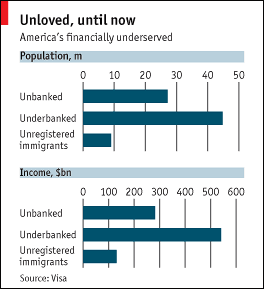 At university one professor cautioned me not to quote so much from The Economist and another professor advised me to keep on reading The Economist. I chose to take the advice of the latter. It’s quite remarkable the number of posts in the bloggersphere that comments about either The Economist or links to its articles. Here’s a sample; Economist Advertising Tactic, Why The Economist is so successful, Cross-Country Relationship Between Wage and Price Inflation, How to Save The Economist and The Journal from Irrelevance, The Design Evolution of The Economist, Facts from the Economist, Lunch with Finance Editor, Burgernomics- a favourite of bloggers, academics and radio stations. Former staff turned bloggers- Chris Anderson and Keith Hart.
Keith Hart, an anthropologist credited three years at The Economist for for teaching him to not only talk about economics as if he knew what he was talking about, but also to do so with unwavering confidence and assurance. Be sure to check The Economist’s style guide.
Iraq's trade unions;According to the Iraqi Workers' Federation (IWF), more than 2,000 of its members have been killed as a direct result of the economic scorched-earth policy waged by the insurgency.
Galbraith Obituary; A decade ago, Mr Galbraith lamented that old age brought an annoying affliction he called the “Still Syndrome”. People would constantly note that he was “still” doing things: still “interested in politics” when he showed up at a meeting, “still imbibing” when he had a drink and “still that way” when his eyes lit up on seeing a beautiful woman. The Still Syndrome lasted an immodestly long time. Its passing has left America poorer
Health in America and Britain; Americans spend far more on health care than the inhabitants of other rich countries, but their life expectancy is below the wealthy world's average. Annual medical costs, measured by the Organisation for Economic Co-operation and Development using purchasing-power parities, which take account of price differences, amount to $5,635 per person in America compared with $2,231 in Britain. Yet an American's life expectancy at birth is 77.2 years compared with 78.5 for a Brit
Iran and the Bomb; He has been greatly helped by the rise in oil prices—propelled, in part, by the worries about Iran. The country's oil revenues for the Iranian year that ended in March were in the region of $50 billion, nearly twice the figure of two years earlier.
Petrol Prices; Many Americans are furious at high petrol prices, but low taxes mean that they get a better deal at the pump than motorists do in most other countries. High taxes make Turkey the most expensive place to fill up, followed by Norway and Britain. The IMF says that higher gasoline taxes in America, which consumes a quarter of the world's oil, would help to curb excessive consumption
Metal prices continue to soar. Copper, nickel, zinc and platinum have all hit record levels. Copper has risen by 60% so far this year; nickel by 45%. Gold is at a 25-year high; silver, a 23-year high
Alternative energy; The notion of American farmers defying the tide of capitalism to grow their own fuel is a glorious delusion. But Mr Schweitzer is right that Congress has some big decisions to make about biofuels. To what extent, if any, should government subsidise this nascent industry? Already it has received plenty of help. Ethanol producers get a tax credit worth 51 cents a gallon, much to the delight of industry powerhouses such as Archer Daniels Midland. There is also a 54 cents-a-gallon tariff on imports of ethanol from Brazil
Japanese toys; Toys that help people to relax have also boosted sales. Primo Puel, a cuddly doll version of a five-year old boy, is fitted with sensors and five levels of happiness, can talk a bit and needs care. It has been a big hit with women over 40, whose own children have left home. “Little Jammer”, a toy jazz band, is also a hit—this time with men. Hidamari no tami (sunshine people), plastic dolls with simple smiley faces, are hot, not just in Japan but in America too. Other local successes include Sega's Homestar Planetarium, which brings the wonders of the night sky into the living room
Flight 93; The film has stirred an angry debate. Isn't Hollywood hijacking the hijacking for its own money-grubbing purposes? Isn't life hard enough without watching people hurtle to their death in a metal tube? And—the most insistent question of all—isn't it too soon for America to relive the horror of September 11th? Trailers for the film were greeted with boos in New York and Los Angeles, and were subsequently pulled. Fully 60% of people tell pollsters that they will not see the film.
Microsoft; The business and regulatory challenges facing Microsoft are related, because the firm needs to be free to compete against rivals in nascent markets on the one hand, yet almost anything it does will invite antitrust concerns on the other. Microsoft's Internet Explorer holds roughly 85% of the market, while the rival Firefox browser boasts 10-15%. But Microsoft lags behind in search. Worldwide, Google has around 50% market share, Yahoo 28% and Microsoft's MSN 13%. The stakes are huge: online advertising in America, today estimated to be worth $12.5 billion, is expected to double by 2010.
Americans Without Bank Accounts; In America at least 12m households have no bank account—are “unbanked”, in the industry's ugly jargon. Once unnaturalised immigrants and the “underbanked”—an even uglier term for those with a low credit score or none—are added, some estimates exceed 40m.
Quantum Computing; Quantum theory allows subatomic particles to exist in more than one state simultaneously, a phenomenon known as superposition. An electron, for example, has a property called spin that can be “up” or “down”—or a bizarre combination of the two. Using the spin of an electron to represent a bit of data would allow it to be both up and down (ie, zero and one) at the same time. Instead of being a bit it is, in the jargon, a qubit
Current Account Balances; Spain's current-account deficit is bigger than America's, relative to the size of the Spanish economy, and it is deteriorating faster. But Spain is in no danger of suffering a run on its currency, which it shares with 11 other countries. Switzerland's current-account surplus, of more than $50 billion, reflects depressed investment rates in the country. Swiss savers are pursuing more lucrative opportunities abroad
Canadian Economy; On April 27th, Mr Harper announced a surprise settlement of a protracted trade war with the United States over softwood lumber….In 2002, for the fourth time since 1982, the United States levied countervailing duties on exports of wood from Canada, its partner in the North American Free Trade Agreement (NAFTA). The American government has mainly failed to persuade NAFTA (and other) panels of its case that Canada subsidises lumber. …But Mr Harper is eager to improve relations with George Bush's government. After a week of talks, both sides agreed a draft deal which in essence returns to the previous regime of managed trade. The Americans will drop the sanctions, and return $4 billion of the $5 billion they have collected in duties. Canada accepted that its share of the American market be capped at 34%. It agreed to impose export taxes and limit shipments if prices in the United States fall much below their current—unusually high—levels. ….Philip Cross, the chief economist of Statistics Canada, reckons that while Americans are paying over 70% more for gasoline than three years ago, prices in Canada are up by only about a third.
French Corruption; The story orginates in a judicial investigation, launched in 2001, into kickbacks, linked to the 1991 sale of six French frigates to Taiwan, that were allegedly channelled through Clearstream accounts.
City of London’s History; AT THE end of the 19th century, an intrepid social scientist visited Stockwell, in south London. He was involved in an ambitious project, led by the shipping magnate Charles Booth, to colour-code every street in the capital according to its social make-up. In general, the area struck him as comfortable. But just east of Stockwell Road he found a pocket of filth and squalor, with rowdy residents and broken windows. It was, he believed, “far the worst place in the division”.
MUSIC company bosses always get a terrible rap…In contrast to many fellow execs, Mr Iovine has musical talent. And although he works for Universal Music Group, the biggest music firm in the world, which is in turn owned by Vivendi, a French conglomerate, artists regard him as much more than just another “suit”. Rappers have even incorporated Jimmy Iovine approvingly into their lyrics. Mr Iovine has street credibility. And—ironically enough—that may be the key to his success as a businessman.
A discussion with Andreas Kluth, Technology Correspondent of The Economist;
“In the participatory era, media will no longer be delivered one way from a media company to an audience...but by audience members to other audience members. The distinction between content creators and consuming audiences first gets blurry and then disappears completely...Instead of media being delivered as a sermon or lecture, it becomes a conversation among the people in the audience”
May 3, 2006
Disintegration of the Fear Barriers in the Middle East

Tom Palmer writes in the Reason magazine on Iraq;
“There is a chance that things will turn out well in Iraq, or at least not badly. Whatever the outcome, libertarians should be eager to assist the Iraqis in creating a free society. That’s why my Arab friends and I have established the Lamp of Liberty (misbahalhurriyya.org) to bring the message of liberty to both Iraqis and the wider Arab world. I am working with Iraqi libertarians who are trying to do the best they can under very difficult circumstances to combat fanaticism, terrorism, and statism. It’s a hard slog, but we have no choice.”
Egyptian sociologist and democracy activist, Saad Eddin Ibrahim is also hopeful about the prospects for democracy in Iraq, pointing out the positives the country has got - a sizeable middleclass, relatively literate population, rich in resources and ethnic diversity – all of which bode well for the development of a liberal democracy.
Related Links:
- Iraq; Rebuilding Iraq: economic reform and transition- World Bank Report
- Reviving Mideastern Democracy- Saad Eddin Ibrahim.
I would highly recommend Professor Ibrahim’s speech above for anyone interested in understanding the current politics of middle east. He talks about the 7 candles of hope in the middle east (the increase in the number of Arab elections, the rinsing role of women and youth in the electoral process, expansion of public space through internet, blogs and Al-Jazeera, proliferation of printed media and the disintegration of the fear barriers, Kifaya or Enough movements).
April 30, 2006
Iraqi Dinar Discussion (April 30, 2006 - July 13, 2006)
AS OF 7/13/2006, THIS POST IS CLOSED TO NEW COMMENTS. A new post has been created: Here's a link to the current active post.
Here are all the posts in sequence:
1) June 16, 2004 - June 27, 2004
2) June 27, 2004 - November 6, 2004
3) November 6, 2004 - April 11, 2005
4) April 11, 2005 - June 22, 2005
5) June 22, 2005 - July 22, 2005
6) July 22, 2005 - April 30, 2006
7) April 30, 2006 - July 13, 2006
8) July 13, 2006 - ...
If you guys & gals encounter any problems, email me at kevin-at-truckandbarter.com.
Your previous email has been very helpful in the administration of this site. Thanks for your patronage.
March 9, 2006
Iraqi Date Merchant and Mobile Phones

“I buy and sell dates and my whole business is now dependent on the mobile phone. Trading in dates (like any other commodity) is a risky business characterized by significant price fluctuations, especially during the harvest season. Prior to having access to a mobile phone, I faced great difficulty in obtaining timely information about price variations. This delay in obtaining up-to-date prices sometimes resulted in significant losses, whereby I would sell a lot of dates at a low price. Since I bought my mobile phone, I am in continuous contact with the date trade exchange center which helps me strike deals at the right price”.
That’s an Iraqi date merchant taking about the importance of mobile phone in his business. Other highlights from a report on the socio-economic role of mobile phones in the Arab middle-east;
- Mobile revenues accounted for 5% of the increase in GDP in Bahrain between 2002-04
- In Jordan, the number of employees in the mobile sector increased by 42% over the 4yr period of liberalization
- Many mobile operators represent more than 30% percent of a total stock market – such as Egypt’s Cairo and Alexandria Stock Exchange
- 95% of Iraqis use their phone to ensure the safety of their loved ones, 83% of Iraqis see it as a necessity in life, and 77% said it made life easier
According to some estimates a developing country with an extra 10 phones per 100 people between 1996 and 2003 would have had GDP growth 0.59% higher than an otherwise identical country ( often these studies are financed by telephone companies);
To illustrate these findings, Mr Waverman considers Indonesia (nine mobile phones per 100 people) and the Philippines (27 phones per 100 people). Long-run growth in the Philippines, he suggests, could be a percentage point higher than in Indonesia if this gap is maintained. But if Indonesia closed the gap, its growth rate would match that of the Philippines. Mr Waverman also notes, however, that there is a large education gap between the two countries. His model predicts that bridging this divide would boost Indonesia's growth rate even more than closing the mobile gap. “Mobile phones are important, but so is education and health care,” he says. “A lot of things are required for growth.” He concludes by calling for regulatory policies that favour competition and encourage the speediest possible spread of mobile telephony. For policymakers interested in closing the “digital divide” to boost growth, the message is clear: mobile phones are the most effective means of doing so.
And liberalization and new technology helps. Look at India.
According to the stats available for January, the telecom sector in India added 5 million new subscribers, of which 4.75 were mobile connections. That's about 167,000 new subscribers (of which 158,000 are mobile users) being added *every day*. By comparison, in the pre-reform period (I am using 1974-1989 data here, though it's even lower pre-1974), India added about 175,000 new connections *every year*.
Now the World Bank has released a brand new report Information and Communications for Development 2006: Global Trends and Policies which takes stock of the progress that has been achieved worldwide in rolling out access to affordable ICT and provides evidence on what makes for success in adopting ICT to meet development challenges. The report also highlights some stark differences as well;
While the developing world has seen huge progress in rollout of basic ICT infrastructure, the picture is more mixed for advanced use of ICT. Worldwide, Internet use more than quadrupled between 2000 and 2005, but differences in the number of secure Internet servers, a proxy for the availability of e-commerce, remain stark. While developed nations have more than 300 such servers per 1 million people, developing nations have fewer than 2.
Are there any people who hate mobile phones? Once a taxi driver (in Male’, Maldives) complained to me that since mobile phones have become so popular, people have reduced taxi trips- Maldives used to have the highest mobile tariffs in the South Asia. In terms of mobile phone subscribers there were over 113,000 subscribers (out of a total population of 280,000). In the US mobile subscribers stood at 615 per 1000 at end 2004. In very small countries like Maldives foreign parties like the Wataniya are interested mostly because they can use the place as a test bed for new technologies.
Related Links:
- Impact of Mobile Phones in Africa, Vodafone
- Socio-Economic Impact of Mobile Phones in Arab World
- Financing ICT Investment in the Developing World
- Telephone is a weapon against poverty
- At A Glace Tables from the World Bank Report; 30 ICT Indicators for 144 Countries; it’s best such of indicators I have seen.
July 22, 2005
Iraqi Dinar Discussion (July 22, 2005 - April 30, 2006)
AS OF 4/30/2006, THIS POST IS CLOSED TO NEW COMMENTS. A new post has been created: Here's a link to the current active post.
Here are all the posts in sequence:
1) June 16, 2004 - June 27, 2004
2) June 27, 2004 - November 6, 2004
3) November 6, 2004 - April 11, 2005
4) April 11, 2005 - June 22, 2005
5) June 22, 2005 - July 22, 2005
6) July 22, 2005 - April 30, 2006
7) April 30, 2006 - July 13, 2006
If you guys & gals encounter any problems, email me at kevin-at-truckandbarter.com. Your previous email has been very helpful in the administration of this site.
Thanks for your patronage.
June 22, 2005
Iraqi Dinar Discussion (June 22, 2005 - July 22, 2005 )
THIS POST IS CLOSED TO NEW COMMENTS. A new post has been created: Here's a link to the current active post.
Here are all the posts in sequence:
1) June 16, 2004 - June 27, 2004
2) June 27, 2004 - November 6, 2004
3) November 6, 2004 - April 11, 2005
4) April 11, 2005 - June 22, 2005
5) June 22, 2005 - July 22, 2005
6) July 22, 2005 - April 30, 2006
7) April 30, 2006 - July 13, 2006
If you guys & gals encounter any problems, email me at kevin-at-truckandbarter.com. Your previous email has been very helpful in the administration of this site.
Thanks for your patronage.
April 11, 2005
Iraqi Dinar - Discussion & Commentary
THIS POST IS CLOSED TO NEW COMMENTS. A new post has been created: Here's a link to the current active post.
Here are all the posts in sequence:
1) June 16, 2004 - June 27, 2004
2) June 27, 2004 - November 6, 2004
3) November 6, 2004 - April 11, 2005
4) April 11, 2005 - June 22, 2005
5) June 22, 2005 - July 22, 2005
6) July 22, 2005 - April 30, 2006
7) April 30, 2006 - July 13, 2006
If you guys & gals encounter any problems, email me at kevin-at-truckandbarter.com. Your previous email has been very helpful in the administration of this site.
Thanks for your patronage.
January 3, 2005
Iraqi Banks Gaining Ground
This is a couple days behind, but I thought it might be of interest to a few visitors: Iraq's Ailing Banking Industry Is Slowly Reviving.
Still, the fall of the Hussein regime has encouraged the private sector.At least two new banks have opened since April 2003, and eight others have submitted applications to open. Foreigners have begun venturing in, taking advantage of investment laws that grant non-Iraqis a level of access to the country unprecedented in much of the Middle East. And Iraqi banks, mostly barred by Mr. Hussein from ties to the outside world, have been welcoming foreigners and venturing abroad as well.
It's a largely unresearched position, but I still contend that economic development will preceed physical security on the level we'd like to see (that is, without the need for armed patrols in neighborhoods). People will be far less willing to join or tacitly support armed resistance if they've got something to lose. Which makes this a disturbing statistic:
Indeed, Iraq's tight credit market has gotten worse. According to a study by Citigroup, which has no banking operations in Iraq, nearly 30 percent of the country's banking assets remain uninvested, up from 12 percent in 2001.
November 6, 2004
Free For All on the Iraqi Dinar
THIS POST IS CLOSED TO NEW COMMENTS. A new post has been created: Here's a link to the current active post.
Here are all the posts in sequence:
1) June 16, 2004 - June 27, 2004
2) June 27, 2004 - November 6, 2004
3) November 6, 2004 - April 11, 2005
4) April 11, 2005 - June 22, 2005
5) June 22, 2005 - July 22, 2005
6) July 22, 2005 - April 30, 2006
7) April 30, 2006 - July 13, 2006
If you guys & gals encounter any problems, email me at kevin-at-truckandbarter.com. Your previous email has been very helpful in the administration of this site.
Thanks for your patronage.
October 23, 2004
Iraqi Macro Update
The IMF has a new report on Iraq:
… Iraq suffered from severe economic mismanagement, and over a decade of international sanctions. GDP per capita is estimated to have dropped from over US$3,000 in the early 1980s to as low as US$200 in the early 1990s. Although GDP per capita recovered somewhat to an estimated US$800 in 2001, it fell again to about US$500 in 2003 as a result of the most recent conflict. Iraq’s human development indicators, which had exceeded the regional average in the early 1980s, are now considered among the lowest in the region. Unemployment is running close to 30 percent and underemployment is pervasive. Furthermore, about 60 percent of the population is thought to depend exclusively on the government’s food distribution system for subsistence.
Brad Setser thinks the report is a gold-mine. He notes two striking facts:
1. In 2004, the amount Iraq will spend importing (yes, importing) refined petroleum ($2.1 billion) will exceed the amount Iraq received in grant aid from the world (transfers are projected at $2.05 billion)2. Iraq is a country where government spending is more than a 100% of gross domestic product (2004 budget is $22.6 billion, 04 GDP seems to more like $21.2 billion)
No wonder Iraq is such a mess.
Iraq: Subsidies and Deficits
While the US military continues to fight terrorist insurgents in Iraq, the Iraqi planning minister has been readying to fight subsidies:
BAGHDAD, Oct 23 (AFP) - The Iraqi government plans to phase out slowly subsidies on basic products, such as oil and electricity, which comprise 50 percent of public spending, equal to 15 billion dollars, the planning minister said on Saturday.This could seriously hurt real incomes of many Iraqis if not done in conjunction with a plan to distribute some oil profits to Iraqis.Unveiling a three year economic plan, compiled by in cooperation with the World Bank and the International Monetary Fund, Madhi al-Hafez pledged "a progressive programme to suppress subsidies... (which) constitute a significant burden on public finances."
Most Iraqis relied on subsidised fuel, electricity and food rations under a United Nations-sponsored oil-for-food programme during the regime of Saddam Hussein.
Also of note are the simple means of creating a budget deficit--i.e. an excuse for international aid--just use an incredibly conservative estimated price of oil:
Iraq itself is predicted to generate revenues (profit?--ed) of 19.4 billion dollars which, coupled with external aid, will bring total revenues to 23.7 billion dollars.But the budget is seen at 30.4 billion dollars, meaning a deficit of some 6.7 billion dollars, including foreign help, and 11 million (sic) dollars without.
The 2005 budget is based on a price of oil of 26 dollars-per-barrel -- a hugely conservative estimate, considering the price of oil, which ended the week at a record 55.50 dollars a barrel.
"We have put very conservative figures on oil prices and if it continues to rise we might be able to cover the deficit," said Hafez.
October 9, 2004
Real Interest Rates in Iraq
According to a frequent commenter on my Iraqi Dinar post, the private Baghdad based Al-Warka investment bank is offering 15% nominal interest on savings accounts (denominated in Iraqi Dinar). According to Central Bank data (pp. 28-30), the Iraqi government banks were offering 6.3% this June, down from 7% in January. If I'm reading this document right, Iraqi government debt is rediscounted at 6.35%.
The public banks are offering loans for 11%. If the private banks offer 15% on savings, how high are the interest rates on their loans? I'll try and find out.
Even if I can, it's tough to extract the real interest component from the nominal figures , because World Bank price inflation estimates in Iraq vary from 8.5% for consumer prices to 15% for the GDP Deflator. Meanwhile, the Central Bank bulletin (p. 29) shows price indices increasing one month and decreasing the next (however, food prices continually decreased and rent continually increased in 2004).
Overall, it seems that real interest rates vary widely in Iraq, so it's hard to come to any solid conclusions about the cost of capital made available in financial markets.
As an aside, I wonder how much capital is made available by the sometimes maligned Iraqi Dinar speculators who hold their currency in private Iraqi Banks...
October 7, 2004
More Troops Yesterday -> Lower Readiness Today?
"We never had enough troops on the ground..."Countless times, I've read this type of criticism of the Bush/Rumsfeld tactic of sending in fewer troops to Iraq than many generals wanted. Now, I don't want to get into who is "right" or "wrong" on this matter, or on the morality of invading Iraq in the first place; instead, I'm assuming Iraq had to be invaded, and that the long-term goal is to forcibly democratize and liberate Iraq and the rest of the Middle East.Prior to the war, the Army chief of staff, Gen. Eric K. Shinseki, said publicly that he thought the invasion plan lacked sufficient manpower, and he was slapped down by the Pentagon's civilian leadership for saying so. During the war, concerns about troop strength expressed by retired generals also provoked angry denunciations by Defense Secretary Donald H. Rumsfeld and Gen. Richard B. Myers, the chairman of the Joint Chiefs of Staff.
We know that Bush/Rumsfeld paid a large price in Iraqi instability for having fewer troops. But I have not seen addressed the question of whether having sent in more troops initially would have actually cost less in the long run, or would have better met long-term objectives.
Note that I cannot answer this question, but I think it must be asked.
I want to point out a tradeoff that many people seem to be ignoring, as if the counterfactual doesn't matter: higher troop levels at the beginning of the invasion would mean much lower average unit personnel readiness today, and that this would make it difficult to operate effectively now and in the future.
I can argue reasonably that if Bush/Rumsfeld had sent in 100,000 more U.S. troops at the beginning of the Iraq invasion--to patrol the streets, secure the borders, etc.--those extra troops would not be in a top readiness category today.
In reality, the troops not sent in actually did later on refresh and replace those who served out their combat tours and those wounded and killed. With a larger invasion, even more reserves would have had to have been called up to replace the initial cohorts. Note that this is not really an arguable point; if a unit is on the ground, in theater, with great likelihood its personnel readiness decreases, without firing a single shot.
The tradeoff is not just "fewer men, more chaos"; it is also "more men, lower readiness". Which is better? Fewer men at the beginning mean a massive degradation of civil society; more men mean it's quieter earlier, but harder to complete the mission during the critical transition period to elections and self-rule. Hence, the strategy of sending in fewer could be justified on grounds that staggering entry into Iraq keeps personnel readiness higher than it would have been; later objectives are given greater weight. The long run goal is better met with a smaller initial footprint.
Of course, one could argue that sending in fewer troops increased the drain on personnel already in theatre, but I don't think those on the ground would agree that their lives are any easier by having more for a longer time. Instead, I think life is easier for troops if they are more frequently sent home, which is far easier to do if there are fresh troops to replace them.
August 25, 2004
More on Iraqi Unemployment
I previously linked to an Al-Jazeera report by Ahmed Janabi quoting unnamed economists at Baghdad University who concluded (through means unknown) that unemployment in Iraq was 70%, even though government estimates for the sum of unemployment and underemployment are about 50% (again, these are difficult to pin down concepts, and are used differently in every study or series).
I emailed Mr. Janabi and his editors, requesting the source and/or the authors' names or contact information. After several emails, I received this reply from Mr. Janabi:
Dear Kevin,I replied, thanking him for his time, but asking for the actual source, which I noted I would have translated at my expense. After a week, Mr. Janabi has yet to reply. Reader assistance on tracking down the report is once again requested.Sorry for the late reply. Actually, it was mentioned in the article that the source is a study conducted by College of Economics, Baghdad University. This is my source. The text of the study was published in the Iraqi press. I wish I could get you the text of the study, but sadly Iraqi newspapers have not linked to the internet yet i.e; they do not have websites yet.
Best Regards
Ahmed Janabi
Newsroom Journalist
Aljazeera Online
Iraqi Oil & Indonesian Planning
While Alex Tabarrok notes this Foreign Affairs article ($) on how to deal with Iraqi oil, those on the ground are getting exports back online:
Prices fell this week after Iraq restored full crude exports of two million barrels a day from its southern Basra fields and restarted deliveries at 450,000 bpd, half capacity, from its northern Kirkuk fields for the first time since May.But the high price of oil caught some government planners by surprise. Hence our next Statsmerkwürdigkeiten award goes to the government of Indonesia, which continues its incredibly distorting "buy-high, sell-low" energy subsidy:
The steep oil price hike since May -- to as high as US$50 per barrel now -- has finally forced the Indonesian government to revise upward from $22 to $36 per barrel the average oil price used to estimate oil tax revenues and the cost of fuel for the current fiscal year....I understand the desire to help the (very truly) poor by keeping kerosene prices affordable, and clearly the result of this policy was highly unexpected. But that's the point that has to be noticed; this example demonstrates that inflexible policies that require a static world (or that require prices to remain within an historical corridor), can fail miserably when price-flexible dyamic markets perform their economic function... Simply put, the Indonesian government thought it could spend freely on subsidies, and didn't see this coming:The government... has decided to abandon its sensible, fuel-economic, 2002 policy to float domestic fuel prices on market quotations in Singapore to encourage efficient use, slash subsidies, target price support only to poor consumers (kerosene for household use) and, most importantly, minimize smuggling overseas. Consequently, fuel subsidies for 2004 will balloon to more than Rp 63 trillion ($7.08 billion), much more than total central government spending on its personnel (civil servants, the police and the military).
Since the government maintains domestic fuel prices way below actual production costs -- applying a blanket subsidy on all kinds of fuel -- the bulk of the subsidies may end up benefiting mostly private car owners (middle and top-income consumers). Most devastatingly, fuel smugglers will receive even stronger incentives, as their profit margins will skyrocket.
True, part of the subsidy will go on kerosene, which is widely used by poor people. But corruption will continue to divert quite a significant portion of this cheap fuel to industrial users and smugglers.
Until last year (when Indonesia was still a net oil exporter), any increase in international crude oil prices would give the government net additional revenues. However, starting this year, as the country is already a net oil importer of about 36,000 barrels a day, an oil-price hike immediately cuts into central government income as additional revenues are much less than additional spending on subsidies.Ouch.
August 18, 2004
Iraqi Airways

There are approximately 108 airports and airfields throughout Iraq. Baghdad and Basra both have international airports, while Mosul, Kirkuk and Irbil have domestic airports.Iraqis have their own share of Chutzpah; one example is the national carrier declaring in January that it intends to resume international flights, even though it cannot field even a single plane:Iraq's airports are heavily outdated, having suffered from a lack of maintenance and shortages of parts for a number of years....
Baghdad International Airport (BIA) is open and has successfully processed more than 4,500 non-military passengers since July 2003. BIA's commercial capability continues to be expanded by a number of renovations, while Basra has almost completed its commercial preparations. The evaluation of Mosul Airport's reconstruction requirements was recently concluded.The airports in Iraq have, as in many of the country's sectors, suffered from a shortage of power, water, sewage and telecommunications, with new plans for the installation of a number of communications systems necessary for safe and effective air traffic control measures, enabling safe air travel.
Iraq has invited international investors to help revive the country's national carrier by assisting in the operation of the five remaining planes from what was once a large fleet. A local newspaper advertisement said that Iraqi Airways was accepting bids to overhaul three Boeing 727s and two 747s. The planes have been inactive in the Jordanian desert and in Tunisia for more than a decade. "The planes are to be operated on joint basis, taking into consideration the experience and abilities of Iraqi Airways," reads the advert.Indeed, this terrifying photo of an Iraqi Air 727 cockpit reveals the fleet to be almost irreparable. (The tails stored in Tunisa were vandalized and ripped apart for scrap).Wars and a crippling economic embargo have wiped out most of the Iraqi Airways fleet, except for the five planes, which were moved out of the country to avoid destruction during the 1991 Gulf War. Iraqi Airways has not operated an international flight since. The US-led administration in Iraq had planned to sell off Iraqi Airways. However, the plan was scrapped following objections from the Iraqi Governing Council (IGC).
Now operating as a skeleton company, Iraqi Airways still has status as a public enterprise under the jurisdiction of the Ministry of Transport. It is not yet clear when an Iraqi Airways plane could take off, or whether indeed the fleet is still operable. Baghdad International Airport (BIA) has been closed to regular traffic since last year, although it was repaired following damage from heavy bombing during the US-led invasion.
I was going to write that there could be a thriving domestic and international aviation industry in Iraq, initially supported by cushy U.S. government contracts, and that the Iraqi authorities have chosen to shackle the industry in a bureaucratic mess. While possible, I don't think that would have been a likely outcome. The real, likely alternative to government ownership might have been a Russian-style oligarchic ownership by crooks and insiders. And I'm not about to argue that a cheap fire sale to corrupt industry neophytes is better than government bureaucrats. As detailed in this report:
Iraq Revenue Watch has obtained a confidential document that reveals plans to privatize Iraq’s air transport industry despite the CPA’s recent pledge to postpone privatization until a sovereign Iraqi government is in place. The powerful Khawwam family, which had close ties to Saddam’s regime, is set to assume control of 75 percent of Iraq’s air transport industry—bypassing any public bidding process. The deal, brokered by a senior official with the Ministry of Transport, would include the assets of Iraqi Airways, the national carrier, which at the same time is seeking to revive its operations. U.S. carriers are reportedly looking to partner with these post-war oligarchs-in-the-making.As we have seen, there is little left to the actual airline except, perhaps, airport slots and a few marginal aircraft, so how big a threat this sale presented to the future airline industry could easily be overblown.
(Note: Image from this website.)
UPDATE 8-25: Iraq to Jordan test flight completed successfully:
(MENAFN) The Director of Iraqi Airways said that the airline sent a test flight from Jordan to Iraq, the first such flight by the state airline since the 1990 U.N. sanctions on Saddam Hussein's regime, the Associated Press reported.An official at the airline's Amman office said that this was a test flight and comes as part of our effort to resume regular flights by Iraqi Airways at the end of this month.
In the first stage, Iraqi Airways will fly once a week from the Jordanian capital to Baghdad, while more routes will be added later.
For now, Jordan's flag carrier Royal Jordanian Airlines and the Virginia-based Air Serv are the only two airlines with regular passenger service to Iraq.
August 11, 2004
Iraqi Economy Update: 70% Unemployment Rate???
The macroeconomic condition of Iraq is impossible to cover thoroughly and objecively without reasonably accurate statistics, which exist for some government-controlled operations, and little else. Hence, data on the decentralized labor markets are nonexistent, except for nonscientific "expert" estimates, which I've already shown to be an inconsistent mish-mash.
One of the most recent estimates was made by unknown experts with unknown agendas at the college of economics at Baghdad University. On Aug. 1, Al-Jazeera reported:
A study by the college of economics at Baghdad University has found that the unemployment rate in Iraq is 70%.No further detail is provided--like the authors' names, when this study was conducted, what methods were used (did they ask 10 men in Baghdad?), which geographical areas were included (probably excluding the Kurdish regions), and who funded the work. Are the sampling and nonsampling error 5% or 30%?The study says the problem of high unemployment is going from bad to worse, with the security situation deterioriating and the reconstruction process faltering.
The article does note that scam artists are are rampant (absolutely credible), and the reporter is sticking to the story that most Iraqis believe that working for the US is treason.
The article spread like wildfire on alternative media outlets (Google 70% unemployment in Iraq), and I report it here only because I insist on finding out more. I have emailed the author of the Al-Jazeera article, Ahmed Janabi, asking him for either a copy of the report or its authors' contact information.I will not stop my inquiries until I get a copy of the report.
Note: Any reader who can connect me with the economists at Baghdad U. will be greatly admired and appreciated.
July 7, 2004
A Little Piracy Goes a Long Way
As I've mentioned before, the developing world might be a perfect place for open-source software to get a foothold. While the benefits of open-source products are numerous, the only one that really matters in the very short-term view of most places that are barely able to scrape together the money for one or two computers is the price. And, in the developed world, price has been one of the things open-source software has been able to compete on.
But what happens when the advantage is taken away? It turns out that, in Iraq at least, a good name will get you pretty far.
Reports from inside [Iraq] say curious citizens are keeping Internet cafes filled to capacity, that eager students are returning to universities to learn how to program and that high-end computer workstations can be bought for as little as $150 in city marketplaces.But even with all the growth, there is still one aspect of technology that has yet to penetrate the country's borders: open-source software. With software piracy so rampant that a CD copy of almost any program can be bought for just 2,000 dinars, or $1, the demand for free software just isn't there yet, according to Ashraf Tariq and Hasanen Nawfal.
{...}
"Most of them just heard about Linux but are afraid of trying it. For home users things are worse -- for them, a computer equals Windows, and vice versa."
Just how hard do you think Microsoft will push to fight piracy in this case? "Path dependence" as an economic argument for resulting equilibria situationas is often a sort of last resort argument, an admission that for whatever reason, "things happened in such a way as to get us here, and now too many people cosider it too costly to shift to something different." One of the problems with it is that the starting point down a certain road is often hard to identify. Seems to me, though, that we might be able to pick this out as the starting point for the growth of Microsoft in Iraq.
Add to the argument certain biases in trade policy:
Though the United States has eased several restrictions governing the export of goods and technologies to Iraq over the past year, "publicly available" software, like Linux, remains caught in limbo because it implements certain security standards -- namely, strong encryption.Linux developers say strong encryption is necessary to protect the security of businesses and Internet users. American policy makers believe it's a tool that terrorists may use to hide their communications from law enforcement officials. In light of the current war on terrorism, the latter argument has so far prevailed -- meaning anyone wishing to send a copy of Linux to Iraq must first obtain permission from the Department of Commerce.
Meanwhile, the Department of Commerce has classified Microsoft Windows and Sun Solaris as "mass-market encryption products," meaning that the vendors can ship them to Iraq without a license, according to Don Marti, president of the Silicon Valley Linux User Group and editor of the Linux Journal.
Simply because there are more Windows products available now, it's easier to sell them elsewhere. Economies of scale at its finest. The distinction, you'll no doubt have noticed, is rediculous. "Mass-market" is being defined here by volume rather than by sales outlet. Windows is "mass-market" because it is available more places, whereas Linux -- though sold through the same stores -- is not because of limited availability.
For reference, here is the relevant section of the Code of Federal Regulations for dealing with encrypted/encryption products.
Get the country hooked now, and they'll be more likely to come begging for more later. (You know, the similarities between software and illegal drug industries are so close, I don't understand why someone doesn't attempt to use insight from the latter to help explain the patterns of the former. Why do people shell out such high prices for such bad software? Why do they keep going back to the same provider when they can be hurt so badly by viruses? )
June 24, 2004
More on the New Iraqi Dinar
THIS POST IS CLOSED TO NEW COMMENTS. A new post has been created: Here's a link to the current active post.
Here are all the posts in sequence:
1) June 16, 2004 - June 27, 2004
2) June 27, 2004 - November 6, 2004
3) November 6, 2004 - April 11, 2005
4) April 11, 2005 - June 22, 2005
5) June 22, 2005 - July 22, 2005
6) July 22, 2005 - April 30, 2006
7) April 30, 2006 - July 13, 2006
If you guys & gals encounter any problems, email me at kevin-at-truckandbarter.com. Your previous email has been very helpful in the administration of this site.
Thanks for your patronage.
We continue our analysis by noting the spectacular losses that some speculators have accrued as the dinar has gradually been losing its position against the dollar:
Speculators who stashed away "Bremer dinars" earlier this year in the hope their value would skyrocket are suffering enormous losses as the official Iraqi currency plummets. Hit particularly hard are a high number of Egyptians, who had earlier raced to pick up the currency.I highly suggest reading the rest of the article."Many people sold anything they could to buy Iraqi dinars," Mohammed al-Abyad, chairman of the Egyptian Foreign Exchange Association told IPS. "When the dinar went down these people lost a lot of money."
The Iraqi dinar was trading at one Egyptian pound (16 cents) per 50 dinars on the black market before its value dropped sharply earlier this year on news of escalating insurgency in Iraq. The pound is now worth 210 dinars on the black market.
"The black market has narrowed and the currency has no liquidity now," said Shady Sharaf, head of market research at Cairo-based al-Shorouk Brokerage. "The people cannot sell the dinars they bought, which presses on demand."
In January, Radio Free Europe noted that "Egyptian media reported last week that one in 10 passengers inspected upon entry from Jordan, Kuwait, and the Gulf States were found to be carrying Iraqi dinars."
I have yet to be convinced that the dinar will increase greatly in value, and do not own any dinar myself.
June 16, 2004
The Iraqi Dinar Exchange Rate
THIS POST IS CLOSED TO NEW COMMENTS. A new post has been created: Here's a link to the current active post.
Here are all the posts in sequence:
1) June 16, 2004 - June 27, 2004
2) June 27, 2004 - November 6, 2004
3) November 6, 2004 - April 11, 2005
4) April 11, 2005 - June 22, 2005
5) June 22, 2005 - July 22, 2005
6) July 22, 2005 - April 30, 2006
7) April 30, 2006 - July 13, 2006
If you guys & gals encounter any problems, email me at kevin-at-truckandbarter.com. Your previous email has been very helpful in the administration of this site.
Thanks for your patronage.
NOTE: For those who want to continue the conversation about the Iraqi Dinar, I can also recommend a new board, the Investor's Iraq Forum or the new Iraqi Dinar Blog.
You all have made about 1700 comments to this post, which I've archived in order to keep bandwidth down. To keep history preserved, all previous comments are downloadable in this HTML file.
You can also find useful comments on the other thread More on the Iraqi Dinar Exchange Rate, but that thread is now closed, also.
The CPA insists that the Iraqi dinar is very stable. However, I'm uncertain how to interpret the short-term volatility. (Check out the pictures in the link).
UPDATE: The best collection of images and links on the New Dinar can be found at globalsecurity.org. A whole bunch of people are speculating on the New Dinar:
Steve Foran headed to Iraq in January for risky but lucrative work as a truck driver, running a fuel tanker on dangerous highways with a soldier riding shotgun and hopes of banking $60,000 or more for the year.If you want to buy Dinar, many companies are selling internationally; see for example buydinar.com, and their FAQ on how to avoid scams.But now he thinks he has found an Iraqi payday that could dwarf his Halliburton contract.
Like thousands of other U.S. contractors and troops -- and stateside Americans drawn by Web pitches from newborn businesses with names like BetOnIraq.com -- Foran is taking a chance on the new Iraqi dinar.
Today, the colorful currency that replaced banknotes bearing the portrait of Saddam Hussein isn't worth much. A dollar will buy about 1,000 dinars -- more if you're in Iraq, fewer if you're sitting safely in the United States.
But next month? Next year? Once Iraq is a stable democracy pumping oil like nobody's business? Who can say what the payoff might be?
Yahoo has an up-to-date history of the US Dollar - Iraqi Dinar exchange rate on the international markets.
For some recent history, here is the CPA's explanation of the currency exchange. At the runup to the end of the conversion in January, exchange merchants were discounting old dinars.
June 15, 2004
Unemployment in Iraq
At Kikuchiyo News, Simon notes the apparent economic malaise in Iraq by summing up Colin Powell's response to Tim Russert:
In other words, don't count on your fuel prices to drop, but count on Iraqis soon getting even more screwed at the pump than you. Also at the grocer and at the power meter. Before all the Iraqis had to suffer through getting cheap gas and free food an electricity, paid for by oil revenues. Now, they will fortunately have the subsidies drop and the prices rocket up.It's impossible to say concisely what unemployment means now in Iraq, or what it meant before the invasion, and before the UN sanctions.Note that the unemployment rate in Iraq exceeds 50%. Note also that Powell said nothing about rising wages. (My economic training is limited, but I generally understand that they tend to rise slower than the market basket. And that that condition is generally best avoided.... Finally, note that 60% of Iraqis depend on food aid to survive.
Unemployment at 50% seems to be a popular misconception. Actually, 25% seems more likely, although some neighborhoods can have rates of 50% to 60%. (See this February CPA brief). Also, this 25%--"28% late last year"--figure does not include the Kurdish areas, which have been better off for quite some time now.
I don't know what the unemployment rate was before the fall of Saddam; but one non-poll estimate put it at... take a guess... 50% , so you make up your own minds. We know the economy was a quasi-socialist basketcase before, and it is by no means clear that the Iraqi unemployment picture is worse now than in 2000 or 2002.
Although unemployment rates may be improving, and appear to be at or below pre-war levels (do you trust the data?), I'd argue that the unemployment picture should be seen as a part of a severe short-term adjustment to a long-term crisis.
Immediate employment by the American/Iraqi central government--in the form of a jobs program--is unlikely to generate a dynamic growing economy outside of the oil industry, which is the only long-term solution. A jobs program will retard short-term adjustment (although ease short-term pain), and could cause difficulty later on, as the Iraqi government fires people it cannot afford to employ indefinitely.
Sources agree that many of the current unemployed are former military and government officials, who could have better references (to put it mildly).
Such a high rate of unemployment as 50% is also extremely inconsistent with the building boom in major cities, and the enormous purchase of automobiles and the like. Why are unemployed people spending so damn much?
It's also unclear how those in outlying areas are affected economically by the collapse of the regime, and the new spending on reconstruction.
I can't estimate real wages very well, because many nominal wages are rapidly increasing, while prices and the consumer basket composition are rapidly changing. Price rises of some necessities must be balanced against the flooding of markets for previously widely unavailable goods (like cars and laptops) which I gather has driven down their prices immensely...
UPDATE: One myth is that a World Bank-UN survey pegged unemployment at 50% last October. "An October survey released by the United Nations and the World Bank put unemployment at around 50 percent."
It turns out that 50% was just a guess (see report here), "Exact unemployment is not known, but estimates are that 50 percent of the labor force is either unemployed or underemployed."
Presumably that 50% is half unemployment, half underemployment, which seems to imply that the 25% unemployment rate is the only data point we have. We should use it when things look bad, and when things look good.
Also, in this context underemployment may (likely) mean overqualified for the job, even if that job earns more than the alternative occupation one is trained for. Such is life in a transition economy...
June 8, 2004
Thamir Ghadbhan & Iraqi Oil
"We are totally now in control, there are no more advisers," Ghadbhan said. "We are running the show, the oil policies will be implemented 100 percent by Iraqis."I have no idea whether a bulk of ordinary Iraqis actually care who runs the industry, as long as profits go back to themselves. It seems, however, that unlike the Saudi oil industry run by foreigners, not only will top decisions be made by Iraqis, but the day-to-day operations are run by Iraqis:
In March, al-Obaydi, who has spent 34 years with North Oil, traveled to Bahrain for his first oil industry seminar outside Iraq since 1990. The trip was part of a broader effort that has sent almost 500 Iraqi oil experts abroad for technical exchanges with specialists with companies such as ChevronTexaco, ExxonMobil and Shell.Under Saddam, Iraq was isolated from technological advances in the oil industry. Vital practices such as three-dimensional seismic surveys, directional drilling and gas injection remain unfamiliar here.

The new head of the Iraqi Oil ministry, Thamir Ghadbhan (pictured above), will have to centrally direct the entire national oil industry. I wish the technocrat the best of luck.
Mr. Ghadbjan briefly oversaw oil operations in Iraq, after the initial liberation, although he was replaced during most of the occupation:
The new oil minister is Thamir Ghadbhan, a British-trained former Iraqi official, who has effectively presided over the oil industry since he was installed last year as the ministry’s “chief executive” by the US-led Office of Reconstruction and Humanitarian Assistance. Ghadbhan has worked closely with Phillip Carroll, former US chief executive of Royal Dutch/Shell, who oversaw the ministry on behalf of the Bush administration.A more traditional biography:
Oil Minister Thamir Abbas Ghadban: born 1945 in Babylon; earned bachelor's degree in geology from University College in London, master's degree in petroleum reservoir engineering from the Imperial College at the London University. Has written and co-written more than 50 studies on Iraqi oil fields. Was detained and demoted from his position in the former regime's oil ministry for supporting democratic reforms.[Emphasis Added].
The more recent history of oil as a political weapon was catalogued by Reuters.
The experienced former head of planning at Iraq's oil ministry became "chief executive" of the ministry after a U.S.-led invasion toppled Saddam Hussein in April 2003.He took on the challenge of raising spirits in an oil industry that survived years of crippling United Nations sanctions but continues to face uncertainty over crude production vital to reviving Iraq's ravaged economy.
Ghadhban lost his position when Ibrahim Bahr al-Uloum, from Iraq's Shi'ite majority, became oil minister in what industry insiders say was a move that reflected party politics.
"They wanted to cater to the parties. He is a very capable technocrat who knows the Iraqi oil industry. He started as a reservoir engineer and was eventually moved to the ministry," said Fadhil Othman, an Iraqi exile with 20 years' experience in the top ranks of Iraq's State Oil Marketing Organization.
June 2, 2004
Bill Jamiseon on the Iraqi Economy
If I were to ask you, "Just how badly is the Iraqi economy doing?" you'd rightly condemn the inherent bias in my question.
Similarly if Bill Jamiseon of the Scotsman asks us , "How will Iraq’s economy be run after June 30? And does it stand a fighting chance?" we know we're in for a rough ride.
After recounting the nominal change in central government control, the attacks on, and the defense and rebuilding of Iraq's oil industry, the enactment of the central bank law, the attempt ease the foreign debt burden racked up by Saddam, the massive amount of private and government funds creating new jobs rebuilding after more than a decade of infrastructure neglect, and noting that the Economist predicts that GDP will grow 60% this year and 25% the next, he still insists that the road to recovery is "invisible to many".
If he wants a few micro level anecdotes--from Iraqis and visible to Iraqis--, he should read Omar, who questions his media's insistence that unemployment is rife, and talks about the amazing increase in real total compensation for some.
We are told by Mr. Jamiseon:
Even assuming that the formidable security and political problems can be overcome, rebuilding Iraq’s economy will not be easy.Question: Why should the basic rules of Iraqi economic expansion, progress, and prosperity be any different than those that apply to the US, India, Chile, or Afghanistan? Remember, Mr. Jamiseon already controlled for security and political problems affecting the economy, and he still thinks there's a huge problem that needs to be understood and solved by someone. Does this imply that specific cultural factors or economic rules make ordinary Iraqis less likely to succeed economically?
I can't say that living under a brutal fascist dictatorship leaves entrepreneurial energies intact--as such a government winds up torturing, maiming, wearing down, killing, or exiling the best and brightest--but it sure seems like a good assumption that the vast mass of Iraqis want themselves to succeed economically, and don't have extraordinary cultural barriers.
How about the rules of economic order? The day is fast approaching when Iraq will be a relatively free country politically and economically. This political-economic order is precisely what a lot of Americans now mean by the term "democracy". The rules of the economic order are favorable in a democratic Iraq, although not all the requirements for economic expansion are in place.
Adam Smith once wrote:
Little else is requisite to carry a state to the highest degree of opulence from the lowest barbarism, but peace, easy taxes, and a tolerable administration of justice; all the rest being brought about by the natural course of things. Under the CPA, Iraq has had easy taxes and tolerable justice, but little peace; it looks like this 2/3 solution will continue under the new government. And to that extent, I agree that Iraq's economy will have difficulties.
But I for one do not want to have the CPA or any other organization be in charge of "rebuilding" the Iraqi economy, when political leaders should be doing their best to secure a long-term peace (which might mean short-term urban warfare).
An economy is best run when command and control of resources is in the hands of a diverse group of people with specific knowledge of effective consumer demand and low-cost supply conditions. This is true regardless of whether an economy is being "rebuilt" or "built from scratch". Having a previously existing infrastructure presents more challenges and options, but it is not a categorically different kind of economic development.
We are also told:
The picture painted in the Iraq investor road show section of the CPA website is almost laughable in its optimism, with headings such as "Iraq’s economy should recover quickly" and "Iraq’s economy has already started to rebound".Unless Mr. Jamiseon is accusing the CPA of blatantly lying, and has sources to back up his pessimism, wouldn't you think the CPA members--being in Iraq and dealing with Iraqis all day long--would actually know better?
Besides, are incomes in Iraq visibly higher today than under Saddam? Yes, they are. I won't refer to anecdotes and pictures showing refurbishing and construction. Instead I refer you to question 24 of this poll of Iraqis conducted by the Pan Arab Research Center--"Has there been an increase or a decrease in the family income compared to that of before the war?". The results: 5% of Iraqis have had their income increase a lot, and 36% somewhat, while 43% say it's the same and 12% say it has decreased somewhat and 4% say it has decreased a lot.
Looks to me like the Iraqi economy has already improved. Hope dawned a long time ago...
UPDATE: Here aresome results of an Oxford Research International of Oxford poll of 2700 Iraqis conducted in March.
Under "Ratings of Specific Living Conditions", we find out that 40%+ of people think schools, household basics, crime protection, medical care, clean water, security, electricity, and jobs (39%) have improved since before the war, while less than ~20% think they've gotten worse (25% for jobs and 26% for security). In every category, we find that ~70%+ of people expect all of these to improve over the next year.
May 24, 2004
The Iraqi Central Bank Law
David DeRosa praises the new Iraqi Central Bank Law:
One part of the Iraq story that gets little attention is what the ruling Coalition Provisional Authority has accomplished in re-building the country, including its financial sector.Under the official rules, the CBI's first task is to maintain "domestic price stability". However, since "price stability" is not defined in the document, it is left to "international standards", meaning a slow and steady inflation will probably result. Only under a regime of price stability is the CBI permitted to pursue policies to promote "sustainable economic growth, employment, and prosperity."The financial architecture for Iraq centers on establishing an independent central bank. What's remarkable is the scope and detail the coalition brought to the task of establishing that institution. In March, the CPA published the Central Bank of Iraq Law, which is far more than a law -- it's a primer on central banking.
The law's 74 articles and 42 densely written pages cover every topic imaginable on how to run a central bank, including: the bank's capital stock, its board of directors, its relationship with the rest of the government, management of its foreign reserves, monetary policy and open market operations, reserve requirements, issuance of currency, supervision of the banking system, the national payments system, compilation of official statistics, audits, criminal offenses and the establishment of a financial services tribunal.
The coalition maintains the "goals of the new law are to achieve long-term growth and prosperity through measures designed to maintain domestic price stability and foster a stable and competitive market-based financial system.'"
At least they're making it harder to game the system than before. Still, actively managing a fiat currency is not an easy task; unlike the rather mundane accounting, minting, and servicing tasks of a government currency based on a set number of certificates tied to gold, fiat money is easy to print, and profitable to manipulate.
But an independent central bank presents advantages to professional economists and the general public, as such experts are required to assume positions of importance and power in the polity. We may think Greenspan has way too much influence on the stock market and other areas, and his position may be a net cost to our economy, but it's hard to deny that the public statements of a powerful secular Iraqi central banker might be the only source of finance and economics education for a vast majority of the rural population, and might be a huge stabilizng force.
Anyway, the Law and the extended and detailed Annex makes for fine reading on a Monday evening after your child and wife have gone to bed.
Meanwhile, note that the CBI is authorized to create balance of payments, monetary, and other financial statistics, but not macroeconomic statistics. How are they to manage the economy when they don't have the data?
Note: Also see my earlier posts on Iraqi Economic Statistics and the head of the CBI, Sinan Shabibi.