Biology Determined Culture
By Paul
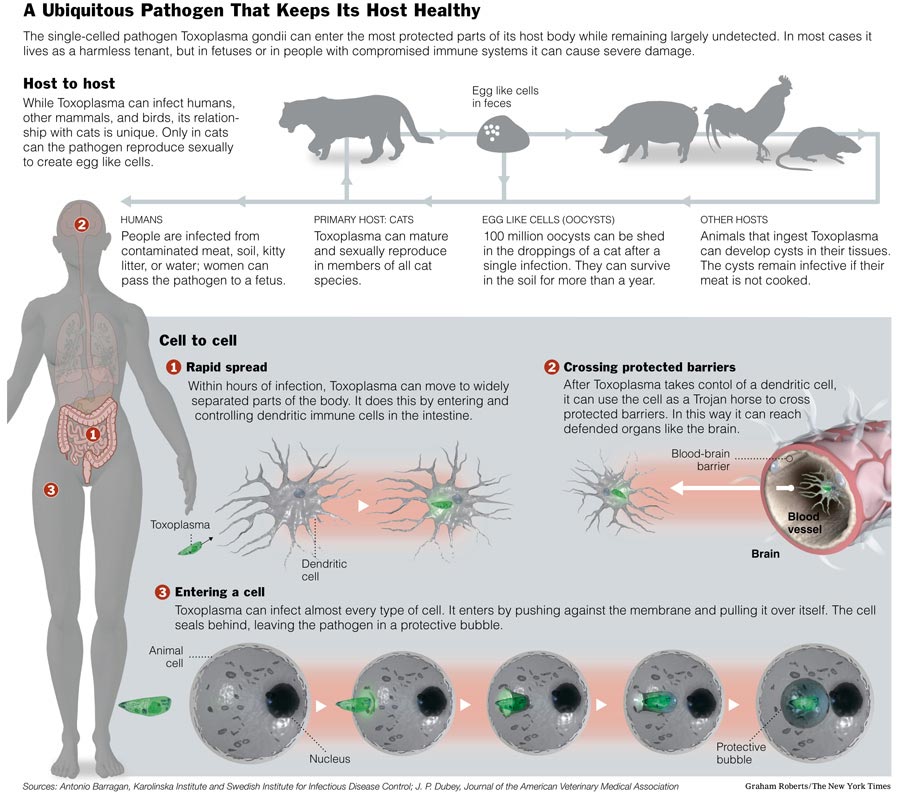
Here’s an abstract of an interesting paper, ‘Can the common brain parasite, Toxoplasma gondii, influence human culture? by Kevin D. Lafferty ;
“The latent prevalence of a long-lived and common brain parasite, Toxoplasma gondii, explains a statistically significant portion of the variance in aggregate neuroticism among populations, as well as in the ‘neurotic’ cultural dimensions of sex roles and uncertainty avoidance. Spurious or non-causal correlations between aggregate personality and aspects of climate and culture that influence T. gondii transmission could also drive these patterns. A link between culture and T. gondii hypothetically results from a behavioural manipulation that the parasite uses to increase its transmission to the next host in the life cycle: a cat. While latent toxoplasmosis is usually benign, the parasite's subtle effect on individual personality appears to alter the aggregate personality at the population level. Drivers of the geographical variation in the prevalence of this parasite include the effects of climate on the persistence of infectious stages in soil, the cultural practices of food preparation and cats as pets. Some variation in culture, therefore, may ultimately be related to how climate affects the distribution of T. gondii, though the results only explain a fraction of the variation in two of the four cultural dimensions, suggesting that if T. gondii does influence human culture, it is only one among many factors.”
Related;
Parasite culture
A Common Parasite Reveals Its Strongest Asset: Stealth
A Nation of Neurotics? Blame the Puppet Masters?; "Lafferty made three straightforward observations.
1. Toxoplasma infection rates vary from country to country. South Korea has prevalance rate of only 4.3%, for example, while Brazil's rate is 66.9%. These rates are determined by many factors, from the eating habits in a country (steak tartar, anyone?) to its climate (Toxoplasma oocysts survive longer in warm tropical soil).
2. Psychologists have measured some of the personality traits influenced by Toxoplasma in these countries. People with Toxoplasma tend to be more self-doubting and insecure, among other things. Among the differences in men, Toxoplasma is associated with less interest in seeking novelty. Toxoplasma-infected women are more open-hearted.
3. A nation's culture can be described, at least in part, as the aggregation of its members' personalities."