October 08, 2004
Sad Maldivian Fact of the Day
By Paul
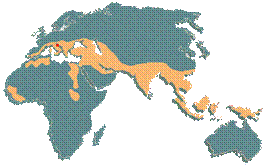
In a recent speech, the President of the Maldives (Mr. Gayoom), quoted some alarming statistics on the prevalence in the Maldives of a rare hereditary disease called thalassaemia:“Another health issue of great concern to the Maldives is that of thalassaemia. Nationally, one in five persons is a thalassaemia carrier and one in every 120 newborns suffers from this blood disorder. If preventive steps to reduce the incidence of thalassaemia in the Maldives are not taken, informed projections show that in 50 years’ time, the cost of treatment could consume over 40 percent of the per capita health expenditure. And what is worse, half the country might have to become blood donors for the other half, a nightmare situation that would be quite unsustainable…”
Thalassemia is a disease which was originally widespread in the Mediterranean Basin, South-East Asia and various countries in equatorial Africa….The term "Thalassemia" implies a genetic disorder of an extremely heterogeneous group which is characterized by a reduced or erroneous production of hemoglobin, the respiratory pigment contained in the red cells. The probability of a child being born affected by Thalassemia Major - the most serious form of this genetic disorder also known as "ß-Thalassemia or Cooleys Disease" - is a 25% chance if the parents are carriers, that is to say if both possess one of the two genes for erroneously coded haemoglobin in their cromosomic make-up… If up until now correct transfusion therapy has been the only available treatment for patients affected by Thalassemia Major, it is today possible to cure the disease by way of performing bone marrow transplant using a compatible donor and in this way replacing diseased cells with healthy ones.
In a poor country like Maldives a bone marrow transplant is not a viable option for many; children suffering from the disease must undergo monthly blood transfusions and daily injections of iron chelating agents. Poverty combined with other related social problems make the situation worse as the following story illustrates:
“Fathimath comes from Himmafushi, an island in North Male atoll with a population of around 800. She is 20 years old, has already been married once, and has two children. Like many other young girls and boys in the islands, she was not lucky enough to complete her studies in the capital Male. The education facilities on her island do not provide tertiary education and hence very few get the chance to complete their studies.Fathimath comes from a poor family of five children, and since she is the third child, the chances of her coming to Male to continue her studies were low. When she had completed grade seven, her family decided that she should get married and settle down. By the age of 17, she was married and was soon pregnant with her first child. By the time she was 19, her husband, who had been working on another island, had divorced her to marry someone else and she was left alone with two children to take care of. As there were very few job opportunities on the island, Fathimath was left with a job that did not pay her enough to take care of her two children and herself……. The Guinness Book of Records latest edition describes Maldives as having the highest divorce rate in the world.”
Here are some background statistics on the health sector in the country and more on how the disease is inherited.
The really sad Maldivian fact is that very few people know where the Maldives are, and even fewer care about their problems.
As soon as global warming raises sea levels high enough to submerge the Maldives, their blood supply problems become a moot point.
Comment by Lugo at October 9, 2004 05:09 PM | PermalinkSolution? New genes need to be introduced to the Maldives. The Governments policy of not allowing tourists to go to all islands militates against this.
Comment by Tim Worstall at October 10, 2004 08:28 AM | Permalink
TrackBack URL for this entry:
http://truckandbarter.com/mt/mt-tb.cgi/221