November 7, 2008
How to Make Me Your Enemy
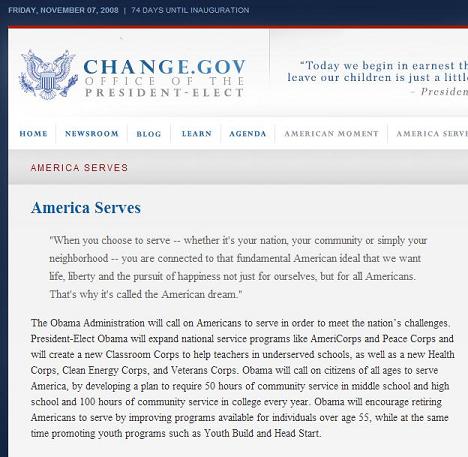
Here's the original.
Solomon has made a preliminary ruling: not 50/50, but 96/4
Next-Day Update: Solomon has put away the sword; instead, he will use other policy levers to achieve his goal of 96/4.
January 24, 2008
"Tax Rebates" are Low-Cost Payday Loans
Folks. Those $300+ "tax rebate" checks Uncle Sam will be sending you. They're loans. Forced loans. Not rebates. Not refunds.
Loans.
Granted, they're loans that won't be paid back in full for a very long time. But either you will repay them with taxes, or somebody else will repay them in taxes, or we'll all repay them with inflation. And whoever holds the debt will be collecting the interest.
But more important than noting that the rebates are loans, is noting the size of the loan is VERY close to the size of the average payday loan, but with a far lower interest rate.
I don't know the best national data to check, but according to this 2005 Washington State report, the average Payday loan there in 2005 was $385, and the average fee was $48. Since the average length of a payday loan was 18 days, this comes out to an APR of about 500%. The Federal Government borrows at considerably lower rates of interest.
Needless to say, I doubt stimulus advocates want to tell you that they're using the Federal Government's long term paper to bring you a low-cost payday loan, but that's precisely what they are doing.
[Later]: I'd be curious to see if people who cash their checks at Wal-Mart spend a quarter of them there, like they did in 2001.
[Even Later:] I'm not sure if I want to read this article, as the headline...
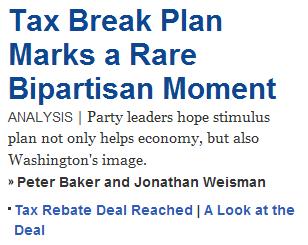
... leads me to believe the authors won't be applying occam's razor or his diligence in using it. Why isn't it plainly obvious to everyone that politicians LOVE pretending to save the economy while giving money directly to voters?
[Update]: I read the article; boy am I sorry.
Bipartisan. Cooperation. Give me a break.
I'm sorry, he sounds just like my four-year-old -- who thinks he can fix anything with a set of plastic tools, when in reality he can break anything with them.
"Many Americans believe that Washington is broken," said House Minority Leader John A. Boehner (R-Ohio). "But I think this agreement, and I hope that this agreement, will show the American people that we can fix it."
Can they make it stick in a balky Senate? And can they extend this moment of cooperation, or is it a one-time deal in the face of economic and political desperation?Bipartisanship and cooperation are low-return, high-risk activities. There will be compromise, of course, but in an environment of self-aggrandizing and self-promoting competition. I should like reporters and editors to stop lying to me; they do not sincerely believe this will herald a new era, and neither does anyone else....
Bush plans in his State of the Union address Monday to outline several areas in which he hopes to work with Congress, including trade and veterans' health care. And some aides think they could find common ground on warrantless surveillance and children's health care. The economic deal showed what is possible. "This is the first example of it," said a senior administration official. "I don't think it will be the last."
[Final Update]: What he said.
March 7, 2007
IMF Criticizes U.K. Tax Policies
O.K., The title I really wanted to put up there was IMF gives Brown a smackdown, but that would be over the top. However, it is interesting to note this news article I saw about the IMF warning of tax increases have negative economic effects. Quote:
Though, to be honest, I can't find the actual report on the website so this will have to do.
Gordon Brown has lifted taxes to the highest level for more than 20 years, the International Monetary Fund declared yesterday.In a hard-hitting assessment, it said the Chancellor's record of hitting families with aggressive tax increases was putting the nation's economic future under threat.
The Washington-based group said taxes must not rise any further, otherwise businesses will be driven away and households could be put under intolerable pressure.
It also warned that property was overvalued and that there may soon be a slump in the housing market.
The IMF pointed out that Britain's tax to Gross Domestic Product ratio - an impor-tant measure of the tax burden - was now at almost 38 per cent, a level it last hit in the mid-1980s.
November 12, 2006
How Egypt implemented a flat tax

"Since 2005 all businesses have paid a 20% corporate income tax – rather than 32% or
40%, depending on the sector. All sector-, location- or business-specific tax holidays and exemptions were eliminated, about 3,000 in all. Businesses can file and pay taxes electronically. As a result two million Egyptians filed taxes in 2005, double the number in 2004."
- Paying Taxes- The Global Picture
Related;
Tax reform: a holistic view
How to Reform the Business Environment
Mahmoud Mohieldin, Minister of Investment for Egypt, spoke on the economic reforms currently being undertaken there. He noted that changes had overcome resistance by proceeding on many fronts, including exchange rates and privatization, with the end result of streamlined business processes and removal of delays.
The Egyptian Center for Economic Studies
September 7, 2005
A Gasoline Tax Rebate
Economists agree -- with experience and theory behind them -- that reducing gasoline taxes will not lower prices in the short run. But will offering a gasoline tax rebate -- refunding all federal taxes paid for gasoline -- increase them? If so (noting that a very small percentage of people complete rebates) by how much?
I envision a national rebate center much like any crooked electronics rebate scheme, only government run. You purchase your gas, and save your receipts. Every quarter, you send in your receipts, with a total tallied on a form, and get a rebate check 6-8 weeks later. You can cash the check for free at Wal-Mart or other fine retailers.
Alternatively, the taxes can be returned to consumers on a uniform basis of car ownership as of a specific date, which eliminates the paperwork (since all the Feds have to do is consult the DMV databases of each state and territory), but this option ignores differences in gasoline consumption. To do that you could adjust for EPA fuel economy, giving gas guzzler owners a greater rebate than fuel efficient small car, diesel, and hybrid owners :-) .
This may not sound appealing, but in the calculations of Lawrence Shephard, a uniform rebate converts an overall regressive tax into a highly progressive tax/rebate schedule.
But if enacted in reality, what could possibly go wrong?
-----
Note that I'm not advocating this policy; I'm just curious about it. In May, Nevada Democrats decided a gasoline tax rebate -- not a lowering of tax rates -- was an excellent way to return a surplus to the people. That never happened, perhaps because it became a ridiculously complicated car registration rebate scheme (which only uses the DMV database to select recpients, but does not refund them DMV fees!?), in order to avoid federal taxation.
May 26, 2005
Taxes on Everything
(With all due apologies to MR.)
Denmark, the land of remarkably high tax rates, has found something else on which to impose a tax.
Denmark, with the world's highest income tax levels, wants sperm donors to pay tax on the 500 crown ($84.59) reimbursement men receive for their services.
Of course, this tax won't divert activity away from the newly-taxed practice. The diversion will simply be in the location.
"It is a special kind of work and therefore the fee cannot be compared to normal working income," Cryos said in a letter to the tax authorities, adding it risked losing donors, most of whom are students.
April 5, 2005
Victim of Negative Income Tax
Because of his four young children, Lee S. Wishing has become a beneficiary victim of the defacto negative income tax:
Believe it or not, the federal government is going to give me $646 of your money.If you feel that bad about it, Lee, you can donate the legal plunder to George Mason University's Economics Department.
March 10, 2005
Open Source Tax Software
Via Slashdot, I found a link to this OSS program for doing your taxes.
Of course, you could always try TaxFreedom.com, but I'm sufficiently skeptical about online-only services to avoid anything I can't do when I'm not hooked up to the internet.
November 29, 2004
Government Efficiency
Why do I read the Ohio State University paper, The Lantern? I am constantly met with misinformation such as this article titled Taxes needed. This anonymous editorial suggests that without the additional 1% in state sales tax that is scheduled to expire next year, Ohioans will not get college education. I am going to quickly try to examine this situation, but this is another of my pet peeve issues that I would love to have time to study in detail.
This is absurd. I know that I don't need to explain the economics of tax to you, preaching to the choir and such. In this state where people continue to plead for lower unemployment, they need to realize that taxes create unemployment! Period. A sales tax specifically taxes consumer purchases from companies typically hiring lower wage employees.
However, think about money loosely in terms of Einstein's relativity, it can be neither created nor destroyed (I realize this is a loose concept.) So the supposed $1.25 billion can either be spent by the Government or saved and spent by the citizens. Approximately $200 per citizen per year. The question is not can one do without $200, the question is who can better decide how to use the $200. This is an issue of efficiency.
Many charities are rated for their efficiency. Usually it terms of how much money ends up spent on the purpose at hand and how much is spent on bureaucracy, salaries and other extraneous expenses. The Government, like any charity, should be measured in terms of efficiency.
Does anyone have a good reference for government efficiency?
A dollar spent for a dollar worth of goods is 100% efficiency. As an individual my efficiency is 100% minus the taxes I pay. Federal income tax reduces this by 30%, state income tax extracts 8%, city income tax takes 2% and sales tax brings it down another 7%. This brings an individual's efficiency to 53%. Charity donations might bring this down another 10%, now I am less than 43% efficient.
So what happens to the 57% consumed by the government and charities? A good charity will spend 75% on the actual charitable cause, so 25% of my lost 10% is a total of 2.5% of an individual's total efficiency lost to a charity, but an individual regains 7.5%. Now the total of an individual's efficiency is about 50.5%. The only remaining question is how much of the government budget is spent efficiently and how much is wasted on salaries and other bureaucracy. I doubt the government can beat 75% efficiency. Let's give them the benefit of the doubt and assume the Government is 50% efficient. Therefore 50% of the Government's 47% is a total of 23.5% loss. Individual (100%) - Charity (2.5%) - Taxes (23.5%) = 74% total efficiency. This is probably the most generous measure I could make since it fails to account for capital gains and lots of other factors. However it is easy to see the difference between losing 2.5% of my income by allowing a charity to spend my money and losing 23.5% of my income by allowing the Government to spend my money.
The fundamental economic assumption is that the best way to make economic decisions is in a market. As a market for charity & taxes, the Government extracts HUGE portions of this market through their monopoly. In the market for charity the Government has excessive market power.
Take control of your money and donate to your favorite charity.
Reduce taxes at every opportunity.
Who knows how to best spend YOUR money? You or the Government?
October 1, 2004
Baseball in DC
I'm so happy that the Expos are moving to DC, not because I am a rabid baseball fanatic, but because the Expos are NOT moving into Northern Virginia!
Virginia Governor Warner and state Republicans get my praise for not being as fast and loose with the public purse as DC government representatives:
Washington, selected this week over Northern Virginia as the new home of the Montreal Expos, "put a lot more public money at risk than we did," Warner said.... "I am not going to put a lot of taxpayer money at risk."DC agreed to pay all the costs of a brand new stadium. Suckers.He disputed claims by Bill Collins, a top booster for Virginia baseball, that the state was turned down because the governor would not support bond financing of a stadium in Loudoun County.
Warner said he wasn't the only high-level foe of bonds; that they were "strongly opposed" by House Speaker William J. Howell, R-Stafford, and Senate Finance Committee Chairman John H. Chichester, R-Stafford.
Warner said public dollars would have covered about one-third of the cost of a Virginia stadium.
In separate comments at an economic development conference in Richmond, Warner said Washington's bid for the Expos included about $100 million more in public funds than the Northern Virginia offer.
"We pursued it very aggressively," Warner said. "But I take very seriously my job as steward of the taxpayers' money."
Government bonds would have been "pledging the state's balance sheet" to the sports venture, Warner said on the radio show....
Warner said there was "no appetite" to impose additional taxes on Virginians to support professional baseball.
UPDATE: Max Sawicky is all over this one.