March 5, 2009
Interpretation
BBC's Will Grant is absolutely clueless.
Last week President Chavez ordered troops to rice processing plants after accusing producers of sidestepping the law on controlled prices by producing a higher grade of rice....
Mr Chavez is attempting to reduce the cost of the basic shopping basket of ordinary Venezuelans at a time of soaring inflation, says the BBC's Will Grant in Caracas.
I don't think inflation fighting is an even remotely acceptable explanation. Here, we have Mr. Chavez's military assets seizing other people's productive assets, because they followed the law to the letter. Who will now retain any profits from the use of these assets? Mr. Chavez's government. So who gets immediate benefits from this seizure? Plainly, Mr. Chavez! Will more rice be produced, and at lower cost? The reporter doesn't seem to realize that it doesn't matter. He won't be reporting the actual results of the seizure either way...
But business leaders and food producers are furious at what they see as a further attack on their ability to turn a profit, our correspondent says
Now I get it. We must judge Mr. Chavez not on the morality of means taken, but stated ends. And we simply shouldn't believe what producers say at all.
June 11, 2007
The Value of Time and Space
I haven't sold used books in years.
Once upon a time, I had success with half.com. But eBay acquired half.com, and after the appropriate mourning period, first suggested and then demanded that I transfer my account to eBay and sell my stock using auction-style listings. This required much time and effort.
I refused. I simply emptied my entire online inventory, and stopped selling; eBay notified me days later that they couldn't believe how they'd offended long-time half.com users. They'd let me keep selling the old way. Too late. I still own most of that deleted stock.
Yet space limitations require that I now eliminate some of my books. Translation: our apartment is packed, and I must choose which books to donate to the library or sell, sell, sell! I used to sell books worth at least $5, and give away anything below the price floor; the going market rate for the rest was usually in the dollar to two dollar range, some down to a cool 1¢ (with the real money being made in the way-too-high shipping allowance). But being a low-volume seller of low-price books meant going to the post office to earn a dollar; so I would just donate them in bulk.
Now I've decided to sell off some of my books by becoming an Amazon Merchant. I was confident I'd sell many of my books because I follow two rules: I 1) keep my books in excellent condition, 2) undersell the lowest comparable used copy by 50¢ to $1.
So far, in twelve hours, I've sold 3 of the first 8 books I put up for sale -- all recent, popular, non-fiction titles. Now, this high volume tells me that I might have to rethink my inventory price floor; If I'm already going to the post office regularly, why not include the cheap books, and make a few extra dollars?
But then I remember that the point is to get rid of books I've read, will not reference, and will not read again; the point is to clear up space with minimal expense of time, not to maximize revenue on book sales; the point is MAX(U), not MAX(Π).
December 18, 2006
The Economics of Remainders, or, Cash still the best gift
Nothing says "I thought about you" like a gift of cold hard cash. Seriously. It means you thought enough to say "I don't know your preferences as well as you do, and what I'd really like to give you is a little slice of selfish pleasure, so go spend this on anything your heart desires."
Don't buy it? Well, it seems like those gift cards are a big way to say "I thought of something you kinda like, but only in large, general terms, so here's a way to spend money within that broad category." But don't feel like you're doing people that much of a favor. Turns out, those things are big boons to the companies that sell them:
Retailers profit from unused gift cards - Yahoo! News
Companies are profiting from your forgetfulness, and the hope that you don't value the gift-giver's dollar the way you value your own. Why else would you let that remaining $5.43 just go to waste sitting on a gift card that's collecting crumbs under the seat of your car? Sure, Aunt Helga wanted you to spend ALL fifty bucks, but really, what can you get for a few bucks, and besides, the store is all the way on the other side of town...
Well, there is an option at SwapAGift, but then you have to be willing to consider your valuation of $100 here versus $100 there. The swap brings down the deadweight loss of Christmas, but doesn't eliminate it. I see it more as a new weapon in the quiver of people who will eat at specific restaurants because they get double mileage points on Thursday lunches when using a credit card.
The cynic in me likes to think that the gift-card sellers have simply learned a valuable lesson from big-city governments, who have long been relying on the remainders from unused farecards for riding on the local subway system as a way to keep the system solvent. Of course, that's not always enough.
October 18, 2006
Middlemen, Sardines Hardest Hit

Via Knowledge Problem and Cold Spring Shops, comes a WaPo article describing how India's sardine fishermen are using cell phones to find the best prices for their catch. Middlemen are not pleased:
the dealers don't necessarily like the new balance of power, but they are paying better prices
Depending on the structure of this market, these higher prices to fishermen -- yielding at least one case of a tripling of income for a boat operator -- should induce them to fish a little more, or induce others to enter the market, and this will have a further "ripple effect" on the Sardine market -- an increase in aggregate supply, yielding lower prices to end consumers.
As much as the middlemen don't like the new balance of power, presumably the sardines like it even less -- especially if short-run supply can be expanded past the sustainable possibility-frontier into over-fishing.
Does anybody have an idea where one can get reliable information about prices and quantites for these markets?
Related:
1) Video of netting sardines on a beach in Goa.
2) AN OVERVIEW OF SARDINES AND ANCHOVIES FISHERY ALONG
THE INDIAN COASTS
August 31, 2006
Verizon DSL Pricing
I'm not sure there's a good reason for Verizon to charge month-to-month payers the same amount for a 768Kbps connection as a 3Mbps connection.

Perhaps most of the monthly fee is accrued to overhead and fixed costs of the pipe, while the marginal cost of additional bandwidth really is zero! But why charge half for a small bandwidth one-year committment, and not charge less for the same max usage to a month-to-month user? Does Verizon need the lower-bandwidth one-year contracts to keep their tubes filled? Are the costs of dealing with month-to-month customers that much higher than one-year contactors?
May 15, 2006
Should you ever buy rental car insurance?
Tim Harford asks that question in his recent column at Slate discussing the prevalence of overpriced insurance;
“Matthew Rabin and Richard Thaler pointed out in 2001, in a paper that surprised even their fellow economists, that anyone who pays even slightly more than the fair premium to escape from a risk on a $90 phone or a $900 insurance deductible must be making a mistake. The stakes are too tiny: In the context of a $1 million lifetime income, even $900 is a small enough risk to swallow. We should turn down these offers of insurance and save the money in a contingency fund to pay for the occasional loss. The odds would be well in our favor and the petty uncertainty shouldn't cause us a single sleepless night.�
Related Blog; Decision Science News
May 7, 2006
Lawmakers tell FTC to Define Price Gouging
What would the Congress be up to next;
“In a measure passed overwhelmingly by the House this week, lawmakers proposed penalties for price gouging -- to $150 million for wholesalers, $2 million for retailers and two years in jail for either -- and ordered the Federal Trade Commission to put a stop to it. The House measure also called for the FTC to define price gouging...."Many economists cringe when they hear politicians talk about price gouging," said N. Gregory Mankiw, an economics professor at Harvard University and former chairman of President Bush's Council of Economic Advisers. "To economists, the price system is central to how market economies allocate resources. Sometimes prices need to rise to balance supply and demand, even if that outcome is politically unpopular."...
"Beyond this, all is the fog of bad and devious legislation," said William D. Nordhaus, a professor of economics at Yale University. He said that for the FTC to come up with a price gouging definition "will presumably involve rule-making, which will require all kinds of cost and benefit inquiries, and will not emerge until after the election, or even after gas prices have declined."
This might fit the criterion for ‘Bad Economics’, a book idea David Friedman is contemplating;
“I have an idea for a book, although I'm not sure if I will write it. The title is "Bad Economics." To write it, I make a large collection of examples of economic errors--get rich quick schemes, news stories, political speeches, et. al. Then explain why they are wrong and in the process teach the relevant principles.Any opinions on whether it would work? If you like the idea, feel free to contribute examples of bad economics, either as comments to this post or as emails to me. And if you happen to find bits of good economics by non-economists with good economic intuition, send them in too--I'm thinking of a short bit at the end of each chapter labelled "Diamonds from the Dungheap."
September 26, 2005
Mr. President, Mind Your Own Business
I do not appreciate the President telling me how or how much to sacrifice in response to a regional natural disaster. I will not play a game of "pretend" so that he may play "good steward" in front of the national press:
Two other points I want to make is, one, we can all pitch in by using -- by being better conservers of energy. I mean, people just need to recognize that the storms have caused disruption and that if they're able to maybe not drive when they -- on a trip that's not essential, that would helpful. The federal government can help, and I've directed the federal agencies nationwide -- and here's some ways we can help. We can curtail nonessential travel. If it makes sense for the citizen out there to curtail nonessential travel, it darn sure makes sense for federal employees. We can encourage employees to carpool or use mass transit. And we can shift peak electricity use to off-peak hours. There's ways for the federal government to lead when it comes to conservation.Mr. President, I'm glad you're temporarily easing regulatory restrictions to reduce bottlenecks, and show a desire for greater refining capacity. But I have a few questions:
First, I'd like to know why it takes a disaster for politicians to realize that protecting existing refineries from competition has a real cost. If we need refining capacity now, then we needed it last year. Why isn't that capacity in place today?
Second, I'd like to know just why I should conserve. We supposedly live in a capitalist society based on property-rights and free-trade; why, all of a sudden, do you ask that I not trust that the price of fuel incorporates all the scarcities at every level of production? What economic lever broke in the past month? Why do you think the price system is failing so bad that we need to "conserve" more than the price signal warrants?
I won't pretend that market prices don't exist, or that markets have suddenly stopped working; I won't pretend that prices are inefficient allocators of resources; I won't pretend that I cannot buy as much gasoline as I can afford at current prices.
Furthermore, Mr. President, I will not pretend that you have legal or moral authority to tell me how much gasoline I may purchase. I will not pretend that your feeble call to use less has any impact whatsoever on my psyche. I will not pretend that the Federal Government knows better than me how much gasoline I should purchase.
In addition, you will be horrified to note that I will not pretend that $3 a gallon gasoline affects my personal driving habits. That's because at my personal margin, it doesn't. I drive 5000 miles a year, and my car gets 30 mpg, meaning I now pay about 10 cents a mile for gasoline to drive, for a total of $500 a year. This is not too much higher than the 6.7 cents ($333) I was paying when gasoline was $2 a gallon. That's about 50 cents a day more than before. I will not change my driving habits for 50 cents a day. I will not pretend that I am driving a Hummer.
I will buy as much gasoline as Sunoco and Exxon and Coastal are willing to supply me at market rates; and there's no reason for me to conserve any more than their prices tell me I should. It doesn't make sense for this citizen to curtail travel, so maybe it doesn't make sense for federal employees to curtail travel either...
A few more questions: How much gasoline do your advisors think will be saved by your plea to conserve? How will that affect prices? How many votes will you gain from a conservation stance? Do you really believe this stuff?
I'd say that it's time your government got out of my gas tank, and kept to minding its own business.
September 13, 2005
Prices at 4600
Here is a graphic of condominium prices at 4600 Duke Street, based on sales data from the City of Alexandria, VA:

But notice that 0,1, and 2 bedroom apartments have been relatively flat since late May, but 3 bedroom units are still escalating. Interesting...
Adding in the 2004 data yields more of the same:

Here is a related post:
September 8, 2005
Q&A About Price Gouging
Here's a post in which I interview myself about anti-price-gouging (anti-PG) laws. It's on T&B for my amusement, and is subject to change at any time. I'm just not satisfied with how economists deal with the craven idiocy of price gouging and the mendacious idiocy of anti-price-gouging laws. Comments are appreciated.
-----
Question: What is price gouging?
Answer: Price gouging is the raising of prices 1) far above one's costs and far above competitors prices, 2) far above what many people think is just, 3) during a human crisis. I disagree with those that state that PG is a non-concept. It is an intentionally vague and deceptive, morally abstruse, and economically harmful concept, but for those very reasons, it must be taken seriously.
Q: Aren't price gougers insipid immoral fly-by-night cretons who prey on the helpless and desperate?
A: We are all part angel, part devil; and we all try to get the most money for our own resources, much of the time. Price gougers are regular people, except that they raise their asking prices for particular resources in times of human crisis.
Q: Isn't price gouging morally wrong and economically inefficient?
A: Here's what we know: price gouging is usually economically efficient but always morally suspicious.
Q: When is PG economically inefficient?
A: When any resource is controlled by a fool or an idiot, PG can yield potentially inefficient results. How? The resource owner sets his prices so high that valuable resources are undersold. Most of the time the market is so "thick" that one idiot doesn't really matter for overall efficiency, but if enough people controlling enough resources set prices too high, then there could be too few sold. But's that's highly unlikely, since most businessmen are not dumb enough to stick it to their customers today, knowing they won't be back tomorrow. They want to maximize profits!
Q: Doesn't price gouging maximize profits?
A: Hell, no! Not in the long-run!
Q: Then why do people price gouge?
A: Because they incorrectly believe that it will maximize their long-run profits! In short, they're idiots. And some gougers (like house contractors) really are fly-by-night operators, which is itself the problem, not the gouging per se.
Q: Why are markets so slow in identifying such bad businessmen?
A: Even fools know how to price competitively in stable retail environments, especially when a major corporation provides daily price points. But a crisis calls for creativity, sensitivity, and ruthless long-run calculation. It also calls for even sharper consumer skills today and vindictive behavior tomorrow.
While a resource owner might be able to guess what price will maximize today's crisis profits, it's really hard for him to identify the price today that will maximize long-run profits. Businesses rely on consumer trust and word of mouth to sustain themselves. So any resource owner better be able to justify price increases -- and very apologetically at that. This is done through surcharges or other indications of cost increases out of their control.
Even if a gasoline station owner could get $10 a gallon for regular unleaded, the cost in terms of reputation could nullify short-term gains. Hence, most far-sighted resource owners will not price gouge consumers.
But some will gouge to absurd levels, and lower their own profits accordingly, because inefficient results punish the price gouger!
Q: Shouldn't we use state law to stop businesses from making stupid pricing choices and taking advantage of consumers? Shouldn't price gougers be punished?
A: I think price gougers should be punished. And price-gougers are punishing themselves with lower good will and lower profits tomorrow. What anti-PG laws actually do is substitute a social, market-based form of punishment with a legislated, political form of punishment. I think the market -- combined with social pressure -- is a lot more severe and effective than the preening politicos who come in and slap merchants on the wrist.
Q: Why doesn't the existence of anti-PG laws stop price gouging?
A: Beat's me. I'm tempted to say that, to the gouger, the expected costs of punishment are worth the expected benefits, but I think that many gougers are so clueless that they don't even know the legislature has made their actions a crime.
Q: Shouldn't the rules of the economic game be different in extraordinary circumstances?
A: Perhaps, but just because the economic environment changes does not mean it is at all possible or desirable to repeal economic law. The fundamental premises of social, cooperative behavior remain the same in and out of crisis. While the price system doesn't work as well in times of rapid change as in more stable times -- nothing does --, in times of extraordinary change it works especially well compared to administrative fiat, forced queuing, and rationing in terms of both allocation and impetus for further production and influx of distribution.
----------UPDATE----------
Q: Is this an example of price gouging?
A McMinnville, Tennessee station was the subject of the second suit after it charged $7.00 a gallon for gasoline. The posted price was $3.50, but gasoline pumps had notes on them saying "Doubled," which most consumers missed until after they had filled their tanks.
A:No, that's an example of deceipt and outright fraud. A price gouger has the temerity of openly quoting his prices; besides being an idiot, this gas station owner is a crook, a swindler, and a cheat. He's a bad, bad man. He should be fined, forced to refund all his customers, and possibly imprisoned. But he's not a real price gouger. Indeed, if he had just posted $7 a gallon on the big board, he would have been just an idiot and a price gouger, but not a crook. Either way, I hope locals will refuse to let their children play with his children.
Q: How can we clearly, simply, objectively determine when price gouging has occurred?
A: You can't. Price gouging is a matter of subjective perception, not objective measurement.
Just accept the fact that the forces that determine prices in markets are the result of individual subjective decisions working within frameworks of social and governmental regulation.
There is no such thing as a just price, or a just price range, because there is no such thing as an unjust price. There are moral obligations, but these are outside of the price system. Anti-PG is a muddle, conflating morality and markets in counterproductive ways. How? Tthese laws assume that one can use a products cost -- or previous market prices -- to determine just prices. But this is nonsense. For a clear counterexample, we find a man stranded in the desert for two days, dying of thirst. Luckily, he comes across a caravan with ample water; I would say that the caravan owner has a moral obligation to give him water. But under anti-PG law, if the caravan owner wants $300 a gallon, the price is not unjust if the caravan owner can prove this amount reflects his actual costs, or if he can demonstrate the willingness of his buyers to have already agreed to pay that much. So much for determining immorality and illegality through cost accounting.)
The difference between profiting and profiteering is entirely a matter of what some people with large political influence -- like politicians themselves who want to buy votes -- feel is "too much". Seemingly objective constraints on prices and profits do not address the underlying consumer objective: to increase supply, which will in turn decrease prices. There is simply no way for the government to lower quoted prices without adverse side effects on supply, or without turning prices into vectors of cash and noncash -- regulated and unregulated -- components. Anti-PG laws do nothing but slow down markets which use short-term prices to get back to their long-run norms.
July 11, 2005
Movie Economics: Quote of the Day
"Shot on budgets ranging from $1 million to $2 million, Sci Fi's movies are made in money-saving locales like Bulgaria, Romania and Missouri."
June 18, 2005
Pontiac Solstice: Dealers vs. GM
Ever so often the "dealer system" is revealed to be a strangely organized, unruly, complicated mess, as when it sets up incentives for dealers (agents) to interfere with the planned maximization of net present value for the whole company:
GM's performance brand already has piled up 9,000 orders for the sporty ragtop, about half the number it had planned to build this year.But GM already took that risk; I simply cannot believe that they didn't think of this ahead of time.But instead of celebrating, Pontiac is quietly -- and delicately -- addressing complaints that its dealers are asking "well above" the $19,995 base sticker price for Solstice, according to a memo sent to Pontiac's 2,700 U.S. dealers....
Pontiac contends that Solstice's $19,995 base price, including destination fees, is a crucial piece of its marketing efforts and that the rebounding brand cannot risk alienating buyers with inflated prices.
June 9, 2005
The CPI does NOT Measure Prices
Because the cost of housing is imputed through housing rental markets, and because hedonic regression quality-change adjustment, the CPI is now alleged to understate inflation:
If you believe that the CPI is supposed to measure such a thing, then this housing argument appears right on target...
Home prices in the Washington area have doubled or tripled in many neighborhoods, and the cost of maintaining, heating, cooling and improving homes also has been soaring....
Yet the department's housing cost index rose only by 2.7 percent in the past year — a discrepancy that has economists scratching their heads.
"The core CPI considerably misrepresents what is happening in the housing market," said John Silvia, chief economist at Wachovia Securities, who added it's "time to can the core."
The problem with the housing index, economists say, is it does not measure the cost of owning a home but rather reflects the cost of renting, which has been rising much more slowly than the cost of home purchases and upkeep.
And what the BLS says about "rental equivalence" is that owners equivalent rent is approximately 22% of the total CPI, and is a sample of renters adjusted to meet the characteristics of nearby owned houses.
Clearly, when housing prices rise but rents don't there is a negative bias in OER. Similarly, when rents rise, but housing prices don't there's a positive bias in OER.
But wait a second, aren't we in a speculator-induced bubble in housing caused by low interest rates? Most people buy homes with mortgages. The monthly cost of owning a home is more than the pro-rated purchase price; it's really the size of the mortgage payment (principal and interest), utilities, and taxes. The core CPI doesn't adjust for lower interest rates and new-fangled interest-only loans either.
As Barry Ritholtz notes, lower interest rates correlate with lower owners equivalent rent through impacts on the demand for house-ownership. Barry considers this a negative bias in the CPI, but I consider this an appropriate adjustment for the lower cost of ownership due to lower interest rates.
The CPI misses the increase in prices, but it also misses the decrease in interest rates. Which is the greater impact on out of pocket costs probably depends on where you live... Compare Santa Monica, CA to Buffalo, NY... Up-to-date data on U.S. fixed and variable mortgage interest rates paid, sizes of mortgages, and sales prices can be found at the Federal Housing Finance Board.
If you haven't had enough housing price talk, you can visit the housing bubble blog.
The rest of the WaTimes article is just one big muddle about too much quality adjustment. But it never defines what the CPI measures, what is meant by "inflation", and how and why this differs from the prices people actually see.
The CPI does not measure "out of pocket" costs, and so if it is underestimating those costs, the fault really lies with the person using the data inappropriately, not with the BLS.
The point is that, yes, non-housing consumer costs are rising, but so are consumer benefits. The CPI is not measuring the change in gross cost to purchasing a thing called a television set, or a computer, or an automobile. It is measuring the change in cost net of change in benefit. It does not try to measure just the increase in the prices people pay, but also the quality and configuration of the goods people are buying.
If you want to gauge out-of-pocket costs, then perhaps you should look at data that actually tries to perform that task.
There is, of course, a very simple solution to this problem. Have the BLS produce a specalist "research" index that doesn't use hedonic indexing or quality adustment at all...
April 8, 2005
Slotting Fees are Efficient (or Maybe not)
Via Progressive Grocer, we find an empirical study that supports the hypothesis that slotting fees -- extra payment for the best shelf space in a retail stores -- are "efficient":
The authors of the report, "Are Slotting Allowances Efficiency-Enhancing or Anti-Competitive?", said they obtained a unique data set consisting of all new products that were offered to a large supermarket chain in a six-month period. It captures more than 1,000 product offers in 21 categories, from major manufacturers such as Kraft, General Foods, Procter & Gamble, as well as smaller manufacturers such as Seneca Foods.Here's a copy of the paper. An abstract of the abstract:The researchers, K. Sudhir of the Yale School of Management and Vithala R. Rao of Johnson Graduate School of Management at Cornell, maintained that the lack of empirical research on slotting allowances prior to their project was due in part to the difficulty in getting retailers and manufacturers to part with information about these transactions....
"We find that when retailers perceive that a product is likely to be a sure hit, they don't seem to ask for slotting allowances; further, manufacturers don't offer slotting allowances when they perceive the product to be a sure dud, either, because they are unlikely to recover the money from sales," said Sudhir.
"It is in the unknown middle, when uncertainty about product success is greatest, that slotting allowances offer the maximum benefit to obtain retail shelf space," according to Sudhir, adding, "This flies in the face of arguments that slotting allowances are merely a form of extortion by retailers."
Using data on all new products that were offered to one retailer for a period of six months, we
empirically investigate support for the alternative rationales for slotting allowances. Our analysis indicates that broadly there is more support for the efficiency theories than for the anticompetitive theories. We find evidence that slotting allowances (1) serve to efficiently allocate scarce retail shelf space; (2) help balance the risk of new product failure between manufacturers and retailers; (3) help manufacturers signal private information about potential success of new products and (4) serve to widen retail distribution for manufacturers by mitigating retail competition. We find little support for the anti-competitive rationales in our data. The fact that we find support for the efficiency rationales suggests that the FTC was correct in being circumspect about banning slotting allowances outright.
UPDATE: Read about contrary views on ALP.
January 5, 2005
More on Drug Reimportation: Price Convergance
The massive discounts on drug prices in Canada don't appear to be too sticky.
Americans purchasing their drugs from Canadian online pharmacies didn't save as much money last year as they did in 2003, with the average discount dropping to 29 percent from 38 percent, a new study found.The average drug price on Canadian Internet pharmacies rose 23 percent from the first quarter of 2003 until the end of last year. Meanwhile, drug prices at American online pharmacies rose 8 percent, according to PharmacyChecker.com, which tracks Internet pharmacy prices and released the study.
Apparently the efforts to block exportation to the US were tighter than I had thought:
To circumvent the restrictions and keep supplying their American customers, Internet pharmacies have been buying drugs from Canadian brick and mortar drug stores, which charge them a markup of between 7 percent and 15 percent above wholesale prices. The higher acquisition costs combined with being paid with weak American dollars is hurting Internet pharmacies' profits."This has become a really low margin business for us," said David MacKay, executive director of the Canadian Internet Pharmacy Association. "We are just trying to hang on."
The comment about the weak dollar here sounds a little like a comment about US economic conditions (though I might be a bit over-tuned, I admit), but in this case it can be seen as a small plus: drugs in the US are now relatively less expensive.
Canada Tightening Hold on Internet Pharmacies
Canda's Health Minister might be trying to strike a fatal blow to the Canadian industry that sells pharmaceuticals across the border to the US.
Health Minister Ujjal Dosanjh may prevent Canadian doctors who do not personally examine U.S. patients from signing prescriptions written by American physicians, a move that could essentially kill the industry. Dosanjh may also create a list of widely used prescription drugs that cannot be exported.
Looks to me like the question of drug reimportation isn't going to be settled by US policy-makers.
December 23, 2004
More DVD Price Wars
Remember that in early October, Netflix raised its price to $22 for it's monthly service, only to have Blockbuster enter at $20. Netflix countered at $18, and blockbuster countered at $17.50. Well, they're still going at it (rr):
How low can you go?I say compare apples with apples: the WM plan for three movies at a time is $17.50--for $15.54, you get two at a time.Like a contestant in a limbo competition, Blockbuster Inc. on Wednesday lowered the price bar for the second time in two months in its war with DVD rental rivals on the Internet.
The video chain slashed the monthly fee for its online subscription service to $14.99 from $17.49, undercutting Netflix's $17.99 rate and the $15.54 charged by Walmart.com, the online branch of retail giant Wal-Mart Stores Inc...
Blockbuster started its online service in August; it has 500,000 subscribers, compared with Netflix's 2.5 million..
Also, while Blockbuster promises 30,000 titles, and Netflix claims 25,000 titles, WM has only 16,000 titles. At the relevant margins, to whom does it make a difference?
December 6, 2004
Oil Price Movements
Via Econopundit I saw this post over at Powerline. Thought it was interesting to look at, so I figured I'd look at a few past years. I've neglected 2003 since Powerline's graph includes some of it, and because the Iraq war introduces an issue that I wanted to sort of skirt around because of time constraints on my end.
Here are the calendar year movements for prices for 2000 -- 2002, all nominal dollars. It's less that I've not got time to adjust the dollars, but more that I was only really interested in the pattern of the movements. (Note: all seasons discussed in terms of Northern Hemisphere -- not meant as a slight to any Southern friends stopping by the site.)

Hmm. That looks a little like we might expect for a seasonal movement in energy. The summer travel season increases demand, while the climb post 11/4/00 might correspond to similar concerns about heating oil supplies we've heard about on the news in relation to current price movements. Possibly a reduction in travel, and potentially the level of oil stocks helped the decrease late in the year.

Summer here is relatively flat. But again we do see that there is some price easing when moving through the late months of the year.

And again a slight increase during the summer into fall, with a reduction in price preceding/entering winter. The difference here, of course, is a marked upturn at the end of the year. Now, what is it that might have occured in late 2002 that made people anxious about oil and oil-producing regions?
The upshot: I'm not terribly convinced that oil prices have moved along with the US campaign for the presidency. Seeing significant movement after controlling for the seasonality of oil prices (that summer is a big time for travel and trasportation -- the biggest sector of oil use -- corresponds to a heated time for the election strikes me as pure conincidence) would do more to sway me towards "conspiracy!!!".
UPDATE: Cite your sources, man! So sorry...all data taken from here.
December 2, 2004
Oil: Stocks vs. Capacity
The recent decline in prices for a barrel of oil seems to be good news for the stock market. No surprise there. But a lot of the commentary in such articles has gotten me thinking. A good deal of the concern is over the stock of oil products. From a WaPo story:
"Oil futures go down, stocks go up. I think that'll be a pattern for a long time, and the good news is that if we keep getting inventory reports like this, oil prices will be ready for a big correction downward," said Brian Belski, market strategist at Piper Jaffray. "Overall, this market has clearly turned to a growth mode over the past few months, and should continue to grow."Stocks of oil and oil products are generally taken as a sign of ability to deliver products on demand when such things as heating oil are needed during the winter. When they're low, the view is that things are getting a bit thin and any unforseen uptick in demand is going to stretch the stocks too far pushing the prices way up. This has been a contributing factor to the recent per-barrel oil prices. From the EIA, here's an illustration of recent stock levels for crude oil:
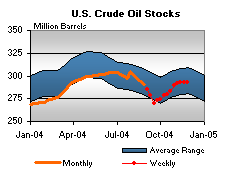
Sitting at or below average for the first half of the year, then dipping back down again, has helped drive the spot price for WTI up to the levels where it became a campaign issue. So the slide back down can be read as a sign that people have a bit more confidence that our ready supply of oil (as opposed to having to wait for more to be pumped and imported) is going to suffice for the coming months. And, as much as there was a lot of talk about oil reaching new and amazing heights in price, the recent moves have prompted talk of a "correction" to get rid of the "fear premium".
Some of the fear, and thus the escalating prices, is due to political factors in the world. Nigeria had civil disturbances, there were labor strikes in the Netherlands, and Iraq is, well, Iraq. But none of that is really new. We've seen it before, and if recent finds in former Soviet Union countries are any indication, the world will continue to face an oil supply rooted in the world's most unstable regions.
Something I tend to think is under-discussed, at least in the popular media, is the issue of refining capacity. While Saudi Arabia is still the world's swing producer, with the largest amount of excess production capacity (they can turn the spigots on faster and wider than anyone else), having more crude sloshing around doesn't help much if you can't do anything with it. In cases of demand spikes or making up for disruptions in supply, the measurement for being able to smooth over the shake up isn't the amount of oil that can be pulled out of the ground, it's how much oil can be turned into usable things like gas, fuel oil, heating oil, and other distillates.
The US hasn't had a new oil refinery come on-line since 1976. Which helps explain this (data from the EIA):
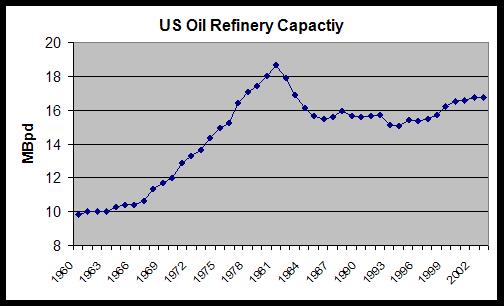
Two things of note, then: 1) the US demands over 20 million barrels of oil a day, and 2) US refineries are running around 90+% of capacity for each plant. This means that, in events like the four hurricanes in the Gulf of Mexico this year (where a large portion of US refining is done) there's little ability for other plants to pick up slack while some refineries are down. And the US isn't the only one pushing its limits. This report from the IEA has one illuminating table (among others):
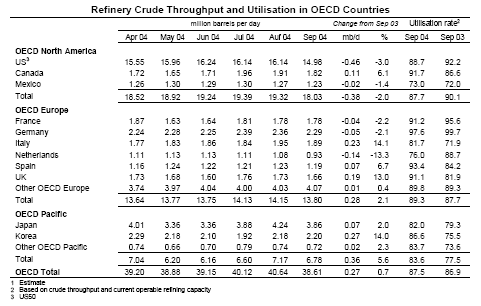
A number of OECD countries are running at higher capacity rates than the US, especially over the 2003 timeframe. (The US number from Sep 2004 has risen sharply again.)* Since the cost to move crude to the point of refinement is so much lower than the cost to move distillate fuels -- which is why we have refineries here that have capacity far beyond the ability of Texas to pump out oil -- widespread stress on refining capacity means delays in getting products to final distribution to consumer; delays in things like heating oil for the winter (thus the so-far mild temperatures for the winter have had calming effect). Also mentioned in the report is an interesting mismatch between those kinds of oil that are seeing an increase in demand (light/sweet) vs. those that are being pumped out of the ground (heavy/sour). The mix of refineries available to us here in the US isn't well-suited to accomidating such changes.
All this has a direct impact on the stocks of oil, since the refineries are essentially how the stocks get filled. Overtaxed refineries can't react well to interruptions, which means that even small shocks get magnified through the system.
"Oil independence", as it's usually considered, is a pipe dream so long as the US uses oil, and someone, somewhere can pump and ship oil for less than it takes to get it from Texas. But that doesn't mean the US has to be so sensitive to shocks. Having more excess refining capacity (or any at all) might be one way to help smooth things out. Too bad, then, that building new refineries is almost entirely out of the question. The return on investment for refining has actually gotten better, but the regulatory and environmental restrictions (more on the environmental issues here), including nearly 800 permits to secure and reductions of 42% of actual profitability against posited levels without environmental regulations, place it out of reach for any of the "majors". Even if large amounts of capital for investment could be obtained, companies would immediately begin fighting the traditional NIMBY problems of any large industrial facility; it's no wonder US refinery building has gone the way of the dodo**.
And so while it's not entirely certain that high oil prices have a negative impact on the world economy (definitions of "sustained" and 'high", and assumptions about behavior make analyses like this fragile), the addition of refining capacity might be, at least, a hedge against the problems that arise from being so sensitive to fluctuations that are beyond our control.
*Some might notice that I said the US uses over 20 million barrels of oil a day while this chart shows that US refining capacity hit 16.25 million barrels a day. This is how stocks move into the lower edge of the average range, as demand not only surpasses refining capacity but also restricts the amount that can be placed in stocks. Either the US continues to draw down stocks, making the market even more nervous, or the US imports refined products, a relatively expensive alternative.
**Though, unless I'm mistaken, the dodo wasn't regulated out of existence.
UPDATE: My apologies for the misspelling in the "capacity chart". It was a casualty of doing the post over lunch. And, for data about capacity, click here and open the XLS file. The US is up to running around 94% for the week of Nov. 26.
Prices of Gas and Other Liquids
While the price of gasoline has declined for four straight weeks, leading to below the fold reports, fark linked to a comparison of the prices (per gallon) of 46 other liquids along with gasoline.
This type of price comparison, while honestly conducted (except for some goods, which are priced too high), doesn't have any other economic value. At the margin, nobody ever chooses between a gallon of gasoline and a gallon of black inkjet toner and a gallon of mercury; there is no production process where these are substitutes, so the relative prices don't provide any decision-assisting information. They're still cool, though.
October 23, 2004
Proper-Coaseans, the Internet, and Price Discrimination

This week’s Economist has an interesting summary of a paper by Andrew Odlyzko in the Review of Network Economics. The following is the abstract of the paper:
A wide-ranging discussion of the evolution of pricing in early transportation industries, such as lighthouses, canals, and turnpikes, is presented. It shows that price discrimination was an important factor in the development of those industries, and tended to intensify with time. In order to make differential tariffs effective, service providers had the right of detailed inspection of the cargo. These historical precedents help explain the drive by large sectors of the telecommunications industry to gain greater control over what is transmitted over the Internet. The implications for the evolution of the Internet are briefly explored.
As the Economist notes, ‘On England's canals, prices by cargo varied widely by the 1790s, according to both content and ultimate use: for instance, transport was free for manure for adjacent fields and stone for road repairs. To some extent, regulation limited canal operators' ability to exploit their market power: until 1845, they were barred from offering transport service themselves, in a “structural separation” of the sort sometimes proposed in telecoms today.”
History of transport applied to telecommunications, very interesting. Here is another must read paper from the journal on regulatory impressionism (thanks to Knowledge Problem).
October 1, 2004
Moore for Free
Michael Moore has been disinvited to speak at GMU. Sad.
Don Boudreaux notes Moore's dismissal smells politically motivated. I agree, even though Moore's invitation could equally well have been politically motivated.
However, I object to Moore speaking at GMU for a reason Don doesn't mention: Moore is not worth his $35,000 pricetag. I think that the university was overpaying for his services; until Conservatives objected, they were suckers at the bargaining table. And there is at least one person who agrees with me--Michael Moore:
Moore, in a telephone interview last night from his home in Flint, Mich., told The Washington Post he intends to speak at George Mason anyway. "I'm going to show up in support of free speech and free expression," he said.You see, to get Michael Moore at a discount--in this case, a freebie--all you have to do is give him a day's worth of free advertising in the major papers.
A while back, Robert Fisk admitted to a packed GMU crowd that there was no massacre in Jenin; his potent exposure of the injustices of Israeli confiscation of land owned by Palestinians was worth the crowd's attention. If Moore were only half as intelligent as Fisk, it might well be worth it going to see him.
August 28, 2004
Library Book Sales
The Beatley branch of Alexandria (VA) Public Library system sells overflow, discarded, and donated books for 50 cents each. The ostensible purpose of such a low price is to increase the number of books that patrons own and read.
This seems like a great deal for those willing to sort through the junk (an embarrasing assortment of third-rate literature, self-help concoctions, and last decade's programming guides) to find a prize (like I have in Bruno Leoni's Freedom and the Law).
For most of the junk books sold, 50 cents appears to be the going market rate, or just a bit under it, as you can find used copies on Amazon and used bookstores for that price. The library--and everyone else-- are practically giving those books away. There is always a substantial inventory of this pulp, and a rather large turnover. The market in junk books is efficient; economists will sleep soundly.
But for almost all of the good books, 50 cents is way too low to achieve the desired aim of wide readership. In fact, at this price, selling a limited number of good books to interested readers seems to be almost impossible.
The actual result of such a low price is to make it so that expensive books (which are usually the good ones) are almost always out of stock. The price ceiling has created a class of middlemen-speculators who sort through the for-sale shelves, and purchase anything worth more than a few dollars. (I have talked with several of these speculators, and they uniformly won't buy books that they can't sell for less than $3-$4--as the transactions cost of packing & shipping are too high). If they think something is valuable, but don't know its market price, they use the library computers to check Amazon.
Hence, it is mostly the trash that could be picked up cheaply elsewhere that winds up in the hands of regular library patrons. As I wrote above, occassionally I have found books that the speculators didn't realize were valuable, or perhaps I beat them to it, since I arrive just when the library opens.
Frankly, I'm disappointed that Alexandria library is giving a living to unknown persons, instead of selling its books at market rates online. By selling its books, I think it could make enough money to purchase and maintain a wi-fi network, or to buy better books. (I grant that this assumes competency in identifying and selling expensive books, but we're talking about library personnel, who presumably specialize in books).
If the library wants to be a charitable organization that gives valuable books to the needy at a discount, then it should find ways to actually perform this service, instead giving retired persons a means to profit at taxpayer loss.