January 17, 2008
Another star in Maldives
Denise Van Outen goes for a dip after fighting the flab (may not be work safe)
January 3, 2008
World Travel Awards 2007
Guess the World's Most Romantic Destination?
December 1, 2007
Telegraph Travel Awards

Favourite Destination Worldwide
1. New Zealand
2. Maldives
3. Australia
Best Specialist Travel Organiser
1. Trailfinders
2. Airline Network
3. Travelbag
Related;
Expenditure on luxury travel, excluding domestic trips, totals around $180 billion a year or $7,200 per arrival, however, this could in reality amount to around $20,000 per arrival as most international trips involve more than one destination.
November 22, 2007
September 18, 2007
The Best Resorts in the World
 The Beach House at Manafaru- a new resort in Maldives opens, New York Times report.
Related;
The world's best hotel was judged to be the One&Only Maldives at Reethi Rah, with an outstanding ambience and top-notch leisure facilities.
-BA, Virgin and easyJet scoop Conde Nast awards
November 19, 2006
Cruise, Holmes leave for Maldives honeymoon

Maldives is now the honeymoon capital for celebrities;
“Newlyweds Tom Cruise and Katie Holmes have jetted off on honeymoon to the Maldives after a fairytale wedding in a 15th century castle in Italy.
The guest list read like a Who's Who of Hollywood as Cruise and Holmes tied the knot in Bracciano on Saturday.
There were fireworks inside and out too as the couple sealed their vows with a "never-ending kiss".
The kiss lasted so long it caused guests to shout "stop, stop!" said Giorgio Armani, who attended the wedding and designed the outfits of the bride, the groom and their baby, Suri.
The couple flew out of Rome on Sunday morning for a honeymoon in the Maldives, said Ciampino airport spokesman Adriano Franceschetti. The rest of the wedding party was due to fly to Los Angeles later on Sunday.”
Related;
Katie Holmes Tom Cruise Wedding Pictures
More links here at A Socialite’s life
November 17, 2006
Smart Sanctions- would it work?

Lonely Planet, one of the leading international travel guidebook companies has advised its readers to support a Friends of Maldives (FOM) campaign for a selective boycott some of the most popular resorts in the country. The following are excerpts form the guide as stated on FOM website- I couldn’t find it on the Lonely Planet website. I’m not convinced that this kind of selective boycott is the right approach.
“In 2005 British based campaign group Friends of Maldives unveiled a carefully targeted boycott of some of the Maldives most popular resorts. Outraged at the torture in Maldivian prisons, the police brutality on the streets and the human rights abuses, the group unveiled its selective boycott to pressure the regime from within. The boycott targets any resort owned wholly or in part by a member of the government, the hope being that the loss of revenue will in turn cause associates of President Gayoom to put pressure on him to an end human rights abuses, hold free and far elections and rein in the police and National Security Services…We support this cleverly targeted campaign and suggest you do too; it fully supports tourism in the Maldives conscious that it’s the country's only major industry, but it tells adherents to avoid about one fifth of the resorts which bring ministers and other senior government figures significant revenue each year….
Friends of Maldives has been roundly discredited in the Maldives by a smear campaign calling them both Islamic terrorists and Christian missionaries. We can confirm that this is not the case, and that the Anglo-Maldivian staff who run the organisation have only the human rights and general welfare of the Maldivian people at heart. They have set up a separate charity, Maldives Aid (reachable through the Friends of Maldives website) that sends aid to the poorest regions of the country. Donations can be made here to projects that will help rural residents rebuild their lives and their future.”It also includes in its history section a description of events such as the Evan Naseem Killing in 2003 and Black Friday 2004, major human rights events in the Maldives. Also mentioning the role of Maldives PR firm:
"Gayoom's other measure was to hire the London office of PR giant Hill & Knowlton to whitewash his dictatorship, a job they continue to do today with sickening success."
For Discussion; Do you think this kind of approach has merit in it? Has economic sanctions brought down any authoritarian regimes?
September 17, 2006
Reinventing Indian Tourism

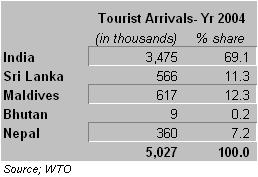
The Financial Express has an article looking at India’s attempt to create a more niche market in tourism;
“As if we needed the Conde Nast Traveller magazine’s recent survey to tell us that we are the fourth most preferred destination among travellers from 134 countries in the world. Just look at the numbers: Last year, 13.2% more international travellers came to India, bringing in more than Rs 8,274 crore. Tourism today is the third largest foreign exchange earner in India, accounting for 2.5% of the GDP. In 2006, a total of 1.28 million tourists came to India as compared to the 1.14 million in 2005…But this heady feeling is marred by a host of problems that plague the industry. Critics say that before we pitch India as the next big world destination, we need to set our own house in order first. From an acute shortage of hotel rooms, which eventually translates into skyrocketing tariffs, to non-existent roads to a skewed mindset towards foreigners, it’s a tough task. Says Rajji Rai, vice-president of the Travel Agents Association of India: “The truth is that there is still a lot that needs to be done. Look at our airports. Take our roads… Every time a tourist lands in India, there is a look of disbelief on his face. Tourists have dollars to burn, we need to grab the maximum share of that money.” Agrees Ravi Wadhwani, a Delhi- based businessman and frequent traveller: “Culturally we may be the richest country in the world. But do we have anything else to boast of? Most successful tourist models today are going in for high-end tourism that has the least impact on the local resources. We, on the other hand, we are going in for mass tourism. We need to learn from the successes of small countries like Maldives, Bhutan, or Chile.” Wadhwani adds: “Look at our connectivity. In foreign countries, you have private planes to ferry tourists. In India, it takes two days to reach the Kanha Wildlife reserve from Delhi. Nobody has so much time to spare.”
Related;
Incredible India
World Tourism Barometer
September 4, 2006
The Norwegian Model
Avoiding Dutch Disease and investing ethically- Norway shows the way;
“The central bank administers the country's pension fund, which is financed mainly by Norway's booming oil and natural gas industries. As the world's third-largest oil exporter, the fund has a king's ransom at its disposal. The last time the the books were balanced, the fund disposed of €196 billion ($250 billion) in assets. Analysts predict it will grow this year to become the second-largest pension fund in the world.Roughly four percent of the fund's financial resources have gone into the state budget every year since 2001. The money is used to cover shortages and finance projects that benefit the well-being of country's citizens. Most of the remaining sums are invested for future generations -- for the time when Norway's oil and natural gas reserves will have been used up.
The fund is responsible for no less than 0.3 percent of all the stocks traded worldwide, it holds shares in more than 3,200 corporations and its portfolio reads like a "Who's Who" guide to the world of international investment. It includes Blue Chip corporations such as Accor, Adidas, BASF, Porsche, Siemens, Volvo and Zürich Financial. Norway has shown great acumen with its portfolio -- in 2005, it had a return on investment of 11.1 percent, or about €20 billion ($26 billion)….
In November 2004, the government established ethical guidelines for the investment policy of its pension fund. Since then, an Ethical Council has overseen the various investments and separated the good from the bad. Seven corporations -- among them BAE Systems, Boeing and Honeywell -- were recently removed from the portfolio. Norwegian stocks worth 3.3 million Norwegian krona or €420 million ($535 million) have been sold as part of the ethical clean-up effort.
The corporations were blacklisted because of their involvement in arms production -- for producing components that go into the production of nuclear weapons that clash with the "fundamental humanitarian principles" of the Norwegian codex. Overall, 17 arms corporations have been declared off limits by Norway's ethics guardians.
In order to avoid similar investments in the future, Norges Bank has armed itself with a strong condex and team of ethicists. "We want to combine economic and ethical interests," investment director Knut Kjaer says. "We are powerful and we can invest in ethical values."
Related;
A Policymakers' Guide to Dutch Disease
Dutch Disease: Too much wealth managed unwisely
Initiatives; EITI, Revenue Watch, Publish What You Pay
The devil's excrement-Is oil wealth a blessing or a curse?;Tricky as this problem is, oil economies such as Norway and Alaska have come up with a clever (though still imperfect) solution: they hive off much of the oil income into “stabilisation” funds, disbursing “dividends” to citizens slowly—directly in Alaska, via social spending in Norway—so that the economy does not overheat. Chile, one of the world's more successful developing countries, has a similar fund for its copper revenues
Fuelling poverty - Oil, war and corruption
Aid, Cost Inflation and 'Dutch Disease': Effects and Implications
Links on Oil, Environment and Human Rights
How to Invest $200 Billion ... Ethically
Norwegian Government Pension Fund Dumps Wal-Mart and Freeport on Ethical Exclusions
Ethical Guidelines; Norwegian Government Pension Fund - Global
Paradise re-arranged; The recent conference in Singapore — CSR in the Travel, Tourism and Hospitality Industries 25-26 July 2006, has sparked some debate about commitment to CSR between one of the speakers — Tricia Barnett, representing Tourism Concern (a UK based NGO that works with communities in destination countries to reduce social and environmental problems and with the out-going tourism industry in the UK) and Hilton International, specifically Hilton operations in the Maldives.
August 26, 2006
Worldmapper

Territory size shows the relative tourist profits made, in US dollars;
"The seven highest earning territories (per person) are islands: Bahamas, Palau, Barbados, Seychelles, Cyprus, Malta and Hong Kong. The highest net earnings are made in Spain where a profit of US$33 billion was made in 2003 which is more than twice the profit made by the second highest tourist earner: the United States."
From Worldmapper – a cool set of maps via Thoughts about K4D-they also have the data files in EXCEL.
July 25, 2006
It all depends on who you’re!

Russ Roberts at Café Hayek recently posted a puzzle of a tourist who goes to a remote island for a vacation where barter is practiced- they don’t use money.
Here’s something that recently happened;
“International supermodel Kate Moss and a cohort of celebrity friends ran up a $500 000 bill when they stayed at Huvafen Fushi resort last week. But the owners reportedly agreed to forgo any payment in return for positive press publicity.”So if the tourists were celebrities they could have got away with not paying the bill at all.
Be sure to check the answer to the puzzle here.
Other blogs discussing the puzzle; The Stalwart, The Faren Report
Related; Kate splashes out on Maldives detox
June 1, 2006
GDP and Wellbeing

"Work may drive growth, but for most people, more free time contributes to well-being, as long as it is not accompanied by lower income. Still, one often-heard remark about the gap in economic performance between OECD countries is that US workers may earn more money but they work longer hours, whereas Europeans prefer more leisure to more work, or indeed, more money, and so are better off. But would ascribing monetary values to leisure time, however arbitrarily, alter GDP per head rankings in favour of European countries? Not by much, according to the latest Going for Growth report. By estimating workers’ time devoted to personal (unpaid) activities, it reports that leisure-adjusted GDP per capita relative to the US is higher for most countries than for the normal measure. But the ranking of OECD countries stays broadly unchanged, with the US still in the top five.
Separately, the OECD Factbook 2006 reports that US household spending on leisure has risen faster than the OECD average over the last decade. It measures spending on recreation and culture by households and government on a range of items from music, show business and sport to pets and photography. Gardening and gambling are also included, but restaurants, hotels and most travel are not. By this measure, the US spends more than France, but less than Spain or the UK."
-OECD Observer
Why is GDP not the best possible indicator of well-being?
- GDP is a production concept, whereas well-being depends more on income and
consumption of individuals and households.
- GDP is a “gross” concept: It makes no allowance for the using-up of capital equipment in
the production of goods and services, and the corresponding need to re-invest part of the
output to maintain production capacity unchanged.
- GDP makes no allowance for the using-up of non-renewable resources, which will
impact on the well-being of future generations.
- GDP excludes leisure, which is clearly of value to society and contributes to well-being.
- GDP does not distinguish between different varieties of income distribution. A society in
which there were a few colossally wealthy families, but the bulk of the population lived
in abject poverty, would presumably enjoy a lower level of “general well-being” than one
with the same GDP but where there was no acute poverty.
- Production might entail the co-production of “bads” (e.g. pollution and deterioration of
the environment). These are rarely taken account of in the GDP accounts.
March 6, 2006
For Hedonists it is without Parallel
 Forbes last year had a list of the world’s most expensive resorts, one of which is in the Maldives;
And certainly, if any unlucky seaman found marooned in the Maldives in the 18th century was told that in the 21st century people would be willing to pay $10,000 to spend the night there, not to mention thousands more to travel there, he would have thought you had been spending too much time at the grog barrel.
But that's the nightly high-season rate at Rania, a new luxury resort that launched this September in the Maldives. The five-figure rate entitles guests to several hours of travel daily in the resort's yacht, unlimited treatments at the on-site spa, and all the meals and drinks they care to consume at the two gourmet restaurants. Oh yeah--and for another $750 (each), they can bring their friends along. Planning a visit in April? Great--it's not high season, but you'll still pay $8,000 a night.
Or take the newest property from One&Only Resorts, the One&Only Maldives at Reethi Rah, which was developed in conjunction with Kerzner International, a five-star hotel and resort operator. Here, guests enjoy the 109-acre island resort and its 12 private, white-sand beaches, and take their pick of the 130 guest villas. Some are on the beach, some over the water and some have their own pools--but each one comes with a "villa host" available around the clock to make sure the Champagne is properly cooled, or to test the pool water before anyone takes the plunge. Nightly room rates here start at a comparatively reasonable $930 during the holidays. But to avoid the riff-raff entirely, plunk down $1 million, which buys five days of room, board, Champagne, wine, tennis, diving and one spa treatment each for you and your 200 nearest and dearest.
It is said that Sol Kirzner invested some 150 million dollars at Reethi Rah which probably set a new standard in the Maldives. Sol Kirzner was named Hotelier of the World last year. The title is from an advertisement for a resort.