November 29, 2006
Markets in Everything – God Helmet

If you’re interested in a short cut to spiritual experiences, neurobiologist Michael Persinger has devised a wired helmet that he says induces religious experiences in those who wear it.
Another helmet called Shakti – claimed to be better than the above one (price $220)
Related;
Shakti and the Koren Helmet - which is more effective?
God on the Brain - questions and answers
The God Experiments
This IsYour Brain on God
God moves in mysterious waves
Visions or Partial-Complex Seizures?
The Significance of Ellen White's Head Injury
Neuroscience - the New Philosophy
Neuroethics (podcast)
Sex and Statistics
In the Chimp world;
“In contrast to humans, the researchers found, male chimps find older females more desirable, approaching them more often to mate, fighting more with other males over them and mating with them far more frequently than with younger females. That is true even for higher-ranking male chimps, which have more choice of mates. The findings confirm the earlier results of other researchers."Multiple lines of evidence indicate that unlike humans, female chimpanzees become more sexually attractive with age," the researchers report in the Nov. 21 issue of the journal Current Biology. "This study demonstrates that male chimpanzees do not merely disdain young females, but actively prefer older mothers to younger mothers."
In the Human world;
Braving "robbing the cradle" jokes, almost one-third of women between ages 40 and 69 are dating younger men (defined as 10 or more years younger). According to a recent AARP poll, one-sixth of women in their 50s, in fact, prefer men in their 40s…But what about the notion that men are "hard-wired" to seek a smooth-faced, curvy receptacle for reproduction and thus are drawn to younger women? "Humans are relatively flexible species," Michael R. Cunningham, Ph.D., a psychologist in the department of communications at the University of Louisville, tells WebMD. "Factors other than biological can be attractive. You can override a lot of biology in pursuit of other goals."
Interestingly, Cunningham did an unpublished study of 60 women in their 20s, 30s, and 40s, who were shown pictures of men aged to those decades. "The women," he says, "were more interested in men their own age or older."As for the men, he says: "I guess it could be nice not to hang around a ditz with no knowledge of music or something like that."
In the blue-eyed world;
Blue-eyed men prefer blue-eyed women, apparently because eye color can help reveal whether their partner has been faithful, researchers said on Monday.“Before you request a paternity test, spend a few minutes looking at your child’s eye color,” Bruno Laeng and colleagues at the University of Tromso in Norway said in the study.
Thanks to Mahalanobis
Related;
If you've got it, flaunt it (P.S. You've got it):
Lake Wobegon effect
Is there a universal positivity bias in attributions? A meta-analytic review of individual, developmental, and cultural differences in the self-serving attributional bias
“Researchers have suggested the presence of a self-serving attributional bias, with people making more internal, stable, and global attributions for positive events than for negative events. This study examined the magnitude, ubiquity, and adaptiveness of this bias. The authors conducted a meta-analysis of 266 studies, yielding 503 independent effect sizes. The average d was 0.96, indicating a large bias. The bias was present in nearly all samples. There were significant age differences, with children and older adults displaying the largest biases. Asian samples displayed significantly smaller biases (d = 0.30) than U.S. (d = 1.05) or Western (d = 0.70) samples. Psychopathology was associated with a significantly attenuated bias (d = 0.48) compared with samples without psychopathology (d = 1.28) and community samples (d = 1.08). The bias was smallest for samples with depression (0.21), anxiety (0.46), and attention-deficit/hyperactivity disorder (0.55). Findings confirm that the self-serving attributional bias is pervasive in the general population but demonstrates significant variability across age, culture, and psychopathology.”
November 27, 2006
Podcasts- Intelligent Design, God and Style
Nature and Religion
Marine scientist Walter Stark, a pioneer of coral reef research who believes the modern view of nature is religious. It holds that nature is pure and perfect, while humans are separate and soiled. He argues that urban Australians' view of nature is problem-obsessed, because problems offer magnificent opportunities to politicians, academics, the media, and of course professional activists
A new branch of moral philosophy
Nick Drayson is a zoologist and a spinner of yarns. His outrageous book, Confessing a Murder, explains the stunning coincidence of Wallace and Darwin 'discovering' natural selection. Now he is in search of platypus memorabilia for the National Museum in Canberra.
Moral Minds: The Evolution of Human Morality
Note; A lot of these podcasts are available for limited time, so download now.
November 26, 2006
Guide to Flirting
An interesting article from the latest edition of The Economist; Flirting-Don't misunderestimate yourself;
“Dr Hill showed heterosexual men and women photographs of people. She asked them to rate both how attractive those of their own sex would be to the opposite sex, and how attractive the members of the opposite sex were. She then compared the scores for the former with the scores for the latter, seen from the other side. Men thought that the men they were shown were more attractive to women than they really were, and women thought the same of the women.Dr Hill had predicted this outcome, thanks to error-management theory—the idea that when people (or, indeed, other animals) make errors of judgment, they tend to make the error that is least costly. The notion was first proposed by Martie Haselton and David Buss, two of Dr Hill's colleagues, to explain a puzzling quirk in male psychology.
As studies show, and many women will attest, men tend to misinterpret innocent friendliness as a sign that women are sexually interested in them. Dr Haselton and Dr Buss reasoned that men who are trying to decide if a woman is interested sexually can err in one of two ways. They can mistakenly believe that she is not interested, in which case they will not bother trying to have sex with her; or they can mistakenly believe she is interested, try, and be rejected. From an evolutionary standpoint, trying and being rejected comes at little cost, except for hurt feelings. Not trying at all, by contrast, may mean the loss of an opportunity to, among other things, spread one's DNA.”
Related;
Interview with Martie Haselton (podcast)
Study links women's fashion sense to ovulation
Looking Good-Our obsession with physical appearance may not be so shallow, after all;
“A Polish researcher named Grazyna Jasienska recently designed an experiment to determine whether symmetrical women have higher levels of the key reproductive hormone estradiol. In the journal Evolution and Human Behavior, her team reports the results. They compared the left and right ring fingers of 183 Polish women between the ages of 24 and 36. Women whose fingers differed in length by more than two millimeters formed the asymmetrical group. Their average estradiol levels were 13 percent lower than the symmetrical group average.When the scientists screened out rural women, whose economic status and harder lives could skew their hormone levels, the difference in average hormone levels between symmetrical and asymmetrical urban women rose to 28 percent.
Marquardt's work has an artistic spin to it. Like Euclid, Leonardo da Vinci and Le Corbusier before him, the doctor became fascinated with the possibility that beauty itself could be quantified. His instincts told him that beauty is not in the eye of the beholder. "I didn't find that to be true," he explains in an interview. "Guys seem to agree. They may argue over whether they prefer Michelle Pfeiffer or Kim Basinger, but you never hear anyone say Roseanne Barr." He had always been mathematically inclined, so, beginning in the early 1970s, Marquardt set out to compile the measurements of beautiful faces. He focused on people who were paid for being attractive -- movie stars and face models. His colleagues scoffed: "Every doctor I talked to told me I was nuts," he recalls.”
Our minds are not what we think
From FT a case of patient with Cotard syndrome;
"She was completely preoccupied with the thought that she was dead," he recalls. "She kept saying that she'd died two weeks before and was worried about whether my office was heaven or not."The young scientist realised that Liz was suffering from a rare and strange condition known as Cotard syndrome, which for the sake of brevity I'll define as the delusion that one is dead. The condition was named after the French psychiatrist Jules Cotard who wrote about some classic cases in the late 1800s. He called it delire des negations and described a host of other symptoms including feelings of guilt, denial of body parts and even, paradoxically for someone who thinks they are dead, thoughts about suicide….
Roughly 100 cases of Cotard delusion have been reported in the medical literature, which certainly makes it rare, although not as rare as some other strange delusions, such as the single case of a man with "perceptual delusional bicephaly". He believed he had two heads and was admitted to hospital suffering gunshot wounds from where he'd tried to shoot one off….
Eventually he did get through, and posed a series of questions to assess an aspect of her personality known as her attributional style. Broadly speaking, this measures a person's tendency to attribute events in their lives to themselves (internal attribution) or to other people or luck (external).
He asked Liz a standard set of questions, presenting her with a range of scenarios - for example, a friend sending her a postcard - and asking her to think about the most likely cause of that event, whether it be herself, other people or chance.The results showed that Liz had a significantly higher number of internal attributions than usual. This was interesting because it relates to one of the prevailing theories about what happens to patients with Cotard delusion. Scientists think that patients with Cotard syndrome have suffered some kind of disruption to the brain wiring for recognising faces. "The idea is that there are two elements to the visual recognition system," McKay explained to me over the phone last week from his new office at Australia's Charles Sturt University. The first element does the pattern-matching business of recognising a face, the second provides the more emotional buzz of familiarity…”
Via Mind Hacks
Related;
Looking Good-Our obsession with physical appearance may not be so shallow, after all
On Consciousness Evolved by VS Ramachandran
Moral Sense Test
Podcasts
Moral Minds: The Evolution of Human Morality
Incest, infanticide, honour killings - different cultures have different rules of justice. But are we all born with a moral instinct - an innate ability to judge what is right and wrong? Could morality be like language - a universal, unconscious grammar common to all human cultures? Eminent evolutionary biologist Marc Hauser and philosopher Richard Joyce take on these controversial questions in impressive new tomes, and to critical acclaim. But could their evolutionary arguments undermine the social authority of morality? Is biology the new 'religion'? Guests include Marc Hauser and Richard Joyce
Mindfulness
The 'holy grail' of meditation techniques is mindfulness. But what is it, exactly? And why has the medical profession suddenly appropriated this age-old technique devised by yogis and Buddhist monks? Professor Emeritus at the University of Massachusetts Medical School, Dr Jon Kabat-Zinn, is the world leader in this field. We also hear from 'the guru of calm', Paul Wilson. Having published scores of books on Calm (Little Book of Calm, Instant Calm etc) Wilson is convinced it's a technique he learned in the Queensland outback
A new branch of moral philosophy
Neuroethics is a new field. It concerns the ethics of the science of the mind and the ethical questions that arise out of our growing knowledge of the way in which the mind works. Before the year 2000 there was little need for the term but rapid advances in the sciences of mind, and the rise of pressing ethical issues surrounding them, mean that we cannot any longer remain without the term or the field to which it refers.
The elimination of iodine deficiency as a cause of brain damage
A Child's Spirit
Encounter ponders the subject of spiritual development in children, and also considers how forces at play in the wider world can shape, and often thwart, children's spiritual lives
Note; Podcasts above are from Radio National and are available for limited time...so download now.
My Stock Broker is an ANN
Its seems like Artificial Neural Networks (ANN) are ready to invade the stock markets;
“Artificial intelligence is becoming so deeply integrated into our economic ecostructure that some day computers will exceed human intelligence,” Mr. Kurzweil tells a room of investors who oversee enormous pools of capital. “Machines can observe billions of market transactions to see patterns we could never see.”…But some are aware that a former Microsoft executive and chairman of the Nasdaq stock market, Michael W. Brown, is an investor in Mr. Kurzweil’s new hedge fund, FatKat, and that Bill Gates once described him as “the best person I know at predicting the future of artificial intelligence.” …
“Five years ago it would have taken $500,000 and 12 people to do what today takes a few computers and co-workers,” said Louis Morgan, managing director of HG Trading, a three-person hedge fund in Wisconsin. “I’m executing 1,500 to 2,000 trades a day and monitoring 1,500 pairs of stocks. My software can automatically execute a trade within 20 milliseconds — five times faster than it would take for my finger to hit the buy button.”
Studies estimate that a third of all stock trades in the United States were driven by automatic algorithms last year, contributing to an explosion in stock market activity. Between 1995 and 2005, the average daily volume of shares traded on the New York Stock Exchange increased to 1.6 billion from 346 million….
For years, computer scientists had tried to help machines perform mundane tasks like reading printed words or telling faces apart. With algorithms similar to those used by stock pickers, programmers created millions of rules designed to tell an “A” from an “a.” But no machine could read a page of text as well as the average child.So Mr. Kurzweil and others took a different tack: instead of creating sequential rules to instruct a computer to read, they thought, why not create thousands of random rules and let the computer figure out what works?
The result was nonlinear decision making processes more akin to how a brain operates. So-called “neural networks” and “genetic algorithms” have become common in higher-level computer science. Neural networks permit computers to create new rules and automatically change underlying assumptions by experimenting with thousands of random sequences and processes. Genetic algorithms encourage software to “evolve” by letting different rules compete, and combining the most successful outcomes….
But as these new techniques proliferate, some worry that promotion is outpacing reality. These techniques may be better for marketing than stock picking.
“Investment firms fall over themselves advertising their latest, most esoteric systems,” said Mr. Lo of M.I.T., who was asked by a $20 billion pension fund to design a neural network. He declined after discovering the investors had no real idea how such networks work.
“There are some pretty substantial misconceptions about what these things can and cannot do,” he said. “As with any black box, if you don’t know why it works, you won’t realize when it’s stopped working. Even a broken watch is right twice a day.”
Related;
The Economist Asks: Are Hedge Funds Necessary?
Inventor Ray Kurzweil on TEDTalks or listen to the podcast
When Genius Failed: The Rise and Fall of Long-Term Capital Management By Roger Lowenstein (book review)
Some posts by Arnold Kling; Nonlinear Thinking, Kurzweil interview, The Age of Radical Enhancement, Why inherited wealth is less important
Kurzweil and Human Capital
Horse Fish?

Local fishermen found the following weird looking fish- if any body knows the scientific name for it, drop in a line.
November 17, 2006
The unwritten rules of proxemics
A fascinating article in NYT talks about role of personal space and its implications;
“Communications scholars began studying personal space and people’s perception of it decades ago, in a field known as proxemics. But with the population in the United States climbing above 300 million, urban corridors becoming denser and people with wealth searching for new ways to separate themselves from the masses, interest in the issue of personal space — that invisible force field around your body — is intensifying….But whether people have become more protective of their personal space is difficult to say. Studies show people tend to adapt, even in cities, which are likely to grow ever more crowded based on population projections.
Yet studies involving airlines show the desire to have some space to oneself is among the top passenger requests. In a survey in April from TripAdvisor, a travel Web site, travelers said that if they had to pay for certain amenities, they would rather have larger seats and more legroom than massages and premium food. And a current advertisement for Eos Airlines, which flies between New York and London, is promoting the fact that it offers passengers “21 square feet of personal space.”
While people may crave space, they rarely realize how entrenched proxemics are. Scholars can predict which areas of an elevator are likely to fill up first and which urinal a man will choose. They know people will stare at the lighted floor numbers in elevators, not one another...
They know commuters will hold newspapers in front of them to read, yes, but also to shield themselves from strangers. And they know college students will unconsciously choose to sit in the same row, if not the same seat, each class.
“If you videotape people at a library table, it’s very clear what seat somebody will take,” Dr. Archer said, adding that one of the corner seats will go first, followed by the chair diagonally opposite because that is farthest away. “If you break those rules, it’s fascinating,” he said. “People will pile up books as if to make a wall — glare.”
Edward T. Hall, an anthropologist and the father of proxemics, even put numbers to the unspoken rules. He defined the invisible zones around us and attributed a range of distance to each one: intimate distance (6 to 18 inches); personal distance (18 inches to 4 feet); social distance (4 to 12 feet); and public distance (about 12 feet or more). …“In the U.S., it’s very closely linked to ideals of individuals,” said Kathryn Sorrells, an associate professor of communication studies at California State University, Northridge, who is writing a book, “Globalizing Intercultural Communications.” “There’s an idea that you have the right to this space,” she said, noting that it was born of a culture that prizes independence, privacy and capitalism. …
Paco Underhill, the author of “Why We Buy: The Science of Shopping” and the chief executive of Envirosell, a research and consulting company whose client list includes Bloomingdale’s, Saks Fifth Avenue, Starbucks and McDonald’s, discovered that most consumers will walk away from whatever they are looking at in a store if a customer inadvertently brushes against their backside, disturbing his or her personal space.
And so, what may seem like a minor behavioral tic can help department stores determine how far apart to place racks of clothes, bistro owners figure out how to configure the bar area and college campuses to design residence halls."
Related;
Some of researchers cited in the article; Robert Krauss, David B. Givens, Kathryn Sorrells, Nick Yee, Paco Underhill
Marketing New Zealand- From fantasy worlds to food
Swarming the shelves-
"Another recent study on the power of social influence indicates that sales could, indeed, be boosted in this way. Matthew Salganik of Columbia University in New York and his colleagues have described creating an artificial music market in which some 14,000 people downloaded previously unknown songs. The researchers found that when people could see the songs ranked by how many times they had been downloaded, they followed the crowd. When the songs were not ordered by rank, but the number of times they had been downloaded was displayed, the effect of social influence was still there but was less pronounced. People thus follow the herd when it is easy for them to do so."
Podcasts;
Trends and Products: Alternate Reality
This week a look into how and why places like You Tube and My Space could suddenly - seemingly out of the blue - be billion dollar sensations. There is a new cultural phenomenon called Alternate Reality, according to University of Sydney's Christy Dena. She explains all
The smell of architecture
Architecture has traditionally favoured sight above all over senses.
So what place is there for the sense of smell in our relationship with the built environment?
Trends and Products: the impact of pdf files
Kevin Kelly writes about the way technology is changing our lives. Today he talks to By Design about the impact of the pdf file, and the way in which information is being digitised. What effect is this having on our day-to-day lives?
Creative prison: design can change behaviour
Do you think that architecture can change behaviour and can influence character? Who knows for sure, but British architect Will Alsop believes good design can change lives for the better.
Trends and Products: ethical fashion
November 12, 2006
Cost-Benefit of Sex
The benefits of sex according to this article;
“In one of the most credible studies correlating overall health with sexual frequency, Queens University in Belfast tracked the mortality of about 1,000 middle-aged men over the course of a decade. The study was designed to compare persons of comparable circumstances, age and health. Its findings, published in 1997 in the British Medical Journal, were that men who reported the highest frequency of orgasm enjoyed a death rate half that of the laggards. Other studies (some rigorous, some less so) purport to show that having sex even a few times a week has an associative or causal relationship with the following:- Improved sense of smell:….
- Reduced risk of heart disease: …
- Weight loss, overall fitness: Sex, if nothing else, is exercise. A vigorous bout burns some 200 calories--about the same as running 15 minutes on a treadmill or playing a spirited game of squash. The pulse rate, in a person aroused, rises from about 70 beats per minute to 150, the same as that of an athlete putting forth maximum effort. British researchers have determined that the equivalent of six Big Macs can be worked off by having sex three times a week for a year. Muscular contractions during intercourse work the pelvis, thighs, buttocks, arms, neck and thorax. Sex also boosts production of testosterone, which leads to stronger bones and muscles. Men's Health magazine has gone so far as to call the bed the single greatest piece of exercise equipment ever invented.
-Reduced depression: …
- Pain-relief: …
- Less-frequent colds and flu: …
- Better bladder control: …
- Better teeth: Seminal plasma contains zinc, calcium and other minerals shown to retard tooth decay. Since this is a family Web site, we will omit discussion of the mineral delivery system. Suffice it to say that it could be a far richer, more complex and more satisfying experience than squeezing a tube of Crest--even Tartar Control Crest. Researchers have noted, parenthetically, that sexual etiquette usually demands the brushing of one's teeth before and/or after intimacy, which, by itself, would help promote better oral hygiene.
- A happier prostate?
Costs? I leave up to the reader. Shouldn’t government be subsidizing it then?
November 11, 2006
Podcasts
“Some people will never learn anything because they understand everything too soon”
- Alexander Pope
Alexander Pope
So how did Pope manage to transform himself from a crippled outsider into a major cultural and moral authority? How did he shape our ideas about what a “modern author” is? Does his work still have resonances today or is it too firmly embedded in the politics, cultural life and rivalries of the period?
The Baghdad Billions- Part 1 (The first year of reconstruction) and Part 2 (Failure of the US aid programme)
Gun control - a new study has found the 1996 gun buy-back had no effect on firearm deaths.
The Science Show versus God
This week Richard Dawkins' remarkable book The God Delusion is released in Australia. Dawkins, Professor of the Public Understanding of Science at Oxford says he hopes that reading his book will make believers doubt their faith. He explains why he is so convinced, through the weight of scientific evidence, that atheism is the more valid viewpoint. Two winners of the Templeton Prize, given for building bridges between spiritual values and science, Professors John Barrow from Cambridge and Paul Davies now in Arizona give alternative views
Stem Cell Research
The history of the science of stem cell research - what are stem cells and when and how were they discovered.
The curse of the Western world: a history of obesity
North Korea
On Rear Vision this week a look at the history of North Korea and in particular the history of the relationship between North Korea and the United States of America
Harry Messel
One of Australia's most famous physicists tells of a childhood in Canada where he excelled at school, did two degrees simultaneously at university, and came to live in Australia. His pioneering work here has to be heard to be believed.
High blood pressure medication
A recent Australian study looked at medication for high blood pressure and the implications of patients' adherence or non-adherence to their doctor's prescription of these types of drugs
Jane Goodall
Jane Goodall talks about her 40 years of work with chimpanzees in Tanzania, and the relationship between chimpanzee behaviour and human behaviour.
Home Fronts: Indonesia
Terry Lane examines the political influence of Islamist values, the impact of radical organisations on Indonesian society and the democratisation of Indonesian institutions, in the fifth program of this six part series
Tobacco and Culture: First Nation Peoples face the Challenge
Sucking on cigarettes. It's a public health nightmare for the world's indigenous peoples. Maori women have the word's highest rates of lung cancer. Smoking rates haven't dropped in 15 years amongst Aboriginal Australians. But, for Native Americans native tobacco still has sacred, ceremonial value.
Paracelsus
He became known as the Luther of Medicine for his reformist medical practices, but Paracelsus, who was born in Switzerland in 1493, was also a religious man. His belief that the body was actually empowered by God had implications for his theories of healing.
November 10, 2006
Not all breast-feeding is equal
“Let’s be honest: if the only adverse consequence of not nursing is that babies get a few more colds, we could leave the decision making to the parents. The real question is whether there are dangerous or potentially long-term damaging illnesses (such as ear infections that lead to hearing loss) for babies who aren’t nursed versus babies who are. And how long (or how much) should a baby be nursed in order to keep his or her risk down?One of the big problems in trying to assess this question is that not all nursing is equal. There are mothers who nurse exclusively, mothers who use expressed breast milk (delivered in bottles), mothers who freeze milk, or use pasteurized (donated) milk, or use some breast milk and some formula, and a combination of all of the above.
Then there are the babies, some of whom are premature, or have low birth weight, or have other health issues that could make nursing harder; there are some babies who are nursed until they are four-years old, and others who nurse until they are six-weeks old.
Finally, we must add a complicating factor that it’s virtually impossible to carry out the gold standard of research on this issue – a randomized controlled study in which mothers are randomly assigned whether to nurse or not. Our observational power may also be limited; at least in principle, because women (and families) who nurse are not the same as those who don’t, making any comparison of the outcomes extremely difficult.”
For a lay person’s guide to how economists think about such issues read, Trade-Offs: An Introduction to Economic Reasoning and Social Issues by Harold Winter.
Here’s a review of the book at Newmark’s Door.
November 9, 2006
Using Cognitive Neuroscience to become a Millionaire?
Winner of Who Wants to Be A Millionaire?, Ogi Ogas explains how he used techniques of congintive neuroscience to win the quiz the show;
"I used priming on my $16,000 question: "This past spring, which country first published inflammatory cartoons of the prophet Mohammed?" I did not know the answer. But I did know I had a long conversation with my friend Gena about the cartoons. So I chatted with Meredith about Gena. I tried to remember where we discussed the cartoons and the way Gena flutters his hands. As I pictured how he rolls his eyes to express disdain, Gena's remark popped into my mind: "What else would you expect from Denmark?" …Another cognitive process essential for winning on Millionaire is intuition, or more precisely, knowing how to make decisions based on intuition. What if you have a feeling about an answer? What should you do with your hunch? Folk wisdom holds that on standardized tests you should go with your first impulse. Research tends to support this idea: a first impulse is more often correct than a second, revised decision. But what if $250,000 is at stake? "More often correct" does not seem certain enough to serve as a basis for a decision. How can you evaluate the true likelihood of a hunch being accurate?...
But I didn't hesitate when I got my $500,000 question: "Who was the only Beatle to never appear on a Jerry Lewis telethon?" I had no clue whatsoever. I quickly Switched-the-Question. But my substitute question was almost as obscure: "When Bayer marketed heroin to consumers in the late nineteenth century, it was promoted as a remedy for what ailment?"I used my last lifeline, the 50/50, reducing the choices to "Stuffy head" and "Persistent cough." I tried using priming and intuition, struggling to recall Victorian-era American opium-addicts, but I got nowhere.
I desperately wanted a shot at the million, so I considered another cognitive capacity explored in my department: theory of mind, the ability to imagine other people's perspectives. I contemplated the show's writers themselves, imagining them sitting at their keyboards composing three fake but credible answers. "Stuffy head" struck me as resembling the kind of manufactured distraction I might come up with."
Via Mind Hacks
Related;
Teach your brain to stretch time
Brain on Fire
Podcasts
The Private Life of a Brain Surgeon
Katrina Firlik's business is brains. Carving into the 'flesh of the soul' is her day job. The first woman admitted into one of the most prestigious neurosurgery programs, she's just penned an insider's account of her world. Part mechanic - part scientist, her intimate encounters of diseased and damaged brains offer a unique, and grisly, lens onto our most mysterious and wondrous organ.
Reclaiming imagination: art, psychosis and the creative mind
Placenta Brain: the cognitive burden of pregnancy?
September 28, 2006
Breast Milk good for Babies motor

According to a new study;
“Social epidemiologist Yvonne J. Kelly of University College London and her colleagues were aware of studies that had suggested neurological benefits from breastfeeding. However, notes Kelly, those earlier analyses tended to be small and done in special populations—such as preemies. They also failed to rule out many factors that might account for differences in a child's developmental skills. Among such possible confounders: race, parent's education, family income, parenting attitudes, depression in the mother, characteristics of childcare, or the baby's overall health.Via Mind HacksKelly and her coauthors had access to information on such features for the families of 18,000 infants from throughout the United Kingdom. The scientists also had motor-development data from in-home interviews with the families of those children when each baby was between 8 and 11 months old. The data were collected as part of the still-ongoing Millennium Cohort Study begun in 2000.
Among these children, 9 percent exhibited gross motor delays, which means being late in reaching such major milestones as sitting up, proficient crawling, or standing. Six percent also showed delays in fine-motor coordination—such as clapping hands, transferring an object from one hand to another, or efficiently using the thumb and forefinger like pincers to pick things up. Only 1 percent of the infants showed both types of delays, the scientists report in the September Pediatrics.
When the researchers began their work, they were skeptical of a link between breastfeeding and motor skills. "Although we thought we'd initially see some kind of effect, we had expected to be able to later explain it all away when we [adjusted for] covariants," such as a family's income or mother's mental health, Kelly says.
To the researchers' surprise, Kelly notes, children "were about 50 percent less likely to have a [developmental] delay if they had prolonged, exclusive breastfeeding when compared to those who were never breastfed." They defined breastfeeding as prolonged when it had lasted at least 4 months. Even babies receiving mother's milk for a short while—2 months or less—were 30 percent less likely to have a developmental delay than those who received solely infant formula, beginning right after birth…”
Related;
The Allen brain atlas
September 27, 2006
Costs of Island inundations not significant?
On the costs and benefits of climate change;
“Robert Mendelsohn, professor at the Yale School of Forestry and Environmental Studies, argues that such negative costs may still be less than the benefits.He sees a net global warming bonus in the near-term, as higher farming yields in northern countries offsets damage elsewhere, especially in Africa.
"In that sense it doesn't make sense to spend money right now," Mendelsohn said, adding that beyond 2050 and a 2 degrees Celsius rise the damage and need for action grows.
He added that he does not cost species extinctions and health effects, and only crudely measures the cost of island inundations.
Richard Tol, Senior Research Officer at Ireland's Economic and Social Research Institute, has a similar stance.
"(My damage estimate) does hide some things that some people will get very upset about," Tol said. "From an economic perspective small island states are so tiny and people are moving out of there anyway."
As an example Tol estimates the welfare loss of the Maldives submerging at three times the inhabitants' annual salaries, in addition to the 100 percent loss of the country's GDP.
Citizens are happy to value the preservation of the global ecosystem at a cost of 50 euros per person per year, Tol says, but added he does not factor in the risk of rapid sea level rise…”
Related;
Leave The Maldives To Sink, Senior Scientist Says
Stern Review on the Economics of Climate Change
The Politics of Climate Change;
“The Bush administration has blocked release of a report that suggests global warming is contributing to the frequency and strength of hurricanes, the journal Nature reported Tuesday. The possibility that warming conditions may cause storms to become stronger has generated debate among climate and weather experts, particularly in the wake of the Hurricane Katrina disaster.”
Podcast of the Day- God in the Genome


First watch this video- the inner workings a cell (via Boing Boing).
For some like Dr. Francis Collins, Head of the Human Genome Project, and Director of the National Human Genome Research Institute, this reinforces the belief in God. Dr Francis S. Collins argues that both scientific and spiritual "truth" are valid and fit together harmoniously and one can at the same time accept modern scientific theories, such as evolution with the belief in God. Listen to the podcast.
Compare with Richard Dawkins and Daniel Dannet views on the topic.
Related;
MeaningofLife.tv
Excerpt: "The Language of God"
Let There Be Light
Scientists on Religion ; Theist and materialist ponder the place of humanity in the universe
September 25, 2006
Podcast of the Day, The Mind-Body Problem Down Under
Mind. Brain. Are they the same thing, or is the mind something special? The conundrum has perplexed us for centuries. Descartes' split the two - into a spiritual, soul-like mind and fleshly, material brain. But in 1956 a group of 'renegade' Oxford graduates Down Under, now international stars in philosophy, launched a challenge. Consciousness and the brain were united, and any talk of mental spooks and ghosts in the machine was out...almost. Now in their 80s, David Armstrong and Jack Smart join Natasha Mitchell and others to reminisce on taking Descartes to task. Listen to the podcast or see the transcript. (Radio National Australia)
Related;
Dennett changes his mind
THE PATH TO POINCARÉ
STEREOTYPES AND FACTS
Fact-checking ``The Female Brain."
“Unfortunately, this is just one of several cases in recent books on sex and neuroscience where striking numbers turn out to be without apparent empirical support. On page 36 of ``The Female Brain," Brizendine writes that ``Girls speak faster on average-250 words per minute versus 125 for typical males." In support of this assertion, her endnotes cite Bruce P. Ryan, ``Speaking rate, conversational speech acts, interruption, and linguistic complexity of 20 pre-school stuttering and non-stuttering children and their mothers," Clinical Linguistics & Phonetics, 14(1), pp. 25-51 (2000). Alas, in Ryan's paper, you won't find the 250 vs. 125 numbers, and in fact, he gives no data at all that breaks down speaking rates by sex.”
September 22, 2006
Phantoms in the Brain
An interesting study- Brain electrodes conjure up ghostly visions;
“Simple stimulation of the brain can cause the mind to play complex and creepy tricks on itself, neurologists have discovered. They found that, by inserting electrodes into a specific part of the brain, they could induce a patient to sense that an illusory 'shadow person' was lurking behind her and mimicking her movements.
Doctors treating the patient, a 22-year-old woman with epilepsy, found that when they stimulated a brain region called the left temporoparietal junction, the patient sensed the presence of a sinister figure behind her who copied her actions. They suspect that the effect is due to the mind projecting its own movements onto a phantom figure conjured up by the brain, an effect that is seen in some patients with serious psychiatric conditions….”
Via Mind Hacks
Related;
Mind Games; What neuroeconomics tells us about money and the brain.
Multimedia;
In the Family - A Journey through Madness
The Dancing Mind
Death; An exploration of the cultural construction of death: the way it's changed in English-based society from rich Victorian ceremony to the simple ritual of today; the difference in response from culture to culture, i.e. Mexico, Ireland and Australia.
The dream debate
Chris Turney on Time, author of Bones, Rocks and Stars: The Science of When Things Happened
September 20, 2006
Science Podcasts
A Brief History of Infinity: Space and the Universe
A Brief History of Infinity: Mathematics
The Communications Revolution;
The global effects of communication
Technology in life of people with disabilities
Communications Technology and Influence
Communications Technology and Communities
Harry Messel's life in science;This week is the 50th anniversary of SILLIAC, the first automatic computer to be built in an Australian university and tonight's guest is the man who made it happen. In his 35-year career as head of the School of Physics at Sydney University, Harry Messel taught thousands of students and used his entrepreneurial skills to raise vast funds to support scientific research. Now in his 80s, he's lost none of his enthusiasm and interest in the world of science
Jess Adkins has a lab full of cucumbers made of stone. They are, in fact, drill cores of corals from all over the world. He analyses these with surprising results, getting a remarkably accurate story of past climates going back thousands of years. This young professor from Caltech (the California Institute of Technology) has some amazing stories to tell of adventure and exploration
Why watch birds?;Author and birdy Sue Taylor from Melbourne has written a book called 'Why watch birds?', a beginner's guide to bird watching.
Photo of the Day- Aurora Borealis

“In 1620, a Frenchman, Pierre Gassendi, saw the northern lights and named them after the Roman goddess, Aurora. He also added the word 'borealis' for the Roman god of the north wind, Boreas. From that point onwards the lights became known to scientists as the aurora borealis.
Aurora was a Roman deity, counterpart of the Greek mythological Titan goddess of the dawn Eos. Eos would rise from her home at the edge of Oceanus, the sea that surrounded the world, to open the gates for her brother Helios to ride his chariot across the sky each day. Aurora's sister was Selene, the moon. and she had many husbands and one of her sons was Boreas, the north wind. The literal translation of Aurora Borealis is therefore "Dawn of the North wind."
From the website of photographer.
See more pictures at Photographer of the Year 2006 -BBC
See also NYT has a nice collection of photos from Ethiopia’s Christian heritage.
September 17, 2006
Podcasts of the Day
Radical Islam in Pakistan; For years there has been debate over Pakistan's role in international terrorism. What is the link between Islamic extremism and Pakistan and when and how did it emerge? Guests include Hussain Haqqani, Associate Professor of International Relations, Boston University, Samina Yasmeen, Senior Lecturer in Political Science and International Relations,University of Western Australia and Ahmed Rashid, Correspondent with The Far Eastern Economic Review
Islam in the Renaissance; Between the 15th and 16th centuries, the European Renaissance generated scientific breakthroughs including the discovery by Copernicus that the Earth revolves around the Sun. The progress in scientific thought has been attributed in part to the translation of Arabic texts into Latin. However, Professor George Saliba argues that crucial information was contained in texts that were not translated, so how did Copernicus know about them? Guest on the show George Saliba, Professor of Arabic and Islamic Science at Columbia University in New York.
The history of scientific discoveries
Peace by Artful Means
In societies fractured by violence, family conflict and global threats of terrorism, how do we encounter 'the other' in ways which build sustainable peace? From the growing practice of mediation to the global art of hip hop, this Encounter explores the role of creativity in transforming conflict
Regaining confidence in western culture
All the podcasts from Radio National’s shows.
September 16, 2006
The Adolescent Brain and Social Policies

“A decade ago, the prevailing notion was that brain growth ended at about the age of 2 years. Since then, we have learned that brain growth continues well into adolescence (between ages 10 and 19) and into young adulthood (see the figure below). During this period the brain undergoes a series of changes, and parts of the brain associated with social skills, problem solving, and identifying emotions mature only by the early twenties. However, this process of brain development cannot entirely explain adolescent decision making and behavior. Nor does it override the effect of the environment—parents, schools, communities—in which young people live.
Brain development: arborization and pruning
The brain is made up of nerve cells—about 10 billion of them—connected by branches or dendrites. These branches move information from one cell to another, but these connections are not soldered together; rather, there are spaces between the branch of one cell and the body of another. These spaces are called synapses, and information moves from cell to cell across these spaces by releasing tiny packets of chemicals. When there are abnormalities in the chemicals in the synapses, a variety of clinical conditions result, such as depression and attention-deficit and hyperactivity disorders.
Different parts of the brain handle different activities—that much is well-known. What is new is the finding that during adolescence certain areas of the brain grow in size and other regions become more efficient. For example, the area of the brain responsible for language more than doubles in size between ages 8 and 14. Consequently, language acquisition is optimal at those ages. So, too, connections grow and strengthen between the brain stem and the spinal cord, increasing the connections between the emotions and what the body feels. Throughout childhood and adolescence, more and more nerve cells grow sheaths around them called white matter or myelin. This is like building a superhighway, allowing information to be interpreted and recalled much faster than was ever possible as a young child.
These structural changes are only some of the brain’s alterations during adolescence. Another major change is called “pruning.” Throughout early childhood, the number of connections between cells increase, and because the process is much like the growth of branches on a tree, it is called arborization. It allows a child’s brain to be very excitable—which is why children seem to be perpetual motion machines. In adolescence, many of those branches die—through pruning. The brain is less excitable but also more efficient in carrying information.
The pruning follows a consistent pattern throughout adolescence and young adulthood starting at the back of the brain and ending at the prefrontal cortex. The prefrontal cortex regulates impulses, risk taking, planning, decision making, empathy, and insight. Research also shows that the cerebellum, recently discovered to be important for mathematics, music, decision making, social skills, and understanding
humor, continues to grow through adolescence and well into emerging adulthood. The last structure of the brain to stop growing, it develops until the mid-twenties.
Implications for social policies
What does this new brain research mean for understanding adolescent decision making and behavior? Although much more research is needed before defi nitive policies can be recommended based on the new brain research, it suggests some interesting policy considerations:
• The loss of neuronal excitation in adolescence is associated with a rise in depression, especially among adolescent females, suggesting a biological basis for the epidemiological finding that gender differences in depression start around the time of puberty. These biological changes combine with external sources of stress to increase the risk of suicide for youth in many countries of the world.
• As the brain matures during adolescence, alternations in the synaptic chemicals may influence learning (drugs for attention-deficit disorders improve information transfer at the level of the neuronal synapse). For example, antidepressive drugs may allow for certain excitatory neurotransmitters to stay in the space between two brain cells longer than otherwise.
• Learning and teaching strategies should be timed to increase neurodevelopmental capacities. Because neurodevelopmental maturation occurs at different chronological ages for different people, their inability to grasp a concept at one age does not mean that they are unable to learn the material. This speaks to the risk of educational “tracking” based on comprehension or performance examinations at a young age.
• Without a fully mature prefrontal cortex, adolescents may be more impulsive than adults and perhaps more susceptible to peer influences. This impulsiveness—especially in reactive decision making, as when faced with a situation or threatened to make an immediate decision—suggests the value of second chance programs.
It is, however, too early in the research to draw definitive conclusions about brain development and behavior. Also, physical development interacts with the social environments to determine behaviors and outcomes. So parental behaviors and expectations, effective schools, communities that are youth oriented and supportive, all make a difference in determining young people’s behavior and how well they learn complex decision-making skills.”
Source- World Development Report 2007, Box 2.9 ‘Brain development among youth: Neuroscience meets social science’, p.61 (emphasis mine)
Related;
Eye gaze and cognition in children
Glazed looks sharpen the mind
Universities: A social duty
Into the Mystery of the Adolescent Mind
A Study of Interactions: Emerging Issues in the Science of Adolescence Workshop Summary
The 7 Habits of Highly Effective Teens
World Development Report 2007 links;
Graphs from the report
Video and Audio
September 6, 2006
Podcasts Carnival
Dr Karl Sauvant - World Investment Prospects to 2010: Boom or Backlash? (Radio Economics). Here is special edition of the report
Jospeh Stiglitz: making globalisation work; Nobel Prize winning economist Joseph Stiglitz has written a follow-up to his best-selling book "Globalisation and it Discontents" which looks at the current problems with globalisation and the forces of reform at work. Related posts by Tyler Cowen on Making Globalization Work, or Joe Stiglitz watch, part II and Joe Stiglitz watch
Sri Lanka; With violence once again erupting in Sri Lanka, Rear Vision traces the historical roots of the conflict. Guests include Jonathan Spencer, Professor of Anthropology of South Asia , University of Edinburgh, Dr. Jayadeva Uyangoda,Professor and Head, Department of Political Science and Public Policy, University of Colombo, Dr. Paikiasothy Saravanamuttu, Executive Director of the Centre for Policy Alternatives, an independent, nonpartisan, public policy centre with a focus on peace and governance, Colombo
Books That Shook the World - Plato's Republic
Anthony Arnove; The Logic of Withdrawal
Christopher Scanlon on The Joint Strike Fighter
Australia and the nuclear renaissance; Nuclear is back. Australia, with its abundant ore and 'good guy' status could become a key member of the uranium enricher's club. But what would the neighbours think? And how would the twin threats of weapons proliferation and waste disposal be addressed?
John Mortimer (Edinburgh International Book Festival)
Polash Larsen's review of Londonstani, by Gautam Malkani
Engineering wonders: tunnels and bridges
Over-fished or over-regulated?; According to marine biologist Dr Walter Starck, Australia has the most over-managed, heavily restricted and least productive fishery industry in the world. He'll be speaking at the upcoming Australian Environment Foundation inaugural conference. We're also joined by chair of the foundation, Don Burke, to hear why Australia needs another environment group.
Australia On The Map Part One: The Siren South; This is the first program in the Australia On The Map series, exploring early Dutch exploration of the Australian coastline. This year marks the 400th Anniversary of the first mapping of our northern coastline by Dutchman Jan Lodewijkszoon van Rosingeyn and the crew of the Duyfken
Jess Adkins has a lab full of cucumbers made of stone. They are, in fact, drill cores of corals from all over the world. He analyses these with surprising results, getting a remarkably accurate story of past climates going back thousands of years. This young professor from Caltech (the California Institute of Technology) has some amazing stories to tell of adventure and exploration
Jane Goodall is one of the best-known observers of animal behaviour. She revolutionised the field in the 1960s by watching chimpanzees in the wild. What now does she make of their relationship with humans? And what are their prospects? Will they really become extinct outside zoos within a generation?
Lee Edwards; BP now stands for Beyond Petroleum. The company says it is proud of its diversification from fossil fuels. But will solar be enough to make a difference? Dr Lee Edwards runs BP's solar research from his base in Chicago and he foresees cities which are self-reliant through the sun and alternative sources rather than through a dependence on oil. But will BP withstand competition from less green rivals?
Western Democracies and Voter Cynicism
Derek Denton: The Dawning of Consciousness
Teachers and Performance Pay
featuring Andrew Leigh, Economist,Australian National University Co-author of "How and Why has Teacher Quality Changed in Australia?"
Anyone who had a heart would know their own language; Another chance to hear virtuoso grammarian Geoff Pullum on the logic of standard English usage...as described in The Cambridge Grammar of the English Language.
Cliches: are they worthless? The poet Chris Wallace Crabbe on the brass razoos in the currency of conversation.
Climate change; Dr Barrie Pittock of the CSIRO talks about climate change and risk management and what to do about climate change
The David Hicks Case; Former attorney-general Kep Enderby QC looks at the imprisonment of David Hicks at Guantanamo Bay
Tea with Glen Matlock; The confessions of a middle aged Sex Pistol.
Michael Whelan, S.M.; He helped found Spirituality in the Pub, a network of groups across Australia that meet to discuss all kinds of spiritual issues with the aim of deepening faith and transforming lives. For Michael Whelan, a priest in the Society of Mary congregation, conversation is a vital instrument of change, and he talks about his own spiritual development away from moralism and toward mysticism
Bad Hair day: principles and politics in international cricket
Africa's struggle for political evolution
Middlebury "Symposium on Terror and Mass Media" sessisions;
Douglas Birch, Baltimore Sun Correspondent on The Politics of Terror
The Media's Role in Promoting or Fighting Terrorism
Ahmed Abdella, Senior producer and reporter for Al- Arabiyya Television
Is Terrorism Challenging Press Freedom?
Pierre-François Mourrier, director of research for the Office of the French President
Non-proliferation of Weapons of Mass Destruction
Hans Blix, Chairman of the WMDC (Weapons of Mass Destruction Commission) addresses a conference at the Fletcher School, Tufts University
James Madison and the Spirit of Republicanism
Colleen Sheehan, Villanova University
Schiavo and the Shibboleth of Privacy
Daniel N. Robinson, Oxford University; Georgetown University
John Marshall and the Myth of Marbury
Robert Lowry Clinton, Southern Illinois University-Carbondale
Lessons from the Lincoln Administration for the War on Terror
Michael Stokes Paulsen, University of Minnesota Law School, on "The Emancipation Proclamation and the Commander-in-Chief Power: Lessons from the Lincoln Administration for the War on Terror
Media Coverage of Climate Science: Broader Lessons for Science Journalism? (VIDEO)
Nature podcasts; Male infertility, Bird flu's structural secrets and silent spread, cryptic Martian spots explained, the ethics of egg donation, Warmth-seeking bees, Poincaré unpickled and more
National Geographic Podcasts, National Geographic World Talk
Scientific American podcasts, Science Talk episodes
August 31, 2006
Authors, Books, Reviews, & Chapters
A collection of links on books and reviews.
Books Online
Trigonometric Delights
U.S. Trade Strategy -Free Versus Fair by Daniel W. Drezner,
Chapters Online
The Next Great Globalization: How Disadvantaged Nations Can Harness Their Financial Systems to Get Rich by Frederic S. Mishkin
Chapter 1 - THE NEXT GREAT GLOBALIZATION: A FORCE FOR GOOD?
Expert Political Judgment: How Good is It? How Can We Know? By Philip E. Tetlock
CHAPTER 1 Quantifying the Unquantifiable
John Kay review of the book
Economics and the Law, Second Edition: From Posner to Postmodernism and Beyond
By Nicholas Mercuro & Steven G. Medema
Chapter 2 CHICAGO LAW AND ECONOMICS
The State of Working America 2006/2007
Book Reviews
Reviews of Good and Plenty-The Creative Successes of American Arts Funding by Tyler Cowen at Weekly Standard and by Donald Boudreaux
Review of Claus Offe, REFLECTIONS ON AMERICA-Tocqueville, Weber and Adorno in the United States Translated by Patrick Camiller
Brain Science and the Moral Order
Interview with Mark Hauser
What Do Animals Think About Numbers?
A Universal Moral Grammer: a case for Intention Predicates, Consequence Predicates and Action Predicates?
Review of Judith Harris’ No Two Alike: Human Nature and Human Individuality
Review of ‘The White Man's Burden-Why the West's Efforts to Aid the Rest Have Done So Much Ill and So Little Good’ at IMF and CATO
Review of The Moral Consequences of Economic Growth, Benjamin M. Friedman,
Institutions and the Path to the Modern Economy: Lessons from Medieval Trade by Greif, Avner
Glyn Morgan, The Idea of a European Superstate: Public Justification and European Integration (Princeton University Press 2005), at Crooked Timber and John Quiggin
Review of Unspeak
DEEPAK LAL'S REVIVING THE INVISIBLE HAND: A REVIEW
Review of THE WAGES OF DESTRUCTION: The Making and Breaking of the Nazi Economy by Adam Tooze
Book Quotes from Fischer Black and the Revolutionary Idea of Finance by Perry Mehrling at Voluntary Exchange
Random Book Quotes at Core Economics.
Review of Mao's Last Revolution By Roderick MacFarquhar and Michael Schoenhals
Naguib Mahfouz obituary
More on Amartya Sen’s Illusions of Identity by Fazeer
August 26, 2006
Political Scientists?

“Recently unearthed documents reveal that Franco's psychiatrist carried out bizarre experiments on members of the International Brigade in 1930s Spain. His aim: to prove that leftwingers are mad…It was here, in 1938, that International Brigade members were subjected to a bizarre set of physical and psychological tests in one of the first systematic attempts to put psychiatry to the service of ideology. Sixty-four years later, the results of Vallejo's project to unravel the "biopsyche of Marxist fanaticism" have finally come to light.
Former prisoners at San Pedro de Cardena remember being subjected to up to 200 tests. They were quizzed on their sex lives, and had their heads and noses measured.
"They made us strip and did all these measurements. We supposed they thought it would be useful if the fascists ever invaded Britain," says Bob Doyle, one of the few remaining survivors of a group of 75 British and Irish prisoners tested at the camp. Another, Carl Geiser, the senior ranking American in the jail and a former political commissar to the Abraham Lincoln Brigade, recalls: "I was photographed with just a small cloth over my penis."
KGB Used Clairvoyants as Agents;
“Correspondents of the Komsomolskaya Pravda daily said that not long before he passed away, Professor Alexander Spirkin, well-known scholar and co-author of the Great Soviet Encyclopedia, admitted in an interview that the Soviet KGB employed clairvoyants to spy on their enemiesAlexander Spirkin used to head a secret lab under the Soviet government and worked closely with clairvoyants hired to carry out special missions for the Kremlin.”
Unrelated link; Pluto loses status as a planet
What is Art?
 ‘Art is a lie that makes us realize the truth’- Pablo Picasso
Some of Vilayanur Ramachandran's speculations about art and neuroscience;
“In particular what I'd like to do is raise the question: "Are there such things as artistic universals?" …Let me put it somewhat differently. Let's assume that 90% of the variance you see in art is driven by cultural diversity or - more cynically - by just the auctioneer's hammer, and only 10% by universal laws that are common to all brains. The culturally driven 90% is what most people already study - it's called art history. As a scientist what I am interested in is the 10% that is universal - not in the endless variations imposed by cultures. The advantage that I and other scientists have today is that unlike we can now test our conjectures by directly studying the brain empirically. There's even a new name for this discipline. My colleague Semir Zeki calls it Neuro-aesthetics - just to annoy the philosophers.
I recently started reading about the history of ideas on art - especially Victorian reactions to Indian art - and it makes fascinating reading.
For example if you go to Southern India, you look at the famous Chola bronze of the goddess Parvati dating back to the 12th century. For Indian eyes, she is supposed to represent the very epitome of feminine sensuality, grace, poise, dignity, everything that's good about being a woman. And she's of course also very voluptuous.
But the Victorian Englishmen who first encountered these sculptures were appalled by Parvati, partly because they were prudish, but partly also just because of just plain ignorance.
They complained that the breasts were way too big, the hips were too big and the waist was too narrow. It didn't look anything like a real woman - it wasn't realistic - it was primitive art. And they said the same thing about the voluptuous nymphs of Kajuraho - even about Rajastani and Mogul miniature paintings. They said look these paintings don't have perspective, they're all distorted.
They were judging Indian art using the standards of Western art - especially classical Greek art and Renaissance art where realism is strongly emphasized.But obviously this is a fallacy. Anyone here today will tell you art has nothing to do with realism. It is not about creating a realistic replica of what's out there in the world. …
But what's it got to do with the rest of art. Let's go back to the Chola bronze of Parvati. Let's talk about Indian art. Well the same principle applies. How does the artist convey the very epitome of feminine sensuality? What he does is simply take the average female form, subtract the average male form - you're going to get big breasts, big hips and a narrow waist. And then amplify it, amplify the difference. And you don't say: "My God, it's anatomically incorrect". You say: "Wow! What a sexy goddess!"
But that's not all there is to it because how do you bring in dignity, poise, grace?
Well what you do is something quite clever, what the Chola bronze artist does is something quite clever. There are some postures that are forbidden to a male. I can't stand like that even if I want to. But a woman can do it effortlessly. So what he does is he goes into an abstract space I call "posture space", and then subtracts the average male posture from the female and then exaggerates the feminine posture - and then you get elegant triple flexion - or tribhanga - pose, where the head is tilted one way, the body is tilted exactly the opposite way, and the hips again the other way. And again you don't say: "My God, that's anatomically inappropriate. Nobody can stand like that." You say: "My God! It's gorgeous. It's beautiful! It's a celestial goddess". So the image is extremely evocative and it's an example of the peak shift principle in Indian art.…
Related;
John Hyman criticizes neuroscientists’ interpretation of art.
The neurological basis of artistic universals
The Cognitive Science of Art
Pamela Anderson and the hindu goddesses
PsyArt is an online, peer-reviewed journal featuring articles using a psychological approach to the arts.
What makes us human?The unfortunate 'rat people' of Pakistan could provide the answer.
Multimedia;
From Mirror Neurons to Mona Lisa- Visual Art and the Brain
Cognitive science podcasts from Science and the City
MeaningofLive.tv
The Lost Temples of India
Ramachandran interview-starts in the middle of the program
Miscellaneous; Short videos of well-known visual illusions, Brain and Behavior, The Exploratorium; Seeing, Vision Experiments, Ramachandran's own page of illusions
Dissociation between cat brain and cat's anatomy
August 6, 2006
Biology Determined Culture
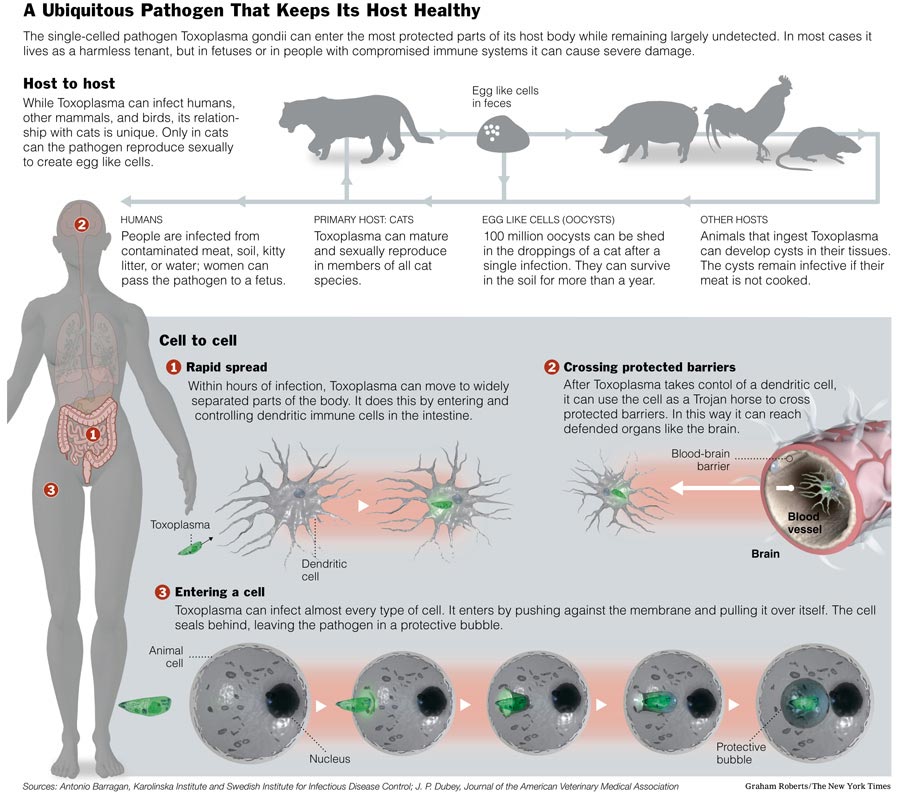
Here’s an abstract of an interesting paper, ‘Can the common brain parasite, Toxoplasma gondii, influence human culture? by Kevin D. Lafferty ;
“The latent prevalence of a long-lived and common brain parasite, Toxoplasma gondii, explains a statistically significant portion of the variance in aggregate neuroticism among populations, as well as in the ‘neurotic’ cultural dimensions of sex roles and uncertainty avoidance. Spurious or non-causal correlations between aggregate personality and aspects of climate and culture that influence T. gondii transmission could also drive these patterns. A link between culture and T. gondii hypothetically results from a behavioural manipulation that the parasite uses to increase its transmission to the next host in the life cycle: a cat. While latent toxoplasmosis is usually benign, the parasite's subtle effect on individual personality appears to alter the aggregate personality at the population level. Drivers of the geographical variation in the prevalence of this parasite include the effects of climate on the persistence of infectious stages in soil, the cultural practices of food preparation and cats as pets. Some variation in culture, therefore, may ultimately be related to how climate affects the distribution of T. gondii, though the results only explain a fraction of the variation in two of the four cultural dimensions, suggesting that if T. gondii does influence human culture, it is only one among many factors.”
Related;
Parasite culture
A Common Parasite Reveals Its Strongest Asset: Stealth
A Nation of Neurotics? Blame the Puppet Masters?; "Lafferty made three straightforward observations.
1. Toxoplasma infection rates vary from country to country. South Korea has prevalance rate of only 4.3%, for example, while Brazil's rate is 66.9%. These rates are determined by many factors, from the eating habits in a country (steak tartar, anyone?) to its climate (Toxoplasma oocysts survive longer in warm tropical soil).
2. Psychologists have measured some of the personality traits influenced by Toxoplasma in these countries. People with Toxoplasma tend to be more self-doubting and insecure, among other things. Among the differences in men, Toxoplasma is associated with less interest in seeking novelty. Toxoplasma-infected women are more open-hearted.
3. A nation's culture can be described, at least in part, as the aggregation of its members' personalities."
July 20, 2006
Finding ‘needles of good design in haystacks of possibility’
“The Mecca of the economist lies in economic biology rather than in economic dynamics” – Alfred Marshall
Should economists use more evolutionary principles? According Eric Beinhocker, of the McKinsey Global Institute, author of the recent “The Origin of Wealth: Evolution, Complexity, and the Radical Remaking of Economics”, it’s a definite yes. The Economist reviews his book;
“The evolutionary formula—variation, selection and replication—is a formal, “all-purpose” principle, which can perform its magic equally well in either domain….He argues that economists should abandon blackboard deduction in favour of computer simulation. The economists he likes do not “solve” models of the economy—deducing the prices and quantities that will prevail in equilibrium—rather they grow them “in silico”, as he puts it.
An early example is the sugarscape simulation done in 1995 by Joshua Epstein and Robert Axtell, of the Brookings Institution. On a computer-generated landscape, studded with “sugar” mountains, they scattered a variety of simple, sugar-eating creatures, which compete for this precious commodity. Some creatures move faster than others, some see farther, and some burn sugar at a higher metabolic rate than their rivals…
Surprisingly, the results of their myopic lives can be gripping. Even simple rules of behaviour result in collective patterns that are impossible to foresee yet easy to recognise. The sugarscape, for example, is quickly beset by a division between haves and have-nots, which bears a strong statistical resemblance to the distribution of income in real economies. These macro-results cannot be deduced from the micro-rules simulators write. Rather, they emerge from the interactions of the creatures in the model, just as “wetness” emerges from the interaction of water molecules, rather than being a property of the molecule itself…”
I’ll wait for a review by David Warsh before buying the book.
Related;
The Power of Biobabble
Creating Strategy in an Unknowable Universe
STRATEGY FORMULATION "IN AN UNKNOWABLE UNIVERSE"
The adaptable corporation
Strategy as a Portfolio of Experiments
Also in the latest Economist, special report on “Japan's economy; As Japan emerges from an era of a zero interest rate, the country still needs to put more of its past behind it”
July 19, 2006
Pharaonic Neurosurgery and other links on science
A couple of links on some science related news;
The latest Carnival of Neuroscience
Secrets of ocean birth laid bare; The largest tear in the Earth's crust seen in decades, if not centuries, could carve out a new ocean in Africa, according to satellite data
Magic mushrooms really cause 'spiritual' experiences; “My guess is that there will be people saying ‘You’re looking for a spiritual shortcut’” says Griffiths. He stresses that the drug is no replacement for the mental health benefits of continuous personal reflection: “There’s all the difference in the world between a spiritual experience and a spiritual life.”
A head for trouble; We like to think it’s our choice to help an old lady across the road or push her into the traffic. But an increasing number of scientists say we’re fooling ourselves. Are some of us just hard-wired to be bad?
The Neuroscience of Playing Chicken; If you don't know what chicken is (are you from this planet?), it involves two people in cars driving at each other at high speeds. The first person to get the hell out of the way is the chicken. Unfortunately, it's impossible to fit a car, much less two, into an fMRI machine, so Fukui et al. came up with a "game theoretical" version. They chose chicken over the more well-known game theoretical game, the Prisoner's Dilemma, because in Prisoner's Dilemma tasks, people don't always behave the way game theory says they should, which leads to empirical and theoretical problems. Chicken is different, largely in that there's no reward for trying to make the same choice as the other participant. In chicken, you want to make the opposite choice of your opponent. I'll let them describe their version of chicken (p. 3; figure from p. 2):…
Trust in Fish; A mutually beneficial interaction between two species of fish turns out to involve the careful appraisal of one by the other — and the appropriately virtuous behaviour by the former while being watched. This is yet another example of a complex social behavior once thought to be unique to mammals
What a synapse does when it’s not doing anything
Connecting cortex to machines: recent advances in brain interfaces; Recent technological and scientific advances have generated wide interest in the possibility of creating a brain−machine interface (BMI), particularly as a means to aid paralyzed humans in communication. Advances have been made in detecting neural signals and translating them into command signals that can control devices. We now have systems that use externally derived neural signals as a command source, and faster and potentially more flexible systems that directly use intracortical recording are being tested. Studies in behaving monkeys show that neural output from the motor cortex can be used to control computer cursors almost as effectively as a natural hand would carry out the task. Additional research findings explore the possibility of using computers to return behaviorally useful feedback information to the cortex. Although significant scientific and technological challenges remain, progress in creating useful human BMIs is accelerating
It’s a Goal; The project is aiming to help young men between the ages of 16-35 who may suffer, or have suffered, with depression, but also to include those who have little confidence, a low opinion of themselves and who have poor communication and social skills.
Psychiatry by Prescription …Is psychiatry an empirical science that studies brain functioning, or a form of humanism that studies the inner workings of the mind in its broad social and cultural context? Assistant professor of psychiatry David Brendel takes up this question in his new book, Healing Psychiatry: Bridging the Science/Humanism Divide, in which he diagnoses the field’s internal schisms and proposes a cure.
Multimedia
The psychology of stalking; Repeated unwanted advances, being followed, distressing packages and letters in the mail, relentless phone calls and emails can all be part of the often-terrifying experience of being stalked. It's a social problem that's increasing and it doesn't just happen to celebrities. From the latest research in forensic psychiatry, we hear what motivates those who stalk, and one woman gives an open account of what impact being the victim of a stalker has had on her life
The Life of Thomas Young; Retired engineer Paul Riddell prepared a tribute to the little known 19th Century English scientist Thomas Young
How many of me are there? This week, we examine the question of personal identity with Douglas Hofstadter (author of the seventies cult classic Gödel, Escher, Bach). We normally assume that our identity is singular - there's one me and one you - but could the person I think of as me really be us
Is football (soccer) good for your mental health? Listen online
July 7, 2006
English woman develops foreign accent after stroke
Human brain is truly amazing;
“Linda Walker awoke in hospital to find her distinctive Newcastle accent had been transformed into a mixture of Jamaican, Canadian and Slovakian….Researchers at Oxford University have found that patients with Foreign Accent Syndrome have suffered damage to tiny areas of the brain that affect speech.
The result is often a drawing out or clipping of the vowels that mimic the accent of a particular country, such as Spain or France, even though the sufferer has limited exposure to that accent.
The syndrome was first identified during World War II, when a Norwegian woman suffered shrapnel damage to her brain. She developed a strong German accent, which led to her being ostracised by her community.”
Related; Those of you in London might want to go the following debate; From bad to worse: the worst ideas on the mind (via Mind Hacks)- The human mind is complex, mysterious and vital to who we are, so it's probably no surprise that over the years some treatments for mental conditions have turned out to be complicated, ridiculous and damaging to patients. In this fun and interactive event four experts will each name and shame an idea from psychiatric history and try to get the audience to name it ‘worst idea on the mind’.
June 29, 2006
Creative Destruction
 Why do Galaxies Exist? How have they evolved and what lies at the centre of a galaxy to make the stars dance round it at such colossal speeds?
The latest podcast from BBC’s ‘In Our Time’ show featuring John Gribbin, Visiting Fellow in Astronomy at the University of Sussex, Carolin Crawford, Royal Society University Research Fellow at the Institute of Astronomy at Cambridge and Robert Kennicutt, Plumian Professor of Astronomy and Experimental Philosophy at the University of Cambridge
Related;
Astronomy Blogs; Tom’s Astronomy Blog, Astronomy Blog, Astronomy a Go-Go, Slacker Astronomy, Universe Today, The Night Sky,
In the beginnings; Young solar systems are like cosmic snooker games, and the universe is flat
See also Nature podcasts