March 9, 2009
Trust
Some top notch economists insist we have a crisis of trust. True enough. Yet it seems to me that the market is trying to fire quite a number of the poor-judging risk-takers in the financial sector -- basically, those that we cannot trust. However, Mr. Obama and Mr. Geithner appear to be doing a damn fine job keeping them there, I think partly because of successful lobbying, but also because they cannot envision the market and political orders that would ensue should AIG, Citi, BoA, and a host of other international conglomerates suddenly disappear.
October 26, 2008
Will Obama Take Your Guns Away?
My going assumption was that Obama would wind up guiding most facets of federal government policy slightly -- not severely -- to the left, meaning more taxes, more spending, more restrictions on employment, guns, and incomes. But his campaign's ceaseless advertising about his vision of change has made me look up his plan.
So how seriously does Obama take your second amendment rights? Well, Obama's website discusses guns under Urban Policy, not Civil Rights.
Address Gun Violence in Cities: As president, Barack Obama would repeal the Tiahrt Amendment, which restricts the ability of local law enforcement to access important gun trace information, and give police officers across the nation the tools they need to solve gun crimes and fight the illegal arms trade. Obama and Biden also favor commonsense measures that respect the Second Amendment rights of gun owners, while keeping guns away from children and from criminals who shouldn't have them. They support closing the gun show loophole and making guns in this country childproof. They also support making the expired federal Assault Weapons Ban permanent, as such weapons belong on foreign battlefields and not on our streets.
In general, I prefer well-thought-out constraints to civil rights, not just what politicians believe to be "commonsense" restrictions. So Obama MAY take your guns away if you or they run afoul of to-be-determined "commonsense measures".
But does it sound to you like Obama and Biden are perfectly OK with keeping already-manufactured assault weapons on the street? It appears to me that Obama MAY take your guns away, if he pushes to ban not just the sale of assault weapons to civilians, but also their possession by civilians.
And I leave it to you whether he'll take your guns away if they cannot be made "childproof"... Who knows?
April 18, 2008
On the Zero Marginal Product of Televised Debates
Regarding this open letter trying to shame ABC.
We're at a crucial moment in our country's history, facing war, a terrorism threat, recession, and a range of big domestic challenges. Large majorities of our fellow Americans tell pollsters they're deeply worried about the country's direction. In such a context, journalists moderating a debate--who are, after all, entrusted with free public airwaves--have a particular responsibility to push and engage the candidates in serious debate about these matters. Tough, probing questions on these issues clearly serve the public interest. Demands that candidates make pledges about a future no one can predict or excessive emphasis on tangential "character" issues do not. This applies to candidates of both parties.
Ah, politics... We're always at a crucial point in history, aren't we? The authors say ABC moderators should push candidates on policy, not character. I find this utterly pointless. Might be better to ask them to talk about their favorite cartoon characters. At least we'd learn something new.
Frankly, at this point in the election cycle, we should know exactly where the candidates stand on the most serious policy issues. A candidate that respects the intelligence of the American academic voter would have his staff write honest domestic and international policy proposals, to as detailed a level as is actionable.
And while we know their soundbites and general operating principles, we don't know specifically what Presidential candidates want to do, because even their detailed proposals on issues that are not subject to the vicissitudes of war (like paying for medical care), are simply extensive marketing strategy documents.
I mean, take a good, hard look at Sen. Clinton's "American Health Choices Plan" and Sen. Obama's "Plan for a Healthy America". I have. At best, they are not executable as designed, rely on a hodgepodge of studies of sundry qualities, and assume almost laughably low levels of implementation risk. These are rough guidelines about how these candidates would act, made up to impress. They do not.
Do our letter authors think 50 minutes more of serious debate is going to clarify the differences in immigration policy or healthcare policy between Sen. Clinton and Sen. Obama? Really?
While a debate presents an additional opportunity for candidates to be powerful, forthright, and rhetorically brilliant, I remain completely unconvinced that any publicly televised debate between candidates generates any information about character or public policy that is not easily available elsewhere.
So I don't value televised debate highly. I think our letter-writers need to step back a minute from their morality campaign against ABC. They should ask themselves whether the high personal and political values they expected from the Sen. Clinton-Sen. Obama debate had any chance of being realized with 50 more minutes of policy discussion.
Would any televised debate be so bountiful? Isn't it more truthful to say that debates, to the academic-oriented, provide zero marginal product?
August 13, 2007
Stupid reasons why parliamentary system is bad
The tiny nation of Maldives is going to have a referendum this month on whether to have a parliamentary or presidential system of government. Their president, Asia’s longest serving ruler, and who has been the world’s longest serving central bank governor and defense minister, wants a presidential system for the country. This is how one of his appointees in the parliament justified why the country cannot afford a parliamentary system;
“Out of the five hundred members in [the Indian] parliament, twenty nine members have physically abused their wives. Seven have been detained for bribery. One hundred are seventeen are accused of rape, murder or theft. Seventy one are now denied loans from banks, because they have not made repayments. Twenty one have ongoing court cases. Eighty four have been fined for various offences.”“This is the nature of the people who will lead us in a parliamentary system of government.”
The Information Minister Mohamed Nasheed went to on to say, Indian MPs “are not able to deal with any issues,” because of “walkouts, peoples’ clothes being ripped off, [and] a woman’s sari being taken off.”
August 11, 2007
Maldives Rising
A documentary about the Maldives from Al Jazeera; Part1(above), Part 2, Part 3 & Part 4
I would highly recommed Part 2.
November 27, 2006
Unschooling for democracy
“It’s always harder to forge your own path without someone telling you what to do.”- Peter Kowalke, 27, unschooled as a child
Gary at Spontaneous Order makes a good comment about why some people may not like homeschooling;
From the demand side, the reason why parents may not want to teach their own kids (other factors being held constant, like their income, time availability, their educational level) at home also occured to me while reading the same NYT story. Peoples' innate fear to go about their own way without guidance. People simply want to be told what to do. This seems related to what Hayek has said in Fatal Conceit. That contemporary people still have that lingering longing to be led, part of the legacy we inherit to this day from the time when we live in a small community and individuals' decisions are made according to the directions of the wiseman in the group.
The other day I heard the exactly the same comment made by a local chief from one of the islands commenting on 3rd November 1988 attempted coup incident –‘The greatest worry we felt was that we had no one to show us the direction, show us the guidance from the capital, Male’. And we had to plan and do things on our own.’
I don’t know whether our first priority aught to be a mentality overhaul before we can think about democracy?
Capitalism, not democracy leads to peace?
 Don Boudreaux links to an interesting working paper by Columbia University political scientist Erik Gartzke; The Capitalist Peace.
The following is the conclusion of the paprer.
“This study offers evidence suggesting that capitalism, and not democracy, leads to peace. Additional research is needed to corroborate, extend, and even refute the findings reported here. One must be circumspect in questioning a body of evidence as large and as carefully constructed as that on the democratic peace. Still, economic liberals have long seen in free markets and prosperity the potential to discourage war. A century ago, the “conventional wisdom” looked more like this study and less like that of democratic peace researchers. While past arguments were clearly simplistic and overblown, there does now seem to be grounds for reconsidering liberal economic peace theory.Critics can differ with my revision of classical arguments, or can plausibly challenge the assumptions on which my version of the capitalist peace is built. The statistical models I develop, and the findings that I present, can be altered, possibly in ways that again show that democracy matters. For now, I hope my claims are coherent, empirically plausible, and at the very least intellectually provocative. What is the “larger” relationship between development, capitalism, and democracy? It might be that democracy actually lies behind the apparent impact of capitalism on peace. Still, the world was not always made up of 50% democracies. Little attempt has been made to rule out the possibility that democracy and peace have common causes. A logical extension of this study is the exploration of determinants of political and economic liberalism, though resolving these more complex causal arrows would seem to require a far more profound set of conclusions about the world, ones that are still under construction in comparative politics, economics, and other fields.
The collapse of the Soviet Union in the early 1990’s gave new impetus to the exploration of domestic determinants of international relations. Today, political revolution from without is being attempted in the Middle East, in no small part because policy makers believe that peace can be had through regime change. If the imposition of liberal politics offers a domestic paradox, at the international level coercing democracy is an extreme, though arguably logical, extension of democratic peace theory. At the same time, allowing people freedom to choose implies that they will sometimes choose to disagree. A growing number of popularly elected leaders oppose the interests of established democracies. If democracy reflects the popular will, and many people in the world are unhappy, we should perhaps not expect that all new democracies will like the old ones.”
Related;
The Democracy Advantage: How Democracies Promote Prosperity and Peace (chapter 1 of the book)
R.J. Rummel's blogs; Freedom's Principles and Democratic Peace
The Declining Advantages of Democracy: A Combined Model of War Outcomes and Duration D. Scott Bennett, Allan C. Stam III
Economic Freedom of the World 2005 Annual Report; Chapter 2 - Economic Freedom and Peace
Book review of Alexis de Tocqueville: Prophet of Democracy in the Age of Revolution—A Biography By Hugh Brogan -Alexis de Tocqueville's strong views on demagoguery and citizenship are worth remembering, as is clear from a splendid new biography
Democracy pays off in the long run...
Economic and Political Freedom: Does One Lead to the Other?
Podcasts;
Niall Ferguson: The War of the World
Private Equity- the purest capitalism
November 25, 2006
Quotes of the Day

“You have shown yourself to have no respect for life, liberty or any civilized value. You have shown yourself to be unworthy of your office, to be unworthy of the trust of civilized men and women,”… “You may succeed in silencing one man but the howl of protest from around the world, Mr. Putin, will reverberate in your ears for the rest of your life.”
- Alexander Litvinenko
"Meanwhile, as far as I know, in the medical report of British doctors, there is no indication that this was an unnatural death. There is none. That means, there is no reason for discussion of that kind.”
- President Putin
Informed advice for anyone contemplating homicide (podcast)
If you are really keen to murder a spouse, which chemical element would you choose? Arsenic is SO last year. Mercury is so - well, mercurial. Cambridge chemist John Emsley offers informed advice for anyone contemplating homicide who would like to show a little flair and impress the team from CSI. He’s the author of the book, The Elements of Murder: A History of Poison.
Related;
Kremlin denies poisoned spy claim
Anna Politkovskaya: Putin's Russia
Putin's 'rape joke' played down
Putin: Once A KGB Thug, Always A KGB Thug
London Riddle: A Russian Spy, a Lethal Dose
Litvinenko is no heroic defector
Alexander Litvinenko's Last Statement
Miscellaneous Links
November 14, 2006
The funniest (and sad) headline I read today
Police releases would be demonstrators;
"The Maldives Police Service has released the passengers of two dhonis who were en route to Male to participate in the November 10th demonstrations. The Police had intercepted the boats as they were arriving to Male and had detained the passengers. The demonstrations were organised by Maldives Democratic Party to force the People’s Special Majlis to amend the constitution."
November 12, 2006
Macaca Op-Ed
S.R. Sidarth has an op-ed in Washington Post;
“After Allen's remarks, my heritage suddenly became a matter of widespread interest. I am proud to be a second-generation Indian American and a practicing Hindu. My parents were born and raised in India and immigrated here more than 25 years ago; I have known no home other than Northern Virginia. The hairstyle inflicted upon me by two friends late one night also became newsworthy; for the record, it was intended to be a mullet and has since grown out to nearly the appropriate length.The larger question that this experience brings up is: How far has society progressed on the issues of race and openness? By 2050, according to most projections, the United States will be a minority-majority nation. But the fact that Allen believed I was an immigrant, when in fact I am a native Virginian, underlines the problems our society still faces.”
Related;
“There are 1.7 million Americans of Indian ancestry. They are the fastest growing ethnic group in this country. Their income is 54% higher than the national average, and 1 in 9 is a millionaire.”
-Foreign Exchange show
Known Known
Slate recycles the poetry of Rumsfeld;
The Unknown
As we know,
There are known knowns.
There are things we know we know.
We also know
There are known unknowns.
That is to say
We know there are some things
We do not know.
But there are also unknown unknowns,
The ones we don't know
We don't know.
—Feb. 12, 2002, Department of Defense news briefing
The Situation
Things will not be necessarily continuous.
The fact that they are something other than perfectly continuous
Ought not to be characterized as a pause.
There will be some things that people will see.
There will be some things that people won't see.
And life goes on.
—Oct. 12, 2001, Department of Defense news briefing
Related
Google and Known Unknowns
November 11, 2006
Lessons to Autocrats
“If you’ve free assembly, the probability that a leader will be in his or here position a year later- they’re not a democracy- the probability decreases by 86 percent if they make the mistake of allowing people to assemble. Of course they don’t make this mistake….
These guys have figured out, if I let these folks get together, if I let them be well-informed, if I let them know what the government is doing, I’m going to be in trouble. I can make them better off economically and so forth without doing that, and I can by that mechanism postpone the risk that I’m going to be kicked out.”
-Bruce Bueno de Mesquita, in this podcast interview.
Related;
Crackdown in the Maldives- special report from Channel 4 UK. The video of the news report can also be seen here.
Maldives opposition calls off protest rally after arrests
EU Expresses Concern About the Maldives
Government U-Turn On Media Freedom
Getting To Know Hill & Knowlton
National branding- A new sort of beauty contest;
“Nor can money spent on glitz and schmooze easily make up for dire political realities, such as a bad record on free speech, or an amnesiac approach to history. But that doesn't stop governments from trying. Russia is spending lavishly in the hope of boosting its international profile. Projects include trips for foreign journalists and politicians (one particularly cushy one was dubbed the “plane of shame”); another is an English-language television channel that aims to counteract the increasingly critical portrayal of the country abroad. A more successful initiative is an annual winter cultural festival in London's Trafalgar Square. That has cleverly combined two of the commonest popular perceptions of Russia: harsh winters and historic strength in art and music.”
November 10, 2006
Politicians do what they do to stay in office
Lessons from the recent elections in the US;
“About $2.6 billion was spent on the 468 House and Senate races. (Scandalized? Don't be. Americans spend that much on chocolate every two months .) Although Republicans had more money, its effectiveness was blunted because Democrats at last practiced what they incessantly preach to others -- diversity. Diversity of thought, no less: Some of their winners even respect the Second Amendment.Free markets, including political markets, equilibrate, producing supplies to meet demands. The Democratic Party, a slow learner but educable, has dropped the subject of gun control and welcomed candidates opposed to parts or even all of the abortion rights agenda. This vindicates the candidate recruitment by Rep. Rahm Emanuel and Sen. Chuck Schumer, chairmen of the Democratic House and Senate campaign committees, respectively. Karl Rove fancies himself a second iteration of Mark Hanna, architect of the Republican ascendancy secured by William McKinley's 1896 election. In Emanuel, Democrats may have found another Jim Farley, the political mechanic who kept FDR's potentially discordant coalition running smoothly through the 1930s.”
Via Russell Roberts
The dynamics are different when it’s not a democracy- still opposition leaders need to work on building coalitions of willing among moderate and reasonable segments of the society if one wants to build a sustainable democracy.
Related;
The Political Economy of Power (podcast)
The Logic of Political Survival
Principles Must Come Before Politics
James M. Buchanan—The Creation of Public Choice Theory
November 7, 2006
"Businesses" Against The Virginia Marriage Amendment
Dewita Soeharjono, Northern Virginia real estate blogger, holds to the professional line: a vote for the marriage amendment is a vote against business:
It challenges the validity of any contracts between non-spousal, for example in case of buying a home, contracts between sisters, parents and children etc....So, vote "NO" to Virginia proposed constitutional marriage amendment (Ballot Question Number 1).
UPDATE: By a count of 1,321,177 to 999,854, the voters of Virginia have passed the VMA. Voting no were the majorities of only two of eleven districts, the 3rd (Richmond, Newport News, and Portsmouth) and 8th (immediate DC suburbs).
The self-interest component is obvious for businesses that utilize complex contracts, and many of the bigger ones have joined The Commonwealth Coalition, which opposes the amendment.
What's striking about TCC's list of business member organizations is the limited lack of direct benefit many will receive if the measure fails. What will landscapers,a book seller, garden centers, a bed and breakfast, a printer, a salon, a wine cellar, a PR firm, and a car dealer gain from the failure to pass the VMA? Clearly, some or all of these firms are small shops in which the "firm" supports the coalition because of the owners' personal views. That is definitely the case for the counseling service firms that are members. This massage therapist even replaced the usual website content with a plea to vote no.
But several of the businesses have real estate ties -- including property management firms and law firms. Interestingly, a large technology consultancy has joined, as well.
November 6, 2006
Alcohol and a New Muslim Nation
Alcohol found aboard barge near Kumundhoo
I imagine that most Maldivans won't think it odd that the discovery of contraband alcohol [al-kuhl , something like "the distilled essence" in Arabic] is big news. After all, the Maldives currently forbids alcohol possession and consumption -- except for foreigners on the resort islands -- on the grounds that the Maldives is an Islamic nation, and citizens by law are Sunni Muslims.
The current regime has used its monopoly over the tenets of Islam to permit the influence of far more conservative forms of Islam (with varying degrees of success). The administration already liked to portray Christians as an enemy that must be stopped through force, and apparently increasingly zealous religious indoctrination.
This is all very good if you're trying to keep your hands on the reigns of government today, but this tactic is bound to unleash forces that you cannot control:
Gayoom’s attempt to portray himself as "protector of Islam" in the Maldives, against unspecified foreign threats, has helped to create a paranoid atmosphere in which radical ideas have spread.Conservative supporters of the government, particularly on isolated islands, often say that "Islam will only be safe with Gayoom" – testament to the president’s success in underming the Islamic credentials of the MDP.
But it will only be at the next parliamentary elections that the real strength of the Adaalath and Islamic Democratic parties will be tested.
And if the Islamic parties win, what about alcohol? The entire economy is based on tourism, which is based on sandy beaches, luxury amenities, and alcohol. Tourists will not pay $2000 a night for two of the three.
Now, I won't argue here about the Koran's prohibition of alcohol for individuals, but I will argue that alcohol prohibition is not a good policy for any country -- even one founded on Islamic principles. (Among writers on this subject, there seems to be no notion that a step is missing in the logic that transfers duty from person to policy. Because something evil can come between a man and his God, why must other men rush in to help eliminate it? Shouldn't a man himself -- or God -- be doing this?)
Anyway, in 2:219 the Koran describes what seems to be a cost-benefit test for the morality of drinking, and comes down against drink and gambling, but I think the Koran is clearly wrong in its policy implications:
"They ask thee concerning wine and gambling, say: "In them is great sin, and some profit, for men; but the sin is greater than the profit..."(2:219)Even if the sin of individual consumption is greater than the profit, the example of U.S. prohibition has showed that the sin of alcohol will only worsen if you try to forbid personally profiting from it. I really don't buy the idea that Muslims are more likely to abstain in the long run -- and neither do the wives of those who work in the Maldivan resorts, who converted to more conservative forms of Islam precisely because they thought their husbands weren't stout enough personally to resist the drink. Yes, I'm arguing that these women should not have the force of law to stop their husbands from drinking.
All this is important because, as you can see from the other posts on T&B, a new Maldives is on the horizon. It will have a mix of traditional, reformist, and hardline Islamic elements.
Maldivans should be asking themselves whether they want to continue to live in a country in which the government forbids the people from making their own moral choices -- a government that insists, under threat of incarceration or banishment for any transgression of sharia, that all Maldivans be true and pure Muslims. Do Maldivans really want their imams (and husbands and wives and neighbors!) to have the power to punish them for every personal moral failure, as is the case when there is no separation between religious and secular authorities?
The Maldives could become free, peaceful, prosperous, and democratic nation rooted in the self-denying personal conduct required by honest adherence to the tenets of a relaxed Islam. Or Maldivan leaders can pretend that Islam contains a comprehensive code of interpersonal conduct for a world that has become far more complex over the past millennium.
However, given the current spread of conservative Islam to the outer atolls, it is likely that in the formation of a multi-party system, there will be a power struggle between those who see democracy as a process in the struggle for freedom and modernity, and those who see the elections democracy offers as a swift means of gaining control over the legislature, the budget, the courts, the police, and hence, the people.
In the Maldives, I have no idea who will win.
Let's hope that Maldivans realize that it isn't true that all one needs to ensure stability and individual morality is a strict enough law -- and a powerful enough police force.
September 27, 2006
Costs of Island inundations not significant?
On the costs and benefits of climate change;
“Robert Mendelsohn, professor at the Yale School of Forestry and Environmental Studies, argues that such negative costs may still be less than the benefits.He sees a net global warming bonus in the near-term, as higher farming yields in northern countries offsets damage elsewhere, especially in Africa.
"In that sense it doesn't make sense to spend money right now," Mendelsohn said, adding that beyond 2050 and a 2 degrees Celsius rise the damage and need for action grows.
He added that he does not cost species extinctions and health effects, and only crudely measures the cost of island inundations.
Richard Tol, Senior Research Officer at Ireland's Economic and Social Research Institute, has a similar stance.
"(My damage estimate) does hide some things that some people will get very upset about," Tol said. "From an economic perspective small island states are so tiny and people are moving out of there anyway."
As an example Tol estimates the welfare loss of the Maldives submerging at three times the inhabitants' annual salaries, in addition to the 100 percent loss of the country's GDP.
Citizens are happy to value the preservation of the global ecosystem at a cost of 50 euros per person per year, Tol says, but added he does not factor in the risk of rapid sea level rise…”
Related;
Leave The Maldives To Sink, Senior Scientist Says
Stern Review on the Economics of Climate Change
The Politics of Climate Change;
“The Bush administration has blocked release of a report that suggests global warming is contributing to the frequency and strength of hurricanes, the journal Nature reported Tuesday. The possibility that warming conditions may cause storms to become stronger has generated debate among climate and weather experts, particularly in the wake of the Hurricane Katrina disaster.”
September 25, 2006
Bombing to Stone Age
General Musharraf's memoir is being serialised in The Times (emphasis mine);
“When I was back in Islamabad the next day, our director-general of Inter Services Intelligence, who happened to be in Washington, told me on the phone about his meeting with the US deputy secretary of state, Richard Armitage. In what has to be the most undiplomatic statement ever made, Armitage added to what Colin Powell had said to me and told the director-general not only that we had to decide whether we were with America or with the terrorists, but that if we chose the terrorists, then we should be prepared to be bombed back to the Stone Age.This was a shockingly barefaced threat, but it was obvious that the United States had decided to hit back, and hit back hard.
I made a dispassionate, military-style analysis of our options, weighing the pros and cons.
My decision was based on the wellbeing of my people and the best interests of my country — Pakistan always comes first. I war-gamed the United States as an adversary. There would be a violent and angry reaction if we didn’t support the United States. Thus the question was: if we do not join them, can we confront them and withstand the onslaught? The answer was no, we could not, on three counts.
First was our military weakness as compared with the strength of the United States. Second was our economic weakness. We had no oil, and we did not have the capacity to sustain our economy in the face of an attack. Third, and worst of all, was our social weakness. We lack the homogeneity to galvanise the entire nation into an active confrontation. We could not endure a military confrontation with the United States from any point of view. The ultimate question that confronted me was whether it was in our national interest to destroy ourselves for the Taleban. Were they worth committing suicide over? The answer was a resounding no….On the other hand, the benefits of supporting the United States were many. First, we would be able to eliminate extremism from our society and flush out the foreign terrorists in our midst. We could not do this alone; we needed the technical and financial support of the United States to be able to find and defeat these terrorists. We had been victims of terrorism by the Taleban and al-Qaeda for years. Earlier Pakistani governments had been hesitant about taking on the militant religious groups that were spreading extremism and fanaticism in our country.
Second, even though being a frontline state fighting terrorism would deter foreign investment, there were certain obvious economic advantages, like loosening the stranglehold of our debt and lifting economic sanctions. Third, after being an outcast nation following our nuclear tests, we would come to centre stage.
This was a ruthless analysis which I made for the sake of my country. Richard Armitage’s undiplomatic language, regrettable as it was, had nothing to do with my decision. The United States would do what it had to do in its national interest, and we would do what we had to in ours. Self-interest and self-preservation were the basis of this decision. Needless to say, though, I felt very frustrated by Armitage’s remarks. It goes against the grain of a soldier not to be able to tell anyone giving him an ultimatum to go forth and multiply, or words to that effect..."
For Comment; Is Musharraf's decision style good enough for a president?
Related;
'America paid us to hand over al-Qaeda suspects'
September 23, 2006
Carnivals for Dictators
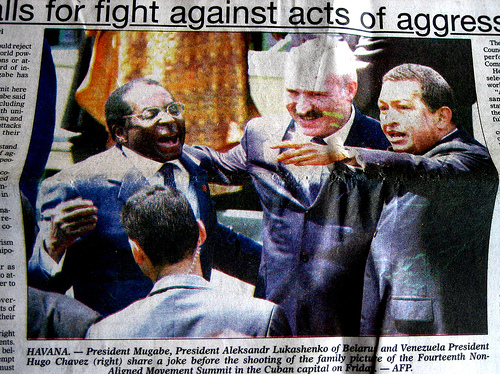
“Detail from the Sunday Mail in Zimbabwe - Mugabe, Lukashenko and Chavez share a laugh at the summit of non-aligned nations.”
Via Ethan Zukerman
Highly recommended – The Ludicrous Nature of Politics from Russell Roberts
Related
Demonization at the UN
President blasts ‘stupid democracy’ (Zimbabwe)
Stopping the dictator- a game from an Egyptian blogger
Maldives
The President addresses UN General Assembly in Dhivehi
This is how the Mr. Gayoom was welcomed in the country
September 19, 2006
Hungarians not happy with their leader

Hungarian Prime Minister admits he lied during the election campaign in a private conversation- at least he’s honest;
“You cannot mention any significant government measures that we can be proud of, apart from the fact that in the end we managed to get governance out of the shit. Nothing. If we have to give an account to the country of what we have done in four years, what are we going to say? …Divine providence, the abundance of cash in the world economy, and hundreds of tricks, which you do not have to be aware of publicly, have helped us to survive this. This cannot go on. Cannot. And of course we can ponder for a long time, and a shitload of analyses can be carried out as to how each social group will be affected, this is what I can say to you. ….
Even if we work ourselves into the ground. We are doing a great and decent job among ourselves. We must do it. I am not talking about the New Hungary, developments, Hungarians beyond the border, relationship with churches, or another thousand things because these are not the most important things compared to the big picture…I will only repeat this once at most: it is fantastic to be in politics. Fantastic. It is fantastic to run a country. Personally, I have been able to go through the past 18 months because one thing has inspired and fuelled me: to give back its faith to the left, that it can do it and it can win. That the left does not have to lower its head in this bloody country. That it does not have to shit its pants from Viktor Orban [chairman of opposition Fidesz - Hungarian Civic Alliance] or the right, and it should learn to measure itself against the world, rather than them...
I know that this is easy for me to say. I know. Do not keep bringing it up against me. But this is the only reason it is worth doing it. I almost perished because I had to pretend for 18 months that we were governing...Instead, we lied morning, noon and night. I do not want to carry on with this. Either we do it and have the personnel for it, or others will do it. I will never give an interview at the end of which we part with each other in argument. Never. I will never hurt the Hungarian left. Never.”
Related;
Google News coverage
Timeline: Hungary
Does transition make you happy?
Colbert Episode on Hungarian Bridge-hilarious
Ideological Amplification
From Cass Sunstein, an interesting study;
“A few years ago, I was involved in some studies that uncovered a funny fact: When Republican-appointed judges sit on three-judge panels with other Republican appointees, they show unusually conservative voting patterns. So too, Democratic-appointed judges on three-judge panels show especially liberal voting patterns when sitting with fellow Democratic appointees. In short, like-minded judges show a pattern if "ideological amplification."The presence of even one Republican appointee often makes Democratic appointees much more moderate. Republican appointees often become much more moderate when even a single Democratic appointee is there.
We now know that ideological amplification is pervasive on federal courts--that it can be found in numerous areas, including sex discrimination, affirmative action, campaign finance law, disability discrimination, environmental law, labor law, and voting rights.
It turns out that ideological amplification occurs in many domains. It helps to explain "political correctness" on college campuses--and within the Bush administration. In a recent study, we find that liberals in Colorado, after talking to one another, move significantly to the left on affirmative action, global warming, and civil unions for same-sex couples. On those same three issues, conservatives, after talking to each other, move significantly to the right.
It's unclear whether anything can be done about ideological amplification. But it's entirely clear that when private organizations and governments blunder, ideological amplification is often the culprit.”
Related;
Watch his book presentation at AEI-Brookings; Infotopia: How Many Minds Produce Knowledge
Deliberation and Infotopia
Ideological amplification
Religion in America

“God told me to strike at al Qaida and I struck them, and then he instructed me to strike at Saddam, which I did, and now I am determined to solve the problem in the Middle East.”
- President Bush according Palestinian President Mahmoud Abbas
“Education on world religions for all our children, in public and private schools, and home schooling.”
-Daniel C. Dennett’s policy proposal (see TED speech below)
The Economist reviews a recent survey of religious attitudes in US;
“WHEN Homer Simpson opted out of church once, staying home to watch football and eat waffle-batter, he dreamed that God peeled off the roof of his house and appeared, furious, in the TV room. According to a new survey, 31% of Americans see God that way. He (always he) is wrathful and ever-watchful; He wants his followers to stop sinning, and thinks government should be promoting Him. In the South, 44% of people go in fear of His lightning bolts.The survey, by Baylor University's Institute for Studies of Religion in Waco, Texas, via Gallup, found four broad views of God in America. Homer's Authoritarian God is the most popular. There then follow, in descending order of intrusiveness, Benevolent God (23%, rising to 29% in the Midwest), who still gives orders but will forgive, rather than smite; Critical God (16%, but 21% in the relativist East), who watches the world but does not intervene; and lastly Distant God (24%), a cosmic force without interest in human matters. This God is especially popular in the wide open West, with its huge views of the stars…”
Related;
Jesus Camp
ABC news report on the documentary
The Anti-Christ Part 1, Part 2, Part 3, Part 4 (History Channel)
See also Rick Warren speech and Daniel Dennet’s response
Podcasts from Center of Inquiry
September 15, 2006
History Podcasts
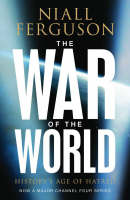
Harvard historian Niall Ferguson discusses his book "The War of the World: 20th Century Conflict and the Descent of the West"- (Sep 12, 2006 at Vanderbilt University). Listen to the podcast.
Some article by Niall- ‘The Next War of the World’, The origins of the Great War of 2007 - and how it could have been prevented, Tomorrow's world war today. See also SHORTER NIALL FERGUSON: IF WE DON'T ATTACK IRAN, THERE'LL BE NUCLEAR WAR
A panel discussion of the recent and historical conflict between Israel and Hezbollah, its effects on Lebanon and its implications for U.S. policy. Featuring Fawaz A. Gerges, professor of International and Middle Eastern Studies, Sarah Lawrence College, Michael Eisenstadt, The Washington Institute for Near East Policy, moderated by Larry P. Goodson, professor of Middle East studies, United States Army War College. Listen to the podcast.
The Wonga Coup
For more detail see this post at Pienso.
Sri Lanka; With violence once again erupting in Sri Lanka, Rear Vision traces the historical roots of the conflict. Guests include Jonathan Spencer, Professor of Anthropology of South Asia , University of Edinburgh, Dr. Jayadeva Uyangoda, Professor and Head, Department of Political Science and Public Policy, University of Colombo and Dr. Paikiasothy Saravanamuttu, Executive Director of the Centre for Policy Alternatives, an independent, nonpartisan, public policy centre with a focus on peace and governance, Colombo
Keeping the peace: the U.N. Security Council; The United Nations Security Council has finally brokered a cease-fire in Lebanon. On Rear Vision this week, a history of the UN's most powerful body.
Guests include Rosemary Righter, Associate Editor, The Times, Ian Williams, UN correspondent , The Nation, Colin Keating, Executive Director, Security Council Report, Former New Zealand UN Ambassador
See also ‘Security Council Report’ will publish, on a regular monthly basis, independent and objective information and analysis about the United Nations Security Council and the issues on its existing and future agendas.
See also this debate from BBC-to mark the end of Radio 4's This Sceptred Isle: Empire series, some of this country's best-known historians will be examining how Britain and other countries around the world have been changed by their experience of empire. They'll be discussing whether Britain should apologise and make reparation for its imperial past or glory in it, and asking whether the twenty-first century will see the birth of new empires. Eric Hobsbawm, Niall Ferguson, Robert Beckford, Linda Colley and Priya Gopal. (the program is available online)
September 14, 2006
The coming clash of China and India
China has been recently courting the countries of South Asia;
“According to a report this year by Dr. Mohan Malik, professor at the Asia-Pacific Center for Security Studies in Hawaii, ‘Beijing is skillfully employing economic and military means to draw Bhutan, Bangladesh, Nepal, Maldives and Sri Lanka into China's orbit.’‘Beijing's main objectives are said to be access to raw materials, commodities, natural resources and access to South Asian markets for Chinese goods and to expand China's influence in the region. However, China's support for India's smaller neighbours suggests that gaining access to markets and natural resources is not the only reason behind Beijing's South Asia policy: Beijing also wants to make a point on the limits of Indian power,’ he adds.
''In fact, aiding "India-wary" countries in South Asia to "concircle" (contain and encircle) India has long been an integral part of China's strategic calculus. As a rising maritime trading power, Beijing is also seeking once again to project force into the Indian Ocean in the manner of the fleets sent out under the command of Admiral Zheng He nearly 600 years ago during the Ming Dynasty,'' Malik concludes.”
Related;
China's top advisor meets Maldivian president
American and Yugoslav to be deported
Work to commence on new museum funded by the Chinese
A recent episode Foreign Exchange;
“China is modernizing economically; that no one denies. But there is a great debate about whether that economic modernization is leading to political change. Is China reforming its political system? To discuss this issue we’re joined by Hongying Wang, who is a Fellow at the Woodrow Wilson International Center and also at the Maxwell School at Syracuse University. Let me ask you; a statistic that is often bandied about, 87,000 protests in China last year compared with 10,000 ten years ago--what does this mean? Is it the sign of political unrest that some are reading it to be?”
September 10, 2006
Will Internet bring democracy to the Arabs?

Kuwait’s Annus Mirabilis, an interesting article on Kuwaiti political developments;
“Like the orange-clad protesters, candidates sent reams of text messages, using lists of cell phone numbers generated from records of attendees asked to sign in at events. Some messages, featuring rumor and gossip, were campaign tricks designed to make another candidate look bad. Most focused on thanking the recipient for his or her support and offered information about the candidate’s next event.Blogs were a more important innovation. Voters could read some of the more sensational blog postings in daily newspapers. The Orange Movement leadership maintains a blog originating in the United States, managed jointly by overseas Kuwaiti students and one of the Orange organizers. This blog, KuwaitJunior, provided running news and commentary during the emiri transition in January 2006. During the campaign, it brought electoral corruption into the public eye thanks to a posting by a woman who recounted how two men in Rula Dashti’s district had attempted to buy her vote with the promise of a Chanel handbag. Although she did not mention the candidate’s name, it soon became public knowledge that she was speaking of Jamal al-‘Umar. The Orange leadership investigated this allegation by dispatching an undercover member, armed with a small video camera, to negotiate with the vote buyers. The camera failed, but the agent managed to capture pictures and voices on her cell phone. Then four young men who were not Orange organizers decided to challenge al-‘Umar during an event at his tent in Jabriyya southeast of Kuwait City. They asked him to explain why people were buying votes on his behalf if he was innocent of corruption as he claimed. The youths were roughed up and thrown out by the candidate’s assistants and, adding insult to injury, the Jabriyya police refused to accept their assault complaint. The worst part of the story came at the end, when al-‘Umar came in second, thereby winning a seat in the 2006 parliament….
All of which brings us back to democracy and Kuwait’s year full of miracles. As political scientist Eleanor Doumato has observed, women’s rights in the Arab Gulf states are the gift of monarchs, not parliaments. This is certainly the case in Kuwait, where opinion polls taken before the electoral law was changed in May 2005 showed a discouraging lack of support for female candidates, although more for female voters. The role of democracy in the 2006 election should be considered in broader terms than that, however. That there was an election at all was even more indicative of expectations that a democratic process should -- and did -- exist in Kuwait. The demonstrations that helped bring down the government were non-violent, as was virtually all of the official response to them. The new emir may have acted precipitously in canceling the parliamentary session and calling a new election -- and the speaker of the parliament later excoriated this decision publicly as unnecessarily confrontational. Yet only 20 years ago, a Kuwaiti emir dissolved a parliament and did not call for a new election until invasion, war and liberation made it impossible for him to continue resisting demands for the restoration of constitutional life.These demands came from Kuwaitis, through a long and occasionally frightening period when street demonstrations were met with more than the possibly accidental injury of one person by a policeman’s baton. The pro-democracy movement of 1989-1990 saw more widespread beating of demonstrators, along with the desecration of a mosque by tear gas and police dogs, and the arrest of more than a dozen prominent dissidents. Demands for reform came from outside, too, not only from exiles abroad during the Iraqi occupation, but also from countries that, having sent troops to liberate Kuwait, expected its leaders to behave better than the ousted invader. Despite clerical and even popular criticism, after liberation foreign ambassadors and NGOs pressed for women’s rights, protection for stateless persons, better treatment of maids and other foreign workers, and structural changes to open Kuwait’s economy and political system. That each of these causes was also advocated by Kuwaitis does not diminish the usefulness of external support from those whose good opinion Kuwaiti leaders value. Such external advocacy is not only an additional check on backsliding toward a more authoritarian past, but is also evidence that other governments support democratization in the Middle East.
Jamie Meyerfeld, writing in support of the International Criminal Court, emphasizes the role of external checks to support democracy. “Like Ulysses tied to the mast…democracies steel themselves against future unwise temptations…. It is astonishing that [102] countries have voluntarily agreed to make their own leaders vulnerable to prosecution and punishment before an international court.” Similarly, international observers add to the checks exercised by national constituents of governments. These national watchers are more important, of course, but a little encouragement from outside can reinforce their efforts to build democratic institutions, and discourage governments impatient with the noisy demands of democratic politics from shutting those institutions down. If the international community were serious about democratization, no pillar of authoritarianism would fall without an attentive audience listening for the crash.”
Via Abu Aardvark
Related;
Young Kuwaitis turn ‘Orange’
Kuwaiti women one step away from their political rights
Kuwait and democracy in the Gulf;
“Kuwait is hardly a model of democracy either—at least, not yet. Its head of state is hereditary, and he appoints the 15-person cabinet. Typically, half its ministers are members of the ruling Al Sabah family. All have voting rights in the parliament. This raises the number of legislators from the 50 elected MPs to 65, and raises the bar for winning a vote against the government. Yet the parliament does have the right to embarrass ministers with tricky questions. It can rely on the Arab world's freest press to air grievances, too, though in this small, hyper-rich state with barely 1m citizens among its 2.3m residents, word of scandal gets around anyway. In January, it won greater legitimacy when it endorsed the removal of the ailing crown prince, only a few weeks after the death of the previous emir, and his replacement by an abler man.”
Can Iraq Make It?
Why America gives Israel its unconditional support
Moody's warns of risk for Gulf banks
Multimedia;
Illusion and Reality in the Middle East-A Discussion of American Strategy Regarding Iran, Syria, and the Greater Middle East (podcast from New America Foundation)
Is Dubai the new model for the Middle-East?
Obituary: Egyptian Nobel Laureate writer Naguib Mahfouz
Balancing freedom against security

Dahlia Lithwick reviews Posner’s new book;
“That is why Judge Richard Posner is such a welcome voice in the national conversation about balancing freedom against security. Posner, the brilliant and prolific federal appeals court judge, is renowned—and not always in a good way—for putting a price tag on everything. But whatever quibbles liberals may have with his law-and-economics approach to anything from rape to unwanted babies, they should celebrate the intellectual rigor he brings to the problem of civil liberties in wartime. In his new book, Not a Suicide Pact: The Constitution in a Time of National Emergency, Judge Posner approaches the wartime civil-liberties problem in precisely the manner the Bush administration will not: with a meticulous, usually dispassionate, weighing of what is gained against what is lost each time the government engages in data-mining, indefinite detentions, or the suppression of free speech…What Posner offers is the suggestion that careful balancing of liberties lost against security gained is a better alternative than the current regime that recognizes no cost to freedoms lost and no accountability for security achieved. By virtue of this careful balancing, Posner even criticizes a few Bush administration decisions. He questions, for instance, the decision to suspend the right to habeas corpus of U.S. citizens or foreign terrorists captured in the United States because he deems the cost of indefinite detention to exceed the gain in public safety.”
Related;
The Constitution is not a suicide pact
The Glenn & Helen Show: Richard Posner on Terrorism and the Constitution
Judge Posner interview Charlies Rose
September 9, 2006
Thought of the Day- Political Dresses

Source- The Good magazine
Related;
Open Secrets- your guide to money in politics
Decision '06
August 6, 2006
Peak Oil Theory of the war on Lebanon
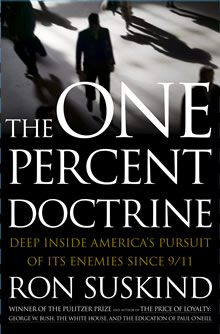 Juan Cole tries a ‘thought experiment’ to explain the US support for the Israeli war on Lebanon;
“I've had a message from a European reader that leads me to consider a Peak Oil Theory of the US-Israeli war on Lebanon (and by proxy on Iran). I say, "consider" the "theory" because this is a thought experiment. I put it on the table to see if it can be knocked down, the way you would preliminary hypotheses in a science experiment…The regime in Iran has not gone away despite decades of hostility toward it by Washington, and despite the latter's policy of "containment." As a result, US petroleum corporations are denied significant opportunities for investment in the Iranian petroleum sector. Worse, Iran has made a big energy deal with China and is negotiating with India. As those two countries emerge as the superpowers of the 21st century, they will attempt to lock up Gulf petroleum and gas in proprietary contracts.
(Since it is already coming up in the comments, I should note that the "fungibility" (easy exchange) of oil is less important in the new environment than it used to be. US petroleum companies would like to go back to actually owning fields in the Middle East, since there are big profits to be made if you get to decide when you take it out of the ground. As Chinese and Indian competition for the increasingly scarce resource heats up, exclusive contracts will be struck. When I floated the fungibility of petroleum as a reason for which the Iraq War could not be only about oil, at a talk at Columbia's Earth Institute last year, Jeffrey Sachs surprised me by disagreeing with me. In our new environment, oil is becoming a commodity over which it really does make sense to fight for control.)…
In a worst case scenario, Washington would like to retain the option of military action against Iran, so as to gain access to its resources and deny them to rivals. If Iran gets a nuclear weapon, however, that option will be foreclosed. Iran may not be trying for a weapon, and if it is, it could not get one before about 2016. But if it had a nuclear weapon, it would be off limits to US attack, and its anti-American regime could not only lock up Iranian gas and oil for the rest of the century by making sweetheart deals with China. It also might begin to exercise a sway over the small energy-producing countries of the Middle East. (The oil interest would explain the mystery of why Washington just does not care that Pakistan has the Bomb; Pakistan has nothing Washington wants and so there was no need to preserve the military option in its regard.)…
Even an Iranian nuke, of course, would not be an immediate threat to the US, in the absence of ICBMs. But the major US ally in the Middle East, Israel, would be vulnerable to a retaliatory Iranian strike if the US took military action against Iran in order to overthrow the regime and gain the proprietary deals for themselves.In the short term, Iran was protected by another ace in the hole. It had a client in the Levant, Lebanon's Hizbullah, and had given it a few silkworm rockets, which could theoretically hit Israeli nuclear and chemical facilities. Hizbullah increasingly organizes the Lebanese Shiites, and the Lebanese Shiites will in the next ten to twenty years emerge as a majority in Lebanon, giving Iran a commercial hub on the Mediterranean.
China and India could get Iran, and Iran could get Lebanon, and as non-OPEC energy production decreases, the US and Israel could find themselves out in the cold on the energy front….
It may be that that hawks are thinking this way: Destroy Lebanon, and destroy Hizbullah, and you reduce Iran's strategic depth. Destroy the Iranian nuclear program and you leave it helpless and vulnerable to having done to it what the Israelis did to Lebanon. You leave it vulnerable to regime change, and a dragooning of Iran back into the US sphere of influence, denying it to China and assuring its 500 tcf of natural gas to US corporations. You also politically reorient the entire Gulf, with both Saddam and Khamenei gone, toward the United States. Voila, you avoid peak oil problems in the US until a technological fix can be found, and you avoid a situation where China and India have special access to Iran and the Gulf.
The second American Century ensues. The "New Middle East" means the "American Middle East."
And it all starts with the destruction of Lebanon.
More wars to come, in this scenario, since hitting Lebanon was like hitting a politician's bodyguard. You don't kill a bodyguard just to kill the bodyguard. It is phase I of a bigger operation….”
Related;
Colbert on One Percent Doctrine
May 20, 2006
All You Need is Mill!
 “The object of this Essay is to assert one very simple principle, as entitled to govern absolutely the dealings of society with the individual in the way of compulsion and control, whether the means used be physical force in the form of legal penalties, or the moral coercion of public opinion. That principle is, that the sole end for which mankind are warranted, individually or collectively, in interfering with the liberty of action of any of their number, is self-protection. That the only purpose for which power can be rightfully exercised over any member of a civilized community, against his will, is to prevent harm to others. His own good, either physical or moral, is not a sufficient warrant. He cannot rightfully be compelled to do or forbear because it will be better for him to do so, because it will make him happier, because, in the opinions of others, to do so would be wise, or even right. These are good reasons for remonstrating with him, or reasoning with him, or persuading him, or entreating him, but not for compelling him, or visiting him with any evil in case he do otherwise. To justify that, the conduct from which it is desired to deter him, must be calculated to produce evil to some one else. The only part of the conduct of any one, for which he is amenable to society, is that which concerns others. In the part which merely concerns himself, his independence is, of right, absolute. Over himself, over his own body and mind, the individual is sovereign.”
John Stuart Mill, On Liberty
The Catallarchy is running Mill-Fest, on his 200th birthday anniversary.
Mill was the Thomas Friedman of the nineteenth century in his ability to coin a telling phrase;
“He was an early master of the soundbite: "Better to be a human being dissatisfied than a pig satisfied; better to be Socrates dissatisfied than a fool satisfied"; "There remain no legal slaves except the mistress of every house"; England is "the ballast of Europe, France its sail"; and, of course, "I never meant to say that the Conservatives are generally stupid. I meant to say that stupid people are generally Conservative” ….
How did he come to acquire this status? Like most public intellectuals, he had one breakthrough book that brought him to wide attention. He did not expect his "scholastic" System of Logic, published in 1843, to sell very well. In fact, it sold out within a few weeks, becoming the standard text at both Oxford and Cambridge and retaining canonical status for most of the rest of the century. Mill's success rested on three factors. First, he wrote clearly and attractively. Second, he managed to attract liberal opinion without provoking too much opposition from the church, by simply putting to one side questions of supernatural power. Third, he appealed to the Romantics by giving poetry and art a vital role in establishing many of the goals for human improvement while remaining firmly on the side of reason and science against "intuitionism"—the idea that certain truths are known a priori without any need for experimental proof.
Mill used his new status as the brain of liberal Britain to beat away at the complacency of the ruling class in the face of the tragedy of the Irish famine. In 1846 he wrote 52 newspaper articles—39 of them headed "The Condition of Ireland." For Mill, the Irish situation was "the most unqualified instance of signal failure which the practical genius of the English people has exhibited." He tore into schemes to promote emigration, compensate landlords, or offer paltry amounts of poor relief to starving peasants. Redistribution of common land was the only solution to Ireland's problems. And he boiled over at Victoria's proclamation of a day of devout fasting as a "piece of empty mummery… on the occasion of a public calamity."
For someone who never went to university but devoting his life to self-education while working at India Office, he’s a remarkable gentleman.
Related Links:
Blogs covering Mill’s birthday; Stumbling and Mumbling, Mathew Mullins, Joseph Miller, Mises Economic Blog
Editorials at WSJ and Prospect Magazine
Briefs on Libertarian Theories of Law and Utilitarianism
Contributions of James Mill (JS Mill’s father); podcast of Rothbard
Earlier post on JS Mill
February 24, 2006
Quote of the Day, but not in a good way
Or, contra a regular MR feature, the worst paragraph I've read today:
So in an axiomatic system (first devised by the ancient Greeks, in particular Euclid), we begin with a few (the fewer the better) axioms, which are supposed to be intuitively obvious, and then proceed onward to prove whatever follows from these axioms. (The fewer the better, because we want to keep our appeals to intuition to a minimum to maximize certainty.) In place of a libertarian policy of "let's-just-depend-on-the-good-intentions- (intuitions)-of-citizens-(mathematicians)-to-do-the-right-thing," the axiomatic system imposes some strict governmental controls. In place of random appeas to intuitions, there is to be general consensus on what is directly given, the bedrock, with everything else subjected to systematic rule-regulation. You can think of axiomatization as sort of "big government mathematics." [Emphasis mine.] From Incompleteness: The Proof and Paradox of Kurt Gödel, Rebecca Goldstein, p. 128.
Proving, I suppose, that some things just cannot be repeated often enough. Perhaps if it read "It is not from the benevolence of the mathematician, the logician, or the philosopher..." And as for the appelation of "libertarian" in this at all, well, Mr. Montoya sums up my response quite nicely.
This does not really detract, however, from a generally compelling book on Gödel's life and work. I've recently read a number of the "Great Discovery" series and find that I enjoy them quite a bit. The writers Norton has tapped for the books do an admirable job of blending a popularization of sometimes very difficult concepts, a good deal of biographical content to flavor the work with some humanity, and situating the discoveries in a (granted, brief) historical foundation. So far, however, David Foster Wallace's Everything and More has been the most engaging. Unfortunately, The Man Who Knew Too Much was largely disappointing.
January 31, 2006
Google Following the Footsteps of Wal-Mart???
In the context of the Google pile-on, James DeLong notes that many in the US have turned turned against Wal-Mart, but he fails to note whether many Chinese have done so...
That's not unusual, since most US coverage of Wal-Mart in China focuses on Wal-Mart sourcing goods there. But WM also has 45 stores in China, and it is this presence -- and the approval by the Chinese government that was needed to make it happen -- that Google critics seem not to have noticed.
For instance, Mr. Kessler writes:
Users in the West may not desert them, but a billion soon-to-be-online Chinese will forever associate Google with lame and censored search results - tools of the state. That just dumb. And totally uncool.
Uncool, yes. Uninspiring, yes. Unexpected, no.
Wal-Mart never had Google's street cred among the Western elite, and I have no idea about its image in China. But I think that it's still important to ask, does Wal-Mart China stock and sell books by Chinese dissidents? Books about the occupation of Tibet? The nature of Falun Gong? Do you think you can find a book with this photo in it? Maybe, -- I don't know since I have never been in a WM China store -- though I highly doubt it, and I will assume that Wal-Mart is engaging in censorship (by just not supplying specific goods) at the behest of the Chinese government.

This leads ot a more important question: since Wal-Mart China is already censoring information available in its stores, do the Chinese people consider Wal-Mart a tool of the Chinese state? Or is it just a decent place to work and shop? I don't know the answer to these questions, but I would insist that the Chinese people are not stupid or inconsistent: why should Google be judged harsher than Wal-mart for acting in the same exact way?
Note: I am making ASSUMPTIONS here, and will gladly rewrite this post in light of hard evidence.
November 7, 2005
West Wing Economics
 If you didn't catch the live presidential debate on the West Wing last night, the you missed a once in a lifetime opportunity to see an open debate with no ground rules, except the script of course. Actually, except for a couple of scripted pauses and audience interruptions, the debate was lively and believable. It would be interesting to experience an honest and open debate between two modern day candidates, but it is unlikely.
Although scripted, the debate included a terrific pro-free market response from Alan Alda's character (a lifelong Democrat playing a Republican character); a response to proposed alternative energy plans to reduce dependence on foreign oil and nuclear power.
I don't trust politicians to choose the right new energy sources. I believe in the free market. You know the government didn't switch us from whale oil to the oil found under the ground, the market did that.The government did not make the Prius the hotest selling car in Hollywood, that was the market that did that. You know, in LA now, the coolest thing you can drive is a hybrid. Well, if the free market can do that in the most car crazed culture on earth, then I trust the free market to solve our energy problems. You know the market has the power to change the way we think; to change what we want. The government can't do that. That is why the market has always been a better problem solver than the government, and it always will be.View Clip (WMV, 204K, 70 secs.)
Wether you agree or disagree with the politics, it is good to see sound economic theory making its way into television scripts.
[KB adds: Neither T&B or its members are receiving advertising revenue from the image -- or the link -- at left. And yes, I find a Republican Alan Alda very, very amusing.]
October 27, 2005
The Revolution Will Be Digitized
So, this isn't exactly what I was thinking about before, but it is interesting. Turns out a former revolutionary from Serbia is building a video game that will help train people in non-violent methods for political revolution.
"You have to worry about your organization," he continued. "Do you set up a hierarchal organization, or a cell-based one? Who is the best figurehead for the media? What kind of training do people need? And if you march on the capital without proper controls, things may turn violent, which will harm your cause. These are the things people can learn.""You can have a 'what if' approach," Marovic said. "Play the same game several times, but try different things every time. You can't do that with books. This interaction makes a player spend more time with a game than with a movie. Weeks, instead of hours."
I wonder if you get to set things like tax rates and the opportunity cost of social unrest? This seems like a compelling first step. The skeptic in me, however, can't refrain from mentioning that the entire game is being built by one "side". First-hand experience gives them insight into the actual life of the oppressed, but I tend to think that the simulation would be a lot more useful if the other side of the equation (the ruling elite) were in fact played by actual people looking to keep hold of their power.
And if it comes to XBox Live, I'm immediately putting KD4r0nAc3m0glu on my friends list.
September 26, 2005
Mr. President, Mind Your Own Business
I do not appreciate the President telling me how or how much to sacrifice in response to a regional natural disaster. I will not play a game of "pretend" so that he may play "good steward" in front of the national press:
Two other points I want to make is, one, we can all pitch in by using -- by being better conservers of energy. I mean, people just need to recognize that the storms have caused disruption and that if they're able to maybe not drive when they -- on a trip that's not essential, that would helpful. The federal government can help, and I've directed the federal agencies nationwide -- and here's some ways we can help. We can curtail nonessential travel. If it makes sense for the citizen out there to curtail nonessential travel, it darn sure makes sense for federal employees. We can encourage employees to carpool or use mass transit. And we can shift peak electricity use to off-peak hours. There's ways for the federal government to lead when it comes to conservation.Mr. President, I'm glad you're temporarily easing regulatory restrictions to reduce bottlenecks, and show a desire for greater refining capacity. But I have a few questions:
First, I'd like to know why it takes a disaster for politicians to realize that protecting existing refineries from competition has a real cost. If we need refining capacity now, then we needed it last year. Why isn't that capacity in place today?
Second, I'd like to know just why I should conserve. We supposedly live in a capitalist society based on property-rights and free-trade; why, all of a sudden, do you ask that I not trust that the price of fuel incorporates all the scarcities at every level of production? What economic lever broke in the past month? Why do you think the price system is failing so bad that we need to "conserve" more than the price signal warrants?
I won't pretend that market prices don't exist, or that markets have suddenly stopped working; I won't pretend that prices are inefficient allocators of resources; I won't pretend that I cannot buy as much gasoline as I can afford at current prices.
Furthermore, Mr. President, I will not pretend that you have legal or moral authority to tell me how much gasoline I may purchase. I will not pretend that your feeble call to use less has any impact whatsoever on my psyche. I will not pretend that the Federal Government knows better than me how much gasoline I should purchase.
In addition, you will be horrified to note that I will not pretend that $3 a gallon gasoline affects my personal driving habits. That's because at my personal margin, it doesn't. I drive 5000 miles a year, and my car gets 30 mpg, meaning I now pay about 10 cents a mile for gasoline to drive, for a total of $500 a year. This is not too much higher than the 6.7 cents ($333) I was paying when gasoline was $2 a gallon. That's about 50 cents a day more than before. I will not change my driving habits for 50 cents a day. I will not pretend that I am driving a Hummer.
I will buy as much gasoline as Sunoco and Exxon and Coastal are willing to supply me at market rates; and there's no reason for me to conserve any more than their prices tell me I should. It doesn't make sense for this citizen to curtail travel, so maybe it doesn't make sense for federal employees to curtail travel either...
A few more questions: How much gasoline do your advisors think will be saved by your plea to conserve? How will that affect prices? How many votes will you gain from a conservation stance? Do you really believe this stuff?
I'd say that it's time your government got out of my gas tank, and kept to minding its own business.
August 2, 2005
Diplomatic Barter: The value of reality
I will pose the question first, then give you the background below.
Question: How do countries decide to go to war? What role do economics play in choosing to pursue military action?
Please share your thoughts! I know we have intelligent readers and I would love to know what you have surmised on this issue.
I have begun reading Conflict After the Cold War: Arguments on Causes of War and Peace by Richard K. Betts (an assigned class reading). Richard Betts is a long time fixture of U.S. foreign relations and is now a professor at Columbia. In his book, Betts proposes to collect the great prose regarding war and peace in an effort to search for global stability. So far, I have been quite disappointed. Betts is a realist, and as such he has begun his book with an obvious bent toward his fellow theorists and through the first 200 pages he ignores liberal ideals and economic theory almost entirely. The next section is titled "Economics: Interests and Interdependence" so there may be hope yet.
Two of the early featured authors are John Mearsheimer and Geoffery Blainey; both are realists, and therefore focus on the balance of power dynamic between nations. Mearsheimer completely ignores the economics, and therefore the decision science, of war, going so far as to reject it when he wrote, "... the main assumption underpinning [liberal economics] is wrong. States are not primarily motivated by the desire to achieve prosperity (Betts 26)." The bulk or Mearsheimer's argument is that a state of bipolarity, with two major powers of equal military might, is the most stable global power configuration.
Blainey is more open minded, after reading his article, I see room for integrating economic theory. Blainey's primary argument lies in that war is the last resort of failed diplomacy. In other terms, Blainey examines the diplomatic process as a barter transaction and he sees war as the final action when double coincidence of wants does not occur. Much as in a barter transaction between a pedestrian and a mugger might go.
Mugger: Give me your wallet and your watch!Pedestrian: My wallet and my watch are quite valuable. What do you offer in barter for my property?
Mugger: I hate mugging economists, I've got to stop prowling George Mason University! I offer you your life in exchange for your property.
Pedestrian: Your terms are not reasonable. I think that I have more might than you do, I choose the tools of war to settle this transaction.
Mugger: Damn, you called my bluff. I'm just a political science major using this street corner as a political science lab, since we cannot otherwise test our hypotheses in real life. Thank you for your participation.
The more subtle aspect of Blainey's argument is that in order for war to occur, both parties must disagree about the military strength of the other party and believe the costs of war will be less than the payoff for winning. As you can see, the mugger and the pedestrian disagree, but they do not both want war.
Blainey does not however come right out and recognize our economic tools in this article. He merely leaves room for insertion of cost & benefit analysis, game theory and economic value. Most other authors in this book have so far dismissed economics as well. Franco Fornari writes, "...economic, political, ideological factors are specifically generators of conflicts but are not specific factors of war." In other words, countries might disagree over economics, but they don't go to war because of economics.
Primarily, these author's either assume economics is only the study transactions involving money, or they reject the idea of competition for resources in general and just assume that power hungry nations always choose war if they have enough power to do so.
As a student of economics, I am convinced that these authors are missing the boat. I realize my bias is present in assuming that economics can help to explain, well, basically everything, but certainly war.
I will be happy to share more thoughts on war as this class will continue for a few more weeks.
If you are interested in more on this topic, you may read the whole paper: The Value of Reality (PDF).
March 16, 2005
Closer to Drilling in ANWR
Well, that was close: 51-49.
"This is more than a battle over the wildlife refuge," Mr. Kerry said in a statement. "It's a battle over two very different visions of our energy future. The president has a plan to sell off our public lands to the special interests that his own scientists and economists admit will not make us less dependent on foreign oil and will not lower prices at the pump."Mr. Kerry is right. Oil is a special interest. So are the environmental groups. So? ANWR drilling will not make America more or less dependent on foreign oil, and will not raise or lower gasoline prices. But it will give a quite a load of money to Alaskans.
Of course, all these informative points are really, really besides the useful (political power) point, which is that it seems the oil interests have bought off enough politicos to actually make this happen.
I'd like to know how much of this rent seeking is social cost versus pure transfer to politicians...
January 10, 2005
AAFRP
Many nonprofit organizations have special chapters for children. But as far as I can tell, AARP doesn't. As flush with cash as they are, they could have websites, literature, and meetings for children grandchildren to teach them all about the benefits of pro-elderly activism.
But the parents of these children are likely to be younger and working; they are definitely not of one mind regarding the policies AARP would like to see enacted or maintained. In fact, the median view of this younger group is likely opposite to many policies AARP lobbies heavily for.
Of course, the AARP openly discriminates against the young--i.e. those who are younger than 50. They can be members, but only "associate members" who get no benefits, and only if they "support the association's goals and objectives", which in the libertarian view are evil..
How can one effectively oppose this goliath?
What if the 87.5% of the U.S. population not in AARP formed an association to further their own interests. This organization would discriminate against those older than 50--call it the American Association of Future Retired Persons, or AAFRP. It would profit and lobby like the AARP; it would solve shirking and collective action problems in the same way that AARP does, by jointly producing activism and selling personal services.
I'm not certain that another tremendously powerful lobbying organization--even one that opposes AARP--is something that would work out well in the long run. In particular, time would put an AAFRP at a clear disadvantage to AARP, since every member of AAFRP would eventually be eligible for AARP... Given the relative rise in the retiree/worker ratio, maybe a feeder organization is not such a good idea.
December 22, 2004
More Mankiw?
Scott Beaulier, guest blooging at Common Knowledge, writes that the administration should let Gregory Mankiw have a more prominent voice:
Mankiw's argument for outsourcing and his jobs projection became the leading news story on major television networks and the source of many attacks... when economic issues were in play during the election year, finding Mankiw was like trying to find Waldo.Brad DeLong seems to like the new non-arithmetically challenged Greg Mankiw too.Even though Mankiw's disappearance might have made political sense, he could end up being right on both points...
He's the best economist in the administration and the most ardent defender of globalization in the bunch. By being close to the mark on his jobs projections, perhaps he'll be allowed to talk about outsourcing again in the future.
In any event, now that the election is out of the way and Bush is seeking to use up some of his political capital, let's hope that he brings one of the more reasonable voices in the administration back into the mix on issues of economic policy and trade.
Still, it seems to me Mankiw can discuss outsourcing all he wants after the President asks him to resign. The rumor is that Mankiw is leaving next year because he wants to return to Harvard. However, M. is keeping mum...
December 14, 2004
Scott Peterson Gets Death
I do not like the death penalty, even when applied to men like this, because I believe in minimizing the power of government.
I do not want the government to have the right (legitimate power) to kill a citizen for even heinous crimes, because of the potential for its killing the wrong person accidentally, or the intentional use against political enemies. Given my ethical predisposition, I am sympathetic to arguments that the death penalty costs more than incarceration for life.
And as it currently imposed in various states, I think the death penalty does cost more than it saves--in purely financial terms. However, the economic arguments that "the death penalty" costs more than "life in prison" usually rest on several very specious assumptions--the most important being that if the total cost of the death penalty is greater than its total benefit, then the costs of any and every execution are greater than its benefits.
But this is not necessarily so. It is most certainly not true that the cost and benefit of each and every particular execution are the same; because of protracted legal battles, some executions are more costly than the average. And because some defendants are younger and healthier than others, executing them will have greater benefits in reduced lifetime prison costs.
Hence, there may be some subset of executions with low costs and high benefits--which could be termed economically advantageous executions.
However, the policy debate is usually considered a yes-no question--you're either for execution as a rule or you're against it. But the universe of policy choices--overarching rules--is much wider than that. In addition to "yes" and "no", one could support "extremely selective execution"--a raising of the legal and economic bar exteremely high so that only the most depraved and absolutely guilty qualify for execution.
I've written about this before (but I can't remember where or when), after I had read most of the major studies linked to by anti-death penalty advocates demonstrating that total costs > total benefits. However, Google has no record of these comments, and they seem to have disappeared forever into the electronic void...
November 29, 2004
Gramm
Robert Novak is reporting in his Sunday column that Phil Gramm may replace Snow at the Treasury should he depart. This can only be good news for free markets and limited government. Gramm is one of the few politicians that I don't dislike and think he would be a great addition to a White House that sometimes has strayed off the reservation. Of course, the cries of the most right-wing government in history will come up, but Gramm is a tough political fighter who may be able to best navigate through the "ownership society" agenda.
Update: Opinion Journal has more.