November 17, 2006
Carnival of Podcasts
The Peasants' Revolt
But who were the rebels and how close did they really come to upending the status quo? And just how exaggerated are claims that the Peasants’ Revolt laid the foundations of the long-standing English tradition of radical egalitarianism?
A bit more of British history podcasts via Brad DeLong. See also British History blog.
Heritage
In this four-part Heritage series Malcolm Billings explores the archaeology of patriotism in the USA; Part One, Part Two.
Air Taxi!
Recently the market for air taxis has really taken off but can this expensive form of personal transport really fly?
Crusading
What exactly were Crusades and how useful are they as a metaphor in the twenty first century?
Interview with John Emsley
If you are really keen to murder a spouse, which chemical element would you choose? Arsenic is SO last year. Mercury is so - well, mercurial. Cambridge chemist John Emsley offers informed advice for anyone contemplating homicide who would like to show a little flair and impress the team from CSI.
Flat Tax Reform in Slovakia: Lessons for the United States
The Liberal Roots of the American Empire
Michael Desch, Professor and Robert M. Gates Chair in Intelligence and National Security Decision-Making, George Bush School of Government and Public Service, Texas A&M University
Talking to terrorists
A discussion about an ongoing dialogue with several groups officially deemed terroist organisations. 'We don't talk to terrorists, full stop' - that is one end of the spectrum of approaches to dialogue. The other end might be: 'We'll talk to anyone, anywhere, anytime, if we think its going to lead to a resolution'. Related - Conflicts Forum
More upheaval in the US newspaper industry
How is technology changing our world?
Today we take stock of these and other questions, have a look at what has and what hasn't changed with respected authors Joel Kotkin and Bill Eggers.
The mystery of Linear B, the script that pre-dated alphabetic writing in Greece. Listen to the podcast.
Interview with Mark Thompson
Dr. Moira Gunn speaks with career entrepreneur and author Mark Thompson, who is currently a visiting scholar at Stanford Business School. Thompson talks about some 200 people he spoke to who have either built organizations or launched crusades – personal success built for a lifetime.
S.H.A.M.
The Self Help and Actualisation Movement is worth more than $8.5 billion U.S. in America alone. From Anthony Robbins getting his clients to run over hot coals to Marianne Williamson teaching that money is energy, and energy is infinite in the universe, it's getting hard to tell the difference between spruikers and sages. But according to investigative author, Steve Salerno, the happiness industry is banking on keeping us unhappy.
The Omidyar Network
In conversation with John Battelle, legendary technologist Pierre Omidyar explains the philosophy and business plan underlying his new network for investment in for-profit ventures which foster economic, social, and political self-empowerment. Applying lessons learned from his founding of eBay, this new investment strategy is based on the belief that people are basically good, and that connecting them with the right tools can build trust and opportunity.
September 18, 2006
Google Special- Banned Books
Explore Banned Books with Google.
Related;
Banned Books Week
Google Scholarships
Google goes Bollywood
Google's For-Profit Philanthropy
Philanthropy Google’s Way: Not the Usual
August 7, 2006
The Man who invented McSurgery
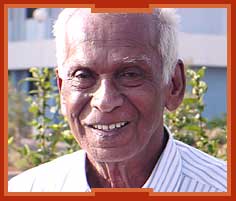
“I am not an idea man, the task is not to aspire to some heaven but to make everyday life divine."- Dr. V
Wall Street Journal has an obituary of Govindappa Venkataswamy, eye-care pioneer (1918-2006), founder of the Aravind Eye Care System ;
“With 2.4 million served, the Aravind Eye Care System in India is in a way the McDonald's of cataract surgery: efficient, effective, influential and -- rare for health care in the developing world -- a clear financial success.It began with one man, Govindappa Venkataswamy, an ophthalmologist who died July 7 at age 87 after a long illness. Dr. V, as he was universally known, created one of the largest eye-care systems in the world, catering largely to the poor in Tamil Nadu, a state in southern India. He was inspired, Aravind says, by the assembly-line model of McDonald's founder Roy Kroc -- learned during a visit to Hamburger University in Oak Brook, Ill.
Building on those lessons, he created a system for sight-saving cataract surgeries that produces enviable medical outcomes in one of the poorest regions of the globe. Its rapid expansion over three decades was not built through government grants, aid-agency donations or bank loans. Instead, Dr. V took the unusual step of asking even poor patients to pay whenever they could, believing the volume of paying business would sustain the rest. Poor people with cataracts in Tamil Nadu can get their sight restored for about $40. If they can't afford that, it's free."
"Starting with an 11-bed clinic in 1976, Dr. V's system is now a five-hospital system. His model became the subject of a Harvard Business School case study, and is being copied in hospitals around the subcontinent. The cheap, high-quality implantable lenses the system manufactures are exported to more than 80 countries around the world, Aravind says. Dr. Venkataswamy's basic insight was that health care can be marketed to the poor if a program is closely tailored to a local niche, something that has come to be known as social marketing. In a country with, by some estimates, 20 million blind eyes -- 80% of them due to curable cataracts -- the appeal for patients was financial. "A blind person is a mouth with no hands," is an Indian saying that Dr. V liked to quote. In India, health professionals say, the years of life left to those who go blind can be counted on one hand. With sight restored, the patient can return to work.The Aravind system offers services that range from a simple pair of spectacles to optical oncology. The bulk of surgeries are to treat cataracts -- removing the cataract and replacing it with an artificial intraoptical lens.
The assembly-line approach is most evident in the operating room, where each surgeon works two tables, one for the patient having surgery, the other for a patient being prepped. In the OR, doctors use state-of-the-art equipment such as operating microscopes that can swivel between tables. Surgeons typically work 12-hour days, and the fastest can perform up to 100 surgeries in a day. The average is 2,000 surgeries annually per surgeon -- nearly 10 times the Indian national average. Despite the crowding and speed, complication rates are vanishingly low, the system says.
Outside the operating rooms, conditions are as spartan as the tables at a fast-food restaurant: Often only a straw mat on a ward floor for postsurgical recovery. Patients who pay more than the basic $40 -- about 30% of patients -- can receive cushier treatment such as private rooms for extended recovery, and hot meals…”
Via Acumen Fund Blog.
Related;
Yesterday, a great hero passed away
The Perfect Vision of Dr. V.
From socialist rags to competitive riches
Multimedia;
A Discussion the Dr. V
See also this TED speech by Larry Brialliant
July 5, 2006
It's not about the money
Easterly offers some advice to Bill Gates, Warren Buffet and other would be philanthropists;
“The misguided media reaction to the Gates-Buffett union was, quite predictably, all about numbers: Warren's $31 billion gift, which roughly doubles the size of Bill's foundation to about $60 billion. Welcome to foreign aid wonderland, where it's always about the spending, never about the impact. "Double" has a venerable history; whenever anyone starts worrying about the world's poor, they almost always call for exactly doubling foreign aid -- from John F. Kennedy to last year's Group of Eight (G-8) Summit agreeing to double aid to Africa.Alas, aid flow reflects the cost of providing services for the poor, not the value of those services. Would Microsoft Corp. promote an executive who bragged about setting a record for costs? Would Berkshire Hathaway invest in a business that headlined its remarkably high spending on office supplies? Unfortunately, the foreign aid business has a sad history of bureaucrats under heavy pressure to spend money on foreign consultants and four-wheel-drive vehicles but with zero pressure to find out whether that spending translates into the forever elusive "technical assistance," "capacity building" and "civil service restructuring" that are supposed to help the poor. Your challenge -- much harder in foreign aid than in business -- is to find out if your final customers are satisfied.”
Related;
Conversation Bill and Melinda Gates and Warren Buffett had about philanthropy with Charlie Rose (via Official Google Blog)
‘World development report 1993 : investing in health’- which according to Bill Gates opened his eyes and gave his mission (see the above interview)
Being smart with Buffett’s billions
July 3, 2006
Fifteen People Who Make America Great

Independence Day greetings to our American readers. The world needs you more than ever. Newsweek celebrates a few of those Americans who’re trying to make the world a better place; "Giving Back Awards" in recognition of people who, through bravery or generosity, genius or passion, devote themselves to helping others (via World Resources Institute blog);
Benita Singh and Ruth Degolia- Mercado Global
Their company will raise $600,000 this year to send Guatemalan kids to school.
Pierre Omidyar
He's using his $10 billion fortune to help people 'tap into their own power.'
"Business can be a force for good," he says. "You can make the world a better place and make money at the same time."
Randy Rusk - A conservative rancher stands up for his land by forging an unlikely alliance.
"People are starting to realize that open space is valuable—no matter what developers think,"
Brad Pitt
He lured the paparazzi to Africa, where people really needed the attention.
"Industrialized nations cost Africa three times what we give it in aid," he says. "We buy their coffee beans, but we don't let them process the beans, which is where the real money is. So what we're doing is digging a hole for them that they can't get out of, and then throwing a little money in the hole. The odds are just stacked against them."
Rick Warren
Mobilizing Christians worldwide to heal the sick and feed the hungry It starts as an ordinary success story.
Aaron Dworkin, Sphinx Organization
A violinist whose life is introducing the music he loves to inner-city children.
"You can't complain about something," he says, "unless you're doing something about it."
Boys & Girls Clubs
On its 100th birthday, this group stays relevant by caring for new groups of poor kids.
"They reach young people everywhere," says Frances Hesselbein of the Leader to Leader Institute, a former CEO of Girl Scouts of the USA. "They're one of the most outstanding and successful social-sector organizations in the country."
Ruby Jones
As Katrina raged, this nurse whispered comfort to her dying patients.
"We are like a family at the end," she says. "You don't just abandon them."
Soledad O'Brien
In a drowning city, who spoke out for those in despair? She did.
"When something happens, say your kid has a temper tantrum, you say, 'OK, this doesn't rise to the level of disaster.' Nothing is going to upset me in my personal life."
Target
When it comes to giving time, talent and cash, this stylish retailer hits the bull's-eye.
In good years and bad, Target donates 5 percent of its pretax profits—more than twice the average of corporate America. That equals about $2 million a week, or $101 million last year. "Other companies wonder how Target does it," says Ian Wilhelm, who covers corporate giving for the Chronicle of Philanthropy. "They ask me to ask them how they get that much money out the door."
Nancy Cox -Centers for Disease Control
She's been a flu researcher her whole life. The stakes are about to get higher."What we're trying to determine is whether or not the avian-flu virus gene and the human-influenza gene can work together," Cox says
John Read -Outward Bound
His wallet took a hit when he left the private sector to run an ailing nonprofit.
Frederick Kaplan - University of Pennsylvania
The disease was so rare, nobody wanted to deal with it, until he came along.
Fibrodysplasia ossificans progressiva (FOP), which strikes roughly one in 2 million people worldwide, causes muscle and tendon to morph into hardened bone, imprisoning children in a second skeleton…
"It was a compelling problem screaming for a solution," he says. And nobody else was helping. "I wanted a mountain to climb."
Timothy Hernandez
He won medals in combat, and now he's handling a crisis on the home front.
Margaret Ross
At 73, this retired librarian does whatever she can to help whomever she can.
PHILANTHROPY'S ALL-STAR TEAM
Lance Armstrong Cancer Research/ Veronica Atkins Obesity, Diabetes/ Eli Broad Education, Medical Research/ Jimmy Carter Global Health/ Michael J. Fox Parkinson's Research/ Bill Gates Global Health, Education/ Al Gore Environmentalism/ Gordon Moore Environmentalism/ Paul Newman Childhood Health/ Rosie O'Donnell Early Education and the Arts/ David Rockefeller Medical Research And the Arts/ Ted Turner International Security/ Oprah Winfrey Disaster Relief/ Tiger Woods Youth Education
If you need even more inspiration listen to this presentation by Tony Robbins.
July 1, 2006
Outsourcing Philanthropy

“How selfish soever man may be supposed, there are evidently some principles in his nature, which interest him in the fortune of others, and render their happiness necessary to him, though he derives nothing from it except the pleasure of seeing it.”
- Adam Smith, The Theory of Moral Sentiments
Bill Gates quoted the above sentence after giving a gift of the Adam Smith’s two books to Warren Buffet for his very generous donation of some $ 31 billion to the Gates Foundation (only $ 6 billion was given to his children’s charities - he once derided those made rich by inherited wealth as “members of the lucky-sperm club”).
I watched the event online (would recommend highly) and was very moved by both the passion of Melinda and Bill to really make a difference in the world and Mr. Buffet’s belief in them. According to the Economist, Mr Buffett made his gift conditional upon Mr Gates giving up his day job at Microsoft;
“Mr Gates was taught by his mother that he had a responsibility to “give back”. Mr Gates famously brought forward his plans to give away most of his wealth after a World Development Report convinced him that by doing so it would have a greater impact than waiting until he grew old.”
NYT reports that Mr. Gates credited Mr. Buffett for encouraging him, in the early 1990's, to read a copy of the World Development Report.
But did the Sage of Omaha made the right decision in giving the largest share of his money to the Gates Foundation? The agency that seems to have had the largest impact on world development is arguably the World Bank and it currently has a monopoly in generating and disseminating policy ideas with regard to low income countries. I think one of the best ways to help the world’s poor would be to bring in some competition in this field.
Related;
Across the blogs; Charity begins at home, American Philanthropy, A Global Health Colossus, Warren Buffett's Gift to the Gates Foundation
Prioritizing ‘inconvenient truths’
Q&A: Gates' Growing Public Health Brand
DATA campaign (Debt, Aids, Trade, Africa)
Drug Development for Neglected Diseases (podcast)
Earlier blog posts; Are Asian billionaires Stingy?, Bill Gates's Post-Microsoft future