August 11, 2007
Maldives Rising
A documentary about the Maldives from Al Jazeera; Part1(above), Part 2, Part 3 & Part 4
I would highly recommed Part 2.
August 5, 2007
Breaking News from Maldives
Police takes over the Justice Ministry and Attorney General's Office as Attorney General Dr Hassan Saeed and Justice Minister Mohamed Jameel resigned from the government;
“I have had to approach members of parliament to put forward reform bills as private members,” Dr Saeed said. “It is a very sad thing for the Attorney General’s Office to have to go to an opposition MP to pass legislation.”Jameel said, “the President has not done enough to control extremist Islam.”
“We submitted an action plan to control religious extremism, but the President has sat on it for six months,” added Dr Saeed.
Dr. Hassan Saeed is the brother of a prominent Islamic Scholar, Professor Abdullah Saeed, Director of Centre for Study of Contemporary Islam at Melbourne University.
It is heartening to see that talented people willing to sell their integrity are becoming scarcer in the Maldives- goodluck and best wishes to the two ministers. Dr. Shaheed when are you resigning?
For Comment; The Maldivians will be going to the polls on August 18th, to decide on whether a presidential or parliamentary system is best for the country- let us hear your comments on this. Is parliamentary or presidential system the better one for a small and culturally cohesive country?
Related;
Voters Uninformed Ahead Of Referendum;
Concerns are growing about the lack of information available to Maldivians ahead of the country’s August 18 constitutional referendum. Campaign observers are reporting most voters lack basic knowledge of a presidential or parliamentary system, while many are even unaware a referendum will be taking place on August 18
Caught In The Act: Lawyers Witness Police Beating Detainee
Another Child Abuser Banished
Government Drug Rehabilitation Programme In Tatters;
Diameri, a company owned by American self-help guru Terence T Gorski and Maldivians Mohamed Fahmi and Dr Mohamed Shafiu, was expected to take over the government’s two rehabilitation facilities, a centre on Himmafushi in North Male’ atoll and a half-way house in Malé. But after nine months of preliminary work and consultation, the government has decided not to offer a contract.
First Female Judges Appointed
Prison: More profitable than running a resort
"Bill Of Rights" Hit By 300 Amendments
Parliament not a rubber stamp legislature of the President anymore
Foreign Minister Outrages Parliament;
Comments made by Dr Shaheed criticising parliament, have been seized on by opposition politicians to gather support for a no confidence motion in the Foreign Minister.Last week Dr Shaheed told journalists “over the past forty years the Majlis [parliament] has failed to protect people’s rights.” The Speaker of the People’s Majlis has since rejected the comments, and opposition MPs have called for “steps to be taken.”
November 28, 2006
Turkey Fact of the Day

“Take the results of a new poll by Tesev, a think-tank which studies society and religion: the number of Turks who put their Muslim identity first has risen to 45% from 36% in 1999; but over the same period the number of people who favoured sharia law dropped from 21% to 9%.”
- From The Economist, The pope's controversial trip to Turkey
Related;
Allure of Islam Signals a Shift Within Turkey
A Real Liberal Under Attack in Turkey for Defending Freedom
“Kemalist secularism is not well understood by Americans and Europeans. As Atilla put it some years ago (about ten, I think) at a seminar I organized for him at the Cato Institute, “People say that you have separation of church and state in America and we have separation of mosque and church and state in Turkey. In America, that means freedom of religion. In Turkey, it means freedom from religion. There is a great difference between the two.” Private property, contract, and limited government should create the framework for people to decide on their own, through voluntary cooperation, whether and how to build a mosque, a church, a synagogue, or anything else. Such decisions should not be made by state officials.”
The Pope, The Condescending, and Closet-Intolerance
November 26, 2006
The budget of the insurgents revealed
 NYT reports on the financing of the insurgency in Iraq;
“The insurgency in Iraq is now self-sustaining financially, raising tens of millions of dollars a year from oil smuggling, kidnapping, counterfeiting, connivance by corrupt Islamic charities and other crimes that the Iraqi government and its American patrons have been largely unable to prevent, a classified United States government report has concluded.The report, obtained by The New York Times, estimates that groups responsible for many insurgent and terrorist attacks are raising $70 million to $200 million a year from illegal activities. It says $25 million to $100 million of that comes from oil smuggling and other criminal activity involving the state-owned oil industry, aided by “corrupt and complicit” Iraqi officials.
As much as $36 million a year comes from ransoms paid for hundreds of kidnap victims, the report says. It estimates that unnamed foreign governments — previously identified by American officials as including France and Italy — paid $30 million in ransom last year…
The group’s estimate of the financing for the insurgency, even taking the higher figure of $200 million, underscores the David and Goliath nature of the war. American, Iraqi and other coalition forces are fighting an array of shadowy Sunni and Shiite groups that can draw on huge armories left over from Mr. Hussein’s days, and benefit from the willingness of many insurgents to fight with little or no pay. If the $200 million a year estimate is close to the mark, it amounts to less than what it costs the Pentagon, with an $8 billion monthly budget for Iraq, to sustain the American war effort here for a single day.
But other estimates suggest the sums involved could be far higher. The oil ministry in Baghdad, for example, estimated earlier this year that 10 percent to 30 percent of the $4 billion to $5 billion in fuel imported for public consumption in 2005 was smuggled back out of the country for resale. At that time, the finance minister estimated that close to half of all smuggling profits was going to insurgents. If true, that would be $200 million or more from fuel smuggling alone.”
Related;
In Search of the Fixers
Iraqi women increasingly targeted in violence
Ferocity of Iraq attacks leaves US troops helpless
Sunni leader must stop bloodshed, says Sadr
Iran: America Destroyed All Our Enemies in the Region
November 23, 2006
Podcast of the Day- Islamic Finance for US
Marc Chandler, global head of currency strategy at Brown Brothers Harriman & Co., talks about opportunities in Islamic finance and the outlook for the U.S. dollar and euro (Bloomberg podcast).
Related;
Britain can be gateway to Islamic finance- Gordon Brown (earlier post)
The State of Islamic Finance in Australia
Short Selling and the Travesty of Islamic Finance
Cayman Islands Emerge As Leading Islamic Finance Domicile
Islamic Finance podcast
Fund for Shariah Scholars in Islamic Finance
Islamic Finance isn’t Islamic
Islamic Finance (World Bank portal on the topic)
Popularity Of Islamic Finance Market On The Rise
“Not surprisingly, the jump in popularity of sukuks has drawn the interest of institutions outside the Middle East.Two years ago, the German state of Saxony Anhalt sold the first sukuk from the West. IFC is the first supranational to issue Islamic securities in the Malaysian market, and the first supranational to issue domestic Islamic bonds in any market”
Islamic Banking (transcript of a program at Radio National)
Two stories on Islamic Finance
Blogs related to Islamic Economics and Finance; Islamic Finance Blog, Islam and Economics
Bibliography on Islamic Banking
Working Papers
Corporate governance in institutions offering Islamic financial services : issues and options
Corporate governance and stakeholders' financial interests in institutions offering Islamic financial services
Regulating Islamic financial institutions : The nature of the regulated
Mapping the possibilities for Islamic microfinance
November 22, 2006
Book recommendations from Tom Palmer

“People who wish to understand the Islamic tradition would do well to try to start with an examination of the role that Islam played in the development of law, rather than with the various Muslim-bashing books that have appeared recently”, says Tom Palmer.
Book recommendations;
Wael B. Hallaq’s The Origins and Evolution of Islamic Law
Harold Berman’s Law and Revolution: The Formation of the Western Legal Tradition.
Law and Revolution, II: The Impact of the Protestant Reformations on the Western Legal Tradition
Mohammad Hashim Kamali’s books-Principles of Islamic Jurisprudence, Freedom of Expression in Islam , Freedom, Equality and Justice in Islam
This Law of Ours and other essays, by Muhammad Asad
Related;
Muslim Basher Robert Spencer Upset at my Dismissal of his Book (Tom Palmer post)
Islam and Economics- blog of Professor at Rice University
Podcasts;
Islam Then and Now
Daniel Peterson believes the key to understanding present Islamic attitudes lies in understanding the religious and philosophical texts of its past.
Interpreting culture
The distinguished American anthropologist Clifford Geertz died last month
November 17, 2006
Carnival of Podcasts
The Peasants' Revolt
But who were the rebels and how close did they really come to upending the status quo? And just how exaggerated are claims that the Peasants’ Revolt laid the foundations of the long-standing English tradition of radical egalitarianism?
A bit more of British history podcasts via Brad DeLong. See also British History blog.
Heritage
In this four-part Heritage series Malcolm Billings explores the archaeology of patriotism in the USA; Part One, Part Two.
Air Taxi!
Recently the market for air taxis has really taken off but can this expensive form of personal transport really fly?
Crusading
What exactly were Crusades and how useful are they as a metaphor in the twenty first century?
Interview with John Emsley
If you are really keen to murder a spouse, which chemical element would you choose? Arsenic is SO last year. Mercury is so - well, mercurial. Cambridge chemist John Emsley offers informed advice for anyone contemplating homicide who would like to show a little flair and impress the team from CSI.
Flat Tax Reform in Slovakia: Lessons for the United States
The Liberal Roots of the American Empire
Michael Desch, Professor and Robert M. Gates Chair in Intelligence and National Security Decision-Making, George Bush School of Government and Public Service, Texas A&M University
Talking to terrorists
A discussion about an ongoing dialogue with several groups officially deemed terroist organisations. 'We don't talk to terrorists, full stop' - that is one end of the spectrum of approaches to dialogue. The other end might be: 'We'll talk to anyone, anywhere, anytime, if we think its going to lead to a resolution'. Related - Conflicts Forum
More upheaval in the US newspaper industry
How is technology changing our world?
Today we take stock of these and other questions, have a look at what has and what hasn't changed with respected authors Joel Kotkin and Bill Eggers.
The mystery of Linear B, the script that pre-dated alphabetic writing in Greece. Listen to the podcast.
Interview with Mark Thompson
Dr. Moira Gunn speaks with career entrepreneur and author Mark Thompson, who is currently a visiting scholar at Stanford Business School. Thompson talks about some 200 people he spoke to who have either built organizations or launched crusades – personal success built for a lifetime.
S.H.A.M.
The Self Help and Actualisation Movement is worth more than $8.5 billion U.S. in America alone. From Anthony Robbins getting his clients to run over hot coals to Marianne Williamson teaching that money is energy, and energy is infinite in the universe, it's getting hard to tell the difference between spruikers and sages. But according to investigative author, Steve Salerno, the happiness industry is banking on keeping us unhappy.
The Omidyar Network
In conversation with John Battelle, legendary technologist Pierre Omidyar explains the philosophy and business plan underlying his new network for investment in for-profit ventures which foster economic, social, and political self-empowerment. Applying lessons learned from his founding of eBay, this new investment strategy is based on the belief that people are basically good, and that connecting them with the right tools can build trust and opportunity.
November 12, 2006
An Arab role model

Profile of a role model for Arab women;
“Every day and night, I think about how the girls need to change,” Sheika Lubna said emphatically. “Ultimately, I am out there for them.”…As a woman who challenged all the societal rules in the 1970s, working her way up the ranks as a computer engineer, then a chief executive and a government minister, she has sought to prove to women here that they, too, must begin assuming a greater role in public life.
Her family is the ruling family of the emirate of Sharjah, the emirate neighboring Dubai; her uncle is the ruler. As royalty, she faced even more traditional demands than most. Moreover, she never really needed to work, and if she chose to, she could have opted for a low-key job in a ceremonial role or as a bureaucrat.She chose the hard way, however. When other women were staying home in the late 1970s, Sheika Lubna left for California to study computer engineering, becoming one of the first Emirati women to travel abroad for study.
But Arab religious sheikhs seem interested in explaining other things.
Related;
Dubai Swats Pests Ogling Beach Beauties;
"Indeed, for the estimated 500,000 foreign workers here, most from the Indian subcontinent, the chance to spot a woman in a bikini may be hard to pass up.
They typically live in a Dickensian world of squalor, working 12-hour shifts six days a week, often denied their wages of about $150 per month for months at a time. Most of them secure work by taking out loans from recruiting agencies at home to get here, forcing most to stay on for years without seeing their families and loved ones. The workmen have become prevalent in Dubai’s public parks and beaches as their numbers have swelled, and because of the lechery-on-the-beach factor, they are especially noticeable at this time of year.They tend to beachcomb in groups, their camera-equipped cellphones always at the ready. Many do not know how to swim; some enter the water wearing their traditional robes, made of thin white cloth that becomes transparent when wet — and reveals far more of their anatomy than most beachgoers want to see. Incidents of physical harm to women are rare, though the police have arrested flashers and men committing lewd acts in public."
November 3, 2006
A long term truce between Palestine and Israel?
Ahmed Yousef, a senior adviser for Hamas has an op-ed in NYT;
“A truce is referred to in Arabic as a “hudna.” Typically covering 10 years, a hudna is recognized in Islamic jurisprudence as a legitimate and binding contract. A hudna extends beyond the Western concept of a cease-fire and obliges the parties to use the period to seek a permanent, nonviolent resolution to their differences. The Koran finds great merit in such efforts at promoting understanding among different people. Whereas war dehumanizes the enemy and makes it easier to kill, a hudna affords the opportunity to humanize one’s opponents and understand their position with the goal of resolving the intertribal or international dispute.”
Related:
Islam, Terror and the Second Nuclear Age
Podcasts;
Islam and the Left
Islamic law expert Jamila Hussein on the veil row
Dr Ameer Ali interview
Islam Then and Now
Daniel Peterson believes the key to understanding present Islamic attitudes lies in understanding the religious and philosophical texts of its past
Middle East Conflict: The Nature of War in the 21st Century
Giora Eiland, former head of the National Security Council of Israel
September 27, 2006
Podcast of the Day- God in the Genome


First watch this video- the inner workings a cell (via Boing Boing).
For some like Dr. Francis Collins, Head of the Human Genome Project, and Director of the National Human Genome Research Institute, this reinforces the belief in God. Dr Francis S. Collins argues that both scientific and spiritual "truth" are valid and fit together harmoniously and one can at the same time accept modern scientific theories, such as evolution with the belief in God. Listen to the podcast.
Compare with Richard Dawkins and Daniel Dannet views on the topic.
Related;
MeaningofLife.tv
Excerpt: "The Language of God"
Let There Be Light
Scientists on Religion ; Theist and materialist ponder the place of humanity in the universe
September 24, 2006
Niall Ferguson on Radical Islam
“The great category error of our time is to equate radical Islamism with fascism. If you actually read what Osama bin Laden says, it's clearly Lenin plus the Koran. It's internationalist, revolutionary, and anticapitalist-rhetoric far more of the left than of the right. And radical Islamism is good at recruiting within our society, within western society generally. In western Europe, to an extent people underestimate here, the appeal of radical Islamism extends beyond Muslim communities.”
- Interview at Boston Globe
Related;
Radical Islam in Pakistan; For years there has been debate over Pakistan's role in international terrorism. What is the link between Islamic extremism and Pakistan and when and how did it emerge?
Spy Agencies Say Iraq War Hurting U.S. Terror Fight;
“The war in Iraq has become a primary recruitment vehicle for violent Islamic extremists, motivating a new generation of potential terrorists around the world whose numbers may be increasing faster than the United States and its allies can reduce the threat, U.S. intelligence analysts have concluded.A 30-page National Intelligence Estimate completed in April cites the "centrality" of the U.S. invasion of Iraq, and the insurgency that has followed, as the leading inspiration for new Islamic extremist networks and cells that are united by little more than an anti-Western agenda. It concludes that, rather than contributing to eventual victory in the global counterterrorism struggle, the situation in Iraq has worsened the U.S. position, according to officials familiar with the classified document.”
A Pilgrimage that led to Inflation
“Mansa Moussa brought the Mali Empire to the attention of the rest of the Muslim world with his famous pilgrimage to Mecca in 1324. He arrived in Cairo at the head of a huge caravan, which included 60,000 people and 80 camels carrying more than two tons of gold to be distributed among the poor. Of the 12,000 servants who accompanied the caravan, 500 carried staffs of pure gold. Moussa spent lavishly in Egypt, giving away so many gold gifts—and making gold so plentiful—that its value fell in Cairo and did not recover for a number of years!
In Cairo, the Sultan of Egypt received Moussa with great respect, as a fellow Muslim. The splendor of his caravan caused a sensation and brought Mansa Moussa and the Mali Empire fame throughout the Arab world. Mali had become so famous by the fourteenth century that it began to draw the attention of European mapmakers. In one map, produced in 1375, Moussa is shown seated on a throne in the center of West Africa, holding a nugget of gold in his right hand.”
- Mansa Moussa: Pilgrimage of Gold (History Channel)
September 23, 2006
Musharaff Quotes
 Most recent;
"The intelligence director told me that (Armitage) said, 'Be prepared to be bombed. Be prepared to go back to the Stone Age,"' Musharraf said. "I think it was a very rude remark."
Last year he made the controversial comments on rape victims;
"You must understand the environment in Pakistan. This has become a money-making concern," he said. "A lot of people say if you want to go abroad and get a visa for Canada or citizenship and be a millionaire, get yourself raped."
Related;
Muslim Women — The Untold Story
Afghanistan: On the Brink
Bombing Pakistan back to the Stone Age
Pakistan criticises Afghan action
Afghan Leader Presses Musharraf
Pakistan rape victim's blog makes waves
Musharraf to pen autobiography
Feminist dimension of the Pakistan Movement;
"No nation can rise to the height of glory unless your women are side by side with you; we are victims of evil customs. It is a crime against humanity that our women are shut up within the four walls of the houses as prisoners. There is no sanction anywhere for the deplorable condition in which our women have to live."- Muhammad Ali Jinnah
September 22, 2006
September 18, 2006
Ancient Prejudices?
Karen Armstrong weighs in on the Pope controversy;
“In the 12th century, Peter the Venerable, Abbot of Cluny, initiated a dialogue with the Islamic world. "I approach you not with arms, but with words," he wrote to the Muslims whom he imagined reading his book, "not with force, but with reason, not with hatred, but with love." Yet his treatise was entitled Summary of the Whole Heresy of the Diabolical Sect of the Saracens and segued repeatedly into spluttering intransigence. Words failed Peter when he contemplated the "bestial cruelty" of Islam, which, he claimed, had established itself by the sword. Was Muhammad a true prophet? "I shall be worse than a donkey if I agree," he expostulated, "worse than cattle if I assent!"Peter was writing at the time of the Crusades. Even when Christians were trying to be fair, their entrenched loathing of Islam made it impossible for them to approach it objectively. For Peter, Islam was so self-evidently evil that it did not seem to occur to him that the Muslims he approached with such "love" might be offended by his remarks. This medieval cast of mind is still alive and well.
Last week, Pope Benedict XVI quoted, without qualification and with apparent approval, the words of the 14th-century Byzantine emperor Manuel II: "Show me just what Muhammad brought that was new, and there you will find things only evil and inhuman, such as his command to spread by the sword the faith he preached." The Vatican seemed bemused by the Muslim outrage occasioned by the Pope's words, claiming that the Holy Father had simply intended "to cultivate an attitude of respect and dialogue toward the other religions and cultures, and obviously also towards Islam".
But the Pope's good intentions seem far from obvious. Hatred of Islam is so ubiquitous and so deeply rooted in western culture that it brings together people who are usually at daggers drawn. Neither the Danish cartoonists, who published the offensive caricatures of the Prophet Muhammad last February, nor the Christian fundamentalists who have called him a paedophile and a terrorist, would ordinarily make common cause with the Pope; yet on the subject of Islam they are in full agreement.
Our Islamophobia dates back to the time of the Crusades, and is entwined with our chronic anti-semitism. Some of the first Crusaders began their journey to the Holy Land by massacring the Jewish communities along the Rhine valley; the Crusaders ended their campaign in 1099 by slaughtering some 30,000 Muslims and Jews in Jerusalem. It is always difficult to forgive people we know we have wronged. Thenceforth Jews and Muslims became the shadow-self of Christendom, the mirror image of everything that we hoped we were not - or feared that we were…."
Related;
Pope apology fails to end anger
Al-Qaida in Iraq warns Pope
Political error or calculated move?
Pope: Manuel II's Views of Muhammad are not My Own
The History of the Decline and Fall of the Roman Empire
Medieval Sourcebook
September 17, 2006
Podcasts of the Day
Radical Islam in Pakistan; For years there has been debate over Pakistan's role in international terrorism. What is the link between Islamic extremism and Pakistan and when and how did it emerge? Guests include Hussain Haqqani, Associate Professor of International Relations, Boston University, Samina Yasmeen, Senior Lecturer in Political Science and International Relations,University of Western Australia and Ahmed Rashid, Correspondent with The Far Eastern Economic Review
Islam in the Renaissance; Between the 15th and 16th centuries, the European Renaissance generated scientific breakthroughs including the discovery by Copernicus that the Earth revolves around the Sun. The progress in scientific thought has been attributed in part to the translation of Arabic texts into Latin. However, Professor George Saliba argues that crucial information was contained in texts that were not translated, so how did Copernicus know about them? Guest on the show George Saliba, Professor of Arabic and Islamic Science at Columbia University in New York.
The history of scientific discoveries
Peace by Artful Means
In societies fractured by violence, family conflict and global threats of terrorism, how do we encounter 'the other' in ways which build sustainable peace? From the growing practice of mediation to the global art of hip hop, this Encounter explores the role of creativity in transforming conflict
Regaining confidence in western culture
All the podcasts from Radio National’s shows.
September 16, 2006
Pope says Sorry
 I’ve to admit that I haven’t read the entire speech of Pope when I commented earlier. Kevin summarizes the gist of the speech in the comments. It’s irresponsible on the part of the advisers of Pope to have included such a comment.
At the same Muslim anger and reaction seems vastly disproportional to the broad issues raised by the Pope (even in secular countries like Turkey-see the pic). Muslims in countries like Pakistan have more things to worry than cartoons and speeches. We have to accept that certain segments of Islamic societies are not willing to accept reasoned dialogue to deal with society’s issues. I don’t think we could have reasoned with the Saudi hijackers who blew up the World Trade Center – their worldview had become too narrow.
Now that Pope has said sorry, overzealous Muslims may calm down.
Juan Cole summarizes some of the factual errors in Pope’s speech;
“He notes that the text he discusses, a polemic against Islam by a Byzantine emperor, cites Qur'an 2:256: "There is no compulsion in religion." Benedict maintains that this is an early verse, when Muhammad was without power.His allegation is incorrect. Surah 2 is a Medinan surah revealed when Muhammad was already established as the leader of the city of Yathrib (later known as Medina or "the city" of the Prophet). The pope imagines that a young Muhammad in Mecca before 622 (lacking power) permitted freedom of conscience, but later in life ordered that his religion be spread by the sword. But since Surah 2 is in fact from the Medina period when Muhammad was in power, that theory does not hold water.
In fact, the Qur'an at no point urges that religious faith be imposed on anyone by force. This is what it says about the religions:
' [2:62] Those who believe (in the Qur'an), and those who follow the Jewish (scriptures), and the Christians and the Sabians-- any who believe in God and the Last Day, and work righteousness, shall have their reward with their Lord; on them shall be no fear, nor shall they grieve. ' …
The idea of holy war or jihad (which is about defending the community or at most about establishing rule by Muslims, not about imposing the faith on individuals by force) is also not a Quranic doctrine. The doctrine was elaborated much later, on the Umayyad-Byzantine frontier, long after the Prophet's death. In fact, in early Islam it was hard to join, and Christians who asked to become Muslim were routinely turned away. The tyrannical governor of Iraq, al-Hajjaj, was notorious for this rejection of applicants, because he got higher taxes on non-Muslims. Arab Muslims had conquered Iraq, which was then largely pagan, Zoroastrian, Christian and Jewish. But they weren't seeking converts and certainly weren't imposing their religion.The pope was trying to make the point that coercion of conscience is incompatible with genuine, reasoned faith. He used Islam as a symbol of the coercive demand for unreasoned faith.
But he has been misled by the medieval polemic on which he depended.
In fact, the Quran also urges reasoned faith and also forbids coercion in religion. The only violence urged in the Quran is in self-defense of the Muslim community against the attempts of the pagan Meccans to wipe it out.
The pope says that in Islam, God is so transcendant that he is beyond reason and therefore cannot be expected to act reasonably. He contrasts this conception of God with that of the Gospel of John, where God is the Logos, the Reason inherent in the universe.
But there have been many schools of Islamic theology and philosophy. The Mu'tazilite school maintained exactly what the Pope is saying, that God must act in accordance with reason and the good as humans know them. The Mu'tazilite approach is still popular in Zaidism and in Twelver Shiism of the Iraqi and Iranian sort. The Ash'ari school, in contrast, insisted that God was beyond human reason and therefore could not be judged rationally. (I think the Pope would find that Tertullian and perhaps also John Calvin would be more sympathetic to this view within Christianity than he is).
As for the Quran, it constantly appeals to reason in knowing God, and in refuting idolatry and paganism, and asks, "do you not reason?" "do you not understand?" (a fala ta`qilun?)
Of course, Christianity itself has a long history of imposing coerced faith on people, including on pagans in the late Roman Empire, who were forcibly converted. And then there were the episodes of the Crusades.
Another irony is that reasoned, scholastic Christianity has an important heritage drom Islam itself. In the 10th century, there was little scholasticism in Christian theology. The influence of Muslim thinkers such as Averroes (Ibn Rushd) and Avicenna (Ibn Sina) reemphasized the use of Aristotle and Plato in Christian theology. Indeed, there was a point where Christian theologians in Paris had divided into partisans of Averroes or of Avicenna, and they conducted vigorous polemics with one another.
Finally, that Byzantine emperor that the Pope quoted, Manuel II? The Byzantines had been weakened by Latin predations during the fourth Crusade, so it was in a way Rome that had sought coercion first. And, he ended his days as a vassal of the Ottoman Empire.
The Pope was wrong on the facts. He should apologize to the Muslims and get better advisers on Christian-Muslim relations.”
The greatest irony I find is that I had to quote Juan Cole, a Christian to defend the position of Islam- even the statement made by the Organization of Islamic Countries doesn’t come close to above. One of the best things that Muslim scholars living in the west could do is to start a dialogue with the youth in Islamic countries- blogs are one effective mean. Akbar Ahmed, Sayyid Hussain Nasr, Hamza Yousuf, Jeffrey Lang, Tariq Ramadan, Yousuf Islam , Murad Hoffman and Timur Kuran are you listening. Minaret of Freedom has a blog coverage of news items but not much analysis.
Related;
Pope's Trip to Turkey in Doubt
Iraq calls for calm after Pope's remarks
Mixed feelings over Khatami visit
Pope and Islam: 'Non Mea Culpa'
How Pakistan's rape reform ran aground
Losing the war on Afghan drugs
'Rottweiler' bares teeth- “First, he has done it before. At Auschwitz, in May, he appalled many Jews by passing up what they saw as a historic opportunity for a German pope to apologise for the Roman Catholic Church's conduct in World War II. The second factor is that the Pope has indicated he favours a tougher line in his church's dealings with Islam.”
Multimedia
Doha Debate
Best of the Spiritual Classics;Highlights from our Spiritual Classics series, with sacred writings from Buddhism, Hinduism and Judaism, through Christianity and Islam, to the wisdom texts of Confucius and the holy book of the Sikhs
September 14, 2006
Silliest thing I heard today
Organization of Islamic Conference is urging Muslim tycoons to buy stakes in global media outlets to help change anti-Muslim attitudes around the world;.
"Muslim investors must invest in the large media institutions of the world, which generally make considerable profits, so that they have the ability to affect their policies via their administrative boards," OIC chief Ekmeleddin Ihsanoglu told the gathering in the Saudi city of Jeddah."This would benefit in terms of correcting the image of Islam worldwide," he said, calling on Muslim countries to set up more channels in widely-spoken foreign languages.
Muslim stakes in Western media are minimal. Billionaire Saudi Prince Alwaleed bin Talal owns 5.46 percent of media conglomerate News Corp., the Rupert Murdoch-run group behind the Fox News Channel. The U.S. channel is generally seen as right-wing and no friend of Arab or Muslim interests.”
If that is the best alternative that ministers from Islamic countries can come up with, than ….
Related;
The War with al-Qaeda
Opium Threats in Afghanistan, Iran
Pakistan’s Troubled Leader
“My God is bigger than yours” Dept.
Pope Benedict XVI quoted criticisms of the Mohammed by a 14th Century Byzantine Christian emperor, Manuel II Paleologus in a recent speech in Germany;
“Show me just what Mohammed brought that was new, and there you will find things only evil and inhuman, such as his command to spread by the sword the faith he preached".
For a different approach at dialogue listen (browse down the page) to Robert Thurman.
Related;
Muslim Leaders Assail Pope’s Tough Speech on Islam
Pope hits out at Islam
Google News coverage
September 10, 2006
“Ignorance Is Bliss”
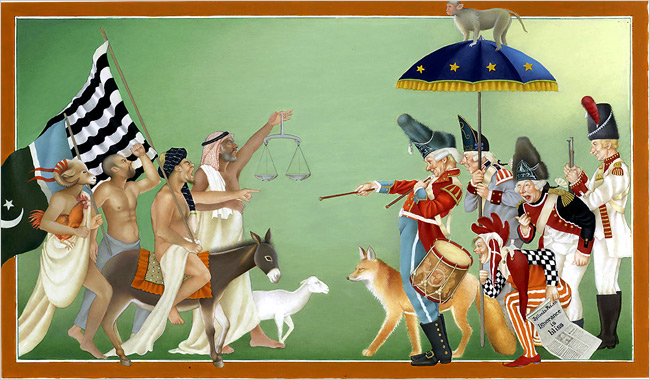
“Ignorance Is Bliss” by Saira Wasim
“With a tip of the hat to Norman Rockwell, “Ignorance is Bliss” illustrates a recent conflict between Western Europe and the Islamic world involving religious freedom and artistic expression”
Related;
A Mélange of Asian Roots and Shifting Identities
Blair confronts art close to home
Will Internet bring democracy to the Arabs?

Kuwait’s Annus Mirabilis, an interesting article on Kuwaiti political developments;
“Like the orange-clad protesters, candidates sent reams of text messages, using lists of cell phone numbers generated from records of attendees asked to sign in at events. Some messages, featuring rumor and gossip, were campaign tricks designed to make another candidate look bad. Most focused on thanking the recipient for his or her support and offered information about the candidate’s next event.Blogs were a more important innovation. Voters could read some of the more sensational blog postings in daily newspapers. The Orange Movement leadership maintains a blog originating in the United States, managed jointly by overseas Kuwaiti students and one of the Orange organizers. This blog, KuwaitJunior, provided running news and commentary during the emiri transition in January 2006. During the campaign, it brought electoral corruption into the public eye thanks to a posting by a woman who recounted how two men in Rula Dashti’s district had attempted to buy her vote with the promise of a Chanel handbag. Although she did not mention the candidate’s name, it soon became public knowledge that she was speaking of Jamal al-‘Umar. The Orange leadership investigated this allegation by dispatching an undercover member, armed with a small video camera, to negotiate with the vote buyers. The camera failed, but the agent managed to capture pictures and voices on her cell phone. Then four young men who were not Orange organizers decided to challenge al-‘Umar during an event at his tent in Jabriyya southeast of Kuwait City. They asked him to explain why people were buying votes on his behalf if he was innocent of corruption as he claimed. The youths were roughed up and thrown out by the candidate’s assistants and, adding insult to injury, the Jabriyya police refused to accept their assault complaint. The worst part of the story came at the end, when al-‘Umar came in second, thereby winning a seat in the 2006 parliament….
All of which brings us back to democracy and Kuwait’s year full of miracles. As political scientist Eleanor Doumato has observed, women’s rights in the Arab Gulf states are the gift of monarchs, not parliaments. This is certainly the case in Kuwait, where opinion polls taken before the electoral law was changed in May 2005 showed a discouraging lack of support for female candidates, although more for female voters. The role of democracy in the 2006 election should be considered in broader terms than that, however. That there was an election at all was even more indicative of expectations that a democratic process should -- and did -- exist in Kuwait. The demonstrations that helped bring down the government were non-violent, as was virtually all of the official response to them. The new emir may have acted precipitously in canceling the parliamentary session and calling a new election -- and the speaker of the parliament later excoriated this decision publicly as unnecessarily confrontational. Yet only 20 years ago, a Kuwaiti emir dissolved a parliament and did not call for a new election until invasion, war and liberation made it impossible for him to continue resisting demands for the restoration of constitutional life.These demands came from Kuwaitis, through a long and occasionally frightening period when street demonstrations were met with more than the possibly accidental injury of one person by a policeman’s baton. The pro-democracy movement of 1989-1990 saw more widespread beating of demonstrators, along with the desecration of a mosque by tear gas and police dogs, and the arrest of more than a dozen prominent dissidents. Demands for reform came from outside, too, not only from exiles abroad during the Iraqi occupation, but also from countries that, having sent troops to liberate Kuwait, expected its leaders to behave better than the ousted invader. Despite clerical and even popular criticism, after liberation foreign ambassadors and NGOs pressed for women’s rights, protection for stateless persons, better treatment of maids and other foreign workers, and structural changes to open Kuwait’s economy and political system. That each of these causes was also advocated by Kuwaitis does not diminish the usefulness of external support from those whose good opinion Kuwaiti leaders value. Such external advocacy is not only an additional check on backsliding toward a more authoritarian past, but is also evidence that other governments support democratization in the Middle East.
Jamie Meyerfeld, writing in support of the International Criminal Court, emphasizes the role of external checks to support democracy. “Like Ulysses tied to the mast…democracies steel themselves against future unwise temptations…. It is astonishing that [102] countries have voluntarily agreed to make their own leaders vulnerable to prosecution and punishment before an international court.” Similarly, international observers add to the checks exercised by national constituents of governments. These national watchers are more important, of course, but a little encouragement from outside can reinforce their efforts to build democratic institutions, and discourage governments impatient with the noisy demands of democratic politics from shutting those institutions down. If the international community were serious about democratization, no pillar of authoritarianism would fall without an attentive audience listening for the crash.”
Via Abu Aardvark
Related;
Young Kuwaitis turn ‘Orange’
Kuwaiti women one step away from their political rights
Kuwait and democracy in the Gulf;
“Kuwait is hardly a model of democracy either—at least, not yet. Its head of state is hereditary, and he appoints the 15-person cabinet. Typically, half its ministers are members of the ruling Al Sabah family. All have voting rights in the parliament. This raises the number of legislators from the 50 elected MPs to 65, and raises the bar for winning a vote against the government. Yet the parliament does have the right to embarrass ministers with tricky questions. It can rely on the Arab world's freest press to air grievances, too, though in this small, hyper-rich state with barely 1m citizens among its 2.3m residents, word of scandal gets around anyway. In January, it won greater legitimacy when it endorsed the removal of the ailing crown prince, only a few weeks after the death of the previous emir, and his replacement by an abler man.”
Can Iraq Make It?
Why America gives Israel its unconditional support
Moody's warns of risk for Gulf banks
Multimedia;
Illusion and Reality in the Middle East-A Discussion of American Strategy Regarding Iran, Syria, and the Greater Middle East (podcast from New America Foundation)
Is Dubai the new model for the Middle-East?
Obituary: Egyptian Nobel Laureate writer Naguib Mahfouz
September 6, 2006
A New Map of the Middle East?

An article in Armed Forces Journal suggests we need to revise the map of the of the Middle East;
“A just alignment in the region would leave Iraq's three Sunni-majority provinces as a truncated state that might eventually choose to unify with a Syria that loses its littoral to a Mediterranean-oriented Greater Lebanon: Phoenecia reborn. The Shia south of old Iraq would form the basis of an Arab Shia State rimming much of the Persian Gulf. Jordan would retain its current territory, with some southward expansion at Saudi expense. For its part, the unnatural state of Saudi Arabia would suffer as great a dismantling as Pakistan.A root cause of the broad stagnation in the Muslim world is the Saudi royal family's treatment of Mecca and Medina as their fiefdom. With Islam's holiest shrines under the police-state control of one of the world's most bigoted and oppressive regimes — a regime that commands vast, unearned oil wealth — the Saudis have been able to project their Wahhabi vision of a disciplinarian, intolerant faith far beyond their borders. The rise of the Saudis to wealth and, consequently, influence has been the worst thing to happen to the Muslim world as a whole since the time of the Prophet, and the worst thing to happen to Arabs since the Ottoman (if not the Mongol) conquest.
While non-Muslims could not effect a change in the control of Islam's holy cities, imagine how much healthier the Muslim world might become were Mecca and Medina ruled by a rotating council representative of the world's major Muslim schools and movements in an Islamic Sacred State — a sort of Muslim super-Vatican — where the future of a great faith might be debated rather than merely decreed. True justice — which we might not like — would also give Saudi Arabia's coastal oil fields to the Shia Arabs who populate that subregion, while a southeastern quadrant would go to Yemen. Confined to a rump Saudi Homelands Independent Territory around Riyadh, the House of Saud would be capable of far less mischief toward Islam and the world.
Iran, a state with madcap boundaries, would lose a great deal of territory to Unified Azerbaijan, Free Kurdistan, the Arab Shia State and Free Baluchistan, but would gain the provinces around Herat in today's Afghanistan — a region with a historical and linguistic affinity for Persia. Iran would, in effect, become an ethnic Persian state again, with the most difficult question being whether or not it should keep the port of Bandar Abbas or surrender it to the Arab Shia State.What Afghanistan would lose to Persia in the west, it would gain in the east, as Pakistan's Northwest Frontier tribes would be reunited with their Afghan brethren (the point of this exercise is not to draw maps as we would like them but as local populations would prefer them). Pakistan, another unnatural state, would also lose its Baluch territory to Free Baluchistan. The remaining "natural" Pakistan would lie entirely east of the Indus, except for a westward spur near Karachi.”
Via Cartography blog.
*I do not share the views of the author
‘There is no compulsion in religion’
Juan Cole reminds us that;
“Al-Sharq al-Awsat reports that the Grand Sheikh of al-Azhar Seminary in Cairo, perhaps the foremost Sunni Arab authority, has issued a statement that jihad or "holy war" was legislated in Islam for the defense of the persons and honor of Muslims, and is not to be used as a threat or a form of aggression against the innocent.”
We shouldn’t forget religious practices are not monolithic;
“In Senegal, I found local Muslims irate at the condescending attitudes of Saudi emissaries who condemned their practices as contrary to Islam. With their long-established Muslim brotherhoods and their beloved marabouts, the Senegalese responded, "We were Islamic scholars when the Saudis were living in tents."From West Africa to Indonesia, an unnoted defense against Islamist extremism is the loyalty Muslims have to the local versions of their faith. No one much likes to be told that he and his ancestors have gotten it all wrong for the last five centuries. Foolish Westerners who insist that Islam is a unified religion of believers plotting as one to subjugate the West refuse to see that the fiercest enemy of Salafist fundamentalism is the affection Muslims have for their local ways. Islamist terrorists are all about globalization, while the hope for peace lies in the grip of local custom.
Uninterested in political correctness, a Muslim from Côte d'Ivoire remarked to me, "You can change the African's dress, you can educate him and change his table manners, but you cannot change the African inside him." He might have said the same of the Russian, the German, or the Chinese. By refusing to acknowledge, much less attempting to understand, the indestructible differences between human collectives, the 20th-century intelligentsia smoothed the path to genocide in Rwanda, Bosnia, and Sudan, as well as to the age of globalized terror. Denied differences only fester; ignored long enough, the infection kills.
Our insistence that human beings will grow ever more alike defies the historical evidence, as well as practical and spiritual needs. Paradoxically, we make a great fuss of celebrating diversity, yet claim that human values are converging. We, too, have our superstitions and taboos.”
Related;
Sheikh of Al-Azhar : Jihad initiated for self-defense and not for threat or attack
Young U.S. Muslims Strive for Harmony
For Conservative Muslims, Goal of Isolation a Challenge
Iran's liberal lecturers targeted
Creation of "Islamic" Bogeyman
World Conference of Religions for Peace
Fair play and civility in interreligious relations
Multimedia;
Dr Gary Bouma, Professor of Sociology, Monash University on the World Conference on Religions for Peace
Weird Babel of Tongues; One hundred years ago an old building on Azusa Street in the industrial part of Los Angeles held religious meetings that started with people 'breathing strange utterances and mouthing a creed...no sane mortal could understand.' It was the beginning of the modern Pentecostal movement, which remains a thriving church tradition mainly within Protestantism
Creating a Sacred Space; The City of Greater Dandenong is one of Australia's two most diversely populated municipalities and its local hospital, a large acute care hospital, has substituted a multi-faith 'sacred space' in the place of its old chapel. Members of the hospital staff and the City of Greater Dandenong's Interfaith Network, and the Dandenong Historical Society tell about the creation of the sacred space
The Dawning of Consciousness; Emeritus Professor, Derek Denton, is internationally recognised for his work on instinctive behaviours. Professor Denton is 82 but remains involved in various research projects around the globe. His most recent venture is the most ambitous to date - it aims to demonstrate the role of evolution in the emergence of animal and human consciousness
Chinese philosophy; To anybody schooled in Western philosophy, Chinese philosophy doesn't look much like philosophy at all: there seems to be no argument, no analysis, just a lot of proverbs and stories. But this is real philosophy and Dr Karyn Lai gives us an overview. And Chin-Ning Chu, author, motivator and strategist explains what relevance the oldest military treatise in the world has in today's boardroom
September 5, 2006
Arundhati Roy’s Question
It is now 4 days to the Dropping Knowledge forum.
Arundhati Roy’s questions about the future of non-violent resistance and armed struggle. “What is effective?,” she wonders. “What is the right thing to do?”.Here is the video.
Related;
Civic Power and the People’s Rights: Nonviolent Action for a New World, Speech by Jack DuVall, President, International Center on Nonviolent Conflict
Political activism with a flick of the joystick
September 4, 2006
Afghanistan- on the road to a narco-state?

"If this thing gets out of hand, you could move from a narco-economy to a narco-state," - Doug Wankel, director, US drugs control office
Things are going good for poppy cultivators in Afghanistan;
"Opium cultivation in Afghanistan rose 59 percent in 2006, largely due to a dramatic increase in the troubled southern provinces, the United Nations Office on Drugs and Crime (UNODC) said on Saturday…The Afghan Government, the Parliament and partner nations have made it clear that legalizing cultivation or buying up the opium crop for medical purposes is not an option under current circumstances. The price differential between the legal market, where opium costs about $20-30 per kilo, and the illegal one, where the price is $100, would lead to even greater cultivation and the massive diversion of supplies to the black market..."
NYT also reports on the report;
“He said the increase in cultivation was significantly fueled by the resurgence of Taliban rebels in the south, the country’s prime opium growing region. As the insurgents have stepped up attacks, they have also encouraged and profited from the drug trade, promising protection to growers if they expanded their opium operations. “This year’s harvest will be around 6,100 metric tons of opium — a staggering 92 percent of total world supply. It exceeds global consumption by 30 percent,” Mr. Costa said at a news briefing…He said the harvest increased by 49 percent from the year before, and it drastically outpaced the previous record of 4,600 metric tons, set in 1999 while the Taliban governed the country. The area cultivated increased by 59 percent, with more than 400,000 acres planted with poppies in 2006 compared with less than 260,000 in 2005….
Afghanistan is already the world’s largest producer of opium, and 35 percent of its gross domestic product is estimated to come from the narcotics trade..”
Related;
Colombia's 'Drugs and Thugs'
Deconstructing Afghanistan
Afghanistan Reconstruction
Afghanistan's Uncertain Transition from Turmoil to Normalcy
South Asia Monitor: The Reconstruction of Afghanistan: A Fight for Survival
Afghanistan; Country in Brief – World Bank
Afghanistan's opium output: what problem?
Afghanistan’s Other War
Life in Afghanistan
Afghanistan-It's rough up north; "In Juma Bazaar, near Maimana, a commander called Rahmatullah Rais, loyal to General Dostum's Jumbesh party, rules the roost. Locals claim that, like most commanders, Mr Rais levies a produce tax, which he calls zakat, after the Muslim tithe to feed the poor, according to his whim. They also say he grabs their water, which after four droughts in five years is a precious resource, and accuse him of the murder of six men in the town earlier this year. Mr Rais denies involvement in the killings and says he hasn't levied zakat for a decade."
Afghanistan: a country on the move
World Drug Report 2006
September 1, 2006
Best Search Words I Read Today
Going through the site meter of T&B, I came across the following search words from a Pakistani visitor;
‘how would u warn irresponsible employees to work positively with reference to Holy Quran’
Some related and not so related links-most of them podcasts;
Tyler Cowen asks 'If I were a Muslim, would I be a Shiite or a Sunni?'
The looming conflict between Shi'ites and Sunnis; If the war in Lebanon appears to have dramatically increased the prestige of shi'ite Hezbollah in the hopeless Middle East, Robert McCulloch, an Australian Columban priest who has been living and working in Pakistan for twenty eight years, says we should not allow ourselves to be distracted - throughout the whole of the Middle East the big looming furture conflict could well be the conflict between Shi'ites and Sunnis
Best of the Spiritual Classics
On Garbage; This week we're rummaging through the philosophy of garbage. John Scanlan's book, On Garbage shows how western progress always has cleared away and discarded what went before; not only material waste but also knowledge. He believes that by examining our garbage we can gain useful insight into the condition of contemporary life
Books That Shook the World - The Qur'an, perspective by Bruce Lawrence
An Exploration of the Baha'i Faith
Lady Wisdom, the Desert and the Shell; Encounter explores the story of the good wife in the Book of Proverbs who represents Lady Wisdom in this Biblical text
Heaven Doesn't Speak;Confucius said that we should learn to be human, and that by doing so we'll create harmony in the cosmos. What he didn't say was that God was necessarily part of this equation, but that hasn't stopped his brand of practical ethics being given a transcendental spin
Nazi New Religions; Part 1, Part 2; Germany in the 1920s was rife with new religious movements which contributed significantly to Nazi ideology. The cult of the hero for example, popularised in German literature, borrowed from Nordic and Eastern mythology, and formed the basis of a 'master race' ideology. And Anti-Semitism and anti-Christianity were persistent features of the new religions. Karla Poewe examines the rise of the new religions in Nazi Germany
Christian Relics and the Historical Jesus
Jerome Kagan - The Father of Temperament
The Nature of Belief : Australian Science Festival Debate
August 15, 2006
What if 9/11 Never Happened?

“The value of counterfactual history lies not in the questions it raises about the past, but the questions it raises about the present and future, and in the reminder that there is nothing inevitable about the world we observe.”
- John Kay
New York Magazine asks the that question after five years (via FP blog);
“Without 9/11, would the London plot have been foiled? Without 9/11, would there have been an Iraq war? Without the Iraq war, would there have been a London plot?
WE’D BE IN A TENSE STANDOFF WITH CHINA Thomas L. FriedmanYOUR APARTMENT WOULD BE WORTH A LOT LESS
Jonathan Miller, real-estate appraiser, Miller SamuelTHE WEEK WOULD HAVE SEVEN SUNDAYS
Bernard-Henri Lévy, author, American VertigoTHE SUPREME COURT WOULD HAVE A MONUMENT TO THE TEN COMMANDMENTS
Dahlia Lithwick, Supreme Court correspondent, SlateBUSH’S WAR WOULD BE AT HOME
Frank Rich, columnist, New York TimesWE’D HAVE BOUGHT A LITTLE TIME
Leon Wieseltier, literary editor, The New RepublicNEW YORK WOULD BE UNRECOGNIZABLE
Tom Wolfe, NovelistFREDDY FERRER WOULD BE MAYOR
Reverend Al SharptonTHE LONDON AIRPLANE PLOT WOULD HAVE WORKED
Ron Suskind, author, The One Percent DoctrineTHE NEW DOWNTOWN? THE NEW WEST SIDE? ATLANTIC YARDS? FORGET IT.
Dan Doctoroff, deputy mayor of economic development and rebuildingTHE U.S. WOULD HAVE A SANE OIL POLICY
Doris Kearns Goodwin , author, Team of RivalsWE WOULDN’T LOOK UP
Robert Ivy, editor-in-chief, Architectural RecordWE’D HAVE PEACE, TRIVIA, AND FOREBODING
Fareed Zakaria, editor, Newsweek InternationalMOBILE, ALABAMA, WOULD BE A HAPPIER PLACE
Dalton Conley, chair, department of sociology, New York UniversityBUSH WOULD HAVE LAUNCHED A MARSHALL PLAN FOR NEW ORLEANS
Douglas Brinkley, author, The Great DelugeNEW YORK WOULDN’T KNOW HOW IMPORTANT IT IS
Hank Sheinkopf, political consultantRUDY GIULIANI WOULDN'T BE "AMERICAN'S MAYOR"
Tony Harris and Brian K. Vaughan
co-creators of Ex Machina, a graphic-novel series about an ex-superhero New York City mayor”
August 11, 2006
War Then and Now
From General Patton’s biography ‘General Patton: A Soldier's Life’, p.278;
“..One of the things he did was to read the Koran. He wanted to get some insight into the character of the native Moroccan population.” Reading the Koran, Patton became especially concerned, because he feared some of the invading troops would have to pass through and desecrate a burial ground. This act might arouse the native population, something Patton wished to avoid.”
Here is a General today.
Related;
Senator Clinton questioning Rumsfeld
Birth Pains of a New Middle-East?

Robert Pape recently had an op-ed in NYT about the war in middle-east (via Alan Miron);
“Contrary to the conventional wisdom, Hezbollah is principally neither a political party nor an Islamist militia. It is a broad movement that evolved in reaction to Israel’s invasion of Lebanon in June 1982. At first it consisted of a small number of Shiites supported by Iran. But as more and more Lebanese came to resent Israel’s occupation, Hezbollah - never tight-knit - expanded into an umbrella organization that tacitly coordinated the resistance operations of a loose collection of groups with a variety of religious and secular aims.In terms of structure and hierarchy, it is less comparable to, say, a religious cult like the Taliban than to the multidimensional American civil-rights movement of the 1960’s. What made its rise so rapid, and will make it impossible to defeat militarily, was not its international support but the fact that it evolved from a reorientation of pre-existing Lebanese social groups.
Evidence of the broad nature of Hezbollah’s resistance to Israeli occupation can be seen in the identity of its suicide attackers. Hezbollah conducted a broad campaign of suicide bombings against American, French and Israeli targets from 1982 to 1986. Altogether, these attacks - which included the infamous bombing of the Marine barracks in 1983 - involved 41 suicide terrorists.
In writing my book on suicide attackers, I had researchers scour Lebanese sources to collect martyr videos, pictures and testimonials and the biographies of the Hezbollah bombers. Of the 41, we identified the names, birth places and other personal data for 38. Shockingly, only eight were Islamic fundamentalists. Twenty-seven were from leftist political groups like the Lebanese Communist Party and the Arab Socialist Union. Three were Christians, including a female high-school teacher with a college degree. All were born in Lebanon.What these suicide attackers - and their heirs today - shared was not a religious or political ideology but simply a commitment to resisting a foreign occupation. Nearly two decades of Israeli military presence did not root out Hezbollah. The only thing that has proven to end suicide attacks, in Lebanon and elsewhere, is withdrawal by the occupying force.”
As I’ve commented earlier organizations like Al Qaida do misuse religion and literalist religious interpretations do play a part in the strategic logic of suicide terrorism. With the current policies of the actors and stakeholders, one thing is certain; the future of middle-east is very bleak.
Related;
Tierney and Pape on the 'War' on Terror
Richard Holbrooke op-ed;
“Two full-blown crises, in Lebanon and Iraq, are merging into a single emergency. A chain reaction could spread quickly almost anywhere between Cairo and Bombay. Turkey is talking openly of invading northern Iraq to deal with Kurdish terrorists based there. Syria could easily get pulled into the war in southern Lebanon. Egypt and Saudi Arabia are under pressure from jihadists to support Hezbollah, even though the governments in Cairo and Riyadh hate that organization. Afghanistan accuses Pakistan of giving shelter to al-Qaeda and the Taliban; there is constant fighting on both sides of that border. NATO's own war in Afghanistan is not going well. India talks of taking punitive action against Pakistan for allegedly being behind the Bombay bombings. Uzbekistan is a repressive dictatorship with a growing Islamic resistance.”
The Age of Post-National Warfare
Tom Palmer suggests Jordan’s King Hussain’s interview whereas one could say the Arab public’s view is more correctly depicted by George Galloway.
Israel Asks U.S. to Ship Rockets With Wide Blast
The logic of suicide terrorism- post by Daniel Drezner
Multimedia; Robert Pape interview by UCTV, at NPR, ScottHorton Show, book discussion.
The Daily Show’s new Middle Eastern correspondent- hilarious
August 10, 2006
Spread Tolerance and Win $ 100,000

“...if anyone saved a life it would be as if he saved the life of the whole humanity.”- Koran (5:32)
Current TV is in a way equivalent of blogs for TV. Most of it are quite original and I like it- see their short film ‘Mining for Bling’ on Congo’s gold mines. In partnership with the Third Millennium Foundation, Current TV is starting a competition for you to submit a short film on the theme of tolerance and you win you’ll get 100,000 dollars.
Tolerance and humility is something the world needs now than anytime in human history.
Related;
'Airlines terror plot' disrupted
Current.tv - The Social Video Sandbox - What NBC Should Be Doing With YouTube
The wars in Iraq and Afghanistan have contributed to the radicalization of second-generation UK Muslims.
August 7, 2006
Afghanistan’s Other War
Washington Post writes;
“In recent weeks, the Western-backed government of President Hamid Karzai has moved aggressively to crack down on what Afghans call imported vices. He is acting partly in response to pressure from domestic religious leaders and partly to upstage Islamic Taliban insurgents who are stepping up attacks across the south.Police in this capital of 4 million, which is also home to several thousand foreigners, have raided about a dozen restaurants and shops suspected of selling alcohol to Afghans and have seized and destroyed thousands of bottles. Officers have detained more than 100 Chinese women as suspected prostitutes, seven of whom were deported at the airport here Wednesday.
The cabinet also approved reviving the Department for the Promotion of Virtue and the Discouragement of Vice, a body that Afghan governments have maintained through much of the country's history. It became notoriously punitive under Taliban rule, from 1996 to 2001, when turbaned enforcers whipped women if their veils slipped and arrested men for wearing too-short beards or playing chess...
"We would be as different from the Taliban as earth and sky," said Sulieman Hamid, an official of the Ministry of Hajj and Religious Affairs who would oversee the virtue and vice monitors. "They used Islam for political purposes. We only want to stop people from committing bad acts and help maintain the honor of Islam."…
"It is very difficult for people here to say they are against the virtue and vice committee, but I am against a department that could be a way of bringing the extremists back," said Shukria Barakzai, a female legislator. "If they want to do something about corruption and domestic violence, fine, but I don't need a department to decide if I am a bad or a good Muslim."
In the same week that the government sent alleged prostitutes back to China, it faced a different foreign challenge to Islamic culture -- the arrival of about 1,200 evangelical Christians from South Korea. They intended to stage a public rally last weekend, but after diplomatic negotiations, they were sent home because Afghan officials feared they would offend local Muslims by proselytizing and risk being physically attacked.The depth of Islamic passion here -- and the wide disparity between Afghan and Western views of religious rights -- were also dramatized in March when an Afghan man who converted to Christianity was threatened with capital punishment. Under foreign pressure, the government let him quietly flee to Italy, but the incident shocked many Americans who thought their troops had liberated Afghanistan from Islamic persecution.”
In Afghanistan tribal values have become indistinguishable from religion which a lot people seem to forget. In Muslim countries religion always seems to become a political issue by default- to appeal to the masses government and opponents find religion a quiet useful tool. This is something western audiences find difficult to understand.
In Maldives, recently the president of the country accused the opposition of being made up of ‘Communists and Christians’, claiming that anti-government activity only started after 1998 once the government had taken action against Christian missionaries;
“The recent anti-government activities have their roots in the decision of the government in deporting foreign missionaries working to destroy the religious unity of the country and spreading other religions, back in 1998,” he said.“The same movement is still in full swing because they see power of Islam and wish to wipe out Islamic religious beliefs from the minds of our people. Their aim is very clear, they wish to replace Islam with their religion. There is concentrated and well-funded work being done to convert Maldivians to their religion.”
Related;
Islam Under Siege, by Akbar Ahmed - his most recent book gives a good overview of the issues
Did Muhammad Really Say That?
Interview - Reza Aslan with US comedian Colbert
Minaret of Freedom Blog
NATO's New Afghan Adventure
Aid in Afghanistan- podcast
Beauty Academy of Kabul
July 31, 2006
The Sorry State of Knowledge in Islamic Countries
 Skimming through Akbar Ahmed’s, Islam Under Siege, pp.96-97, I came across the following anecdote about lack of respect for knowledge in some Islamic societies of today;
“In January 2001 Dr. Sohail Zaidi, a distinguished Pakistani scientist in the Mechanical and Aerospace Engineering Department at Princeton University, shared with me the enduring image of education in his homeland. It was a memory from his youth and it was seared in his mind. He recalled that he lived in a remote part of Pakistan and his school was at a distance. He would journey from his home to school everyday by train. The train was always full, so usually he had to fight his way into the compartments. He recalled one day, just before his exams, gathering his notes and books under his arm and jumping on to the moving train. He clung on to the railing with one hand while holding on to his treasure of knowledge with the other. To his great dismay the people inside the compartment refused to open the door to let him in although they could see his plight. He pleaded with them. They ignored him. The train now began to pick up speed. He had to decide whether to throw his books and notes away or save his life. He saved his life. All those years later he recounted the story with bitterness; his society had no respect for learning or books.The scholar was aware that because he did not belong to an elite Pakistani family he was denied access to better schools. He was also aware that, because he was a refugee from India, he would find it difficult to work in the administrative and political structure of Pakistan, which was weighted heavily against people like him. Yet what burnt in him was an obsession to acquire knowledge. He had accumulated degree after degree in western universities.
Western universities had been good to him. He migrated to the United States. Pakistan’s loss was the gain of the West, and another scholar was lost to the Muslim world. His story reflects that indifference to ilm or knowledge that characterizes Muslim society. This is particularly poignant as ilm is so highly treasured in Islam itself.”
*The picture above is leaf from an Arabic translation of the Materia Medica of Dioscorides ("The Pharmacy"), dated 1224 Iraq, Baghdad School
Related;
Ramin Jahanbegloo: a philosopher in prison; The Iranian philosopher Ramin Jahanbegloo is currently behind bars in Tehran's notorious Evin prison, where he has been held in solitary confinement since April 27th, 2006, with no formal charges brought against him. Hundreds of scholars across the globe have signed an open letter to Iran's president demanding his immediate release. From ABC's Philosopher's Zone.
Anwar Ibrahim - Shakespeare, Islam and Democracy
The gods that failed; “The 280m Arabs spend a higher percentage of GDP on education than any other developing region, and yet some 65m adults are illiterate and about 10m children still have no schooling at all. There is little Arab writing, or translation from other languages: in the 1,000 years since the Caliph Mamoun, noted the authors, the Arabs have translated as many books as Spain translates in a single year.”
The Laws of Economics are Universal
Good Economic News for Bin Laden
Even Angels Ask! Corruption of Public Discourse in Islamic Countries
The Appeal of Bin Laden and Al-Qaida
July 4, 2006
‘Religious Tolerance’ Dutch Style
Jerusalem Post reports;
“In an address to parliament on June 6, Prime Minister Jan Peter Balkenende applauded Queen Beatrix for agreeing not to shake hands with the leaders of the Mobarak Mosque in The Hague during a state visit to commemorate the mosque's 50th anniversary on June 2.
Queen Beatrix agreed not to shake hands with the Muslim leaders in deference to their belief that Islam forbids men to touch women other than their wives. This move was a laudable "example of religious tolerance," the prime minister said, that would make Muslims feel more welcome.”
June 30, 2006
Al Qaeda’s Strategic Vision

Here’s a translation of what is said to be a key document of Al Qaeda; The Management of Savagery (via The Blotter). Some things that caught my eye in the book;
“The most important skill of the art of administration that we must use is learning how to establish committees and specializations and dividing labor so that all the activities do not fall on the shoulders of a single person or small group of people, in addition to training all of the individuals and passing on practical knowledge until (the point is reached) that if one manager disappears another will arise (to take his place). And it is necessary that each individual be trained in all or a large part of the branches so that it is possible to pass on skills, according to need, from one place to another. Of course, this is without the individuals knowing the secrets of the branches in which they do not work; rather, I mean training and passing on practical knowledge, such as skills and techniques, and no more.The mastery of the art of administration saves a lot of time and blesses the effort exerted (to acquire it), especially since we are in a race against time and we need to undertake any effort in such a way that we get the best results….
We must make use of books on the subject of administration, especially the management studies and theories which have been recently published, since they are consonant with the nature of modern societies. There is more than one site on the Internet in which one can obtain management books.”
Related;
What makes al-Qaeda a global learning network?
Al-Qaida in Action and Learning: A Systems Approach
News Coverage Granger Causes Terrorism
Earlier blog posts; The Psychology of Terrorism, Bin Laden Studied Economics, The Appeal of Bin Laden and Al-Qaida
The photo is that of a niece of Bin Laden.
June 24, 2006
Mutual Hatred?

-The Great Divide: How Westerners and Muslims View Each Other (via FP Passport and Sepia Mutiny)
Related;
A God of the Gaps? John Bradshaw is Professor of Neuropsychology at Monash University in Melbourne and in this talk discusses where we should draw the lines between fairy tales, myths, superstition and religion