April 14, 2008
Rents: The Best Defense Against Counterfeiting
Your Problem: Selling your wares sight-unseen in a foreign land with limited rule of law through unaffiliated intermediaries.
His Problem: Buying your wares of uncertain durability during an annual fair from some wandering merchant.
Your Solution: Belong to guild that enforces medieval ISO Standards, work rules, creates distinctive products requiring unique raw materials and capital goods.
In Brand Names Before the Industrial Revolution ($5), Gary Richardson argues that the "conspicuous characteristics" of durable goods produced by the end of the Middle Ages in Europe were used by their manufacturers as they would use brand-names today.
He starts with adverse selection (suppliers knowing more than consumers about the true quality of the goods), and moves to counterfeiting (highly prevalent in the middle ages and today -- tons of people in developing nations actually buy knock-off durables and pirated data instead of the "real" thing).
Enter Guilds, which were local manufacturing associations that controlled quality, and required unique production techniques that created distinctive, standardized, readily discernible outputs for consumers.
The heart of the analysis is sown from wonderfully diverse sources:
It examines the principal industries of the British Isles, continental Europe, and Levant during the thirteenth through sixteenth centuries.... Evidence comes from many sources. Court records reveal defects in manufactured merchandise. So do artifacts studied by archeologists, antique collectors, and museum curators. Legal codes reveal the structure of property rights and the effectiveness of enforcement. Other government documents – including tariff lists, tax accounts, inventories of property, and tax lists of municipal governments and the royal household – provide information about the nature of guilds, durable goods, and good names. Commercial documents illustrate the value of reputations and the mechanisms that transmitted information from craftsmen to consumers. Linguistic and literary studies confirm these conclusions. Guilds’ internal documents illuminate their goals, structure, and activities. So do returns surviving from England’s guild census of 1388.
The key consumer problem was ensuring that durable products were of the expected quality, when consumers had no voice, no insurance, and no legal recourse.
And that's just up to page 7 of 55. I look forward to the rest of the paper.
December 29, 2007
Maldives - the central banker for trade in the ancient world

Cowrie Shells used to exported from the Maldives which were a form of money used in the ancient world.
More on primitive forms of money;
Porcelain-like shells from mollusks found mainly in the Indochina-Pacific region were the first kind of money to circulate freely in trade in the ancient world.
Related;
Maldivian Cowrie Trade History;
As early as the mid-ninth century AD, the Maldives were known to the Arab merchant Sulayman as a producer of cowries (Cypraea moneta), the tiny shells once used as a medium of exchange in Bengal, China, Southeast Asia, and throughout large parts of Africa. Although there are no indications of a direct trade in cowries between the Maldives and East Africa, it is known that huge quantities of these shells were taken to the ports of Southern Arabia as ballast in Arab dhows crossing the Indian Ocean from Southeast Asia by way of Male. These cowries must have been re-exported to Africa via Sinai, the Red Sea, and the ports of the Somali and Swahili coasts. It is also likely that dhows sailing to Africa carried cowries as ballast, exchanging them for slaves and local produce in ports such as Mogadishu, l amu, Malindi, Mombasa and Kilwa.
The profits attached to the cowrie trade were substantial. Ibn Baututa, who visited the Maldives in 1343-4 and again in 1346 (and who did some trading in cowries) records that cowries sold at Male for between 400,000 and 1,200,000 to the gold dinar. Seven years later this 'Traveler of Islam' was to see similar cowries, almost certainly of Maldivian origin, selling at 1,150 to the gold dinar in the West African Kingdom of Mali-a tidy profit margin indeed!With the arrival of European vessels in eastern waters during the late 15th and early 16th centuries, Arab domination of the cowrie trade between the Maldives and eastern Africa was rapidly superseded first by the Portuguese and then by the Dutch. During the 16th and early 17th centuries Maldivian cowries were generally shipped in bulk to Bengal, often aboard Maldivian vessels, and then re-exported in European ships to both the east and west coasts of Africa.
During the latter half of the 17th century the Maldivian cowrie trade was largely re-routed via Ceylon, which had fallen under Dutch control between 1640 and 1658. The Dutch did very well out of this trade, and each successive governor of Ceylon was urged by the Dutch authorities at Batavia to supply larger quantities of Maldivian cowries for the rapidly expanding slave trade on the West African coast. By the middle of the 18th century, when the West African slave trade was at its peak, Dutch control of the traffic in Maldivian cowries was long-established and their value in West Africa, although still substantial, had started to fall. An anonymous Dutch account published in 1747 draws attention to this development in the following matter-of-fact teens: 'Formerly twelve thousand weight of these cowries would purchase a cargo of five or six hundred negroes, but those lucrative times are now no more; and the negroes now set such a value on their countrymen that there is no such thing as having a cargo under twelve or fourteen tons of cowries.'
October 28, 2007
Ibn Battuta in the Maldives
From The Travels of Ibn Battuta - A Virtual Tour with the 14th Century Traveler;
The Maldive Islands were important in medieval times for their exports: coconut fiber used to make ropes and cowrie shells which were used as currency (money) in Malaysia and in parts of Africa. About the middle of the twelfth century the people of Maldives converted from Buddhism to Islam when a pious Muslim from north Africa rid the land of a terrible demon. (The demon had demanded a young virgin each month - and the Muslim hero offered to take the place of the girl. Before the sacrifice, he recited the Koran throughout the night, and the demon could do nothing out of fear of the Sacred Word.) These islands rise only a few feet above the surface of the sea and stretch for about 475 miles like a white pearl necklace.Ibn Battuta had not planned to spend much time here as he arrived at the capital, Male. But the rulers happened to be looking for a chief judge, someone who knew Arabic and the laws of the Koran. The rulers were delighted to find a visitor that fit their requirements. They sent Ibn Battuta slave girls, pearls, and gold jewelry to convince him to stay. They even made it impossible for him to arrange to leave by ship - so like it or not, he stayed. He agreed to remain there with some conditions, however: he would not go about Male on foot, but be carried in a litter or ride on horseback, just like the king or queen! He even took another wife after staying there less than two months, a noblewoman related to the queen. It seems as though Ibn Battuta was playing politics. He was now part of the royal family and the most important judge.
He set about his duties as a judge with enthusiasm and tried with all his might to establish the rule of strict Muslim law and change local customs. He ordered that any man who failed to attend Friday prayer was to be whipped and publicly disgraced. Thieves had their right hands cut off, and he ordered women who went "topless" to cover up. "I strove to put an end to this practice and commanded the women to wear clothes; but I could not get it done."
He took three more wives who also had powerful social connections, and seems to brag: "After I had become connected by marriage ... the [governor] and the people feared me, for they felt themselves to be weak."
And so he began to make enemies, especially the governor. After nasty arguments and political plots, Ibn Battuta decided to leave after almost nine months in the islands. He quit his job as qadi, but he really would have been fired. He took three of his wives with him, but he divorced them all after a short time. One of them was pregnant. He stayed on another island, and there he married two more women, and divorced them, too. He tells us about marriage and divorce in the Maldives at the time:
"It is easy to marry in these islands because of the smallness of the dowries and the pleasures of society which the women offer... When the ships put in, the crew marry; when they intend to leave they divorce their wives. This is a kind of temporary marriage. The women of these islands never leave their country."
Later, he even thought about going back to the Maldive Islands and taking over under the support of an army commander in southern India. But that was not to be.
November 26, 2006
Podcast of the Day- Lecture 3 Reform and Deregulation
The Boyer lectures by Ian Macfarlene, former governor of Reserve Bank of Australia, continuos;
By the 1970s the world's developed economies were stuck in the worst position they had been in since the Great Depression of the 1930s. Australia shared this experience but, propelled by a program of reform and deregulation, it slowly became competitive again and began to register strong rates of growth. In this environment the corporate sector embarked on an era of heightened activity, driven by massive borrowings, takeovers and mergers. It is now apparent that the implications of sudden financial deregulation were not fully understood, and the dawn of the 1990s would bring with it new challenges for those charged with navigating the twin hazards of boom and bust.
Listen to the podcast. Some excerpts below;
“Let me digress for a moment to discuss another epithet routinely applied by those opposed to economic reasoning, which is to refer to economics as the dismal science. Whenever I hear this term, I wonder how many people who use it know its origin. It was coined by Thomas Carlyle, in 1849, in an essay called, Occasional Discourse on the Negro Question, in which he argued for the reintroduction of slavery into the West Indies. He viewed the former slaves as 'indolent, two-legged cattle, who should be subject to the beneficent whip'. It is extraordinary that the author of these views which were reactionary and racist even by the standards of 1849, should have had the temerity to refer to his opponents, the most prominent of whom was John Stuart Mill, as representing the dismal science, when all they were doing was arguing that freed slaves should have the same rights as other free people. Mill wrote a reply to Carlyle expressing views that would be widely held today, but unfortunately it is Carlyle's throwaway line that has endured, not Mills' sensible reply….
While there had been a long series of steps in the process of financial deregulation, the decisive one that shook up the system was the entry of 15 foreign banks in 1985. They were eager to gain a foothold in Australia, and this meant lending where it was easiest to do so, which was lending to businesses. Foreign banks everywhere have always found it difficult to break into the household lending market.The existing banks also increased their lending to maintain their market share, even though they had little experience of the credit assessment required in the new deregulated world. One prominent bank chief said that he had 'thirty years experience as a lending banker, but the first 29 were all the same.' As the competition to lend intensified, many borrowers, who had formerly not been able to obtain credit, did so, and in large amounts.
The journalist and financial historian, Trevor Sykes, sums up the period this way: 'Never before in Australian history had so much money been channelled by so many people incompetent to lend it, into the hands of so many incompetent to manage it.'..
November 23, 2006
Podcasts
Altruism
The term altruism was coined by the 19th century sociologist Auguste Comte and is derived from the Latin “alteri” or "the others”. It describes an unselfish attention to the needs of others. Comte declared that man had a moral duty to “serve humanity, whose we are entirely.” The idea of altruism is central to the main religions: Jesus declared “you shall love your neighbour as yourself” and Mohammed said “none of you truly believes until he wishes for his brother what he wishes for himself”. Buddhism too advocates “seeking for others the happiness one desires for oneself.”…
If both mankind and the natural world are selfishly seeking to promote their own survival and advancement, how can we explain being kind to others, sometimes at our own expense? How have philosophical ideas about altruism responded to evolutionary theory? And paradoxically, is it possible that altruism can, in fact, be selfish? Contributors include Miranda Fricker, Senior Lecturer in the School of Philosophy at Birkbeck, University of London, Richard Dawkins, evolutionary biologist and the Charles Simonyi Professor of the Public Understanding of Science at Oxford University and John Dupré, Professor of Philosophy of Science at Exeter University and director of Egenis, the ESRC Centre for Genomics in Society (from BBC’s In Our Time).
Niall Ferguson: The War of the World
The 20th century was a period of unprecedented economic growth and scientific discovery, but equally a century of unparalleled bloodshed and warfare - estimates suggest that 1 in every 22 deaths in the 20th century were the result of violence. Niall Ferguson argues that the intensity of the 'hundred years war' can be explained by the factors of ethnic disintegration, economic volatility, and empires in decline - forces which are to be found behind sites of contemporary conflict, notably the Middle East.
Can chocolate cure hypochondria?
Associate Professor in Latin Humanism Yasmin Haskell from the University of Western Australia talks about the history of hypochondria and benefits of chocolate.
Des Moore on Milton Friedman
“Why was Friedman so influential? It was not due to esoteric analyses of economic theory accepted in academia. He did very little of this and many academics resented his rebuttals of the merits of government intervention. His influence came importantly from his ability to explain and defend his beliefs in terms that were comprehensible and persuasive to the layman. His constant theme that adoption of free market policies were in the interests of the common man helped enormously.”
Utility of Force- General Sir Rupert Smith (ret., British Army)
The Long War General John Philip Abizaid, Commander of U.S. CENTCOM
A Conversation with Akbar Ganji and Martha Nussbaum
Democracy Amercian and British style
Does raising the miminum wage help the poor?
Private equity - the purest capitalism
Related blog- Going Private
More on Milton Friedman

David Friedman, son of Milton Friedman notes the geographical diversity of comments for condolences about his father on his blog. One thing I noticed was that there was not a single Arab country and only three were Muslim nations. I don’t know whether this means anything about the state of mindset about the people of these countries.
Related;
Milton Friedman and the Social Responsibility of Business
Milton Friedman: A Tribute
The Draft: Charles Rangel, Milton Friedman, and William Meckling
Milton Friedman's Wisdom and the Impending London Olympics
Milton Friedman, Friedrich Hayek, Augusto Pinochet, and Hu Jintao: Authoritarian Liberalism vs. Liberal Authoritarianism
The other Milton Friedman by Cal Thomas
The Other Milton Friedman: A Conservative With a Social Welfare Program by Robert Frank
Milton Friedman-A heavyweight champ, at five foot two
From the archive-A Tract for the Times;
"Writing in the preface to a later edition, Milton Friedman recalled that his book's views “were so far out of the mainstream that it was not reviewed by any major national publication... though it was reviewed by the London Economist and by the major professional journals.” More than 400,000 copies of “Capitalism and Freedom” were sold in the 18 years after it was first published."
November 22, 2006
Podcast of the Day- First genocide of the 20th Century?
One million people were killed in the Armenian genocide in 1915. It was the first genocide of the twentieth century, and in many ways set horrific template for all the genocides that came after it - including the Holocaust. The Armenian genocide has been in the news a bit lately because the French National Assembly and Senate have passed a bill that makes denying the Armenian genocide a crime.
Taner Akcam argues that issue of the genocide is inextricably linked to the idea of modern Turkey, and says that if Turkey is going to make it as a democracy it must start facing up to its past. Akcam is part of a small group or Turkish scholars who are starting to challenge the Turkish governments' account of the genocide - and he is the first specialist to actually use the politically and morally charged word "genocide' to describe the killings. The release of his book in Turkey earlier this month was met with irate criticism in the mainstream Turkish press. Listen to the podcast (from Radio National).
Related; Genocide?
November 21, 2006
The price of delaying democratic reform?

Jonathan at The Head Heeb has interesting analysis of recent riots in Tonga;
“It looks like Tonga will finally have its democracy, but at staggering economic and social cost. And the price of withholding democratic reform for so long may in fact be even greater than it first appears; during the past three years of turmoil, Tongans have become used to revolutionary protest, and the effect on national politics and governmental legitimacy may remain with the country for a long time.”
Related;
Trouble in Tonga (Radio National Podcast)
NYT new blog The Lede has more on the Tonga riots
Information hub on the Kingdom of Tonga
Country profile: Tonga
November 17, 2006
Carnival of Podcasts
The Peasants' Revolt
But who were the rebels and how close did they really come to upending the status quo? And just how exaggerated are claims that the Peasants’ Revolt laid the foundations of the long-standing English tradition of radical egalitarianism?
A bit more of British history podcasts via Brad DeLong. See also British History blog.
Heritage
In this four-part Heritage series Malcolm Billings explores the archaeology of patriotism in the USA; Part One, Part Two.
Air Taxi!
Recently the market for air taxis has really taken off but can this expensive form of personal transport really fly?
Crusading
What exactly were Crusades and how useful are they as a metaphor in the twenty first century?
Interview with John Emsley
If you are really keen to murder a spouse, which chemical element would you choose? Arsenic is SO last year. Mercury is so - well, mercurial. Cambridge chemist John Emsley offers informed advice for anyone contemplating homicide who would like to show a little flair and impress the team from CSI.
Flat Tax Reform in Slovakia: Lessons for the United States
The Liberal Roots of the American Empire
Michael Desch, Professor and Robert M. Gates Chair in Intelligence and National Security Decision-Making, George Bush School of Government and Public Service, Texas A&M University
Talking to terrorists
A discussion about an ongoing dialogue with several groups officially deemed terroist organisations. 'We don't talk to terrorists, full stop' - that is one end of the spectrum of approaches to dialogue. The other end might be: 'We'll talk to anyone, anywhere, anytime, if we think its going to lead to a resolution'. Related - Conflicts Forum
More upheaval in the US newspaper industry
How is technology changing our world?
Today we take stock of these and other questions, have a look at what has and what hasn't changed with respected authors Joel Kotkin and Bill Eggers.
The mystery of Linear B, the script that pre-dated alphabetic writing in Greece. Listen to the podcast.
Interview with Mark Thompson
Dr. Moira Gunn speaks with career entrepreneur and author Mark Thompson, who is currently a visiting scholar at Stanford Business School. Thompson talks about some 200 people he spoke to who have either built organizations or launched crusades – personal success built for a lifetime.
S.H.A.M.
The Self Help and Actualisation Movement is worth more than $8.5 billion U.S. in America alone. From Anthony Robbins getting his clients to run over hot coals to Marianne Williamson teaching that money is energy, and energy is infinite in the universe, it's getting hard to tell the difference between spruikers and sages. But according to investigative author, Steve Salerno, the happiness industry is banking on keeping us unhappy.
The Omidyar Network
In conversation with John Battelle, legendary technologist Pierre Omidyar explains the philosophy and business plan underlying his new network for investment in for-profit ventures which foster economic, social, and political self-empowerment. Applying lessons learned from his founding of eBay, this new investment strategy is based on the belief that people are basically good, and that connecting them with the right tools can build trust and opportunity.
November 10, 2006
Why it’s better to be a Women
Thirty reasons why it’s better to be a women. On top is that they got off the Titanic first. Would it be the case today, I wonder? Read the following piece by Fareed Zakaria;
“Of the many differences between the movie "Titanic" and history, one in particular is telling. In the movie, as the ship is sinking the first-class passengers (all third-class human beings) scramble to climb into the small number of life-boats. Only the determination of the hardy seamen -- who use guns to keep the grasping men at bay -- gets the women and children into the boats.In fact, according to survivors' accounts, the "women and children first" convention was observed with almost no dissension, particularly among the upper classes. The statistics make this plain. In first class, every child was saved, as were all but five (of 144) women, three of whom chose to die with their husbands. By contrast, 70 percent of the men perished. In second class, 80 percent of the women were saved but 90 percent of the men drowned.
The men on the first-class list of the Titanic virtually made up the Forbes 400 of the time. John Jacob Astor, reputedly the richest man of his day, is said to have fought his way to a boat, put his wife in it and then stepped back and waved her goodbye. Benjamin Guggenheim similarly refused to take a seat, saying: "Tell my wife . . . I played the game out straight and to the end. No woman shall be left aboard this ship because Ben Guggenheim was a coward." In other words, some of the most powerful men in the world adhered to an unwritten code of honor -- even though it meant certain death for them. The movie makers altered the story for good reason: no one would believe it today.”
September 25, 2006
Bombing to Stone Age
General Musharraf's memoir is being serialised in The Times (emphasis mine);
“When I was back in Islamabad the next day, our director-general of Inter Services Intelligence, who happened to be in Washington, told me on the phone about his meeting with the US deputy secretary of state, Richard Armitage. In what has to be the most undiplomatic statement ever made, Armitage added to what Colin Powell had said to me and told the director-general not only that we had to decide whether we were with America or with the terrorists, but that if we chose the terrorists, then we should be prepared to be bombed back to the Stone Age.This was a shockingly barefaced threat, but it was obvious that the United States had decided to hit back, and hit back hard.
I made a dispassionate, military-style analysis of our options, weighing the pros and cons.
My decision was based on the wellbeing of my people and the best interests of my country — Pakistan always comes first. I war-gamed the United States as an adversary. There would be a violent and angry reaction if we didn’t support the United States. Thus the question was: if we do not join them, can we confront them and withstand the onslaught? The answer was no, we could not, on three counts.
First was our military weakness as compared with the strength of the United States. Second was our economic weakness. We had no oil, and we did not have the capacity to sustain our economy in the face of an attack. Third, and worst of all, was our social weakness. We lack the homogeneity to galvanise the entire nation into an active confrontation. We could not endure a military confrontation with the United States from any point of view. The ultimate question that confronted me was whether it was in our national interest to destroy ourselves for the Taleban. Were they worth committing suicide over? The answer was a resounding no….On the other hand, the benefits of supporting the United States were many. First, we would be able to eliminate extremism from our society and flush out the foreign terrorists in our midst. We could not do this alone; we needed the technical and financial support of the United States to be able to find and defeat these terrorists. We had been victims of terrorism by the Taleban and al-Qaeda for years. Earlier Pakistani governments had been hesitant about taking on the militant religious groups that were spreading extremism and fanaticism in our country.
Second, even though being a frontline state fighting terrorism would deter foreign investment, there were certain obvious economic advantages, like loosening the stranglehold of our debt and lifting economic sanctions. Third, after being an outcast nation following our nuclear tests, we would come to centre stage.
This was a ruthless analysis which I made for the sake of my country. Richard Armitage’s undiplomatic language, regrettable as it was, had nothing to do with my decision. The United States would do what it had to do in its national interest, and we would do what we had to in ours. Self-interest and self-preservation were the basis of this decision. Needless to say, though, I felt very frustrated by Armitage’s remarks. It goes against the grain of a soldier not to be able to tell anyone giving him an ultimatum to go forth and multiply, or words to that effect..."
For Comment; Is Musharraf's decision style good enough for a president?
Related;
'America paid us to hand over al-Qaeda suspects'
September 24, 2006
A Pilgrimage that led to Inflation
“Mansa Moussa brought the Mali Empire to the attention of the rest of the Muslim world with his famous pilgrimage to Mecca in 1324. He arrived in Cairo at the head of a huge caravan, which included 60,000 people and 80 camels carrying more than two tons of gold to be distributed among the poor. Of the 12,000 servants who accompanied the caravan, 500 carried staffs of pure gold. Moussa spent lavishly in Egypt, giving away so many gold gifts—and making gold so plentiful—that its value fell in Cairo and did not recover for a number of years!
In Cairo, the Sultan of Egypt received Moussa with great respect, as a fellow Muslim. The splendor of his caravan caused a sensation and brought Mansa Moussa and the Mali Empire fame throughout the Arab world. Mali had become so famous by the fourteenth century that it began to draw the attention of European mapmakers. In one map, produced in 1375, Moussa is shown seated on a throne in the center of West Africa, holding a nugget of gold in his right hand.”
- Mansa Moussa: Pilgrimage of Gold (History Channel)
September 22, 2006
Perspectives on Thailand coup

The Economist worries;
“But the bigger danger lies farther south. Indonesia and Thailand were partners in the democratic experiment of the late 1990s. Thailand's democracy constitution of 1997 preceded by a year the downfall of Suharto. And Thailand's apparent success in taming its soldiers has been a model for Indonesia in transforming a deeply repressive society into one of Asia's most vibrant and open. So far, Indonesia's generals have behaved pretty impeccably, despite the many problems of that vast archipelago. It would be a tragedy if the dangerous events in Thailand gave them other ideas.”
“Mr Thaksin graduated from Class 10 (a sort of fraternity) of the Armed Forces Academies' Preparatory School and went on to become a police colonel, and then a hugely rich businessman, before entering politics. He has continued to foster links with his former Class 10 comrades and, in recent months, has been accused of trying to land them top military jobs. In this he was pitted against the alumni of Class 6, principally General Sonthi and the commanding officers of the navy, air force and national police. All four of these men are members of the junta that has removed Mr Thaksin from office.”
Barry Bosworth, a senior fellow at the Brookings Institution, talks with Bloomberg's Tom Keene from Washington about the characteristics of Thailand's economy, the outlook for economies in Southeast Asia and trade relations between the U.S. and Asia. Listen to the podcast.
'More tank festival than coup'
From Harry Clarke;
"On a nostalgic note, I was living in Bangkok when the 1985 coup happened and was most surprised at how unruffled the local population were by it. My housemaid just laughed when I expressed my concern. ‘Oh Mister, This always happen’. So the next day I got the bus from my home on the Superhighway out to my workplace about 40 km north of the city. We got stopped by army officers holding automatic weapons somewhere around the airport. When the officers got on the bus the young Thai girls on the bus giggled at the soldiers loudly. I remember being petrified with fear but the soldiers just got off the bus and we were on our way – the girls still giggling and me remaining very, very quiet. Later I was told that the giggling was an Asian way of handling a tense situation – maybe."
Corruption in the Suvarnabhumi Airport project
Thai coup worries regional press
Book recommendations from Hugo Chavez
“During his two-hour rant on Bush's satanic identity, the communist leader took time to plug Noam Chomsky's "Hegemony or Survival: America's Quest for Global Domination" recommending that all Americans read it, and it looks like they might. Despite his supposed hatred of capitalism, Chavez's impassioned endorsement has jolted sales of the linguist's 2003 book from relative obscurity to Amazon's top 5 in less than 36 hours.”
Via OFF/beat
Related;
Watch the YouTube of the comment
Bush's Use of 'Evil' Comes Home to Roost
Simon Bolivar: The Liberator
“Hugo Chavez describes himself as a 'Bolivarian Revolutionary' and has renamed his country, 'The Bolivarian Republic of Venezuela'. But who was Simon Bolivar, and would he approve of the uses contemporary politicians in Latin America are putting him to?”- (discussion starts at the end of the podcast)
September 20, 2006
Angry Arab on Thailand coup

“There was a coup in Thailand. I am jealous. Very jealous. When was the last time we had a coup in the Arab world? Wait. We had one in Mauritania and it was pretty lousy. Never mind. Just day dreaming.”
IMF Statement on the Thai coup;
"We are following the situation closely. Thailand's economy is fundamentally strong and financial market reactions have been limited. Regional financial markets have also been little affected thus far."On the whole, Asian economies are resilient to external shocks, having strengthened their macroeconomic frameworks, increased exchange rate flexibility, and reduced external vulnerabilities in recent years."
Related;
Thailand in crisis
Like Old Times in Bangkok
Thai coup leader unveils PM plans
Thai king 'endorses coup leader'
Q&A: Thailand's coup impact
Multimedia
Postcard: Thailand Coup (podcast)
Politics of economic reform in Thailand- Tarrin Nimmanahaeminda, Chairman of Siam Pithiwat and former Thai Minister of Finance
Photo of the Day- Aurora Borealis

“In 1620, a Frenchman, Pierre Gassendi, saw the northern lights and named them after the Roman goddess, Aurora. He also added the word 'borealis' for the Roman god of the north wind, Boreas. From that point onwards the lights became known to scientists as the aurora borealis.
Aurora was a Roman deity, counterpart of the Greek mythological Titan goddess of the dawn Eos. Eos would rise from her home at the edge of Oceanus, the sea that surrounded the world, to open the gates for her brother Helios to ride his chariot across the sky each day. Aurora's sister was Selene, the moon. and she had many husbands and one of her sons was Boreas, the north wind. The literal translation of Aurora Borealis is therefore "Dawn of the North wind."
From the website of photographer.
See more pictures at Photographer of the Year 2006 -BBC
See also NYT has a nice collection of photos from Ethiopia’s Christian heritage.
September 18, 2006
Un-Atlantic Economic History from Brad de Long
Brad de Long is running a list of useful economic history books which are not biased towards North America;
Fernand Braudel, The Structure of Everyday Life (Civilization and Capitalism: 15th-18th Century)
Janet Abu-Lughod, Before European Hegemony: The World System A.D. 1250-1350
K.N. Chaudhuri, Trade and Civilisation in the Indian Ocean: An Economic History from the Rise of Islam to 1750
Tirthankar Roy, The Economic History of India 1857-1947
Some books commentators added;
Brook, Timothy. (1998) The Confusions of Pleasure: Commerce and Culture in Ming China. Berkeley: University of California Press.
Ian Brown, "Economic Change in South-East Asia, c.1830-1980." (1997, Kuala Lumpur: Oxford UP)
Reid, Anthony ed. Slavery, Bondage and Dependency in Southeast Asia. 1983.
Adas, Michael. The Burma Delta: Economic Development and Social Change on an Asian Rice. Frontier, 1852-1941. Madison: University of Wisconsin Press. 1974. .
The Eastern Origins of Western Civilisation By John M. Hobson
The Great Divergence: China, Europe, and the Making of the Modern World Economy
By Kenneth Pomeranz
China Transformed: Historical Change and the Limits of European Experience By Roy Bin Wong
Nils Jacobsen 'Mirages of Transition: the Peruvian Altiplano 1780-1940' (Berkeley: University of California Press)
Anand Yang's _Bazaar India: Markets, Society, and the Colonial State in Gangetic Bihar._ (Berkeley, Los Angeles, London: University of California Press, 1998; New Delhi:
Victor Lieberman (2003) Strange Parallels: Southeast Asia in Global Context, c. 800-1830,
Abu-Lughod, Janet L., editor Sociology for the Twenty-first Century: Continuities and Cutting Edges
The Human Web: A Bird's-Eye View of World History
T'Ang China: The Rise of the East in World Historyby Samuel Adrian M. Adshead
An Ottoman Tragedy: History and Historiography at Play
By Gabriel Piterberg
See also;
Why China Stagnated -- Economic History As Lesson
Why Europe and the West? Why Not China?
The World's First Corporations
History of the World in Seven Minutes
Blogs- Book Pundit, Civilisation Pundit,
Ancient Prejudices?
Karen Armstrong weighs in on the Pope controversy;
“In the 12th century, Peter the Venerable, Abbot of Cluny, initiated a dialogue with the Islamic world. "I approach you not with arms, but with words," he wrote to the Muslims whom he imagined reading his book, "not with force, but with reason, not with hatred, but with love." Yet his treatise was entitled Summary of the Whole Heresy of the Diabolical Sect of the Saracens and segued repeatedly into spluttering intransigence. Words failed Peter when he contemplated the "bestial cruelty" of Islam, which, he claimed, had established itself by the sword. Was Muhammad a true prophet? "I shall be worse than a donkey if I agree," he expostulated, "worse than cattle if I assent!"Peter was writing at the time of the Crusades. Even when Christians were trying to be fair, their entrenched loathing of Islam made it impossible for them to approach it objectively. For Peter, Islam was so self-evidently evil that it did not seem to occur to him that the Muslims he approached with such "love" might be offended by his remarks. This medieval cast of mind is still alive and well.
Last week, Pope Benedict XVI quoted, without qualification and with apparent approval, the words of the 14th-century Byzantine emperor Manuel II: "Show me just what Muhammad brought that was new, and there you will find things only evil and inhuman, such as his command to spread by the sword the faith he preached." The Vatican seemed bemused by the Muslim outrage occasioned by the Pope's words, claiming that the Holy Father had simply intended "to cultivate an attitude of respect and dialogue toward the other religions and cultures, and obviously also towards Islam".
But the Pope's good intentions seem far from obvious. Hatred of Islam is so ubiquitous and so deeply rooted in western culture that it brings together people who are usually at daggers drawn. Neither the Danish cartoonists, who published the offensive caricatures of the Prophet Muhammad last February, nor the Christian fundamentalists who have called him a paedophile and a terrorist, would ordinarily make common cause with the Pope; yet on the subject of Islam they are in full agreement.
Our Islamophobia dates back to the time of the Crusades, and is entwined with our chronic anti-semitism. Some of the first Crusaders began their journey to the Holy Land by massacring the Jewish communities along the Rhine valley; the Crusaders ended their campaign in 1099 by slaughtering some 30,000 Muslims and Jews in Jerusalem. It is always difficult to forgive people we know we have wronged. Thenceforth Jews and Muslims became the shadow-self of Christendom, the mirror image of everything that we hoped we were not - or feared that we were…."
Related;
Pope apology fails to end anger
Al-Qaida in Iraq warns Pope
Political error or calculated move?
Pope: Manuel II's Views of Muhammad are not My Own
The History of the Decline and Fall of the Roman Empire
Medieval Sourcebook
September 16, 2006
Pope says Sorry
 I’ve to admit that I haven’t read the entire speech of Pope when I commented earlier. Kevin summarizes the gist of the speech in the comments. It’s irresponsible on the part of the advisers of Pope to have included such a comment.
At the same Muslim anger and reaction seems vastly disproportional to the broad issues raised by the Pope (even in secular countries like Turkey-see the pic). Muslims in countries like Pakistan have more things to worry than cartoons and speeches. We have to accept that certain segments of Islamic societies are not willing to accept reasoned dialogue to deal with society’s issues. I don’t think we could have reasoned with the Saudi hijackers who blew up the World Trade Center – their worldview had become too narrow.
Now that Pope has said sorry, overzealous Muslims may calm down.
Juan Cole summarizes some of the factual errors in Pope’s speech;
“He notes that the text he discusses, a polemic against Islam by a Byzantine emperor, cites Qur'an 2:256: "There is no compulsion in religion." Benedict maintains that this is an early verse, when Muhammad was without power.His allegation is incorrect. Surah 2 is a Medinan surah revealed when Muhammad was already established as the leader of the city of Yathrib (later known as Medina or "the city" of the Prophet). The pope imagines that a young Muhammad in Mecca before 622 (lacking power) permitted freedom of conscience, but later in life ordered that his religion be spread by the sword. But since Surah 2 is in fact from the Medina period when Muhammad was in power, that theory does not hold water.
In fact, the Qur'an at no point urges that religious faith be imposed on anyone by force. This is what it says about the religions:
' [2:62] Those who believe (in the Qur'an), and those who follow the Jewish (scriptures), and the Christians and the Sabians-- any who believe in God and the Last Day, and work righteousness, shall have their reward with their Lord; on them shall be no fear, nor shall they grieve. ' …
The idea of holy war or jihad (which is about defending the community or at most about establishing rule by Muslims, not about imposing the faith on individuals by force) is also not a Quranic doctrine. The doctrine was elaborated much later, on the Umayyad-Byzantine frontier, long after the Prophet's death. In fact, in early Islam it was hard to join, and Christians who asked to become Muslim were routinely turned away. The tyrannical governor of Iraq, al-Hajjaj, was notorious for this rejection of applicants, because he got higher taxes on non-Muslims. Arab Muslims had conquered Iraq, which was then largely pagan, Zoroastrian, Christian and Jewish. But they weren't seeking converts and certainly weren't imposing their religion.The pope was trying to make the point that coercion of conscience is incompatible with genuine, reasoned faith. He used Islam as a symbol of the coercive demand for unreasoned faith.
But he has been misled by the medieval polemic on which he depended.
In fact, the Quran also urges reasoned faith and also forbids coercion in religion. The only violence urged in the Quran is in self-defense of the Muslim community against the attempts of the pagan Meccans to wipe it out.
The pope says that in Islam, God is so transcendant that he is beyond reason and therefore cannot be expected to act reasonably. He contrasts this conception of God with that of the Gospel of John, where God is the Logos, the Reason inherent in the universe.
But there have been many schools of Islamic theology and philosophy. The Mu'tazilite school maintained exactly what the Pope is saying, that God must act in accordance with reason and the good as humans know them. The Mu'tazilite approach is still popular in Zaidism and in Twelver Shiism of the Iraqi and Iranian sort. The Ash'ari school, in contrast, insisted that God was beyond human reason and therefore could not be judged rationally. (I think the Pope would find that Tertullian and perhaps also John Calvin would be more sympathetic to this view within Christianity than he is).
As for the Quran, it constantly appeals to reason in knowing God, and in refuting idolatry and paganism, and asks, "do you not reason?" "do you not understand?" (a fala ta`qilun?)
Of course, Christianity itself has a long history of imposing coerced faith on people, including on pagans in the late Roman Empire, who were forcibly converted. And then there were the episodes of the Crusades.
Another irony is that reasoned, scholastic Christianity has an important heritage drom Islam itself. In the 10th century, there was little scholasticism in Christian theology. The influence of Muslim thinkers such as Averroes (Ibn Rushd) and Avicenna (Ibn Sina) reemphasized the use of Aristotle and Plato in Christian theology. Indeed, there was a point where Christian theologians in Paris had divided into partisans of Averroes or of Avicenna, and they conducted vigorous polemics with one another.
Finally, that Byzantine emperor that the Pope quoted, Manuel II? The Byzantines had been weakened by Latin predations during the fourth Crusade, so it was in a way Rome that had sought coercion first. And, he ended his days as a vassal of the Ottoman Empire.
The Pope was wrong on the facts. He should apologize to the Muslims and get better advisers on Christian-Muslim relations.”
The greatest irony I find is that I had to quote Juan Cole, a Christian to defend the position of Islam- even the statement made by the Organization of Islamic Countries doesn’t come close to above. One of the best things that Muslim scholars living in the west could do is to start a dialogue with the youth in Islamic countries- blogs are one effective mean. Akbar Ahmed, Sayyid Hussain Nasr, Hamza Yousuf, Jeffrey Lang, Tariq Ramadan, Yousuf Islam , Murad Hoffman and Timur Kuran are you listening. Minaret of Freedom has a blog coverage of news items but not much analysis.
Related;
Pope's Trip to Turkey in Doubt
Iraq calls for calm after Pope's remarks
Mixed feelings over Khatami visit
Pope and Islam: 'Non Mea Culpa'
How Pakistan's rape reform ran aground
Losing the war on Afghan drugs
'Rottweiler' bares teeth- “First, he has done it before. At Auschwitz, in May, he appalled many Jews by passing up what they saw as a historic opportunity for a German pope to apologise for the Roman Catholic Church's conduct in World War II. The second factor is that the Pope has indicated he favours a tougher line in his church's dealings with Islam.”
Multimedia
Doha Debate
Best of the Spiritual Classics;Highlights from our Spiritual Classics series, with sacred writings from Buddhism, Hinduism and Judaism, through Christianity and Islam, to the wisdom texts of Confucius and the holy book of the Sikhs
September 15, 2006
History Podcasts
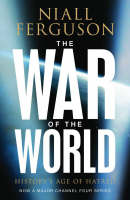
Harvard historian Niall Ferguson discusses his book "The War of the World: 20th Century Conflict and the Descent of the West"- (Sep 12, 2006 at Vanderbilt University). Listen to the podcast.
Some article by Niall- ‘The Next War of the World’, The origins of the Great War of 2007 - and how it could have been prevented, Tomorrow's world war today. See also SHORTER NIALL FERGUSON: IF WE DON'T ATTACK IRAN, THERE'LL BE NUCLEAR WAR
A panel discussion of the recent and historical conflict between Israel and Hezbollah, its effects on Lebanon and its implications for U.S. policy. Featuring Fawaz A. Gerges, professor of International and Middle Eastern Studies, Sarah Lawrence College, Michael Eisenstadt, The Washington Institute for Near East Policy, moderated by Larry P. Goodson, professor of Middle East studies, United States Army War College. Listen to the podcast.
The Wonga Coup
For more detail see this post at Pienso.
Sri Lanka; With violence once again erupting in Sri Lanka, Rear Vision traces the historical roots of the conflict. Guests include Jonathan Spencer, Professor of Anthropology of South Asia , University of Edinburgh, Dr. Jayadeva Uyangoda, Professor and Head, Department of Political Science and Public Policy, University of Colombo and Dr. Paikiasothy Saravanamuttu, Executive Director of the Centre for Policy Alternatives, an independent, nonpartisan, public policy centre with a focus on peace and governance, Colombo
Keeping the peace: the U.N. Security Council; The United Nations Security Council has finally brokered a cease-fire in Lebanon. On Rear Vision this week, a history of the UN's most powerful body.
Guests include Rosemary Righter, Associate Editor, The Times, Ian Williams, UN correspondent , The Nation, Colin Keating, Executive Director, Security Council Report, Former New Zealand UN Ambassador
See also ‘Security Council Report’ will publish, on a regular monthly basis, independent and objective information and analysis about the United Nations Security Council and the issues on its existing and future agendas.
See also this debate from BBC-to mark the end of Radio 4's This Sceptred Isle: Empire series, some of this country's best-known historians will be examining how Britain and other countries around the world have been changed by their experience of empire. They'll be discussing whether Britain should apologise and make reparation for its imperial past or glory in it, and asking whether the twenty-first century will see the birth of new empires. Eric Hobsbawm, Niall Ferguson, Robert Beckford, Linda Colley and Priya Gopal. (the program is available online)
The Hammer Against Witches

Kevin in a comment to an earlier post mentioned that ‘No bigot I have ever known was as scientistic or as vicious as the writer of this article in EB,’. I think the following book Malleus Maleficarum (1486), written as a guide to witch hunting beats the Negro definition from the Encyclopedia Britannica. The book was second only to Bible in popularity when it was published (watched the History Channel video). Some excerpts from the chapter titled; “Concerning Witches who copulate with Devils. Why is it that Women are chiefly addicted to Evil superstitions”-
“…For S. Jerome in his Contra Iouinianum says: This Socrates had two wives, whom he endured with much patience, but could not be rid of their contumelies and clamorous vituperations. So one day when they were complaining against him, he went out of the house to escape their plaguing, and sat down before the house; and the women then threw filthy water over him. But the philosopher was not disturbed by this, saying, “I knew the rain would come after the thunder.”There is also a story of a man whose wife was drowned in a river, who, when he was searching for the body to take it out of the water, walked up the stream. And when he was asked why, since heavy bodies do not rise but fall, he was searching against the current of the river, he answered: “When that woman was alive she always, both in word and deed, went contrary to my commands; therefore I am searching in the contrary direction in case even now she is dead she may preserve her contrary disposition.”
And indeed, just as through the first defect in their intelligence that are more prone to abjure the faith; so through their second defect of inordinate affections and passions they search for, brood over, and inflict various vengeances, either by witchcraft, or by some other means. Wherefore it is no wonder that so great a number of witches exist in this sex.
Women also have weak memories; and it is a natural vice in them not to be disciplined, but to follow their own impulses without any sense of what is due; this is her whole study, and all that she keeps in her memory. So Theophrastus says: If you hand over the whole management of the house to her, but reserve some minute detail to your own judgement, she will think that you are displaying a great want of faith in her, and will stir up a strife; and unless you quickly take counsel, she will prepare poison for you, and consult seers and soothsayers; and will become a witch.
But as to domination by women, hear what Cicero says in the Paradoxes. Can he be called a free man whose wife governs him, imposes laws on him, orders him, and forbids him to do what he wishes, so that he cannot and dare not deny her anything that she asks? I should call him not only a slave, but the vilest of slaves, even if he comes from the noblest family. And Seneca, in the character of the raging Medea, says: Why do you cease to follow your happy impulse; how great is that part of vengeance in which you rejoice? Where he adduces many proofs that a woman will not be governed, but will follow her own impulse even to her own destruction. In the same way we read of many woman who have killed themselves either for love or sorrow because they were unable to work their vengeance.S. Jerome, writing of Daniel, tells a story of Laodice, wife of Antiochus king of Syria; how, being jealous lest he should love his other wife, Berenice, more than her, she first caused Berenice and her daughter by Antiochus to be slain, and then poisoned herself. And why? Because she would not be governed, and would follow her own impulse. Therefore, S. John Chrysostom says not without reason: O evil worse than all evil, a wicked woman, whether she be poor or rich. For if she be the wife of a rich man, she does not cease night and day to excite her husband with hot words, to use evil blandishments and violent importunations. And if she have a poor husband she does not cease to stir him also to anger and strife. And if she be a widow, she takes it upon herself everywhere to look down on everybody, and is inflamed to all boldness by the spirit of pride.
If we inquire, we find that nearly all the kingdoms of the world have been overthrown by women. Troy, which was a prosperous kingdom, was, for the rape of one woman, Helen, destroyed, and many thousands of Greeks slain. The kingdom of the Jews suffered much misfortune and destruction through the accursed Jezebel, and her daughter Athaliah, queen of Judah, who caused her son's sons to be killed, that on their death she might reign herself; yet each of them was slain. The kingdom of the Romans endured much evil through Cleopatra, Queen of Egypt, that worst of women. And so with others. Therefore it is no wonder if the world now suffers through the malice of women.
And now let us examine the carnal desires of the body itself, whence has arise unconscionable harm to human life. Justly we may say with Cato of Utica: If the world could be rid of women, we should not be without God in our intercourse. For truly, without the wickedness of women, to say nothing of witchcraft, the world would still remain proof against innumerable dangers. Hear what Valerius said to Rufinus: You do not know that woman is the Chimaera, but it is good that you should know it; for that monster was of three forms; its face was that of a radiant and noble lion, it had the filthy belly of a goat, and it was armed with the virulent tail of a viper. And he means that a woman is beautiful to look upon, contaminating to the touch, and deadly to keep.
Let us consider another property of hers, the voice. For as she is a liar by nature, so in her speech she stings while she delights us. Wherefore her voice is like the song of the Sirens, who with their sweet melody entice the passers-by and kill them. For they kill them by emptying their purses, consuming their strength, and causing them to forsake God. Again Valerius says to Rufinus: When she speaks it is a delight which flavours the sin; the flower of love is a rose, because under its blossom there are hidden many thorns. See Proverbs v, 3-4: Her mouth is smoother than oil; that is, her speech is afterwards as bitter as absinthium. [Her throat is smoother than oil. But her end is as bitter as wormwood.]
Let us consider also her gait, posture, and habit, in which is vanity of vanities. There is no man in the world who studies so hard to please the good God as even an ordinary woman studies by her vanities to please men. An example of this is to be found in the life of Pelagia, a worldly woman who was wont to go about Antioch tired and adorned most extravagantly. A holy father, named Nonnus, saw her and began to weep, saying to his companions, that never in all his life had he used such diligence to please God; and much more he added to this effect, which is preserved in his orations.
It is this which is lamented in Ecclesiastes vii, and which the Church even now laments on account of the great multitude of witches. And I have found a woman more bitter than death, who is the hunter's snare, and her heart is a net, and her hands are bands. He that pleaseth God shall escape from her; but he that is a sinner shall be caught by her. More bitter than death, that is, than the devil: Apocalypse vi, 8, His name was Death. For though the devil tempted Eve to sin, yet Eve seduced Adam. And as the sin of Eve would not have brought death to our soul and body unless the sin had afterwards passed on to Adam, to which he was tempted by Eve, not by the devil, therefore she is more bitter than death.
More bitter than death, again, because that is natural and destroys only the body; but the sin which arose from woman destroys the soul by depriving it of grace, and delivers the body up to the punishment of sin.
More bitter than death, again, because bodily death is an open and terrible enemy, but woman is a wheedling and secret enemy.
And that she is more perilous than a snare does not speak of the snare of hunters, but of devils. For men are caught not only trough their carnal desires, when they see and hear women: for S. Bernard says: Their face is a burning wind, and their voice the hissing of serpents: but they also cast wicked spells on countless men and animals. And when it is said that her heart is a net, it speaks of the inscrutable malice which reigns in their hearts. And her hands are as bands for binding; for when they place their hands on a creature to bewitch it, then with the help of the devil, they perform their design.
To conclude. All witchcraft comes from carnal lust, which is in women insatiable. See Proverbs xxx: There are three things that are never satisfied, yea, a fourth thing which says not, It is enough; that is, the mouth of the womb. Wherefore for the sake of fulfilling their lusts they consort even with devils. More such reasons could be brought forward, but to the understanding it is sufficiently clear that it is no matter for wonder that there are more women than men found infected with the heresy of witchcraft. And in consequence of this, it is better called the heresy of witches than of wizards, since the name is taken from the more powerful party. And blessed be the Highest Who has so far preserved the male sex from so great a crime: for since He was willing to be born and to suffer for us, therefore He has granted to men the privilege.”
Related;
Sexy Devils;What really lay behind the massive witch hunts of the Middle Ages?
Witchcraft Collection- Cornell University
The massa marittima mural / the malleus maleficarum
Images of Circe and Discourses of Witchcraft, 1480-1580
History of Witchcraft - Research Guide
Multimedia;
WITCHCRAFT- BBC
"Why did practices that had been tolerated for centuries suddenly become such a threat? What brought the prosecutions of witchcraft to an end, and was there anything ever in Europe that could be truly termed as a witch?"
Listen to Helen Fisher for an intelligent discussion for some real differences between the sexes (very highly recommended).
September 14, 2006
“My God is bigger than yours” Dept.
Pope Benedict XVI quoted criticisms of the Mohammed by a 14th Century Byzantine Christian emperor, Manuel II Paleologus in a recent speech in Germany;
“Show me just what Mohammed brought that was new, and there you will find things only evil and inhuman, such as his command to spread by the sword the faith he preached".
For a different approach at dialogue listen (browse down the page) to Robert Thurman.
Related;
Muslim Leaders Assail Pope’s Tough Speech on Islam
Pope hits out at Islam
Google News coverage
September 13, 2006
Some Podcasts
The history of scientific discoveries; The author of a book called 'Who Discovered What When', David Ellyard, discusses the history of discoveries in science
TCS podcasts- the latest is with Dierdre McCloskey
Regaining confidence in western culture
Facing the evidence - part one; Only one in two patients receives the healthcare they should receive according to the evidence. One in ten patients receives care that isn't recommended and which is potentially harmful. In the first part of this series about getting health professionals to practice with evidence, Associate Professor Alex Barratt takes a close look at the catastrophic errors that have occurred when evidence has been ignored, and why evidence based practice is still not being implemented in consultation rooms near you. Read the transcript.
Drug-driving; why Australia is the world's leader when it comes to random saliva drug testing for drivers
Free Gardeners, Odd Fellows and Druids: a history of health insurance in Australia
Celebrating 50 years of television
Gaia and accelerating climate change; It was in the late 1960s that James Lovelock first suggested the Earth acted as a single organism. He named his observation, Gaia. He was ridiculed and the idea was ignored for decades. It wasn't until the end of the 90s that a new branch of science grew out of his theory; that of Earth System Science. Now, as the effects of climate change have become obvious for all to see, James Lovelock has taken his theory further in a book, The Revenge of Gaia. Lovelock claims we've passed the point of no return with climate change.
Peter Singer, Professor of Bioethics at Princeton University, debates his views on life and death with a panel of experts
How can we resolve the tensions between the different communities in Europe in the light of the growing threat from Islamic extremists, sometimes dubbed the 'Enemy Within'? Hisham Hellyer is a policy analyst, academic and commentator, based at the University of Warwick as an Associate Fellow, the American University in Cairo as a Visiting Professor and Trinity College in Dublin as a Senior Research Fellow. His research interests include European Muslim communities, the interplay between Islam and modernity, European social policy and political philosophy. In his latest book on European Muslims (due to be published by IB Tauris in March 2007 under the title of ''Islam in Europe: Multiculturalism and the European 'Other'), he argues that Europe must come to terms with all of her history, past and present, and that Muslim communities should work to be integral to, rather than simply 'integrated' parts of, Europe.
History of Israel-Palestine conflict
September 12, 2006
The Seduction of Culture in German History


During the Allied bombing of German cities, Hitler was more concerned by the loss of cultural treasures than he was by human casualties. At the time, his propagandists broadcast the fact, believing it would impress the German public by revealing Hitler's cultural sensitivity: the artist's spirit inside the military uniform. Wolf Lepenies argues that this incident is part of the long German tradition of valuing cultural achievement above all else, including politics - a tradition which he believes has had a catastrophic consequences for his country. Listen to the podcast from Radio National (starts at the end of the program).
Here is the Introduction of the book;
“This book examines the German attitude of regarding culture as a substitute for politics and of vilifying politics, understood above all as parliamentary politics, as nothing but an arena of narrow-minded, interest-group bargaining and compromise. But this work is not a debate on the Sonderweg (special path) in disguise, asserting that the aversion to politics and the idealist and romantic veneration of culture were the main reason why Germany departed from the "normal" Western course of development and steered into the disaster of Nazism. I do not describe an attitude that is a uniquely German phenomenon. Still, I argue that an overestimation of cultural achievements and a "strange indifference to politics" (G.P. Gooch) nowhere played a greater role than in Germany and have nowhere else survived to the same degree. Seeing culture as a substitute for politics has remained a prevailing attitude throughout German history--from the glorious days of eighteenth- and nineteenth-century Weimar through, though now in considerably weaker form, the reunification of the two Germanys after the fall of communism. Peter Gay, Georg Mosse, Fritz Ringer, Fritz Stern, Peter Viereck, and others have explored this specific German attitude toward culture and politics. I am revisiting their arguments and try to offer new insights into an old problem. “
Also recommended;
The Wages of Destruction: The Making and the Breaking of the Nazi Economy by Adam Tooze. See reviews at Financial Times and The Guardian. Brad de Long also recommends the book.
The Myth of a Tragic Past
Andrei Lankov, debunks the myth that Korea has a monopoly over a tragic history;
“Well, let’s have a look at the Choson Dynasty period, from 1392 to 1910. The last four decades of these five centuries were turbulent indeed, but what about earlier times? Even a cursory look demonstrates that it was hardly a time of troubles. Throughout 1392-1865, Korea fought three wars against foreign invaders, not including some minor border skirmishes with nomads in the north, and Japanese pirates on the coasts. In one case, the war with Japan from 1592-1598, known as Hideyoshi’s invasion in the West, and as the Imjin War in Korea, was disastrous and the entire country was devastated. As you know, the medieval armies, all those knights in shining armor, were not too nice when they encountered the civilian population. The two other conflicts, of 1627 and of 1636, were of much smaller scale _ essentially, two blitzkriegs brilliantly executed by Manchu generals whose cavalry units broke through Korean defenses, approached Seoul, and forced the Korean government to agree to an unfavorable peace.Let’s compare this with the fate of more or less every European country. Throughout the same period of 1392-1865, almost every country in Europe fought a much greater number of conflicts, and suffered much greater casualties. Let’s have a look at German history. The period under consideration is marked by at least four major military conflicts, each lasting for one or several decades, and resulting in mass death and destruction: the Reformation Wars, the Thirty Years War (1618-1648), the Prussian campaigns of the mid-18th century and the Napoleonic wars. And these are only large-scale wars, each being as significant and bloody as Korea’s war with Japan in 1592-1598 (in all probability, all these conflicts were more destructive than the Hideyoshi invasion). Apart from these, there were a number of smaller conflicts, many of which were not small at all like the War of the Spanish Succession (1701-1714), or the chain of conflicts that accompanied German unification in the 1850s and 1860s. And, of course, there were countless quarrels between the mini-states which formed the Germany of the era, each such quarrel being a military conflict on its own right, far exceeding Korea’s occasional skirmishes with Japanese raiders.
Is Germany an exception? By no means. This is the fairly typical history of any European country, and against such a background Korean history appears rather quiet. Rather than being a country with a uniquely turbulent history, Korea actually was a country, which enjoyed stability undreamed of in most other parts of the world!”
September 9, 2006
Iraq Chaos

Juan Cole has a commentary in Salon on the divisions between the Shiite community in Iraq;
“Sadly, not even the man once considered the Shiites' great peacemaker has been able to stop the violence. The decline in influence of Grand Ayatollah Ali Sistani, once a revered voice of calm and unity, underlines the fragmentation of the Shiite south. When his call to stop a Shiite-on-Shiite skirmish in mid-August went unheeded, Sistani was reportedly so discouraged that he was said to be contemplating a complete withdrawal from politics. Sistani had earlier been a key architect of Shiite unity, cobbling the various religious parties into the United Iraqi Alliance, which has more or less won both parliamentary elections. But his influence has waned as he has continued to preach social harmony and avoidance of reprisals against Sunnis, a message the Shiite masses no longer want to hear.The military position of the United States and Britain in Iraq is already fragile. Coalition forces seem barely able to keep a lid on the Sunni Arab guerrilla movement in Ramadi, Samarra, Mosul and even Baghdad. The Pentagon admitted in its recent quarterly report that violence was up 15 percent in May through July over the previous quarter. July was the most violent month in terms of civilian fatalities since the fall of Saddam. Some 90 percent of the dead are simply found in the street - bullet in the brain, hands tied, signs of torture. For the most part such violence has been a dirty war conducted by Sunni and Shiite militias against one another. If Shiite-on-Shiite violence spreads, at a time when even Grand Ayatollah Sistani has been helpless to intervene, it is difficult to see how the American and British militaries can remain viable in Iraq.”
Related:
Iraq Country Analysis- Energy Information Administration
Cordesman: Civil War Can Break Out Anytime In Iraq
Iraq, Terrorism, and U.S. Politics
Fact Sheet: The President's National Strategy for Combating Terrorism
Saddam 'had no link to al-Qaeda' ; Senate's Intelligence Committee report
The Official Website of the Multi-National Force in Iraq
After the Guns of August- Saad Eddin Ibrahim;
"President George W. Bush has been short on neither initiatives nor catchy slogans and acronyms. Recent years are littered with them: “Global War on Terror” (GWOT), “Road Map,” “Middle East Partnership Initiative “ (MEPI), “Broader Middle East and North Africa” (BMENA) – originally “Greater Middle East Initiative (GMEI) – Democracy Assisted Dialogue (DAD), and so on. His latest reverie, envisioned in the thick of the recent fighting between Israel and Hezbollah, was the New Middle East (NME), with US clients Israel, Egypt, Jordan, and Saudi Arabia serving as the pillars of regional order."
Watchdog criticises US-run Radio Sawa, Alhurra TV; The Government Accountability Office (GAO) also found that Sawa and the Alhurra satellite television network were falling short in measuring the quality of their programmes, which the stations say reach nearly 36 million people.
Measuring Security and Stability in Iraq- Quarterly Reports
The Iraqi Conflict- miscellaneous links on Iragi history
Talking to Terrorists (podcast)
"This is a conversation with Rick Welch, a lawyer from McConnelsville, Ohio, who is also a Lieutenant Colonel in the US Army reserve. For 18 months, from late 2003 until the middle of last year, Rick was the civil-military advisor to the commander of the 1st Cavalry Division, Taskforce Baghdad, and a major part of his job was to sit down with key figures in the insurgency"
September 6, 2006
A New Map of the Middle East?

An article in Armed Forces Journal suggests we need to revise the map of the of the Middle East;
“A just alignment in the region would leave Iraq's three Sunni-majority provinces as a truncated state that might eventually choose to unify with a Syria that loses its littoral to a Mediterranean-oriented Greater Lebanon: Phoenecia reborn. The Shia south of old Iraq would form the basis of an Arab Shia State rimming much of the Persian Gulf. Jordan would retain its current territory, with some southward expansion at Saudi expense. For its part, the unnatural state of Saudi Arabia would suffer as great a dismantling as Pakistan.A root cause of the broad stagnation in the Muslim world is the Saudi royal family's treatment of Mecca and Medina as their fiefdom. With Islam's holiest shrines under the police-state control of one of the world's most bigoted and oppressive regimes — a regime that commands vast, unearned oil wealth — the Saudis have been able to project their Wahhabi vision of a disciplinarian, intolerant faith far beyond their borders. The rise of the Saudis to wealth and, consequently, influence has been the worst thing to happen to the Muslim world as a whole since the time of the Prophet, and the worst thing to happen to Arabs since the Ottoman (if not the Mongol) conquest.
While non-Muslims could not effect a change in the control of Islam's holy cities, imagine how much healthier the Muslim world might become were Mecca and Medina ruled by a rotating council representative of the world's major Muslim schools and movements in an Islamic Sacred State — a sort of Muslim super-Vatican — where the future of a great faith might be debated rather than merely decreed. True justice — which we might not like — would also give Saudi Arabia's coastal oil fields to the Shia Arabs who populate that subregion, while a southeastern quadrant would go to Yemen. Confined to a rump Saudi Homelands Independent Territory around Riyadh, the House of Saud would be capable of far less mischief toward Islam and the world.
Iran, a state with madcap boundaries, would lose a great deal of territory to Unified Azerbaijan, Free Kurdistan, the Arab Shia State and Free Baluchistan, but would gain the provinces around Herat in today's Afghanistan — a region with a historical and linguistic affinity for Persia. Iran would, in effect, become an ethnic Persian state again, with the most difficult question being whether or not it should keep the port of Bandar Abbas or surrender it to the Arab Shia State.What Afghanistan would lose to Persia in the west, it would gain in the east, as Pakistan's Northwest Frontier tribes would be reunited with their Afghan brethren (the point of this exercise is not to draw maps as we would like them but as local populations would prefer them). Pakistan, another unnatural state, would also lose its Baluch territory to Free Baluchistan. The remaining "natural" Pakistan would lie entirely east of the Indus, except for a westward spur near Karachi.”
Via Cartography blog.
*I do not share the views of the author
Podcasts Carnival
Dr Karl Sauvant - World Investment Prospects to 2010: Boom or Backlash? (Radio Economics). Here is special edition of the report
Jospeh Stiglitz: making globalisation work; Nobel Prize winning economist Joseph Stiglitz has written a follow-up to his best-selling book "Globalisation and it Discontents" which looks at the current problems with globalisation and the forces of reform at work. Related posts by Tyler Cowen on Making Globalization Work, or Joe Stiglitz watch, part II and Joe Stiglitz watch
Sri Lanka; With violence once again erupting in Sri Lanka, Rear Vision traces the historical roots of the conflict. Guests include Jonathan Spencer, Professor of Anthropology of South Asia , University of Edinburgh, Dr. Jayadeva Uyangoda,Professor and Head, Department of Political Science and Public Policy, University of Colombo, Dr. Paikiasothy Saravanamuttu, Executive Director of the Centre for Policy Alternatives, an independent, nonpartisan, public policy centre with a focus on peace and governance, Colombo
Books That Shook the World - Plato's Republic
Anthony Arnove; The Logic of Withdrawal
Christopher Scanlon on The Joint Strike Fighter
Australia and the nuclear renaissance; Nuclear is back. Australia, with its abundant ore and 'good guy' status could become a key member of the uranium enricher's club. But what would the neighbours think? And how would the twin threats of weapons proliferation and waste disposal be addressed?
John Mortimer (Edinburgh International Book Festival)
Polash Larsen's review of Londonstani, by Gautam Malkani
Engineering wonders: tunnels and bridges
Over-fished or over-regulated?; According to marine biologist Dr Walter Starck, Australia has the most over-managed, heavily restricted and least productive fishery industry in the world. He'll be speaking at the upcoming Australian Environment Foundation inaugural conference. We're also joined by chair of the foundation, Don Burke, to hear why Australia needs another environment group.
Australia On The Map Part One: The Siren South; This is the first program in the Australia On The Map series, exploring early Dutch exploration of the Australian coastline. This year marks the 400th Anniversary of the first mapping of our northern coastline by Dutchman Jan Lodewijkszoon van Rosingeyn and the crew of the Duyfken
Jess Adkins has a lab full of cucumbers made of stone. They are, in fact, drill cores of corals from all over the world. He analyses these with surprising results, getting a remarkably accurate story of past climates going back thousands of years. This young professor from Caltech (the California Institute of Technology) has some amazing stories to tell of adventure and exploration
Jane Goodall is one of the best-known observers of animal behaviour. She revolutionised the field in the 1960s by watching chimpanzees in the wild. What now does she make of their relationship with humans? And what are their prospects? Will they really become extinct outside zoos within a generation?
Lee Edwards; BP now stands for Beyond Petroleum. The company says it is proud of its diversification from fossil fuels. But will solar be enough to make a difference? Dr Lee Edwards runs BP's solar research from his base in Chicago and he foresees cities which are self-reliant through the sun and alternative sources rather than through a dependence on oil. But will BP withstand competition from less green rivals?
Western Democracies and Voter Cynicism
Derek Denton: The Dawning of Consciousness
Teachers and Performance Pay
featuring Andrew Leigh, Economist,Australian National University Co-author of "How and Why has Teacher Quality Changed in Australia?"
Anyone who had a heart would know their own language; Another chance to hear virtuoso grammarian Geoff Pullum on the logic of standard English usage...as described in The Cambridge Grammar of the English Language.
Cliches: are they worthless? The poet Chris Wallace Crabbe on the brass razoos in the currency of conversation.
Climate change; Dr Barrie Pittock of the CSIRO talks about climate change and risk management and what to do about climate change
The David Hicks Case; Former attorney-general Kep Enderby QC looks at the imprisonment of David Hicks at Guantanamo Bay
Tea with Glen Matlock; The confessions of a middle aged Sex Pistol.
Michael Whelan, S.M.; He helped found Spirituality in the Pub, a network of groups across Australia that meet to discuss all kinds of spiritual issues with the aim of deepening faith and transforming lives. For Michael Whelan, a priest in the Society of Mary congregation, conversation is a vital instrument of change, and he talks about his own spiritual development away from moralism and toward mysticism
Bad Hair day: principles and politics in international cricket
Africa's struggle for political evolution
Middlebury "Symposium on Terror and Mass Media" sessisions;
Douglas Birch, Baltimore Sun Correspondent on The Politics of Terror
The Media's Role in Promoting or Fighting Terrorism
Ahmed Abdella, Senior producer and reporter for Al- Arabiyya Television
Is Terrorism Challenging Press Freedom?
Pierre-François Mourrier, director of research for the Office of the French President
Non-proliferation of Weapons of Mass Destruction
Hans Blix, Chairman of the WMDC (Weapons of Mass Destruction Commission) addresses a conference at the Fletcher School, Tufts University
James Madison and the Spirit of Republicanism
Colleen Sheehan, Villanova University
Schiavo and the Shibboleth of Privacy
Daniel N. Robinson, Oxford University; Georgetown University
John Marshall and the Myth of Marbury
Robert Lowry Clinton, Southern Illinois University-Carbondale
Lessons from the Lincoln Administration for the War on Terror
Michael Stokes Paulsen, University of Minnesota Law School, on "The Emancipation Proclamation and the Commander-in-Chief Power: Lessons from the Lincoln Administration for the War on Terror
Media Coverage of Climate Science: Broader Lessons for Science Journalism? (VIDEO)
Nature podcasts; Male infertility, Bird flu's structural secrets and silent spread, cryptic Martian spots explained, the ethics of egg donation, Warmth-seeking bees, Poincaré unpickled and more
National Geographic Podcasts, National Geographic World Talk
Scientific American podcasts, Science Talk episodes
Google News Corporation
Google has started a new feature- News Archive Search. I tried searching for Maldives news items- some interesting things came up (slight spelling corrections made below);
“Holland Evening Sentinel - NewspaperArchive - Jul 7, 1952, THE BENIGHTED MALDIVES LACK CIVILIZED WOES; Now that the Maldive islands, in the Indian ocean, have adopted a republican form of government, it is obvious that something ought to be done to bring the benefits twentieth century civilization to the inhabitants. The MALDIVES, known chiefly to stamp collectors, seem to be singularly backward. They have no relations to speak of with other nations, and hence no cold war tensions. They have no television, and only a few automobiles, limited to one' of the inhabited islands. They have no crime and no jails. The islanders never need aspirin or pheno-barbital. The people, it seems, spend most of their time fishing, fashoning lacquer work, making rope and collecting. They've never learned to get stirred up over things. When the time comes to change their government, they don't make a lot of fuss and speeches; they simply tell some- ody to sit under a palm tree and up a constitution. It's something of a mystery why these benighted people have not tried before this to improve their sorry lot and learn how to enjoy he boons we civilized people take or granted. There's a possible answer which we hate to consider, .faybe they're smarter than we.”Native Revolt In Maldives Is Disclosed; LONDON, Jan. 8 1959 (AP)--Angry mobs swarming from a canoe armada have wrecked and burned offices of the native Government on a remote ...
Reno Evening Gazette - NewspaperArchive - Dec 7, 1934, Maldive Islands lack a sultan Until recently this Indian ocean archipelago had a ruler, Sultan Shamsudeen Iskander, who paid tribute to the British government of Ceylon. Caught trying to substitute an absolute monarchy for the established representative government of the MALDIVES, he has just been dethroned by King George V. "Dreamers who long for an Idyllic Island existence would find their dreams punctured by a visit to the Maldive Islands says a bulletin from the Washington, D C headquarters of the NATIONAL Geogiaphic Society.…Tourists are warned against sleeping on the islands, as they, even more than natives, fall prey to strange complaints…; climate more than anything else, has hindered the development of these islands, especially their foreign intercom se "Only seventeen of the two thousand Islands are inhabitable, …But even agriculture In the MALDIVES has its drawbacks. Natives have to fight armies of rats which menace their cocoanut crops. All the rice consumed must be imported, and is so expensive that only the wealthy can afloid It …..So frequent are wrecks on this and other Maldive Islands that the governor of Ceylon, in granting Ceylon's, and therefore Britain's protection to the MALDIVES, stipulated that, In return, the islanders must aid all Europeans wrecked on their atolls. "In spite of bad climate, bad water, and other obstacles that would discourage most people, the eighty thousand Maldive Islanders live fairly comfortably. Most of them are short, dark copper in color, Intelligent and Industrious They weave their own cloth, and their own boats and nautical Instruments They are skilled navigators and spend much time on the water fishing for bonito. Several of the islands maintain training schools for sailors Maldivans are Mohammedans and occasionally make pilgrim voyages to the Red Sea …
"Native products are peddled among the Islands in native boats, but all trading with foreign countries is done from Male Island, capital of the group. Male, or Sultan’s Island, Is one of the nine inhabited islands ol a group of fifty which compiise Male atoll. On its small surface, less than one square mile In extent, aie crowded trees, houses along sandy streets, foits, the Sultans tomb, and the dethroned sultan's wall-enclosed palace One thousand of Its approximate five thousand Inhabitants are soldiers. "Coral patches and tide lips make one side of Male Island inaccessible, but the harbor on Its east side, protected by a rough breakwater is good. Once a month, two-masted sailing vessels leave for Colombo, Ceylon, with mail, reaching there in three days If the monsoon winds are favorable, sometimes not for thirty days, If they are unfavorable. In August 01 September boats leave for Ceylon, and Calcutta India, carrying principally coir yarn Male Island reaches its peak of activity and excitement when the annual foreign tiaclers call in March. Natives who have brought their product from other atolls gather on the shore to hall ijith delight ships from Ceylon, Sumatia, and Chittagong, India. Duty, consisting of bags of rice, red handkerchiefs, and other commodities such as onions coriander seed and cummin seed, was formerly presented to the Sultan and his government officials "To watch Maldivians do their equivalent of Christmas shopping is to witness a colorful sight. Foreign traders purchase from them large quantities of bonito, which is in great demand in Sumatra and Ceylon. They also buy tortoise shells, coconuts, coir yam, woven glass mats, and cowrie shells used as currency by some Asiatics. In return, the islanders receive rice, dates, salt, curry- stuff, leaf tobacco and betel nuts. They prize red and white checkered handkerchiefs, coarse white cloth, and colored waist cloths. Chinaware and Indian pottery go over big. Although they make a kind of sugar from cocoanuts, they are glad to get coarse brown sugar. They will also trade their cowrie shells for small quantities of steel, thread and brass."
August 31, 2006
‘Iraq Is Bound to Fail'
Amity Shlaes summarizes a recent Easterly paper;
“Authors Alberto Alesina and Janina Matuszeski of Harvard University and William Easterly at New York University divided countries into two categories: natural and artificial. A natural state is one defined by ethnicity and geographic features such as mountain ranges. Mountains reinforce ethnic communities -- if only by isolating them. Natural national borders would tend to be bumpy.The map of an artificial state by contrast looks like it was drawn with a ruler, which it often was. Its straight borders sometimes partition ethnic communities, placing them in two countries. Other times, they place tribes that are hostile to one another in the same nation.
Most nations have borders that are a combination of lines and bumps, so the authors developed a mathematical measure to quantify the extent of border bumpiness, which they called squiggliness. Since borders on oceans are extremely squiggly, the authors controlled for that and studied only the squiggliness of national borders with other nations. Their thesis is that it is better to be natural than artificial, and that squiggliness is good for growth and stability….
Less squiggly countries, the scholars found, generally have lower income, worse public services and higher infant mortality rates. They also found that social unrest, the sort that leads to wars, was also more frequent in unsquiggly places. The net finding, says Alesina, is that artificiality is ``correlated with bad stuff.''It turns out that squiggliness matters even among countries ranking in the middle of the squiggliness scale. ``When you move from the top quarter of squiggly countries to the bottom quarter you see a serious loss of gross domestic product,'' Matuszeski says.
There are outliers, to be sure. At No. 11, Lebanon is super squiggly, which makes the current war there seem like an anomaly. The U.S. and Canada, as stable as they come, have long straight borders and low rankings. Here the situation is different, Matuszeski says, for ``a key factor is when the border is drawn.'' If it is drawn before settlers came -- as was the case in the near-empty New World -- then trouble is less likely…
There are other aspects of the study to challenge here, starting with the choice of the word ``squiggly.'' (It turns out the scholars thought about ``wiggly,'' but felt that ``squiggly'' worked better.)
The bigger problem with the study is the circularity of the argument. The great powers of a 100 or 50 years ago drew the lines that created the colonies or satellite countries.
Britain for example arbitrarily constructed Iraq, and arbitrarily decided its size, which is a bit less than twice that of the U.S. state of Idaho.
``The worst thing that ever happened to Iraq was the invention of the straight edge,'' Easterly says. ``They took Mesopotamia and combined mutually antagonistic groups in one nation.'' Colonialism or tyranny sets trouble in motion. The lines themselves came later. …``The lesson of history is respect nationality,'' Easterly says. ``For Iraq, at the very least you want to emphasize the federalism established there and strengthen it.'' He and his partners are looking at this in a new study, on wars and squiggliness."
Related;
Engaging Fragile States- a new initiative from CGD
State-Building: Governance and World Order in the 21st Century with Francis Fukuyama
State Building and Global Development
The Failed States Index Rankings
Squiggly border theory
Count Ethnic Divisions, Not Bombs, to Tell if a Nation Will Recover From War
The J Curve: A New Way to Understand Why Nations Rise and Fall By Ian Bremmer
Postwar Economics
August 30, 2006
Markets in Everything- Slave Trade

“It took 400 years to import 12 million African slaves to the New World. In just the past 10 years 30 million people have been trafficked in SE Asia alone. The “people trade” affects at least 4 million humans valued at $10 billion a year.”- Illicit by Moises Naim
August 23rd was the International Day for the Remembrance of the Slave Trade and its Abolition
Related;
The Slave Trade map
Moisés Naím on writing ILLICIT
TRAFFICKING FROM RUSSIA & THE CIS: History & Trends
Trafficking in Persons Report
The State Department as hallway monitor
Convention for the Suppression of the Traffic in Persons and of the Exploitation of the Prostitution of Others
Trafficking in human beings-Interpol
Trafficking in human beings: Global Patterns
Multimedia
The Dark Side of Globalization
Drugs, Security, and Development
Philippines model for Iraq?
Does U.S. war in the Philippines at the turn of the 20th century provide an example of how Americans can win in Iraq? Jon Wiener says no;
“The Philippine war was part of the Spanish-American War of 1898, in which the U.S. promised to bring democracy to the Filipinos by freeing them from the Spaniards. But, as Ricks says, things there "began badly" when a powerful Philippine resistance movement challenged U.S. troops — "like Iraq in 2003." In 1902, after three years of guerrilla fighting, the United States declared victory, although American forces remained in the country for decades, administering it first as a colony and then as a commonwealth. The Philippines was granted independence in 1946 — after almost five decades of U.S. military occupation (interrupted by World War II). Today it's a functioning democracy.The problem with this version of history is that it doesn't look closely enough at what happened in the Philippines.
First, it neglects the massive differences between the Philippines in 1900 and Iraq in 2006. The guerrillas in the Philippines fought the Army with old Spanish muskets and bolo knives; today's insurgents in Iraq employ sophisticated improvised explosive devices, rocket-propelled grenades and heat-seeking shoulder-fired missiles that can shoot down helicopters. And combat in Iraq takes place in a fully urbanized society where "pacification" is much more difficult than in the mostly rural islands of the Philippines.
Also, the Filipinos who fought the U.S. Army at the turn of the 20th century had no outside allies or sources of support. Today's Iraqi insurgents are at the center of a burgeoning anti-Americanism that has spread throughout the Arab and Muslim worlds, with supporters in Iran, Syria, Saudi Arabia and elsewhere.And of course today there's also the media. Images of resistance fighters in Iraq, and of the victims of American attacks, are broadcast hourly throughout Iraq, Arab and Muslim countries and the rest of the world. Compared with the Philippines guerrillas of 1900, the Iraqi insurgents are much stronger and more capable and have a much broader base of support that extends beyond national boundaries.
There is also the matter of the atrocious "winning" conduct of the U.S. in the four years of the Philippine war. The U.S. did not count Filipino casualties, but historians today estimate 16,000 deaths for the guerrilla army and civilian deaths between 200,000 and 1 million — a horrifying toll. American tactics included massacres of civilians, "kill and burn" operations that resulted in the destruction of entire villages and starvation of the countryside that created the threat of famine, all exacerbated by a cholera epidemic."
Related;
Legal Quandaries in Iraq
The Iraq-America Freedom Alliance (IAFA) is a coalition of American and Iraqi organizations and individuals committed to fostering goodwill between our nations' citizens and winning the war on terror.
Retaliation Alleged for Teaching on Iraq War
Lie by Lie: Chronicle of a War Foretold: August 1990 to March 2003
Putting the Iraq War on Trial; An army officer who refused duty in Iraq goes to court with a novel argument: he had a duty to disobey because the war is illegal
Seven Questions: Back to School with Bob Kerrey
Rumsfeld Accuses Critics of Appeasement of Fascists
The misguided logic of the "long war"
Arabic T-shirt sparks airport row
August 26, 2006
Political Scientists?

“Recently unearthed documents reveal that Franco's psychiatrist carried out bizarre experiments on members of the International Brigade in 1930s Spain. His aim: to prove that leftwingers are mad…It was here, in 1938, that International Brigade members were subjected to a bizarre set of physical and psychological tests in one of the first systematic attempts to put psychiatry to the service of ideology. Sixty-four years later, the results of Vallejo's project to unravel the "biopsyche of Marxist fanaticism" have finally come to light.
Former prisoners at San Pedro de Cardena remember being subjected to up to 200 tests. They were quizzed on their sex lives, and had their heads and noses measured.
"They made us strip and did all these measurements. We supposed they thought it would be useful if the fascists ever invaded Britain," says Bob Doyle, one of the few remaining survivors of a group of 75 British and Irish prisoners tested at the camp. Another, Carl Geiser, the senior ranking American in the jail and a former political commissar to the Abraham Lincoln Brigade, recalls: "I was photographed with just a small cloth over my penis."
KGB Used Clairvoyants as Agents;
“Correspondents of the Komsomolskaya Pravda daily said that not long before he passed away, Professor Alexander Spirkin, well-known scholar and co-author of the Great Soviet Encyclopedia, admitted in an interview that the Soviet KGB employed clairvoyants to spy on their enemiesAlexander Spirkin used to head a secret lab under the Soviet government and worked closely with clairvoyants hired to carry out special missions for the Kremlin.”
Unrelated link; Pluto loses status as a planet
August 20, 2006
A History of Boredom
 “When hit by boredom, let yourself be crushed by it; submerge, hit bottom. The sooner you hit bottom, the faster you surface.”- Joseph Brodsky
A review of the book A Philosophy of Boredom by Lars Svendsen;
“Any concept that attracted comment from Kant, Goethe, and other giants accomplished enough to be identifiable by one name must be complex, profound, and worthy of attention even in a sweltering August.(If you immediately think, "Wait, there's probably some other concept that's drawn attention from other single-named giants such as Beyoncé, Madonna and Brittany - like bling - that's utterly simpleminded," then you possess a genuine philosophical aptitude and should continue reading.)
"Very few people," writes the witty Norwegian philosopher Lars Svendsen, "have any well-thought-out concept of boredom." That hasn't stopped folks from trying to capture it in a phrase or tossed-off digression.
Kierkegaard declared it "the root of all evil," following on church fathers who condemned its forerunner, the sin of acedia. Svendsen, a professor at the University of Bergen, cleverly updates that, noting that boredom has been accused of causing such modern ills as "drug abuse, alcohol abuse, smoking, eating disorders, promiscuity, vandalism..."
Schopenhauer thought boredom "a tame longing without any particular object." For Kafka, it was "as if everything I owned had left me, and as if it would scarcely be sufficient if all of it returned." Theodor Adorno blamed boredom on alienation at work. Russian poet Joseph Brodsky suggested boredom taught us "life's most important lesson... that you are completely insignificant."
Via Distributed Presses and 3 Quarks Daily
“Politicians are experts in boredom. To sit through a select committee on local transport issues needs superhuman boredom defences, or a vat of Red Bull. And the aura of boredom is the mark of death to a politician. Some have tried to turn their own lack of lustre to advantage. “I am a quiet man,” Iain Duncan Smith said, attempting to disguise his own worthy dullness under a thin euphemism. From that moment, IDS was toast. “What’s wrong with being a boring kind of guy? ” wondered President George Bush Sr, shortly before he was ousted from the White House. Nothing is more hilarious than the spectacle of a naturally tiresome politician attempting to make himself seem interesting by, say, wearing an amusing hat.”
Related;
The Nature of Belief : Australian Science Festival Debate; Why do you believe what you do? Is the human mind an organ designed for belief? Why are we so convinced of the existence of things we can't prove or see? Are some beliefs healthy and others pathological? Margaret Wertheim, author of Pythagoras' Trousers, and The Pearly Gates of Cyberspace; cognitive scientist Professor Max Coltheart, co-editor of Pathologies of Belief, and theologian, film-maker and cult-buster, Reverend Dr David Millikan, join Natasha Mitchell to unravel the perplexing power of belief.
Is This What Happiness Looks Like?
Lionel Tiger on Pursuing Pleasure
August 17, 2006
Race for the Republican presidential nomination of 1896

Only a Bait; T. C. P. "If this don't fetch trade, then I don't understand the hucksterin' business."
Via HarpWeek, Cartoon of the Day
“Cartoonist W. A. Rogers features presidential hopeful Thomas C. Platt, former and future senator from New York, as a huckster peddling "presidential water-melon" to his rivals for the Republican nomination of 1896. Platt cleverly hopes to make the "boys" sick from eating too much of the sweet fruit, so that he can claim the crown himself. Governor Levi P. Morton ("L.P.M") of New York, former vice president (1889-1893), in lace collar and boater, is already gorging himself; Congressman Thomas Reed of Maine (left), former and future speaker of the house, wearing a clownish polka-dot shirt, looks on curiously; and, Governor William McKinley of Ohio (center), who ordered the National Guard to put down labor unrest in his state, appears concerned, but has his toy sword in case of trouble. In the background, Benjamin Harrison, former president of the United States (1889-1893), emerges from his "Ice Wagon" (a pun on his nickname, "the human iceberg," reflecting his cold personality).With the country in an economic depression, and the Democratic Party deeply divided over monetary policy (stable gold versus inflationary silver), the positive prospects for a GOP victory in 1896 induced a number of Republican candidates to enter the field. By the end of 1895, McKinley had become the leading contender, but serious favorite-son candidacies were advanced by Reed, Morton (who captured support of the New York delegation from Platt), Senator William Allison of Iowa, and Senator Matthew Quay of Pennsylvania. Former president Harrison withdrew his name from consideration in early 1896.
Born in 1843, McKinley fought in the Civil War as a young man, and upon its conclusion, studied and practiced law in Canton, Ohio. In 1876, he won election as a Republican to Congress, where he quickly became a spokesman for high protective tariffs. In 1889, he became chairman of the powerful House Ways and Means Committee, using the position to ensure passage of the McKinley Tariff of 1890, which raised the average levy on imports to 48% (the highest rate in American history to that date). Angry voters turned him and other protectionist Republicans out of office later that year. McKinley, though, remained popular in his party and state, and was elected governor of Ohio in October 1891, and reelected two years later...”
Related;
"Historical Aspects of U.S. Trade Policy "
August 15, 2006
What if 9/11 Never Happened?

“The value of counterfactual history lies not in the questions it raises about the past, but the questions it raises about the present and future, and in the reminder that there is nothing inevitable about the world we observe.”
- John Kay
New York Magazine asks the that question after five years (via FP blog);
“Without 9/11, would the London plot have been foiled? Without 9/11, would there have been an Iraq war? Without the Iraq war, would there have been a London plot?
WE’D BE IN A TENSE STANDOFF WITH CHINA Thomas L. FriedmanYOUR APARTMENT WOULD BE WORTH A LOT LESS
Jonathan Miller, real-estate appraiser, Miller SamuelTHE WEEK WOULD HAVE SEVEN SUNDAYS
Bernard-Henri Lévy, author, American VertigoTHE SUPREME COURT WOULD HAVE A MONUMENT TO THE TEN COMMANDMENTS
Dahlia Lithwick, Supreme Court correspondent, SlateBUSH’S WAR WOULD BE AT HOME
Frank Rich, columnist, New York TimesWE’D HAVE BOUGHT A LITTLE TIME
Leon Wieseltier, literary editor, The New RepublicNEW YORK WOULD BE UNRECOGNIZABLE
Tom Wolfe, NovelistFREDDY FERRER WOULD BE MAYOR
Reverend Al SharptonTHE LONDON AIRPLANE PLOT WOULD HAVE WORKED
Ron Suskind, author, The One Percent DoctrineTHE NEW DOWNTOWN? THE NEW WEST SIDE? ATLANTIC YARDS? FORGET IT.
Dan Doctoroff, deputy mayor of economic development and rebuildingTHE U.S. WOULD HAVE A SANE OIL POLICY
Doris Kearns Goodwin , author, Team of RivalsWE WOULDN’T LOOK UP
Robert Ivy, editor-in-chief, Architectural RecordWE’D HAVE PEACE, TRIVIA, AND FOREBODING
Fareed Zakaria, editor, Newsweek InternationalMOBILE, ALABAMA, WOULD BE A HAPPIER PLACE
Dalton Conley, chair, department of sociology, New York UniversityBUSH WOULD HAVE LAUNCHED A MARSHALL PLAN FOR NEW ORLEANS
Douglas Brinkley, author, The Great DelugeNEW YORK WOULDN’T KNOW HOW IMPORTANT IT IS
Hank Sheinkopf, political consultantRUDY GIULIANI WOULDN'T BE "AMERICAN'S MAYOR"
Tony Harris and Brian K. Vaughan
co-creators of Ex Machina, a graphic-novel series about an ex-superhero New York City mayor”
August 7, 2006
“It is good to be an economist, it is better to be a social scientist”

Richard Easterlin’s book The Reluctant Economist should be more widely read; some excerpts from the first chapter (emphasis mine) -
“Economic theory, as taught to undergraduate and graduate students, starts from the assumption that preferences are given and unchanging. Yet a little reflection by economists on their graduate school experience should disabuse them of this notion. Graduate school not only teaches subject matter but also the values of the economics profession – what are the important subjects of economic research, what is the status hierarchy of the profession, which individuals are the proper role models. Graduate training is indoctrination (Klamer and Colander 1990; Reder 1999)…I took two courses from Kuznets, one in statistics, which chiefly conveyed a strong skepticism toward the field and urged the use of simple, understandable methods, and one in economic development, which was essentially a course in general economic history. This development course, too, transmitted a strong sense of skepticism, not, however, toward economic history but toward economic theory. Kuznets’s basic point was simple: the “givens” of economics – technology, tastes, and institutions – are the key actors in historical change, and hence most economic theory has, at best, only limited relevance to understanding long-term change. In Kuznets’s view, what was then called “development theory” – even the widely hailed work of Schumpeter – lacked concrete empirical reference.
I was impressed by Kuznets’s intellect, as were graduate economics students generally, but these courses did not make me into a Kuznetsian. Rather, it was chiefly what Kuznets wrote. As a graduate student, I collaborated on several studies of national income with Raymond T. Bowman, the economics department chairman and a great admirer of Kuznets. Thanks largely to Bowman’s urging, I also did a thesis under Kuznets’s direction on conceptual aspects of the measurement of economic growth. As a result of these two lines of work, I read virtually everything Kuznets had written on national income and economic growth. It was this reading that demonstrated for me the scope, depth, and brilliance of Kuznets’s mind.
Kuznets believed that insight into other times and places started not from economic theory but from knowledge of the facts – especially quantitative facts. It is typical of Kuznets that one of his rare speculative pieces, “Towards a Theory of Economic Growth,” is mostly devoted to summarizing the facts that growth theory must explain. In the present age of endogenous technical change and the “new” growth theory, this article remains well worth reading (Kuznets 1955, see also Kuznets 1966).
Kuznets also believed that it is important to know the scholarly literature of specialists in the study of other times and places. As work on my dissertation led to a growing interest in economic development and away from macroeconomic policy, Kuznets channeled me into an interdisciplinary seminar on South Asia, where I came into contact with scholars doing humanistic and social science research on India and came to know some leading Indian scholars such as N. V. Sovani. Kuznets also encouraged my tutelage in the literature of economic history by Daniel Thorner, who was himself an eminent scholar of Indian economic history…This three-year project affected my development in two ways. For one thing, it gave me my first practical experience in economic measurement. I learned firsthand what had already been clear from Kuznets’s writings: that there is no measurement without theory (Kuznets 1948a, b). I also came to respect the mission of the NBER as originally conceived by Mitchell. This was to build a broad quantitative base of economic measures that would further the “cumulation of economic knowledge” (Burns 1948; Kuznets 1947, 33–4). In my personal experience, the value of this philosophy is demonstrated by the fact that, in economic history, the most often cited work of mine is still my estimates of state income done in the 1950s as part of the Kuznets–Thomas project.
But these notions about the importance of economic measurement ran strongly against the tide of mainstream economics. I can still remember the shock and sense of betrayal I felt one day when economic theorist George Stigler, himself an NBER staff member and eventual Nobel laureate, opined that a doctoral dissertation providing historical estimates of the U.S. balance of payments was not appropriate for a Columbia University Ph.D. in economics….
But economics alone is not enough -- and this is why I am a reluctant economist. We cannot comprehend the world about us without knowledge of the facts and insights provided by the other social sciences. Economics is a starting point, but only a starting point, in the application of social science to the world’s problems. As I reflect on my own philosophy, instilled by Kuznets and molded by experience, it boils down to a few words -- it is good to be an economist, it is better to be a social scientist.”
Related;
"The Story of a Reluctant Economist” in Michael Szenberg and Lall Ramrattan (eds.), Reflections of Eminent Economists.
Why Isn't the Whole World Developed?
"The Economics of Happiness,” Daedalus, 2004
Some Blog coverage of writings by Easterlin; Aplia Econ Blog, Environmental Economics, Canadian Scorecard Weblog, Economics Unbound, The Fly Bottle, Happiness and Public Policy
On Kuznets; from Econlib, Biographical Memoir of Kuznets
*Somebody needs to expand the Wikipedia article on Kuznets. I also checked the Google Book search and Amazon search inside the book on The Reluctant Economist; it seems to me that the Amazon is the better one, with Google being more restricted.
August 5, 2006
Cost of Conflicts
“According to the nonprofit Iraq Body Count Database Project(iraqbodycount.net), between 34,000 and 39,000 Iraqis had died as a result of the conflict by the end of April 2006. While any estimates are controversial, these numbers are actually quite close to theestimate of 30,000 Iraqi casualties that President Bush provided in December 2005. Using the low end of the estimated number of casualties and a VSL calibrated to Iraq’s prewar GDP per capita, the cost of Iraqi lives lost so far tops $150 billion.”
-The Iraq War: The Economic Costs, Milken Institute Review (a quarterly magazine from the Milken Institute, freely available with registration)
Related;
Fiasco, Fiasco II, Fiasco III
Lebanon’s Future- podcast
Iraqis are Chicken
World Peace Through Films? – a must see presentation by Jehane Noujaim at TED conference
July 31, 2006
Provocative Podcast of the Day- Daniel Dennett
Daniel Dennett on Religion; as the world wages war over geographical, religious and historical turf - a growing number of big note scientists want religious faith put under the microscope. Uber philosopher of mind and popular provocateur, Daniel Dennett, author of Darwin's Dangerous Idea, is one of them. He joins Natasha Mitchell to discuss his latest controversial offering, Breaking the Spell. Listen to the podcast. More links on the Radio National's site.
Related; Neuroscience Carnival at Thinking Meat Blog.
July 24, 2006
Gan Island- Used to be a British Base

Dhivehi Observer is running some old Times articles on the Maldives;
Gan Aft Agley (Feb. 23, 1959)
"It is difficult," pontificated the Times of London two years ago, "to imagine either extreme nationalism or a scrupulous addiction to neutrality arising seriously in the Maldives." Seldom has the Times been more wrong. Unceremoniously kicked out of their sea-air bases by newly independent and neutralist Ceylon, the British decided to set up new bases farther south on the placid island of Gan in the Maldives, a splatter of palm-fringed dots in the Indian Ocean 400 miles from Ceylon. There are only 93,000 Maldivians—nut-brown, peaceable folk who have been under the wing of the...”
Those who served at RAF Gan have their own website- Royal Air Force Gan Remembered.
THE PASSIONS & PERILS OF NATIONHOOD (Mar. 11, 1966)
“FOR sheer and pervasive fervor, the love of nationhood has no equal among contemporary political passions. Independence is the fetish, fad and totem of the times. Everybody who can muster a quorum in a colony wants Freedom Now—and such is the temper of the age that they can usually have it. Roughly one-third of the world, some 1 billion people, have run up their own flags in the great dismantlement of empires since World War II, creating 60 new nations over the face of the earth. In the process they have also created, for themselves and for the world, a congeries of unstable and uneasy...”
Didi-Dee & Didi-Dum (Sep. 14, 1953)
“Most nations take years and shed much blood running the political gamut from monarchy to anarchy. But in the placid, unruffled Maldive Islands, which lie some 400 miles southwest of Ceylon in the Indian Ocean, these things are done more calmly. Last January, after centuries of autocratic rule under a sultanate, the Maldives became the world's youngest republic by simple popular vote (TIME, Jan. 12). There was no trouble whatever; the sultans had long since tired of their confining work, and Amin Didi, the man the Maldivians unanimously elected to serve as both President and Prime Minister in the...”
Newest Republic (Jan. 12, 1953)
“The familiar strains of Auld Lang Syne swelled up from a sprawling cluster of tiny coral islands in the Indian Ocean last week, but the singers were not celebrating the New Year; they were merely singing their own national anthem. After years of autocratic rule under Sultans known as the Golden Feet,* the Maldive (rhymes with small hive) Islands had just become the world's newest republic. Queen Elizabeth herself sent the Moslem islanders a message from another island, wishing them "good luck, fair winds and calm waters." A British cruiser stood by to fire a salute, and thousands of...”
Amen for Amin (Feb. 1, 1954)
“THE MALDIVES Soon after the gentle people of the Maidive Islands abolished their centuries-old sultanate and elected Amin Didi their first President (TIME. Jan. 12, 1953), they began to regret it. Amin Didi was chock-full of reform plans—he wrote a new anthem to the tune of Auld Lang Syne; he abolished purdah and designed a new Mother Hubbard for women to wear; he forced the men to elect women to the legislature; he built an elaborate handicraft shop, despite the fact that rarely more than a half dozen tourists a year visit the isolated island chain (pop. 90,000) southwest of Ceylon. But the...”
Related;
Maldives History articles
History of British Empire
The Expelled People of Chagos Islands - evicted to make room for an American military base in Diego Garcia, just south of the Maldives
July 21, 2006
Podcast of the Day- History of Democracy
Radio National’s Rear Vision presents a two part series on the history of democracy, from its beginnings in 2,500 BCE to today- Part 1 and Part 2.
Guests include John Keane, Professor of Politics at the University of Westminster and at the Wissenschaftszentrum Berlin (WZB) and founder of the Centre for the Study of Democracy, Tariq Ali London-based historian, novelist, filmmaker, playwright and anti-imperialist activist, Professor Charles Tilly Joseph L. Buttenwieser Professor of Social Science, Columbia University, Joseph Ketan,Visiting Fellow in Governance Programme, Pacific Institute of Advanced Studies in Development and Governance, University of the South Pacific.
Related;
What’s Democracy? Words of Wisdom from F.A. Hayek
Democratic Peace- blog by R.J. Rummel
Robert A. Dahl’s books are highly recommended
The Democracy Advantage; How Democracies Promote Prosperity and Peace
July 20, 2006
The Future of Middle East?


Related;
Tom Palmer says, ‘Enough....More than Enough’
The War over Israel’s Influence
Juan Cole’s analysis;
“There are two most likely outcomes of the war. One is the collapse of the Lebanese government and the creation of another failed state on Israel's border, where desperation will breed terrorism for decades. The other is a strengthened Hezbollah, which will become the leading force in Lebanese nationalism, weakening the reformists. The maximalist option would likely turn Beirut into a poor Shiite city, reinforcing Shiite political power at the center. Destroying a few Katyusha emplacements in the south will not affect either outcome, and in both cases Hezbollah will probably be able to rebuild its arsenal.The Israelis' current blank check will begin to be canceled by the world community, as the full scale of the destruction of Lebanon becomes apparent and humanitarian crises ensue. At some point it will be forced to cease its attack. Israel will not get the Lebanese government of which it dreams. It may get a U.N. or Lebanese buffer for a while, but it will not be effective, and the southern Lebanese clans are famed for nothing if not long memories and determined feuding.
If, as Abba Eban once said, the Palestinians never missed an opportunity to miss an opportunity, it is equally true that the Israelis, with their reflexive instinct to shoot first and negotiate later, never miss an opportunity to make a bad situation worse. The Israelis have responded the same way to military threats for decades -- with overwhelming force. This is perhaps understandable, but each time they overreact they create future catastrophes for themselves. Just as their 1982 invasion of Lebanon and occupation of the south haunted them for a generation, they will be living with the blowback of their ill-considered war on hapless little Lebanon for decades to come. Tragically, the United States, as Israel's closest ally, will also have to suffer for its actions.”
Meanwhile, Civil War in Iraq?
July 2, 2006
Carnival of Podcasts

Alan Krueger, a professor of economics at Princeton University, talks with Bloomberg's Tom Keene from Princeton, New Jersey, about President George W. Bush's selection of Columbia University scholar Frederic S. Mishkin as a Federal Reserve governor, Mishkin's relationship with Fed Chairman Ben S. Bernanke, and inflation targeting.
Former U.S. Treasury Secretary John Snow talks with Bloomberg's Tom Keene from Washington about the results of a Bloomberg/Los Angeles Times poll that finds more than six in 10 Americans say the country is on the wrong track and that more than half disapprove of President George W. Bush's handling of the economy, Snow's disappointment at not gaining enough support for changes in Social Security and future career plans.
U.S. Trade Policy in the Wake of Doha: Why Unilateral Liberalization Makes Sense; Featuring Jagdish Bhagwati, Professor of Economics and Law, Columbia University, Senior Fellow in International Economics, Council on Foreign Relations and Daniel Ikenson, Associate Director, Center for Trade Policy Studies, Cato Institute
World Economic Update ( a discussion at CFR, June 27,2006)
A Conversation with Hoshyar Zebari, Minister of Foreign Affairs, Republic of Iraq
Brazil's law-enforcing buffaloes ; Police have taken to an unusual form of locomotion in the Brazilian city of Belem
Behavioural Economics: Fear, Anxiety, Overconfidence, and the End of the Financial Year
Philanthropy; The world's two richest individuals are set to give away most of their money to the needy. The personal philanthropy of Bill Gates and Warren Buffett will amount to tens of billions of dollars - so are they setting a trend - will others follow? And just how generous are Australian companies and individuals when it comes to charitable acts?
Emotions at work; This week we hear about some learnable techniques that might help people be more self-aware at work, allowing them to use their emotions as a positive force.
The 'curse' of having a girl ; India might be a country rushing headlong into 21st century but every year thousands of babies are aborted or killed at birth because they are girls
Higher Education Hype and the myth about Chinese engineers
Give Me Land ; Across the world millions of people have no land that they can call their own. Many have been made landless from great injustices. As populations grow and property prices rise the struggle for land becomes more difficult every day. This four-part series travels to China, India, South Africa and Brazil to see how people are fighting for land.
Peter Day looks at the long-running battle between Airbus and Boeing
The Enlightenment Is Not Godless; The 17th Century philosophers in England, France and Germany have been roundly criticised for being anti-religious. Professor of Philosophy at Griffith University, Wayne Hudson, resurrects their different understandings of God and argues they have been ignored in the rush to rubbish the Enlightenment as a den of unbelievers
Zen Brush, Zen Mind; A thousand years after Buddhism arose in 550 BC, Japanese Zen developed zenga - ink painting - which included calligraphy as a way of communicating its message
Interiors - how we 'invented' them; The interior of a house is always undergoing 'renovation' - not only physically, but also within our imagination. Charles Rice is an architect with a theory on how our significant philosphers and psychoanalysts, people like Freud, have shaped not only our sense of self, but the interior of our homes and the settings of most television shows. In fact media and self are now dependent on one another.
Computers and new ways of thinking; Computers are more than an extended drawing tool, or just a way of imaginging 3D. Now they are forging new ways of thinking, and offering ways of imaging the world that would be impossible without a computer. Hear how computers are changing engineering and architecture - indeed blurring the two.
Nutrition for children in Sub-Saharan Africa; In Sub-Saharan Africa malnutrition, particularly in babies and toddlers, is part of every day life. However, there may be some help available through some dietary intervention
Chris Turney; This week, Paul Willis takes the chair and goes dating with Chris Turney. Chris's specialty is carbon dating. He explains how this area of science has been called upon to solve some long-standing mysteries. When did the Minoan civilisation of Europe collapse and why? When did various groups of people arrive on the major continents? These are questions that can now be answered quite accurately using carbon dating, which looks at ratios of radioactive carbon in organic samples and compares the amounts present to the known rate of decay
The Political Speeches of Cicero; Dr Kathryn Welch on the rhetorical brilliance of the master orator of the Roman Republic
Faux Pas; Robert Dessaix on Philip Gooden's no-nonsense guide to words and phrases from other languages.
Those who have ears; Former Queensland teacher Jennifer Riggs looks at an extensive study by the Australian Council for Education Research which identifies serious problems with auditory processing in a high proportion of children
The future for manufacturing in Australia
Putting Ethics First; This year sees the hundredth anniversary of the birth of the philosopher Emmanuel Levinas, who died in 1995. A survivor of the Holocaust, Levinas was a philosopher of ethics who insisted that all human beings, whoever they may be, and he was thinking of Nazis, have a claim on our respect
The philosophy in Tristram Shandy; In 1904, Ivan Pavlov received the Nobel Prize for medicine for his work on the phenomenon he called the conditioned reflex. He had applied stimuli - aural, visual, tactile - to dogs and then fed them. After a while the association in their minds between the stimulus and food was so strong that they'd salivate at the application of the stimulus, even if there was no food around
Cosmopolitanism; It's not about being worldly and sophisticated and it's not about cocktails. Cosmopolitanism is a very old philosophical idea that is coming back into favour. The cosmopolitan believes that each person has a moral responsibility towards each other person, no matter where that person lives or their nationality, religious commitment, ethnic affiliation, socio-economic class, or gender might be. It's a moral virtue for a global age
Developing Australia; This month, federal and state governments bowed to public pressure and abandoned plans to privatise the Snowy Mountains Hydro-Electric Scheme. Rear Vision looks at the history of government involvement in Australia's big projects
East Timor Since Independence; What has happened in East Timor since independence to give rise to the violence, turmoil and political upheaval that culminated this week in the resignation of Prime Minister Mari Alkatiri?
Computer games are not childsplay; Do you remember Donkey Kong, Pacman and Super Mario? Computer games now have names like Doom and Grand Theft Auto, and it's the extreme violence in these games that concerns computer science lecturer Simon McCallum, especially as they are often available to children.
Maternal Health and Foreign Policy Symposium; Session 1 and Session 2
A Conversation with James Baker
Water in India; The cost of boom times in India is a surge in demand for everything - and top of the list is water. Industry, agriculture, households in middle class suburbs and global corporations all want as much as they can get. Is privatisation the answer when governments are struggling?
Workers of the world; Whether you call them guest workers or skilled immigrants, they're part of a globalising workforce
June 25, 2006
Podcast of the Day- Chinese Spirituality
The Way is how Confucius described his system of moral education, contained in the Analects. The Way is also the path found in the Daoist text, the Daodejing, a nameless, hidden truth that cannot be pursued but only spontaneously manifested. And even older than these, the Yi Jing (also, I Ching or Book of Changes) continues to inform the Chinese on every aspect of life from building homes to auspicious dates. Listen to the podcast. More links at the Radio National site.
A Related Blog; The Useless Tree
June 24, 2006
What do the Iraqis Think?

An interesting survey about what Iraqis think based on face-to-face interviews conducted between March 23 – March 31, 2006. I found the response to the following curious.
The Iraqi government currently provides cheap fuel to all Iraqis. Would you be willing to accept a small increase in the price of fuel in exchange for a large reduction in Iraq’s international debt, an increase of several hundred thousand new jobs for Iraqis, and significantly improved government services for the poorest Iraqis?
The majority- some 61 percent- said NO.
Here is a link to survey summary. The graph above shows the ratings for economic conditions.
Related Links;
Some Iraq cost metrics on a one year anniversary
Officer says Iraq firms were slow to return passports
War Post- a blog that posts letters on Iraq 90 Years Apart: Soldiers' Letters from the Mesopotamian Expeditionary Force, 1914-1918, and Operation Iraqi Freedom, 2003-Present
After Zaraqawi; “The Enemy” in Iraq. A podcast featuring Juan Cole.
June 23, 2006
The Spanish Inquisition

The latest ‘In Our Time’ program looks at the Spanish inquisition;
”The Inquisition has its roots in the Latin word 'inquisito' which means inquiry. The Romans used the inquisitorial process as a form of legal procedure employed in the search for evidence. Once Rome's religion changed to Christianity under Constantine, it retained the inquisitorial trial method but also developed brutal means of dealing with heretics who went against the doctrines of the new religion. Efforts to suppress religious freedom were initially ad hoc until the establishment of an Office of Inquisition in the Middle Ages, founded in response to the growing Catharist heresy in South West France.
The Spanish Inquisition set up in 1478 surpassed all Inquisitorial activity that had preceded it in terms of its reach and length. For 350 years under Papal Decree, Jews, then Muslims and Protestants were put through the Inquisitional Court and condemned to torture, imprisonment, exile and death.
How did the early origins of the Inquisition in Medieval Europe spread to Spain? What were the motivations behind the systematic persecution of Jews, Muslims and Protestants? And what finally brought about an end to the Spanish Inquisition 350 years after it had first been decreed?”
Contributors include John Edwards, Research Fellow in Spanish at the University of Oxford, Alexander Murray, Emeritus Fellow in History at University College, Oxford and Michael Alpert, Emeritus Professor in Modern and Contemporary History of Spain at the University of Westminster.