August 21, 2007
A Row Over Migrants
That is in a tiny country of 300,000.
Immigrant Workers May Be Withdrawn: Bangladesh High Commission;
Bangladesh’s High Commissioner has told the government he will pull out his country’s 25,000 expatriate workers if the Home Ministry cannot guarantee their security.
Bangladeshi Castrated In Haa Daal Horror Death;
A Bangladeshi worker has been found dead, with his penis chopped off and stuffed up into a black bra strapped around his groin.
November 27, 2006
Capitalism, not democracy leads to peace?
 Don Boudreaux links to an interesting working paper by Columbia University political scientist Erik Gartzke; The Capitalist Peace.
The following is the conclusion of the paprer.
“This study offers evidence suggesting that capitalism, and not democracy, leads to peace. Additional research is needed to corroborate, extend, and even refute the findings reported here. One must be circumspect in questioning a body of evidence as large and as carefully constructed as that on the democratic peace. Still, economic liberals have long seen in free markets and prosperity the potential to discourage war. A century ago, the “conventional wisdom” looked more like this study and less like that of democratic peace researchers. While past arguments were clearly simplistic and overblown, there does now seem to be grounds for reconsidering liberal economic peace theory.Critics can differ with my revision of classical arguments, or can plausibly challenge the assumptions on which my version of the capitalist peace is built. The statistical models I develop, and the findings that I present, can be altered, possibly in ways that again show that democracy matters. For now, I hope my claims are coherent, empirically plausible, and at the very least intellectually provocative. What is the “larger” relationship between development, capitalism, and democracy? It might be that democracy actually lies behind the apparent impact of capitalism on peace. Still, the world was not always made up of 50% democracies. Little attempt has been made to rule out the possibility that democracy and peace have common causes. A logical extension of this study is the exploration of determinants of political and economic liberalism, though resolving these more complex causal arrows would seem to require a far more profound set of conclusions about the world, ones that are still under construction in comparative politics, economics, and other fields.
The collapse of the Soviet Union in the early 1990’s gave new impetus to the exploration of domestic determinants of international relations. Today, political revolution from without is being attempted in the Middle East, in no small part because policy makers believe that peace can be had through regime change. If the imposition of liberal politics offers a domestic paradox, at the international level coercing democracy is an extreme, though arguably logical, extension of democratic peace theory. At the same time, allowing people freedom to choose implies that they will sometimes choose to disagree. A growing number of popularly elected leaders oppose the interests of established democracies. If democracy reflects the popular will, and many people in the world are unhappy, we should perhaps not expect that all new democracies will like the old ones.”
Related;
The Democracy Advantage: How Democracies Promote Prosperity and Peace (chapter 1 of the book)
R.J. Rummel's blogs; Freedom's Principles and Democratic Peace
The Declining Advantages of Democracy: A Combined Model of War Outcomes and Duration D. Scott Bennett, Allan C. Stam III
Economic Freedom of the World 2005 Annual Report; Chapter 2 - Economic Freedom and Peace
Book review of Alexis de Tocqueville: Prophet of Democracy in the Age of Revolution—A Biography By Hugh Brogan -Alexis de Tocqueville's strong views on demagoguery and citizenship are worth remembering, as is clear from a splendid new biography
Democracy pays off in the long run...
Economic and Political Freedom: Does One Lead to the Other?
Podcasts;
Niall Ferguson: The War of the World
Private Equity- the purest capitalism
November 15, 2006
Podcast of the Day- May the Force Be With You
“The New Rules of the Game is a three part in depth look at globalisation what it means and how it has developed. BBC diplomatic correspondent Jonathan Marcus will take us to Europe, the United States, the Balkans, and China, where he investigates globalisation as a force for both good and evil.
In program one, May the Force Be With You, Jonathan Marcus travels to China and the United States to explore the sinews that bind the new globalised world together. He examines what is meant by globalisation; where did it come from and how has it evolved? What is the relationship between technological change and globalisation? Is it really, as its advocates suggest, a force for good? We hear from one of globalisation's greatest advocates Tom Friedman and from one of its fiercest early critics Robert Kaplan.”
Listen to the podcast.
September 22, 2006
Martin Feldstein on time consistency in fiscal policy
“When I look at the current fiscal situation, in contrast to what we experienced in the '80s when the fiscal deficits were larger and rising, and debt-to-GDP ratios were rising, we're currently at a relatively comfortable level. The federal deficit-to-GDP ratio this year will be under 3 percent, probably low enough that the debt-to-GDP ratio will actually come down.
The problems are not that very far into the future, though, with increases in Social Security and Medicare costs relative to the tax revenue that comes in. The markets seem to be ignoring that, which is a puzzle, but there's nothing about long-term interest rates that suggests that the markets are afraid that Social Security and Medicare are really going to create large fiscal deficits. Now maybe they're right. And maybe the political process will raise taxes or cut benefits. What has to be done is to reform those programs. I wouldn't set my goal in terms of the fiscal deficit. I'd set it in terms of limiting the tax levels that are going to be needed to support them.”
- Interview with Martin S. Feldstein- latest Region magazine
The Region also has review of Martin Wolf’s Why Globalisation Works
See also this book review-Development's Discontents
Related;
The Nation's Long-Term Fiscal Outlook: September 2006 Update
Budgetblog
A Visual Representation of the US Federal Budget
September 20, 2006
Events, Interviews, Discussions- Making Globalization Work
Making Globalization Work; Lee C. Bollinger, Tina Rosenberg, Nancy Birdsall, George Soros, and Joseph E. Stiglitz discuss solutions for some of the world's most pressing problems, such as debt, unfair trade, the "resource curse", the need to curb harmful emissions and world poverty at Columbia University.
Clinton Global Initiative 2006
IMF-World Bank Program of Seminars at annual meeting –Singapore (not yet online)
New Foundations of Cost-Benefit Analysis (not yet online)
How Nations Prosper: Economic Freedom and Doing Business in 2007 (tomorrow)
James Galbraith, an economist at the University of Texas, talks on the outlook for the U.S. economy (podcast)
Related;
Discussions about the IMF-World Bank annual meetings issues at PSD Blog;
Private sector public goods
Business takes on the poverty penalty
Can the World Bank fight corruption?
Economists debate financial sector in India and China
Reforming collateral laws
Roubini has a couple of posts on the IMF-World Bank annual meeting
FT special coverage of Clinton Summit
The latest Foreign Exchange show;
“The World Bank and the IMF are getting together for their annual meeting in Singapore. This year it's not just talk of exchange rates and balance of payments - the United States is pushing hard to give greater weight to Asian and other emerging market economies. To help us understand the dynamics at play, we're joined by Zanny Minton-Beddoes, Washington Economics Editor from The Economist.”
September 18, 2006
Un-Atlantic Economic History from Brad de Long
Brad de Long is running a list of useful economic history books which are not biased towards North America;
Fernand Braudel, The Structure of Everyday Life (Civilization and Capitalism: 15th-18th Century)
Janet Abu-Lughod, Before European Hegemony: The World System A.D. 1250-1350
K.N. Chaudhuri, Trade and Civilisation in the Indian Ocean: An Economic History from the Rise of Islam to 1750
Tirthankar Roy, The Economic History of India 1857-1947
Some books commentators added;
Brook, Timothy. (1998) The Confusions of Pleasure: Commerce and Culture in Ming China. Berkeley: University of California Press.
Ian Brown, "Economic Change in South-East Asia, c.1830-1980." (1997, Kuala Lumpur: Oxford UP)
Reid, Anthony ed. Slavery, Bondage and Dependency in Southeast Asia. 1983.
Adas, Michael. The Burma Delta: Economic Development and Social Change on an Asian Rice. Frontier, 1852-1941. Madison: University of Wisconsin Press. 1974. .
The Eastern Origins of Western Civilisation By John M. Hobson
The Great Divergence: China, Europe, and the Making of the Modern World Economy
By Kenneth Pomeranz
China Transformed: Historical Change and the Limits of European Experience By Roy Bin Wong
Nils Jacobsen 'Mirages of Transition: the Peruvian Altiplano 1780-1940' (Berkeley: University of California Press)
Anand Yang's _Bazaar India: Markets, Society, and the Colonial State in Gangetic Bihar._ (Berkeley, Los Angeles, London: University of California Press, 1998; New Delhi:
Victor Lieberman (2003) Strange Parallels: Southeast Asia in Global Context, c. 800-1830,
Abu-Lughod, Janet L., editor Sociology for the Twenty-first Century: Continuities and Cutting Edges
The Human Web: A Bird's-Eye View of World History
T'Ang China: The Rise of the East in World Historyby Samuel Adrian M. Adshead
An Ottoman Tragedy: History and Historiography at Play
By Gabriel Piterberg
See also;
Why China Stagnated -- Economic History As Lesson
Why Europe and the West? Why Not China?
The World's First Corporations
History of the World in Seven Minutes
Blogs- Book Pundit, Civilisation Pundit,
September 15, 2006
History Podcasts
Harvard historian Niall Ferguson discusses his book "The War of the World: 20th Century Conflict and the Descent of the West"- (Sep 12, 2006 at Vanderbilt University). Listen to the podcast.
Some article by Niall- ‘The Next War of the World’, The origins of the Great War of 2007 - and how it could have been prevented, Tomorrow's world war today. See also SHORTER NIALL FERGUSON: IF WE DON'T ATTACK IRAN, THERE'LL BE NUCLEAR WAR
A panel discussion of the recent and historical conflict between Israel and Hezbollah, its effects on Lebanon and its implications for U.S. policy. Featuring Fawaz A. Gerges, professor of International and Middle Eastern Studies, Sarah Lawrence College, Michael Eisenstadt, The Washington Institute for Near East Policy, moderated by Larry P. Goodson, professor of Middle East studies, United States Army War College. Listen to the podcast.
The Wonga Coup
For more detail see this post at Pienso.
Sri Lanka; With violence once again erupting in Sri Lanka, Rear Vision traces the historical roots of the conflict. Guests include Jonathan Spencer, Professor of Anthropology of South Asia , University of Edinburgh, Dr. Jayadeva Uyangoda, Professor and Head, Department of Political Science and Public Policy, University of Colombo and Dr. Paikiasothy Saravanamuttu, Executive Director of the Centre for Policy Alternatives, an independent, nonpartisan, public policy centre with a focus on peace and governance, Colombo
Keeping the peace: the U.N. Security Council; The United Nations Security Council has finally brokered a cease-fire in Lebanon. On Rear Vision this week, a history of the UN's most powerful body.
Guests include Rosemary Righter, Associate Editor, The Times, Ian Williams, UN correspondent , The Nation, Colin Keating, Executive Director, Security Council Report, Former New Zealand UN Ambassador
See also ‘Security Council Report’ will publish, on a regular monthly basis, independent and objective information and analysis about the United Nations Security Council and the issues on its existing and future agendas.
See also this debate from BBC-to mark the end of Radio 4's This Sceptred Isle: Empire series, some of this country's best-known historians will be examining how Britain and other countries around the world have been changed by their experience of empire. They'll be discussing whether Britain should apologise and make reparation for its imperial past or glory in it, and asking whether the twenty-first century will see the birth of new empires. Eric Hobsbawm, Niall Ferguson, Robert Beckford, Linda Colley and Priya Gopal. (the program is available online)
September 13, 2006
Recent Publications from IMF
Some recent publications from the IMF which are well worth a read;
Global Financial Stability Report- Market Developments and Issues
World Economic Outlook-Financial Systems and Economic Cycles
(analytical chapters)
Doha Development Agenda and Aid for Trade; “This paper summarizes recent developments in the Doha Round negotiations, and aid for trade. As requested by the Development Committee last September, it reviews existing mechanisms for cross-country and regional aid for trade needs. It proposes possible options to overcome the coordination and capacity problems affecting regional cooperation.”
Corruption and Technology-Induced Private Sector Development; “This paper asks whether corruption might be the outcome of a lack of outside options for public officials or civil servants. We propose an occupational choice model embedded in an agency framework to address the issue. We show that technology-induced private sector expansion leads to a decline in publicly supplied corruption as it provides outside options to public officials who might otherwise engage in corruption. We provide empirical evidence that strongly shows that technology-induced private sector development is associated with a decline in aggregate corruption. This suggests that the decline in publicly supplied corruption outweighs the potential increase in privately supplied corruption that could result from private sector expansion.”
Insuring Public Finances Against Natural Disasters--A Survey of Options and Recent Initiatives; “Natural disasters can put severe strain on public finances, in particular in developing and small countries. But catastrophe insurance markets increasingly offer opportunities for the transfer of such risks. Thus far, developing countries have only tepidly begun to tap these opportunities. More frequent and intensive use of insurance markets may be desirable because it could help introduce an important element of predictability in the post-disaster public finances of disaster-prone developing countries. Against this background, the paper surveys the various available insurance modalities and reviews recent initiatives in developing and emerging market countries. It also identifies some key challenges for the insurance community, donors, and international financial institutions (IFIs).”
Prospects for the World Economy-address By Rodrigo de Rato
Economic Policies and Global Prosperity: Challenges for Asia and the IMF- address by John Lipsky
Latest IMF survey
For comment; Why can’t the international financial institutions release a joint economic outlook? IMF deserves credit for putting online most of its publication unlike the OECD, World Bank, or the ADB.
Related;
Chief Economist Jean-Philippe Cotis, OECD on their recent assessment of economic outlook (podcast)
Asian Development Outlook 2006 Update
Labor Markets in Asia: Issues and Perspectives, recent publication of ADB-not available on the web.
September 12, 2006
Globalization’s Assassin
A discussion with senior World Bank economist, Branko Milanovic, who says there are growing fears in both rich and poor countries about the impact of globalisation. He shifts the focus from economics to migration - from the movement of goods and services to the movement of people. The real hot-spot, he says, is Europe, where the fear of job losses to low-pay countries, coupled with ethnic and cultural dilution from immigration, will rock Europe's welfare state economy to its foundations. Listen to the podcast from Late Night Live, Radio National.
related;
Branko Milanovic's posts
Why Globalization Is in Trouble, Part 1 and Part 2
Worlds Apart: Book Discussion
THE THREE CONCEPTS OF INEQUALITY DEFINED
Branko Milanovic columns at Project Syndicate
What Can Foreign Aid Do For the World’s Poor?
Martin Wolf’s Forum on Globalisation
Income Distribution and Trade Policy
General and Conceptual Discussions of Poverty, Inequality & Globalization
Explaining the Gains from Globalization
Inequality around the world
September 9, 2006
Singapore keep up to its reputation
IMF/ World Bank released a statement rebuking Singapore government of refusing entry of certain NGOs for the annual meetings of the multilateral banks;
“In the interest of good governance, transparency and accountability, we urge the Government of Singapore to allow all properly accredited civil society representatives to attend our meetings. We have consistently opposed any restrictions on full participation and peaceful expression of views. Open dialogue with civil society is also important for the effective operation of our institutions.The Singapore Government has informed us of their objection to the accreditation of a number of these civil society representatives, and has stated their intention to block those individuals' access to the Annual Meetings. These individuals have been cleared to attend the Annual Meetings by their respective governments and we have accredited them according to our standard procedure.”
Financial Times notes;
“Some NGOs alleged that the IMF/World Bank, which holds its annual meetings outside Washington every three years, had selected Singapore as the venue for this year's meeting because of its authoritarian reputation. Previous IMF/World Bank meetings have been marred by violent protests.
Among those banned by Singapore were representatives from the UK-based World Development Movement, Thailand's Focus on the Global South, the Freedom from Debt Coalition in the Philippines and the Forum on Indonesian Development (Infid)”
Related;
Singapore to ban outdoor protests at IMF meeting
September 8, 2006
Free Reads from The Economist

Free reads from latest edition of The Economist;
Climate change- The heat is on; The uncertainty surrounding climate change argues for action, not inaction. America should lead the way. Editorial on a survey of the topic.
A discussion with Emma Duncan, Deputy Editor of The Economist; “We need to think about climate change maybe as individuals think about insuring their houses: you spend maybe 1% of your annual income insuring your house not because you think it's going to burn down, but because if by any chance it did burn down, the consequences for you would be disastrous.” Listen to the podcast
Doing business; Singapore took first prize as the easiest place to do business in the World Bank's “Doing Business 2007” report. The Democratic Republic of Congo is the hardest place. Reform was the theme and Georgia the quickest reformer, leaping to 37th place in the rankings from 112th last year. China became one of the top-ten reformers by improving investor protection, cutting red tape and establishing credit history for loans
India's rupee- A disappointment for those hoping capital controls might ease soon; “THE chapter on the Fall of the Rupee you may omit,” counselled Oscar Wilde's prudish governess in “The Importance of Being Earnest”. “It is somewhat too sensational.” A new work on the rupee, in contrast, has set few pulses racing. A report by a committee set up in March by the Reserve Bank, India's central bank, to “revisit” the question of full convertibility of the currency recommends only slow change—too slow, for two of the committee's members, who have dissented from some of its cautious conclusions.
Business in Africa-Once again, Africa is listed as the most difficult place in the world to do business. So why are some businessmen happy to be there?; Foreign investors are governed by trust. India and China also rank relatively poorly in the World Bank survey, but are nonetheless investment magnets. Mr Klein argues this is because investors are confident that these countries are going in the right direction and they want to tap into their large markets early. Africa will have to prove itself through years of good performance and sustained reform before it can gain such confidence. But if it does, those who are already betting on the continent will be miles ahead.
Globalisation- Joe has another go; But if the writing is crisp, the arguments are a little soggy. Mr Stiglitz assumes the worst of markets, the best of governments—except, of course, his own. Too often, he wants to have it both ways: his distaste for the IMF has made him suspicious of all technocratic bodies, even to the point where he questions the case for independent central banks. But at the same time he wants to set up international tribunals to rule on unfair tax competition, for example, or health standards. He says that debt relief for the poorest countries is “simply a matter of accounting”, because they could not repay anyway. But he also wants to argue that the burden of red ink has crippled them.
Dismal science, dismal sentence-The efficient markets hypothesis can land you in jail
Can America's farmers be weaned from their government money?
Mexico's presidential election
Japan- The imperial imperative
Qatar-A bouncy bantam
The French presidency
Charlemagne-Europe's tentative reformers; In Germany it has long been customary for the government, in the interests of consensus politics and social stability, to give “the social partners”—the catch-all name for employers' associations, trade unions and other interest groups—special privileges when writing new laws. On occasion, governments have even asked specific groups to draft legislation. But in drawing up health-care and tax reforms, Angela Merkel's grand coalition has tried to shut health insurers and other lobby groups out of the decision-making process, refused to listen to mere objections and demanded that, if a lobby group has a criticism, it must come up with an alternative way of meeting the government's aim (one reason why the lobbies have turned on the government with offended fury). At the same time, two members of parliament who are also heads of employers' federations (and thus personify Germany's close ties between lobbies and government) have had to choose between their business jobs and their parliamentary seats. Oh, the indignity.
Bagehot-The sands run out ; Labour MPs may come to regret their attempt to force Tony Blair from office
Steve Irwin, crocodile hunter, died on September 4th, aged 44
Economic forecasts-The panel now expects America's GDP growth to slow to 2.5% in 2007, compared with August's prediction of 2.7%. The soothsayers think that the euro area will grow by 2.3% this year (up from 2.2% in August), then slow to 1.8% next year. Germany's growth in 2006 has been revised up from 1.7% to 2.0%. But Japan is now tipped to grow by 2.8%, down from August's prediction of 3.0%. The biggest upward revision is in Sweden's growth this year: it is now forecast to be 4.1%, the fastest of all the economies in the table
Cancer genetics-Variations on a theme; There are a lot more cancer genes around than were previously known
An explanation of how the Atkins diet works
A promising new artificial heart wins regulatory approval
Pluto fights back
Europe's financial sector is ill prepared for a coming upheaval
A row breaks out over the future of Japan's consumer finance
Banks in developing countries
The global housing market
Business Section; Mobile phones on planes / Pharmaceuticals / Drug patents / Viacom / Corporate corruption in Germany / Japan's basic industries / Mobile telecoms
Alan Mulally jumps from Boeing to rescue America's troubled carmaker
September 7, 2006
Good Inaugurals
The John Curtin Institute of Public Policy has just established the journal Public Policy.
Via Andrew Leigh
Good Magazine- your subscription money goes to a charity of your choosing. See Jeffrey Sachs article and their blog.
Via Pienso
September 6, 2006
Google News Corporation
Google has started a new feature- News Archive Search. I tried searching for Maldives news items- some interesting things came up (slight spelling corrections made below);
“Holland Evening Sentinel - NewspaperArchive - Jul 7, 1952, THE BENIGHTED MALDIVES LACK CIVILIZED WOES; Now that the Maldive islands, in the Indian ocean, have adopted a republican form of government, it is obvious that something ought to be done to bring the benefits twentieth century civilization to the inhabitants. The MALDIVES, known chiefly to stamp collectors, seem to be singularly backward. They have no relations to speak of with other nations, and hence no cold war tensions. They have no television, and only a few automobiles, limited to one' of the inhabited islands. They have no crime and no jails. The islanders never need aspirin or pheno-barbital. The people, it seems, spend most of their time fishing, fashoning lacquer work, making rope and collecting. They've never learned to get stirred up over things. When the time comes to change their government, they don't make a lot of fuss and speeches; they simply tell some- ody to sit under a palm tree and up a constitution. It's something of a mystery why these benighted people have not tried before this to improve their sorry lot and learn how to enjoy he boons we civilized people take or granted. There's a possible answer which we hate to consider, .faybe they're smarter than we.”Native Revolt In Maldives Is Disclosed; LONDON, Jan. 8 1959 (AP)--Angry mobs swarming from a canoe armada have wrecked and burned offices of the native Government on a remote ...
Reno Evening Gazette - NewspaperArchive - Dec 7, 1934, Maldive Islands lack a sultan Until recently this Indian ocean archipelago had a ruler, Sultan Shamsudeen Iskander, who paid tribute to the British government of Ceylon. Caught trying to substitute an absolute monarchy for the established representative government of the MALDIVES, he has just been dethroned by King George V. "Dreamers who long for an Idyllic Island existence would find their dreams punctured by a visit to the Maldive Islands says a bulletin from the Washington, D C headquarters of the NATIONAL Geogiaphic Society.…Tourists are warned against sleeping on the islands, as they, even more than natives, fall prey to strange complaints…; climate more than anything else, has hindered the development of these islands, especially their foreign intercom se "Only seventeen of the two thousand Islands are inhabitable, …But even agriculture In the MALDIVES has its drawbacks. Natives have to fight armies of rats which menace their cocoanut crops. All the rice consumed must be imported, and is so expensive that only the wealthy can afloid It …..So frequent are wrecks on this and other Maldive Islands that the governor of Ceylon, in granting Ceylon's, and therefore Britain's protection to the MALDIVES, stipulated that, In return, the islanders must aid all Europeans wrecked on their atolls. "In spite of bad climate, bad water, and other obstacles that would discourage most people, the eighty thousand Maldive Islanders live fairly comfortably. Most of them are short, dark copper in color, Intelligent and Industrious They weave their own cloth, and their own boats and nautical Instruments They are skilled navigators and spend much time on the water fishing for bonito. Several of the islands maintain training schools for sailors Maldivans are Mohammedans and occasionally make pilgrim voyages to the Red Sea …
"Native products are peddled among the Islands in native boats, but all trading with foreign countries is done from Male Island, capital of the group. Male, or Sultan’s Island, Is one of the nine inhabited islands ol a group of fifty which compiise Male atoll. On its small surface, less than one square mile In extent, aie crowded trees, houses along sandy streets, foits, the Sultans tomb, and the dethroned sultan's wall-enclosed palace One thousand of Its approximate five thousand Inhabitants are soldiers. "Coral patches and tide lips make one side of Male Island inaccessible, but the harbor on Its east side, protected by a rough breakwater is good. Once a month, two-masted sailing vessels leave for Colombo, Ceylon, with mail, reaching there in three days If the monsoon winds are favorable, sometimes not for thirty days, If they are unfavorable. In August 01 September boats leave for Ceylon, and Calcutta India, carrying principally coir yarn Male Island reaches its peak of activity and excitement when the annual foreign tiaclers call in March. Natives who have brought their product from other atolls gather on the shore to hall ijith delight ships from Ceylon, Sumatia, and Chittagong, India. Duty, consisting of bags of rice, red handkerchiefs, and other commodities such as onions coriander seed and cummin seed, was formerly presented to the Sultan and his government officials "To watch Maldivians do their equivalent of Christmas shopping is to witness a colorful sight. Foreign traders purchase from them large quantities of bonito, which is in great demand in Sumatra and Ceylon. They also buy tortoise shells, coconuts, coir yam, woven glass mats, and cowrie shells used as currency by some Asiatics. In return, the islanders receive rice, dates, salt, curry- stuff, leaf tobacco and betel nuts. They prize red and white checkered handkerchiefs, coarse white cloth, and colored waist cloths. Chinaware and Indian pottery go over big. Although they make a kind of sugar from cocoanuts, they are glad to get coarse brown sugar. They will also trade their cowrie shells for small quantities of steel, thread and brass."
‘There is no compulsion in religion’
Juan Cole reminds us that;
“Al-Sharq al-Awsat reports that the Grand Sheikh of al-Azhar Seminary in Cairo, perhaps the foremost Sunni Arab authority, has issued a statement that jihad or "holy war" was legislated in Islam for the defense of the persons and honor of Muslims, and is not to be used as a threat or a form of aggression against the innocent.”
We shouldn’t forget religious practices are not monolithic;
“In Senegal, I found local Muslims irate at the condescending attitudes of Saudi emissaries who condemned their practices as contrary to Islam. With their long-established Muslim brotherhoods and their beloved marabouts, the Senegalese responded, "We were Islamic scholars when the Saudis were living in tents."From West Africa to Indonesia, an unnoted defense against Islamist extremism is the loyalty Muslims have to the local versions of their faith. No one much likes to be told that he and his ancestors have gotten it all wrong for the last five centuries. Foolish Westerners who insist that Islam is a unified religion of believers plotting as one to subjugate the West refuse to see that the fiercest enemy of Salafist fundamentalism is the affection Muslims have for their local ways. Islamist terrorists are all about globalization, while the hope for peace lies in the grip of local custom.
Uninterested in political correctness, a Muslim from Côte d'Ivoire remarked to me, "You can change the African's dress, you can educate him and change his table manners, but you cannot change the African inside him." He might have said the same of the Russian, the German, or the Chinese. By refusing to acknowledge, much less attempting to understand, the indestructible differences between human collectives, the 20th-century intelligentsia smoothed the path to genocide in Rwanda, Bosnia, and Sudan, as well as to the age of globalized terror. Denied differences only fester; ignored long enough, the infection kills.
Our insistence that human beings will grow ever more alike defies the historical evidence, as well as practical and spiritual needs. Paradoxically, we make a great fuss of celebrating diversity, yet claim that human values are converging. We, too, have our superstitions and taboos.”
Related;
Sheikh of Al-Azhar : Jihad initiated for self-defense and not for threat or attack
Young U.S. Muslims Strive for Harmony
For Conservative Muslims, Goal of Isolation a Challenge
Iran's liberal lecturers targeted
Creation of "Islamic" Bogeyman
World Conference of Religions for Peace
Fair play and civility in interreligious relations
Multimedia;
Dr Gary Bouma, Professor of Sociology, Monash University on the World Conference on Religions for Peace
Weird Babel of Tongues; One hundred years ago an old building on Azusa Street in the industrial part of Los Angeles held religious meetings that started with people 'breathing strange utterances and mouthing a creed...no sane mortal could understand.' It was the beginning of the modern Pentecostal movement, which remains a thriving church tradition mainly within Protestantism
Creating a Sacred Space; The City of Greater Dandenong is one of Australia's two most diversely populated municipalities and its local hospital, a large acute care hospital, has substituted a multi-faith 'sacred space' in the place of its old chapel. Members of the hospital staff and the City of Greater Dandenong's Interfaith Network, and the Dandenong Historical Society tell about the creation of the sacred space
The Dawning of Consciousness; Emeritus Professor, Derek Denton, is internationally recognised for his work on instinctive behaviours. Professor Denton is 82 but remains involved in various research projects around the globe. His most recent venture is the most ambitous to date - it aims to demonstrate the role of evolution in the emergence of animal and human consciousness
Chinese philosophy; To anybody schooled in Western philosophy, Chinese philosophy doesn't look much like philosophy at all: there seems to be no argument, no analysis, just a lot of proverbs and stories. But this is real philosophy and Dr Karyn Lai gives us an overview. And Chin-Ning Chu, author, motivator and strategist explains what relevance the oldest military treatise in the world has in today's boardroom
September 1, 2006
Best Search Words I Read Today
Going through the site meter of T&B, I came across the following search words from a Pakistani visitor;
‘how would u warn irresponsible employees to work positively with reference to Holy Quran’
Some related and not so related links-most of them podcasts;
Tyler Cowen asks 'If I were a Muslim, would I be a Shiite or a Sunni?'
The looming conflict between Shi'ites and Sunnis; If the war in Lebanon appears to have dramatically increased the prestige of shi'ite Hezbollah in the hopeless Middle East, Robert McCulloch, an Australian Columban priest who has been living and working in Pakistan for twenty eight years, says we should not allow ourselves to be distracted - throughout the whole of the Middle East the big looming furture conflict could well be the conflict between Shi'ites and Sunnis
Best of the Spiritual Classics
On Garbage; This week we're rummaging through the philosophy of garbage. John Scanlan's book, On Garbage shows how western progress always has cleared away and discarded what went before; not only material waste but also knowledge. He believes that by examining our garbage we can gain useful insight into the condition of contemporary life
Books That Shook the World - The Qur'an, perspective by Bruce Lawrence
An Exploration of the Baha'i Faith
Lady Wisdom, the Desert and the Shell; Encounter explores the story of the good wife in the Book of Proverbs who represents Lady Wisdom in this Biblical text
Heaven Doesn't Speak;Confucius said that we should learn to be human, and that by doing so we'll create harmony in the cosmos. What he didn't say was that God was necessarily part of this equation, but that hasn't stopped his brand of practical ethics being given a transcendental spin
Nazi New Religions; Part 1, Part 2; Germany in the 1920s was rife with new religious movements which contributed significantly to Nazi ideology. The cult of the hero for example, popularised in German literature, borrowed from Nordic and Eastern mythology, and formed the basis of a 'master race' ideology. And Anti-Semitism and anti-Christianity were persistent features of the new religions. Karla Poewe examines the rise of the new religions in Nazi Germany
Christian Relics and the Historical Jesus
Jerome Kagan - The Father of Temperament
The Nature of Belief : Australian Science Festival Debate
August 31, 2006
Wal-Mart’s Communist Party Branch

“The world's leading retailer giant Wal-Mart has seen the establishment of the first branch of the Communist Party of China (CPC) and the first branch of the Communist Youth League of China (CYLC) in one of its outlets in the northeastern city of Shenyang, capital of Liaoning Province….Wal-Mart has set up 59 outlets in 30 Chinese cities since it entered China in 1996. It has more than 23,000 employees in China, including over 700 in Shenyang”
Related;
China Digital Times
Forget the World Bank, Try Wal-Mart; Between 1990 and 2002 more than 174 million people escaped poverty in China, about 1.2 million per month. With an estimated $23 billion in Chinese exports in 2005 (out of a total of $713 billion in manufacturing exports), Wal-Mart might well be single-handedly responsible for bringing about 38,000 people out of poverty in China each month, about 460,000 per year.
Fight poverty by shopping at Wal-Mart?
Managing Governments: Unilever in India and Turkey, 1950-1980
Podcast of the Day- Loot: real money in virtual worlds
Virtual worlds are flourishing as millions of online players move in to set up their virtual lives. There are fortunes to be made, and there are real world consequences. Lissten to the podcast- the latest Background Briefing from ABC.
Related;
Terra Nova blog
Play Money: the wiki
State of Play
Ludium Conferences
Chinese Gold Farmers- video
Worlds without end; "Mr Castronova's thesis is that these synthetic worlds are increasingly inter-twined with the real world. In particular, real-world trade of in-game items—swords, gold, potions, or even whole characters—is flourishing in online marketplaces such as eBay. This means in-game items and currency have real value. In 2002, Mr Castronova famously calculated the GNP per capita of the fictional game-world of “EverQuest” as $2,000, comparable to that of Bulgaria, and far higher than that of India or China. Furthermore, by “working” in the game to generate virtual wealth and then selling the results for real money, it is possible to generate about $3.50 per hour. Companies in China pay thousands of people, known as “farmers”, to play MMORPGs all day, and then profit from selling the in-game goods they generate to other players for real money."
August 24, 2006
Definition of Negro

I was shocked to see the following entry for Negro from the Encyclopedia Britannica, 1798 (emphasis mine);
“NEGRO, Homo pelli nigra, a name given to a variety of the human species, who are entirely black, and are found in the Torrid zone, especially in that part of Africa which lies within the tropics. In the complexion of negroes we meet with various shades; but they likewise differ far from other men in all the features of their face. Round cheeks, high cheek-bones, a forehead somewhat elevated, a short, broad, flat nose, thick lips, small ears, ugliness, and irregularity of shape, characterize their external appearance. The negro women have the loins greatly depressed, and very large buttocks, which give the back the shape of a saddle. Vices the most notorious seem to be the portion of this unhappy race: idleness, treachery, revenge, cruelty, impudence, stealing, lying, profanity, debauchery, nastiness and intemperance, are said to have extinguished the principles of natural law, and to have silenced the reproofs of conscience. They are strangers to every sentiment of compassion, and are an awful example of the corruption of man when left to himself.”
- The History of Human Rights-From Ancient Times to the Globalization Era by Micheline R. Ishay, p.113, try Google Book Search.
Related;
Jon Stewart’s “senior black correspondent” Larry Wilmore- The Daily Show
First Chapter of Ishay’s book
Competition and Pandemic Control
Recently I watched the TED speech of Larry Brilliant where he talked about the importance of ‘early detection and early response’ as key for any pandemic control plan. He also talked about the role of public databases like GPHIN in early detection of pandemics and competition it brought to reporting of pandemics. The following article from The Economist summarises some of current data sharing efforts on pandemic diseases;
“The Global Pandemic Initiative, formed in May, is a collaboration between the WHO and the CDC, together with IBM, a large computer firm, and over a dozen other groups. It is intended to develop “the use of advanced analytical and computer technology as part of a global preparedness programme for responding to potential infectious disease outbreaks.” One approach IBM hopes to take is to develop software that will help predict how diseases might spread.Another new group wants to turn the entire process of identifying outbreaks on its head. Larry Brilliant, a former WHO official who helped to eradicate smallpox in India, dreams of an open-source, non-governmental, public-access network that would help the world move quickly whenever potential pandemics start brewing. He looks for inspiration to the Global Public Health Intelligence Network (GPHIN), an obscure programme run by the Canadian government that searches public databases in seven languages looking for early signs of disease outbreak.
Dr Brilliant, who is now the head of Google's philanthropy arm, made his wish known at the Technology Entertainment Design conference, an annual gathering in California of leading entrepreneurs and thinkers from the information-technology and entertainment industries. His speech so galvanised the gathered titans that he now has the backing of Sun Microsystems, Google and several big Silicon Valley venture-capital funds and investors. They are helping to develop a new “web crawler” that will expand GPHIN to track newspapers and internet blogs in 40 to 100 languages.
A reasonable objection to such a system is that it is based on press reports, not verified scientific data. Even so, its supporters argue that it could prove valuable. Press reports have the virtue of immediacy, and its results will always be subject to verification by the WHO and government authorities, of course. But its very existence might persuade them to act more promptly. After all, that is what GPHIN did a few years ago during the SARS outbreak, when it sounded the alarm and forced the authorities to respond. The direct result, in Dr Brilliant's words: “SARS is the pandemic that did not occur.”
Related;
A Summary of Larry Brilliant’s speech
My avian flu policy paper- Tyler Cowen
Avian Influence information; from CDC, WHO, World Bank, Wikipedia, Fluwiki, Pandemic News, BBC, National Geographic Multimedia, InterAction, US Government, FAO
Data sharing; GISAID, International HapMap Project
Support Builds For Pre-Pandemic Vaccination
Warnings of a Flu Pandemic-Web Focus from Nature
WHO changes H5N1 strains for pandemic vaccines
Pandemic flu: fighting an enemy that is yet to exist
Pandemic Influenza Plans- US, US States Plans, UK, Canada, New Zealand, Australia, Singapore, links to other National Influenza Pandemic Plans
Blogs; H5N1, Ethics of Vaccines
BirdLife Statement on Avian Influenza; 'Globalisation has turned the chicken into the world’s number one migratory bird species'
Analysing the Avian Flu Threat- Charlie Rose
August 20, 2006
Colbert Celebrates World Breast Feeding Week

Some funny videos from Colbert, the Daily Show, etc.;
Tip of the Hat, Wag of the Finger
Hizbullah’s Next Mission
Civil Lights
Macaque
Colbert Interviews Paul Hackett
Give cease a chance
The Stranger
Marilyn Manson on The O'Reily Factor
Talking to Americans- a hilarious Canadian TV Show; Part 1, Part 2, Part 3, Part 4, and Part 5 (via Boing Boing)
August 16, 2006
The Truth about Globalization and Inequality

According to P. Sainath;
“India is a classic example of engineered inequality. On 20 October, The New York Times had a front page lead celebrating the birth of a class of people in India who spend their weekends at malls. It failed to mention that this year, India slipped three places in the human development ranking of the United Nations. We now stand at rank 127. This year’s UN Human Development Report had found that for the bulk of the Indian population, living standards are lower than those of Botswana – or even the occupied territories of Palestine. So while some of the richest people in the world live in India, so do the largest number of the world’s poor.The euphoria over one good monsoon (actually, we’ve had several these past 15 years) seems to have erased any debate in the media on what’s happening in Indian agriculture. Small farms are dying. Investment in agriculture is down. Rural credit has collapsed and debt has exploded. Many are losing their lands as a few celebrate at the malls. In March this year, as Professor Utsa Patnaik points out, the per person availability of foodgrain was lower than it had been during the notorious Bengal Famine of 1942-43.
Thousands of farmers have committed suicide since the late 1990s. In a single district of Andhra Pradesh, Anantapur, more than 2400 farmers have taken their own lives since 1997. Elsewhere in India, like in Gujarat or Mumbai, the loss of countless jobs in industry is boosting religious fundamentalism. In the 2002 violence in Gujarat in which over 1500 lives were lost, many of the rioters were workers from shut-down textile mills.
The huge new inequalities are feeding into existing ones: For instance, in a society where they are already disadvantaged, hunger hits women much harder. Millions of families are making do with less food. In the Indian family women eat last. After they have fed their husbands and children. With smaller amounts of food being left over now, poor Indian women are eating even less that they did earlier. The strain on their bodies and health becomes greater. Yet, health care is ever more expensive.”
According to Phillipe Legrain;
"Wade points out that absolute income gaps are widening and argues that this is a matter for concern. Really? Consider again his example of economy A, where the average income is $10,000, and economy B, where it is $1,000. Their relative income is 10:1 and the absolute gap between them is $9,000. Suppose B grows at a racy 10 per cent a year. Its income will rise by $100 to $1,100. If the absolute gap between A and B is not to widen, A can add at most $100 to its income of $10,000, which means growth cannot exceed 1 per cent. In short, because A starts off so much richer than B, even if B booms the absolute gap between them will initially widen unless A stagnates—and if A stagnates, B is unlikely to boom, since A’s demand for its exports will also stagnate. Perhaps Wade wants the gap between rich and poor to shrink through economic stagnation in rich countries—if so, he should say so explicitly. But surely what is happening now is preferable: rich countries are growing steadily, but poor countries are growing faster, and thus catching up in relative terms. If this continues, they will eventually narrow the absolute gap too. For example, if B grows at 10 per cent a year for 30 years, its income will rise to $17,449; while if A grows at 2 per cent a year over the same period, its income will rise to $18,114.”
Related;
What to Read: Inequality and Development in a Globalizing World- A Syllabus
Inequality Does Cause Underdevelopment
Globalisation, Inequality and Poverty Relationships: A Cross Country Evidence
The global redistribution of income
New Economist blog's posts on Inequality.
Everybody Loves a Good Drought: Stories from India’s Poorest Districts- Book Review
Multimedia;
Why Inequality Matters in a Globalizing World- Nancy Birdsall
How Unequal Can America Get Before it Snaps- Robert Reich
Economic Growth, Inequality and Poverty: Findings from a New Dataset
Perspectives on Growth, Inequality and Poverty
Poverty, Inequality and Growth in the Era of Globalization
World Inequality in the Second Half of the 20th Century
Globalization, Growth, and Poverty: Building an Inclusive World Economy
Hans Rosling at TED
Gapminder
The Globalisation of Inequality – Sainath
Rice Trade in 16th Century Southern India
“It is worth stressing one again in the context of the south-west coast that the channels for the movement of rice, one of the more important on this circuit, were well defined. Thus, while Kanara rice found its way annually to the Persian Gulf and Muscat, not much made its way to Ceylon, except when the Portuguese Estado intervened to direct a fraction of the thither. Again, while we know of extensive trade in rice between Bengal and the Maldives, not much by way of Kanara rice, which had to travel a much shorter distance than that of Bengal, was exported to these islands. One part of the explanation lies in the re-export of Kanara rice from Malabar to the Maldives, but we must also bear in mind, besides the tastes and preferences for specific varieties, the fact that Bengal shippers and traders had a strong motivation to trade in the Maldives, given the importance of the return cargo, cauris.”
- The Political Economy of Commerce: Southern India 1500-1650 by Sanjay Subrahmanyam, pp.57-58, thanks to Google’s Book Search.
Related;
Subrahmanyam columns for Outlook India
Sanjay Subrahmanyam on Nandy: secularism, convivencia, millet system
August 15, 2006
Learn from the England
In earlier post I commented that Brookings had suggested that State Department should follow DFID’s lead in the development aid. Now Posner suggests, “We Need Our Own MI5”;
“Intelligence succeeded in part because of the work of MI5, England's domestic intelligence agency. We do not have a counterpart to MI5. This is a serious gap in our defenses. Primary responsibility for national security intelligence has been given to the FBI. The bureau is a criminal investigation agency. Its orientation is toward arrest and prosecution rather than toward the patient gathering of intelligence with a view to understanding and penetrating a terrorist network….The bureau's tendency, consistent with its culture of arrest and prosecution, is to continue an investigation into a terrorist plot just long enough to obtain enough evidence to arrest and prosecute a respectable number of plotters. The British tend to wait and watch longer so that they can learn more before moving against plotters.
The FBI's approach means that small fry are easily caught but that any big shots who might have been associated with them quickly scatter. The arrests and prosecutions warn terrorists concerning the methods and information of the FBI. Bureaucratic risk aversion also plays a part; prompt arrests ensure that members of the group won't escape the FBI's grasp and commit terrorist attacks. But without some risk-taking, the prospect of defeating terrorism is slight.
MI5, in contrast to the FBI (and to Scotland Yard's Special Branch, with which MI5 works), has no arrest powers and no responsibilities for criminal investigation, and it has none of the institutional hang-ups that go with such responsibilities. Had the British authorities proceeded in the FBI way -- rather than continuing the investigation until virtually the last minute, which enabled them to roll up (with Pakistan's help) more than 40 plotters -- most of the conspirators might still be at large, and the exact nature and danger of the plot might not have been discovered. We need our own MI5, not to supplant but to supplement the FBI…”
More at their weblog.
August 12, 2006
The Secret of Making a Bollywood Superhit

Young and talented Bollywood director Karan Johar has a new film out;
“Bollywood is set to take a big leap this week with the opening of a blockbuster set around marital tensions, a brave departure by an industry known more for showcasing marriage as the heart of Indian family values."Kabhi Alvida Naa Kehna" (Never Say Goodbye), an extra-marital potboiler which opens on Friday, is one of the most eagerly awaited releases of the year.
The story begins where most traditional Bollywood plots end -- after a couple hold hands and walk happily into the sunset -- and explores what happens to relationships after marriage.
"The alarming statistics of failing marriages in recent times often made me wonder about the relevance of the institution to our society today," said director Karan Johar.”
In this interview Karan Johar explains his style of film making, including some of his regrets of portraying Hindi patriotism over enthusiastically in one of his earlier movies. I had commented earlier about this aspect of some Hindi movies.
New York Times review takes a different view of the film;
“A French version would have a lot more sex and cigarette smoking. An American one would probably end with a letter opener in someone’s back. But only in Bollywood would the standard-issue marital-infidelity tale include disco-style musical numbers and clock in at almost three and a half hours.”
For Discussion; How important is artistic criticism of a culture for a society? Is Bollywood moving in the right direction or just aspiring to be a clone Hollywood?
Related;
Bollywood Dreams- a short film about the book by Jonanthan Torgovnik
Naveen’s recent post on Indian Cinema
Some videos about the making of the film; Part 1, Part 2
BBC review of the film.
Some blogs with Bollywood coverage; Prasadu, Beliefs, Blackness and Bollywood
August 11, 2006
Podcast of the day-Is Shakespeare still relevant ?

A panel discussion from the 8th World Shakespeare Congress, hosted by the University of Queensland, on Shakespeare's relevance to the modern world. Listen to the podcast.
Related;
A review of Shakespeare's Twenty-First Century Economics: The Morality of Love and Money;
“Turner writes, "This book makes three arguments, following Shakespeare. First, that human art, production, and exchange are a continuation of natural creativity and reproduction, not a rupture of them. Second, that our human bonds with one another, even the most ethical and personal, cannot be detached from the values and bonds of the market. And third, that there is a mysterious dispensation according to which our born condition of debt can be transformed into one of grace. These three arguments may be taken as refutations of the three reproaches to the market offered by its critics: that the market necessarily alienates us from nature, from each other, and from God." Thus the challenge of Turner's book is twofold: It invites us to rethink our view of Shakespeare, but perhaps more important, it invites us to rethink the relation of our economic to our spiritual life…
For example, Turner operates with a peculiar definition of money "as a generalized and quantified measure of the obligations that unspecified others owe me and the obligations I owe others." In a book devoted to countering Marxism, it is surprising to find a concept of money that comes perilously close to the labor theory of value. Turner's failure to understand the commodity nature of money leads him in turn to misunderstand the monetary nature of inflation, as shown by perhaps his most peculiar economic claim in the book: "A low rate of inflation is the sign that a people at large...actually trust the fairness and truthfulness of the market that gives money its value." As most reputable economists would agree, inflation is a product not of the regular functioning of the free market but of government intervention in the market: Inflation is the fall in the value of money brought about by government manipulation of currency and credit. Fortunately, Turner's occasional errors in economic theory do not invalidate his overall argument and are basically irrelevant to what he has to say about Shakespeare.”
Related
Shakespeare on the web; MIT, Google Books, Internet Public Library, BBC, Podcasts, Wikipedia
Across the blogs; Complete William Shakespeare on CD, A New “Shakespeare”, Economic History of Shakespeare, Brand Consultant, The changing value of Shakespeare
Charlie Rose interview with Harold Bloom on Shakespeare
Frederick Turner columns at TCS
August 10, 2006
Food transport bad for the environment
Environment Agency of UK is worried about the social cost of food transport;
“Food transport has a significant and growing impact on road congestion, road accidents, climate change, noise and air pollution according to a new report published today by Defra.The environmental and social costs of the impacts are estimated at £9 billion per year with more than half due to road congestion. Consumers travel an average of 136 miles a year by car to shop for food and the quantity of food transported by heavy goods vehicles has doubled since 1974. Food transport now accounts for 25% of all HGV vehicle kilometres in the UK…
Food transport produced 19 million tonnes of carbon dioxide in 2002, of which 10 million tonnes were emitted in the UK (almost all from road transport), representing 1.8% of the total annual UK CO2 emissions, and 8.7% of the total emissions of the UK road sector.”
What would we hear next? Every time you go to the grocery, plant a tree to offset the CO2 emmisons!
Outsourcing- America’s gift to the world?

The latest edition of Foreign Exchange is up, this week focus is on outsourcing in the medical practice;
“Are you going in for X-rays any time soon? Well, guess where they're probably being read? Potentially across the world in Bangalore, India. If you worry about outsourcing, bear in mind that it can save Americans as much as 25% on their hospital bills. You will hear the views of two Indian doctors serving American patients from India.”
Other guests on the show include Clyde Prestowitz and Martin Baily.
Related;
How Long Will America Lead the World?
Accelerating the Globalization of America: The Role for Information Technology
The Economist reviews World Bank’s recent publication of India Development Policy Review.
Interview with the man who told Thomas Freedman that the world is flat.
The wired man of Bangalore;In his latest innovation, N.R. Narayana Murthy, founder of Infosys, retires this month-
"Infosys, he says, is at the top of the tree. It attracts 1.4m job applicants a year. Wages make up just 14% of its costs, so even an annual increase of 15%, say, would reduce margins by only 2.1 percentage points, which can be matched by productivity improvements."
Economic Strategy Institute Blog
August 9, 2006
“America faces decades of red ink”
“The nearest thing to eternal life we’ll ever see on this earth is a government program.”
- President Ronald Reagan
I wonder why Americans politicians are not listening to their Comptroller General. Following are excerpts from a recent speech David Walker gave World Future Society conference (emphasis mine);
“But, first, I think it’s important to understand how myopia or shortsightedness can undermine a nation’s willingness and ability to act. In the case of the United States, strong economic growth, modest inflation levels, relatively low interest rates, and our current superpower status have given many policymakers and the American public a false sense of security about our nation’s current position and future prospects. Even though we know a demographic tsunami is building silently offshore—I’m referring to the impending retirement of our baby boom generation—America continues to party on and pile up record levels of debt….In this spirit and in an effort to lead by example, GAO has published an unprecedented report called “21st Century Challenges” that asks a series of probing, sometimes provocative, questions about current government policies, programs, and operational practices. The report brings home how much of the U.S. government reflects organizational models, labor markets, life expectancies, transportation systems, security strategies, and other conditions that are rooted in the past…
The same goes for many tax policies. For example, just this summer, the U.S. government announced it will stop collecting a 3-percent tax on long-distance telephone calls. This doesn’t seem particularly startling until you realize that the tax had been introduced in 1898 to help pay for the Spanish-American War—a war that lasted only a few months!..
To better meet Congress’ information need on these emerging issues, GAO has developed an approach we call “grounded foresight.” We believe that to be credible, foresight work must have a strong factual and conceptual basis. Such work needs to ground all trends in evidence. After all, everyone’s entitled to their own opinion but not to their own facts! At the same time, such work also needs to clearly convey the uncertainty that’s inherent in foresight analysis.Several key tools are available to encourage a forward focus. These tools include strategic planning, key national indicators, and scenario planning. Unfortunately, not all governments, including my own, have taken full advantage of these tools…
So what themes or trends does GAO expect to concentrate on in the coming years? Perhaps the most urgent issue is America’s worsening financial condition and growing long-term fiscal imbalance. Long-term fiscal analyses by GAO and our sister agency in the legislative branch, the Congressional Budget Office, show that federal deficits will grow to unsustainable levels in as little as two decades. At that point, without significant policy changes, federal deficits could reach 10 percent or more of our economy. States and local governments face increasing future fiscal pressures as well. Largely because of our aging population, rising health care costs, and relatively low revenues as a percentage of the economy, America faces decades of red ink.
Clearly, a crunch is coming and eventually all of government will feel its impact. If America continues on its current course, it’s only a matter of time before our ship of state hits the rocks. To put us on a more prudent and sustainable long-term path, the federal government must begin to make tough choices in connection with budget systems, legislative processes, entitlement programs, spending patterns, and tax policies. There’s no way we will grow our way out of our fiscal hole. The sooner we begin to act, the better because, as the world’s largest debtor nation, time is working against us.
As a citizen, a senior government official, and a father and grandfather, I take America’s fiscal imbalance very seriously. It’s not just a matter of numbers, it’s also about values. It’s easy to forget that deficits eventually have real-life consequences for real people, including our own children and grandchildren….
In the 21st century, an effective governance structure recognizes that more and more policy challenges require multilateral action. We’re also going to need greater coordination among various levels of government and the private and citizen sectors both domestically and internationally. The plain but simple truth is that no nation in today’s world, including the United States, can or should go it alone.
Beyond changing our governance approaches, we also need to consider how we keep score. In my view, key national and outcome-based indicators can help policymakers better assess a nation’s status, its progress over time, and its position relative to other nations on issues like public safety, health care, housing, education, and the environment. Such indicators can help guide strategic planning, facilitate foresight, inform agenda setting, enhance performance and accountability reporting, and encourage more informed decision making and oversight, including much-needed and long-overdue efforts to reengineer the base of our federal government….
If we expect to successfully tackle the tough issues I’ve described tonight, we’ll need more leaders in the United States and elsewhere with four key attributes. These attributes are courage, integrity, creativity, and stewardship.
By courage, I mean people who state the facts, speak the truth, and do the right thing even if it isn’t easy or popular. By integrity, I mean people who practice what they preach and lead by example. People who understand that the law and professional standards represent the floor of acceptable behavior. People who set their sights higher and strive to do what’s right. By creativity, I mean people who can think outside the box and see new ways to address old problems. Individuals who have foresight and can help others see the way forward. Finally, by stewardship, I mean people who don’t just generate positive results today but who also leave things better positioned for the future when they depart their jobs and this earth. That’s what real stewardship is all about, and we don’t have enough of it today.”
I think the Mr. David Walker should be invited for next year’s TED conference. Going over the World Future Society’s website I wasn’t impressed. They can learn a thing or two from the TED conference.
Related;
World Future Society conference review
Top 10 Forecasts from Outlook 2006
Why Sustainability, not Terrorism, Should Be Our Real Security Focus
Child genius Sirena Huang

On TED Blog.
(Note -- KB: Apologies to TED for not using the standard code to run the video, but it doesn't work on T&B.)
August 8, 2006
The Vanity of Breast-Feeding

“At the same time, a fashion for breast-feeding took hold among high-society women, a group who had never before concerned themselves with babies who now insisted on suckling their infants in order to fit in with progressive notions regarding motherhood. Women who hardly knew where the nursery was in their own house began compulsively exposing their breasts, often between courses of luncheons and dinners. Once again, the cartoonists stepped in to call for moderation.”
-Alain de Botton, Status Anxiety, pp. 164-166
In some cultures, the artists’ role is still very controversial. Fashions and fads need to be seen within the broad context of time and phase of the society.
* The picture above, A fashionable mother breastfeeding her baby, Coloured etching by James Gillray, English, 1796; James Gillray is best known for biting political satires, but in this piece he pokes fun at a fashionable society woman, fully dressed for an evening out. This 'fashionable mamma' is wearing a dress with slits across the breast so that she can feed her baby before she dashes off to the carriage waiting outside. This mamma is fashionable because, instead of following the earlier 18th-century practice of farming babies out to professional 'wet-nurses', she is following Jean-Jacques Rousseau's fashionable theories of a "return to nature" and is breast-feeding the baby herself.
Related;
The Cartoonist’s Responsibility
David Warsh, in a review of Vanity of the Philosopher; The "Vanity of the Philosopher": From Equality to Hierarchy in Post-Classical Economics by Sandra Peart and David M. Levy
“Their title comes from a passage in The Wealth of Nations in which Adam Smith asserts that the difference between the most dissimilar characters -- between, for example, a philosopher and a common street porter -- arises less from nature than from "habit, custom and education." For their first six or eight years, any two youths are likely to remain pretty much alike, Smith writes. But as they begin to go to work, they grow more and more different in their skills, "till at last the vanity of the philosopher is willing to acknowledge scarce any resemblance."…In keeping with the spirit of the age of democratic revolutions, the classical economists presumed a high degree of equality among human beings. From Adam Smith to John Stuart Mill, the classicals rejected race and genetic endowment as factors that might determine the differences among nations, took for granted a certain human homogeneity with respect to the taste for commerce, and focused on the role of institutions instead. The classical system of "analytical homogeneity," according to Peart and Levy, was one in which everyone counted equally and was presumed equally capable of making decisions about their own welfare.
No sooner had the nineteenth century begun, however, than systems of "analytical hierarchy," emphasizing human heterogeneity, re-entered the debate in new and "scientific" forms. These inevitably argued that some groups were privileged over others, usually along lines of race or capability. Such doctrines dated back to Plato, the authors say; it was he who famously asked, Why it was we breed cattle but not people? The tacit presupposition of this question -- that there must be philosophical experts who in their wisdom differ fundamentally from human "cattle: -- would take many forms during the coming decades, the authors write. In the mid-nineteenth century, it flared up first as a debate over slavery”
August 7, 2006
Afghanistan’s Other War
Washington Post writes;
“In recent weeks, the Western-backed government of President Hamid Karzai has moved aggressively to crack down on what Afghans call imported vices. He is acting partly in response to pressure from domestic religious leaders and partly to upstage Islamic Taliban insurgents who are stepping up attacks across the south.Police in this capital of 4 million, which is also home to several thousand foreigners, have raided about a dozen restaurants and shops suspected of selling alcohol to Afghans and have seized and destroyed thousands of bottles. Officers have detained more than 100 Chinese women as suspected prostitutes, seven of whom were deported at the airport here Wednesday.
The cabinet also approved reviving the Department for the Promotion of Virtue and the Discouragement of Vice, a body that Afghan governments have maintained through much of the country's history. It became notoriously punitive under Taliban rule, from 1996 to 2001, when turbaned enforcers whipped women if their veils slipped and arrested men for wearing too-short beards or playing chess...
"We would be as different from the Taliban as earth and sky," said Sulieman Hamid, an official of the Ministry of Hajj and Religious Affairs who would oversee the virtue and vice monitors. "They used Islam for political purposes. We only want to stop people from committing bad acts and help maintain the honor of Islam."…
"It is very difficult for people here to say they are against the virtue and vice committee, but I am against a department that could be a way of bringing the extremists back," said Shukria Barakzai, a female legislator. "If they want to do something about corruption and domestic violence, fine, but I don't need a department to decide if I am a bad or a good Muslim."
In the same week that the government sent alleged prostitutes back to China, it faced a different foreign challenge to Islamic culture -- the arrival of about 1,200 evangelical Christians from South Korea. They intended to stage a public rally last weekend, but after diplomatic negotiations, they were sent home because Afghan officials feared they would offend local Muslims by proselytizing and risk being physically attacked.The depth of Islamic passion here -- and the wide disparity between Afghan and Western views of religious rights -- were also dramatized in March when an Afghan man who converted to Christianity was threatened with capital punishment. Under foreign pressure, the government let him quietly flee to Italy, but the incident shocked many Americans who thought their troops had liberated Afghanistan from Islamic persecution.”
In Afghanistan tribal values have become indistinguishable from religion which a lot people seem to forget. In Muslim countries religion always seems to become a political issue by default- to appeal to the masses government and opponents find religion a quiet useful tool. This is something western audiences find difficult to understand.
In Maldives, recently the president of the country accused the opposition of being made up of ‘Communists and Christians’, claiming that anti-government activity only started after 1998 once the government had taken action against Christian missionaries;
“The recent anti-government activities have their roots in the decision of the government in deporting foreign missionaries working to destroy the religious unity of the country and spreading other religions, back in 1998,” he said.“The same movement is still in full swing because they see power of Islam and wish to wipe out Islamic religious beliefs from the minds of our people. Their aim is very clear, they wish to replace Islam with their religion. There is concentrated and well-funded work being done to convert Maldivians to their religion.”
Related;
Islam Under Siege, by Akbar Ahmed - his most recent book gives a good overview of the issues
Did Muhammad Really Say That?
Interview - Reza Aslan with US comedian Colbert
Minaret of Freedom Blog
NATO's New Afghan Adventure
Aid in Afghanistan- podcast
Beauty Academy of Kabul
Podcasts of the Day- Amartya Sen and Morality
Amartya Sen talks about his new book, Identity and Violence: The Illusion of Destiny- via a cool economics blog, Endogenous preferences, by an economist at University of Helsinki.
What is Morality?; Is morality about what we do or who we are? Should we try to do the right thing or should we try to be the sort of person who does the right thing - and what's the difference? Podcast from Radio National’s Philosophers Zone.
Related;
Identity and Violence – Amartya Sen
More on 'Identity and Violence'
August 6, 2006
Biology Determined Culture
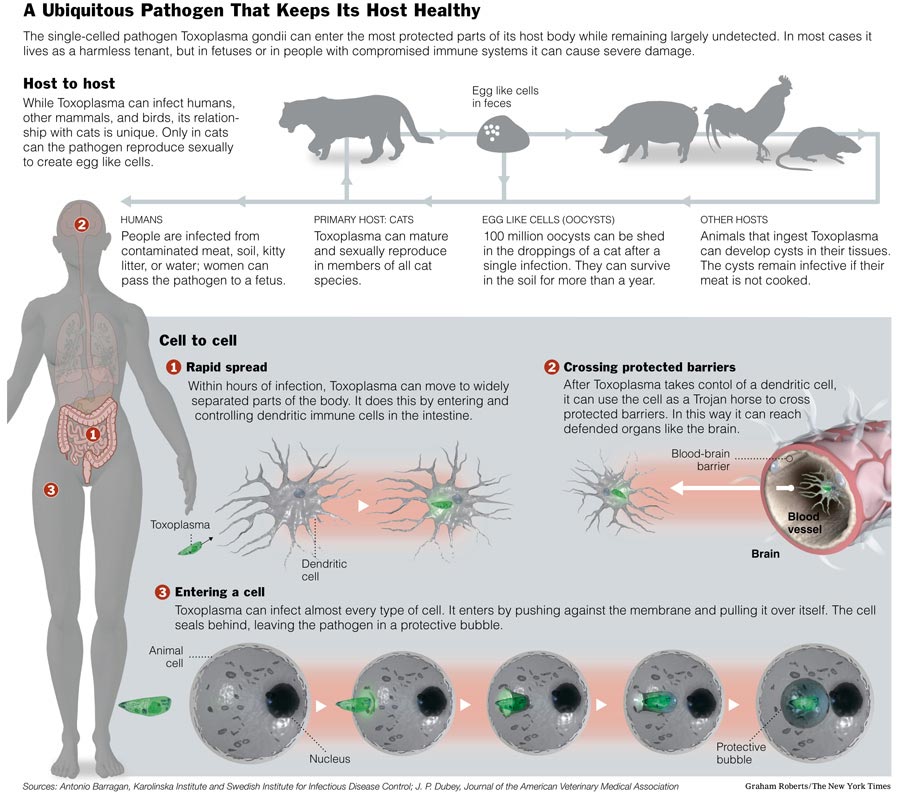
Here’s an abstract of an interesting paper, ‘Can the common brain parasite, Toxoplasma gondii, influence human culture? by Kevin D. Lafferty ;
“The latent prevalence of a long-lived and common brain parasite, Toxoplasma gondii, explains a statistically significant portion of the variance in aggregate neuroticism among populations, as well as in the ‘neurotic’ cultural dimensions of sex roles and uncertainty avoidance. Spurious or non-causal correlations between aggregate personality and aspects of climate and culture that influence T. gondii transmission could also drive these patterns. A link between culture and T. gondii hypothetically results from a behavioural manipulation that the parasite uses to increase its transmission to the next host in the life cycle: a cat. While latent toxoplasmosis is usually benign, the parasite's subtle effect on individual personality appears to alter the aggregate personality at the population level. Drivers of the geographical variation in the prevalence of this parasite include the effects of climate on the persistence of infectious stages in soil, the cultural practices of food preparation and cats as pets. Some variation in culture, therefore, may ultimately be related to how climate affects the distribution of T. gondii, though the results only explain a fraction of the variation in two of the four cultural dimensions, suggesting that if T. gondii does influence human culture, it is only one among many factors.”
Related;
Parasite culture
A Common Parasite Reveals Its Strongest Asset: Stealth
A Nation of Neurotics? Blame the Puppet Masters?; "Lafferty made three straightforward observations.
1. Toxoplasma infection rates vary from country to country. South Korea has prevalance rate of only 4.3%, for example, while Brazil's rate is 66.9%. These rates are determined by many factors, from the eating habits in a country (steak tartar, anyone?) to its climate (Toxoplasma oocysts survive longer in warm tropical soil).
2. Psychologists have measured some of the personality traits influenced by Toxoplasma in these countries. People with Toxoplasma tend to be more self-doubting and insecure, among other things. Among the differences in men, Toxoplasma is associated with less interest in seeking novelty. Toxoplasma-infected women are more open-hearted.
3. A nation's culture can be described, at least in part, as the aggregation of its members' personalities."
August 2, 2006
Lomberg with Fareed Zakaria

The latest Foreign Exchange show is up; discusses change in Saudi Arabia, interview with Lomberg, Mexican immigrants and a perspective on Dubai.
“While many rulers flush with oil profits are wasting their opportunity to build for their future, Dubai is going against the stream and it is not going unnoticed. Both Bahrain and Qatar are now trying to join Dubai as the world’s premier tourist destination. This summer you may be visiting Europe or Yosemite, but soon your flight plans may take you to the Middle East for rest and relaxation.”
The previous two shows are also worth a look.
Identity and Violence – Amartya Sen
Prospect magazine reviews Amartya Sen’s latest book;
“At the heart of the book is an argument against what Sen calls the communitarian view of identity—the belief that identity is something to be "discovered" rather than chosen. "There is a certain way of being human that is my way," the Canadian philosopher Charles Taylor wrote in his much-discussed essay "The Politics of Recognition." "I am called upon to live my life in this way." But who does the calling? Seemingly the identity itself. For Taylor, as for many communitarians, identity appears to come first, with the human actor following in its shadow. Or, as the philosopher John Gray has put it, identities are "a matter of fate, not choice."Sen will have none of it. "There are two issues here," he says when I meet him at King's College, Cambridge, where he was master until returning to Harvard two years ago. "First, the recognition that identities are robustly plural and the importance of one identity need not obliterate another. And second, that a person has to make choices about what relative importance to attach, in a particular context, to their divergent loyalties and identities. The individual belongs to many different groups and it's up to him or her to decide which of those groups he or she would like to give priority to." We are multitudes and we can choose among our multitudes.
Sen is particularly critical of the ways in which communitarian notions of identity have found their way into social policy, especially through the ideas of multiculturalism, and in so doing have diminished the scope for individual freedom. "I am not opposed to multiculturalism," he says. "But I am opposed to the way it has been interpreted. There are two basically distinct approaches to multiculturalism. One concentrates on the promotion of diversity as a value in itself. The other focuses on the freedom of reasoning and decision-making, and celebrates cultural diversity to the extent that it is freely chosen. The way that British authorities have interpreted multiculturalism has very much undermined individual freedom. A British Muslim is not asked to act within the civil society or the political arena but as a Muslim. His British identity has to be mediated by his community."What policymakers have created in Britain, Sen suggests, is not multiculturalism but "plural monoculturalism," a system in which people are constantly herded into different identity pens. "Take the case of the Bangladeshis," says Sen. "Bangladesh's separation from Pakistan was not based on their religion but on their language, their literature and their secular politics. At the time of independence Bangladeshis who came here had a very strong sense of Bengali identity. But all that disappeared, because the official government classification ignored language, culture and secular politics, and insisted on viewing all Bangladeshis as Muslims. Suddenly they had lost all identity other than being Islamic. And suddenly Bangladeshis stopped being Bangladeshis and were merged with all other Muslims from Morocco to Indonesia."
"We have a system in which Muslim organisations are in charge of all Muslims, Hindu organisations in charge of all Hindus, Jewish organisations in charge of all Jews and so on." This parcelling out of the nation can only weaken civil society. "In downplaying political and social identities, as opposed to religious identities, the government has weakened civil society precisely when there is a great need to strengthen it."
Related;
See a video presentation on the book at World Bank
Amartya Sen and the War on Terrorism
Amartya Sen: "Identity and Violence"
There are some who allege that Sen abused Indian History- Nimai Mehta, "Truth Before Sympathy: The Use and Abuse of Indian History from Mill to Sen"
August 1, 2006
Podcasts on Two Outlooks- Global Economy and Information Economy
Kenneth Rogoff, a professor of economics at Harvard University and former chief economist at the International Monetary Fund, talks about the outlook for global economic growth, Treasury Secretary Henry Paulson and the IMF's role in global economics at Bloomberg. Listen to the podcast.
Graham Vickery gives an overview of the information and communication technologies (ICT) industry for the OECD countries for 2006. Topics discussed amongst others; Market growth across the OECD and Non-OECD ICT markets, Top 250 ICT firms, World semiconductor market 1990-2005, Structural change in the ICT sector, ICT globalisation and trade, New trade competition, ICT-enabled service globalisation and offshoring; China and ICTs; ICT skills and employment; IT policy in OECD countries. Podcast from Radioeconomics.
Reinventing the IMF - Renewing the Commitment to Poor Countries
Some highlights from a major speech by IMF Managing Director at Center for Global Development today;
“Earlier this year, I set out a road map for implementing the International Monetary Fund's Medium-Term Strategy. This afternoon I want to talk about a particular aspect of the strategy: the Fund's relationship with low-income countries…The Medium-Term Strategy is based on the premise that the Fund needs to adapt to help all of its members deal with the challenges of 21st century globalization. The strategy covers all areas of the Fund's activities, including the way we conduct surveillance of individual members' economies and of the global economy; our instruments for preventing and dealing with crises in emerging markets; and the Fund's own governance. The measures proposed in the strategy are important not only for systemically important countries and emerging markets, but also for low-income countries. Tackling global imbalances will reduce the risk of chaotic exchange rate movements, abrupt shifts in financial markets, and crippling protectionism. Avoiding crises in emerging markets will help keep down the cost of low-income countries' borrowing and maintain demand for their exports. And low-income countries as well as clearly underrepresented emerging markets have reason to be concerned about their voice and representation in the Fund.
Telling countries to avoid debt is likely to be most effective if we can offer them alternative sources of finance. As the Irish playwright George Bernard Shaw wrote, "I can't talk religion to a man with bodily hunger in his eyes." It is therefore important that the international community address the urgent needs of low-income countries by offering sufficient grants and highly concessional loans to enable them to finance development without relying on expensive debt. This leads me to the second part of the Gleneagles compact: a significant increase in aid.
The Fund has also been a consistent advocate of the effective use of aid. Better outcomes from increases in aid flows will depend not only on the amount of the support, but on its effective use. This depends partly on macroeconomic policies, and one of the Fund's responsibilities is to help countries manage their macroeconomic policies in ways that maximize their capacity to absorb aid and debt relief.The Fund is also strongly committed to making sure that countries have the fiscal space they need to expand social programs, especially in health and education. I want to remove any misconceptions about our views on this. I have repeatedly heard concerns expressed, especially by NGOs, about budgetary ceilings limiting social sector outlays.
The first concerns trade. Most of the discussion of trade policy in recent months has focused on the WTO negotiations on the Doha Round. This is appropriate: increased trade, bolstered by multilateral agreements, has been a cornerstone of growth in the global economy for many years, and is fundamental to the prospects of low-income countries….
Before concluding, I would like to also say a few words about a policy area where it is particularly important that the Fund cooperate with donors and low-income country governments. This is governance. Paul Wolfowitz made a speech focusing on this issue earlier today, and I very much agree with his comments. Governance was a key element of the Monterrey compact and it is an area where the Fund has a well-defined and important role to play. When governance issues are macroeconomically relevant and threaten the success of a program, we set conditions to address them. We also promote good governance through broader initiatives. For example, we promote transparency through the General Data Dissemination System, a framework to develop national statistical systems to which over 90 countries have subscribed. In some countries we are developing action plans to improve the transparency of Public Expenditure Management systems. We also support the Extractive Industries Transparency Initiative and give advice on transparent use of revenues from natural resources. Underlying this work is the belief that more public accountability and more transparency can raise the quality of public expenditure, cut corruption, and reduce poverty..”
Related;
IMF to Propose Greater Representation for Developing Countries- see the event online
July 31, 2006
Prostitution Cartels
Tyler Cowen asks, “Should prostitution be cartelized?”
It’s effectively a cartel in some parts of the world;
“The police have arrested ten foreign nationals for alleged involvement in prostitution…“From what we gathered from the investigation so far, it appears that they are sending the money made from prostitution to their agents in their country…The individuals themselves are paid by their agents. The investigation is still ongoing and the full report will be made public very soon,” a police spokesperson said.”
In countries with large relative expatriate populations it will be extremely difficult root out prostitution.
July 27, 2006
Globalization is Working?

Philippe Legrain debates Robert Wade;
“Wade claims that, “If the liberal argument holds, we would expect the global shift towards free markets in the past 25 years to have raised the rate of world economic growth. Instead, there has been a slowdown in developed and developing countries. Between the era of managed capitalism (roughly 1960-78) and the era of globalisation (roughly 1979-2000), the growth rate of world output fell by almost half, from 2.7 per cent to 1.5 per cent.”Not so. According to the latest IMF figures, the world economy grew by 3.3 per cent a year from 1986-95 and by 3.9 per cent a year from 1996-2005. Better still, while in 1986-95 emerging economies grew only fractionally faster than advanced economies (3.7 per cent a year compared with 3 per cent), in 1996-2005 they grew over twice as fast (5.5 per cent a year compared with 2.7 per cent). Far from stagnating, the world economy is booming—and developing countries are outpacing developed ones.
But in any case, Wade’s methodology is shoddy. Even if global growth had slowed since 1979, one could not deduce from such aggregate figures that globalisation wasn’t working. Contrary to what he asserts, there has not been a global shift towards free markets, let alone one that can be dated to 1979. Countries have opened their markets to varying degrees and at different times; some have failed to liberalise at all or have even become more protectionist. What’s more, globalisation is not the only economic change of the past 40 years, and so cannot necessarily be considered responsible for any particular change in economic performance. The right way to judge whether globalisation is working is to look at individual economies’ performance before and after they liberalised, controlling for other changes that might affect the picture—and one finds a mountain of evidence that it is indeed delivering the goods.”
*The picture is from the cover of the latest edition of The Economist
Related;
Philippe Legrain’s Globalization posts
Thomas Palley’s Globalization posts
July 26, 2006
Why are we surprised that Doha Failed?

"The cause of this collapse is not specific countries' unwillingness to concede on particular themes, but growing public opposition in poor and rich countries alike to the very WTO model," said Lori Wallach director of Public Citizen's Global Trade Watch
“Last year, the World Bank estimated that global gains from trade liberalisation would equal roughly $287 billion, of which $86 billion would accrue to developing nations, lifting at least 66m people out of poverty”
-The Economist
At least some people seems happy that Doha trade round has failed. Paul Blustein asks whether Doha failure could lead to more uncertainty about the path of future globalization in this op-ed. Stiglitz refers to as America’s New Trade Hypocrisy.
Related;
Q&A with Pascal Lamy
Doha Talks Break Down
Doha on Life Support
DOHA, R.I.P.????
Doha dead as dodo
The Gamble Fails: Doha talks collapse
Some farmers punch above their weight
Where is the U.S. Leadership on Trade?
No Progress Toward Freer Trade Under Bush
The Doha Failure: Plenty of Blame to Go Around
Ten Observations about WTO’s First Decade
Bhagwati & Ikenson on unilateral liberalization
Bhagwati versus Bhagwati on trade liberalization
Is Doha failure a sign of hegemonic decline?
(Why) Does Free Trade Favour The Rich?
Stationary Bandits, Plunder, and Trade Negotiations
Multimedia
Daniel Ikenson discusses the failure of Doha; a premier on trade talks highly recommend (podcast)
The Future of Trade after Doha: What’s in It for Developing Countries?
Global Economy: International Trade
Michael Moore: Globalization & Development: Its Implications & Institutions
The Case for Open Industrial Policy
Testing the Grandsons of Hecksher and Ohlin
July 21, 2006
Podcast of the Day- History of Democracy
Radio National’s Rear Vision presents a two part series on the history of democracy, from its beginnings in 2,500 BCE to today- Part 1 and Part 2.
Guests include John Keane, Professor of Politics at the University of Westminster and at the Wissenschaftszentrum Berlin (WZB) and founder of the Centre for the Study of Democracy, Tariq Ali London-based historian, novelist, filmmaker, playwright and anti-imperialist activist, Professor Charles Tilly Joseph L. Buttenwieser Professor of Social Science, Columbia University, Joseph Ketan,Visiting Fellow in Governance Programme, Pacific Institute of Advanced Studies in Development and Governance, University of the South Pacific.
Related;
What’s Democracy? Words of Wisdom from F.A. Hayek
Democratic Peace- blog by R.J. Rummel
Robert A. Dahl’s books are highly recommended
The Democracy Advantage; How Democracies Promote Prosperity and Peace
July 20, 2006
Do Some Countries Lose Out in Cultural Trade?

“Every culture represents an equilibrium among current economic and social forces”
-Eric Zones
According to UNESCO, three countries - the United Kingdom, United States and China - produced 40 percent of the world’s cultural trade products in 2002, while Latin America and Africa together accounted for less than four percent. So this implies to UNESCO head that;
“However, “while globalization offers great potential for countries to share their cultures and creative talents, it is clear that not all nations are able to take advantage of this opportunity,” said UNESCO Director-General Koïchiro Matsuura. “Without support to help these countries participate in this trade, their cultural voices will remain marginalized and isolated.”
Even the Pope is worried about globalization. Pope Benedict’s 2007 encyclical will address “ethical and spiritual questions posed by the process of globalization.”
I’m not sure whether Daniel Cohen’s observation (cited at Café Hayek) that globalization adds to cultural diversity is generally shared among the general public. The title of the book reminded me of the comment made by Jagdish Bhagwati of the difficulty he had getting a publisher for the French edition of his book, In Defense of Globalization- he had to include an additional chapter on capital flows.
As for me, growing up in the Maldives one is bombarded in a sense by the culture of the neighboring giant, India. A large number of Maldivians understand the Hindi language- learned through watching Hindi films. I think it adds to the richness of the local culture and doesn’t make me less of a Maldivian.
Related;
INTERNATIONAL FLOWS OF SELECTED CULTURAL GOODS AND SERVICES, 1994-2003
Does culture need protection?- Podcast of the Day
July 19, 2006
Is China the Paramount Power in South East Asia?
Dr Milton Osborne at Lowy Institute gives a summary of his recent paper The Paramount Power: China and the Countries of Southeast Asia. Listen to the podcast.
New Economist has more on the paper.
Miscellaneous on China;
Political and Economic Introduction to China from British Parliament’s research group
Web users urged on China policy
Hidden factors may diminish China's actual trade surplus
Podcast of the Day- A Guide to Nonsense

British author and journalist Francis Wheen discusses his book, How Mumbo-Jumbo Conquered the World, with some entertaining examples of celebrities like Princess Diana, Cherie Blair and Hillary Clinton who are deluded by crystals and healing stones, cults, gurus and other quackery in what he calls our post-political era. Here is the podcast, and the transcript.
Related;
Writer's choice 1: Francis Wheen at Normblog
Reviews of the book; Crooked Timber, The Economist
July 14, 2006
Does culture need protection?- Podcast of the Day
Should cultures be protected from destruction by outside forces, or might the introduction of new ideas and global economics create positive change? We hear from two leading economic historians, Eric Jones and Tyler Cowen, on how cultures can merge.
Also in the podcast Former World Bank economist William Easterly talks about foreign aid and development. Listen to the podcast.
Also see Moscow Gets Mortgaged- the latest show of Foreign Exchange with Fareed Zakaria.
July 9, 2006
Podcast of the Day- Sporting Globalization & why Soccer is not boring


Globalization now describes just about everything, from the way we do business right through to the way we watch the football World Cup. So what are the implications for sport in a world where global is rapidly replacing local? Listen to the podcast.

Related;
Why Tyler Cowen find soccer boring
Tell that soccer is boring to this woman from Maldives; a 55 old lady smashes TV set, throws around noodles following Brazil’s World Cup loss- soccer is truly universal.
Merkel makes hay while Germans watch the play
If football was a drug it would be outlawed
The World Cup Final of Culture
If still you find soccer boring try this; How to appreciate a soccer game on TV
July 5, 2006
‘Iraqi Government - Paralysis by Consensus’

The latest edition of Foreign Exchange is up. The focus this week is on Iraq, fashion giant from Spain and continuation of the discussion with Franklin Foer on soccer and globalization;
- In the United States the debate has become quite fierce: Should the US pull out of Iraq or stay the course? Has the American military become part of the problem or is it holding the country together? To get an Iraqi perspective we sit down with Laith Kubba, currently Program Director of the Middle East and North Africa at the National Endowment for Democracy, but not long ago the spokesman for Iraqi Prime Minister Ibrihim Jaffari
- In Part 2 of our discussion with Franklin Foer, author of How Soccer Explains the World, we discuss how national identities are manifested through sport and how globalization is changing the way teams play soccer all over the world.

- This week’s In Focus takes us to Spain to learn the secret of a fashion giant one competitor calls “possibly the most innovative and devastating retailer in the world.” In an era when clothing retailers outsource all their manufacturing to developing countries, one company, Zara, is having enormous success doing things differently: Much of their production stays in the region, and they spend almost nothing on advertising ( they can move the whole production chain in 2 weeks or if need be in 48 hours).
- Less than 5% of American donations go overseas. By giving to the Gates Foundation, Warren Buffet has chosen to be in the minority and focus on those less fortunate in foreign countries
Related;
- A discussion with Paul Markillie, Business correspondent of The Economist- “Could [companies] have become a little bit too lean and mean in their supply chains? They’re literally using vans and aeroplanes as their mobile warehouses. Could they have taken things too far and could there be risks in the system?”, authored the recent Survey on Logistics.
July 1, 2006
The Island of Minicoy – India

In one of the islands in the Indian territory of Lakshadeep, the language spoken by the people is the same as that of Maldivians and yet in no time in history were the islands under Maldives rule, though there have been close cultural ties.
How the language of Minicoy came to be referred to as Mahl;
"The Lakhshadweep Administration refers to Divehi-bas as Mahl. This is due to a misunderstanding on the part of a British civil servant who came to Minicoy in the Twentieth Century during the time of the Indian Empire. The official asked a local what his language was and he said "Divehi-bas". The Englishman looked confused as he had never heard of this language. Noticing this, the islander said "Mahaldeebu" as he knew that people on the subcontinent referred to the kingdom to the south (the Maldives) by that name. The local name was and is Divehiraajje (Kingdom of Islands) and the language is Divehi-bas (language of the islands). The English official recorded the language of Minicoy as Mahl."
Related;
Globalization and the Maldives in the 14th Century & Today
Sohar; In 1981 the Irish adventurer Tim Severin wanted to build a replica of the ships that sailed the spice route 1,200 years ago. When he was looking for a reliable supervisor, Dr. Jones recommended Ali Manikfan to Tim Severin. Thus Ali Manikfan was given the responsibility of making the ancient Arab trading ship a reality. Ali Manikfan took this mission as a challenge and went to Oman to direct the team of carpenters. It took one year to build the 27 metres long ship and four tons of coir were needed to sew the planks of its hull, in the same way that ancient Maldivians had built ships
What the yuan can learn from the yen

A policy brief from ADBI on current and future issues for the Chinese economy; deals with various issues and challenges including regional imbalance, economic reform, exchange rate, and the PRC-Japan relationship.
Related;
Growth in jobless a problem for Asia as exports surge; China's economy grows at 10%; its employment grows at 1% - UN Report.
The "divisible by nine" rule; The "divisible by nine" rule is a tradition that the People's Bank of China follows when it changes interest rates
June 28, 2006
The World Cup Paradox
“ I mean the--the World Cup is a paradox because it’s at once a great spectacle of globalization fueled by multi-national corporations giving the world this common language of soccer, but at the same time it’s--it’s a festival of nationalism, so people thought that globalization was going to smush nationalism and the World Cup proves that it can actually facilitate nationalism.”
Franklin Foer, author of How Soccer Explains the World- An Unlikely Theory of Globalization
More from the latest Foreign Exchange show with Fareed Zakaria.