November 15, 2006
Madness in Bollywood Movies
 Seems like an interesting study;
“OBJECTIVE: To study the portrayal of mental illness (especially psychosis) in Hindi films since 1950 and to study the influence of prevalent social, political and economic factors on each portrayal. METHOD: Using two encyclopedias and one source book, films that had mental illness affecting one of the protagonists were identified. The social, economic and political factors were identified using history texts. RESULTS: In the 1960s after India became a Republic, the political climate was one of idealism and as a result the portrayal of mental illness was gentle, more international in its outlook, and used psychoanalytic techniques. In the 1970s and 1980s, as a result of increased political and bureaucratic corruption and an unstable political climate, the portrayals became harder and psychopaths were portrayed more often. In the 1980s, the trend continued with female psychopaths, and avenging women emerged as a major force because the political and judicial systems were seen as impotent in delivering justice. In the 1990s, following economic liberalization, the women were seen and used as possessions in society and the cinema, and portrayals of stalking and morbid jealousy increased. CONCLUSION: Hindi films since the 1950s appear to have been influenced by changing cultural norms which in turn affected the way mental illness is portrayed.”
Via Mind Hacks; Lights, camera, madness - Bollywood style
Related;
A pat on the back for `Lage Raho Munnabhai'
Insanity in films
Indian author and film-maker Ruchir Joshi interview
November 12, 2006
Macaca Op-Ed
S.R. Sidarth has an op-ed in Washington Post;
“After Allen's remarks, my heritage suddenly became a matter of widespread interest. I am proud to be a second-generation Indian American and a practicing Hindu. My parents were born and raised in India and immigrated here more than 25 years ago; I have known no home other than Northern Virginia. The hairstyle inflicted upon me by two friends late one night also became newsworthy; for the record, it was intended to be a mullet and has since grown out to nearly the appropriate length.The larger question that this experience brings up is: How far has society progressed on the issues of race and openness? By 2050, according to most projections, the United States will be a minority-majority nation. But the fact that Allen believed I was an immigrant, when in fact I am a native Virginian, underlines the problems our society still faces.”
Related;
“There are 1.7 million Americans of Indian ancestry. They are the fastest growing ethnic group in this country. Their income is 54% higher than the national average, and 1 in 9 is a millionaire.”
-Foreign Exchange show
November 11, 2006
Micro health insurance
An interesting article on health financing among the poor in India;
“India is a world leader in this emerging field, with 5 to 10 million people enrolled in micro health insurance nationwide. Fewer than 10 percent of India's 1.1 billion people have any sort of health insurance, much of which covers only government employees. Poor people usually work in informal jobs or are self-employed, so they are extremely unlikely to be included in employment-related plans.Consequently, health financing poses an acute problem for India. About one-fourth of hospitalized Indians fall below the poverty line as a direct result of their hospital expenses, according to a 2002 World Bank report. Many people take out steep loans or sell their homes in order to pay. And for the poor, losing even a day's wages while waiting in the hospital can be devastating.”
Related;
UpLift India Association
News Roundup: Risk-Reward Edition
Micro-insurance: Extending Health Insurance to the Excluded
Healing Fields Foundation
Community-Based Health Insurance in Rwanda
Public Health Services in India
September 23, 2006
Musharaff Quotes
 Most recent;
"The intelligence director told me that (Armitage) said, 'Be prepared to be bombed. Be prepared to go back to the Stone Age,"' Musharraf said. "I think it was a very rude remark."
Last year he made the controversial comments on rape victims;
"You must understand the environment in Pakistan. This has become a money-making concern," he said. "A lot of people say if you want to go abroad and get a visa for Canada or citizenship and be a millionaire, get yourself raped."
Related;
Muslim Women — The Untold Story
Afghanistan: On the Brink
Bombing Pakistan back to the Stone Age
Pakistan criticises Afghan action
Afghan Leader Presses Musharraf
Pakistan rape victim's blog makes waves
Musharraf to pen autobiography
Feminist dimension of the Pakistan Movement;
"No nation can rise to the height of glory unless your women are side by side with you; we are victims of evil customs. It is a crime against humanity that our women are shut up within the four walls of the houses as prisoners. There is no sanction anywhere for the deplorable condition in which our women have to live."- Muhammad Ali Jinnah
September 22, 2006
Maldives to set up Bollywood Studio

“The government plans to open the country’s first professional film studio, officials have announced.
The studio will be located in one of the new resorts currently being constructed in the country. The government hopes the studio will attract the Bollywood film industry to shoot more of their motion pictures in the Maldives.
“We will devote a resort island to the studios so that film units can use it as a single stop for their work. That will spread the good word about Maldives,” said Hussain Shihab, Minister of State for Arts..”
From Minivan News.
Recent economic news;
Opposition Criticises New Tourism Tax
Board of directors sell STO tea plantation
September 21, 2006
Trying hard to be a darling of IMF/World Bank
News from Sri Lanka;
“Sri Lanka said Tuesday it was moving towards eliminating oil subsidies that are threatening to blow a hole in the nation’s budget and asked lenders for financial help to tide over oil shocks.Public Administration minister Sarath Amunugama said the government “has responded appropriately to the sustained sharp rise in oil prices,” by adjusting domestic prices and moving towards oil futures to hedge future risks.
“Oil subsidies, which had been an enormous burden on the budget, have been eliminated,” he told delegates during the IMF World Bank annual meetings here.
Sri Lanka consumes around 30 million barrels of oil a year, buying 2.2 million metric tones oil light crude from Iran, Saudi Arabia and Malaysia.
The country’s oil bill is expected to climb to about 2.0 billion dollars this year, up from 1.6 billion dollars in 2005, due to surging global fuel prices.
“We reiterate our call for the creation of a special medium term oil facility to assist countries that have been adversely affected by the sharp increases in oil prices,” he said in an appeal to some of the world’s biggest financial backers…”
Related;
World Bank hates Philippines
Sri Lanka to lead South Asian initiative to study impact of oil prices
The boom in bank deposits (India)
Port Infrastructure, High Costs Seen Hampering India's Progress
South Asia conference to address sanitation
Weathering the Storm So Far: The Impact of the 2003-05 Oil Shock on Low-Income Countries
September 19, 2006
Death Threats and Game Theory
South Asia correspondent to UK Telegraph writes in his blog about a recent incident involving a death threat to Maldivian dissident in UK;
“British police traced the foul-mouthed email to an address belonging to Husna Latheef, who is the wife of the Maldives Chief of Police, Adam Zahir. Mrs Latheef copped the caution but Mr Moosa (and I’ve no idea if he’s right or not) is convinced Mr Zahir is behind the threat.The text of the threat is worth repeating for those who missed it, simply because it is so Neanderthal and unpleasant and tells you a fair bit about the people who run the Maldives once they are out of the clutches of their slick UK PR agency, Hill and Knowlton, whose top man once span for Tony Blair.
Try spinning this: “if i ever see u, i will f***ing kill you, you better watch ur f***ing back, id like to see you try and reply back to me u dumb motherf***er. who the f*** do u thnk [sic] you are. i know where u live so u better not go far from ur house in london cos i will f***ing shoot u.”…
Read the rest of the post for his speculation on the strategic reasons for British government sponsoring talks between the government and the opposition in the Maldives and using a bit of game theory he suggests;
“If Gayoom’s regime reads the Brit moves the same way Indian intelligence apparently does, and the Brits are seen to have an ulterior motive, then they might find Gayoom digs his toes in and the whole plan backfires.”
Related;
Zahir's Wife Received UK Police Caution
UK police warn wife of Maldives policeman over threat
Adam Zahir Cautioned By British Police
“The British police were able to act on the email because it was sent from a ‘blueyonder’ account, which was traced to Zahir’s London property. The email account was registered in Adam Zahir's wife's name, Husna Latheef.”
British Government Calls For Peaceful Evan Naseem Day
September 18, 2006
Nest - $80,000 to 90,000

The Economist runs an article on the booming Indian art market;
“IT IS not just Indian software and “business-process outsourcing” firms that are benefiting from the rise of the internet. Indian modern art is also on an upward spiral, driven by the aspirations of newly rich Indians, especially those living abroad, who use the internet to spot paintings and track prices at hundreds of gallery and auction websites. Prices have risen around 20-fold since 2000, particularly for prized names such as Tyeb Mehta and F.N. Souza.There would have been “no chance” of that happening so fast without the internet, says Arun Vadehra, who runs a gallery in Delhi and is an adviser to Christie's, an international auction house. He expects worldwide sales of Indian art, worth $200m last year, to double in 2006. It is still a tiny fraction of the $30 billion global art market, but is sizeable for an emerging market.
For newly rich—often very rich—non-resident Indians, expensive art is a badge of success in a foreign land. “Who you are, and what you have, are on your walls,” says Lavesh Jagasia, an art dealer in Mumbai. Indian art may also beat other forms of investment. A painting by Mr Mehta that fetched $1.58m last September would have gone for little more than $100,000 just four years ago. And a $22m art-investment fund launched in July by Osian's, a big Indian auction house, has grown by 4.1% in its first two months.
Scant attention was paid to modern Indian art until the end of the 1990s. Then wealthy Indians, particularly those living abroad, began to take an interest. Dinesh Vazirani, who runs Saffronart, a leading Indian auction site, says 60% of his sales go to buyers overseas.
The focus now is on six auctions this month. Two took place in India last week; work by younger artists such as Surendran Nair and Shibu Natesan beat estimates by more than 70%. Sotheby's and Christie's have auctions in New York next week, each with a Tyeb Mehta that is expected to fetch more than $1m. The real question is the fate of other works, including some by Mr Souza with estimates of up to $600,000. If they do well, it will demonstrate that there is strong demand and will pull up prices across the board. This looks like a market with a long way to run.”
* Above drawing by Anju Dodiya

Related;
Sepia Mutiny- art posts
Marginal Revolution- art posts
Indian painter agrees $21m deal
Wonders of Sikh Spirituality Come Alive
Donald Pittenger on Illustration
Donald Pittenger on Flair in Art, Part One
Donald Pittenger on Flair, Part 2
In the Land of Beautiful People, an Artist Without a Face
Banksy shop-drops 500 remixed Paris Hilton CDs
Un-Atlantic Economic History from Brad de Long
Brad de Long is running a list of useful economic history books which are not biased towards North America;
Fernand Braudel, The Structure of Everyday Life (Civilization and Capitalism: 15th-18th Century)
Janet Abu-Lughod, Before European Hegemony: The World System A.D. 1250-1350
K.N. Chaudhuri, Trade and Civilisation in the Indian Ocean: An Economic History from the Rise of Islam to 1750
Tirthankar Roy, The Economic History of India 1857-1947
Some books commentators added;
Brook, Timothy. (1998) The Confusions of Pleasure: Commerce and Culture in Ming China. Berkeley: University of California Press.
Ian Brown, "Economic Change in South-East Asia, c.1830-1980." (1997, Kuala Lumpur: Oxford UP)
Reid, Anthony ed. Slavery, Bondage and Dependency in Southeast Asia. 1983.
Adas, Michael. The Burma Delta: Economic Development and Social Change on an Asian Rice. Frontier, 1852-1941. Madison: University of Wisconsin Press. 1974. .
The Eastern Origins of Western Civilisation By John M. Hobson
The Great Divergence: China, Europe, and the Making of the Modern World Economy
By Kenneth Pomeranz
China Transformed: Historical Change and the Limits of European Experience By Roy Bin Wong
Nils Jacobsen 'Mirages of Transition: the Peruvian Altiplano 1780-1940' (Berkeley: University of California Press)
Anand Yang's _Bazaar India: Markets, Society, and the Colonial State in Gangetic Bihar._ (Berkeley, Los Angeles, London: University of California Press, 1998; New Delhi:
Victor Lieberman (2003) Strange Parallels: Southeast Asia in Global Context, c. 800-1830,
Abu-Lughod, Janet L., editor Sociology for the Twenty-first Century: Continuities and Cutting Edges
The Human Web: A Bird's-Eye View of World History
T'Ang China: The Rise of the East in World Historyby Samuel Adrian M. Adshead
An Ottoman Tragedy: History and Historiography at Play
By Gabriel Piterberg
See also;
Why China Stagnated -- Economic History As Lesson
Why Europe and the West? Why Not China?
The World's First Corporations
History of the World in Seven Minutes
Blogs- Book Pundit, Civilisation Pundit,
September 17, 2006
Reinventing Indian Tourism

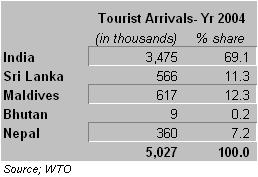
The Financial Express has an article looking at India’s attempt to create a more niche market in tourism;
“As if we needed the Conde Nast Traveller magazine’s recent survey to tell us that we are the fourth most preferred destination among travellers from 134 countries in the world. Just look at the numbers: Last year, 13.2% more international travellers came to India, bringing in more than Rs 8,274 crore. Tourism today is the third largest foreign exchange earner in India, accounting for 2.5% of the GDP. In 2006, a total of 1.28 million tourists came to India as compared to the 1.14 million in 2005…But this heady feeling is marred by a host of problems that plague the industry. Critics say that before we pitch India as the next big world destination, we need to set our own house in order first. From an acute shortage of hotel rooms, which eventually translates into skyrocketing tariffs, to non-existent roads to a skewed mindset towards foreigners, it’s a tough task. Says Rajji Rai, vice-president of the Travel Agents Association of India: “The truth is that there is still a lot that needs to be done. Look at our airports. Take our roads… Every time a tourist lands in India, there is a look of disbelief on his face. Tourists have dollars to burn, we need to grab the maximum share of that money.” Agrees Ravi Wadhwani, a Delhi- based businessman and frequent traveller: “Culturally we may be the richest country in the world. But do we have anything else to boast of? Most successful tourist models today are going in for high-end tourism that has the least impact on the local resources. We, on the other hand, we are going in for mass tourism. We need to learn from the successes of small countries like Maldives, Bhutan, or Chile.” Wadhwani adds: “Look at our connectivity. In foreign countries, you have private planes to ferry tourists. In India, it takes two days to reach the Kanha Wildlife reserve from Delhi. Nobody has so much time to spare.”
Related;
Incredible India
World Tourism Barometer
September 14, 2006
The coming clash of China and India
China has been recently courting the countries of South Asia;
“According to a report this year by Dr. Mohan Malik, professor at the Asia-Pacific Center for Security Studies in Hawaii, ‘Beijing is skillfully employing economic and military means to draw Bhutan, Bangladesh, Nepal, Maldives and Sri Lanka into China's orbit.’‘Beijing's main objectives are said to be access to raw materials, commodities, natural resources and access to South Asian markets for Chinese goods and to expand China's influence in the region. However, China's support for India's smaller neighbours suggests that gaining access to markets and natural resources is not the only reason behind Beijing's South Asia policy: Beijing also wants to make a point on the limits of Indian power,’ he adds.
''In fact, aiding "India-wary" countries in South Asia to "concircle" (contain and encircle) India has long been an integral part of China's strategic calculus. As a rising maritime trading power, Beijing is also seeking once again to project force into the Indian Ocean in the manner of the fleets sent out under the command of Admiral Zheng He nearly 600 years ago during the Ming Dynasty,'' Malik concludes.”
Related;
China's top advisor meets Maldivian president
American and Yugoslav to be deported
Work to commence on new museum funded by the Chinese
A recent episode Foreign Exchange;
“China is modernizing economically; that no one denies. But there is a great debate about whether that economic modernization is leading to political change. Is China reforming its political system? To discuss this issue we’re joined by Hongying Wang, who is a Fellow at the Woodrow Wilson International Center and also at the Maxwell School at Syracuse University. Let me ask you; a statistic that is often bandied about, 87,000 protests in China last year compared with 10,000 ten years ago--what does this mean? Is it the sign of political unrest that some are reading it to be?”
The Commonwealth on World Bank
The annual meeting of finance ministers of the Commonwealth countries were recently held in Colombo. Their views on the World Bank and IMF from the final communiqué;
- recognised the need to increase the voice and representation of developing and poor countries in the IMF and World Bank, and urged a time-bound conclusion to a process of fundamental reform in a way that would increase the institutions’ credibility and legitimacy;- welcomed and encouraged rapid further progress in the joint efforts of the Bank and Fund to identify opportunities for significant scaling up in assistance and reforms to help countries meet the MDGs;
- recognised the importance of good governance for development and encouraged the Bank and Fund to support moves to strengthen the various dimensions of governance as an aspect of their support for countries’ development. Emphasised that the current focus on governance should not obscure the Bank’s core focus on poverty elimination. In this context, Ministers stressed the pre-eminent role of states in promoting good governance; the need for the development community to help build countries’ own capacity and to find ways to engage with poor countries even where governance is weak; and the mutual responsibilities of industrial countries to ensure responsible behaviour in this context by their citizens and companies;- welcomed the Bank’s current emphasis on infrastructure development.
- looked forward to the conclusions of the current external review of Bank-Fund collaboration and called for continued efforts to strengthen this collaboration and to increase the combined efficiency and effectiveness of the two institutions in their support for low and middle income countries;
- stressed the importance of sustaining the Fund’s financial resources so as not to compromise its role, including its role in low-income countries;
- welcomed the creation of the Fund’s new Exogenous Shocks Facility and encouraged flexibility in its scope and use to facilitate timely disbursement of concessional finance;
- welcomed the World Bank’s proposals to become more responsive to the needs of its middle-income country clients, including MDG related needs; to provide more customised and flexible financial and advisory services such as through blending; and to accelerate moves to use country systems and to find other ways to reduce the costs to member countries of doing business with the Bank; and welcomed the Bank’s work on the Clean Energy Investment Framework and urged its rapid implementation, working with other IFIs.
-Urged the parties involved, including the African Development Bank and World Bank, to accelerate progress in implementing the recently established African Consortium for infrastructure development.
Related;
India asks Commonwealth finance ministers to make united push for reform at IMF
Deputy Secretary-General Urges World Bank to Create Youth Investment Fund
Commonwealth Finance Ministers seek new answers to old questions
Some of the papers from the agenda;
Current World Economic Situation and Prospects
Review of IMF and World Bank Issues
An Agenda for Growth and Livelihoods: Public-Private Partnerships for Infrastructure
Toward and Outward Oriented Development Strategy for Small States: Issues Opportunities and Resilience Building
Promoting Investment into Economies with "Endowed" Handicaps: Progress Report
Reform of the International Aid Architecture: A Role for the Commonwealth?
September 7, 2006
The Road Less Traveled of Business Regulatory Reform
 According to the World Bank's Doing Business 2007, the four steps to successful business regulatory reform;
• Start simple and consider administrative reforms that don’t need legislative changes.
• Cut unnecessary procedures, reducing the number of bureaucrats entrepreneurs interact with.
• Introduce standard application forms and publish as much regulatory information as possible.
• And remember: many of the frustrations for businesses come from how regulations are administered. The internet alleviates these frustrations without changing the spirit of the regulation
More on the report from the preface;
“Regulations affecting 10 areas of everyday business are measured: starting a business, dealing with licenses, employing workers, registering property, getting credit, protecting investors, paying taxes, trading across borders, enforcing contracts and closing a business. The indicators are used to analyze economic outcomes and identify what reforms have worked, where and why.The methodology has limitations. Other areas important to business—such as a country’s proximity to large markets, quality of infrastructure services (other than services related to trading across borders), the security of property from theft and looting, the transparency of government procurement, macroeconomic conditions or the underlying strength of institutions—are not studied directly by Doing Business. To make the data comparable across countries, the indicators refer to a specific type of business—generally a limited liability company operating in the largest business city.
The methodology for 4 of the Doing Business topics changed in this edition. For paying taxes, the total tax rate now includes all labor contributions paid by the employer and excludes consumption taxes. For enforcing contracts, the case study was revised to reflect a typical contractual dispute over the quality of goods rather than a simple debt default. For trading across borders, Doing Business now reports the cost associated with exporting and importing cargo in addition to the time and number of documents required. And for employing workers, nonwage labor costs are no longer included in the calculation of the ease of employing workers. For these reasons— as well as the addition of 20 new economies—last year’s rankings on the ease of doing business are recalculated using the new methodology and reported in the Overview.”
Singapore is the number one in the rankings- coincidently the World Bank-IMF annual meetings are also being held in Singapore this month. It is interesting that Singapore (not a democratic country according to Acemoglu) beat more deomcratic countries like Australia in the rankings.
As for a lot of the other poor countries, there is a sense in these countries that a lot of the wealth has been generated through either corruption or unfair competition. May be one need to take a hard look at some of the local partners of the Doing Business survey for their independence.
Quick Links;
The Doing Business Law Library
Create their own custom dataset of main indices
Local Partners
Economy Rankings
Explore Economies
Economy Characteristics
Related;
Blog coverage of the report- PSD Blog, New Economist, Greg Mankiw, Econlog, Pienso.
Doing Business and Poverty Reduction
Measuring Labor Market Flexibility
Doing Business in 2006: Creating Jobs-online discussion
How Should States Encourage Entrepreneurship?
"At the heart of this public policy issue are two competing views of how to facilitate entrepreneurship. For some policymakers encouraging entrepreneurship involves improving the entrepreneurial climate through the lowering of tax and regulatory burdens. This view is consistent with a large body of academic literature showing that a good way to encourage entrepreneurship is to provide individuals with the freedom to pursue their dreams. Other policymakers focus on the financial constraints facing would-be entrepreneurs and how public policy can mitigate the financial hurdles to entrepreneurship. State financing of venture capital firms is consistent with this view."
Multimedia
Podcast of news from the World Bank on the Doing Business 2007
The Mystery of Capital: Why Capitalism Triumphs in the West and Fails Everywhere Else; I would also highly recommed de Soto's book, 'The Other Path'
How to Reform the Business Environment ; highly recommended especially comments by Egyptian minister.
Doing Business in 2006: Creating Jobs- Book Event at Cato
Doing Business in India Today: McDonalds Experience Entering the Indian Market
Related Bank Publications
Doing business in 2006 - creating jobs
Doing Business in 2005
Doing business in 2004 : understanding regulation
Doing business in South Asia in 2005
Doing business in 2005: comparing the Cambodian business environment with the world
Doing business in 2005 : India regional profile
Ukraine - Cost of doing business survey, 2002
Latvia : self-assessment report on administrative barriers to doing business
Perceived obstacles to doing business: worldwide survey results
Doing better business through effective public consultation and disclosure : a good practice manual
Doing business in Brazil
Doing business in Mexico
Despite many reforms, doing business is still not easy in Vietnam
Institutional obstacles to doing business : region-by-region results from a worldwide survey of the private sector
*updated 8th September, 2006
September 4, 2006
India - Five-year roadmap to fuller rupee convertibility

The Hindu reports;
“The Reserve Bank of India (RBI) Committee, headed by S. S. Tarapore, on Fuller Capital Account Convertibility has recommended that the scheme should be implemented in a five-year period in three phases and at the end of the five-year period ending in 2010-11, "there would be a comprehensive review to chalk out the future plan of action".The committee, whose report was submitted to the RBI on July 31 and which was made public on Friday, recommended that the annual limit of remittance by individuals to open foreign currency accounts overseas be raised to $50,000 in phase one from the current level of $25,000 and further raised to $100,000 in phase two and $200,000 in phase three. Difficulties in operating this scheme should be reviewed, it observed. Since this facility straddles the current and capital accounts, the Committee recommended that "where current account transactions are restricted, that is, gifts, donations and travel, these should be raised to an overall ceiling of $25,000 without any sub-limit".
"All individual non-residents should be allowed to invest in the Indian stock market through SEBI registered entities including mutual funds and portfolio management Schemes who will be responsible for meeting Know-Your-Customer norms and the money should come through bank accounts in India". It recommended allowing non-resident corporates also to invest in Indian stock markets in the same manner the RBI allowed non-resident individuals...”
Related;
Fuller Capital Account Convertibility Report. See also the ‘Dissent’ piece by Surjit Bhalla in the report.
Ajay Shah's blog- has a roundup of the report
A Monetary Policymaker's Passage to India
India's RBI to Consult Government on Rupee Conversion
The rupee; fear of freedom
Are free capital movements a good idea?
India: Selected Issues- IMF February 2006
India Development Policy Review 2006
India: Country in Brief
Should India go for Capital Account Convertibility?
India-Research Publications from World Bank
How to solve the RBI problem
Subsidizing inefficiency
Doing Business India-Dealing with Licenses-The steps, time, and costs of complying with licensing and permit requirements for ongoing operations in India- It takes 20 steps and 270 days to complete the process, and costs 678.5% of income per capita.
Recent edition of Foreign Exchange TV show with focus on India- Arvind Panagariya interviewed in the show.
Time for India to reduce inequality
Economic and Political Weekly
Mukherji, Joydeep. "Economic Growth and India's Future."
New Economist posts on India
August 16, 2006
The Truth about Globalization and Inequality

According to P. Sainath;
“India is a classic example of engineered inequality. On 20 October, The New York Times had a front page lead celebrating the birth of a class of people in India who spend their weekends at malls. It failed to mention that this year, India slipped three places in the human development ranking of the United Nations. We now stand at rank 127. This year’s UN Human Development Report had found that for the bulk of the Indian population, living standards are lower than those of Botswana – or even the occupied territories of Palestine. So while some of the richest people in the world live in India, so do the largest number of the world’s poor.The euphoria over one good monsoon (actually, we’ve had several these past 15 years) seems to have erased any debate in the media on what’s happening in Indian agriculture. Small farms are dying. Investment in agriculture is down. Rural credit has collapsed and debt has exploded. Many are losing their lands as a few celebrate at the malls. In March this year, as Professor Utsa Patnaik points out, the per person availability of foodgrain was lower than it had been during the notorious Bengal Famine of 1942-43.
Thousands of farmers have committed suicide since the late 1990s. In a single district of Andhra Pradesh, Anantapur, more than 2400 farmers have taken their own lives since 1997. Elsewhere in India, like in Gujarat or Mumbai, the loss of countless jobs in industry is boosting religious fundamentalism. In the 2002 violence in Gujarat in which over 1500 lives were lost, many of the rioters were workers from shut-down textile mills.
The huge new inequalities are feeding into existing ones: For instance, in a society where they are already disadvantaged, hunger hits women much harder. Millions of families are making do with less food. In the Indian family women eat last. After they have fed their husbands and children. With smaller amounts of food being left over now, poor Indian women are eating even less that they did earlier. The strain on their bodies and health becomes greater. Yet, health care is ever more expensive.”
According to Phillipe Legrain;
"Wade points out that absolute income gaps are widening and argues that this is a matter for concern. Really? Consider again his example of economy A, where the average income is $10,000, and economy B, where it is $1,000. Their relative income is 10:1 and the absolute gap between them is $9,000. Suppose B grows at a racy 10 per cent a year. Its income will rise by $100 to $1,100. If the absolute gap between A and B is not to widen, A can add at most $100 to its income of $10,000, which means growth cannot exceed 1 per cent. In short, because A starts off so much richer than B, even if B booms the absolute gap between them will initially widen unless A stagnates—and if A stagnates, B is unlikely to boom, since A’s demand for its exports will also stagnate. Perhaps Wade wants the gap between rich and poor to shrink through economic stagnation in rich countries—if so, he should say so explicitly. But surely what is happening now is preferable: rich countries are growing steadily, but poor countries are growing faster, and thus catching up in relative terms. If this continues, they will eventually narrow the absolute gap too. For example, if B grows at 10 per cent a year for 30 years, its income will rise to $17,449; while if A grows at 2 per cent a year over the same period, its income will rise to $18,114.”
Related;
What to Read: Inequality and Development in a Globalizing World- A Syllabus
Inequality Does Cause Underdevelopment
Globalisation, Inequality and Poverty Relationships: A Cross Country Evidence
The global redistribution of income
New Economist blog's posts on Inequality.
Everybody Loves a Good Drought: Stories from India’s Poorest Districts- Book Review
Multimedia;
Why Inequality Matters in a Globalizing World- Nancy Birdsall
How Unequal Can America Get Before it Snaps- Robert Reich
Economic Growth, Inequality and Poverty: Findings from a New Dataset
Perspectives on Growth, Inequality and Poverty
Poverty, Inequality and Growth in the Era of Globalization
World Inequality in the Second Half of the 20th Century
Globalization, Growth, and Poverty: Building an Inclusive World Economy
Hans Rosling at TED
Gapminder
The Globalisation of Inequality – Sainath
Amartya Sen’s Advice to Indians

Outlook India has an interview with Amartya Sen- some excerpts below (free with registration);
“The consumption pattern of urban middle-class Indians is becoming increasingly similar to their counterparts of the West. From household goods to food to cultural products, there is now a close resemblance between Indians and those in the West. Are Indians becoming increasingly similar to their counterparts in the West? If so, what are the perils of this trend?The increase in global contact and association has led to much greater homogeneity of the consumption of the rich across the world—it is not an isolated trend exclusive to India (you see it in Rio, Accra and Johannesburg as well as in Mumbai and Shanghai). This is, in a basic form, an age-old phenomenon. I have discussed in my book The Argumentative Indian how the consumption pattern of rich Indians changed in the early centuries AD, because of the trade in luxury products from China (with plentiful references in Indian literature, including Kalidasa and Bana), to Chinese silk, Chinese fruits, Chinese cosmetics used by the rich. But this is happening on a much larger scale in the contemporary world.
The basic problem is not what commodities the rich spend their money on, but that the economic gap between the rich and the poor is so large and also that it is growing (it has not grown as fast as in China, but it has certainly grown in significant ways). In fact, it is the existence and the expansion of this gap that we have to address. This may be an inevitable part of the price to pay to retain high-skill technical experts within the country and realism may well require that this connection be taken into account. But social ethics also demands that we examine—with realism but also with a sense of equity—what is really inescapable and what can be done to reduce the divergent fortunes of the rich and very rich on the one hand, and the poor and very poor on the other. This is not just a matter of the commodity pattern of the consumption of the rich.
Having said that, however, I should also mention that there is still at least one special problem in the hold of modern Western consumption patterns on the rich in India—and in other poor countries. The labour component in the production of these 'modern amenities' is often quite low in comparison with the older patterns of luxury consumption (for example, widespread services provided directly by unskilled labour), and this can have a negative effect on labour demand and through that on employment. This is not in itself a strong enough reason to curb that type of consumption through government control, but it is a reason to pay special attention to the critical role of employment generation in the process of economic development and to see what can be done to address this issue.
Even as India strives to become a global power, politically and economically its social indices remain poor. In terms of human development, India lags far behind. Has India become less caring? How does it dovetail with India's quest to become a global power? And what kind of future do you envisage for the poor as India changes?You are absolutely right to point to India's relatively poor record in human development. This is not a new phenomenon, so it is not a question of India becoming 'less caring' than in the past, but the old problem of the neglect of social facilities and of the development of human capabilities which has not been adequately addressed or removed. It is hard for me not to feel frustrated when I look at some of the things I wrote in the media in the 1950s and early 1960s—grumbling about illiteracy, lack of basic health facilities etc...they still remain relevant. I would have loved to have become a purveyor of obsolete problems, but alas these problems are not obsolete even now. More attention is certainly being paid by the present government to elementary healthcare and other basic failures in capability formation. But much more needs to be done, without shutting off other good things like the expansion of Indian industries, extension of its global economic connections, development of more technological sectors, greater attention to physical infrastructure. These too are potentially helpful developments for reducing economic deprivation, but they are not adequate in themselves in eliminating India's handicap in human development.
Post-9/11, India's democratic example has been hailed worldwide. Yet the last 10-15 years have seen the emergence of unstable polity, rise of religious fundamentalism, and the trend among lower castes to move away from mainstream parties like the Congress. What explains the strengthening of the politics of identity? Do you think this in itself is a reaction to globalisation, and the shift in our politics from concentrating on 'poor India' to 'shining India'?
This is an important subject, but I don't think it is globalisation that is the source of the problem here. Indeed, as a successful democracy, India's ability to tackle these problems demands democratic politicisation of issues of poverty and social backwardness, which is entirely compatible with a more thriving participation of India in the global world. The exploitation of divisive identities, by focusing on our contrasts and conflicts, neglecting other identities that unite people in different ways, is a phenomenon that has plagued the world persistently. The field of divisive action has changed, but the basic problem of the exploitability of one division or another—forgetting everything else—remains. World War I was fed by the division of national identities, with the British, the Germans and the French tearing each other apart. Now the most exploited source of belligerent identity is linked to religious divisions, and here, despite tendencies in that direction unleashed particularly by religious majoritarianism, India's democracy has helped to reduce and restrain the divisive exploitation of communal differences.
Indeed, in the reading of the outcome of the 2004 general elections, while there are many local factors involved, it would be hard to overlook the real presence of a general disapproval in the country of communal fanaticism (especially after what happened in Gujarat in 2002). Nor can we overlook a strong desire to reassert a commitment to the poor rather than taking the 'shining' of the middle classes to be itself adequate. More can, however, be done in these respects and they demand greater political engagement with the entire population—not just some sections of it to the exclusion of others. However, you are also absolutely right that the fragmentation of lower caste movements into divisive groups, rather than providing a united front for social equity, has been a negative influence. It is the task of the socially committed political leaders of today to focus more fully on the shared challenges of economic poverty, social deprivation, gender inequality and other defects that require a joint approach, rather than a divisive outlook that splits the deprived groups into mutually hostile segments.
To what extent is this change in perception an outcome of globalisation, where knowledge of English has become a skill that counts. A large number of Indians, even in villages, want to go through the English system of education. What do you think could be the perils of this trend?
Certainly globalisation has made English something like a lingua franca of the world. We have to accept that, without seeing globalisation and the spread of English as a necessarily problematic phenomenon. Indeed, I do not see the wide interest in learning English as a regressive force, since the use of the English language both allows India to speak to the world and serves as the medium through which Indians from across the country can share their technical knowledge and social and political dialogue. If the interest in English were to eclipse the interest in India's enormously rich languages, with its rich literature and long histories, that would be a loss, but that is not the situation now and future dangers too can be avoided through giving the issue our conscious attention. It is possible to be both interested in the richness of India's own culture and heritage and take an interest in the cultures and achievements of the rest of the world, in exactly the way that Rabindranath Tagore discussed so eloquently and convincingly. There is no necessary conflict between 'the home' and 'the world', if we continue to stand on our own feet and look at the world with interest and involvement, rather than with docility and slavishness.
What has to be watched, however, is the possibility that the role of English acts as a serious barrier for the underprivileged to get their voices heard whenever they are expressed in other languages. The linguistic divide can also contribute to the strengthening of economic divisions. These are, however, issues that can be addressed through intelligent and humane government policy, rather than our seeing them as inescapable problems that make the use of English irresistibly retrograde.
The attributes of power you'd want India to acquire?
I fear I am not a great believer in power as a source of redemption. Power is mainly the dividing line that separates the powerful from the powerless. Having been on the powerless side in the world for so long, I hope India does not get too hung up on cultivating power to be on the other side! The really important powers to acquire would come not so much from India's nuclear arsenal or missiles, but from our ability to help in solving the problems that ail the world today, which, alas, are too plentiful. We have something to offer through our experience of a working democracy (not just the rhetoric of democracy, delivered through invading armies) and sustained secularism (tested but still thriving in India), and these are not negligible issues in the thoroughly messed-up world today. If we do try to be good global players in the confused world in which we live, then a bigger global voice for India would indeed be an excellent thing.
There is a further issue about power. There is a positive role for the empowerment of the underprivileged groups within India—the landless labourers, the subjugated housewives, the economically deprived making a precarious living, the social underdogs maltreated by the privileged, and others.If we are concerned with inequality, then inequality of power must command our attention. And if a reduction of inequality of power within India is seen as making India as a whole more "powerful," then we may sensibly want "more power" in that rather special sense. We have to think more critically and more fully about exactly what powers we want, in what sense, and precisely what we want to do with power. Having more power is not a virtue in itself.”
Related;
Google has a couple of good Amartya Sen videos.
India through its calendars
Rice Trade in 16th Century Southern India
“It is worth stressing one again in the context of the south-west coast that the channels for the movement of rice, one of the more important on this circuit, were well defined. Thus, while Kanara rice found its way annually to the Persian Gulf and Muscat, not much made its way to Ceylon, except when the Portuguese Estado intervened to direct a fraction of the thither. Again, while we know of extensive trade in rice between Bengal and the Maldives, not much by way of Kanara rice, which had to travel a much shorter distance than that of Bengal, was exported to these islands. One part of the explanation lies in the re-export of Kanara rice from Malabar to the Maldives, but we must also bear in mind, besides the tastes and preferences for specific varieties, the fact that Bengal shippers and traders had a strong motivation to trade in the Maldives, given the importance of the return cargo, cauris.”
- The Political Economy of Commerce: Southern India 1500-1650 by Sanjay Subrahmanyam, pp.57-58, thanks to Google’s Book Search.
Related;
Subrahmanyam columns for Outlook India
Sanjay Subrahmanyam on Nandy: secularism, convivencia, millet system
August 12, 2006
The Secret of Making a Bollywood Superhit

Young and talented Bollywood director Karan Johar has a new film out;
“Bollywood is set to take a big leap this week with the opening of a blockbuster set around marital tensions, a brave departure by an industry known more for showcasing marriage as the heart of Indian family values."Kabhi Alvida Naa Kehna" (Never Say Goodbye), an extra-marital potboiler which opens on Friday, is one of the most eagerly awaited releases of the year.
The story begins where most traditional Bollywood plots end -- after a couple hold hands and walk happily into the sunset -- and explores what happens to relationships after marriage.
"The alarming statistics of failing marriages in recent times often made me wonder about the relevance of the institution to our society today," said director Karan Johar.”
In this interview Karan Johar explains his style of film making, including some of his regrets of portraying Hindi patriotism over enthusiastically in one of his earlier movies. I had commented earlier about this aspect of some Hindi movies.
New York Times review takes a different view of the film;
“A French version would have a lot more sex and cigarette smoking. An American one would probably end with a letter opener in someone’s back. But only in Bollywood would the standard-issue marital-infidelity tale include disco-style musical numbers and clock in at almost three and a half hours.”
For Discussion; How important is artistic criticism of a culture for a society? Is Bollywood moving in the right direction or just aspiring to be a clone Hollywood?
Related;
Bollywood Dreams- a short film about the book by Jonanthan Torgovnik
Naveen’s recent post on Indian Cinema
Some videos about the making of the film; Part 1, Part 2
BBC review of the film.
Some blogs with Bollywood coverage; Prasadu, Beliefs, Blackness and Bollywood
August 10, 2006
Outsourcing- America’s gift to the world?

The latest edition of Foreign Exchange is up, this week focus is on outsourcing in the medical practice;
“Are you going in for X-rays any time soon? Well, guess where they're probably being read? Potentially across the world in Bangalore, India. If you worry about outsourcing, bear in mind that it can save Americans as much as 25% on their hospital bills. You will hear the views of two Indian doctors serving American patients from India.”
Other guests on the show include Clyde Prestowitz and Martin Baily.
Related;
How Long Will America Lead the World?
Accelerating the Globalization of America: The Role for Information Technology
The Economist reviews World Bank’s recent publication of India Development Policy Review.
Interview with the man who told Thomas Freedman that the world is flat.
The wired man of Bangalore;In his latest innovation, N.R. Narayana Murthy, founder of Infosys, retires this month-
"Infosys, he says, is at the top of the tree. It attracts 1.4m job applicants a year. Wages make up just 14% of its costs, so even an annual increase of 15%, say, would reduce margins by only 2.1 percentage points, which can be matched by productivity improvements."
Economic Strategy Institute Blog
August 7, 2006
The Man who invented McSurgery
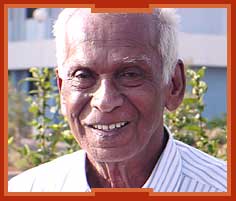
“I am not an idea man, the task is not to aspire to some heaven but to make everyday life divine."- Dr. V
Wall Street Journal has an obituary of Govindappa Venkataswamy, eye-care pioneer (1918-2006), founder of the Aravind Eye Care System ;
“With 2.4 million served, the Aravind Eye Care System in India is in a way the McDonald's of cataract surgery: efficient, effective, influential and -- rare for health care in the developing world -- a clear financial success.It began with one man, Govindappa Venkataswamy, an ophthalmologist who died July 7 at age 87 after a long illness. Dr. V, as he was universally known, created one of the largest eye-care systems in the world, catering largely to the poor in Tamil Nadu, a state in southern India. He was inspired, Aravind says, by the assembly-line model of McDonald's founder Roy Kroc -- learned during a visit to Hamburger University in Oak Brook, Ill.
Building on those lessons, he created a system for sight-saving cataract surgeries that produces enviable medical outcomes in one of the poorest regions of the globe. Its rapid expansion over three decades was not built through government grants, aid-agency donations or bank loans. Instead, Dr. V took the unusual step of asking even poor patients to pay whenever they could, believing the volume of paying business would sustain the rest. Poor people with cataracts in Tamil Nadu can get their sight restored for about $40. If they can't afford that, it's free."
"Starting with an 11-bed clinic in 1976, Dr. V's system is now a five-hospital system. His model became the subject of a Harvard Business School case study, and is being copied in hospitals around the subcontinent. The cheap, high-quality implantable lenses the system manufactures are exported to more than 80 countries around the world, Aravind says. Dr. Venkataswamy's basic insight was that health care can be marketed to the poor if a program is closely tailored to a local niche, something that has come to be known as social marketing. In a country with, by some estimates, 20 million blind eyes -- 80% of them due to curable cataracts -- the appeal for patients was financial. "A blind person is a mouth with no hands," is an Indian saying that Dr. V liked to quote. In India, health professionals say, the years of life left to those who go blind can be counted on one hand. With sight restored, the patient can return to work.The Aravind system offers services that range from a simple pair of spectacles to optical oncology. The bulk of surgeries are to treat cataracts -- removing the cataract and replacing it with an artificial intraoptical lens.
The assembly-line approach is most evident in the operating room, where each surgeon works two tables, one for the patient having surgery, the other for a patient being prepped. In the OR, doctors use state-of-the-art equipment such as operating microscopes that can swivel between tables. Surgeons typically work 12-hour days, and the fastest can perform up to 100 surgeries in a day. The average is 2,000 surgeries annually per surgeon -- nearly 10 times the Indian national average. Despite the crowding and speed, complication rates are vanishingly low, the system says.
Outside the operating rooms, conditions are as spartan as the tables at a fast-food restaurant: Often only a straw mat on a ward floor for postsurgical recovery. Patients who pay more than the basic $40 -- about 30% of patients -- can receive cushier treatment such as private rooms for extended recovery, and hot meals…”
Via Acumen Fund Blog.
Related;
Yesterday, a great hero passed away
The Perfect Vision of Dr. V.
From socialist rags to competitive riches
Multimedia;
A Discussion the Dr. V
See also this TED speech by Larry Brialliant
July 23, 2006
Carnival of Podcasts
Ray Canterbery, an author and economics professor emeritus at Florida State University, talks with Bloomberg's Tom Keene about economic theory, Canterbery's book "A Brief History of Economics: Artful Approaches to the Dismal Science" and U.S. economic policy.
Dan Griswold, director of the Cato Institute's Center for Trade Policy, talks with Bloomberg's Tom Keene from Washington about China's currency policy, the benefits of imports from China to the U.S. economy and the need for increased national savings in the U.S.
James Galbraith on economics and contributions of his father.
How many logics? If we think about logic at all, we probably think of it as one and indivisible - truth is truth and an argument is either valid or it isn't. But perhaps we need a logic that is more subtle than that, one that allows for degrees or truth. This, it turns out, is the Australian way. For more see the blog of the guest.
Hearing Voices - the invisible intruders
Around 10% of the population hear voices that aren't there. Some people can live harmoniously with them, but for those whose voices are associated with a psychiatric illness, they can be frightening and menacingly real. We discuss the latest research on how auditory hallucinations occur in the brain, what it's like to live with voices in your head - and the healing power of the international Hearing Voices Network
U.S.-China Trade, Exchange Rates, and the U.S. Economy
Featuring Nicholas Lardy, Institute for International Economics; Frank Vargo, National Association of Manufacturers; and Daniel Griswold, Cato Institute; One year after China’s modest currency reforms, the issue remains a sticking point in U.S.-China trade relations. Critics argue that China’s yuan remains grossly undervalued, bestowing an unfair advantage on imports from China at the expense of U.S. producers. Other observers contend that benefits from trade with China far outweigh any concerns about its currency. Policy options range from doing nothing to aggressive diplomacy to imposing steep tariffs on Chinese imports. Three experts on U.S.-China trade will discuss the status of reform in China, the impact of U.S.-China trade and exchange rates on our economy, and what change, if any, should be made in U.S. economic policy toward China
Myths, Lies, and Downright Stupidity: Get Out the Shovel—Why Everything You Know is Wrong
Two Views on Global Development: Revive the Invisible Hand or Strengthen a "Society of States"? Deepak Lal and Ethan Kapstein.
U.S. Trade Policy in the Wake of Doha: Why Unilateral Liberalization Makes Sense
Featuring Jagdish Bhagwati, Professor of Economics and Law, Columbia University, Senior Fellow in International Economics, Council on Foreign Relations and Daniel Ikenson, Associate Director, Center for Trade Policy Studies, Cato Institute
Israel, Lebanon and Palestine
Ross Burns; Former Australian Ambassador to Lebanon and Syria in the 1980s, South Africa and Greece in the 1990s and in Israel until 2003'
Human Betterment Through Globalization by Vernon Smith
Via Café Hayek
Christian Emissary of Kublai Khan
Before Marco Polo plied the Silk Route to visit the great Khan in the 13th century, the Mughal Emperor sent out a Christian emissary to retrieve relics from Jerusalem and send a message to the Pope. His name was Rabban Sawma and his story is told by Professor Sam Lieu
The Prophet Muhammad He came from desert obscurity in the sixth century, to become a leading figure in the prosperous Arabian town of Medina. The Prophet Muhammad went on to found a religion that would dominate the Middle East in just a century after his death. Interview with Reza Aslan
Coping by cutting
The incidence of self harm is rising and there's a search for understanding and solutions. Princess Di admitted to it. As many as 1 in 5 young people are likely to deliberately hurt themselves to release internal tension and pressure. What is it, and how can parents handle it? Reporter, Jane Shields
Bird flu: risks, laws and rights
Scientists, lawyers, politicians, security forces—everyone's walking a fine line with avian flu, between the rights of the individual and the rights of the wider public. When a pandemic happens each of us will be on our own, as the authorities look at the big picture. Reporter, Ian Townsend
Business, design and Innovation
By Design is intrigued by the connection between design and the marketplace. To look at how design and economics are further embedding themselves in our cultures and what inhibits this if the connection is not happening, our discussion this morning focuses on design and innovation
British ex-ambassador discusses US role in Middle East
Defining obesity; A powerful expert committee in the US has plans to alter the definition of healthy weight levels, which will result in almost 40% of children aged 6 to 11 years being defined as 'overweight'. We speak to Ray Moynihan and Michael Gard on how the West got so worried about being fat
Darwinian aesthetics
When Darwin first published Origin of Species back in the middle of the nineteenth century, it was, to put it mildly, a revelation. His theories radically altered our perceptions of ourselves and the world around us...and it seems the aftershocks are continuing to this day. There is a growing academic movement that aims to apply Darwin's theories to the study of art and literature. But what does the survival of the species have to do with art? Professor Dennis Dutton is a philosopher at the University of Canterbury in New Zealand. He is interested in the study of evolutionary psychology, or Darwinian aesthetics, so he's bound to know the answers.
Listen online
Anwar Ibrahim - Shakespeare, Islam and Democracy
Anwar Ibrahim is a guest of the World Shakespeare Congress in Brisbane and he lectures there on Shakespeare this week. What does the former Deputy Prime Minister of Malaysia have to say about the Bard's influence on him, especially during his years of imprisonment? Anwar Ibrahim also lectures this week at the University of Queensland on Islam and Democracy in Asia and other parts of the world. These two subjects are disparate but their common ground is a world recognised scholar and political thinker. Find out more on Encounter this week
Design island; For its size, Tasmania can boast a disproportionately high number of creative people, and at a recent design forum the mostly Tasmanian-based designers and craftspeople discussed the challenges many artists in far-flung places face; of isolation, and of regional identity versus international style.
Adult Attention Deficit Hyperactivity Disorder - what is it and what can be done about it? We'll also look at some assumptions and controversies surrounding this condition. One of the commonly asked questions is whether adult ADHD really exists
‘You Must Use The Bath' is an exploration of a little-known part of Australia's Colonial history - the emergence and widespread 'take up' of Turkish Baths. It's a tale of entrpreneurial spirit and, at the time, many claimed 'whacky vision'. However, the larger-than-life Turkish Bath devotees were not to be diverted and there were soon baths in all major cities and regional centres
Behind The News - a profile of Dr Peter Russo
For 50 years journalist and academic Dr Peter Russo told Australians about Asia and about themselves, but it was often not what they wanted to hear.
Free to learn - the history of progressive education in Australia
If the words progressive education mean anything to you at all, they may well conjure up the name Summerhill—probably the most famous progressive school in the world—in England, where children can choose whether or not they go to lessons, and are free to do pretty well what they want
Joel Shurkin, biographer of William Shockley
Robyn's guest this week is author Joel Shurkin, who's written a biography of William Shockley, the Nobel prize winning inventor of the transistor. Shockley was an extraordinary man whose work gave birth to modern electronics, yet on a personal level, his colleagues felt he was deeply flawed. It's suggested that he had reverse charisma; he'd walk into a room and engender instant dislike! We take a look at Shockley's fascinating and tragic life
Barbara Biggs has been a journalist, a prostitute and a property developer. She has written three books about her remarkable experiences. She talks to Robyn Williams about why she chose to expose the man who abused her when she was young. What was the point of enduring public attention and the law courts so long after the event? Do victims need to revisit distress in this way?
Dr Jim Cotter and the 100 hour challenge; The 100 hour challenge is not for most of us. You run for that length of time, across country, with hardly any sleep. Dr Jim Cotter has done it and studied the physiological implications. How much water do you need to keep going? Do branded sports drinks help? How do you prepare for such an ordeal - or for regular jogging that normal people do?
Defecation, Copulation and Exclamation: A Social History of Swearing
Six hundred years ago the English were known to the French as "les goddems" due to their propensity for foul language. English-speakers' long-standing partiality to oaths, profanity and ethnic slurs reveals much about our shifting understandings of sexuality, class, race and humour
Lifetime Economics; Bob Blain is one of the world's leading economic reformers. He believes that today's monetary system has stalled and has failed to complete its evolution. He proposes developing a more sustainable world economy by adopting an "hour of work" as the world monetary standard, a way to share work and wealth more equitably.
Which lies matter - which ones don't? Are some lies now so much a part of daily life that they've lost their sting? Today on Life Matters we look at how we deceive and are deceived on a daily basis
Listing love's loves; Peta Logan unpacks tales of unrequited love in one of the many lists in James Joyce's novel, Ulysses
Correspondents and Fixers
Have you ever wondered how foreign correspondents fly into the latest disaster zone and instantly report with authority? The answer is The Fixer, a local, often taking extraordinary risks
The Strange Case of Dr John Bodkin Adams
Medical historian Dr Jim Leavesley from Margaret River in Western Australia tells us the story of the medical murder trial of Dr John Bodkin Adams, who practiced in the English seaside town of Eastbourne and who was beneficiary to no less than 132 wills
Green Power; Author Christine Williams has written a book called 'Green Power'in which she tells the story of environmentalists who have changed the face of Australia.
We the People
The Constitution of the United States of America, adopted in 1788, became the first formal blueprint for a modern democracy. What happened to the expression of those democratic ideals during the twentieth century - the American century
The creative brain; Stephanie White studies Australian zebra finches and how they sing. They learn a standard song but need to maintain it and add creative flourishes. In research just published in The Journal of Neuroscience she reveals that the gene linked to this singing may well be the same as those involved in human speech. Not only does this have relevance for investigating speech disorders, it may also have implications for creativity. Stephanie White is a professor at UCLA (University of California, Los Angeles).
An Inconvenient Truth
David Fisher reviews director David Guggenheim's film, An Inconvenient Truth, which features former US Vice President Al Gore's 'travelling global warming show'. In the wake of defeat in the 2000 election, Al Gore re-set the course of his life to focus on a last-ditch, all-out effort to help save the planet from human-induced irrevocable change
Dark Paganism and Deep Blue Religion; Witches' Sabbats that include death rituals are frightening, but they have a therapeutic value, says PhD student Marian Dalton, a witch who practices Dark Paganism. And strong communal values are also evident, says paganism researcher Dr. Douglas Ezzy from the University of Tasmania. Paganism's earth-based spiritualities often exclude the importance of the sea but sociologist Sylvie Shaw has discovered that "deep blue religion" is alive and well
The New Animism; The oldest living religion, Animism, has a new advocate in pagan expert, Graham Harvey. We also hear from practising pagans in South Australia
Mentoring and sport; For some young athletes negotiating the off field demands of expectation and celebrity can be a difficult part of the game, so who's there to guide them?
The New Arab World; Dubai, Oman, Qatar
A Witch's Brew; It is barely fifteen years since Kazakhstan, Kyrgyzstan, Uzbekistan, Tajikistan and Turkmenistan emerged from the shadows of the Soviet Empire and all now find themselves facing enormous environmental problems
GREEK COMEDY
But how did Greek comedy evolve? Why did its subsequent development differ so radically from that of Greek tragedy? To what extent did it reflect the anxieties and preoccupations of a nascent democracy? And can it be said to have left any lasting legacy? Listen online
India struggles to catch China
The rapid growth of the Indian and Chinese economies have transformed the two countries in recent years. But this prosperity has also brought other problems.
A review of developments in Latin America over the past year, particularly the Bolivian and Mexican elections
Nature Podcast; untangling foodwebs, our Neanderthal heritage, lungfish dammed, military secrets, graphene hits the scene, the origin of the ocean floor, and paramutational phenomena
More on science; Brain-computer interfaces, science and the battle of the sexes, human transmission of H5N1, science and religion, deep sea secrets, the unshelled mollusc, tropospheric radicals, and atomic tweasers
Forensic Economics 101
An interview with Forensic Economist Don Frankenfeld
From Google Authors; Gene Sperling, Hal Varian, Seth Godin, John Battelle, Barry Swartz,
Charlie Rose Show; with Fouad Ajami, Christiane Amanpour
Other videos; Investment Opportunities in China, Leveraging India as India Stands Up, Our Lives Our Facebooks, The Next Fifty Years of Science
July 19, 2006
Facts about Poverty in South Africa

A recent article from UN highlights;
“According to the Basic Income Grant (BIG) lobby group, around half of South Africa's 47 million people are poor. But the government's welfare scheme - child grants, pensions, foster children support and disability payments - reach only 11 million people
Child support grants pay R190 (US$27) per child per month, roughly R6 (85 cents) a day - about the cost of a loaf-and-a-half of bread. Around seven million children receive the means-tested payments, and that money often supports an entire family
An unemployment rate estimated at around 40 percent…
It believes a total of 12 million children up to the age of 18 live in poverty.”
Related;
Interview with the author of recent survey on South Africa at The Economist
Value of foreign direct investment soars ; THE value of mergers and acquisitions in SA soared 63% last year, helping the country eclipse India for the first time in terms of foreign direct investment, according to Ernst & Young
July 7, 2006
The Economics of France's attempt to open up iTunes

The Economist’s Economic Focus column looks at French attempt to allow customers to play music bought from iTunes on one of the iPod's rivals;
“Put these practical difficulties aside, and ask whether France's policymakers identified a real problem. Are they right to worry about the inseparability of Apple's store and its player?Such controversies normally turn on the analogy chosen to illuminate them: is the iPod like a CD or cassette player, or an inkjet printer? Since it appeared in 2001, the iPod has become this decade's answer to the Sony Walkman. Supporters of the French law point out that if you buy a music cassette at a shop, you can listen to it on any cassette player that takes your fancy. You do not have to play it on a Walkman. Why then can customers not listen to songs from Apple's music store on whatever player they like? Surely Apple is guilty of exploiting the popularity of its store to stifle rivals to its iPod?
The law's opponents reach for different analogies. They compare the iPod not to the Walkman, but to printers, games consoles and razors. Buy an inkjet printer, for example, and you must buy the manufacturer's cartridges to be sure that it will work properly. (Although French parliamentarians will not come to your rescue, European regulators might.) Indeed, manufacturers make much of their money from the cartridges, not the printer itself, which is often sold cheaply. Economists explain this business model as a clever way for companies to “meter” their customers, charging them according to use. If they could not tie their customers to their cartridges, they would charge more for the printer itself, and the kind of person who now uses his printer rarely would not buy one at all.
Apple's business model, however, turns this on its head. Apple makes its money from sales of the iPod, not sales of music; the printer, not the cartridge; the razor, not the blade. As Bill Shope, an equity analyst at JPMorgan, puts it, the music store is a “loss leader” that serves only to boost sales of the iPod. It is as if record stores existed only to sell record players.”
Other free-reads from the latest Economist;
The trouble with Pakistan; An unstable, nuclear-armed Pakistan, intertwined with a chaotic and Taliban-dominated Afghanistan: it is not a settling prospect. It has all happened before, of course. The result was September 11th, swiftly followed by a terrorist outrage in Delhi that came close to provoking full-scale war between Pakistan and also-nuclear India. What will happen next time?... A Survey of Pakistan, here’s a podcast of the interview with the author.
Lexington- Faith, race and Barack Obama
HOW can Americans overcome their divisions? Barack Obama, the son of a lapsed Kenyan Muslim, has some arresting thoughts. On the subject of tackling head-on “the mutual suspicion that sometimes exists between religious America and secular America”, the junior senator from Illinois delivered last week one of the best speeches of his brief career.
Genetics-The genetics of mammoth coat colour
“ICE AGE”, a film about the antics of a group of prehistoric mammals, was such a hit that Regent Street in London was festooned with Christmas lights in honour of its stars: Manny the mammoth, Sid the sloth, Diego the sabre-tooth and an irritating squirrelly creature called Scrat.
Memory formation- There may be a link between the way memories are formed and the adverse effects of sleep deprivation
Dr Tononi's hypothesis is, it must be said, controversial. Many researchers hold almost precisely the opposite opinion—that sleep serves to re-activate synapses that were strengthened during the day, and thus reinforces their strength rather than diminishing it. There is, however, a certain logical sense to the Tononi view of the world. It is impossible to remember everything, so a process of winnowing must take place somehow. The idea that, after a period of expansion, the brain pares back its workforce to become leaner and meaner is somehow rather appealing
Face value-The business of persuasion
Erel Margalit, an Israeli venture capitalist, dreams of using his dealmaking skills to revitalise Jerusalem
High-tech industries now provide around 55% of Israel's exports, and in the past ten years accounted for about 40% of its growth. Mr Margalit argues otherwise. The city's reservoir of intellectual and creative life can be tapped, he insists. A few elite institutions—the Hebrew University, the Bezalel art academy, the state-run Israel Broadcasting Authority, the hospitals, even the government—that now function largely in isolation from the city could become “a cluster of creative elements, a cohesive arena.”
Internet advertising- The ultimate marketing machine
Thanks to the power of the internet, advertising is becoming less wasteful and its value more measurable.
Within a year, however, Messrs Brin and Page changed their minds and came up with AdWords, a system based on Overture's idea of putting advertising links next to relevant search results and charging only for clicks (but with the added twist that advertisers could bid for keywords in an online auction). Google soon added AdSense, a system that goes beyond search-results pages and places “sponsored” (ie, advertising) links on the web pages of newspapers and other publishers that sign up to be part of Google's network. Like AdWords, these AdSense advertisements are “contextual”—relevant to the web page's content—and the advertiser pays for them only when a web surfer clicks. Together, AdWords and AdSense produced $6.1 billion in revenues for Google last year.
Kenneth Lay- founder of Enron, died on July 5th, aged 64
July 2, 2006
Carnival of Podcasts

Alan Krueger, a professor of economics at Princeton University, talks with Bloomberg's Tom Keene from Princeton, New Jersey, about President George W. Bush's selection of Columbia University scholar Frederic S. Mishkin as a Federal Reserve governor, Mishkin's relationship with Fed Chairman Ben S. Bernanke, and inflation targeting.
Former U.S. Treasury Secretary John Snow talks with Bloomberg's Tom Keene from Washington about the results of a Bloomberg/Los Angeles Times poll that finds more than six in 10 Americans say the country is on the wrong track and that more than half disapprove of President George W. Bush's handling of the economy, Snow's disappointment at not gaining enough support for changes in Social Security and future career plans.
U.S. Trade Policy in the Wake of Doha: Why Unilateral Liberalization Makes Sense; Featuring Jagdish Bhagwati, Professor of Economics and Law, Columbia University, Senior Fellow in International Economics, Council on Foreign Relations and Daniel Ikenson, Associate Director, Center for Trade Policy Studies, Cato Institute
World Economic Update ( a discussion at CFR, June 27,2006)
A Conversation with Hoshyar Zebari, Minister of Foreign Affairs, Republic of Iraq
Brazil's law-enforcing buffaloes ; Police have taken to an unusual form of locomotion in the Brazilian city of Belem
Behavioural Economics: Fear, Anxiety, Overconfidence, and the End of the Financial Year
Philanthropy; The world's two richest individuals are set to give away most of their money to the needy. The personal philanthropy of Bill Gates and Warren Buffett will amount to tens of billions of dollars - so are they setting a trend - will others follow? And just how generous are Australian companies and individuals when it comes to charitable acts?
Emotions at work; This week we hear about some learnable techniques that might help people be more self-aware at work, allowing them to use their emotions as a positive force.
The 'curse' of having a girl ; India might be a country rushing headlong into 21st century but every year thousands of babies are aborted or killed at birth because they are girls
Higher Education Hype and the myth about Chinese engineers
Give Me Land ; Across the world millions of people have no land that they can call their own. Many have been made landless from great injustices. As populations grow and property prices rise the struggle for land becomes more difficult every day. This four-part series travels to China, India, South Africa and Brazil to see how people are fighting for land.
Peter Day looks at the long-running battle between Airbus and Boeing
The Enlightenment Is Not Godless; The 17th Century philosophers in England, France and Germany have been roundly criticised for being anti-religious. Professor of Philosophy at Griffith University, Wayne Hudson, resurrects their different understandings of God and argues they have been ignored in the rush to rubbish the Enlightenment as a den of unbelievers
Zen Brush, Zen Mind; A thousand years after Buddhism arose in 550 BC, Japanese Zen developed zenga - ink painting - which included calligraphy as a way of communicating its message
Interiors - how we 'invented' them; The interior of a house is always undergoing 'renovation' - not only physically, but also within our imagination. Charles Rice is an architect with a theory on how our significant philosphers and psychoanalysts, people like Freud, have shaped not only our sense of self, but the interior of our homes and the settings of most television shows. In fact media and self are now dependent on one another.
Computers and new ways of thinking; Computers are more than an extended drawing tool, or just a way of imaginging 3D. Now they are forging new ways of thinking, and offering ways of imaging the world that would be impossible without a computer. Hear how computers are changing engineering and architecture - indeed blurring the two.
Nutrition for children in Sub-Saharan Africa; In Sub-Saharan Africa malnutrition, particularly in babies and toddlers, is part of every day life. However, there may be some help available through some dietary intervention
Chris Turney; This week, Paul Willis takes the chair and goes dating with Chris Turney. Chris's specialty is carbon dating. He explains how this area of science has been called upon to solve some long-standing mysteries. When did the Minoan civilisation of Europe collapse and why? When did various groups of people arrive on the major continents? These are questions that can now be answered quite accurately using carbon dating, which looks at ratios of radioactive carbon in organic samples and compares the amounts present to the known rate of decay
The Political Speeches of Cicero; Dr Kathryn Welch on the rhetorical brilliance of the master orator of the Roman Republic
Faux Pas; Robert Dessaix on Philip Gooden's no-nonsense guide to words and phrases from other languages.
Those who have ears; Former Queensland teacher Jennifer Riggs looks at an extensive study by the Australian Council for Education Research which identifies serious problems with auditory processing in a high proportion of children
The future for manufacturing in Australia
Putting Ethics First; This year sees the hundredth anniversary of the birth of the philosopher Emmanuel Levinas, who died in 1995. A survivor of the Holocaust, Levinas was a philosopher of ethics who insisted that all human beings, whoever they may be, and he was thinking of Nazis, have a claim on our respect
The philosophy in Tristram Shandy; In 1904, Ivan Pavlov received the Nobel Prize for medicine for his work on the phenomenon he called the conditioned reflex. He had applied stimuli - aural, visual, tactile - to dogs and then fed them. After a while the association in their minds between the stimulus and food was so strong that they'd salivate at the application of the stimulus, even if there was no food around
Cosmopolitanism; It's not about being worldly and sophisticated and it's not about cocktails. Cosmopolitanism is a very old philosophical idea that is coming back into favour. The cosmopolitan believes that each person has a moral responsibility towards each other person, no matter where that person lives or their nationality, religious commitment, ethnic affiliation, socio-economic class, or gender might be. It's a moral virtue for a global age
Developing Australia; This month, federal and state governments bowed to public pressure and abandoned plans to privatise the Snowy Mountains Hydro-Electric Scheme. Rear Vision looks at the history of government involvement in Australia's big projects
East Timor Since Independence; What has happened in East Timor since independence to give rise to the violence, turmoil and political upheaval that culminated this week in the resignation of Prime Minister Mari Alkatiri?
Computer games are not childsplay; Do you remember Donkey Kong, Pacman and Super Mario? Computer games now have names like Doom and Grand Theft Auto, and it's the extreme violence in these games that concerns computer science lecturer Simon McCallum, especially as they are often available to children.
Maternal Health and Foreign Policy Symposium; Session 1 and Session 2
A Conversation with James Baker
Water in India; The cost of boom times in India is a surge in demand for everything - and top of the list is water. Industry, agriculture, households in middle class suburbs and global corporations all want as much as they can get. Is privatisation the answer when governments are struggling?
Workers of the world; Whether you call them guest workers or skilled immigrants, they're part of a globalising workforce
June 29, 2006
Stylized facts about regional disparities of growth in India
 The latest IMF survey summarized the working paper ‘Mind the Gap - Is Economic Growth in India Leaving Some States Behind?’ in which the author examines how economic growth has varied across India's states. The following five are given as stylized facts about growth in India.
1. The gap between in income levels across states is widening.
2. Richer and faster-growing states are generally better at reducing poverty.
3. Poor and slower-growing states generated fewer private sector jobs.
4. Capital and labor flows do little to address imbalances in economic activity and
income across states.
5. Growth has been the most volatile in the poorest states.
Some more statistics;
-Between 2006 and 2051, about 60 percent of the projected 620 million increase in the Indian population is expected to occur in three of its poorest states (Bihar, Madhya Pradesh, and Uttar Pradesh)
- The ratio of average per capita income in India’s richest state, Punjab, to that in its poorest state, Bihar, rose to 4.5 percent in 2004, from 3.4 percent in 1970. The pace of growth in real per capita income in India’s fastest-growing states—just over 3 percent a year—has been more than twice as fast as that in the slower-growing poor states.
- On average, richer states have been about 50 percent more effective in reducing poverty, for each percentage point of growth, than poorer states. The pace of job creation in middle- and high-income states has far outstripped that in poorer states. India’s poorest and most populous states account for about 40 percent of the population but capture only one-fourth of jobs in the organized sector.
- About 55 percent of outstanding bank loans in India in FY2004/05 were to borrowers in the five richest states, whereas borrowers in the five poorest states accounted for a mere 15 percent. Moreover, over half of the foreign direct investment inflows into India in recent years have gone to five largely prosperous states.
- Only 6 percent of migration in rural areas and 20 percent of migration in urban areas in recent years has occurred across state borders.
- Take, for example, one of India’s richest and fastest-growing states, Maharashtra (which includes the financial capital of India, Mumbai). It was less successful in translating its growth into jobs and poverty reduction over the past three decades than Rajasthan, which grew much more slowly than the national average (see table).
- Using district-level data, Abhijit Banerjee and Lakshmi Iyer found that areas in which proprietary land rights were historically given to landlords had significantly lower agricultural investment and productivity after independence than areas in which these rights were given to cultivators.
For comment; Why is that female literary is not found to have a significant exogenous impact on states’ growth performance (coefficients are in fact negative)?
Related links;
Economic Growth in South Asia- a recent report from World Bank
Reports on India from Planning Commission
Water in India; The cost of boom times in India is a surge in demand for everything - and top of the list is water. Industry, agriculture, households in middle class suburbs and global corporations all want as much as they can get. Is privatisation the answer when governments are struggling?
A Tale of Two Giants: India's and China's Experience with Reform and Growth. See also the panel discussion on the topic; China’s economy is three times larger than India’s and contributes significantly more to global economic growth.
June 25, 2006
Are Asian billionaires Stingy?
Sepia Mutiny raises an interesting question about lack of wealthy Asian especially Indian philanthropists;
“In general, I’m scratching my head trying to understand why rich desis have taken after their white counterparts spending habits in every way except this one: a penchant for big ticket charitable giving. Is it simply that they’ve got new money, and they’ll start to give in a few decades once their appetite for weddings, cars, houses and jewelry has been slaked? Are they simply numb to poverty having grown up with it? Is it something cultural that I’m missing? If so, what - all the desi religions emphasize charitable giving, so it’s not that.Are rich brown people simply more selfish than rich white ones?”
Some Indian billionaires are known for their lavish lifestyles ( Mittal spend over $ 55 million for a wedding and $ 127 million for a London mansion) but their western counterparts like Bill Gates and Soros are well known for the opposite.
May be Mittal had never read a World Development Report - Bill Gates read a World Bank World Development Report and realised he could do something to improve public health in the world's poorest countries, so he started the Gates Foundation. Or just may be that Asian philanthropists’ work are not publicized enough.
Related;
Deepak Lal tells a tale about a wealthy Indian and how he decided on the inheritor to his wealth in this podcast book discussion.
Blogs discussing the latest World Wealth Report- New Economist and Andrew Leigh
A discussion with Matthew Bishop, American business editor of The Economist who ealry this year wrote a survey of philanthropy in the magazine; “It's very, very striking that the new philanthropists, the likes of Bill Gates or Pierre Omidyar, who founded eBay, or Thomas Hunter, the Scottish retailer, who are coming into the field, are all very concerned about how do we make sure that our money isn't wasted, that it actually does make a difference. And they're rethinking the way philanthropy is done"
A Flavor of Bollywood for the Weekend- Geela Geela

A sample of Bollywood songs from YouTube; have a nice weekend.
Dil Samandar (with English subtitles)
Aashiq Banaya Aapne ( not work safe)
A tamil song from Indian musical genius A R Rahman – see also this clip where his music is used in this Hollywood movie with great effect.
Related; Bollywood Comedy
June 24, 2006
The benefits of corruption are not worth the costs
An interesting paper on corruption; Does Corruption Produce Unsafe Drivers? by Marianne Bertrand (University of Chicago Graduate School of Business, NBER, CEPR and IZA), Simeon Djankov (International Finance Corporation), Rema Hanna (New York University Wagner School of Public Service) and Sendhil Mullainathan (Harvard University and NBER)- quite a handful of authors. Here’s the abstract;
“We follow 822 applicants through the process of obtaining a driver’s license in New Delhi, India. To understand how the bureaucracy responds to individual and social needs, participants were randomly assigned to one of three groups: bonus, lesson, and comparison groups. Participants in the bonus group were offered a financial reward if they could obtain their license fast; participants in the lesson group were offered free driving lessons. To gauge driving skills, we performed a surprise driving test after participants had obtained their licenses. Several interesting facts regarding corruption emerge. First, the bureaucracy responds to individual needs. Those who want their license faster (e.g. the bonus group), get it 40% faster and at a 20% higher rate. Second, the bureaucracy is insensitive to social needs. The bonus group does not learn to drive safely in order to obtain their license: in fact, 69% of them were rated as “failures” on the independent driving test. Those in the lesson group, despite superior driving skills, are only slightly more likely to obtain a license than the comparison group and far less likely (by 29 percentage points) than the bonus group. Detailed surveys allow us to document the mechanisms of corruption. We find that bureaucrats arbitrarily fail drivers at a high rate during the driving exam, irrespective of their ability to drive. To overcome this, individuals pay informal “agents” to bribe the bureaucrat and avoid taking the exam altogether. An audit study of agents further highlights the insensitivity of agents’ pricing to driving skills. Together, these results suggest that bureaucrats raise red tape to extract bribes and that this corruption undermines the very purpose of regulation.”
I learned about it via Sepia Mutiny.
Related Links;
Driving in New Delhi- Don't complain about standing in line at the DMV
Parking tickets, diplomats and corruption
Peter Foster in New Delhi ( the blog of Daily Telegraph's South Asia correspondent)
TI India chapter
June 21, 2006
Martin Wolf on World Bank and Economic Reform in India

“The experience with national economic planning has important lessons. It helps us understand what a state can usefully do — and is obliged not do — if it is to see a rise in the living standards of the people for whom it has responsibility.
This undermined the professional integrity of the staff and encouraged borrowers to pile up debt, no matter what the likely returns. This could not last — and did not do so. As Montek Ahluwalia — former economic secretary and later finance secretary — once told me, the Bank was a growing business in a dying industry. It was certain to reach the limit to its growth.
I worked on India as senior divisional economist for three years. During that time, my chief function, so far as the Bank was concerned, was to justify the provision of significant quantities of aid — even though this money was helping the government of India avoid desperately needed policy changes.
As it turned out, those changes were made in the midst of a deep foreign exchange crisis in 1991 — almost two wasted decades later.
The changes were made under the direction of Manmohan Singh — then finance minister — with the assistance of Montek Ahluwalia.
This experience confirmed three lessons: Policy changes could make a huge difference to economic performance. Such changes could be put into effect by relatively small teams of intelligent, motivated and well-disciplined individuals. And most important of all, those changes could not be imposed from outside.
Unfortunately, lending too much was not the World Bank's only fault. It also had to lend to governments.”
Martin Wolf, “Why Globalization Works”
Related; Montek Ahluwalia, Some Lessons from Economic Reforms in India
Some Facts about Bollywood

“Although Bollywood's budgets and box-office takes still do not compare to Hollywood's, the scale of the business is not trivial. According to a PricewaterhouseCoopers report, India's film business earned $1.12 billion in 2004, up from $617 million in 2001, though that would not cover the takings from one Harry Potter film. In 2003, the industry earned more than $703 million. Much of this success is driven by global popularity. An average Indian movie's budget is $500,000 (though the major titles can budget more than $10 million), far below the average $14 million spent in the US.
PricewaterhouseCoopers believes that Bollywood will double its turnover by 2009. Since 2001, the government has allowed financial institutions to finance up to $1 million of a picture's budget or up to about 40% of the total production cost. A Rabo India study indicates that the number of films financed through organized sources last year went up 200% against 2002, though the total corporate finance into films is still quite low and was a little more than $150 million in 2004.
According to a study by KPMG, although India produces more films than any other country, its share of global cinema revenue is a lowly 1%. The US leads with 60%, and India is far behind Japan, the UK and France as well. However, KPMG projects that the revenue of the Indian film industry will cross $2 billion next year and $3.5 billion by 2010.”
- Foreign shoots spread Bollywood's reach
More on India
What Detroit Can Learn From Bangalore
On Bollywood; Welcome to Bollywood and two earlier posts about Bollywood- Bollywood Sarukar and thought of the day.
Access Bollywood;behind the scenes with Bollywood actor Tom Alter.
If India Played the World Cup

Hindu ascetics play soccer on the banks of the River Ganges in Allahabad, India. India did qualify for world cup in 1950. (Via Sepia Mutiny)
June 1, 2006
Should India go for Capital Account Convertibility?

What does John Williamson, the father of the Washington Consensus think;
“I therefore see a series of reasons for India to take a go-slow approach in moving to liberalise the capital account. That it would be wise to liberalise one day I do not doubt. That there are some liberalizing measures that should be made early – of FDI, of portfolio investment, of small private transactions – I find compelling. But there are many other liberalizing reforms – from electricity pricing to making the courts work expeditiously to pruning the fiscal deficit – that deserve to be priorities over complete capital account liberalisation for the next 10 years (at least). At this stage full capital account liberalization promises no large benefits, while it increases the risk of things going badly wrong.”
The Economic and Political Weekly have an interesting debate on the capital account convertibility issue in India.
Related Links;
Pablo points to another article by Williamson on the Indian economy. Listen a discussion with Williamson on the Washington Consensus.
Charles Wheelan talks about taking his students to India on an International Policy Practicum – interesting idea for teaching economic policy.
World Economic Forum- India Summit. See also India posts at New Economist and Indian Economy blog.
A Survey of Business in India from the latest edition of The Economist; This survey will argue that Indian business can play a big part in delivering faster growth, but only if the government helps. The successes of the past 15 years have been, in a sense, the easy part. Many of the bars that caged the Indian tiger have been removed, leaving the beast free to roam and roar. In particular, India has been able to exploit its great comparative advantage in an era of broadband communications and globalisation: its wealth of technically adept, English-speaking talent. Now, however, further reforms are needed. Here is an interview with the author.
Indians on the Indian economy (multimedia);
Y.V. Reddy, Governor, Reserve Bank of India, Professor B.B. Bhattacharya, Vice-Chancellor of Jawaharlal Nehru University, New Delhi
P. Chidambaram, Finance Minister of India on U.S.-India Economic Relations and the Evolving World Economy. And here is the latest budget speech.