November 28, 2006
Turkey Fact of the Day

“Take the results of a new poll by Tesev, a think-tank which studies society and religion: the number of Turks who put their Muslim identity first has risen to 45% from 36% in 1999; but over the same period the number of people who favoured sharia law dropped from 21% to 9%.”
- From The Economist, The pope's controversial trip to Turkey
Related;
Allure of Islam Signals a Shift Within Turkey
A Real Liberal Under Attack in Turkey for Defending Freedom
“Kemalist secularism is not well understood by Americans and Europeans. As Atilla put it some years ago (about ten, I think) at a seminar I organized for him at the Cato Institute, “People say that you have separation of church and state in America and we have separation of mosque and church and state in Turkey. In America, that means freedom of religion. In Turkey, it means freedom from religion. There is a great difference between the two.” Private property, contract, and limited government should create the framework for people to decide on their own, through voluntary cooperation, whether and how to build a mosque, a church, a synagogue, or anything else. Such decisions should not be made by state officials.”
The Pope, The Condescending, and Closet-Intolerance
November 26, 2006
Podcast of the Day- Lecture 3 Reform and Deregulation
The Boyer lectures by Ian Macfarlene, former governor of Reserve Bank of Australia, continuos;
By the 1970s the world's developed economies were stuck in the worst position they had been in since the Great Depression of the 1930s. Australia shared this experience but, propelled by a program of reform and deregulation, it slowly became competitive again and began to register strong rates of growth. In this environment the corporate sector embarked on an era of heightened activity, driven by massive borrowings, takeovers and mergers. It is now apparent that the implications of sudden financial deregulation were not fully understood, and the dawn of the 1990s would bring with it new challenges for those charged with navigating the twin hazards of boom and bust.
Listen to the podcast. Some excerpts below;
“Let me digress for a moment to discuss another epithet routinely applied by those opposed to economic reasoning, which is to refer to economics as the dismal science. Whenever I hear this term, I wonder how many people who use it know its origin. It was coined by Thomas Carlyle, in 1849, in an essay called, Occasional Discourse on the Negro Question, in which he argued for the reintroduction of slavery into the West Indies. He viewed the former slaves as 'indolent, two-legged cattle, who should be subject to the beneficent whip'. It is extraordinary that the author of these views which were reactionary and racist even by the standards of 1849, should have had the temerity to refer to his opponents, the most prominent of whom was John Stuart Mill, as representing the dismal science, when all they were doing was arguing that freed slaves should have the same rights as other free people. Mill wrote a reply to Carlyle expressing views that would be widely held today, but unfortunately it is Carlyle's throwaway line that has endured, not Mills' sensible reply….
While there had been a long series of steps in the process of financial deregulation, the decisive one that shook up the system was the entry of 15 foreign banks in 1985. They were eager to gain a foothold in Australia, and this meant lending where it was easiest to do so, which was lending to businesses. Foreign banks everywhere have always found it difficult to break into the household lending market.The existing banks also increased their lending to maintain their market share, even though they had little experience of the credit assessment required in the new deregulated world. One prominent bank chief said that he had 'thirty years experience as a lending banker, but the first 29 were all the same.' As the competition to lend intensified, many borrowers, who had formerly not been able to obtain credit, did so, and in large amounts.
The journalist and financial historian, Trevor Sykes, sums up the period this way: 'Never before in Australian history had so much money been channelled by so many people incompetent to lend it, into the hands of so many incompetent to manage it.'..
November 24, 2006
Mexico Facts of the Day

“Mexico is the country of inequality. No where does there exist such a fearful difference in the distribution of fortune, civilization, cultivation of the soil, and population.”
- Alexander von Humboldt, Problems And Progress in Mexico, c. 1800
“In Mexico the law is an aspiration, not the norm. We made many laws to look good, not to obey them. There is no public condemnation of lawbreakers.”- Bernardo León, a lawyer who advised Mr Fox on judicial reform.
- By most estimates, as many as 80 percent of Mexicans do not have bank accounts.
- Compared with countries that have similar levels of development, World Bank figures show that Mexico is well behind Brazil and Chile in an important measure of banking activity — private credit as a percentage of total output. In Mexico that figure was 18 percent in 2003, compared with almost 40 percent in Brazil.
- Mexican workers are only a third as productive as those in the United States. Foreign direct investment, apart from a couple of big bank takeovers, has fallen from 3.5% of GDP in 1994 to less than 2% a decade later.
- The Inter-American Development Bank estimates that remittances from Mexicans abroad will total $24 billion this year, about a third more than the flow of foreign direct investment
- Mexico has fewer phones per person than any other OECD country or Brazil, which privatised eight years later but encouraged competition
- Informal sector accounts for slightly more than half of total employment in Mexico
- Drug-related killings last year were running at twice the rate in 2004, and numbers have been rising further this year, to 1,500 in the first eight months.
- Over the past decade the locus of power in the drug trade, as in so many other businesses, has moved closer to the final consumer. That means it has shifted from Colombia to Mexico, which is now the gateway for up to 90% of cocaine entering the United States, as well as ever-increasing amounts of marijuana and methamphetamine.
- Mexico has some 400,000 police in hundreds of different forces. On average policemen have spent just six years at school, have received only two weeks' training and are paid just $370 a month for the job. Some 35% of them use drugs, and two-fifths leave each year.
- Official figures show that one Mexican in two still lives in some degree of poverty; in much of the south that figure rises to three in four.
- Since 1960 the number of years the average Mexican child spends at school has gone up from 2.6 to nearly eight. But that still means some 35m adults have failed to complete the nine years of basic primary and lower secondary schooling.
- At present 95% of education spending goes to the producers and only 5% to the consumers in the form of scholarships.
- Total tax revenues in 2004 (excluding oil income) amounted to only 11.4% of GDP. That is not only much less than the average for the OECD countries (36%), but also below the average for Latin America (13.7%)
- Most railways and roads were built in a radial pattern, with Mexico City as the spider in the centre of the web. That pattern met the needs of centralised political control and the policy of import substitution pursued until 1982. At the peak in 1970, half of the country's industrial production took place in Mexico City alone
The above data are from recent survey of Mexico in The Economist and from the article on Wal-Mart in Mexico which Bob referred to below- it’s also on the NYT.
Related;
A discussion with Michael Reid, the author of the Mexico survey in The Economist (podcast)
Mexico - Poverty in Mexico : an assessment of conditions, trends, and Government strategy
Mexico : Income generation and social protection for the poor
November 22, 2006
Ukraine and fiscal space for growth
A recent World Bank report on Ukraine- Creating Fiscal Space for Growth: A Public Finance Review;
“Recent economic and fiscal trends in Ukraine, combined with the financing requirements of the reform agenda, have brought fiscal pressures to the fore. Ukraine’s economy grew by more than 50 percent between 1999 and 2004, but growth decelerated from 12.1 percent in 2004 to 2.6 percent in 2005. Contributing to this slowdown were less favorable terms of trade dynamics (in particular for metal prices)1 and a substantial deceleration in investment demand (partly as a result of uncertainty about government policies and cutbacks in public investment). Despite the recovery of the economy in the first semester of 2006 (5 percent growth y/y), the short term outlook is still threatened by potential further increases in energy prices in 2007. At the same time, increasing public spending threatens to crowd out the private sector. Driven by hikes in pensions and public sector wages, public spending soared from 39.4 to 44 percent of GDP in 2005, placing significant pressure on public finances. This high public spending and its consumption orientation risks generating inflationary impulses and higher interest rates, and eroding household wealth. Ukraine also has a high tax burden which discourages the private sector.”
Related;
Ukraine's politics-The birth-pangs of democracy, or an unseemly power struggle?
Back to Basics -- Fiscal Space: What It Is and How to Get It;
“What is fiscal space? It can be defined as room in a government´s budget that allows it to provide resources for a desired purpose without jeopardizing the sustainability of its financial position or the stability of the economy. The idea is that fiscal space must exist or be created if extra resources are to be made available for worthwhile government spending. A government can create fiscal space by raising taxes, securing outside grants, cutting lower priority expenditure, borrowing resources (from citizens or foreign lenders), or borrowing from the banking system (and thereby expanding the money supply). But it must do this without compromising macroeconomic stability and fiscal sustainability—making sure that it has the capacity in the short term and the longer term to finance its desired expenditure programs as well as to service its debt.”
November 15, 2006
Afghanistan Drug Control- GAO’s views
A recent report from GAO; Afghanistan Drug Control: Despite Improved Efforts, Deteriorating Security Threatens Success of U.S. Goals
“The prevalence of opium poppy cultivation and drug trafficking in Afghanistan imperils the stability of its government and threatens to turn the conflict-ridden nation once again into a safe haven for traffickers and terrorists. To combat the drug trade, the U.S. government developed a counternarcotics strategy consisting of five pillars--alternative livelihoods, elimination and eradication, interdiction, law enforcement and justice, and public information. The Emergency Supplemental Appropriations Act of 2005 directed GAO to examine the use of all fiscal year 2005 funds administered by the U.S. Agency for International Development (USAID) and Department of State (State) for Afghan counternarcotics programs. To comply with this mandate, we examined progress under each counternarcotics pillar, challenges faced, and efforts to ensure that funds were used for intended purposes. To address these objectives, GAO reviewed pertinent USAID and State documents and met with cognizant U.S. and international officials in Washington, D.C., and Afghanistan. GAO makes no recommendations in this report. USAID, State, Department of Defense, and Department of Justice were provided a draft of this report, but did not provide formal comments.”
Related;
Afghanistan’s Other War
Afghanistan- on the road to a narco-state?
November 13, 2006
Haiti Fact of the Day

“Haiti’s income distribution is among the world’s most inequitable with a Gini coefficient of 0.66. Nearly half of Haiti’s households are trapped in absolute poverty and live on less than a dollar a day. Social indicators such as literacy, life expectancy, infant mortality, and child malnutrition show that poverty is extensive. About 40 percent of people cannot read and write; some 20 percent of children suffer from malnutrition; nearly half the population has no access to healthcare; and more than four-fifths have no clean drinking water. However, indicators suggest that non-income poverty has declined in recent years. Access to assets such as education, infrastructure, and basic services is highly unequal and strongly associated with poverty.”
Source; En Breve No. 94 - Social Resilience and State Fragility in Haiti: Breaking the Conflict-Poverty Trap (NewsletterIssue), World Bank
Related;
Online game about struggling to survive in Haiti-
Have a look at the comment made by one;
"What an interesting concept! Though, the game is amazingly difficult... Is it really this tough out there in the developing world?
November 11, 2006
Private schooling in Pakistan
A recent working paper from the World Bank;
A dime a day : the possibilities and limits of private schooling in Pakistan- This paper looks at the private schooling sector in Pakistan, a country that is seriously behind schedule in achieving the Millennium Development Goals. Using new data, the authors document the phenomenal rise of the private sector in Pakistan and show that an increasing segment of children enrolled in private schools are from rural areas and from middle-class and poorer families. The key element in their rise is their low fees-the average fee of a rural private school in Pakistan is less than a dime a day (Rs.6). They hire predominantly local, female, and moderately educated teachers who have limited alternative opportunities outside the village. Hiring these teachers at low cost allows the savings to be passed on to parents through low fees. This mechanism-the need to hire teachers with a certain demographic profile so that salary costs are minimized-defines the possibility of private schools: where they arise, fees are low. It also defines their limits. Private schools are horizontally constrained in that they arise in villages where there is a pool of secondary educated women. They are also vertically constrained in that they are unlikely to cater to the secondary levels in rural areas, at least until there is an increase in the supply of potential teachers with the required skills and educational levels.
November 3, 2006
A long term truce between Palestine and Israel?
Ahmed Yousef, a senior adviser for Hamas has an op-ed in NYT;
“A truce is referred to in Arabic as a “hudna.” Typically covering 10 years, a hudna is recognized in Islamic jurisprudence as a legitimate and binding contract. A hudna extends beyond the Western concept of a cease-fire and obliges the parties to use the period to seek a permanent, nonviolent resolution to their differences. The Koran finds great merit in such efforts at promoting understanding among different people. Whereas war dehumanizes the enemy and makes it easier to kill, a hudna affords the opportunity to humanize one’s opponents and understand their position with the goal of resolving the intertribal or international dispute.”
Related:
Islam, Terror and the Second Nuclear Age
Podcasts;
Islam and the Left
Islamic law expert Jamila Hussein on the veil row
Dr Ameer Ali interview
Islam Then and Now
Daniel Peterson believes the key to understanding present Islamic attitudes lies in understanding the religious and philosophical texts of its past
Middle East Conflict: The Nature of War in the 21st Century
Giora Eiland, former head of the National Security Council of Israel
September 29, 2006
The Story of Transparency International

Ashoka’s video, ‘Champion of Accountability; The Story of Peter Eigen and the founding of the Transparency International’ is available for download on Google Video. The interview gives an interesting overview of how the anticorruption agenda came to the forefront of international development agencies and reflects a personal story of courage and commitment to making this world a better place. A must see.
Related;
Q & A with Peter Eigen
Clean sheet: Transparency International’s new chapter
West failing to curb bribery overseas
Bribe Payers Index 2006
Fukuyama, Indrawati join the WB anti-anti-corruption corps
Corrupting practices
Using the Right to Information as an Anti-corruption Tool
Governance matters V
Multimedia (Radio National- Australia);
High Court decides on FOI and conclusive certificates; The High Court decision upholding the government's use of a conclusive certificate to snuff out a Freedom of Information request for tax figures on bracket creep and the first home buyer's scheme is being criticised as a dark day for democracy.
September 27, 2006
Costs of Island inundations not significant?
On the costs and benefits of climate change;
“Robert Mendelsohn, professor at the Yale School of Forestry and Environmental Studies, argues that such negative costs may still be less than the benefits.He sees a net global warming bonus in the near-term, as higher farming yields in northern countries offsets damage elsewhere, especially in Africa.
"In that sense it doesn't make sense to spend money right now," Mendelsohn said, adding that beyond 2050 and a 2 degrees Celsius rise the damage and need for action grows.
He added that he does not cost species extinctions and health effects, and only crudely measures the cost of island inundations.
Richard Tol, Senior Research Officer at Ireland's Economic and Social Research Institute, has a similar stance.
"(My damage estimate) does hide some things that some people will get very upset about," Tol said. "From an economic perspective small island states are so tiny and people are moving out of there anyway."
As an example Tol estimates the welfare loss of the Maldives submerging at three times the inhabitants' annual salaries, in addition to the 100 percent loss of the country's GDP.
Citizens are happy to value the preservation of the global ecosystem at a cost of 50 euros per person per year, Tol says, but added he does not factor in the risk of rapid sea level rise…”
Related;
Leave The Maldives To Sink, Senior Scientist Says
Stern Review on the Economics of Climate Change
The Politics of Climate Change;
“The Bush administration has blocked release of a report that suggests global warming is contributing to the frequency and strength of hurricanes, the journal Nature reported Tuesday. The possibility that warming conditions may cause storms to become stronger has generated debate among climate and weather experts, particularly in the wake of the Hurricane Katrina disaster.”
Two Iranian blogs

"I think my flight has become a sort of ray of hope for young Iranians living in Iran, helping them to look forward to something positive, because everything they've been hearing is all so very depressing and talks of war and talks of bloodshed,"- Ansari
Anousheh Ansari- first female tourist, first female Muslim, and first Iranian in orbit- is blogging from space.
Iranian President Mahmoud Ahmadinejad’s blog
Readers can see from the comments on the blogs who the Iranians consider as their role model.
September 25, 2006
Bombing to Stone Age
General Musharraf's memoir is being serialised in The Times (emphasis mine);
“When I was back in Islamabad the next day, our director-general of Inter Services Intelligence, who happened to be in Washington, told me on the phone about his meeting with the US deputy secretary of state, Richard Armitage. In what has to be the most undiplomatic statement ever made, Armitage added to what Colin Powell had said to me and told the director-general not only that we had to decide whether we were with America or with the terrorists, but that if we chose the terrorists, then we should be prepared to be bombed back to the Stone Age.This was a shockingly barefaced threat, but it was obvious that the United States had decided to hit back, and hit back hard.
I made a dispassionate, military-style analysis of our options, weighing the pros and cons.
My decision was based on the wellbeing of my people and the best interests of my country — Pakistan always comes first. I war-gamed the United States as an adversary. There would be a violent and angry reaction if we didn’t support the United States. Thus the question was: if we do not join them, can we confront them and withstand the onslaught? The answer was no, we could not, on three counts.
First was our military weakness as compared with the strength of the United States. Second was our economic weakness. We had no oil, and we did not have the capacity to sustain our economy in the face of an attack. Third, and worst of all, was our social weakness. We lack the homogeneity to galvanise the entire nation into an active confrontation. We could not endure a military confrontation with the United States from any point of view. The ultimate question that confronted me was whether it was in our national interest to destroy ourselves for the Taleban. Were they worth committing suicide over? The answer was a resounding no….On the other hand, the benefits of supporting the United States were many. First, we would be able to eliminate extremism from our society and flush out the foreign terrorists in our midst. We could not do this alone; we needed the technical and financial support of the United States to be able to find and defeat these terrorists. We had been victims of terrorism by the Taleban and al-Qaeda for years. Earlier Pakistani governments had been hesitant about taking on the militant religious groups that were spreading extremism and fanaticism in our country.
Second, even though being a frontline state fighting terrorism would deter foreign investment, there were certain obvious economic advantages, like loosening the stranglehold of our debt and lifting economic sanctions. Third, after being an outcast nation following our nuclear tests, we would come to centre stage.
This was a ruthless analysis which I made for the sake of my country. Richard Armitage’s undiplomatic language, regrettable as it was, had nothing to do with my decision. The United States would do what it had to do in its national interest, and we would do what we had to in ours. Self-interest and self-preservation were the basis of this decision. Needless to say, though, I felt very frustrated by Armitage’s remarks. It goes against the grain of a soldier not to be able to tell anyone giving him an ultimatum to go forth and multiply, or words to that effect..."
For Comment; Is Musharraf's decision style good enough for a president?
Related;
'America paid us to hand over al-Qaeda suspects'
September 24, 2006
A Pilgrimage that led to Inflation
“Mansa Moussa brought the Mali Empire to the attention of the rest of the Muslim world with his famous pilgrimage to Mecca in 1324. He arrived in Cairo at the head of a huge caravan, which included 60,000 people and 80 camels carrying more than two tons of gold to be distributed among the poor. Of the 12,000 servants who accompanied the caravan, 500 carried staffs of pure gold. Moussa spent lavishly in Egypt, giving away so many gold gifts—and making gold so plentiful—that its value fell in Cairo and did not recover for a number of years!
In Cairo, the Sultan of Egypt received Moussa with great respect, as a fellow Muslim. The splendor of his caravan caused a sensation and brought Mansa Moussa and the Mali Empire fame throughout the Arab world. Mali had become so famous by the fourteenth century that it began to draw the attention of European mapmakers. In one map, produced in 1375, Moussa is shown seated on a throne in the center of West Africa, holding a nugget of gold in his right hand.”
- Mansa Moussa: Pilgrimage of Gold (History Channel)
September 23, 2006
Musharaff Quotes
 Most recent;
"The intelligence director told me that (Armitage) said, 'Be prepared to be bombed. Be prepared to go back to the Stone Age,"' Musharraf said. "I think it was a very rude remark."
Last year he made the controversial comments on rape victims;
"You must understand the environment in Pakistan. This has become a money-making concern," he said. "A lot of people say if you want to go abroad and get a visa for Canada or citizenship and be a millionaire, get yourself raped."
Related;
Muslim Women — The Untold Story
Afghanistan: On the Brink
Bombing Pakistan back to the Stone Age
Pakistan criticises Afghan action
Afghan Leader Presses Musharraf
Pakistan rape victim's blog makes waves
Musharraf to pen autobiography
Feminist dimension of the Pakistan Movement;
"No nation can rise to the height of glory unless your women are side by side with you; we are victims of evil customs. It is a crime against humanity that our women are shut up within the four walls of the houses as prisoners. There is no sanction anywhere for the deplorable condition in which our women have to live."- Muhammad Ali Jinnah
Carnivals for Dictators
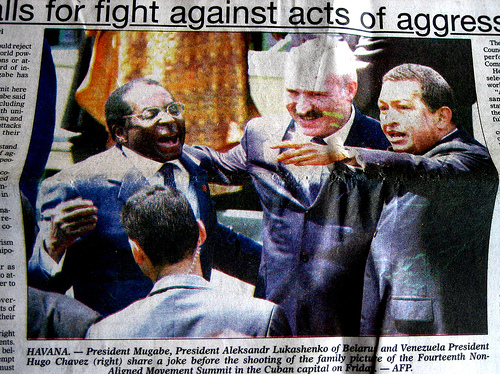
“Detail from the Sunday Mail in Zimbabwe - Mugabe, Lukashenko and Chavez share a laugh at the summit of non-aligned nations.”
Via Ethan Zukerman
Highly recommended – The Ludicrous Nature of Politics from Russell Roberts
Related
Demonization at the UN
President blasts ‘stupid democracy’ (Zimbabwe)
Stopping the dictator- a game from an Egyptian blogger
Maldives
The President addresses UN General Assembly in Dhivehi
This is how the Mr. Gayoom was welcomed in the country
September 22, 2006
Perspectives on Thailand coup

The Economist worries;
“But the bigger danger lies farther south. Indonesia and Thailand were partners in the democratic experiment of the late 1990s. Thailand's democracy constitution of 1997 preceded by a year the downfall of Suharto. And Thailand's apparent success in taming its soldiers has been a model for Indonesia in transforming a deeply repressive society into one of Asia's most vibrant and open. So far, Indonesia's generals have behaved pretty impeccably, despite the many problems of that vast archipelago. It would be a tragedy if the dangerous events in Thailand gave them other ideas.”
“Mr Thaksin graduated from Class 10 (a sort of fraternity) of the Armed Forces Academies' Preparatory School and went on to become a police colonel, and then a hugely rich businessman, before entering politics. He has continued to foster links with his former Class 10 comrades and, in recent months, has been accused of trying to land them top military jobs. In this he was pitted against the alumni of Class 6, principally General Sonthi and the commanding officers of the navy, air force and national police. All four of these men are members of the junta that has removed Mr Thaksin from office.”
Barry Bosworth, a senior fellow at the Brookings Institution, talks with Bloomberg's Tom Keene from Washington about the characteristics of Thailand's economy, the outlook for economies in Southeast Asia and trade relations between the U.S. and Asia. Listen to the podcast.
'More tank festival than coup'
From Harry Clarke;
"On a nostalgic note, I was living in Bangkok when the 1985 coup happened and was most surprised at how unruffled the local population were by it. My housemaid just laughed when I expressed my concern. ‘Oh Mister, This always happen’. So the next day I got the bus from my home on the Superhighway out to my workplace about 40 km north of the city. We got stopped by army officers holding automatic weapons somewhere around the airport. When the officers got on the bus the young Thai girls on the bus giggled at the soldiers loudly. I remember being petrified with fear but the soldiers just got off the bus and we were on our way – the girls still giggling and me remaining very, very quiet. Later I was told that the giggling was an Asian way of handling a tense situation – maybe."
Corruption in the Suvarnabhumi Airport project
Thai coup worries regional press
September 21, 2006
Iranian Economy
 All’s not well with the Iranian economy;
“But not all the developments since 2003 have strengthened Iran. Despite the oil price bonanza, Iran's economy is in poor shape. With roughly the same population, its GDP is half that of Turkey. Even the official unemployment figures have risen to 12.4 percent (a massive understatement) under Ahmadinejad and what few jobs have been created are in the public sector. The Tehran stock market lost 25 percent of its value last year and another 12 percent so far this year.
In June, 50 of the country's leading economists wrote an open letter saying that Ahmadinejad's economic policies lacked "expertise and scientific basis." Inflation is officially running at 12 percent, but most economists reckon it to be close to double that level. There are credible reports of large-scale capital flight to Dubai and elsewhere, fueled by Ahmadinejad's fatuous decree to state and private banks to cut their interest rates, whose main impact has been to dry up bank lending.”
Related:
United States, Iran Trade Barbs at UN
The George and Mahmoud show
Iranian minister urges World Bank to back nuclear energy investment
Iranian Economy- Crony Capitalism in Islamist Garb
Recent publications from IMF
Inside Iran
Iran in Maps
Thomas Schelling on the Iran nuclear issue;
“I don’t think the U.S. has a convincing argument against this Iranian charge of nuclear apartheid — especially since we’ve been allies of Israel for many decades knowing they have nuclear weapons. Although, the Iranians should recognize clearly the limits on Israel — even when it had the perfect target for tactical nuclear weapons of Egyptian troops as sitting ducks out in the Sinai desert in 1973, Golda Meir didn’t use them.I don’t know if there is any way to stop the Iranians from acquiring nuclear weapons. If they do, we should try to persuade them to declare — as the Indians and Pakistanis have done — that they are for deterrence and defense, not for offensive use.
Further, we should assist the Iranians in making sure custody of their weapons are secure in any time of disruption. In the case of a riot in the streets, will the weapons be safe? Who might grab them in case of civil war?
It is important for the Iranians to understand — and have access to — technology like we have in the U.S. that disables bombs if they get into the wrong hands. U.S. weapons, for example, have “permissive action links”— a radio signal code that arms weapons but that will also automatically disarm them it if launched at an unauthorized target.
This will be a big dilemma for the U.S. If the Iranians get weapons, will we be willing to share the technology to ensure the security of their use? That is where the debate is heading.”
Pocket Guide to Asian Think Tanks
From Asian Development Bank Institute;
“This is a handy guide to the leading Asia-Pacific think tanks working on development and economics. Each entry
- provides web links to the think tank and its research staff,
- describes the current research program,
- lists if visiting researcher or internship programs are offered, and
- states whether online publications are freely available."
Related; Think Tanks and Policy Advice in Countries in Transition
Trying hard to be a darling of IMF/World Bank
News from Sri Lanka;
“Sri Lanka said Tuesday it was moving towards eliminating oil subsidies that are threatening to blow a hole in the nation’s budget and asked lenders for financial help to tide over oil shocks.Public Administration minister Sarath Amunugama said the government “has responded appropriately to the sustained sharp rise in oil prices,” by adjusting domestic prices and moving towards oil futures to hedge future risks.
“Oil subsidies, which had been an enormous burden on the budget, have been eliminated,” he told delegates during the IMF World Bank annual meetings here.
Sri Lanka consumes around 30 million barrels of oil a year, buying 2.2 million metric tones oil light crude from Iran, Saudi Arabia and Malaysia.
The country’s oil bill is expected to climb to about 2.0 billion dollars this year, up from 1.6 billion dollars in 2005, due to surging global fuel prices.
“We reiterate our call for the creation of a special medium term oil facility to assist countries that have been adversely affected by the sharp increases in oil prices,” he said in an appeal to some of the world’s biggest financial backers…”
Related;
World Bank hates Philippines
Sri Lanka to lead South Asian initiative to study impact of oil prices
The boom in bank deposits (India)
Port Infrastructure, High Costs Seen Hampering India's Progress
South Asia conference to address sanitation
Weathering the Storm So Far: The Impact of the 2003-05 Oil Shock on Low-Income Countries
September 20, 2006
Angry Arab on Thailand coup

“There was a coup in Thailand. I am jealous. Very jealous. When was the last time we had a coup in the Arab world? Wait. We had one in Mauritania and it was pretty lousy. Never mind. Just day dreaming.”
IMF Statement on the Thai coup;
"We are following the situation closely. Thailand's economy is fundamentally strong and financial market reactions have been limited. Regional financial markets have also been little affected thus far."On the whole, Asian economies are resilient to external shocks, having strengthened their macroeconomic frameworks, increased exchange rate flexibility, and reduced external vulnerabilities in recent years."
Related;
Thailand in crisis
Like Old Times in Bangkok
Thai coup leader unveils PM plans
Thai king 'endorses coup leader'
Q&A: Thailand's coup impact
Multimedia
Postcard: Thailand Coup (podcast)
Politics of economic reform in Thailand- Tarrin Nimmanahaeminda, Chairman of Siam Pithiwat and former Thai Minister of Finance
September 19, 2006
Hungarians not happy with their leader

Hungarian Prime Minister admits he lied during the election campaign in a private conversation- at least he’s honest;
“You cannot mention any significant government measures that we can be proud of, apart from the fact that in the end we managed to get governance out of the shit. Nothing. If we have to give an account to the country of what we have done in four years, what are we going to say? …Divine providence, the abundance of cash in the world economy, and hundreds of tricks, which you do not have to be aware of publicly, have helped us to survive this. This cannot go on. Cannot. And of course we can ponder for a long time, and a shitload of analyses can be carried out as to how each social group will be affected, this is what I can say to you. ….
Even if we work ourselves into the ground. We are doing a great and decent job among ourselves. We must do it. I am not talking about the New Hungary, developments, Hungarians beyond the border, relationship with churches, or another thousand things because these are not the most important things compared to the big picture…I will only repeat this once at most: it is fantastic to be in politics. Fantastic. It is fantastic to run a country. Personally, I have been able to go through the past 18 months because one thing has inspired and fuelled me: to give back its faith to the left, that it can do it and it can win. That the left does not have to lower its head in this bloody country. That it does not have to shit its pants from Viktor Orban [chairman of opposition Fidesz - Hungarian Civic Alliance] or the right, and it should learn to measure itself against the world, rather than them...
I know that this is easy for me to say. I know. Do not keep bringing it up against me. But this is the only reason it is worth doing it. I almost perished because I had to pretend for 18 months that we were governing...Instead, we lied morning, noon and night. I do not want to carry on with this. Either we do it and have the personnel for it, or others will do it. I will never give an interview at the end of which we part with each other in argument. Never. I will never hurt the Hungarian left. Never.”
Related;
Google News coverage
Timeline: Hungary
Does transition make you happy?
Colbert Episode on Hungarian Bridge-hilarious
What is effective aid?
A working paper by Charles Kenny, “What is effective aid? How would donors allocate It?”
"Abstract: There are significant weaknesses in some of the traditional justifications for assuming that aid will foster development. This paper looks at what the cross-country aid effectiveness literature and World Bank Operations Evaluation Department reviews have suggested about effective aid, first in terms of promoting income growth, and then for promoting other goals. This review forms the basis for a discussion of recommendations to improve aid effectiveness and a discussion of effective aid allocation. Given the multiple potential objectives for aid, there is no one right answer. However, it appears that there are a number of reforms to aid practices and distribution that might help to deliver a more significant return to aid resources. We should provide aid where institutions are already strong, where they can be strengthened with the help of donor resources, or where they can be bypassed with limited damage to existing institutional capacity. The importance of institutions to aid outcomes, as well as the fungibility of aid flows, suggests that programmatic aid should be expanded in countries with strong institutions, while project aid should be supported based on its ability to transfer knowledge and test new practices and support global public good provision rather than (merely) as a tool of financial resource transfer. The importance of institutions also suggests that we should be cautious in our expectations regarding the results of increased aid flows."
Related;
Aid: Can It Work?
Owen’s posts on aid
September 16, 2006
Pope says Sorry
 I’ve to admit that I haven’t read the entire speech of Pope when I commented earlier. Kevin summarizes the gist of the speech in the comments. It’s irresponsible on the part of the advisers of Pope to have included such a comment.
At the same Muslim anger and reaction seems vastly disproportional to the broad issues raised by the Pope (even in secular countries like Turkey-see the pic). Muslims in countries like Pakistan have more things to worry than cartoons and speeches. We have to accept that certain segments of Islamic societies are not willing to accept reasoned dialogue to deal with society’s issues. I don’t think we could have reasoned with the Saudi hijackers who blew up the World Trade Center – their worldview had become too narrow.
Now that Pope has said sorry, overzealous Muslims may calm down.
Juan Cole summarizes some of the factual errors in Pope’s speech;
“He notes that the text he discusses, a polemic against Islam by a Byzantine emperor, cites Qur'an 2:256: "There is no compulsion in religion." Benedict maintains that this is an early verse, when Muhammad was without power.His allegation is incorrect. Surah 2 is a Medinan surah revealed when Muhammad was already established as the leader of the city of Yathrib (later known as Medina or "the city" of the Prophet). The pope imagines that a young Muhammad in Mecca before 622 (lacking power) permitted freedom of conscience, but later in life ordered that his religion be spread by the sword. But since Surah 2 is in fact from the Medina period when Muhammad was in power, that theory does not hold water.
In fact, the Qur'an at no point urges that religious faith be imposed on anyone by force. This is what it says about the religions:
' [2:62] Those who believe (in the Qur'an), and those who follow the Jewish (scriptures), and the Christians and the Sabians-- any who believe in God and the Last Day, and work righteousness, shall have their reward with their Lord; on them shall be no fear, nor shall they grieve. ' …
The idea of holy war or jihad (which is about defending the community or at most about establishing rule by Muslims, not about imposing the faith on individuals by force) is also not a Quranic doctrine. The doctrine was elaborated much later, on the Umayyad-Byzantine frontier, long after the Prophet's death. In fact, in early Islam it was hard to join, and Christians who asked to become Muslim were routinely turned away. The tyrannical governor of Iraq, al-Hajjaj, was notorious for this rejection of applicants, because he got higher taxes on non-Muslims. Arab Muslims had conquered Iraq, which was then largely pagan, Zoroastrian, Christian and Jewish. But they weren't seeking converts and certainly weren't imposing their religion.The pope was trying to make the point that coercion of conscience is incompatible with genuine, reasoned faith. He used Islam as a symbol of the coercive demand for unreasoned faith.
But he has been misled by the medieval polemic on which he depended.
In fact, the Quran also urges reasoned faith and also forbids coercion in religion. The only violence urged in the Quran is in self-defense of the Muslim community against the attempts of the pagan Meccans to wipe it out.
The pope says that in Islam, God is so transcendant that he is beyond reason and therefore cannot be expected to act reasonably. He contrasts this conception of God with that of the Gospel of John, where God is the Logos, the Reason inherent in the universe.
But there have been many schools of Islamic theology and philosophy. The Mu'tazilite school maintained exactly what the Pope is saying, that God must act in accordance with reason and the good as humans know them. The Mu'tazilite approach is still popular in Zaidism and in Twelver Shiism of the Iraqi and Iranian sort. The Ash'ari school, in contrast, insisted that God was beyond human reason and therefore could not be judged rationally. (I think the Pope would find that Tertullian and perhaps also John Calvin would be more sympathetic to this view within Christianity than he is).
As for the Quran, it constantly appeals to reason in knowing God, and in refuting idolatry and paganism, and asks, "do you not reason?" "do you not understand?" (a fala ta`qilun?)
Of course, Christianity itself has a long history of imposing coerced faith on people, including on pagans in the late Roman Empire, who were forcibly converted. And then there were the episodes of the Crusades.
Another irony is that reasoned, scholastic Christianity has an important heritage drom Islam itself. In the 10th century, there was little scholasticism in Christian theology. The influence of Muslim thinkers such as Averroes (Ibn Rushd) and Avicenna (Ibn Sina) reemphasized the use of Aristotle and Plato in Christian theology. Indeed, there was a point where Christian theologians in Paris had divided into partisans of Averroes or of Avicenna, and they conducted vigorous polemics with one another.
Finally, that Byzantine emperor that the Pope quoted, Manuel II? The Byzantines had been weakened by Latin predations during the fourth Crusade, so it was in a way Rome that had sought coercion first. And, he ended his days as a vassal of the Ottoman Empire.
The Pope was wrong on the facts. He should apologize to the Muslims and get better advisers on Christian-Muslim relations.”
The greatest irony I find is that I had to quote Juan Cole, a Christian to defend the position of Islam- even the statement made by the Organization of Islamic Countries doesn’t come close to above. One of the best things that Muslim scholars living in the west could do is to start a dialogue with the youth in Islamic countries- blogs are one effective mean. Akbar Ahmed, Sayyid Hussain Nasr, Hamza Yousuf, Jeffrey Lang, Tariq Ramadan, Yousuf Islam , Murad Hoffman and Timur Kuran are you listening. Minaret of Freedom has a blog coverage of news items but not much analysis.
Related;
Pope's Trip to Turkey in Doubt
Iraq calls for calm after Pope's remarks
Mixed feelings over Khatami visit
Pope and Islam: 'Non Mea Culpa'
How Pakistan's rape reform ran aground
Losing the war on Afghan drugs
'Rottweiler' bares teeth- “First, he has done it before. At Auschwitz, in May, he appalled many Jews by passing up what they saw as a historic opportunity for a German pope to apologise for the Roman Catholic Church's conduct in World War II. The second factor is that the Pope has indicated he favours a tougher line in his church's dealings with Islam.”
Multimedia
Doha Debate
Best of the Spiritual Classics;Highlights from our Spiritual Classics series, with sacred writings from Buddhism, Hinduism and Judaism, through Christianity and Islam, to the wisdom texts of Confucius and the holy book of the Sikhs
The Adolescent Brain and Social Policies

“A decade ago, the prevailing notion was that brain growth ended at about the age of 2 years. Since then, we have learned that brain growth continues well into adolescence (between ages 10 and 19) and into young adulthood (see the figure below). During this period the brain undergoes a series of changes, and parts of the brain associated with social skills, problem solving, and identifying emotions mature only by the early twenties. However, this process of brain development cannot entirely explain adolescent decision making and behavior. Nor does it override the effect of the environment—parents, schools, communities—in which young people live.
Brain development: arborization and pruning
The brain is made up of nerve cells—about 10 billion of them—connected by branches or dendrites. These branches move information from one cell to another, but these connections are not soldered together; rather, there are spaces between the branch of one cell and the body of another. These spaces are called synapses, and information moves from cell to cell across these spaces by releasing tiny packets of chemicals. When there are abnormalities in the chemicals in the synapses, a variety of clinical conditions result, such as depression and attention-deficit and hyperactivity disorders.
Different parts of the brain handle different activities—that much is well-known. What is new is the finding that during adolescence certain areas of the brain grow in size and other regions become more efficient. For example, the area of the brain responsible for language more than doubles in size between ages 8 and 14. Consequently, language acquisition is optimal at those ages. So, too, connections grow and strengthen between the brain stem and the spinal cord, increasing the connections between the emotions and what the body feels. Throughout childhood and adolescence, more and more nerve cells grow sheaths around them called white matter or myelin. This is like building a superhighway, allowing information to be interpreted and recalled much faster than was ever possible as a young child.
These structural changes are only some of the brain’s alterations during adolescence. Another major change is called “pruning.” Throughout early childhood, the number of connections between cells increase, and because the process is much like the growth of branches on a tree, it is called arborization. It allows a child’s brain to be very excitable—which is why children seem to be perpetual motion machines. In adolescence, many of those branches die—through pruning. The brain is less excitable but also more efficient in carrying information.
The pruning follows a consistent pattern throughout adolescence and young adulthood starting at the back of the brain and ending at the prefrontal cortex. The prefrontal cortex regulates impulses, risk taking, planning, decision making, empathy, and insight. Research also shows that the cerebellum, recently discovered to be important for mathematics, music, decision making, social skills, and understanding
humor, continues to grow through adolescence and well into emerging adulthood. The last structure of the brain to stop growing, it develops until the mid-twenties.
Implications for social policies
What does this new brain research mean for understanding adolescent decision making and behavior? Although much more research is needed before defi nitive policies can be recommended based on the new brain research, it suggests some interesting policy considerations:
• The loss of neuronal excitation in adolescence is associated with a rise in depression, especially among adolescent females, suggesting a biological basis for the epidemiological finding that gender differences in depression start around the time of puberty. These biological changes combine with external sources of stress to increase the risk of suicide for youth in many countries of the world.
• As the brain matures during adolescence, alternations in the synaptic chemicals may influence learning (drugs for attention-deficit disorders improve information transfer at the level of the neuronal synapse). For example, antidepressive drugs may allow for certain excitatory neurotransmitters to stay in the space between two brain cells longer than otherwise.
• Learning and teaching strategies should be timed to increase neurodevelopmental capacities. Because neurodevelopmental maturation occurs at different chronological ages for different people, their inability to grasp a concept at one age does not mean that they are unable to learn the material. This speaks to the risk of educational “tracking” based on comprehension or performance examinations at a young age.
• Without a fully mature prefrontal cortex, adolescents may be more impulsive than adults and perhaps more susceptible to peer influences. This impulsiveness—especially in reactive decision making, as when faced with a situation or threatened to make an immediate decision—suggests the value of second chance programs.
It is, however, too early in the research to draw definitive conclusions about brain development and behavior. Also, physical development interacts with the social environments to determine behaviors and outcomes. So parental behaviors and expectations, effective schools, communities that are youth oriented and supportive, all make a difference in determining young people’s behavior and how well they learn complex decision-making skills.”
Source- World Development Report 2007, Box 2.9 ‘Brain development among youth: Neuroscience meets social science’, p.61 (emphasis mine)
Related;
Eye gaze and cognition in children
Glazed looks sharpen the mind
Universities: A social duty
Into the Mystery of the Adolescent Mind
A Study of Interactions: Emerging Issues in the Science of Adolescence Workshop Summary
The 7 Habits of Highly Effective Teens
World Development Report 2007 links;
Graphs from the report
Video and Audio
Violence is not sexy
BBC reports;
“Wives and girlfriends of gang members in one of Colombia's most violent cities have called a sex ban in a bid to get their men to give up the gun.Dozens of women are said to be taking part in what is being called the "strike of crossed legs", a move backed by the mayor of Pereira…”
Related; Center for International Policy’s Colombia blog
Discussing Doing Business
 World Bank is running an online discussion of its recent report Doing Business 2007, via PSD Blog. The discussion questions are interesting particularly the second one. I’ve tried to link to various local news coverage of the report – among the media there seems to be some fundamental misunderstanding of the purpose of the report it seems. World Bank should be doing more for media to understand its publications.
-Of the 10 topics in the Doing Business report, where do you think reforms can most significantly improve the investment climate? -A country's ranking in the Doing Business report has become a well-known indicator. Are countries beginning to "game" the ranking by reforming only those areas of business regulation covered by the report’s methodology? -What are good reform strategies for administrations which have left the "reform window" of the first 15 months? -Have you read earlier Doing Business reports and how would you evaluate this one in comparison to the others? -The next report may address topics like the quality of business infrastructure and the cost of corruption. With this addition to the indicators, what research questions would you like to see in future Doing Business reports?
Some news coverage of the report;
Doing business is still very tough
"How free is India's economy after 15 years of liberalisation? Not very, say two reports released last week. Economic Freedom of the World 2006, published by the Fraser Institute and Cato Institute in North America, ranks India 53rd out of 130 countries in its Freedom of the World Index.
Not too bad. But Doing Business 2007, a World Bank report on how difficult it is to conduct business, ranks India 134th out of 175 countries, deep in the bottom half. The indicators used in the two reports are different."
Chasing the dragon
There is no point belabouring comparisons with China that attracts nine times more foreign direct investment (FDI) than India gets every year.
Time for step two
"Investment Minister Mahmoud Mohieddin was not a happy man. Speaking at the opening of this year's 11th annual Euromoney conference in Cairo, the minister directed his anger at the International Finance Corporation's (IFC) 2006 Doing Business report, which ranked Egypt at 165th worldwide in terms of countries that had improved business regulations and cut red tape. Mohieddin said the experts who put together the report did not appear to "have a full understanding of our economy". The 16 firms that the IFC -- the World Bank's private sector arm -- chose to examine for its report, he said, were not a very representative sample."
Business Scene-GEORGIAN AMBASSADOR Lasha Zhvania is happily circulating a World Bank and International Finance Corporation report that lists Georgia as the top reformer in the Commonwealth of Independent States (CIS). According to the report, Georgia also led the global top 10 reformer rankings on the ease of doing business in 2005-2006.
World Bank says: work 24/7 with no rights;"A new World Bank report calls for the wholesale elimination of workers' rights. The 2007 edition of the ‘Doing Business’ report has declared the Marshall Islands to be the world’s “Best Performer” for its almost total absence of labour regulation, displacing last year’s champion, Palau. According to the International Confederation of Free Trade Unions (ICFTU), both Marshall Islands and Palau have in common that they are tiny Pacific island nations that have no labour code and are not members of the International Labour Organisation. The World Bank’s online Doing Business database explains that it has given top ranking for labour market regulations to these countries because, among other exemplary features, both allow workers to be forced to work up to 24 hours per day and up to seven days per week and require no vacations or advance notice for dismissal."
India, top reformer in South Asia, says World Bank report
China is ranked top ten in reforming business practices
GHANA AMONG TOP TEN BUSINESS REFORMERS
World Bank praises Romanian reforms
Cameroon: Harsh Taxes Impede Business - World Bank
Consultant reiterates obstacles persist for doing business in Dominican Republic
World Bank rectifies report on Dominican business standing
Bettering business environment with ‘iron hands’
Tanzania and Rwanda Lead in Regional Economic Reforms
Hungary slips 6 places on World Bank's “Doing Business" ranking
World Bank's 2007 Doing Business Report ranks Saudi Arabia #1 in the MENA region
Africa is performing better than Latin America
World Bank: CR no. 52
"The CR dropped two spots year on year. Of the 10 indicators of the overall business environment tracked in the study, the Czech Republic had improved only in two categories: starting a business (74), the time period for which shortened to nine months, and the dealing with licenses (110) category, which relates to already-existing business operations. The country fared best in the getting credit category (21) and worst in closing a business (113), that is bankruptcy procedures — which can still take up to nine years, compared to the average 3.5 years in European and Central Asian regions. Creditors receive 18 hellers for each Kč 1 of debt, again less than half the regional average."
Morocco is top reformer in the Middle East and North Africa
World Bank hails Kenya’s success in tax reforms
"THE World Bank (WB) and the International Finance Corporation (IFC) have praised the Kenyan government for introducing the electronic data interface system in the Customs department. Consequently, Kenya is ranked among Africa’s top nations striving to create an enabling atmosphere to do business"
World Bank reports rank Tanzania among top reformers
Nigeria: World Bank Ranks Nigeria's Economic Climate Low
"We know Nigeria is making efforts to ease the process of doing business" but advised that "there is still room for improvement". She said reforms need to address the whole process, including business registration. She noted there still exists, some complex regulations as against other countries."
The World Bank said early this week that the impact of reforms instituted by the current administration led by President Olusegun Obasa-njo was rather slow.
Dominican Customs is Latin America's 2nd best;Argentina is better than Brazil and Mexico when it comes to customs procedures. And Haiti is generally among the worst in the region.
Cameroon: Harsh Taxes Impede Business - World Bank
Why reform has become a dirty word;“Reform” has been hijacked, even by the World Bank, which should know better, to mean reducing the “burden” on corporations. Te Bank’s index, which has become quite influential and is widely used by governments around the world to set their policies, specifically excludes things like infrastructure, institutions and security, i.e. these pesky things usually provided by good governments and paid by taxes and “forgotten” by businesses when they complain about governmental interference (but not when they choose where to invest, as attests France’s almost permanent presence in the top five favorite destinations for FDI alongside China and the USA). That such issues can be mindlessly excluded from public discourse on this topic via a 3 line disclaimer in their report is profoundly dishonest.
If the logic was to facilitate wealth creation by companies with a later focus on redistribution of that wealth, that might make a little bit of sense, but the goal seems only to be wealth capture by corporations per se, whether out of actual creation of wealth or, increasingly, from the shifting of costs from their P&L to the public purse. Where that wealth goes is obviously no longer a worry of the World Bank, something I find frankly disquieting. Even more, as taxes are seen as a negative thing, any redistributive policy is explicitly considered an obstacle to “reform”. Thus we end up in situations where economies appear to be growing strongly and yet median income (as opposed to average income) is stagnant or even declining, a sure sign of growing inequality rather than growing prosperity."
Malawi drops 14 steps on business ease index
Reforms in Charter to make RP business-friendly, says AdCom
The Philippines' dismal ranking in the latest World Bank (WB) economy rankings of countries worldwide should serve as a wake-up call that the local business environment is not too encouraging to foreign investors.
Pace of business reforms slows-"UGANDA has lagged behind Kenya on the pace of reforms to ease doing business, but a report notes that her effort to ease registration requirements made it easy for companies to operate in the formal sector. Uganda was ranked 107 compared to Kenya’s 83rd position, while Tanzania trailed at 142, a study on tracking reforms done by the World Bank and the International Finance Corporation (IFC) shows. However, Uganda was cited as one of the countries that undertook reforms that eased the burden of doing business in the country"
World Bank study laments red tape in the Philippines
African Countries Emerge as Regulation Reformers, Report Says; World Bank views a push by donor countries as a contributing factor
"China, Number 93 a year ago, moved up 15 places. Like Georgia, Mexico, Tanzania and Ghana, China is among the World Bank’s “top 10 reformers.” Its government has sped up the business-starting process, increased investor protections, reduced red tape in trade, and established a credit-information registry for consumer loans that provides credit histories of 340 million citizens, according to the report.
A separate report on foreign direct investment, released by Columbia University and The Economist publishing group, predicts that until 2010 China will be the top emerging market for business investment inflows, but Africa will not receive much investment any time soon.
Karl Sauvant, director of the Columbia Program on International Investment, which released the investment report, said China will attract $87 billion from U.S. businesses alone in 2006, while sub-Saharan Africa, with 10 percent of the world’s population, gets less than 1 percent of total foreign direct investment flows."
Fiji ranks 31 in World Bank report
"FIJI has dropped back two rankings to 31 on the 2007 World Bank's Doing Business report after being ranked 29 this year.
The drop in ranking comes amid concerns from the bank about some aspects of doing business in Fiji even though it has improved a lot from its previous ranking in previous years."
Bangladesh 3rd best business place in S Asia
"Bangladesh is the third easiest country in which to do business in South Asia, although as a whole is lagging behind other parts of the world when it comes to reforms that could enhance business activity, says a World Bank-IFC (International Finance Corporation) report. The top ranked countries in the region are the Maldives (53) and Pakistan (74), followed by Bangladesh (88), Sri Lanka (89) and Nepal (100). India comes in at 134, Bhutan at 138 and Afghanistan at 162."
Mozambique says to cut red tape in 2007
Mozambique will shake up its ineffective judiciary in a series of radical measures aimed at cutting red-tape and increasing business confidence in its resurgent economy
World Bank: Indonesia Losing Appeal As Invest Destination
Less Foreign Direct Investment forecasted for 2007;In a global context of weaker foreign direct investment, FDI, in emerging markets because of “structural weaknesses”, Latinamerica is also set to suffer, according to a report from the University of Columbia in New York and The Economist group. ..
However another report but from the International Finance Corporation, IFC, the private sector arm of the World Bank shows that doing business became easier worldwide in 2005/06. Two hundred and thirteen regulatory reforms—in 112 economies— reduced the time, cost, and hassle for businesses to comply with legal and administrative requirements.
Meeting with private sector to clarify delivery system..He said Malaysia’s 25th ranking in the recent World Bank’s report on Doing Business 2007 needed to be improved.
Taiwan climbs a spot to become 24th-freest economy; Taiwan is the world's 24th freest economy among 130 nations, one spot up from last year, according to a report released on Thursday by the Fraser Institute, an independent public policy organization in Canada
According to a recent report released by the World Bank and the International Finance Corp, Taiwan ranked No. 47 in ease of doing business, down from 43rd last year.
In what do we trust?The language of business is peppered with the word trust. Trust deed, deed of trust, unit trust, trust account, investment trust, trust fund are just a few of the plethora of trust terms in the commercial world.
That's no coincidence. Without trust, much business activity could not be carried out. There has to be an underlying belief that the other party to a transaction will fulfill his/her obligations. Two reports that came out recently give a seemingly contradictory view of the state of trust in contemporary China.
WB Increases Azerbaijan’s Rating on Favorable Business Environment
Israel 26th business-friendly country
Malaysia Is More Business Friendly Than That Rated By World Bank, Says MB
Caribbean Way Behind as Business Destination
Slovakia offers best business conditions of V4 states
Britain overtaken by Hong Kong in table of best places to do business
Zambian investment environment worsening
ARMENIA LEADER IN CIS AS A COUNTRY WITH TROUBLE-FREE CONDITIONS FOR RUNNING A BUSINESS
Sri Lanka lags reforming nations in South Asia
''The Easiest Place To Do Business In South Asia''-“The Maldives remains ‘the easiest place to do business’ in South Asia, but it is only the best of a bad bunch, according to an influential World Bank report….
The report found that the South Asia region ranks behind all others on the pace of reforms, with only a quarter of countries, making at least one reform that improved the Doing Business indicators.
However, the World Bank’s methodology is fiercely skewed towards liberalization and privatization regardless of context. It does not track variables such as market size, macroeconomic policy, quality of infrastructure, currency volatility, investor perceptions, or crime rates.
The Maldives was therefore criticized in this year’s report for introducing some measure of labour protection. The World Bank condemned the new mandatory two-month notice period before workers can be dismissed, saying it was ‘a move that may especially discourage small business and the hiring of poor, low-skilled, and young workers’.
The Maldives’ high regional ranking reflects its exceptionally laissez-faire attitude to tax and employment protection. It ranked first out of all 175 countries on ‘paying taxes’ – businesses pay back an average of just 9.3% of profit to the state, in comparison to a regional average of 45.1% and a developed world average of 47.8%...”
Australia eighth in easy business survey
Australia has moved up one spot into eighth place in the World Bank's latest ranking of the easiest markets to do business, overtaking Norway.
NZ knocked from top business spot
"New Zealand has been knocked off its perch, at the top of world rankings for ease of doing business….Australia's significant reforms of the last year have helped it improve to 8th place"
How Nations Prosper: Economic Freedom and Doing Business in 2007- an event coming up at Cato later in the month.
Earliers posts- The Road Less Traveled of Business Regulatory Reform, Excessive Anti-Corruption Drive Hurting the Economy?
September 14, 2006
The Commonwealth on World Bank
The annual meeting of finance ministers of the Commonwealth countries were recently held in Colombo. Their views on the World Bank and IMF from the final communiqué;
- recognised the need to increase the voice and representation of developing and poor countries in the IMF and World Bank, and urged a time-bound conclusion to a process of fundamental reform in a way that would increase the institutions’ credibility and legitimacy;- welcomed and encouraged rapid further progress in the joint efforts of the Bank and Fund to identify opportunities for significant scaling up in assistance and reforms to help countries meet the MDGs;
- recognised the importance of good governance for development and encouraged the Bank and Fund to support moves to strengthen the various dimensions of governance as an aspect of their support for countries’ development. Emphasised that the current focus on governance should not obscure the Bank’s core focus on poverty elimination. In this context, Ministers stressed the pre-eminent role of states in promoting good governance; the need for the development community to help build countries’ own capacity and to find ways to engage with poor countries even where governance is weak; and the mutual responsibilities of industrial countries to ensure responsible behaviour in this context by their citizens and companies;- welcomed the Bank’s current emphasis on infrastructure development.
- looked forward to the conclusions of the current external review of Bank-Fund collaboration and called for continued efforts to strengthen this collaboration and to increase the combined efficiency and effectiveness of the two institutions in their support for low and middle income countries;
- stressed the importance of sustaining the Fund’s financial resources so as not to compromise its role, including its role in low-income countries;
- welcomed the creation of the Fund’s new Exogenous Shocks Facility and encouraged flexibility in its scope and use to facilitate timely disbursement of concessional finance;
- welcomed the World Bank’s proposals to become more responsive to the needs of its middle-income country clients, including MDG related needs; to provide more customised and flexible financial and advisory services such as through blending; and to accelerate moves to use country systems and to find other ways to reduce the costs to member countries of doing business with the Bank; and welcomed the Bank’s work on the Clean Energy Investment Framework and urged its rapid implementation, working with other IFIs.
-Urged the parties involved, including the African Development Bank and World Bank, to accelerate progress in implementing the recently established African Consortium for infrastructure development.
Related;
India asks Commonwealth finance ministers to make united push for reform at IMF
Deputy Secretary-General Urges World Bank to Create Youth Investment Fund
Commonwealth Finance Ministers seek new answers to old questions
Some of the papers from the agenda;
Current World Economic Situation and Prospects
Review of IMF and World Bank Issues
An Agenda for Growth and Livelihoods: Public-Private Partnerships for Infrastructure
Toward and Outward Oriented Development Strategy for Small States: Issues Opportunities and Resilience Building
Promoting Investment into Economies with "Endowed" Handicaps: Progress Report
Reform of the International Aid Architecture: A Role for the Commonwealth?
September 12, 2006
The Seduction of Culture in German History


During the Allied bombing of German cities, Hitler was more concerned by the loss of cultural treasures than he was by human casualties. At the time, his propagandists broadcast the fact, believing it would impress the German public by revealing Hitler's cultural sensitivity: the artist's spirit inside the military uniform. Wolf Lepenies argues that this incident is part of the long German tradition of valuing cultural achievement above all else, including politics - a tradition which he believes has had a catastrophic consequences for his country. Listen to the podcast from Radio National (starts at the end of the program).
Here is the Introduction of the book;
“This book examines the German attitude of regarding culture as a substitute for politics and of vilifying politics, understood above all as parliamentary politics, as nothing but an arena of narrow-minded, interest-group bargaining and compromise. But this work is not a debate on the Sonderweg (special path) in disguise, asserting that the aversion to politics and the idealist and romantic veneration of culture were the main reason why Germany departed from the "normal" Western course of development and steered into the disaster of Nazism. I do not describe an attitude that is a uniquely German phenomenon. Still, I argue that an overestimation of cultural achievements and a "strange indifference to politics" (G.P. Gooch) nowhere played a greater role than in Germany and have nowhere else survived to the same degree. Seeing culture as a substitute for politics has remained a prevailing attitude throughout German history--from the glorious days of eighteenth- and nineteenth-century Weimar through, though now in considerably weaker form, the reunification of the two Germanys after the fall of communism. Peter Gay, Georg Mosse, Fritz Ringer, Fritz Stern, Peter Viereck, and others have explored this specific German attitude toward culture and politics. I am revisiting their arguments and try to offer new insights into an old problem. “
Also recommended;
The Wages of Destruction: The Making and the Breaking of the Nazi Economy by Adam Tooze. See reviews at Financial Times and The Guardian. Brad de Long also recommends the book.
The Myth of a Tragic Past
Andrei Lankov, debunks the myth that Korea has a monopoly over a tragic history;
“Well, let’s have a look at the Choson Dynasty period, from 1392 to 1910. The last four decades of these five centuries were turbulent indeed, but what about earlier times? Even a cursory look demonstrates that it was hardly a time of troubles. Throughout 1392-1865, Korea fought three wars against foreign invaders, not including some minor border skirmishes with nomads in the north, and Japanese pirates on the coasts. In one case, the war with Japan from 1592-1598, known as Hideyoshi’s invasion in the West, and as the Imjin War in Korea, was disastrous and the entire country was devastated. As you know, the medieval armies, all those knights in shining armor, were not too nice when they encountered the civilian population. The two other conflicts, of 1627 and of 1636, were of much smaller scale _ essentially, two blitzkriegs brilliantly executed by Manchu generals whose cavalry units broke through Korean defenses, approached Seoul, and forced the Korean government to agree to an unfavorable peace.Let’s compare this with the fate of more or less every European country. Throughout the same period of 1392-1865, almost every country in Europe fought a much greater number of conflicts, and suffered much greater casualties. Let’s have a look at German history. The period under consideration is marked by at least four major military conflicts, each lasting for one or several decades, and resulting in mass death and destruction: the Reformation Wars, the Thirty Years War (1618-1648), the Prussian campaigns of the mid-18th century and the Napoleonic wars. And these are only large-scale wars, each being as significant and bloody as Korea’s war with Japan in 1592-1598 (in all probability, all these conflicts were more destructive than the Hideyoshi invasion). Apart from these, there were a number of smaller conflicts, many of which were not small at all like the War of the Spanish Succession (1701-1714), or the chain of conflicts that accompanied German unification in the 1850s and 1860s. And, of course, there were countless quarrels between the mini-states which formed the Germany of the era, each such quarrel being a military conflict on its own right, far exceeding Korea’s occasional skirmishes with Japanese raiders.
Is Germany an exception? By no means. This is the fairly typical history of any European country, and against such a background Korean history appears rather quiet. Rather than being a country with a uniquely turbulent history, Korea actually was a country, which enjoyed stability undreamed of in most other parts of the world!”
September 9, 2006
Singapore keep up to its reputation
IMF/ World Bank released a statement rebuking Singapore government of refusing entry of certain NGOs for the annual meetings of the multilateral banks;
“In the interest of good governance, transparency and accountability, we urge the Government of Singapore to allow all properly accredited civil society representatives to attend our meetings. We have consistently opposed any restrictions on full participation and peaceful expression of views. Open dialogue with civil society is also important for the effective operation of our institutions.The Singapore Government has informed us of their objection to the accreditation of a number of these civil society representatives, and has stated their intention to block those individuals' access to the Annual Meetings. These individuals have been cleared to attend the Annual Meetings by their respective governments and we have accredited them according to our standard procedure.”
Financial Times notes;
“Some NGOs alleged that the IMF/World Bank, which holds its annual meetings outside Washington every three years, had selected Singapore as the venue for this year's meeting because of its authoritarian reputation. Previous IMF/World Bank meetings have been marred by violent protests.
Among those banned by Singapore were representatives from the UK-based World Development Movement, Thailand's Focus on the Global South, the Freedom from Debt Coalition in the Philippines and the Forum on Indonesian Development (Infid)”
Related;
Singapore to ban outdoor protests at IMF meeting
Podcast of the Day- Diplomats and Parking fine corruption
The Case of the Unpaid Parking Ticket- podcast of the Tim Harford article in Slate.
Or listen to a Tim’s interview discussing the issue online;
“There's a depressing conclusion and there's an optimistic conclusion. The depressing conclusion is there's nothing you can do about corruption because, well, you know, these guys from Chad and Bangladesh, they're just corrupt. That's what a lot of people, I think, have read this paper and thought that. But I take a different view. Because there's a kicker right at the end of the paper, which is what happened when the law changed. There was the Clinton-Schumer Amendment in 2002. It meant that, OK, you couldn't fine people for committing parking violations. But you could, and you would, tow their cars. And you would actually deduct the parking fines from each country's allocation of foreign aid. So they really started to take a stand on this.And guess what? Personal morality matters, but enforcing the law matters, too. Because when the amendment was passed, all of these parking violations, by all of these ambassadors, immediately fell by 90 percent. So there is hope for improving the world and stamping out corruption after all.”
There was an interesting letter in this week’s The Economist;
“SIR – In international events bronze medallists usually get little attention (“A ticket for corruption”, August 12th). However, when describing a new corruption ranking based on parking violations by UN diplomats you singled out Chad, the third-highest offender, and ignored Kuwait, the gold winner, which had twice as many infractions. I take solace in finding that my country's diplomats committed zero violations. Manuel Navas, Bogotá, Colombia”
Related;
“A study* by Raymond Fisman and Edward Miguel, economists at Columbia University and the University of California, Berkeley, gives a rare picture of how people from different cultures perform under new cultural norms. For instance, between 1997 and 2002 diplomats from Chad averaged 124 unpaid parking violations; diplomats from Canada and the United Kingdom had none. The results from 146 countries were strikingly similar to the Transparency International corruption index, which rates countries by their level of perceived sleaze. In the case of parking violations, diplomats from countries with low levels of corruption behaved well, even when they could get away with breaking the rules. The culture of their home country was imported to New York, and they acted accordingly.
The same applied to high-corruption countries. Their diplomats became increasingly comfortable with parking where they liked; as they spent more time in New York, their number of violations increased by 8-18%. Overall, diplomats accumulated 150,000 unpaid parking tickets during the five years under review.
Yet any moral superiority New Yorkers may feel should be tempered by the behaviour of the American embassy in London. Last year, embassy staff stopped paying the congestion charge—now £8, or over $15—for bringing cars into central London. The growing pile of unpaid charges now stands at $716,000.”
Blogs discussing the above paper; PSD blog, Marginal Revolution, Healthcare Economist
How Did Suharto Steal $35 Billion?
UN Diplomats Owe $18 Million in Parking Tickets
In The Economist this Week: Katrina, FEMA, and Corruption
Adventures in Cheating-A guide to buying term papers online
Some recent columns of Tim Harford;
Explaining the huge rise in teen oral sex
'Product sabotage' helps consumers
Overpaid, underworked and in charge
September 6, 2006
Podcasts Carnival
Dr Karl Sauvant - World Investment Prospects to 2010: Boom or Backlash? (Radio Economics). Here is special edition of the report
Jospeh Stiglitz: making globalisation work; Nobel Prize winning economist Joseph Stiglitz has written a follow-up to his best-selling book "Globalisation and it Discontents" which looks at the current problems with globalisation and the forces of reform at work. Related posts by Tyler Cowen on Making Globalization Work, or Joe Stiglitz watch, part II and Joe Stiglitz watch
Sri Lanka; With violence once again erupting in Sri Lanka, Rear Vision traces the historical roots of the conflict. Guests include Jonathan Spencer, Professor of Anthropology of South Asia , University of Edinburgh, Dr. Jayadeva Uyangoda,Professor and Head, Department of Political Science and Public Policy, University of Colombo, Dr. Paikiasothy Saravanamuttu, Executive Director of the Centre for Policy Alternatives, an independent, nonpartisan, public policy centre with a focus on peace and governance, Colombo
Books That Shook the World - Plato's Republic
Anthony Arnove; The Logic of Withdrawal
Christopher Scanlon on The Joint Strike Fighter
Australia and the nuclear renaissance; Nuclear is back. Australia, with its abundant ore and 'good guy' status could become a key member of the uranium enricher's club. But what would the neighbours think? And how would the twin threats of weapons proliferation and waste disposal be addressed?
John Mortimer (Edinburgh International Book Festival)
Polash Larsen's review of Londonstani, by Gautam Malkani
Engineering wonders: tunnels and bridges
Over-fished or over-regulated?; According to marine biologist Dr Walter Starck, Australia has the most over-managed, heavily restricted and least productive fishery industry in the world. He'll be speaking at the upcoming Australian Environment Foundation inaugural conference. We're also joined by chair of the foundation, Don Burke, to hear why Australia needs another environment group.
Australia On The Map Part One: The Siren South; This is the first program in the Australia On The Map series, exploring early Dutch exploration of the Australian coastline. This year marks the 400th Anniversary of the first mapping of our northern coastline by Dutchman Jan Lodewijkszoon van Rosingeyn and the crew of the Duyfken
Jess Adkins has a lab full of cucumbers made of stone. They are, in fact, drill cores of corals from all over the world. He analyses these with surprising results, getting a remarkably accurate story of past climates going back thousands of years. This young professor from Caltech (the California Institute of Technology) has some amazing stories to tell of adventure and exploration
Jane Goodall is one of the best-known observers of animal behaviour. She revolutionised the field in the 1960s by watching chimpanzees in the wild. What now does she make of their relationship with humans? And what are their prospects? Will they really become extinct outside zoos within a generation?
Lee Edwards; BP now stands for Beyond Petroleum. The company says it is proud of its diversification from fossil fuels. But will solar be enough to make a difference? Dr Lee Edwards runs BP's solar research from his base in Chicago and he foresees cities which are self-reliant through the sun and alternative sources rather than through a dependence on oil. But will BP withstand competition from less green rivals?
Western Democracies and Voter Cynicism
Derek Denton: The Dawning of Consciousness
Teachers and Performance Pay
featuring Andrew Leigh, Economist,Australian National University Co-author of "How and Why has Teacher Quality Changed in Australia?"
Anyone who had a heart would know their own language; Another chance to hear virtuoso grammarian Geoff Pullum on the logic of standard English usage...as described in The Cambridge Grammar of the English Language.
Cliches: are they worthless? The poet Chris Wallace Crabbe on the brass razoos in the currency of conversation.
Climate change; Dr Barrie Pittock of the CSIRO talks about climate change and risk management and what to do about climate change
The David Hicks Case; Former attorney-general Kep Enderby QC looks at the imprisonment of David Hicks at Guantanamo Bay
Tea with Glen Matlock; The confessions of a middle aged Sex Pistol.
Michael Whelan, S.M.; He helped found Spirituality in the Pub, a network of groups across Australia that meet to discuss all kinds of spiritual issues with the aim of deepening faith and transforming lives. For Michael Whelan, a priest in the Society of Mary congregation, conversation is a vital instrument of change, and he talks about his own spiritual development away from moralism and toward mysticism
Bad Hair day: principles and politics in international cricket
Africa's struggle for political evolution
Middlebury "Symposium on Terror and Mass Media" sessisions;
Douglas Birch, Baltimore Sun Correspondent on The Politics of Terror
The Media's Role in Promoting or Fighting Terrorism
Ahmed Abdella, Senior producer and reporter for Al- Arabiyya Television
Is Terrorism Challenging Press Freedom?
Pierre-François Mourrier, director of research for the Office of the French President
Non-proliferation of Weapons of Mass Destruction
Hans Blix, Chairman of the WMDC (Weapons of Mass Destruction Commission) addresses a conference at the Fletcher School, Tufts University
James Madison and the Spirit of Republicanism
Colleen Sheehan, Villanova University
Schiavo and the Shibboleth of Privacy
Daniel N. Robinson, Oxford University; Georgetown University
John Marshall and the Myth of Marbury
Robert Lowry Clinton, Southern Illinois University-Carbondale
Lessons from the Lincoln Administration for the War on Terror
Michael Stokes Paulsen, University of Minnesota Law School, on "The Emancipation Proclamation and the Commander-in-Chief Power: Lessons from the Lincoln Administration for the War on Terror
Media Coverage of Climate Science: Broader Lessons for Science Journalism? (VIDEO)
Nature podcasts; Male infertility, Bird flu's structural secrets and silent spread, cryptic Martian spots explained, the ethics of egg donation, Warmth-seeking bees, Poincaré unpickled and more
National Geographic Podcasts, National Geographic World Talk
Scientific American podcasts, Science Talk episodes
September 5, 2006
Equality of opportunity among states
Robert H. Wad reviews Economic Justice in an Unfair World: Toward a Level Playing Field by Ethan B. Kapstein;
“Focusing on poverty is inadequate, Kapstein argues, because it does not put relations between states front and center. "It is governments," he writes, "that sign treaties and agreements, impose sanctions and boycotts, and make war and peace, and it is governments that -- for good or for bad -- are ultimately accountable for their actions at home and abroad." In other words, a theory of global distributive justice must emphasize relations between states and the kinds of economic arrangements states subscribe to. Individuals are not the only moral agents; states are also moral agents, with duties and responsibilities to one another as well as to their citizens.Kapstein's goal is to present an alternative framework of global justice, one that centers on equality of opportunity among states. He refers to this framework as "liberal internationalism" and calls for an international economic system that is "inclusive, participatory, and welfare-enhancing for all." This order, Kapstein writes, "would give the smallest and poorest states greater voice in the system than they have at present," including in the governance of international organizations.
Building on the work of the political theorist Charles Beitz, Kapstein distinguishes two different social compacts: the domestic one between a state and its citizens, which expresses a society's basic principles of economic justice, and an international one among states, which determines the context in which countries pursue their domestic compacts. Some theorists of international relations hold that relative power, especially military power, shapes the international compact entirely. But Kapstein points out that powerful states do not always operate with a bit-better-than-the-law-of-the-jungle morality. In fact, they often forgo immediate relative gains in the interest of building a system of interactions that all participants view as reasonably fair. The resulting stability of expectations brings benefits for powerful states while increasing the common good. By way of evidence, Kapstein cites studies of the Tokyo and Uruguay Rounds of trade negotiations finding that the most powerful countries did not press their full advantages. Steered by the goal of promoting greater market access for all countries, they gave up more than they got.The social arrangement that, in Kapstein's view, guarantees inclusiveness and participation and is "welfare-enhancing for all participants" is a global regime of free trade. In other words, free trade is the social arrangement that has the potential to best achieve justice in interstate relations and to fulfill each state's domestic social compact.
Kapstein believes that free trade can generate the highest attainable economic growth -- because it maximizes the scope of opportunity and equalizes opportunities for all potential participants -- and that high economic growth is good for the poor as well as the nonpoor. But he is also aware that despite the expansion of free trade, the growth rates of poor countries have not converged with those of rich countries, as free-trade advocates had predicted they would (the experiences of East Asia and, more recently, South Asia notwithstanding). Some of the continuing disparity -- owing to persistent low growth in a majority of poorer countries -- results from domestic politics and policies and from geography. But a good part, Kapstein argues, is due to the fact that rich countries have rigged the trade regime; far from being a level playing field, it is distinctly tilted against producers in poor countries…”
Via Peinso- a cool new development issues blog.
Watch or listen book event featuring Kasptein and Deepak Lal at Cato.
Related;
Excerpt from the Book, and Chapter 1 of the book
Daniel Dreszner’s short review of the book
Interesting papers by Ethan B. Kapstein;
The Economics of Young Democracies: Policies and Performance
Behavioral Foundations of Democracy and Development
The Political Economy of International Cooperation: A View From Fairness Economics
A Global Third Way Social Justice and the World Economy
Models of International Economic Justice
The Case for Open Industrial Policy- webcast of an event featuring Robert Wade
The Truth about Globalization and Inequality
September 4, 2006
Afghanistan- on the road to a narco-state?

"If this thing gets out of hand, you could move from a narco-economy to a narco-state," - Doug Wankel, director, US drugs control office
Things are going good for poppy cultivators in Afghanistan;
"Opium cultivation in Afghanistan rose 59 percent in 2006, largely due to a dramatic increase in the troubled southern provinces, the United Nations Office on Drugs and Crime (UNODC) said on Saturday…The Afghan Government, the Parliament and partner nations have made it clear that legalizing cultivation or buying up the opium crop for medical purposes is not an option under current circumstances. The price differential between the legal market, where opium costs about $20-30 per kilo, and the illegal one, where the price is $100, would lead to even greater cultivation and the massive diversion of supplies to the black market..."
NYT also reports on the report;
“He said the increase in cultivation was significantly fueled by the resurgence of Taliban rebels in the south, the country’s prime opium growing region. As the insurgents have stepped up attacks, they have also encouraged and profited from the drug trade, promising protection to growers if they expanded their opium operations. “This year’s harvest will be around 6,100 metric tons of opium — a staggering 92 percent of total world supply. It exceeds global consumption by 30 percent,” Mr. Costa said at a news briefing…He said the harvest increased by 49 percent from the year before, and it drastically outpaced the previous record of 4,600 metric tons, set in 1999 while the Taliban governed the country. The area cultivated increased by 59 percent, with more than 400,000 acres planted with poppies in 2006 compared with less than 260,000 in 2005….
Afghanistan is already the world’s largest producer of opium, and 35 percent of its gross domestic product is estimated to come from the narcotics trade..”
Related;
Colombia's 'Drugs and Thugs'
Deconstructing Afghanistan
Afghanistan Reconstruction
Afghanistan's Uncertain Transition from Turmoil to Normalcy
South Asia Monitor: The Reconstruction of Afghanistan: A Fight for Survival
Afghanistan; Country in Brief – World Bank
Afghanistan's opium output: what problem?
Afghanistan’s Other War
Life in Afghanistan
Afghanistan-It's rough up north; "In Juma Bazaar, near Maimana, a commander called Rahmatullah Rais, loyal to General Dostum's Jumbesh party, rules the roost. Locals claim that, like most commanders, Mr Rais levies a produce tax, which he calls zakat, after the Muslim tithe to feed the poor, according to his whim. They also say he grabs their water, which after four droughts in five years is a precious resource, and accuse him of the murder of six men in the town earlier this year. Mr Rais denies involvement in the killings and says he hasn't levied zakat for a decade."
Afghanistan: a country on the move
World Drug Report 2006
August 31, 2006
‘Iraq Is Bound to Fail'
Amity Shlaes summarizes a recent Easterly paper;
“Authors Alberto Alesina and Janina Matuszeski of Harvard University and William Easterly at New York University divided countries into two categories: natural and artificial. A natural state is one defined by ethnicity and geographic features such as mountain ranges. Mountains reinforce ethnic communities -- if only by isolating them. Natural national borders would tend to be bumpy.The map of an artificial state by contrast looks like it was drawn with a ruler, which it often was. Its straight borders sometimes partition ethnic communities, placing them in two countries. Other times, they place tribes that are hostile to one another in the same nation.
Most nations have borders that are a combination of lines and bumps, so the authors developed a mathematical measure to quantify the extent of border bumpiness, which they called squiggliness. Since borders on oceans are extremely squiggly, the authors controlled for that and studied only the squiggliness of national borders with other nations. Their thesis is that it is better to be natural than artificial, and that squiggliness is good for growth and stability….
Less squiggly countries, the scholars found, generally have lower income, worse public services and higher infant mortality rates. They also found that social unrest, the sort that leads to wars, was also more frequent in unsquiggly places. The net finding, says Alesina, is that artificiality is ``correlated with bad stuff.''It turns out that squiggliness matters even among countries ranking in the middle of the squiggliness scale. ``When you move from the top quarter of squiggly countries to the bottom quarter you see a serious loss of gross domestic product,'' Matuszeski says.
There are outliers, to be sure. At No. 11, Lebanon is super squiggly, which makes the current war there seem like an anomaly. The U.S. and Canada, as stable as they come, have long straight borders and low rankings. Here the situation is different, Matuszeski says, for ``a key factor is when the border is drawn.'' If it is drawn before settlers came -- as was the case in the near-empty New World -- then trouble is less likely…
There are other aspects of the study to challenge here, starting with the choice of the word ``squiggly.'' (It turns out the scholars thought about ``wiggly,'' but felt that ``squiggly'' worked better.)
The bigger problem with the study is the circularity of the argument. The great powers of a 100 or 50 years ago drew the lines that created the colonies or satellite countries.
Britain for example arbitrarily constructed Iraq, and arbitrarily decided its size, which is a bit less than twice that of the U.S. state of Idaho.
``The worst thing that ever happened to Iraq was the invention of the straight edge,'' Easterly says. ``They took Mesopotamia and combined mutually antagonistic groups in one nation.'' Colonialism or tyranny sets trouble in motion. The lines themselves came later. …``The lesson of history is respect nationality,'' Easterly says. ``For Iraq, at the very least you want to emphasize the federalism established there and strengthen it.'' He and his partners are looking at this in a new study, on wars and squiggliness."
Related;
Engaging Fragile States- a new initiative from CGD
State-Building: Governance and World Order in the 21st Century with Francis Fukuyama
State Building and Global Development
The Failed States Index Rankings
Squiggly border theory
Count Ethnic Divisions, Not Bombs, to Tell if a Nation Will Recover From War
The J Curve: A New Way to Understand Why Nations Rise and Fall By Ian Bremmer
Postwar Economics
Bad weather equal bad government?
The latest edition of The Economist summarizes Leeson and Sobel paper on corruption and weather;
“According to a new paper by Peter Leeson and Russell Sobel of West Virginia University, natural disasters not only wreck property and disrupt lives, but also encourage graft. The academics compared the rate at which public officials were convicted for corruption in different states with the geographical distribution of natural disasters. Their correlation was striking. States which see lots of disasters, such as Mississippi, Florida and South Dakota, are also the most corrupt.That link, reckon the authors, is not spurious. When disasters occur, the federal government dispenses large dollops of cash in affected areas through FEMA, the Federal Emergency Management Agency. A windfall of federal cash spawns graft in much the same way that oil wealth or foreign aid can cause corruption in poor countries. States with bad weather get more frequent gobs of FEMA cash and hence are more corrupt.
Help from FEMA encourages graft in many ways. Public officials can embezzle cash directly; they can overstate peoples' damage claims in return for a bribe, or demand kick-backs for rebuilding contracts. All told, the impact is big. The authors' calculations suggest that in the average state, an extra $1 per person in money from FEMA increases corruption in that state by 2.5%. Eliminating FEMA relief entirely would cut corruption by more than 20% in the average state. But don't hold your breath.”
Related;
Earlier post about the paper; Could bad weather be responsible for U.S. corruption?
Stevens admits to blocking the bill; Alaska Sen. Ted Stevens acknowledged holding up legislation that would open federal spending practices to public scrutiny.
Alaska Senator Stevens' successful investments
Sunlight Foundation
Porkbusters
CNN report on Sen Ted Stevens
A Constitutional Counterrevolution
Competent Government through Amendment: Reviving Madison's Vision by Cost-Benefit Analysis and Incentive
August 30, 2006
Philippines model for Iraq?
Does U.S. war in the Philippines at the turn of the 20th century provide an example of how Americans can win in Iraq? Jon Wiener says no;
“The Philippine war was part of the Spanish-American War of 1898, in which the U.S. promised to bring democracy to the Filipinos by freeing them from the Spaniards. But, as Ricks says, things there "began badly" when a powerful Philippine resistance movement challenged U.S. troops — "like Iraq in 2003." In 1902, after three years of guerrilla fighting, the United States declared victory, although American forces remained in the country for decades, administering it first as a colony and then as a commonwealth. The Philippines was granted independence in 1946 — after almost five decades of U.S. military occupation (interrupted by World War II). Today it's a functioning democracy.The problem with this version of history is that it doesn't look closely enough at what happened in the Philippines.
First, it neglects the massive differences between the Philippines in 1900 and Iraq in 2006. The guerrillas in the Philippines fought the Army with old Spanish muskets and bolo knives; today's insurgents in Iraq employ sophisticated improvised explosive devices, rocket-propelled grenades and heat-seeking shoulder-fired missiles that can shoot down helicopters. And combat in Iraq takes place in a fully urbanized society where "pacification" is much more difficult than in the mostly rural islands of the Philippines.
Also, the Filipinos who fought the U.S. Army at the turn of the 20th century had no outside allies or sources of support. Today's Iraqi insurgents are at the center of a burgeoning anti-Americanism that has spread throughout the Arab and Muslim worlds, with supporters in Iran, Syria, Saudi Arabia and elsewhere.And of course today there's also the media. Images of resistance fighters in Iraq, and of the victims of American attacks, are broadcast hourly throughout Iraq, Arab and Muslim countries and the rest of the world. Compared with the Philippines guerrillas of 1900, the Iraqi insurgents are much stronger and more capable and have a much broader base of support that extends beyond national boundaries.
There is also the matter of the atrocious "winning" conduct of the U.S. in the four years of the Philippine war. The U.S. did not count Filipino casualties, but historians today estimate 16,000 deaths for the guerrilla army and civilian deaths between 200,000 and 1 million — a horrifying toll. American tactics included massacres of civilians, "kill and burn" operations that resulted in the destruction of entire villages and starvation of the countryside that created the threat of famine, all exacerbated by a cholera epidemic."
Related;
Legal Quandaries in Iraq
The Iraq-America Freedom Alliance (IAFA) is a coalition of American and Iraqi organizations and individuals committed to fostering goodwill between our nations' citizens and winning the war on terror.
Retaliation Alleged for Teaching on Iraq War
Lie by Lie: Chronicle of a War Foretold: August 1990 to March 2003
Putting the Iraq War on Trial; An army officer who refused duty in Iraq goes to court with a novel argument: he had a duty to disobey because the war is illegal
Seven Questions: Back to School with Bob Kerrey
Rumsfeld Accuses Critics of Appeasement of Fascists
The misguided logic of the "long war"
Arabic T-shirt sparks airport row
August 24, 2006
A master-dispenser of illegal spoils

The Economist has an obituary of the ex dictator of Paraguay Alfredo Stroessner;
“For 35 years, from 1954 to 1989, Alfredo Stroessner ruled there. Under him, although he brought electrification, asphalt roads and friendship with America, the place became yet more isolated and benighted. The economy was based on contraband: whisky, cigarettes, passports, coffee, cocaine, luxury cars, rare bird skins, anything, until the unofficial value of Paraguay's exports was said to be three times the official figure. The style of government was a spoils system, underpinned by terror of a vicious network of spies and secret police. Foreign policy was a buddies' brigade with other dictators—Videla of Argentina, Pinochet of Chile—to co-ordinate counter-terrorism and assassinations. And the most famous tourist was Josef Mengele, the fugitive doctor of Auschwitz, riding into a village in the Paraguayan wilderness to be welcomed and protected….His main machine of power was not the army. Although he was a distinguished soldier, rising to brigadier-general by the age of 36, and indeed had done nothing else in life since he was 17, he did not trust military men. He himself had skilfully ridden the divisions in the army to seize power from a civilian president in 1954. His policy was to keep the officers sweet with a cut from the smuggling revenues or a share of the contracts for his grandest project, the Itaipu hydroelectric plant built with Brazil on the Paraná. Some cronies amassed fortunes. General Andrés Rodríguez, who eventually overthrew him in what he contemptuously called a cuartelazo, or barracks revolt, built himself a replica of the Palace of Versailles…
…Paraguayans as a whole, however, were much slower to be disillusioned. It was true that he treated the country as his fief, to the point of picking out teenage girls for himself when he presented school diplomas; but he paid for the girls, set them up in houses, and gave their relatives money. You could argue that the Itaipu project left Paraguay with only 2% of the energy and 15% of the contracts; but that 15% had given the country, for eight years in the 1970s, the highest rate of growth in Latin America. General Stroessner was a master-dispenser of illegal spoils. Yet the dark truth of his Paraguay was that he co-opted even his opponents into that system with him.”
Eric Rasmusen offers an interesting anecdote;
“One former American ambassador to Paraguay, Robert E. White, remembered General Stroessner as darkly brilliant at profiting from others’ mistakes. Once, Mr. White recalled, the Paraguayan ambassador to Argentina had gambled away the embassy’s entire budget. The ambassador was immediately summoned to Asunción and was handed a confession to sign. General Stroessner then promoted him to foreign minister. “He could never have an independent thought or deed after that,” Mr. White explained.”
The above is a common denominator of all dictators. The sad story is how otherwise decent people remain silent in the face of such corruption and abuse of human rights and let people corrupt to their bones sit in the offices of government and parliament.
Related;
Ex-Paraguayan ruler dies in exile
Alfredo Stroessner: revisiting the general
Timeline: Paraguay
Even Angels Ask! Corruption of Public Discourse in Islamic Countries
Development as Accountability
Corruption of Legitimacy
Some Maldives related news;
Allegations of Corruption Against Top Ministers
ADK Hospital Leader; a clear-cut case of corruption
Sixteen Reasons why President Gayyoom Should Face Justice
Two Promoted In Kinbidhoo Health Centre Following Political Pressure
August 23, 2006
Dictators Watch- Burma

The military dictators of Myanmar (Burma) has got another asset to maintain their tyranny over the Burmese people and play around with neighboring giants- ten trillion cubic feet of natural gas;
“The Great Game of the 19th Century was played between empire builders Britain and Russia, using Afghanistan as their football in seeking control of central Asia. Today, there is a new great game under way between two very different competitors -- China and India. But this time the ball is Burma…Burma is saturated in more than ten trillion cubic feet of natural gas, and possibly also oil, beneath its offshore waters, which stretch from the border of Bangladesh in the Bay of Bengal down to within sight of Thailand's azure blue coastline, dotted with tourist resorts. It is that rugged and undeveloped coastline of almost 1,000 miles that particularly interests the new great game players.
After much wrangling, and especially after a first-ever visit by an Indian head of state, President Abdul Kalam, to Burma last March, New Delhi thought it had secured exclusive purchase from Burma of 5.6 trillion cubic feet of natural gas. That was the quantity onfirmed by independent U.S. assessors Gaffney, Cline & Associates to be in just one undersea block, known as A-1, of the Shwe field near the port of Sittwe. But while India was sizing up the route of a 960-mile land pipeline bypassing Bangladesh, China swooped in and signed a memorandum of agreement to buy the A-1 gas.”
Related;
Burma: Orwellian state, with teashops
Burma's confusing capital move
Annan pays tribute to UN envoy in Myanmar upon his resignation
Junta Pressures Social Welfare Group;
“Rangoon’s only funeral service association, under pressure by authorities, is likely to be taken over by a military-backed civilian group, according to social workers in Rangoon”
August 17, 2006
Dictators for Life?

A new report from Freedom House ‘Countries at the Crossroads: A Survey of Democratic Governance’ finds;
“The countries of the Middle East and North Africa received the lowest scores in this survey. Yemen saw a significant drop, owing chiefly to severe restrictions on press freedom. During the two years covered in the survey, Yemeni journalists faced numerous incidents, including "violence, death threats, arbitrary arrests, and convictions under weak laws governing the freedom of the press." In Jordan, freedom of association and assembly became even more restricted after Interior Minister Samir Habashneh demanded that professional associations completely halt all activities deemed political, and after the governor of Amman announced that "any kind of event, gathering or meeting, save for weddings, should obtain prior approval."However, there were some signs of modest progress in the MENA region. Morocco has enjoyed gains since the last review, principally in the spheres of Accountability and Public Voice and Civil Liberties. In a significant development, the country's interior commission in the Chamber of Deputies approved new legislation to reform the process involved in the formation of political parties and the campaign finance law, including providing parties with an annual subsidy.”
August 15, 2006
The Jordanian Stock Market—Risk Diversification versus Performance?

“Thriving capital markets are the lifeblood of capitalism, with all of that economic system's attendant benefits. Capitalism is the best method yet devised of generating growth, raising living standards and reducing poverty.”
-Anne O. Krueger
A recent working paper from IMF on the “The Jordanian Stock Market--Should You Invest in it for Risk Diversification of Performance?” concludes;
“This study finds that the Amman Stock Exchange is integrated with Arab markets but not with other emerging and developed stock markets. We used both bivariate and multivariate cointegration approaches in our analysis. The multivariate approach shows that Arab stock markets are cointegrated and that they share one long-term equilibrium relationship. The bivariate approach shows that the Jordanian market is individually cointegrated with most Arab markets with the exception of Tunisia and Morocco. However, the results also show that the ASE is not cointegrated with other emerging and developed stock markets.From this, we conclude that the Arab stock markets are integrated in an economic sense but that the integration is incomplete. The analysis found that there are five common stochastic trends driving the six stock markets. The five common stochastic trends could be attributed to outside factors determining the stock markets or to barriers to investment and trading among the countries. The countries in the study have common cultural characteristics; they also have implemented several deregulation and privatization projects, and have intensified trade and financial relations. All of these factors may have contributed to existing market integration. As cooperation among these countries increases, it is likely that the number of outside common trends will decrease and that the stock markets will become even more integrated.
Our findings have some implications for international portfolio diversification. Overall, the results suggest that investing in several Arab stock markets may offer limited opportunity for further long-term risk diversification. Investors desiring to diversify their portfolios vis-à-vis developed and other non-Arab emerging stock markets may be able to achieve additional diversification by investing in Jordan. The ASE compares favorably with many other Arab markets in terms of investment restrictions, transparency, and the regulatory environment, and has had relatively low historical price volatility. The study also shows that the Jordanian market is Granger-caused by the markets in Saudi Arabia and Kuwait. Thus, outside investors could get indirect exposure to these markets by investing in Jordan.Our results also have important policy implications for Jordan. The fact that the ASE is cointegrated with the other Arab markets could be due to the fact that global investors see these markets as close substitutes, and the analysis shows that they are. Jordan should thus continue enhancing the transparency and the effectiveness of regulation and supervision of its capital markets so as to distinguish itself further from other markets. This would be important, as Jordan will likely rely on foreign capital inflows in the foreseeable future. Moreover, it would tend to reduce any potential contagion from adverse regional developments.
Finally, there are areas where future research might be useful. One issue that could be investigated is when the Jordanian stock market became integrated with Arab markets under study and why. Another topic could be the role of banks in the Jordanian market, and Arab Bank, in particular.”
For Comment; The more we can tie the countries in the Middle East economy, the better chances for peace in the region. One possible area is tourism. What are other possible areas for cooperation? And western media are very fond of people like Queen Rania inviting them to forums and discussions ranging from middle east politics to Islamic reformation. How does the average Arab view this or are they reflecting the view of the general Arab population or not?
Related;
Counterterrorism and stockmarkets
NEW WORLD BANK ECONOMIC PLAN FOR JORDAN
The 30 most influentional people in Jordan
Creating Incentives for Israeli-Palestinian Peace
“Suppose all government tourist-generated revenues from all of Jerusalem were divided according to a fixed formula between the two sides. For instance, Israel's current population is about 6.3 million. The populations of Gaza and the West Bank are 2.9 million. Proportionality argues that about 31 percent of tourist revenue go to Palestine and 69 percent to Israel. This division is only one possible allocation. The key is that this pooled revenue be shared according to a prearranged fixed formula.A revenue-sharing arrangement ties the wealth flowing to the Palestinians to their ability to enforce a tourist-friendly atmosphere. Tourist income ebbs and flows with violence. As the record low tourism in Bethlehem over the recent Christmas holiday makes clear, when peace is lacking, tourism declines. In an arrangement that ties revenue to tourism, both Palestinians and Israelis have incentives to minimize violence. Because tourism is currently so much weaker in Palestinian areas, the incentive is asymmetric. A fixed revenue-sharing arrangement, regardless of where the tourist income is generated, gives both sides an interest in seeing the pie expand and gives the Palestinian leadership reasons to control the Intefada and terrorism.”
Jordan - Development policy review : a reforming state in a volatile region
Amman- the most expensive city in the Arab World
Economy of Jordan according to Wikipedia version, and according to the King
Reform in Muslim Societies- featuring Queen Rania (video)
Discussions with King Hussain- Charlie Rose and at World Affairs Council
Doing Business – Jordan; Starting a business-
“The challenges of launching a business in Jordan are shown below. Entrepreneurs can expect to go through 11 steps to launch a business over 36 days on average, at a cost equal to 45.9% of gross national income (GNI) per capita. They must deposit at least 1011.6% of GNI per capita in a bank to obtain a business registration number.”
Compare with Israel;
“Entrepreneurs can expect to go through 5 steps to launch a business over 34 days on average, at a cost equal to 5.3% of gross national income (GNI) per capita. There is no minimum deposit requirement to obtain a business registration number.”
Some Stock Exchanges in the region; Israel, Palestine, Egypt, Saudi Arabia, UAE
August 14, 2006
A Central Banker in a time of war

There is an interesting discussion with the Governor of Central Bank of Israel, Stanley Fischer at Bloomberg. The interview illustrates the difficulties for economic policy makers at a time of war; though the country’s finance minister allocated additional money for the war effort, it will come from reductions in other programs. Fischer also increased interest rates recently. Fischer deserves lot of credit for the resilience of the Israeli economy.
I think the quality of a country’s central bank website gives an indication of the state of development of a country and an assessment of the capacity and expertise of the country’s economic policy makers. On that account Israel does an excellent job, and the neighboring Arab countries have a long way to go.
For comment; What’s the equivalent in the US, of Bank of Israel’s the State of the Economy Index?
Related;
The Governor, Stanley Fischer - "Reflections on One Year at the Bank of Israel"
Stanley Fischer - The Role of the Central Bank: The Israeli Case
Other interesting papers from Bank of Israel;
Studying Texts: A Gemara of the Israeli Economy
The Interaction Between Fiscal and Monetary Policy in Israel
Bank of Israel Annual Report - 2005 (highly recommeded)
Wicksell's Classical Dichotomy: is the Natural Rate of Interest Independent of the Money Rate of Interest?
Targeted Killings: Evaluating the Effectiveness of a Counterterrorism Policy
New Horizons: Telecommunications Policy In Israel In The 21st Century
The Development in Israel of the Concept of Economic Independence
The State-of-The-Economy Index and The probability of Recession: The Markov Regime-Switching Model
Some of Fischer's Work at the IMF
Farewell Dinner Speech
Exchange Rate Regimes: Is the Bipolar View Correct?
International Economic Policy Under the Clinton Administration
Capital Account Liberalization and the Role of the IMF
REFORMING WORLD FINANCE;A Commentary Lessons from a Crisis
Exchange Rate Regimes: Is the Bipolar View Correct?
The Asian Crisis and the Changing Role of the IMF
IMF Response to the World Gold Council
In defense of the IMF: specialized tools for a specialized task
Is MENA a Region? The Scope for Regional Integration
From Transition to Market - Evidence and Growth Prospects
Africa - Is This the Turning Point?
The Transition Economies After Ten Years
Israeli Inflation from an International Perspective
Modern Hyper- and High Inflations
Stabilization and Growth in Transition Economies - The Early Experience
Interviews with Fischer; The Region, PBS, CitiGroup
The interesting odysseys of Stanley Fischer
The young Stanley Fischer problem
Some World Bank work of Fischer;
Currency boards and external shocks : how much pain, how much gain?, Volume1
Inflation and the poor, Volume1
Issues in medium-term macroeconomic adjustment,
Economic development and the debt crisis
The economics of the government budget constraint
Policies for economic development,
Issues in socialist economy reform
The Soviet economic decline : historical and republican data,
Moderate inflation,
Miscellaneous
The Price of Occupation
A Brief Economic History of Modern Israel, (book review)
IMF reports on Israel
Israel's stabilization program (1988)
Macroeconomic performance before and after disinflation in Israel
Berkshire Hathaway and Iscar- Israel over-enthuses at Warren Buffett's latest deal
Erel Margalit, an Israeli venture capitalist, dreams of using his dealmaking skills to revitalise Jerusalem
Economy of Israel (wikipedia)
Globes - business magazine
August 11, 2006
A Tale of Two Small Countries

This August 13 marks the notorious Black Friday in the Maldives. There is still a long way to go till the country becomes a decent democracy.
In another small country, Seychelles, things seems to be going smoothly at least on the democratic front;
To the casual eye, Seychelles seems both fortunate and well-governed. The 115 islands, most of them uninhabited, cover a mere 445 square kilometres (175 square miles) of the Indian Ocean, north of Madagascar, and enjoy several advantages over most of the rest of Africa. The weather is never extreme. There is no malaria. The islanders have free education and health care. Their multiracial society is pretty harmonious. With GDP at around $8,000 a head, there is almost no discernible poverty.But this standard of living has come at a cost: the IMF says its public debt is too high and may be unsustainable. Mr Michel's main opposition, the Seychelles National Party, which scored 46% in the elections, claims that Seychelles, per person, is the world's most indebted country; with some $590m of external debt for just 82,000 people, it is certainly one of them. A black market in foreign currency already exists as speculation persists that the government, unable to meet its obligations, may be forced to devalue. Basic consumer goods sometimes run out. If, as the IMF predicts, GDP falls by over 1% this year, Mr Michel may find his next five years in power more testing than he had hoped.
The country needs more ways of making money. In the cold war, it was easy. The Seychelles played each side off against the other, remaining a member of the Commonwealth as well as the Non-Aligned Movement and taking military aid from the Soviet Union while leasing a satellite tracking station to the Americans. Since those streams of revenue dried up, the main Seychellois streams of revenue have been from tourism—leasing land to foreign hoteliers—and from tuna: the government earns about $200m a year from selling tuna-fishing licences to Spain, France and South Korea.”
For Discussions; Does bigger neighbors have a role to play in promoting democracy in small countries?
* Figures above from WDI 2006.
Related;
Fisheries Sector in of Seychelles and Maldives
“We’ve Been Lied To For 30 Years”
The Impact of Globalisation - a Maldivian Perspective
Virtual Seychelles
Australia and the South Pacific: roles and responsibilities; lessons from pacific
Birth Pains of a New Middle-East?

Robert Pape recently had an op-ed in NYT about the war in middle-east (via Alan Miron);
“Contrary to the conventional wisdom, Hezbollah is principally neither a political party nor an Islamist militia. It is a broad movement that evolved in reaction to Israel’s invasion of Lebanon in June 1982. At first it consisted of a small number of Shiites supported by Iran. But as more and more Lebanese came to resent Israel’s occupation, Hezbollah - never tight-knit - expanded into an umbrella organization that tacitly coordinated the resistance operations of a loose collection of groups with a variety of religious and secular aims.In terms of structure and hierarchy, it is less comparable to, say, a religious cult like the Taliban than to the multidimensional American civil-rights movement of the 1960’s. What made its rise so rapid, and will make it impossible to defeat militarily, was not its international support but the fact that it evolved from a reorientation of pre-existing Lebanese social groups.
Evidence of the broad nature of Hezbollah’s resistance to Israeli occupation can be seen in the identity of its suicide attackers. Hezbollah conducted a broad campaign of suicide bombings against American, French and Israeli targets from 1982 to 1986. Altogether, these attacks - which included the infamous bombing of the Marine barracks in 1983 - involved 41 suicide terrorists.
In writing my book on suicide attackers, I had researchers scour Lebanese sources to collect martyr videos, pictures and testimonials and the biographies of the Hezbollah bombers. Of the 41, we identified the names, birth places and other personal data for 38. Shockingly, only eight were Islamic fundamentalists. Twenty-seven were from leftist political groups like the Lebanese Communist Party and the Arab Socialist Union. Three were Christians, including a female high-school teacher with a college degree. All were born in Lebanon.What these suicide attackers - and their heirs today - shared was not a religious or political ideology but simply a commitment to resisting a foreign occupation. Nearly two decades of Israeli military presence did not root out Hezbollah. The only thing that has proven to end suicide attacks, in Lebanon and elsewhere, is withdrawal by the occupying force.”
As I’ve commented earlier organizations like Al Qaida do misuse religion and literalist religious interpretations do play a part in the strategic logic of suicide terrorism. With the current policies of the actors and stakeholders, one thing is certain; the future of middle-east is very bleak.
Related;
Tierney and Pape on the 'War' on Terror
Richard Holbrooke op-ed;
“Two full-blown crises, in Lebanon and Iraq, are merging into a single emergency. A chain reaction could spread quickly almost anywhere between Cairo and Bombay. Turkey is talking openly of invading northern Iraq to deal with Kurdish terrorists based there. Syria could easily get pulled into the war in southern Lebanon. Egypt and Saudi Arabia are under pressure from jihadists to support Hezbollah, even though the governments in Cairo and Riyadh hate that organization. Afghanistan accuses Pakistan of giving shelter to al-Qaeda and the Taliban; there is constant fighting on both sides of that border. NATO's own war in Afghanistan is not going well. India talks of taking punitive action against Pakistan for allegedly being behind the Bombay bombings. Uzbekistan is a repressive dictatorship with a growing Islamic resistance.”
The Age of Post-National Warfare
Tom Palmer suggests Jordan’s King Hussain’s interview whereas one could say the Arab public’s view is more correctly depicted by George Galloway.
Israel Asks U.S. to Ship Rockets With Wide Blast
The logic of suicide terrorism- post by Daniel Drezner
Multimedia; Robert Pape interview by UCTV, at NPR, ScottHorton Show, book discussion.
The Daily Show’s new Middle Eastern correspondent- hilarious
August 10, 2006
Syrian Economic Outlook
IMF released their survey of the Syrian economy- one of the few Arab countries that publishes the Article IV consultation reports. Some things that caught my eye;
“Over the medium term Syria faces daunting economic challenges. The decline of oil reserves poses a threat to fiscal and external sustainability, and the associated fall in oil revenues will make it harder to preserve, much less expand living standards. A bulge in labor market entrants will strain an already precarious unemployment situation and increase pressure to protect redundant labor in an overstaffed public sector. These challenges are further compounded by political uncertainties and a volatile regional environment. In this context, the surge in international oil prices has provided a short-term windfall but will aggravate the medium-term outlook when Syria becomes a net oil importer around the year 2010 based on current oil price projections. Based on the latest projections for oil output, staff estimates that budgetary oil revenues and net oil exports will deteriorate by more than 10 percentage points of GDP in the next 10 years.”
“Syria faces two interrelated medium-term challenges posed by the prospective decline in its oil reserves:
- The first challenge is to preserve fiscal sustainability and financial stability: with the budget still relying to the tune of 25 percent of GDP on oil revenues to finance public spending, and with these revenues projected to be halved over the next ten years, current fiscal policies are clearly unsustainable and call for a major fiscal adjustment.
- The second challenge is to boost growth in order to: (i) expand and diversify the production and export base of the economy before oil resources are exhausted, and (ii) absorb a bulge in entrants to the labor force arising from decades of very rapid population growth. With the labor force projected to increase at 4 percent a year,1 unemployment could exceed 20 percent by the end of the decade. An average employment growth rate of 4½ percent a year would need to be sustained over the next 10 years to reverse this trend—a daunting challenge.”
“Syria’s public finances are headed for challenging times in the coming 10-15 years. Oil revenues, on which the budget relies to the tune of 25 percent of GDP,4 are expected to decline rapidly over the medium term, creating a budgetary gap of some 12 percent of GDP by 2015. Unless addressed through a forward-looking fiscal policy framework (FPF), this imbalance will seriously disrupt the macroeconomic stability Syria has enjoyed in the recent past.”
“In addition to their fiscal costs and large deadweight losses, energy subsidies in Syria are very inequitable. The World Bank estimates that the richest population decile benefits 25 times more than the poorest decile, while the poorest half of the population captures less than 20 percent of total benefits.”
Related;
IMF Staff Report and Selected Issues
Interview with Bashar Asad
Central of Syria
Links to Government websites
Human Development Indicators
One in 10 Syrians live on less than $2 a day
Syria bids farewell to dollar
Syrian investment climate assessment : unlocking the potential of the private sector- World Bank Report
Doing Business Indicators; for example Dealing with Licenses, it takes 20 steps and 134 days to complete the process, and costs 359.8% of income per capita.
Syria related blogs; SyriaComment, The Damascene Blog, Syria Planet
Spread Tolerance and Win $ 100,000

“...if anyone saved a life it would be as if he saved the life of the whole humanity.”- Koran (5:32)
Current TV is in a way equivalent of blogs for TV. Most of it are quite original and I like it- see their short film ‘Mining for Bling’ on Congo’s gold mines. In partnership with the Third Millennium Foundation, Current TV is starting a competition for you to submit a short film on the theme of tolerance and you win you’ll get 100,000 dollars.
Tolerance and humility is something the world needs now than anytime in human history.
Related;
'Airlines terror plot' disrupted
Current.tv - The Social Video Sandbox - What NBC Should Be Doing With YouTube
The wars in Iraq and Afghanistan have contributed to the radicalization of second-generation UK Muslims.
August 7, 2006
Afghanistan’s Other War
Washington Post writes;
“In recent weeks, the Western-backed government of President Hamid Karzai has moved aggressively to crack down on what Afghans call imported vices. He is acting partly in response to pressure from domestic religious leaders and partly to upstage Islamic Taliban insurgents who are stepping up attacks across the south.Police in this capital of 4 million, which is also home to several thousand foreigners, have raided about a dozen restaurants and shops suspected of selling alcohol to Afghans and have seized and destroyed thousands of bottles. Officers have detained more than 100 Chinese women as suspected prostitutes, seven of whom were deported at the airport here Wednesday.
The cabinet also approved reviving the Department for the Promotion of Virtue and the Discouragement of Vice, a body that Afghan governments have maintained through much of the country's history. It became notoriously punitive under Taliban rule, from 1996 to 2001, when turbaned enforcers whipped women if their veils slipped and arrested men for wearing too-short beards or playing chess...
"We would be as different from the Taliban as earth and sky," said Sulieman Hamid, an official of the Ministry of Hajj and Religious Affairs who would oversee the virtue and vice monitors. "They used Islam for political purposes. We only want to stop people from committing bad acts and help maintain the honor of Islam."…
"It is very difficult for people here to say they are against the virtue and vice committee, but I am against a department that could be a way of bringing the extremists back," said Shukria Barakzai, a female legislator. "If they want to do something about corruption and domestic violence, fine, but I don't need a department to decide if I am a bad or a good Muslim."
In the same week that the government sent alleged prostitutes back to China, it faced a different foreign challenge to Islamic culture -- the arrival of about 1,200 evangelical Christians from South Korea. They intended to stage a public rally last weekend, but after diplomatic negotiations, they were sent home because Afghan officials feared they would offend local Muslims by proselytizing and risk being physically attacked.The depth of Islamic passion here -- and the wide disparity between Afghan and Western views of religious rights -- were also dramatized in March when an Afghan man who converted to Christianity was threatened with capital punishment. Under foreign pressure, the government let him quietly flee to Italy, but the incident shocked many Americans who thought their troops had liberated Afghanistan from Islamic persecution.”
In Afghanistan tribal values have become indistinguishable from religion which a lot people seem to forget. In Muslim countries religion always seems to become a political issue by default- to appeal to the masses government and opponents find religion a quiet useful tool. This is something western audiences find difficult to understand.
In Maldives, recently the president of the country accused the opposition of being made up of ‘Communists and Christians’, claiming that anti-government activity only started after 1998 once the government had taken action against Christian missionaries;
“The recent anti-government activities have their roots in the decision of the government in deporting foreign missionaries working to destroy the religious unity of the country and spreading other religions, back in 1998,” he said.“The same movement is still in full swing because they see power of Islam and wish to wipe out Islamic religious beliefs from the minds of our people. Their aim is very clear, they wish to replace Islam with their religion. There is concentrated and well-funded work being done to convert Maldivians to their religion.”
Related;
Islam Under Siege, by Akbar Ahmed - his most recent book gives a good overview of the issues
Did Muhammad Really Say That?
Interview - Reza Aslan with US comedian Colbert
Minaret of Freedom Blog
NATO's New Afghan Adventure
Aid in Afghanistan- podcast
Beauty Academy of Kabul
August 1, 2006
Singapore, a heaven for corrupt cronies?
In an earlier post I mentioned that Professor Acemoglu doesn’t think that Singapore is a democracy. The following article suggests the country’s financial sector also has serious flaws of transparency;
“Singapore finally agreed to negotiate an extradition treaty last year after years of Indonesia begging for one. The process has been ridiculously drawn out. At least six rounds of talks have been held. Indonesia is angry and feels that Singapore is being obstructionist. But why should Singapore be slow? Probably because it is a haven for Indonesian crooks on the run, and they bring their money with them. Billions of dollars in corruptly obtained funds have flowed into Singapore's property market and its banks.It's a sensitive matter because financial services account for 22 per cent of Singapore's economy. You can imagine the situation from Jakarta's point of view. Singapore lectures Indonesia about the importance of the rule of law while giving its criminals a haven….
The US doesn't have an extradition treaty with Indonesia but co-operation by US officials saw the fugitive Indonesian David Nusa Wijaya, wanted in connection with embezzlement of about $US140 million, return to Indonesia from San Francisco earlier this year….
But that didn't stop India from signing such a treaty with the Philippines in 2004, or Australia from signing one with Indonesia. Fugitive Indonesian banker Hendra Rahardja, who embezzled almost $US300 million, was on the verge of being extradited from Australia in early 2003 when he died of cancer in Sydney. His funds in Australia were frozen and returned to Indonesia….A corollary of Singapore's reluctance to sign an extradition treaty with Indonesia is its apparent lack of fussiness about the sources of the funds attracted to its banking sector…
Singaporean officials make all the right noises when it comes to monitoring illicit funds. But there is a perception that in practice Singapore is not fully meeting international expectations and obligations. One person involved in monitoring international money flows for a Western government told me last week that the results of Singapore's efforts to date were disappointing.
And a senior fund manager in the region had this to say: "Singapore has truly become the global centre for parking ill-gotten gains. The private banking teams are huge and in practice ask almost no questions (compared with the branches elsewhere, including Switzerland)…”
I’m interested to hear what the Singapore economist thinks of the issue. Singapore is a favorite place for Maldivian cronies; the second president of the country exiled himself to the country after according to some looting the state’s treasury and world’s longest serving foreign minister also ‘retired’ to the country.
Singapore has signed the UN Convention on Corruption though haven’t ratified it.
Related; Singapore to ban outdoor protests at IMF meeting
Some comments on the issue are at Singabloodypore.
July 31, 2006
The Sorry State of Knowledge in Islamic Countries
 Skimming through Akbar Ahmed’s, Islam Under Siege, pp.96-97, I came across the following anecdote about lack of respect for knowledge in some Islamic societies of today;
“In January 2001 Dr. Sohail Zaidi, a distinguished Pakistani scientist in the Mechanical and Aerospace Engineering Department at Princeton University, shared with me the enduring image of education in his homeland. It was a memory from his youth and it was seared in his mind. He recalled that he lived in a remote part of Pakistan and his school was at a distance. He would journey from his home to school everyday by train. The train was always full, so usually he had to fight his way into the compartments. He recalled one day, just before his exams, gathering his notes and books under his arm and jumping on to the moving train. He clung on to the railing with one hand while holding on to his treasure of knowledge with the other. To his great dismay the people inside the compartment refused to open the door to let him in although they could see his plight. He pleaded with them. They ignored him. The train now began to pick up speed. He had to decide whether to throw his books and notes away or save his life. He saved his life. All those years later he recounted the story with bitterness; his society had no respect for learning or books.The scholar was aware that because he did not belong to an elite Pakistani family he was denied access to better schools. He was also aware that, because he was a refugee from India, he would find it difficult to work in the administrative and political structure of Pakistan, which was weighted heavily against people like him. Yet what burnt in him was an obsession to acquire knowledge. He had accumulated degree after degree in western universities.
Western universities had been good to him. He migrated to the United States. Pakistan’s loss was the gain of the West, and another scholar was lost to the Muslim world. His story reflects that indifference to ilm or knowledge that characterizes Muslim society. This is particularly poignant as ilm is so highly treasured in Islam itself.”
*The picture above is leaf from an Arabic translation of the Materia Medica of Dioscorides ("The Pharmacy"), dated 1224 Iraq, Baghdad School
Related;
Ramin Jahanbegloo: a philosopher in prison; The Iranian philosopher Ramin Jahanbegloo is currently behind bars in Tehran's notorious Evin prison, where he has been held in solitary confinement since April 27th, 2006, with no formal charges brought against him. Hundreds of scholars across the globe have signed an open letter to Iran's president demanding his immediate release. From ABC's Philosopher's Zone.
Anwar Ibrahim - Shakespeare, Islam and Democracy
The gods that failed; “The 280m Arabs spend a higher percentage of GDP on education than any other developing region, and yet some 65m adults are illiterate and about 10m children still have no schooling at all. There is little Arab writing, or translation from other languages: in the 1,000 years since the Caliph Mamoun, noted the authors, the Arabs have translated as many books as Spain translates in a single year.”
The Laws of Economics are Universal
Good Economic News for Bin Laden
Even Angels Ask! Corruption of Public Discourse in Islamic Countries
The Appeal of Bin Laden and Al-Qaida
Perspectives on the Middle East


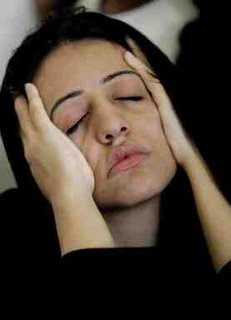
Niall Ferguson-“Yet the biggest ethnic conflict in the Middle East today is not between Jews and Arabs. It is between Sunni and Shiite Muslims.”
Paul Krugman: Shock and Awe
“Israel’s decision to rely on shock and awe ..., like the U.S. decision ...[in] Iraq ..., is having the opposite of its intended effect. Hezbollah has acquired heroic status, while Israel has both damaged its reputation as a regional superpower and made itself a villain in the eyes of the world. ...”
Thomas Sowell- Pacifists versus peace
"Peace" movements are among those who take advantage of this widespread inability to see beyond rhetoric to realities. Few people even seem interested in the actual track record of so-called "peace" movements — that is, whether such movements actually produce peace or war.
Take the Middle East. People are calling for a cease-fire in the interests of peace. But there have been more cease-fires in the Middle East than anywhere else. If cease-fires actually promoted peace, the Middle East would be the most peaceful region on the face of the earth instead of the most violent.”
Sistani Threatens US over Israeli War on Lebanon
Israel Halts Strikes, U.S. Now Seeks Ceasefire
The ethics of war- Mind those proportions
Tomgram: Air War, Barbarity, and the Middle East
Multimedia
A Perspective from Palestine
Sociologist, politician and Christian Palestinian, Dr Bernard Sabella, is a passionate advocate of peace between Israelis and Palestinians and argues that finding "a joint vision of the future" is an urgent priority for Palestinians and Israelis. This program presents Dr Sabella's address to a Canberra audience during his Australian visit this month
Hezbollah
As violence coninues in Lebanon and northern Israel, Rear Vision looks at the history of Hezbollah
Israel Dialogue
A conversation about Israel with three Israelis who are indicative of the immigrant nation, and whose range of views is broadly representative of the breadth of public opinion in Israel.
Juan Cole interview with Barry Gordon
Two angry bloggers- an Israeli and an Arab
Meanwhile UN has a breakthrough on the middleast;
“A News Focus Web site has been created compiling related statements, documents, resolutions, links to UN system Web sites and more.”
“Gas taxes make you happy”
'Can Americans be prodded to invest more in friendships?' Asks Sebastian Mallaby in a recent column- Why So Lonesome?;
“The question about loneliness is: Why do people do this to themselves? Why do Americans, who reported an average of nearly three close friends in 1985, now report an average of just over two? And why does one in four have nobody with whom to discuss personal issues? This is the age of Oprah and MySpace, of public emoting on television and the Web. Apparently people watch "Friends" but don't actually have many….But there's one antidote to loneliness that is at least intriguing. In an experiment in Austin, Princeton's Daniel Kahneman found that commuting -- generally alone, and generally by car -- is rated the least enjoyable daily activity, but commuting by car pool is reasonably pleasant. Measures that promote car pooling could make Americans less isolated and healthier.”
Some findings from the recent study from American Sociological Association;
- the number of people who say they have no one with whom to discuss important matters has more than doubled
- The trend toward social isolation mirrors other class divides: Non-whites and people with less education tend to have smaller networks than white Americans and the highly educated.
- Racial diversity among people’s networks has increased. The percentage of people who count at least one person of another race in their close network has gone up from about 9 percent to more than 15 percent.
-The percentage of people who talk only to family members about important matters increased from about 57 percent to about 80 percent, while the number of people who depend totally on their spouse has increased from about 5 percent to about 9 percent.
Related; The Strength of Internet Ties
The Outlook for the US Economy
The IMF released its views on the US economy;
“The staff's baseline scenario for the short-term outlook is for a "soft landing," with growth easing to potential and inflation remaining contained. The housing market is likely to cool in response to high valuations and tightening financial conditions, reducing the impetus from consumption and residential investment, but strong fundamentals should continue to support business investment. The external deficit is likely to remain wide, but the drag on activity from net exports will lessen as growth abroad strengthens. On the supply side, solid productivity growth should accommodate wage gains while containing price pressures.There appear to be competing risks to this outlook. The possibility of a more abrupt slowdown in the housing market, disappointments on the productivity front, and a disorderly adjustment to global imbalances, as well as the risk of higher oil prices more than offset the upside potential for business investment. Avian flu and geopolitical events represent further and more difficult to quantify downside risks. In contrast, inflation risks-which mainly stem from supply effects-seem mostly on the upside. These include the possibility of a larger-than-anticipated productivity slowdown pushing up unit labor costs, and the potential for pass-through of high commodity and oil prices.”
U.S. Is on Its Way to a Recession by Year End - Roubini
Related;
United States: 2006 Article IV Consultation - Staff Report and Selected Issues from IMF
Roubini of New York University Predicts a U.S. Recession -podcast from Bloomberg
July 21, 2006
GAO on Global War On Terror
The latest testimony by David M. Walker, Comptroller General of the United States, on GWOT;
“GAO’s prior work found numerous problems with DOD’s processes for recording and reporting GWOT costs, including long-standing deficiencies in DOD’s financial management systems and business processes, the use of estimates instead of actual cost data, and the lack of adequate supporting documentation. As a result, neither DOD nor the Congress reliably know how much the war is costing and how appropriated funds are being used or have historical data useful in considering future funding needs.”
Via Menzie Chinn
Related;
No Shame, No Sense and a $296 Billion Bill
July 20, 2006
The Future of Middle East?


Related;
Tom Palmer says, ‘Enough....More than Enough’
The War over Israel’s Influence
Juan Cole’s analysis;
“There are two most likely outcomes of the war. One is the collapse of the Lebanese government and the creation of another failed state on Israel's border, where desperation will breed terrorism for decades. The other is a strengthened Hezbollah, which will become the leading force in Lebanese nationalism, weakening the reformists. The maximalist option would likely turn Beirut into a poor Shiite city, reinforcing Shiite political power at the center. Destroying a few Katyusha emplacements in the south will not affect either outcome, and in both cases Hezbollah will probably be able to rebuild its arsenal.The Israelis' current blank check will begin to be canceled by the world community, as the full scale of the destruction of Lebanon becomes apparent and humanitarian crises ensue. At some point it will be forced to cease its attack. Israel will not get the Lebanese government of which it dreams. It may get a U.N. or Lebanese buffer for a while, but it will not be effective, and the southern Lebanese clans are famed for nothing if not long memories and determined feuding.
If, as Abba Eban once said, the Palestinians never missed an opportunity to miss an opportunity, it is equally true that the Israelis, with their reflexive instinct to shoot first and negotiate later, never miss an opportunity to make a bad situation worse. The Israelis have responded the same way to military threats for decades -- with overwhelming force. This is perhaps understandable, but each time they overreact they create future catastrophes for themselves. Just as their 1982 invasion of Lebanon and occupation of the south haunted them for a generation, they will be living with the blowback of their ill-considered war on hapless little Lebanon for decades to come. Tragically, the United States, as Israel's closest ally, will also have to suffer for its actions.”
Meanwhile, Civil War in Iraq?
July 19, 2006
Facts about Poverty in South Africa

A recent article from UN highlights;
“According to the Basic Income Grant (BIG) lobby group, around half of South Africa's 47 million people are poor. But the government's welfare scheme - child grants, pensions, foster children support and disability payments - reach only 11 million people
Child support grants pay R190 (US$27) per child per month, roughly R6 (85 cents) a day - about the cost of a loaf-and-a-half of bread. Around seven million children receive the means-tested payments, and that money often supports an entire family
An unemployment rate estimated at around 40 percent…
It believes a total of 12 million children up to the age of 18 live in poverty.”
Related;
Interview with the author of recent survey on South Africa at The Economist
Value of foreign direct investment soars ; THE value of mergers and acquisitions in SA soared 63% last year, helping the country eclipse India for the first time in terms of foreign direct investment, according to Ernst & Young
Let’s Bomb Each Other
 I just had to post the following about the craziness of the middle-east conflict by a Tel Aviv blogger;
“…Al Manar TV, Hezbollah television, is showing Zvi live while he is in the Tel Aviv studio. They are broadcasting our broadcast in real time, from Beirut, translating from Hebrew into Arabic what Zvi is saying, and responding in real time. "We can see you!" said the Al Manar moderator, mockingly, as he smiled into the camera.Zvi is listening to the whole thing via his earphone, and he even posed a question in Arabic.
This is just one example of how mad and complex this conflict is: We watch each other's television broadcasts, we talk to one another, and then...we bomb each other.
This morning a friend of mine called from Gaza. He's not a journalist, not a politician - just an ordinary Palestinian guy in his twenties. He lives down the street from the offices of Hamas's Ministry of the Interior in Gaza, which was bombed a few days ago by an Israeli fighter plane. He has about two hours of electricity a day in his house and about as much running water. But he called me to ask if I was okay, after he saw on Al Jazeera television that Nasrallah was threatening to bomb Tel Aviv. "I'm worried about you," he said.
And late, late last night I chatted via Instant Message with this Lebanese blogger, while he sat on the roof of his apartment building and watched Israeli fighter planes bomb Beirut.”
Related;
Israel and the Doctrine of Proportionality
Crisis in the Middle East: Bloggers Report
With Israeli Use of Force, Debate Over Proportion
A 'shadow war' performed for Western voyeurs;
“These latest clashes between Israel and Palestine look like a performance for an audience, rather than a real fight on behalf of a constituency. There is almost a complicity between both sides: the Palestinians need Israel to respond to the kidnapping with bombing raids in order to show that they face a spiteful and unreasonable neighbour, while Israel needs the Palestinians to hold Shalit for a bit longer so they can continue trying to make mileage out of it. Yet this performance is not only for a domestic audience – it is staged for international viewers too. Indeed, in many ways it is the internationalisation of Middle Eastern politics which today provokes these kinds of low-level violent scraps between Israel and Palestine.The conflict in the Middle East is no longer merely a clash over territory – rather it has become the most internationalised war on Earth, with everyone from the US to the UN, Russia to the EU, and numerous commentators, activists and academics around the world defining themselves and their missions on the back of the Israel-Palestine question. This has had the effect of upping the ante, and prolonging the conflict.”
July 17, 2006
Three Surveys; Iran, US religiosity and expensive cities
The American Religious Identification Survey of 51,000 adult Americans last month found some of the secularizing trends seen in Europe;
“Unchurched increase: 14% claimed no religious affiliation. That number was 8% in a similar study from 1990.”
What do the Iranians think;
“The poll revealed a country divided on many issues, although united on the role that Iran should play in the region. Iranians said they believe their country should lead the region “diplomatically and militarily” – 56% supported this view, and only 12% said their country should not be the dominant regional power. Nearly equal percentages of respondents want Iran to become more secular and liberal (31%) as want the country to become more religious and conservative (36%)….Despite tensions between the United States and Iran, most Iranians – nearly two thirds – said they don’t believe that the two countries will go to war in the next decade.
Iranian men were more interested than women in making the economy work better. Among men, 47% said the economy should be a top government priority, while just 33% of women agreed. The older the respondent, the less important they considered development of a nuclear arsenal.
A majority said they would be willing to suffer through a bad economy if that were the price the country had to pay to develop its nuclear program. Also, 25% said they would blame the United States if the United Nations imposed nuclear-related sanctions, although nearly 40% said they were not sure whom to blame. Only one in six would blame Iran’s own government. If their country were to develop nuclear weapons, 25% said it would make the Middle East a safer place, but 35% disagreed with that statement.”
World most expensive cities;
"Moscow is the most expensive city in Europe and in the rest of the world, with a score of 123.9. "Steep accommodation costs have contributed to the city's high ranking, as the recent property boom has driven up rental prices for expatriates," said Anna Krotova, Senior Researcher at Mercer.
London is the second most expensive city in Europe and ranks in 5th position (score 110.6). "While prices have actually increased slightly over the last year, the strengthening of the dollar against the pound means London has dropped two places since last year," said Ms. Krotova.
Other costly European cities include Geneva in 7th place (103), Copenhagen in 8th (101.1) and Zurich in 9th (100.8) - all have been pushed down one place this year. Oslo remains in 10th place with a score of 100 while St. Petersburg is in 12th position (99.7).
Ms Krotova commented: "The Euro has weakened against a number of currencies, for example the Canadian and US dollars, reducing the cost of living for expatriates in many European countries."
Related;
At Cato Unbound debate on What to do about Iran
July 5, 2006
Israeli strike on an electricity plant in Gaza - cost millions to US taxpayers?
Haaretz reports;
“The power station in Gaza was built over a period of five years, at a cost of $150 million. In 1999, the Enron Corporation, along with Palestinian businessman Said Khoury, began working on the project. In 2000, Khoury's Morganti Group purchased Enron's share of the project.The power station began operating in 2002, reaching full commercial capacity in 2004. The owners of the power station insured it, through the Overseas Private Investment Corporation, for a sum of $48 million due to "political risks." OPIC is a U.S. government authority that insures U.S. investments in developing markets.”
For Comment; Should governments be involved in political risk insurance?
Related;
Violence Plagues Middle East
MidEastWeb blog- a news blog on middle-east
July 4, 2006
Indonesia has come a long way
Pablo links to a blog of Indonesia’s defense minister (which cannot be independently verified).
Even if this is a hoax, I think everyone would agree that Indonesia has come a long way since time of Suharto.
Earlier posts which talked about corruption in Indonesia; Excessive Anti-Corruption Drive Hurting the Economy?, Advice to Mr. Wolfowitz on Fighting Corruption
June 30, 2006
US Government through Google
Google has a new feature- Google US Government Search;
I tried searching for following report from GAO about Treasury’s influence on advancing US interests in the IMF- I couldn’t find it through the Google search engine. Here’s the findings in brief;
“The Department of the Treasury has sustained a formal process for advancing U.S. policies at the IMF. A task force facilitates coordination between Treasury and the U.S. Executive Director and identifies early opportunities to influence decisions of IMF members. Since our September 2005 report, the task force has continued to meet on a regular basis to identify opportunities to advance legislative mandates at the IMF. Treasury continues to promote the task force as a tool for monitoring and promoting legislative mandates and other policy priorities by, for example, including discussion on crosscutting policy issues such as debt relief and focusing attention n on both present and prospective IMF programs.We have identified 70 legislative mandates that prescribe U.S. policy goals at the IMF, which is similar to the numbers we reported in our previous reports. Since our last report, 9 mandates have either replaced older mandates or represented amendments to mandates, and 1 mandate, concerning direct support to the central government of Cambodia, has expired. Treasury continues to notify the U.S. Executive Director about new mandates through instruction letters.”
June 21, 2006
Terrorism Index

The latest Foreign Policy Magazine has summary of a survey related to security issues called Terrorism Index. I don’t know whether it qualifies to be referred to as an index. For more see their resources section.
Development as Accountability
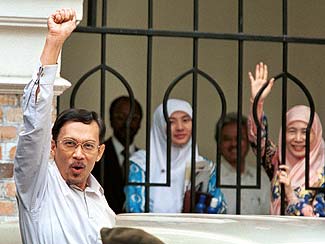
Here’s an interesting speech (though not by content) by Malaysia’s former finance minister Anwar Ibrahim;
“Ibrahim spoke on governance and accountability as drivers for social change, led by development organizations. He drew upon his experiences in Malaysia to illustrate this point, highlighting the positive results from anticorruption initiatives. Ibrahim also tied accountability to freedom, calling it the process of “civilizing power,” and he advocated cooperation with the World Bank to countries that are working toward good governance.”
The speech was high on quotations and referred to Ibn Khaldun, Thomas Jefferson, Isaiah Berlin, Amartya Sen, Mancur Olson, and Kafka amongst others. He also went on to suggest that World Bank should have an independent office of accountability with a broad mandate. His book Asian Renaissance, published in 1996 is decent enough book. I wonder how Mahathir would react to his speech.
Related video; Anwar Ibrahim clarifies his role at the World Bank
I haven’t come across a good economics blog on Malaysia. Let us know if you’ve come across one.
June 18, 2006
Republic of Hill & Knowlton

The UK Telegraph reports that the government of Maldives is using the services of Hill & Knowlton UK to improve its image overseas;
“The Maldives government has enlisted the services of a former Labour spin doctor to try to improve its tarnished image abroad.
Tim Fallon, a public relations expert who was seconded to Tony Blair's election team in 1997, is in charge of the Maldives account for the Hill and Knowlton PR agency.
There are some striking similarities between the New Labour spin machine and the tactics used by President Gayoom's autocratic regime
In May 2004, six months after Hill and Knowlton accepted a £13,000-a-month retainer, the government opened a "strategic communications unit" which almost daily pumps out press releases trumpeting the dictatorship's paper commitments to reform.”
We all have heard about the case of ‘babies in incubators’ during the first gulf war;
“More than 10 years later, I can still recall my brother Sean's face. It was bright red. Furious. Not one given to fits of temper, Sean was in an uproar. He was a father, and he had just heard that Iraqi soldiers had taken scores of babies out of incubators in Kuwait City and left them to die. The Iraqis had shipped the incubators back to Baghdad. A pacifist by nature, my brother was not in a peaceful mood that day. "We've got to go and get Saddam Hussein. Now," he said passionately….The Kuwait government had to find a way to "sell the war" to the American public, who were interested, but not deeply involved. So under the auspices of a group called Citizen for a Free Kuwait, which was really the Kuwait government in exile (the group received almost $12 million from the Kuwaiti government, and only $17,000 from others, according to author John R. MacArthur) the American PR firm Hill & Knowlton was hired for $10.7 million to devise a campaign to win American support for the war. Craig Fuller, the firm's president and COO, had been then-President George Bush's chief of staff when the senior Bush has served as vice president under Ronald Reagan. The move made a lot of sense – after all, access to power is everything in Washington and the Hill & Knowlton people had lots of that.”
Some spin on behalf of rich countries may not be so much of a problem. But spinning for poor undemocratic countries using public money has real costs on the development.
Do you agree with the comment made by Tim Fallon? Let us know what you think?
"We are working to assist the government in a process of engagement with international institutions which we believe will ultimately be to the benefit of all the people of the Maldives."
Related Links:
Struggle for democracy exposes the dark side of paradise islands
Hill & Knowlton Still Spinning For The Government
Anglobalisation and British Empire
A must listen podcast from the BBC;
“To mark the end of Radio 4's This Sceptred Isle: Empire series, some of this country's best-known historians will be examining how Britain and other countries around the world have been changed by their experience of empire. They'll be discussing whether Britain should apologise and make reparation for its imperial past or glory in it, and asking whether the twenty-first century will see the birth of new empires- Eric Hobsbawm, Niall Ferguson, Robert Beckford, Linda Colley and Priya Gopal.”
The debate gets very heated at times. I think one way to view the role of British Empire and its relation with the colonies like India is to look at it as India or any other colony giving a huge interest free loan to Britain- this point was highlighted by the late Mahbub ul Haq in one of his books.
Related podcast;
Francis Fukuyama- No longer neocon; The man who wrote The End of History? is now disenchanted with American foreign policy. Fukuyama remains a conservative, but has strong views on what has gone wrong. He sees a need to demilitarise the struggle against violent fundamentalism.
‘Crackdown on Sugar Hoarders to be Launched’

Breaking news from Pakistan;
“Monopoly Control Authority (MCA) said Saturday stock 1.2 million ton sugar was available with sugar mills by May 31, 2006, which they didn’t release in the market. However, action on this count would be taken against the hoarders.
A total stock of 2.97 million ton sugar was reported by May 31, 2006 of which 1.738 million ton sugar was sold out and the sugar mills 1.169 million ton sugar amassed in their godowns instead of releasing it in the market, according to Authority.
MCA told a crackdown would be launched on those involved in the sugar hoarding, which skyrocketed the sugar prices in the market.”
Related;
World Bank to double aid to Pakistan -- Will the money help?
Inflation in Pakistan: Money or Wheat?
Summary: This paper examines the relative importance of monetary factors and structuralist supply-side factors for inflation in Pakistan. A stylized inflation model is specified that includes standard monetary variables (money supply, credit to the private sector), the exchange rate, as well as the wheat support price as a supply-side factor that has received considerable attention in Pakistan. The model is estimated for the period January 1998 to June 2005 on a monthly basis. The results indicate that monetary factors have played a dominant role in recent inflation, affecting inflation with a lag of about one year. Changes in the wheat support price influence inflation in the short run, but not in the long run. Furthermore, the wheat support price matters only over the medium term if accommodated by monetary policy.
Lahore School of Economics blog
June 17, 2006
A Tipping Point for Infrastructure in Latin America

Some statistics on the state of infrastructure in Latin America from the latest edition of The Economist;
“In Mexico, public spending on infrastructure—electricity generation, roads, railways, water plants and the like—was a third lower in 2004 than a decade earlier, according to a report by Merrill Lynch, an investment bank. The World Bank describes two-fifths of the country's motorways as “pre-modern”. Nevertheless, the government has found the money to spend 0.7% of GDP on subsidising the electricity that is consumed—which does nothing for the poorest, who live in the dark in rural areas…Between 1990 and 2003, Latin America accounted for half of total private-sector participation in infrastructure in developing countries.
In recent years, total spending in the region on infrastructure has averaged less than 2% of GDP. It is not enough. According to the World Bank, 58m Latin Americans lack access to potable water and 137m lack sewerage. In Brazil and Peru, less than a quarter of the main highways are classified as good. In surveys by the bank, 55% of businessmen consulted in Latin America cite infrastructure as a serious problem compared with just 18% in East Asia. The bank says the region will have to double or triple its current spending to bring its infrastructure up to the level of that in East Asia's fast-growing economies.
Chile- the exception…Now the roads that whisk the traveller into Santiago, the capital, from the airport are privately run, as are most other motorways and the airport itself. Nearly all Chile's water is supplied by private companies. Long-term “infrastructure bonds”, denominated in inflation-adjusted pesos, have financed much of the $8 billion investment in roads, airports and the like. Chile is planning to issue contracts for private investors to build and maintain public hospitals.
Brazil,…Infrastructure will be “a point of strangulation”, holding the rate of economic growth to less than 4%, predicts Adriano Pires of the Centro Brasileiro de Infra Estrutura, a consultancy. The federal investment budget is just 0.5% of GDP. Add in lower levels of government and state companies, and public spending on infrastructure totals about 2%—probably not enough to maintain the stock of infrastructure….Since Brazil has little scope for raising taxes and debt and cannot easily re-allocate spending, it will have to rely on the private sector over the next few years, believes Paulo Correa, co-author of a forthcoming World Bank report on Brazilian infrastructure. ..In Brazil 36% of concession contracts have been renegotiated, usually at the instigation of the government—above the regional average of 30%. All but the most profitable investments have been deterred by the high—though now falling—cost of capital.”
Related:
A Primer on Risk Management: Applications to Latin America and the Caribbean
Mexico - Infrastructure public expenditure review
Ranking economic policies ($ required)
Asian Highway network gathers speed
June 15, 2006
The Chinese Exception

The latest Pew survey of world opinion is out. With regard to national conditions most publics surveyed are dissatisfied with national conditions. But China is a notable exception - 81% of Chinese say they are satisfied with the way things are going in their country, up from 72% in 2005. Only about three-in-ten Americans (29%) say they are satisfied with the way things are going in the U.S., down from 39% last year and 50% in 2003. Levels of national satisfaction in France have followed a similar downward trajectory - from 44% in 2003 to just 20% today.
Earlier we reported on the Chinese views on free markets.
China has also the largest number of infrastructure projects with private participation.
What does this all mean?
Related; War Bedevils American Image
June 7, 2006
IMF on the US External Balance, again
“The ease with which the United States has financed its record current account deficit has been remarkable, but is unlikely to be sustained indefinitely. A number of (possibly temporary) factors, such as short-term interest rate differentials and increasing demand for long-term bonds, have helped support the U.S. current account deficit and dollar over the past year. However, most forecasters project that the current account deficit will rise further in coming years, which may begin to strain the global appetite for U.S. assets. Delaying the inevitable multilateral adjustment will mean continued increases in U.S. external indebtedness, magnifying the potential for disruption to exchange rates, financial markets, and growth, both domestically and abroad.”
- United States of America—2006 Article IV Consultation, Concluding Statement of the IMF Mission
Related Audio Links:
The U.S. Current Account Deficit Once Again- Brad De Long’s Afternoon Tea.
Allen Sinai chief economist at Decision Economics, talks with Bloomberg's Tom Keene about stagflation risk in the U.S. and Federal Reserve Chairman Ben S. Bernanke's comments about monetary policy..
June 3, 2006
Globalization with a Chinese Face!

“I never think of the future. It comes soon enough”- Albert Einstein
Shell Global Scenarios to 2025 propose three possible political environments for business. The scenarios are based on the results of the interplay between three global forces identified as efficiency, social justice and security. They are:
“Low trust globalization”, in which globalization continues but an ongoing crisis of security and trust leads to a legalistic world of overlapping and conflicting laws with intrusive checks and controls.
“Open doors”, in which cooperation between governments, investors and civil society flourishes in a pragmatic fashion producing a more transparent world.
“Flags”, in which suspicion of outsiders and conflicts over values, religion and national preferences creates regulatory fragmentation, gated communities and a dogmatic world.
Canuckflack has more on the last year’s scenario.
Related;
- Managing Globalization- a blog Daniel Altman
- OECD Forum 2006- Balancing Globalization
May 31, 2006
Even Angels Ask! Corruption of Public Discourse in Islamic Countries
Most often commentary on the problems of reforming Islamic societies are led by lawyers, theologians, orientalists and philosophers- only rarely you hear from economists. I would recommend reading Timur Kuran and Albert Hirschman.
In the following quote Kuran tries to explain one of causes of the problem (Islam and Mammon, by Timur Kuran, p.143-144);
“The relevant mechanisms are developed in my book Private Truths, Public Lies, though within a general context rather than the particular one of Islamic civilization. It shows how inefficient social structures can survive indefinitely when people privately supportive of change refrain from publicizing their dispositions. The motivation for such preference falsification is the desire to avoid the punishments that commonly fall on individuals who enunciate unpopular public positions. One of its by-products is the corruption of public disclosure. This is because of individuals choosing to misrepresent their personal wishes will also, to keep others from seeing through the falsification, conceal their perceptions and knowledge pointing to the desirability of change. It follows that unpopular structures sustained through preference falsification might, if the conditions last long enough, achieve increasingly genuine acceptance. The transformation would occur partly through population renewal: in the absence of criticisms of the status quo, the society’s new members would fail to discover why change might be beneficial. The argument applies to both the privileged and the underprivileged. If public disclosure treats a social structure as optimal, even its victims may fail to see how its destruction would improve their lives.”
So the real issue becomes how do we move away from the vicious equilibrium caused by the bandwagon effect under which preferences and ideas inimical to the status quo remain unexpressed? Edmund Burke was right after all- the only thing necessary for evil to flourish is for good men to do nothing.
Related Podcasts;
Spiritual Classics: Islam- The Qur'an is the holy text of Islam, revealed to the Prophet Muhammad, and taught by his Companions and Successors. Contemporary interpreters like Abdullah Saeed see signs of flexibility in the Qur'an itself and believe its ethico-legal content should be interpreted within a modern context. From New York, Reza Aslan discusses key concepts in the historical development of Islam. And Canadian author Irshad Manji looks to 8th century Islam for a liberal precedent. Abdualla Saeed is a Maldivian national.
What is Enlightenment? In 18th century Europe, the Enlightenment was a great movement of thought valuing freedom of expression and the pursuit of knowledge. But was it, in fact, rather narrow? Did it close off as many possibilities as it opened? This week we hear from an enemy of the Enlightenment, the Australian philosopher James Franklin
The Land of War and Opium

"I like growing eggplants because it is not against Islam and it means I don't have to depend on those people," one farmer said. "But to be honest, I do not have much hope that things will change. This little field is the only place you see vegetables. If you go a little farther, you will see that all the other villages are nothing but poppy."
- In Afghan Poppy Heartland, New Crops, Growing Danger
Last year, farmers in Afghanistan harvested more than 4500 tons of opium -- nearly 90-percent of the world's market. For more see the latest edition of Foreign Exchange show.
Jeffrey Alan Miron talks about lessons from Afghanistan for the war on drugs
May 24, 2006
The Great Andalusian Stamp Scandal
The Financial Times recently had an editorial warning everyone about pyramid schemes as is illustrated by the recent stamp scandal in Spain;
“Two stamp companies have been accused by public prosecutors of embezzling money in a fraud involving 343,000 investors. Those investors were guaranteed high returns on their investments in what were said to be rare stamps, although experts believe the stamps have a low market value.The Spanish companies have denied wrongdoing, but if the prosecutors are right, the stamp scandal is a Ponzi scheme in which the promised returns are paid to early customers using the cash from new ones. Such schemes efficiently channel money away from the many to the few and the majority lose everything. Stamps have a history in this regard: in 1920 Charles Ponzi promised impossible returns based on arbitrage of international postal reply coupons, initially from Spain.
It is hard not to feel sorry for the frightened investors. They should have realised that high returns cannot be guaranteed, but many have swallowed that old story before. Albania was consumed by pyramid schemes in 1997, after two-thirds of the population sought returns of 30 per cent a month.”
Spanish police had earlier issued the following statement;
"Potential investors were offered high returns from the purchase and management of a stamp fund, which was apparently made up of overvalued - or even fake - stamps and whose returns did not apparently come [from the fund] but from money received from new clients,"
Related Links;
- An earlier post about Pyramid Scheme Warning
- Stamps to Become a Marketing Vehicle;The U.S. Postal Service is allowing companies to create their own branded stamps for first-class mail. Instead of flags, you can expect to see a company logo; instead of photos of famous Americans, you might see pictures of your local real estate agent
May 23, 2006
A Lot of Noise from an Ex World Banker

"Is it time for a financial sector assessment? And, if so, will she be able to keep Basel out of her hair? "
Per Kurowski, a former Executive Director at the World Bank was kind enough to post a lot of interesting comments on a couple of our posts. I haven’t seen his book referred to by any World Bank bloggers- I wonder what might be the reason. I’ve collected some of them below;
“For a start it is not and cannot ever be the role of World Bank to take upon its shoulder the responsibility for fighting dictatorships, whenever and wherever they are. That responsibility has to be shared by many more, preferably all. There are thousands of way you can get rid of a dictator, including extravagant one as offering 5 million visas to all people in Turkmenistan so that they are all able to go and live elsewhere and the dictator dies of loneliness but, to serve a useful purpose, they should all first be able to answer the question of what to do after the dictator is gone? Build a nation? Outsource the government? Send them all to universities, so that they can be taxi drivers in New York?
It is a very delicate matter to get involved in trying to change other peoples or other countries life, and pure good intentions are not enough. That said and reading the description of the Father of the Turkmen People he sounds like a very insecure person with a tremendous inferiority complex and in need of asserting his importance anyway, anywhere, anytime, something that is frequently quite useful for profiling dictators in general. If this is right, one way to do it, a peaceful alternative, would be to rob from him all his mantles of respectability, laughing and scorning him out of power. Careful though, don’t confuse the target, you do not want to scorn the belief and the blind faith in their leader that many locals might already have developed. If this is the chosen strategy, it would then be clearly contra productive to have a technician from the World Bank go and have a serious talk with him…among technicians. By the way since so many governments keep themselves elevated only by means of the lot of hot air they inflate themselves with, we should not underestimate the risk of a catastrophic domino effect.
But, do not think for a moment that my comments are in jest. No, it is way too important for the world to find a mechanism to get rid of the rogues, in the name of that overriding sovereign right we have as citizens of a very small and interrelated planet. We cannot and should not allow for too many too infectious diseases to poison our planets future."
Fighting Poverty with the Espresso Book Machine
"This machine is best for that odd or old special book that it would be to expensive to have in the inventory. As you would have to ship the machine, the paper, the inks and what have you plus arrange for the university in Mozambique to duly pay the royalties to the author I seriously doubt it would work for our friend of Mozambique. But you know the saddest part of it all? That is that in his desperate plea for a book in microeconomics, he might actually get a really bad one. A book that got printed just because the author was the friend of someone, or in cahoots with someone. "
Don’t Worry, Everybody will get a chance to be rich
“Don’t Worry, Everybody will get a chance to be rich” YES!... And perhaps even the rich will get their chance of being a little bit poorer. Whatever, it is clear that we do not have the tools for measuring where we really want and should be heading.
For instance, the GNP figures, currently just the result of adding, could perhaps explain more if we also did some subtractions; like of the cost for consuming more than your world equitable share of energy; the cost of developing an energy addiction; and perhaps even the cost of the time wasted daily answering automated phone calls from computers that want to get more intimate with your family’s finances."
Budget Support – Another Passing Fad in the Development Community?
"I find absolutely nothing rhetoric about the need of country ownership but indeed much abusive and self-serving interpretations of what it really means and, foremost, on how its existence is evidenced. In a country where there exists a generalized commitment for taking the next step up the ladder of development, almost any help in any way will do some good. Where this national sense of responsibility and a real we want, we can, and we will do it attitude does not exist, almost any help, in any way, would do little good and could even be harmful. Now these are the facts, and their recognition is a must, even though of course that does not make the life of a developing institution any easier… but, then again why should their life be easy?"
Advice to Mr. Wolfowitz on Fighting Corruption
"In relation to the World Bank’s fight against corruption I have no doubts whatsoever that the most important first step it needs to take is to make perfectly clear what it cannot be expected to do. For the World Bank to help create the impression that certain risks of corruption are effectively taken cared off, would be collaborating and camouflaging for corruption.
For this I would recommend that all projects include in their documentation, a very simple one page Public Notice that lays out the most important risks of corruption in the operation, making clear what the World Bank is doing to diminish them but, much more importantly, what is not in their hands to do. That page should then surf transparently the web in order to enlist the civil civilians in the fight.
As an institution the World Bank is always well served by a good dose of humility and should always fight the corruptive arrogance of believing it can do it all on its own. The world needs, more than ever, a World Bank that needs the world."
Mr. Metaphor and the First Law of Petropolitics
Now go and read his book, Voice and Noise.
May 19, 2006
Budget Support -Does US use it to buy votes at UN?
Recently there has been much talk about the UN reform, but how do you restructure UN so that powerful nations are not able to bribe poorer countries to vote? A paper at Kiel Institute alleges that US aid buys voting compliance in the UN;
“This paper empirically investigated whether US aid has had an influence on voting patterns in the UN General Assembly over the period 1973-2002. Compared to other bilateral donors, notably the Netherlands and Scandinavian countries, the United States is widely believed to be less altruistic in allocating aid for humanitarian and developmental reasons. Apart from pursuing economic self-interests, US aid is supposed to be used to buy political support from recipient countries. The hypothesis that aid is applied as an instrument to induce recipients voting in line with the United States in the UN General Assembly is based on two observations: (i) various UN members are susceptible to bilateral pressure, and (ii) UN voting is considered relevant by the United States in defining bilateral relationships and foreign policy. As the main innovation of this paper, we used disaggregated aid data in order to assess whether aid was “effective” in inducing recipients to vote in line with the United States in the UN General Assembly. Different forms of aid may differ in their ability to induce political support by recipients. In particular, program aid (notably in the form of general budget support), grants, and untied aid are most likely to shape UN voting behavior. These links have been ignored in the previous literature.Accounting for the potential endogeneity of aid, our results provide strong evidence that US aid has indeed bought voting compliance. More specifically, the results suggest that general budget support and untied grants are the major aid categories with which recipients have been induced to vote in line with the United States. When replicating the results for the other G7 countries, however, we did not find a similar pattern.”
Related;
UN Fact File – at Telegraph UK
The Oil-for-Food Scam: What Did Kofi Annan Know, and When Did He Know It?
An earlier post about Budget Support
May 17, 2006
Advice to a would be Mexican Immigrant
“The way it works is like this,” says Ewa, a graphic designer. “You start off in a bar or restaurant. You get to know the customers and find out what they do. When you find one who has the kind of work that you like and can do, you make friends with them and try to get introduced to their boss. Then you persuade him to try you out for a week, even unpaid. And because you are Polish and have good skills and work hard, you will get a job. Maybe even your new friend's job,” she laughs.
That’s from a recent survey of Poland in The Economist. See the author's blog for details;
“The numbers working abroad are huge, even for a country with nearly 40m people. Since 2004, some 200,000 Poles have gone to Ireland, and probably over half a million to Britain. The main reason is that there are few jobs at home, especially for the young and the unskilled. General unemployment is running at 18% and youth unemployment at a shameful 40%, partly because of a demographic bulge, but also because Poland's hefty pension and social charges make its labour expensive. For a couple with two children, this tax “wedge” is 42%, the third-highest in the industrialised world. Only half the working-age population is active in the labour market.”
May 15, 2006
Does China Manipulate it’s Currency?
Recent bloomberg pocast interviewed William Cline, fellow at IIE and CGD on the above question and also about his paper on The Case for New Plaza Agreement.
World Bank recently released Quarterly update on the Chinese economy;
“The change in the exchange rate system and the accompanying revaluation may further slow domestic demand. The impact on the trade balance is likely to be limited, but some of the capital flows associated with an expected revaluation could moderate in the months ahead, and therefore give the authorities more independence in conducting monetary policy. Development of forward markets to allow for hedging of trade and investment related capital flows is now a priority, as is close monitoring of short-term capital flows and exposure of domestic institutions to foreign exchange rate risk. Over time, more clarity on how the authorities will use their increased autonomy in monetary policy will become desirable….
While macroeconomic policymakers should remain alert to the possibility that risks materialize, for now the focus could be more on the structural issue of rebalancing growth. The rebalancing would be away from the relatively volatile export and investment-based growth to more stable consumption-based growth. Measures in social security and shifting government spending away from investment towards health, education, and social safety could help increase consumption's share in GDP, policies that would also help in redressing the surpluses on the current account. To maintain growth and employment creation as consumption increases, however, more efficient investment as well as a shift of investment to services is needed. Financial sector reforms, better corporate governance, and a dividend policy for state enterprises could be measures towards that goal.”
Related;
- For the answer to the question in the title see this post Econbrowser.
- The latest ADB Review has the following two articles which are worth a read; Development Lessons for Asia from Non-Asian Countries by Dani Rodrik and Asia’s Current Account Surplus: Savings Glut or Investment Drought?
Is there such thing as an Australian Model?

Via Economist’s View comes a recent column at FT on the Australian economic success;
“It is a developed country that enjoyed faster economic growth than the US over the past decade. Yet it also offers universal healthcare and other social welfare benefits that the US does not. Unemployment is similar to America’s, but without the glaring income disparities that characterise US growth. It is a country that seems to have achieved a sweet spot, combining the vigour of American capitalism with the humanity of European welfare, yet suffering the drawbacks of neither. And it manages this while keeping a consistent budget surplus. That country, rolling into its 16th year of uninterrupted growth, is Australia.
“In the last decade of the twentieth century, Australia became a model for other OECD countries,” wrote the 30-nation club of rich economies in its latest annual assessment of the country. Australia, which started life as a dump for Britain’s criminal effluent, was such an unlikely candidate to be any sort of economic role model that it should give hope to others. Australia’s economic development in the twentieth century seemed to be arrested at the quarry-and-farm phase. And when the founder of modern Singapore, Lee Kuan Yew, forecast in the 1980s that Australians were destined to become “the poor white trash of Asia”, he seemed to know what he was talking about. In 1970, Australian per-capita incomes were the fourth highest in the world. In the 20 years that followed, its ranking fell inexorably. By 1991, Australia was placed 19th. Other countries surged. Australia stagnated.”
Australian has another lesson for the US; the so called Pacific Solution.
Related; Harry Clarke has interesting comments on the Australia’s savings rates. The major obstacles to growth may be from the supply side; so the need for more immigration.
Recommended; the most recent monetray policy statement from RBA, espcially the bit about the Capital Gains and Measures of Household Savings;
“The most frequently-cited measure of household saving is the net saving rate, which is measured as a residual by subtracting consumption and depreciation from household disposable income. On this measure, the saving rate of Australian households has been declining, and in recent years has been negative (Graph D1). This is lower than in many other developed countries, though not dissimilar to developments in the US. Adding back the amount deducted for depreciation (most of which is on housing) lifts the saving rate, though the position of Australia and the US remains below average. These conventional measures of saving are calculated from the household income account in the national accounts and do not include in income (and therefore saving) that part of the return on investments that comes in the form of capital gains. In the case of equity investments, for example, only the return that is in the form of dividends is included as income even though historically this has accounted for only about one-third of the overall return on equities.
In countries such as Australia where the composition of household investments has shifted from bank deposits and fixed income to equity holdings, this measure of saving has increasingly understated the true extent of household saving. In such countries a more meaningful measure of household saving is the change in household net financial wealth, defined as household financial assets (bank deposits, bonds, equities and unit trusts) less non-housing debt. This measure, which can be directly measured using fi nancial data, focuses only on financial wealth and abstracts from wealth in the form of dwellings and the household debt used to fund that investment in dwellings. To the extent that households borrow against dwellings to buy fi nancial assets (i.e. engage in housing equity withdrawal) the measure of financial wealth used here would be overstated, but on average over the 1990s the impact of this has not been very significant…”
May 13, 2006
Pyramids and Currency Boards

Some of you might have heard of the first European pyramids being excavated in Bosnia. It is a country with a rich history and more recently seen as a successful model of post-conflict reconstruction.
It’s in a way very true; the Clinton administration effectively wrote their constitution. Sebastian Mallaby notes in ‘The World’s Banker’, the economic parts of the constitution was written by a team led by a World Bank staff Christine Wallich. Mallaby suggests that if not for the financial aid promised by the World Bank, the peace deal at Dayton would never have come about.
There constitution is really unique, parts relating to the Central Bank are quoted below;
"1.The Central Bank's responsibilities will be determined by the Parliamentary Assembly. For the first six years after the entry into force of this Constitution, however, it may not extend credit by creating money, operating in this respect as a currency board; thereafter, the Parliamentary Assembly may give it that authority.
2.The first Governing Board of the Central Bank shall consist of a Governor appointed by the International Monetary Fund, after consultation with the Presidency, and three members appointed by the Presidency, two from the Federation (one Bosniac, one Croat, who shall share one vote) and one from the Republika Srpska, all of whom shall serve a six-year term. The Governor, who shall not be a citizen of Bosnia and Herzegovina or any neighboring state, may cast tie-breaking votes on the Governing Board."
For Comment; Could the Bosnian approach (Clinton administration using the World Bank and other development agencies as a tool of enlightened foreign policy) have worked in the case of Iraq?
Related:
- Bosnia and Herzegovina, Post-Conflict Reconstruction; Country Case Study Series
- Are Currency Boards a Cure for All Monetary Problems?
- Ten years after the Dayton accords ($ subscription required)
May 9, 2006
Size of Iraq’s Shadow Economy
 One brave soul attempts to estimate the size of the informal economy in Iraq;
“Most importantly, the analysis confirmed that Iraq’s informal economy was around 35% of GDP in the year 2000. Substituting Iraq’s values for the three independent variables in the regression equation resulted in a prediction of 35.86% of GNP for the size of the country’s shadow economy The high standardized coefficient associated with control of corruption (0.842) as opposed to 0.193 and 0.206 for Greater Middle East member country and banking and finance development respectively suggests that this is the dominant element in explaining the relative size of the informal economy across countries.
Finally, Schneider and Enste have calculated the likely shadow labor force in a group of developing countries for 1998. They present values of the shadow economy labor force in absolute terms, and as a percentage of the official labor force under the assumption that the shadow economy is rural areas is at leas as high as in the cities (where the original surveys were taken). While Iraq does not appear in their sample, there is a close relationship between the size of the shadow economy and its associated labor force. Using the 35 percent of GNP figure for Iraq ’s shadow economy derived above produces an estimate of a shadow labor force in Iraq at this time (1998) of 68.3 percent of the total labor force. This is equivalent to a shadow labor force of 32.2 percent of the total population.”
Given that the data on the Iraqi economy is scant it’s probably anybody’s guess. As the medium term National Development Strategy published last year suggest there is widespread unemployment, in particular among young men whose unemployment rate reaches an astonishing 37%. The employment situation is complicated by the fact that Iraq has an estimated 192 State-owned enterprises that together employ 500,000 people.
I was surprised to learn that Iraqi budget includes war reparations of $1 billion in 2005, $1.3 billion in 2006 and $1.46 billion in 2007. According to a UN Security Council Resolution, war reparations should constitute 5% of the revenues from oil exports. Another Iraqi is worried that mediocre goods of all kinds are flooding Iraq.
Related;
- Links to Iraqi Government Agencies
- Doing Business in Iraq
- Iraq Living Conditions Survey 2004
- More news from Iraq
May 5, 2006
Broadway Diplomacy- Will it work between Cuba and US?

A great country
exists in North America
Where I’ll get,
looking for my ideal world
What a great nation,
behind our immense sea
Where I am sure
my life will change
And I will triumph
My talent and luck will be my tools
Cause I will fight and the opportunity
In America will lie
Above might be one reason why last year alone some close to 3,000 Cubans were intercepted on the high seas by the US Coast Gourd Service. The lyrics are from a musical that premiered recently – The Havana Carnival. It’s the brainchild of U.S. director and playwright Tony Giordano and Italian Massimo Mastruzzi (in case you’re wondering the Mastruzzi of “Kaufmann, Kraay, and Mastruzzi’ Governance Indicators”); they hope the musical will contribute to "reducing the tensions" between the two countries.
In the musical , lead character Marianne chooses to live in Cuba;
“The plot of Giordano's musical revolves around the romance between Miguel, a Cuban singer, and Marianne, a dancer from the United States who comes to Havana for advanced training. It also addresses the difficulties the young couple have to face because their parents are completely opposed to their engagement…."I'm not taking sides," said the playwright and director, who said he was "not influenced by any stereotypes whatsoever." He was, however, aware that his play may be misinterpreted by either side in the conflict.
That is "because, although my writing is not politicised," his play addresses "the rights of individuals" and their freedom "to become self-realised persons. Individuality is the most political issue one can struggle for in life," he said.
Will the people here in this ‘great free country’ of USA be able to see the ‘Havana Carnival’;
"…the producer of "Havana Carnival" has not managed to find his way to staging his musical on Broadway. "I would love to have it play in my country, but I don't know how that could happen," he said. "Now that it's going so well, I think people in the United States would like to see it."
May be US and Cuba may learn a bit from India and Pakistan.
Related Links;
- The script of the musical
- Cuban Art
- The Cuban Cigar Mystery
- Broadcasting in Cuba
- Broadway comes to Havana
May 3, 2006
Disintegration of the Fear Barriers in the Middle East

Tom Palmer writes in the Reason magazine on Iraq;
“There is a chance that things will turn out well in Iraq, or at least not badly. Whatever the outcome, libertarians should be eager to assist the Iraqis in creating a free society. That’s why my Arab friends and I have established the Lamp of Liberty (misbahalhurriyya.org) to bring the message of liberty to both Iraqis and the wider Arab world. I am working with Iraqi libertarians who are trying to do the best they can under very difficult circumstances to combat fanaticism, terrorism, and statism. It’s a hard slog, but we have no choice.”
Egyptian sociologist and democracy activist, Saad Eddin Ibrahim is also hopeful about the prospects for democracy in Iraq, pointing out the positives the country has got - a sizeable middleclass, relatively literate population, rich in resources and ethnic diversity – all of which bode well for the development of a liberal democracy.
Related Links:
- Iraq; Rebuilding Iraq: economic reform and transition- World Bank Report
- Reviving Mideastern Democracy- Saad Eddin Ibrahim.
I would highly recommend Professor Ibrahim’s speech above for anyone interested in understanding the current politics of middle east. He talks about the 7 candles of hope in the middle east (the increase in the number of Arab elections, the rinsing role of women and youth in the electoral process, expansion of public space through internet, blogs and Al-Jazeera, proliferation of printed media and the disintegration of the fear barriers, Kifaya or Enough movements).
April 30, 2006
The Appeal of Bin Laden and Al-Qaida

"The incompetence and authoritarianism of many Muslim and Middle Eastern governments fosters Islamist radicalism. These governments are overwhelmingly unelected, unaccountable, and corrupt; they provide no legitimate outlet for youth discontent. Unsurprisingly, these governments are widely despised by their young people. The old, largely nationalist, ideologies of these governments have failed to deliver either material goods or a sense of dignity either at home or abroad. The half-century failure of Arab states to resolve the Palestinian situation and the inability of Pakistan to ease the lot of Kashmiri Muslims have contributed to the evident corrosion of regimes’ legitimacy in the eyes of youth. Nationalism has not disappeared; it has been assimilated into the Islamists’ discourse. And, as George Orwell once said, “the nationalism of defeated peoples is necessarily revengeful and short-sighted”.
- Professor Alan Richards, “Explaining the Appeal of Islamic Radicals”
Tom Palmer quotes Mancur Olson, referring to the ongoing saga in Egypt where two judges are under investigation for accusing the government of meddling in the last parliamentary elections;
“Interestingly, the conditions that are needed to have the individual rights needed for maximum economic development are exactly the same conditions that are needed to have a lasting democracy. Obviously, a democracy is not viable if individuals, including the leading rivals of the administration in power, lack the rights to free speech and to security for their property and contracts or if the rule of law is not followed even when it calls for the current administration to leave office. Thus the same court system, independent judiciary, and respect for law and individual rights that are needed for a lasting democracy are also required for security of property and contract rights.”
The rule of law and an independent judiciary is a joke in a lot of these countries. Would democracy work in Middle East? I think it would remain a question unanswered for a long time to come.
Related Links:
- Democratizing the Middle East?- a conference at Tufts University (webcasts)
- U.S. Policy in the Middle East: A Congressional Perspective by R. Nicholas Palarino, U.S. House of Representatives
- Mr. Jafferson goes to Middl East (via Austrian Economists)
- Blogs covering Egyptian politics; Baheyya, The Arabist, Angry Arab and Freedom for Egyptians.
Fact Attack on Globalization

Scientific American has overview article on ‘Does Globalization Help or Hurt the World's Poor’ by Pranab Bardhan. Some statistics from the article are summarized below.
- Between 1980 and 2000, trade in goods and services expanded from 23 to 46 percent of gross domestic product (GDP) in China and from 19 to 30 percent in India.
- Between 1981 and 2001 the percentage of rural people living on less than $1 a day decreased from 79 to 27 percent in China, 63 to 42 percent in India, and 55 to 11 percent in Indonesia.
- Of the more than 400 million Chinese lifted above the international poverty line between 1981 and 2001, three fourths got there by 1987.
- Between 1981 and 2001 the fraction of Africans living below the international poverty line increased from 42 to 47 percent.
- A recent study by Gordon H. Hanson of the University of California, San Diego, which took into account only people born in a particular region (thus leaving out migrants), found that during the 1990s average incomes in the Mexican states most affected by globalization increased 10 percent more than those least affected.
- In 2001 Naila Kabeer of the University of Sussex in England and Simeen Mahmud of the Bangladesh Institute of Development Studies did a survey of 1,322 women workers in Dhaka. They discovered that the average monthly income of workers in garment-export factories was 86 percent above that of other wage workers living in the same slum neighborhoods.
- In 1993, anticipating a U.S. ban on imports of products made using child labor, the garment industry in Bangladesh dismissed an estimated 50,000 children. Wages and conditions in garment factories are poor by world standards but better than those in alternative occupations such as domestic service or street prostitution.
- South Korea and the Philippines had similar per capita incomes in the early 1960s, but the Philippines languished in terms of political and economic institutions (especially because power and wealth were concentrated in a few hands), so it remains a developing country, while South Korea has joined the ranks of the developed.
- The international coffee market, for example, is dominated by four companies. In the early 1990s the coffee earnings of exporting countries were about $12 billion, and retail sales were $30 billion. By 2002 retail sales had more than doubled, yet coffee-producing countries received about half their earnings of a decade earlier.
- The Asian financial crisis of 1997 –following speculators' run on the Thai currency, the baht, the poverty rate in rural Thailand jumped 50 percent in just one year. In Indonesia, a mass withdrawal of short-term capital caused real wages in manufacturing to drop 44 percent.
- The annual loss to developing countries as a group from agricultural tariffs and subsidies in rich countries is estimated to be $45 billion; their annual loss from trade barriers on textile and clothing is estimated to be $24 billion. The toll exceeds rich countries' foreign aid to poor countries.
- Globalization does not explain the differing fates of Botswana and Angola, both diamond exporters, one democratic, the other ravaged by civil war.
April 20, 2006
World Bank and Dictators
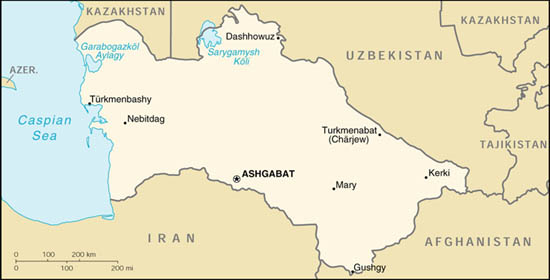
Ex-World Banker Dennis de Tray offers some advice for EU in its dealings with Turkmanistan’s dictator;
“I was until recently World Bank director for the five Central Asia “stans” (Kazakhstan, Kyrgyzstan, Tajikistan, Turkmenistan, Uzbekistan). The World Bank had no program in Turkmenistan because we could find no way to do anything remotely positive for its people. Natural gas is important to Europe. But it is the money Mr. Niyazov receives from natural gas sales that keeps him in power. While I am a strong advocate of engagement, in this case the European Parliament should reject Turkmenistan’s “most favored nation” status. If it does not, the EU must accept responsibility for supporting the ongoing destruction of a country and a people.”
Turkmenistan, a country of 5m people in Central Asia, …
“used to be a Soviet vassal state, ruled by a Moscow stooge called Saparmurat Niyazov. When the Soviet Union collapsed, Mr Niyazov deftly reinvented himself as a Turkmen patriot, the “Turkmenbashi” or father of all Turkmen. He banned all opposition, declared himself president-for-life and erected golden statues of himself everywhere, including one in Ashgabat, the capital, which revolves with the sun.A collection of his thoughts on philosophy, ethics and Turkmen culture, the “Rukhnama” (“Book of the Soul”), forms the basis of the school curriculum. Even to pass a driving test, his subjects must show their knowledge of this “sacred” text. The children who have passed through the country's schools most recently are now nearly as brainwashed as North Koreans.”
On the state of education in the country;
“Basic education has been reduced to nine years, and university from four years to two. From September to November, students are usually sent to cotton fields for the harvest. The number of students in higher education has dropped from 40,000 at independence to 7,000 or so today. Those who can afford it go to study in Moscow or other former communist capitals, perpetuating a tradition from Soviet times. Over 12,000 teachers were fired a few years ago, and those who have kept their jobs are paid badly, if at all. Classes are overcrowded, and grades as well as admission are often for sale.
The curriculum has been increasingly geared towards vocational skills—subjects deemed useless such as physical education and arts were eliminated—and political indoctrination. A substantial part of school time is now dedicated to learning passages from the “Rukhnama” (Book of the Soul), in which President Saparmurat Niyazov rambles on about practically everything, from proper social behaviour and morals to the motherland and its glorious leader. The book and its author have acquired quasi-religious status….As a result, the education level has collapsed. With over 45% of the population under 19 years old, general knowledge and critical thinking—let alone vaguely accurate views of the outside world—are vanishing rapidly.”
The situation appears to be grim in the country, as one human rights campaigner from the country comments;
“It's the law of the land in Turkmenistan that attempting to "sow doubt about the foreign and domestic policies of the one and eternal President of Turkmenistan, the Great Saparmurat Niazov, Father of the Turkmen People," is treason, and is punishable by up to life imprisonment.I was in prison with people doing time for this "crime." ….
There's a joke that there are three types of people in my country - those who were in prison, those now in prison, and those about to get thrown into prison.
For people in Turkmenistan the only hope is in international organizations such as the United Nations, the European Union and the Organization for Security and Cooperation in Europe. They believe that international pressure on the Turkmen dictatorship will somehow lighten their burden.
I owe my freedom to the international community. I urge the EU to be consistent in standing up for human rights, to demand real reform of the Niazov regime before it gives his government a trade agreement. Please don't rob people in Turkmenistan of their hope for real change.”
For Comment: Is disengagement the best way to deal with wealthy despots and dictators?
Related Links:
- The most recent economic reports from the World Bank and IMF on Turkmanistan.
- Relations with Iran and China and other current news from Turkmanistan Project of Open Society Institute
- A Survey of the Economic Relations Between Iran and the Republic of Turkmenistan
- Background Brief on the country from Institute for War & Peace Reporting.
- ICT at a Glance –Turkmanistan
- Blogs covering Turkmanistan issues; Registan, Neweurasia, Global Voices Online, Publus Pundit, and Brian’s Study Breaks.
April 12, 2006
Corruption Quote of the Day
“the proceeds of corrupt practices in Africa…are often laundered and made respectable by some of the most well-known banks in the City of London…It is estimated that a third of the money stolen by the Nigerian military dictator Sani Abacha, and found by the Swiss authorities in Swiss banks, had been deposited first in the British banking system until it was clean enough to bank in Switzerland…”
Mohamed Ibrahim, founder of Celtel International , referring to Royal African Society Report on Corruption (via Pablo at PSD blog)
The General Abacha is estimated to have stolen $3 billion to $5 billion from the state coffers.
April 5, 2006
IMF Improves Disclosure Policy
The IMF is taking steps to reduce the number of deletions made in the publicly disclosed versions of its key reports about member countries;
“About one-quarter of published reports contain substantive corrections going beyond what is permitted under existing guidelines. In most cases, these changes related not only to the presentation of the authorities’ views, but also to the staff’s analysis and views. This procedure was also used, not infrequently, to add or delete information. In about 25 percent of published reports, corrections were made after the Board discussion of the report.The transparency policy appears to have had subtle, but noteworthy effects on candor. About 9 percent of reports are published with deletions that entail some diminution of candor and 16 percent of reports with corrections that blur or tone down staff’s analyses and assessments. Only in five percent of cases was a key message significantly altered. However, the survey of mission chiefs suggests that concerns remain about potential losses of candor, regarding both the policy dialogue and staff’s reporting to the Executive Board.”
The report also tries to ‘name and shame’ (you have to read between the lines) those countries that don’t publish the Article IV reports. The members not publishing any Article IV or UFR reports in the period from July 1, 2003, to Feb. 28, 2005, were: Bahrain, Brazil, Brunei Darussalam, Cote d'Ivoire, Dominican Republic, Egypt, El Salvador, Eritrea, Fiji, Guyana, Honduras, Lebanon, Malaysia, Maldives, Marshall Islands, Mauritius, Myanmar, Oman, Panama, Saudi Arabia, Seychelles, St. Kitts & Nevis, St. Vincent and The Grenadines, Swaziland, Syrian Arab Republic, Thailand, Togo, Tonga, Turkmenistan, Uzbekistan, Venezuela, Yemen.
Not surprisingly Middle East is the worst performer in terms of share of reports published (47 %, see Table 2).
The IMF review also includes a literature review of pros and cons of transparency.
Interesting Related Link:
- The Art of Information Access Project -it’s anthropologist’s version of the
practices involved in gaining access to government-held documents through the Freedom of Information Act (FOIA) in the United States
April 2, 2006
Mr. Githongo goes to Washington

We should thank Kenya for at least two things with regard to the world wide fight against corruption; for the very courageous Mr. John Githongo, former anti-corruption chief of Kenya and the its links with the formation of Transparency International. According to Sebastian Malleaby, “Peter Eigen, the World Bank’s former representative in Kenya, grew so frustrated with the Bank’s refusal to confront corruption that he left to set up Transparency International, a corruption watchdog, in 1993. Several of his former colleagues wanted the Bank to back his experiment with a donation, but this was opposed as a violation of the Bank’s apolitical charter by the chief counsel.” (p. 417-18, The World’s Banker).
Githongo in a recent event at Cato explained in more detail the ongoing corruption sagas that are continuing in Kenya and offered his insights in the fight against corruption. A couple of points he made are well worth highlighting; that security related procurement has become the last refuge of the corrupt and retribution not prosecution should be the focus. The corrupt politicians are more than happy to go to court and more often they have better paid lawyers.
Professor George Ayittey was actually the more accomplished speaker at the event; he pointed it out that in a lot of countries the governments are in effect vampire states ruled by bandits and thugs. As he says, “We remove one rat from office only for the next cockroach to do the very same things!”
So what does this all mean for well-meaning westerners who are dieing to help Africa; more foreign aid says Bono and Sachs.
"Foreign aid has done more harm to Africa than we care to admit. It has led to a situation where Africa has failed to set its own pace and direction of development free of external interference. Today, Africa's development plans are drawn thousands of miles away in the corridors of the IMF and World Bank. What is sad is that the IMF and World Bank "experts" who draw these development plans are people completely out of touch with the local African reality."
- Dr. Joshat Karanja, a former Kenya member of parliament, in New African, June 1992, 20.
Ayittey suggests smart aid focusing on developing a free and independent media, a vigilant civil society and improve the rule of law by directly assisting the people.
The opportunity costs of corruption are huge; according to George Ayittey, African Union estimates it costs Africa 148 billion dollars a year. In Kenya a recent report highlights,
The Kibaki government had spent $12.5 million on luxury cars, largely for personal use by top Kenyan officials. That is enough to pay for eight years of school for 25,000 children or provide anti-retroviral treatment for an entire year for nearly 150,000 people living with HIV/AIDS
It heartening to hear that recent set backs for democracy in Kenya haven’t led to general apathy among the people, ‘people even pity the politicians’ and even civil servants have come forward with complaints of misuse. Too often civil servants forget public service means serving the people not individuals.
One has to be aware that corrupt governments are often able to talk the rhetoric that the international community likes to hear and will enact elaborate anti corruption laws and as Ayittey jokingly says, “If you tell government to reduce spending, they will open a 'Ministry of Less Government Spending”
Related Links:
- George B. N. Ayittey presentation at Princeton on his book ‘Africa Unchained’ (webcast)
- The New Path for Africa: Establishing Free-Market Societies (audio of Ayittey at Independent Institute)
- Githongo’s Report on Kenya corruption and an interview with him at TI
- Two Kenyan bloggers comments on the Githongo Speech; Whisperin Inn and Medusa
- TI Kenya
- Rhetoric and Reality- An AEI conference on Africa; one of the presenters is George Ayittey (webcast)
- Interview with Robert Guest, African editor of the Economist
March 27, 2006
Latin American Economies- Destiny or Choice

“How many numerical indicators would have to be created in order to let us realize that we are getting closer to solve the poverty problem?”- question put to a World Bank economist discussing a report on Latin American poverty (Poverty Reduction and Growth: Virtuous and Vicious Circles).
The report points out that ‘Latin America needs to cut poverty to boost growth’;
Two of their main conclusions are a breakthrough for the bank: that private-sector growth is not a panacea for the poor and that inequality must be targeted directly. A third conclusion is almost heretical for the bank: that the state needs to take on more responsibility rather than less. "Converting the state into an agent that promotes equality of opportunities and practices efficient redistribution is, perhaps, the most critical challenge Latin America faces in implementing better policies that simultaneously stimulate growth and reduce inequality and poverty," the report says.
Some statistics from the report;
- On average, for every one percent of economic growth, poverty declines by 1.25 percent in Latin America.
- About 25 percent of Latin Americans live on less than $2 a day. While China experienced annual per capita growth rates of about 8.5 percent between 1981 and 2000, reducing poverty by 42 percentage points, Latin America's per capita GDP declined by 0.7 percent during the 1980s and increased by about 1.5 percent per year in the 1990s, with no significant changes in poverty levels.
- On average, a 10 percent increase in poverty reduces annual growth by 1 percentage point . A 10 percent increase in poverty is likely to be associated with a decline in investment of about 6-8 percentage points
- Latin America and the Caribbean is the most unequal region with the exception of Sub-Saharan Africa. If Latin America had the level of inequality of the developed world, its income poverty levels would be closer to 5 percent than to the actual rate of 25 percent
- In 2000, income per capita in the poorest municipality in Brazil was barely 10 percent of that in the richest; in Mexico, per capita income in Chiapas was only 18 percent of that in the capital
- Having a mother with only primary education increases the risk of school dropout by as much as 1.6 times in Chile and 60 percent in El Salvador compared to having a college-educated mother. A low educated father additionally increases school failure risks by up to 1.4 times in Chile and 40 percent in the Dominican Republic
Related Links:
- IMF F&D edition with a focus on Latin American economies
- Interview with Dr. John Edwards (Radioeconomics podcast- download now, available for only limited time)
- Latin America goes South (podcast from Hoover)
- The Future of Reforms in Latin America (webcast from World Bank)
- Podcasts from BBC on Brazil and Argentina
- Political and Economic Future of Latin America (podcast from Institute for Policy Studies)
- Latin America and the Caribbean: What Lies Ahead? The Search for Life After Debt- a webcast (real video, 300k) of a discussion at Princeton by David de Ferrenti
- Cato events; The Roots of Poverty in Latin America, A Modern Vision for Latin America, Dollarization for Latin America?, Liberty for Latin America: How to Undo Five Hundred Years of State Oppression
- The Latinobarómetro poll- Democracy’s ten year rut
-After the Washington Consensus: Restarting Growth and Reform in Latin America
March 19, 2006
Excessive Anti-Corruption Drive Hurting the Economy?
Sebastian Mallaby in his book, The World’s Banker, narrates an anecdote about a discussion with Wolfensohn, Indonesia’s former dictator Suharto and Zhu Rongji, Chinese vice premier (emphasis mine);
Suharto was talking to Zhu, and he summoned Wolfensohn over; and then he broached the subject of corruption. The latest corruption rankings produced by a watchdog group called Transparency International were most upsetting, Suharto declared, for they rated Indonesia as less corrupt than China; he had been happier with the previous year’s results, which had recognized his own country as the more energetic embezzler. Zhu looked visibly annoyed, but Suharto carried on. “Don’t you think we should tell the president of the World Bank about corruption in this part of the world?” he asked Zhu, who maintained a stony reticence. The Suharto looked at Wolfensohn. “You know, what you regard as corruption in your part of the world, we regard as family values.”
Suharto’s family values resulted in the embezzling of 15-35 billion dollars from state coffers. The country has come a long way and the government appears a little bit over-zealous nowadays in dealing with corruption. When tsunami struck in Aceh the governor of that province was in jail and was sentenced later to 10 years for the corrupt purchase of a helicopter in 2001.
Recently the country’s finance minister expressed concern that the current anticorruption drive was seen as rather excessive, discouraging government officials from making decisions, thus jeopardizing the economy;
In an effort to eradicate corruption the government has tightened bidding and procurement procedures, as stipulated in a 2003 presidential decree, resulting in much lengthier tenders. Many government contractors have complained about the lengthy process of bidding……A reluctance of PLN [state power firm] directors, for instance, to take prompt action in replacing old generators could disrupt the electricity supply. The public would face a situation whereby SOE directors would rather sacrifice public interests than sacrifice their personal safety. It would be ironic if a deterioration in public services occurred, not because of a lack of funds, but because of the war against corruption.
For Comment: Is the Indonesian Finance Minister right? Should the country be complacent in its fight against corruption?
Related Links;
- Stealing from People, an interesting publication from Governance Reform in Indonesia. Papers include Corruption Through The Perspective Of Culture and Islamic Law and Anti-Corruption and NGOs in Indonesia.
- Reflections on Corruption in Indonesia by Gary Goodpaster
“Suharto was a stationary bandit running a stationary bandit regime. Under Suharto, businesses that bribed or shared wealth to obtain economic opportunities, advantages, or protection did get services in return. They obtained licenses, land and environmental concessions, security of investment, contract enforcement, and assistance in managing labor disputes.”
- An Indonesia Anti Corruption NGO
- I couldn’t find any Indonesian economics related blogs; there is one by a Phillipine economist (Go Figure) and another by a Mauritian economist. Asia Finance and Asia pundit ( warning: not always work safe) are closest I could find. Another thing I learned; Jakarta ( Indonesia capital) in Korean means ‘The Perfect Crime’.
- Money and Politics in Indonesia
- How Multinational Investors Evade Developed Country Laws – give Indonesian examples
March 13, 2006
Good Economic News for Bin Laden

The latest Finance & Development, a quarterly magazine from the IMF is out. The latest issue focuses on Growth. My favorite regulars are People in Economics, Back to Basics, Picture This and Country Focus sections. It struck me that Arab countries have the highest unemployment rates in the world;
Although unemployment fell markedly in developed economies in 2005 to an average of 6.7 percent from 7.1 percent a year earlier, it continued to rise in the former Soviet bloc countries. The Middle East and North Africa have the highest regional rate (13.2 percent), while East Asia has the lowest (3.8 percent).
Let us hear from a well known Arab economist;
"The greatest challenges in the Arab world today are the rate of population growth and the need for increasing financial resources, both for capital investment and social development, to meet the current needs and rising expectations. At an average rate of 2.5 percent a year, population growth is hindering progress in most Arab countries. The demographic challenge is not only about numbers, but more critical is the shortfall in certain required skills and capabilities in all countries. The failure to reform the educational system and adjust to the needs of the marketplace is a real obstacle to the modernization that is necessary for global competition. Growth is hampered, and unemployment and poverty are rising. This is the situation today in most countries, including such oil-rich Gulf countries as Kuwait and Saudi Arabia, where the unemployment rate is rising rapidly….The region must create some 50 million new jobs in order to keep unemployment at its present level, and close to 70 million jobs to reach full employment in the next 20 years. ..the Arab Human Development Report 2002 highlighted three deficits that are slowing development in the region: deficits in freedom, in knowledge, and in women’s empowerment. All Arabs would agree that they need to make up these deficits and to overcome other major difficulties that are hampering their development."
Even in areas like internet use they lag far behind; the 22 Arab League members had only 11.7 million Internet users out of a total population of 316 million in 2004. Unless the Arab ruling autocrats can get their act together angry young Arabs will remain fertile ground to gain converts for the cause of fanatics like Bin Laden. With lavish oil money around we cannot know for sure whether another would be Bin Laden is buying up a failed state. May be Arabs need to think hard about the following saying of Prophet Mohammed’s nephew Ali, ‘If God were to humiliate a human being, He would deny him knowledge’.