March 01, 2005
Getting High in Paradise
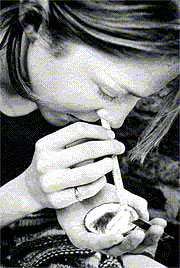
The following accounts tell the grim story of the drug abuse situation in the Maldives:
My mother first introduced me to sex. A family friend abused me for money to support her mother’s drug usage. I was abused at the age of nine years. As my mother was an addict she sent me with a man asking me to do whatever he says. There I was abused. I came and told my mother about it and she pretended that she didn’t know that he was such a bad person. After that I heard mom encouraging him for the act saying that I might deny, as I was a child. My abuse was one main reason I had to use drugs in order to avoid stress. Thereafter sex is nothing precious for me. I had sex when I was 12 years old with my boyfriend. Later as I started using drugs I wanted to support my addiction so I got into a relationship with a dealer. My boyfriend does not allow me to be with many addicts or to go and buy drugs from others. I mostly use in my room at home with my boyfriend.-female drug user
Wife of a brown sugar and hashish oil abuser had the following story:
On those days when my husband had taken a lot of drugs I ask my children not to irritate Dad. Not to make him promise to do anything for them or give anything to them. Because I know that he will not be able to keep the promises he makes to the children.Sometimes I felt like killing all of my children and myself. There were days when I was not able to afford basic needs. Like a sanitary napkin when I have my periods. I go out in the night and collect plastic bags and make pads for myself. On such occasions people approach me thinking that I am a prostitute. I had no way of supporting my three children and myself so I had two affairs. They were with people who approached me when I go out at night to collect ‘things’.
My in -laws blame me for my husband’s drug use. They say that he uses drugs because of me. I feel very heavy inside as I feel that there is nobody who understands me. The fact that I do not have my husband by my side makes the hurt more. After my husband was taken away this time I felt lonelier than ever before. We were much close physically and mentally this time than any other time.
In Maldives the legal system interacts to make drug situation more complicated as the following story of a 19 year old boy illustrates:
I was dependent on brown sugar by the age of 16 and started stealing from home and outside. I used to steal from shops, mug people on the streets, cheat people for money and even begged on the streets. I continued like his until I was caught robbing a shop and sent to jail for two weeks and the brought to house arrest.I was sentenced within a week and was banished. During my banishment, I used cologne and alcohol. I was brought back to house arrest after one year and then released after six months.
The above quotes are from the UNDP sponsored first ever comprehensive study of drug abuse in the country, Rapid Situation Assessment of Drug Abuse Situation in the Maldives 2003. Though the approach and the sampling used could have been better, it illustrates the grim situation facing an entire generation of Maldivians. Newspaper reports constantly remind of ever worsening of the situation. The Government’s response has been to spend more money on rehabilitation, getting more committees set-up and even praying to God for deliverance from drugs.
For Discussion & Comment: How could the Maldives effectively control the drug abuse situation in the country? Legalization is not an option- Maldives is a 100 percent Muslim country where all forms of alcohol and drugs are banned for locals. Quoting John Stuart Mill, "Over himself, over his own body and mind, the individual is sovereign" will not work.
Here is good survey of illegal drugs from The Economist. Here are drug policy experts on the blogosphere; Mark Kleiman, Drug War Rant of Pete Guither and Vicesquad.
Here is a recent story from New York Times Magazine about drug abuse, My Addicted Son.
January 31, 2005
Tsunami and Human Stupidity
Maldivian opposition newsmagazine The Dhivehi Observer had the following satirical joke related to the tsunami disaster that struck the Maldives and the region on the December 26th 2004.
On 26th Dec '04 early morning several hrs before the catastrophe happened, Honolulu Tsunami Monitoring centre have been trying to call our Meteorological Dept. monitoring centre at Male' International Airport, Hulhule but failed. They also got in touch with President's Office however it was informed that he's out of the island on a private vacation.Finally they called Defense Minister's office, but Defense minister was out on his morning meeting. Thinking at least it's best to keep him vigilant on this, the Honolulu officials left the message with the person who picked up the phone to inform Defense Minister that there's a Tsunami coming from Indonesia.
On Defense Minister's return, the operator told Defense Minister Hon. Shafeeu about the call, said Mr.T. Sunami from Indonesia is arriving in 2 hrs. Defence Minister promptly took action to send a delegation to Male' International Airport with name boards ' Welcome Mr. T. Sunami – Indonesia…
Across in the Andaman and Nicobar Islands, the BBC reported, an Indian helicopter dropping food and water over the Islands was attacked by tribesmen using bows and arrows. The Indian government was relieved saying that the attack was a sign that they survived.
May be humans should learn from animals.
December 31, 2004
New Year Deluge in the Maldives
When I went to the office on that calm Sunday morning everyone was talking about the small earthquake tremor that was felt in the capital Male’ at around 6.30 am in the morning. 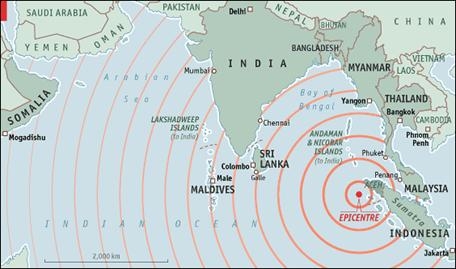 There was no acknowledgment of the earthquake by the government media yet banned opposition sites confirmed the earthquake and its links with Indonesian earthquake early in the morning. At around 9.35 am somebody shouted in horror that the sea was coming. We ran near the windows and my goodness, the sea was coming in like a torrent. The roads were flooded up to the knees and people were shouting, crying and screaming in shock. No body in living memory has seen such a thing.
Male’ the Capital was spared most of the damage thanks to the Japanese built tetrapod breakwater across the island. The total number casualties is over 70 and some 40 people are missing. The number is likely to double when everything settles down.
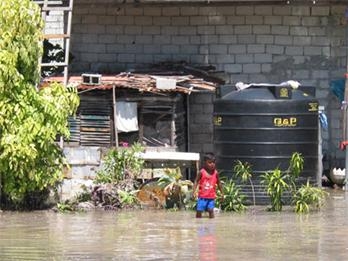 One person from the Laamu atoll I met told about the horror he witnessed when tsunami came in. At around 9.30 in the morning while he was sitting near his beach front home, suddenly the sea disappeared for about half a mile. He could see the fishes gasping and struggling on the dry sea-bed. It stayed like that for about five to six minutes then the waves started coming in like a torrent. He was saved when he jumped on to a boat nearby.
Compared with other countries, Maldives is lucky that waves were not as high as that hit India and Sri Lanka. The 200 islands that are inhabited and some 80 resort islands are at their highest 3 feet above sea level.
When the shock had subsided most people were feeling angry at the way government handled the whole thing. The government established a Task Force at one of the schools (it might be more appropriately called a Confusion Force). The telecommunication system had broken down and even after 24 hours there was no contact and news from many of the islands. People asked why was there no early warning of a possible tsunami as everyone new of the massive earthquake that occurred off Sumatra. To make things worse some of relief supplies sent by the government to the islands had labels such as ‘complements from such and such a person’ (this was the time of election campaign for the parliament). It is amazing that some senior government officials had the guts to do such a thing during a time of national disaster.
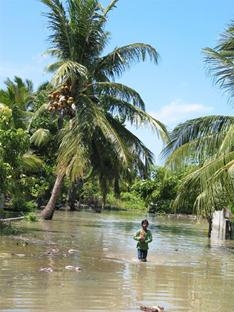 As the Maldives economy wholly depends on tourism (in Thailand tourism is about 12% of GDP and about 9% of employment), the Maldives can be said to be relatively the worst hit of the countries affected. We would need huge assistance from foreign countries to get back on our feet. But more importantly the country needs accountable leaders and prudent management of the country’s thin public finances. We cannot afford the current levels of waste and endemic corruption.
The best way one could help is to urge your governments to assist Maldives (probably in-kind assistance will be the most helpful in the short-term). Below please find the account details set up by the government for donation:
Name of the Accounts: Ministry of Finance and Treasury - Disaster Relief Fund
Bank: Bank of Maldives PLC, Malé, Republic of Maldives
Bank SWIFT Code: MALBMVMV
Account numbers:
7701 - 147 900 - 002 (Foreign Currency)
7701 - 147 900 - 001 (Local Currency)
Assistance urgently required for relief operations: Water, Food (eg: Packet food), Medicine and Clothing.
December 27, 2004
Tsunami hits the Maldives
I have not been able to check in with Paul, our Maldives correspondent. The Maldives is a popular tourist destination this time of year. From a first-hand account:
Hope everything is well, Paul. Let us know what you need.The Maldives are pretty much in a straight line north to south.
"The tsunami hit right across the face of the Maldives. Some of the atolls and islands are anything from sea level to a maximum of 4ft above water....
"When we went back to the island where the airport is, there were many troops from the security forces. There is a Pakistani warship in town and its helicopter has been used to check out some of the outlying islands.
The water in Male had receded 75% from early this morning. Things seemed to be much better. But as the water recedes it has left all the silt and sand and debris. There has been lifting of all the paving stones and tarmac, it has ruined the transport infrastructure.
There is no determination whether the election will proceed or not. We are supposed to go out to the outlying islands on Tuesday, then stay after the elections to draft our report before returning on 5 or 6 January.
November 15, 2004
Amartya Sen and the War on Terrorism
I was surprised to learn that Al Qaida had planned to attack even the Maldives as mentioned in the 9/11 Report:
Furthermore, during the summer of 2001, KSM approached Bin Ladin with the idea of recruiting a Saudi Arabian air force pilot to commandeer a Saudi fighter jet and attack the Israeli city of Eilat. Bin Ladin reportedly like this proposal, but he instructed KSM to concentrate on the 9/11 operation first. Similarly, KSM’s proposals to Atef around this time for attacks in Thailand, Singapore, Indonesia, and the Maldives were never executed, although Hambali’s Jemaah Islamiah operatives did some casing of possible targets. (p. 150, 9/11 Report)
Would it be ever possible to stop people like Al-Zarqawi graduating from delinquency to extremism and terrorism. The Noble laureate Amartya Sen seems to think so. Sen (age 70) is currently working on a book that focuses on the concept of identity:
"A person can be a U.S. citizen, of Malaysian origin, of Chinese racial roots, a Christian, a vegetarian, a tennis player, a good cook, a heterosexual but supportive of gay rights, a lover of classical music, a hater of opera, and a believer in creatures from outer space with whom it is ‘extremely urgent’ to talk— preferably in English!” Each of these identities might be very important to an individual, he says, but a problem can arise when others use these identities to typecast the individual or to persuade or pressure him or her into being recruited into sectarian groups that are belligerent toward other groups. Identity-based thinking might seem innocent, he argues, but repercussions can be tremendously harmful.What we need, Sen counsels, is “clarity of thought” to make the world a better place. It is particularly important to emphasize the role of choice in deciding what relative importance we would like to attach—“have reason to attach”—to our competing multiple identities. A Hutu who is being recruited to a group that torments Tutsis can try to see that he is also a Rwandan, an African, a human being. He can resist, Sen insists, “smallness being thrust upon him.”
If Bin Ladin is reading this he might understand this, after all he studied economics.
Globalization and the Maldives in the 14th Century & Today
 Arab traders brought Islam to the Maldives in the twelfth century AD. The following quote from a famous Arab traveler, Ibn Batuta (1304-77 AD), looks at the Maldivian society of the time when he reluctantly accepted the post of judge or Qadi:
The people of Maldive Islands are upright and pious, sound in belief and sincere in thought; their bodies are weak, they are unused to fighting, and their armour is prayer. Once when I ordered a thief’s hand to be cut off, a number of those in the room fainted. The Indian pirates do not raid or molest them, as they have learned from experience that anyone who seizes anything from them speedily meets misfortune. In each island of theirs there are beautiful mosques and most of their buildings are made of wood…Their womenfold do not cover their hands, not even their queen does so, and they comb their hair and gather it to one side. Most of them wear only an apron from their waists to the ground, the rest of their bodies being uncovered. While I held the qadiship there I tried to put an end to this practice and ordered them to wear clothes, but I met with no success. No woman was admitted my presence in a lawsuit unless her body was covered, but apart from that I was unable to effect anything.” (cited in Islam: A Very Short Introduction, Malise Ruthven, p. 123)
It is hard to believe that an unknown stranger would be invited to become the Attorney General upon arrival. Maybe people trusted each other more in those times. Or maybe the Maldivians are so sincere that they never think bad about other people. Who would not love to be a dictator over such a docile group of people?
Here is a site devoted to the ethnography of the Maldives. The most widely read news media is The DO news bulletin published on the net which happen to be banned and the URL blocked by the government. The site has the highest number of daily hits per capita of any banned political site on the web. For more on the Maldives read Thor Hayerdahl’s Maldives Mystery.
October 10, 2004
Quote of the Day
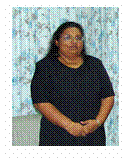 A new cabinet Minister was recently assigned as Minister of Gender, Family Development and Social Security in the Maldives (shown in the photo). In a recent interview she was quoted saying the following:
“It is your (media’s) problem that you are promoting thin women and not looking at fat women (to find beauty in them)! Perhaps with the right medical attention those who need to thin needs to get thin…I can’t see any sense why the media would conduct any program that promotes unhealthy dieting habits. Media should not air any programs that endangers health. We can still diet in a good way but I have to say that most of Maldivians’ eating habits are not good. We eat too much hedhika (oily snacks)! We should eat more vegetables and fruits. We should also eat the right amount and not in excess. If this is so, then it’s not a very big issue. Everybody wants to look beautiful. If in this era people think thin people look beautiful, then people will try to stay thin…It’s not good to go hungry to become thin.”
October 08, 2004
Sad Maldivian Fact of the Day
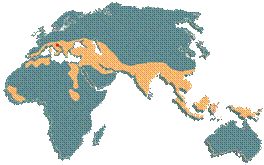
In a recent speech, the President of the Maldives (Mr. Gayoom), quoted some alarming statistics on the prevalence in the Maldives of a rare hereditary disease called thalassaemia:“Another health issue of great concern to the Maldives is that of thalassaemia. Nationally, one in five persons is a thalassaemia carrier and one in every 120 newborns suffers from this blood disorder. If preventive steps to reduce the incidence of thalassaemia in the Maldives are not taken, informed projections show that in 50 years’ time, the cost of treatment could consume over 40 percent of the per capita health expenditure. And what is worse, half the country might have to become blood donors for the other half, a nightmare situation that would be quite unsustainable…”
Thalassemia is a disease which was originally widespread in the Mediterranean Basin, South-East Asia and various countries in equatorial Africa….The term "Thalassemia" implies a genetic disorder of an extremely heterogeneous group which is characterized by a reduced or erroneous production of hemoglobin, the respiratory pigment contained in the red cells. The probability of a child being born affected by Thalassemia Major - the most serious form of this genetic disorder also known as "ß-Thalassemia or Cooleys Disease" - is a 25% chance if the parents are carriers, that is to say if both possess one of the two genes for erroneously coded haemoglobin in their cromosomic make-up… If up until now correct transfusion therapy has been the only available treatment for patients affected by Thalassemia Major, it is today possible to cure the disease by way of performing bone marrow transplant using a compatible donor and in this way replacing diseased cells with healthy ones.
In a poor country like Maldives a bone marrow transplant is not a viable option for many; children suffering from the disease must undergo monthly blood transfusions and daily injections of iron chelating agents. Poverty combined with other related social problems make the situation worse as the following story illustrates:
“Fathimath comes from Himmafushi, an island in North Male atoll with a population of around 800. She is 20 years old, has already been married once, and has two children. Like many other young girls and boys in the islands, she was not lucky enough to complete her studies in the capital Male. The education facilities on her island do not provide tertiary education and hence very few get the chance to complete their studies.Fathimath comes from a poor family of five children, and since she is the third child, the chances of her coming to Male to continue her studies were low. When she had completed grade seven, her family decided that she should get married and settle down. By the age of 17, she was married and was soon pregnant with her first child. By the time she was 19, her husband, who had been working on another island, had divorced her to marry someone else and she was left alone with two children to take care of. As there were very few job opportunities on the island, Fathimath was left with a job that did not pay her enough to take care of her two children and herself……. The Guinness Book of Records latest edition describes Maldives as having the highest divorce rate in the world.”
Here are some background statistics on the health sector in the country and more on how the disease is inherited.
August 11, 2004
Prisoner of the Month

A cyberdissident and prominent artist in the Maldives, Naushad Waheed has been an outspoken critic of the government for many years. His latest arrest took place on 9 December 2001 in Malé. He was held in Dhoonidhoo detention centre for about five months before being transferred to house arrest. On 14 October 2002 he was tried in the Criminal Court without access to a lawyer or the opportunity to defend himself and ten days later was sentenced to fifteen years. He was charged with treason, reportedly because of his involvement in public debates deemed critical of the government and correspondence with Amnesty International detailing human rights abuses…
The following Amnesty report comments on the dire states of the human rights situation in the country including the state of the criminal justice system:
…The courts apply a version of the Islamic Shari’a mixed with elements of the civil law of 1968 and its amendments. The modified Shari’a does not include amputation or stoning to death but sanctions floggings and the sentence of banishment to a remote island. The origin of banishment as a punishment in the Maldives reportedly dates back to previous centuries when rebellious slaves - brought back by some Maldivians from the Hajj pilgrimage to Mecca - were marooned in the island of Felidhu.Under current regulations, the length of the banishment sentence may vary from eight months to one or two years but much longer sentences are reportedly also imposed. The prisoner is sent to live on an island with the local inhabitants. It is then left to the prisoner to earn money - usually through hard labour - to top up the meagre daily allowance given to him or her by prison authorities. This allowance is reportedly a very small amount of money hardly sufficient for one meal a day. Prisoners who cannot find work have to rely on the financial support of their relatives for subsistence…
Mohamed Nasheed, writer, politician and member of parliament advocating reforms, was arrested on 8 October 2001 and held incommunicado for several weeks. On 8 November, following a trial lasting only two hours, he was sentenced to be banished for two and a half years to a remote atoll, on charges of "theft" of unspecified government property. During his trial at the Criminal Court, he was not permitted access to a lawyer or to speak in his own defence. After the trial, he was banished to a remote island.… He was "expelled" from the Parliament in March 2002 on grounds that he had been absent for more than six months - while he was in detention.
…On 8 November 2001 he was taken to court where he was charged with the "theft" of "government property". The charge reportedly related to the purchase, apparently without payment, of several children’s copy books at an auction at the former residence of former President Amir Ibrahim Nasir in October 2001. Mohamed Nasheed was one of dozens of visitors to this auction. According to him, the official from whom Mohamed Nasheed inquired about the price told him the books were insignificant and he need not pay. Several other visitors who were buying other small items were also reportedly told they need not pay. However, Mohamed Nasheed was the only one who was charged with theft…A political motive behind his arrest was obvious. Prior to his arrest, he was outspoken in the parliament, advocating reforms. …Furthermore, Mohamed Nasheed’s computer was taken away for scrutiny…
For some lucky criminals being banished to a remote island may not be that bad after all as this article from CNN suggests. Anyway it is such a sad spectacle to see peoples’ fundamental rights being violated in this age of democracy and the internet. Another MP seems to have become now in disfavor of the government.
July 30, 2004
Drafting a Criminal Code for the Maldives

Recently some controversy has been brewing with regard to a decision by the University of Pennsylvania’s Law School’s Professor Paul Robinson to cancel his “Criminal Law Theory Seminar” and replace it with the three-credit Maldive project:
“The seminar will revolve around a single project: drafting a new criminal code for the Maldives. The work has been requested by the Maldivian government and is sponsored by the United Nations Development Program. Because the Maldives is by constitutional mandate an Islamic nation and, as a matter of law, all citizens are Muslim, the code will be the world’s first criminal code of modern format that is based upon the principles of Shari‘a.
After studying the existing Maldivian criminal law statutes and the criminal law principles contained in Shari’a, student teams will propose criminal code provisions and critique the proposals of others”.
Daniel Pipes and the blogger at LittleGreenFootballs (both of them are noted for their hatred of Islam) have been critical of Professor Paul Robinson’s consulting work. He defends his work saying:
I do criminal code consulting for many countries. A few days ago, one client, China, beheaded a person for embezzlement. (Worse than anything the Maldivians have done.) Should I now refuse to advise them further on what I think a criminal code should look like? Your strategy of willful disengagement seems an odd way of bringing greater justice to the world.The Maldivians are in the midst great social change. A special parliament called to draft a new constitution met for the first time two days ago; disagreements among the members spilled into demonstrations in the streets…
I do not know how the Maldivian criminal code project will turn out. Like many criminal code projects, it may go nowhere. I have no power other than the persuasiveness of my advice, which, experience tells, is often limited. But is it an enterprise worth undertaking? I would think it shameful to decline.
Here is a Maldivian opposition group alleging the UNDP’s support in assisting human rights abuses in the country and a recent case illustrating the state of the criminal justice system in the country:
Criminal court says case against parliament speaker cannot be looked intoFor an overview of the current system see the article. It will be interesting to hear from other heavy weight lawyer bloggers on the web: I mean those at the Volokh Conspiracy, Crescat Sententia, Legal Theory Blog, and Punishment Theory amongst others.
…Referring to the Justice Ministry’s Circular 98/3, a criminal case has to be investigated, and has to be forwarded to the Criminal Court by the Attorney General’s Office, the court said in a press release. The court said that a criminal case filed by an individual cannot be looked into by the court…
July 29, 2004
Still More Porn Lessons
The ever interesting Michael at 2Blowhards had the following post on the history of porn in Denmark:
Porn was legalized in two stages. The first, in 1967, lifted restrictions on print porn ("print" as in "text" -- novels, etc). The second stage ended restrictions on virtually all other kinds of porn.
While the business of erotic novels and such had flourished under censorship in a modest and illicit way, once this work was made legal everyone lost interest in it. The market for it collapsed.
Legislators took the second step -- making all other kinds of porn legal -- believing that the demise of text-porn was a trustworthy predictor of the move's consequences. Instead, demand for all these other kinds of porn (pictures, movies, etc) exploded.
Unsure what to make of this but ever-curious.
My take: I think one needs to look at a much broader level as well. Enacting a law is the typical default response from lawyers and politicians when they see a vice. But for laws to be effective there probably needs to be a social will to enforce those laws. To quote a great sociologist Emile Durkheim, “When mores are sufficient, laws are unnecessary. When mores are insufficient, laws are unenforceable.” By hurrying to enact laws, we are also taking away responsible behavior as well.
Vice Squad from the Maldives

An 18-year-old man has been fined Rf1,000 (about US$78) by the Criminal Court for downloading pornographic pictures from the Internet.
Haveeru has been informed that this is the first conviction of such kind in Maldives which has no cyber laws in force yet.
A cyber expert was present at the trial and the historic ruling on July 8 was passed on the context that under Maldives' existing laws, downloading pornography from the Internet amounted to "importing pornographic material into the Maldives from a foreign source," Criminal Court's senior magistrate Hassan Saeed told Haveeru on Thursday.
It is obvious the lawyer who tried the poor teenager did it for his own vanity and ambitious lawyers are the last thing a poor country needs.
The economist Steven Landsburg, in his book Fair Play: What Your Child Can Teach You About Economics, Values and the Meaning of Life gives the following advice to his daughter.
Surf the Internet. I’d much rather have you getting your pornography from cyberspace than by rummaging around your parents’ bedroom.In fact, I’m glad the net makes it easy for you to get ahold of things that other people would prefer you not to get ahold of. Family values crusader Donna Rice complains that “any child with a computer can access vile pornography in matter of seconds. And once they have seen it, it can never be erased from their mind.” You betcha, Donna. The Internet is the natural enemy of those who are out to erase other people’s minds.
Let’s be honest- access to pornography is not part of the cost of the Internet; it’s one of the benefits. The whole purpose of the Internet is to facilitate communication and to thwart those who would hamper the free exchange of information.
Lawyers will probably not understand it. For more on economics of vice see the excellent blog Vice Squad.