April 18, 2005
Starbucks Messes With Traffic Models
Another attempt to predict a complex system -- foiled by Starbucks and Dunkin Donuts:
In addition to its effect on mileage, the boom in on-the-go breakfasts has confounded attempts to forecast travel patterns, which are based on computer models that rely heavily on the predictability of the morning commute. Those models assume that people take the shortest, fastest routes to work, not the ones that necessarily lead past a doughnut shop."How do we predict future travel when commercial and social interactions like this can surprise us?" McGuckin asked.
December 19, 2004
India in 2005
The Economist came out with its annual crystal ball - The World in 2005. There are two articles in India that are worth a read, it's forecast and a general editorial-style outlook. Both read to similar tunes - beware of the left leaning coalition partners that support the ruling party.
Its other outlook, "The World in Figures - Countries" outlook is a very mixed bag as well, essentially concluding that the government will stay, but will end up doing very little next year. It also has a nice little blurb on an important fact that I had totally forgotten about (it was the topic of my Bachelor's thesis) - the fact that 2005 heralds drug patenting regulations under the WTO agreements. The Economist says (in reference to creating new drugs), 'Indian companies will rise to the challenge: costs are low and scientists plentiful.' My own conviction believes that for the blurb to be true, the companies still need to figure out how to contend with the brain drain. Then there is the question of R&D money, will there be enough?
My own short term outlook for the pharmaceutical industry is that it could end up being a free-for-all "dead traveler in the desert" story with drugs whose patent regimes are soon to end. Trust the Indian jackals to have the niftiest set of wings that do Darwin proud.
August 29, 2004
Two Estimates
The difference is up to an order of magnitude. Which one is more accurate?
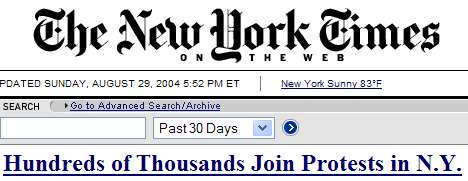

UPDATE: A headline without the possibly misleading statistic:
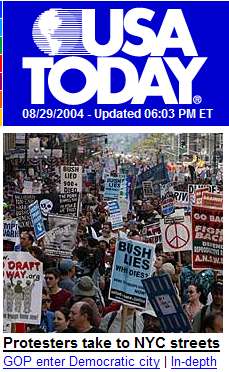
UPDATE 2: You have to love unnamed police sources. From the NYT:
The protest organizer, United for Peace and Justice, estimated the crowd at 500,000, rivaling a 1982 antinuclear rally in Central Park, and double the number it had predicted. It was, at best, a rough estimate. The Police Department, as is customary, offered no official estimate, but one officer in touch with the police command center at Madison Square Garden agreed that the crowd appeared to be close to a half-million.
Police gave no official crowd estimate, though one law enforcement official, speaking on condition of anonymity, put the crowd at 120,000; organizers claimed it was roughly 400,000.
August 17, 2004
Stability and Autocracy
Despite the common arguments about the complementary aspects of political and economic liberalism, there are some instances when autocracy is rewarded: Oil Falls on Reduced Concern About Venezuelan, Russian Supply.
Also of possible interest during this time of electoral uncertainty in Venezuela is Acemoglu's paper: A Theory of Political Transitions.
July 14, 2004
Remember...
Remember that in economics, constants are always variable:
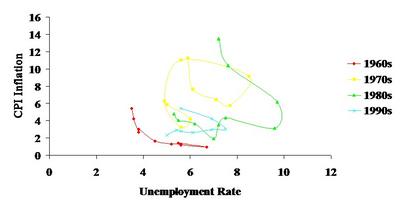
Cute picture care of Chris Neely at the St. Louis Fed.