July 19, 2005
Economics in the Movies: Wedding Crashers
Loosely following up on Ian's Movie Economics post, I am going just going to pretend that the last 3 months or so that I was absent didn't happen.
Sunday I did my part to boost the sluggish Hollywood movie market and I paid to see Wedding Crashers. I will not bore you with my review of this fantastic piece of comedy.
What does this have to do with economics other than my $25 contribution to GDP? The premise of the movie actually revolves around the main characters falling in love with the daughters of the Treasury Secretary, an economist, played by Christopher Walken. Walken offers some advice to his daughter helping her to choose between two beaus. As only an economist could; Secretary Cleary tells Claire, "We never know what the future holds. We can only choose based on all of the information we have available."
Brilliant! However, Claire finds that she is on the losing end of a transaction suffering from the moral hazard of information asymmetry. Claire's suitor, Owen Wilson, is using a false name, false career & false invitation to the wedding.

July 03, 2005
Calculus of Faith
Tino’s post about death caused me to ponder a little about spirituality. I think only the spiritually hollow people feel that death makes life meaningless. Jeffrey Lang, a mathematics professor at University of Texas, in his book “Even Angel’s Ask: A Journey to Islam in America” attempts to develop a conceptual model for the one who wants to improve his faith:
“If one were able to plot a person’s spiritual growth against time, a Muslim would envision it as a continuous curve that, at any point, is either ascending, descending, or at a critical turning point. According to this perspective, faith is not a steady state. A believer must be on guard against unwittingly slipping into a downward slope,…”
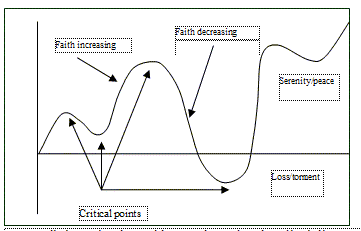 It follows from the model that we must always continuously review the current state of one’s religiosity. Some diagnostic checks that could be used might include asking questions: “how’s your faith?”; “Do I feel closer or farther from God in my daily prayers lately?”; “Am I giving more or less in charity these days?”; “Was I at greater or lesser peace with myself and with others in the past?”
Most religious rituals enable people to develop discipline over the course of their lives. Muslims fast during one month of the year from sunrise to sunset; I try to use this ‘Ramadan button’ during times of hardship in life (for those familiar with Stephen Covey's work might understand it as the ‘pause button’).
I agree with the advice of Bryan Caplan that ‘immortality through your work is better than nothing’. It was memorably put by Justice Oliver Wendell Holmes:
"If I could think that I had sent a spark to those who come after I should be ready to say Goodbye." (cited by Thomas Sowell at the end of his biography A Personal Odyssey)
My advice to Tino for his unlucky attempt at making himself religious is read some spiritual autobiographies. My favourite is Mohamed Asad’s Road to Mecca. Across the economics blogosphere the most religious blogger seems to be Rasmusen. John Palmer had also noted that one day he would like to post on the econometrics of God; I think this book will be of some help, Frank Tipler’s The Physics of Immortality.
It was ironic that while writing this the TV was showing the Hindi film, Kal Ho Na Ho (Tomorrow May Never Come).
June 27, 2005
Extreme Savers (Updated)
CNN/Money has an amusing ongoing series about the lives and habits of "Extreme Savers" -- people who invest wisely, spend frugally, and live like there's no today. These homo-economicae are so good at the penny-pinching lifestyle that they sound like caricatures of real people from The Onion.
Still, I kind of like Rick Kuhlman's approach:
The 33-year-old Topeka, Kansas resident replaced all 52 light bulbs in his house with fluorescents three years ago, in order to cut his monthly electricity bill.To me, the incandescent glow is worth a few bucks a month, but that's just me."I even replaced the one in the fridge," he laughs.
His savings, however, are no joke. Rick explains that his $60 investment in energy efficient light bulbs saves him some $20 a month. And he has yet to replace a single bulb.
"The return on that is astronomical. I wish that I could find that in the stock market," Rick states.
Anyway the ending is just sad:
"If you're smart 360 days a year, then you can celebrate the other five," he explains. A couple of extra days of celebration, though, can hardly be held against him.See also the woman who won't look at advertising, and saves over half of her gross income:
"If you have the philosophy of saving 10 percent to 15 percent then you end up spending the rest. That also puts you in the trap of thinking, 'As my income increases, so will my spending,'" she said.And don't miss the parents of twins:
"I spent my pregnancy lying on the couch, eating peanut butter and jelly sandwiches and working on a budget," said Jenny, who in true twin mom fashion recounted her story while working out on her Stairmaster....There are several economic justifications for "extreme saving", most of which involve a substantial preference for personal or liesure time today, or early retirement. There are stories of people getting by on garbage scraps for decades and at death bequeathing millions of dollars to charitable foundations, schools, and even complete strangers. But these strategies aren't for most of us; in fact, I'd argue that the median household thinks these people are nuts.The couple lives in a remote location – so Will can coordinate highway maintenance – but the price is right, at $115 a month for a three-bedroom house. Moving to the middle of nowhere was just one of their tactics for keeping costs in check.
This opinion is based on one anecdote: I remember watching an episode of Oprah when I was a pre-teen. The episode followed a family that lived in the middle of nowhere; there parents wanted a large family and had about a half dozen kids. They lived on the husband's meagre income, and the mother stayed home. To keep in budget, they bought everything generic and in bulk, rarely went on vacation, had a beat-up car or van, and almost never went out to eat (and when they did, they went to McDonalds).
Do you know what the audience's reaction was: respect, understanding, and humility? NO: scorn, disbelief, shock, and horror! I think thir response reflected an attitude of most big-city Americans, who have become used to a much easier and pleasure-filled life. They think that real sacrifice and discipline is unnecessary in this day and age. This is, in my opinion, a very narrow view...
June 22, 2005
Good for Auto Design , Bad for Public Policy Research
This from Fastlane struck me as something that a serious policy researcher would never, ever admit to, no matter how accurately it portrays how many "academic" researchers approach their subject matter.
Today, we’re operating on a much more emotional, creative level and our designers have been empowered to express themselves. Our winning products will not be determined by careful analysis; they will captivate and enthrall through imaginative design and flawless execution....I like to think creatively about how I design and execute my research, but my winning products start with a refusal to bring my emotions into the mix, which is a small but critical part of careful analysis. The latter is, of course, what I am paid to do...
Back to Lutz:
What we are re-learning as a company is that we are not simply in the [public policy] business; we’re in the art and entertainment business. So, what we’ve got... now, is a general comprehension that you can’t run this business by the left intellectual, analytical side of your brain alone, you have to have a lot of right side creative input.It's a good thing I don't design GM's cars, or you'd have a very small, ugly, and reliable econobox with airbags, A/C and CD Stereo that gets 45 mpg...
[Text modified for amusement purposes only.]
June 16, 2005
Diversity as an Arbitrary Social Construct
For those relatively new to T&B, you should know that my wife, son, and I live in a large, aging, ethnically diverse condominium building. It's not "luxury", but it's home. Frankly, I would have liked quieter neighbors, cleaner hallways, higher ceilings, thicker walls, and smaller public schools, but the location was excellent, and at $87K for a 1100 sqft. two bedroom with a view, it was all we could afford when I was a lowly research assistant.
Now the same condo sells for $200-$250K, and some of the diversity is moving elsewhere -- but mostly, it's the same people in the building. As I wrote a long time ago, we mostly leave each other alone, except as I have since found out, for the children.
I discovered this out over the past week, as my son and I have been swimming in the condo pool in the early evenings. At that time, you will find a large diversity of ethnicities among the children: Russians, Iranians, Indians, Africans, American blacks and whites, and various Latinos.
Many of these "foreign" children have spent most or all of their lives in the United States; what struck me most about them was the utter lack of cultural diversity among these children. They were all American kids. They've grown up in the same area, with each other, have had the same experiences, mostly.
Not to say there aren't differences. Because language is learned at home, national and regional accents still prevail. Some children are friendly; others are born to hate. The older boys are learning to posture, claim territory, and fight. Many boys and girls group themselves by race and gender.
But the younger ones don't care about your race, color, religion, age, or gender. They just want to play. To them, diversity is just plain worthless. How does diversity help you make a bigger splash with a cannonball? How does it make you swim faster? How does being X make you better?
Sometimes children do have much to teach us... or at least much to remind us.
May 31, 2005
Recommended Reading
A few weeks ago I had the distinct pleasure of hearing Steven Levitt speak to a gathering of UC alumni on the subject of his new book. Reviews and insights on Freakonomics abound, so I won't bother to say much other than while I recommend taking the weekend afternoon required to read through it all, it was sorely lacking in the part that interests me most: the process Levitt goes through to find/investigate subjects.
In addition to the talk being entertaining and engaging (not a frequent characteristic for economists) in general, I was particularly caught by a simple comment Levitt made at the very start of his presentation. Specifically he said that he dislikes using the word "rational" to define actors, since it seems to carry with it baggage that simply gets in the way of the discussion. In its stead, he suggested the term "optimizing". Perhaps this is already orthodoxy in a world in which I don't participate, but I find that I like it, at least as much as "rationality".
The odd nature of the word is well identified in a book I picked up while in transit from Texas this weekend, and heartily recommend: Everything And More: A Compact History of ∞:
It was always around that same time t every morning, and Mr. Chicken had figured out that t(man + sack) = food, and thus was confidently doing his warmup-pecks on that last Sunday morning when the hired man suddenly reached out and grabbed Mr. Chicken and in one smooth motion wrung his neck and put him in a burlap sack and bore him off to the kitchen. Memories like this tend to remain quite vivid, if you have any. But with the thrust, lying here, being that Mr. Chicken appears now to have been correct -- according to the Principle of Induction -- in expecting nothing but breakfast from that (n + 1)th appearance of man + sack at t. Something about the fact that Mr. Chicken not only didn't suspect a thing but appears to have been wholly justified in not suspecting a thing -- this seems concretely creepy and upsetting....
For instance, we know that in a certain number of cases every year cars suddenly veer across the centerline into oncoming traffic and crash head-on into people who were driving along not expecting to get killed; and thus we also know, on some level, that whatever confidence lets us drive on two-way roads is not 100% rationally justified by the laws of statistical probability. And yet 'rational justification' might not apply here. It might be more the fact that, if you cannot believe your car won't suddenly get crashed into out of nowhere, you just can't drive, and thus that your need/desire to be able to drive functions as a kind of 'justification' for your confidence.
[Footnote]
IYI Depending on mood/time, it might strike you as interesting that people who cannot summon this strange faith in principles that cannot be rationally justified, and so cannot fly, are commonly referred to as having an 'irrational fear' of flying.
David Foster Wallace is one of my favorite contemporary authors, but I will concede that this book is much more technical than his past essays. The care he takes to explain the enormity of the effort to pin down the precise nature of ∞ makes the effort of reading the book entirely worthwhile.
Also, in case you're a fan of these "microhistories" as they've come to be called, I would recommend you towards Zero: The Biography of a Dangerous Idea (clean, enjoyable prose; compelling description of the difficulties and history of the idea, though perhaps too light in technical detail for some) and away from A Tour of the Calculus (Berlinski's apparent desperation to be considered apart from the common idea of a mathematician as someone entirely unable to converse with non-mathematicians makes the writing almost painfully over-adorned with pointless flourishes and bad analogies).
May 23, 2005
Employment is Destiny?
Those of you toiling in a more "masculine" profession and are expecting, it looks like you might be more likely to be saying "Atta boy!"
Blokey jobs encourage baby boys, study saysThe conclusion comes from a survey of 3,000 people from various professions by the London School of Economics and printed in the Journal of Theoretical Biology.
In the population as a whole in Britain, roughly 105 boys are currently born for every 100 girls, according to the study, The Sunday Times newspaper said.
But according to calculations by chief researcher Satoshi Kanazawa, for engineers and other "systemisers" [a description given to a form of cognition considered more "male"] the ratio is 140 boys per 100 girls.
Nurses and the like produce around 135 girls for every 100 boys, the study found.
Interestingly, the sciences are included in those professions termed "systematic", thus making the description of "masculine" mean more than simply requiring more brawn. If this conclusion is true, and the effect does exist, might it not have something interesting to say about the representation (or under-) of women in the upper tiers of scientific study? The women who do choose the life of an academic and excel to the top postions might be more likely to have male children, an effect that, coupled with the fact that children of highly educated parents are more likely to pursue similar vocations, would make comparisons to the normal distribution of men and women in the general population less and less applicable as generations wore on.
(Via, and with more to be found at, Illuminating Science.)
Doesn't seem a minute since the Tirolean spa had the chess boys in it...
In the end, it can be said that Kasparov has defeated all of his intellectual adversaries but one: Vladimir Putin. And now, Kasparov is making his move against the Russian president.Announcing his retirement from chess recently, the 42-year-old master declared that his new vocation is politics and vowed to take on the increasingly autocratic power structure ruling Russia. He wants Putin to step down in 2008, as the constitution mandates, and a democratically elected ruler to take his place.
Not that the fight will be fair, of course. It does, however, make for an interesting discussion on the value of two very different facets of understanding strategy. Apart from his dictatorial intentions, Putin is clearly a skilled manipulator of personal and political incentives. Kasparov, on the other hand, drew a tie from a machine that could calculate 50 billion moves in three minutes.
"I felt that I could use my resources, to apply my philosophy, my strategic vision in my native country, because it's such a crucial, decisive moment in history, and I felt my presence could make some difference," said Kasparov, who claims that he has been banned from state-owned television because of the threat he poses to the government....
He is finishing work on a book, scheduled for publication in 2006, titled How Life Imitates Chess. In it, he asserts that the sharp reasoning and brilliant intuition that guide a chess player's moves are the same elements that determine all effective decision-making.
One wonders how abstract the book's discussion will be: must we simply be cognizant of potential reactions by "opponents" and choose our moves according to their most likely response, or is it that a lifelong devotion to a single subject and dogged review of a narrow set of potential rivals in the pursuit of refining individual-specific assumptions (priors) for better evaluation during competition is what's called for to make "effective" decision making? It's certainly not the case that Kasparov confronted Deep Blue restorting to only a Maclom Gladwell-style style game. Likewise Putin has spent his career deep within the system of Soviet/Russian machinations. While both are supreme strategists, it seems the specificity of their fields would make it hard to compare abilities between the two. And considering that it's Kasparov moving onto Putin's turf, I don't hold out much hope for the chess genius.
(Via Political Wire.)
May 05, 2005
The Baby-Goods Industry
 y two reactions to this article on the baby goods business: "You've got to be kidding me!" and "Who are these people?"
Like many parents-to-be, my wife and I are spending our last few babyless weeks in a panic-purchase feedback loop. Anxiety and uncertainty fuel impulsive trips to baby-goods superstores, whose gargantuan inventories only beget more anxiety and uncertainty, to which we -- good American consumers that we are -- respond by filling an oversize shopping cart until it's difficult to steer. ("Honey, do we need one of these vibrating Pack 'N Play play yards in Ivy League print with optional canopy accessory? Are you sure? The mother on the package seems awfully happy that she has one . . . .")I'm sorry, but this "feedback loop" is not a problem with markets. It's not a problem with consumers, or with superstores, or with manufacturers. It's just not a problem at all.
I count myself as a "good" American consumer, and as a devoted father of a 21 month old, I can tell you that I had no anxiety in such stores, never felt social pressure (except from insistent relatives) to buy anything. I would never engage in "impulsive" trips to baby stores, and never once filled an oversize shopping cart.
We did spend a lot of money on a stroller, car seat, crib and chaging table, because a) we saw quality for our dollar, and b) we like stuff that looks cool, and can afford to pay for it.
There will always be those who don't mind using their children to broadcast their wealth, but for the most part, America's $6 billion-a-year baby gear industry thrives on two seemingly incompatible mindsets that tend to coexist in new parents: terror and schmaltz.
And there will always be those who can't help thinking that everybody is out to impress them. Terror and schmaltz? How about being an adult and having self-responsibility? Again, who are these people? Apparently, they are the kind that would drop dead if they ever entered a Wal-Mart Supercenter:
When they arrived at Babies 'R' Us in Silver Spring, Zambotti found the experience of entering its 37,000-square-foot space "overwhelming," she says. "I was paralyzed. I just stood there in the front of the store. We decided we had to go get lunch before we could even go in. We didn't even buy anything that day."Paralyzed?!?! Another woman feels guilty for not having a complete nursery ready for the newborn -- as if it could possibly make a difference to the baby!
We bought baby furniture that matched our office furniture, which made sense since our nursery was also our "office" -- we just moved the desk over to the side. However, the crib was in our bedroom for 6 months. No guilt here folks.
Then there are the self-help authors, who of course, have absolutely no incentive to make it sound like reading their books are in any way necessary:
Iovine urges new parents -- and especially new mothers -- to take a deep breath and stay calm when faced with the vast sea of supposed "must-haves." But she knows it can be hard to stand up to aggressive product marketing -- not to mention parenting books and magazines filled with alarming anecdotes -- aimed directly at this emotionally vulnerable population.Can anybody tell me what "aggressive product marketing" is? Do the car-seat manufacturers send out goons to physically threaten parents-to-be? Do toy manufacturers send out leaflets that imply that you're a terrible parent if you don't spend $1000 on flashing lights?
What surprises me is that people actually buy things because they think that a smiling baby on a box implies that their baby won't be happy without one.
My wife and I bought NOTHING that was in any way advertised or promoted to us; instead, we made decisions based on the relative quality, prices, and styles of the goods we wanted.
I believe that nearly all parents have the simple ability to think, "these magazines are just magazines". I remember reading a lot about doctors' opinions, but very, VERY little about scientifically demonstrated results.
I do wish however that formula manufacturers would stop pretending that breastfeeding is just another choice...
April 12, 2005
Krugman, Darwin, Keynes, Popper, Kolmogorov, and Buchanan
Recently I saw Paul Krugman's analogy between disrespecting Keynes and disrespecting Darwin -- quoted with no registration required here. Is Keynes really comparable to Darwin? Instead of, perhaps, someone with fuzzier and more controversial ideas (punctuated equilibrium, sociobiology...) laid over Darwin?
Is there a good layman's summary somewhere of nice sharp phenomena that Keynes' ideas cleanly and reliably predict that rival ideas didn't? For Darwin, off the top of my head, I think of (1) sex (of course!:-), (2) the way that molecular biological genetic relatedness so closely matches relatedness worked out by other methods before 1950, and (3) the way that so many of the most common human genetic illnesses (most famously sickle cell anemia) are simple mutations away from wild type which provide crude protection against some important threat in some historical environment. As far as I have heard (as a layman but probably more informed than the target NYT audience that Krugman was writing for), the footprint of Keynes' theories in the real world might not include anything particularly sharp at all, and probably includes nothing comparable to the endless megabytes of regularities in the flood of genetic data which started coming in only long after Darwin's death. I was under the impression that the footprint of Keynes' theories is more like the footprint of theories about the effectiveness of capital punishment in deterring murder: one can come to conclusion "yes" or "no" (esp. if one is predisposed to prefer that conclusion!) but either way, one's strongest conclusion might be that the effect is not so huge compared to the other confounding effects that it's easy to pick it out without clever statistical analysis.
On the flip side of predictive power, Darwin's ideas perennially take flak for allegedly not being "falsifiable" in the sense of Karl Popper; one example I picked up from a little Googling is here. But in at least one sense, natural selection seems cleanly falsifiable: I can easily imagine a history of the last 130 years in an alternate universe where natural selection was wrong, and where we would have realized its falsity by now. If, e.g., our universe had no nuclear fusion, so that Lord Kelvin's famous analysis showed correctly that the Sun could not be nearly old enough to have kept things running for a suitably long period of evolution, then we would at least have very serious doubts about natural selection origins of modern life forms. And if instead of all one genetic code, it had turned out that apparently-related organisms generally had gratuitously incompatible genetic mechanisms, with no reasonable way to evolve incrementally from common ancestors, the theory of evolution might have dropped dead right then. Is there an alternate history from 1930 to 2005, in some alternate universe where Keynes was wrong, that would have convinced the Keynesians in that universe that they were mistaken?
Of course, even if it turns out that Keynes' ideas have relatively weak predictive footprint in the observable world compared to Darwin's ideas, that doesn't mean that they're necessarily unimportant or wrong. Human nutrition doesn't explain most disease, and picking its effects out of messy real world datasets can be tricky, and some formulations like "nutrition affects health" might even be hard to falsify in general. Still, it would be foolish to deny that nutrition is vital in understanding disease and health, and if in the early 20th century Senyek had exploded the conventional wisdom by revealing that nutrition affects health, perhaps he might be compared with Darwin. On another hand, though, the footprint of nutrition isn't always hard to see: it would be easy to point nutrition skeptics to extreme cases like scurvy on early ocean voyages where the effect of nutrition on health is enormous. And while theories with hard-to-see footprints can be important, tolerance for them is a necessary condition for people believing for centuries that human health is usefully modelled with humors.:-| So I sort of hope that the Keynesians have a standard evidentiary smackdown for ignorant but interested skeptics.
Incidentally, sometimes I see flareups of an ongoing low-intensity conflict about how much mathematics is appropriate in economics, and whether current math emphasis tends to displace other useful methods of analysis. The intellectual history of the falsifiability-related ideas that I'm slinging around here might be an interesting case study to think about. Popper and Lakatos did a lot of qualitative philosophical work on the qualitative idea of falsifiability, but at about the same time, people like Shannon and Kolmogorov were working out the math of information theory and computational complexity, which can be used to make quantitative versions of similar arguments. And to me, it looks as though the math results are more useful. In particular, my superficial study of the philosophers (mostly in one semester of undergrad philosophy of science) left me with the impression that the philosophers got tied in knots by situations like Newton's theory being mostly right, but "falsified" a little bit: subtly but clearly in the real world by the precession of Mercury, or grossly and clearly in a hypothetical world where, e.g., a moon of Neptune reversed the direction of its orbit every two years. For theories with numerical values, like computational complexity (number of bits) and information theory (entropy), this seems to be less of a scary problem, just a messy one. If you're working with qualitative definitions, it's easy to get stuck on, more or less, "a little bit falsified is like a little bit pregnant." But if your definition of a theory's goodness is quantitative, so e.g. "the messages in this stream are written in English" means "with an English-specific computer program I can compress the messages effectively" then when it turns out that some of the messages have Russian quotes in them, you can still say useful things about how useful the English-specific computer program is in compressing the mostly-English stream, instead of just saying "the old hypothesis has been falsified and must be discarded!" It's like Occam's Razor on performance drugs: once you can actually measure ad-hoc-ness, you can in principle say something like "yes, I grant this part is ad hoc, but still my theory is still 14.8 surprisons more predictive than yours over the entire dataset." In this one case, it seems to me that the math folk were ahead of the (nonetheless justifiably highly regarded) qualitative folk.
Another possible point of comparison is that Darwin's ideas have turned out to be fruitful in ways which would have been very hard to anticipate in the 19th century. In particular, now that we have powerful computers, people can use computerized "genetic algorithms," simulating natural selection in a computer program by allowing millions of partial solutions to "mutate" randomly and "breed" and "reproduce" with no designer input other than granting more offspring to partially successful solutions. Not only do such genetic algorithms turn out to be a surprisingly effective way of solving some kinds of problems, but the detailed analogy to natural selection in biology provides clear guidance for algorithmic improvements. In particular, features borrowed from biological sexual reproduction are extremely effective for helping genetic algorithms find good solutions faster. I would be interested to hear of Keynes' insights cross-pollinating other fields; I haven't so far.
Incidentally, I have also heard people say that some of Hayek's ideas have also been fruitful outside of the field of economics. I gather that Krugman would be hostile to such claims, and I don't know enough to address his hostility on that point. Perhaps fair is fair: I have heard people say that Marx's insights have been fruitful outside economics, and *I'm* hostile to that.:-|
Also incidentally, perhaps genetic algorithms aren't really a case of Darwin's insights cross-pollinating other fields, but a case of Darwin's controversial analysis being validated by later independent discoveries in other fields. If Darwin had been eaten by a Galapagos Giant Finch before writing up, and somehow no one else in biology had come up with his ideas by 1980, I'd guess that workers in algorithms would have reinvented these search tricks independently. Then, if they had, the analogy to sex is so strong that I'd rather expect that algorithms researchers would have been able to follow the analogy in the opposite direction and conclude that aha! Nature seems to be refining its designs using a selection process analogous to what we use in our computers!)
Finally, by (happy?) coincidence, if I were to nominate a theme in twentieth century economics comparable to natural selection, and if I were to nominate such a theme in twentieth-century economics to twit Krugman by highlighting left-wing closedmindedness and willingness to ignore the Nobel-prize-level well-known when it is politically inconvenient, it would be the same theme: not Keynesianism, but public choice theory. With or without the idea of natural selection, messy biological arms race situations (like the ecology of parasites and infectious disease, and the immune system, omigod) are still bewilderingly complicated. But once you appreciate natural selection, you find regularities all over the place which reliably help to simplify things...
April 06, 2005
MMOs Turning Into Laboratorys
Here's an interesting piece indicating that I might not be in the minority thinking that online games could be a fascinating way to not only work with other people, but to actually model issues and interactions.
Second Life was crafted as an open-ended environment that would allow players to fly, drive fantastical vehicles, dress up in outlandish outfits and build just about anything they could imagine. The game's developers at San Francisco's Linden Lab, however, didn't expect it to be used as a way for business school students to test entrepreneurial talents or for abused children to rediscover social skills.
This just sounds ripe for building social experiments that would be ruled "unethical" if performed in real life. Randomizing people in and out of various conditions, sharp shocks to abilities, and so on. Imagine the varieties of common-pool games that could be constructed almost without explicit agreement from players of Second Life!
April 01, 2005
Information Asymmetries and Dating
Oh, sure, the picture on the website looks pretty good, and the emails have proven that the other person seems to be at lest semi-intelligent. But how do you really know what you're getting into when you try finding a prospective partner online?
Enter, TrueDater.com featuring "customer reviews" of people who have dated someone found through an online source. Here's a Wired article about the new service.
Combined with the primary function of something like PunterNet (links to the place I found it: Mahalanobis, to keep down the link spam), it seems like the "anonymity" of the internet isn't the only driver for those seeking "romantic" connections via the Web.
March 18, 2005
iTV For Me, Please
For people interested in the possibilities of the question Kevin ventures below, here's a link to an interesting paper (RR: I've done it, but I'm not going to put the file up for free) about the potentials for implementing television via broadband connections.
I really can't imagine that this isn't the way television is going to move in a few years. TiVo, and similar DVR tools, strike me as a sort of an intermediary step in the process, a slight shift towards video on demand. The stream is still set, but the box lets you grab what you want from the stream. The issue now, of course, is just moving to the point where the stream only starts when you ask for it.
The bigger issue, however, is what happens to the traditional method of paying to produce TV. I recently read a brief discussion on someone's blog (and please, if you know where, post a comment and I'll make the appropriate attribution -- I dislike "disembodied" references) about the role advertising plays in "subsidizing" the production of the paper: the revenue from people buying a newspaper doesn't cover the cost of production. Since much the same occurs for TV, the idea that people are going to call up their own shows presents a massive problem. Do you want to spend the extra time downloading a show that has 11 minutes of commercials? Fully one third of a regular sitcom download would be for advertising. Basically, you'd be paying to watch ads. Ads, of course, that you'll simply skip or fast-forward through. (And I'd give it about 12 hours before someone cracks the Digital Rights Management encoding and starts posting "edited" versions of the shows online like they do now.)
My best guess right now is that we'll get closer to some sort of iTunes-like service for television shows. The hardest part, I would think, is figuring out the pricing structure. Right now I pay something to have basic cable through a digital box so I can use the DVR. But that's hundred of potential channels I can surf. The effective price per show is miniscule right now. Are you willing to pay even $0.50 to download an episode of Everybody Loves Raymond when you had 200 channels 24 hours a day for $49.95 a month? Perhaps the payments would be per studio/"network" (in quotes, given the antiquated notion that term takes on). $2.00 a month for everything NBC has to offer. I'd welcome it, personally.
Among the major benefits I could foresee? Shows more people want, and improved ability for smaller studios to compete. Given the ability to price discriminate at such a low level, there would be far more information about the demand for certain kinds of shows. Plus, as more popular distributors start charging more to offset server loads and bandwidth usage, people might be induced to check out the lower-price options, and start stumbling on shows they might not have seen before.
Maybe this isn't all that far away, either. Check out what the revitalized Battlestar Galactica has been doing with their site. Audio commentaries (like those found on DVDs) are available, and the entire first episode is viewable, commercial-free.
[Personal plug: This is one of the most intelligent series on TV now. Whatever conceptions you may have had about the original schlock-fest, this is radically different. Strip away the standard nods to the hardcore sci-fi fan base, and nothing else - especiallly not West Wing -- comes close to having so rich a discussion about subjects ranging from the tensions between branches of government, the definition of humanity, the role of secrecy and the State, even cloning and the use of torture. Agreeing with the slant of the show isn't necessary to appreciate their willingness to make the issues messy.]
March 17, 2005
The Betrayal Bit: Credibility, Cheap Talk, and Arrant Nonsense
Steven Pinker's essay on taboo topics reminded me of two social cliches (cliched in my work environment, anyway). I think they illustrate an interesting ambiguity (or incompatibility, and sometimes persistent confusion) about what it means to establish credibility.
There is a (very short) chapter in Jim McCarthy's book
Dynamics of Software Development called "Don't Flip the Bozo Bit". It is about my first social cliche, the tendency of software developers to come to the conclusion that someone is not worth taking seriously. The point of that chapter is that this behavior is unwise, but all I need from the chapter is that whether or not it is unwise, at least the tendency clearly exists. (People who don't deal with software developers sometimes doubt this. Strange but true.)
This tendency is strong enough that its existence (and the projection of its existence onto other people -- sometimes, naively, onto people other than software folk) is in fact a significant consideration in the interactions of software folk with other people. This can lead to a certain amount of friction and confusion when a programmer interacts with others who are also prone to oversimplifying people into those you can rely on and those you can't -- and who use an incompatible definition of reliability.
Engineers and -- in preparation for daringly using "we" despite dwelling in Dallas -- nonengineers-in-Texas, like those who work with software for a living, prize accuracy of judgment. We don't have nearly as much of it as we might like, and we don't know anyone who does, but what we do have and can find is very valuable. Then when we reduce someone's reliability to a quick "yes" or "no" summary, voila, the bozo bit. (This is a convenient oversimplification; really "bozo bit" can describe competence at achieving things, too. But I don't think it's a big oversimplification, or a misleading one.) But others -- like some in management -- are place higher value on other kinds of reliability, like respect for taboos. Thus, my second social cliche: the classic scenario where the engineer^Wsoftware worker gives his best judgment about how long something would take, acting with the boss as he might act with a technical person who might flip the bozo bit if the judgment were found to be nonsense. Then, when the boss is the kind of political person who for whom reliability is blind loyalty, there's a mismatch: the boss gets pissed, and the result is that the boss flips the betrayal bit ("loyal? no") on the might-be-an-engineer-in-some-less-free-state. (Meanwhile, the legally-not-an-engineer flips the bozo bit on the boss; to each his own...)
Can't we just get along? I have seen enough of this kind of behavior that I think I can see the pattern clearly. But by inclination I am very solidly on the accuracy-of-judgment side. Even though I think I understand the thought processes of the blind loyalty side, I still consider the signalling that they seem to want to be deeply weird. Really, to the extent that one cares about the things one is supposed to be caring for (like the welfare of the company), or even that one cares about things that the boss might cynically want one to care for (like the welfare of the boss, company be damned), or that one respects the things one is supposed to (like the judgment of the boss), then the true way to show loyalty would be to give the correct information (and agree to respect the boss's decision). But something in political animals seems to hunger for the "damn the actual consequences" (and damn other considerations too, like the literal truth) answer: the incorrect answer which doesn't help the organization, and which doesn't even help the boss, but does have the special virtue that it signals loyalty because blind loyalty is the only plausible reason for giving that answer. Strange, strange. But it is not such complicated logic that I can't follow it, and something like this does seem to go on, because it explains behavior which seems hard to explain otherwise.
By the way, I was also tickled to see, for the first time I remember, an opinion piece draw a analogy between creationism on the right and various kinds of wilful blindness on the left. Cruel, certainly; and certainly no less cruel for Pinker drawing the analogy in a demurely backwards way. But I am still in reaction to the big 2004 crescendo of the perennial theme that left are on the left not because they love their preferred controversial means for their own sake or by unreasoning faith, unlike their opponents on the right or, of course, the libertarians. The left, instead, are the smart pragmatic reality-driven folk who can see the truth that their preferred means are pragmatically the best way to achieve uncontroversial goals (like prosperity and safety). Maybe if and when I'm ready to return to an IRC channel where accumulated aggravation about this helped drive me to blow a fuse, I will find that my reaction has mellowed somewhat. But not yet; meanwhile, my grumpy opinion is in fact not just "cruel" but "cruel but, far too often, apt." Of course, by the analysis above possibly it is not, on net, cruel at all, but backhandedly helpful. After all, if the strategy is signalling one's credibility as a loyalist by destroying one's credibility on matters of literal truth, then it could become even more effective when unbelievers are acidly observing just how asinine the nonsense is; it is not such cheap talk any more. (So another possible subtitle might have been "Thank you, Professor Pinker, may I have another?")
March 02, 2005
Ogling Google
I'm a huge movie buff. Love the things. Watch 'em all the time. Old, new, foreign, domestic, amateur, whatever. Almost got into the movie-making biz after college. Well, I was in it for a short time. Discovered I hated it. Possibly the worst career any thinking person can have unless you get to be the writer, cinematographer, or director. If you're not, it's sheer, living, breathing hell. Had a similar experience with the world of comic books. But that's neither here nor there. Add to this, though, T&B's penchant for discussing Google-related issues, and I can now work in that small reference to other personal interests.
Without further ado (read: blather), Google now has a new operator for searching: "movies:".
Give it a spin. It actually works quite well. Of course, this will certainly not enhance my productivity.
(Aside: The post's headline strikes me as a great title for a blog that does something similar to Always Low Prices. But I think it's ground that's being covered elsewhere.)
February 11, 2005
The Simulated Economy
I must admit to having a great deal of fascination with online gaming communities. Not so much for the games themselves (though I do recommend City of Heroes to any kid who grew up reading comics) but for the extent of interaction they elicit and the depth of commitment they inspire in so many players.
Indeed, the depth of the interactions go so far as to create real-time markets for things that only exist in the games (real estate, "experience", and more). Meanwhile, within the game everything from armed combat to dog-walking to intimate encounters are being made possible. That the screen is the medium doesn't erase the fact that real people are behind the keyboard. While some might lament this as a sign of social degradation and the rotting of kid's minds, I tend to wonder if this development might be a huge new tool for social science.
During my time at the University of Chicago, I saw any number of professors get physically...well, there's no other word....excited about potential natural experiments, or at the very least legal/policy changes that -- no matter their intrinsic value -- would provide a rough approximation of the same. With the growing popularity of the Sims games, and ever more clever gaming models that allow for deeper and more nuanced interactions, could it be possible to develop economic experiments that could be carried out in these virtual worlds where real people are still making decisions?
Certainly, the people won't be as vested in their avatars as they are in themselves, but don't experiments run in computer science/econ labs with students deciding to reward/punish, pay/not pay, contribute/not-contribute etc. run afoul of the same problem? Since the subjects are able to simply walk away with the 15-30 bucks they were paid to participate, what keeps some of them from deciding to act in a certain way "just to see what happens"? Of course, those who run experiments are adept at controlling for this, and it often happens that people who volunteer for such things are basically honest people. But I would think the incentives at least more closely approximate a "real-life" situation when they deal involve a character that a person has invested a good deal of time and energy in developing. What's more, the rewards for some behavior (say, having a job to earn income vs. being on welfare) can be rewarded in "real-time" by trading on sites such as Gaming Open Market where in-game commodities (like SecondLife's "Linden Dollars") are bought and sold with actual dollars.
In a more advanced extention of this, some doctors are attempting their own version of simulacra-level testing. In terms of social experiments, we need not require the computer to be able to exactly model human responses, since himans would be controlling the actions. But randomization could indeed occur (into such things as drug trials or rehab programs) without worry about the potential effects on those who were left out.
Perhaps this is already being done and it's just my lack of knowledge of experimental econ that has kept me from seeing it. If it's not, I know if I were a researcher I'd be on the phone with one of these MMORPG companies while filling out research grant proposals.
That, and my character could have a cape. I mean, how cool is that?
February 07, 2005
Genetic Modification Justification?
When looking back over trends of the past, the media tends (in my opinion) to either ignore or drastically discount the role it plays in shaping cultural opinion and outlook. As an example, see this page at the BBC.
On the chance that it changes, the large headline for the page's article is:
Baby Size Linked to Cancer RiskLarger babies have higher risk of developing certain cancers in adulthood, research suggests.
While, to the right we see the "SEE ALSO" section that points readers to articles with the following titles:
Thin babies 'face diabetes risk
Both small and large children appear to have a number of hurdles ahead of them. How big are the risks?
The researchers found that each increase in birth weight of 450g was associated with a 17% increase in lympathic cancers, and a 13% increase in digestive cancers, including stomach, colorectal and pancreatic cancer.
Of course, what they fail to relate is that this is, most likely, a percentage increase in a child's Relative Risk Ratio. As such, it must be remembered that this increase is in a likelihood for contracting certain cancers as compared to the likelihood in a group of average sized babies. That is to say, a normal child isn't free from the risk while a larger child now appears to be closing in on 50/50 chances for cancer. This reports a percentage increase over an original value (say, from .1%, or 1 in 1000 originally to .117%, or 1.17 in 1000).
Beyond the glossy reporting meant, I'm sure, to "make people aware of the risks", this is the kind of thing that could send parents towards the "yes" column when considering genetic engineering of children. I mean to take no public position on this; rather, I just want to point out that since people aren't that hot at comprehending the extremes of values or percentages and thus tend to inflate or discount the information when evaluating, reporting such as this will only contribue to a fearful population looking to confront such issues with means that could be too aggressive for the problem.
January 31, 2005
Accountants & Literature
The latest Student Accountant of ACCA had a story about an interesting survey of reading habits of accountants:
According to a survey conducted on World Book Day last year, accountants read more for pleasure than many other professionals. It was estimated that accountants spend an average of more than five hours per week reading their favourite choices. Five hours may not sound much, but in the modern busy world it represents quite an investment of time to devote to reading – certainly more than the MPs, journalists and teachers surveyed were able to put in…..More intriguing, it turned out that humorous literature was very popular with the profession, together with fantasy novels such as those of J R R Tolkein...
About 35% of accountants surveyed admitted to liking crime fiction. One of the greatest writers of such fiction in the 19th century, Charles Dickens, gave accountancy mixed treatment. As the son of a father who had very poor money management skills, was chronically in debt and even imprisoned for his failure to pay up, Dickens had no great love for financial contracts, loans, taxes and indebtedness of all kinds. Frankly, it embarrassed and worried him. Perhaps for this reason some of those characters who record financial information, or show too great an interest in money, are not very attractive either physically or in behaviour. The exception to this negative image is Bob Cratchett in A Christmas Carol. Cratchett is the perfect and modest bookkeeper who scratches away busily with his pen in a ledger (you had to have a large thick ledger book in the 19th century to be taken seriously), keeping a faithful account of Mr Scrooge’s transactions while managing to remain unperturbed by the harsh treatment he receives from this classic employer from hell…. Truth is always stranger than fiction as they say, and if any of the 19% of accountants who admitted to liking biography were reading the story of Al Capone.
January 27, 2005
Closer to Reality Than They Thought?
So, the discussion begun by LibertarianGirl and followed up by Catallarchy might have been a bit more prescient than even they thought.
Lawmakers Look to Tax Plastic SurgeryLawmakers trying to plump up the bottom line are considering a "vanity tax" on cosmetic surgery and Botox injections in Washington, Illinois and other states.
Plastic surgeons and their patients say the idea is just plain ugly.
The case made for taxing these procedures is not the same one advanced by LG above. In this case, the notion is that these are voluntary exchanges (elective surgery), and that they can be taxed as such. It's also a blatant case of pointing the tools of state at a group that is unlikely to organize to prevent the tax from occuring. How likely are people to protest in the streets for untaxed tummy-tucks? And how easy would it be to make these people look foolish by simply branding them as examples of vanity gone amuck?
Just for reference, here are just a few statistics on plastic surgery (both reconstructive as well as cosmetic).
Two thoughts on this. First, I have a general dislike for levying taxes simply because the state or federal government feels it needs more money and can locate an easy target. Second, the cause for such taxes as suggested by LG is a bit troubling once it's extended to what I think is a logical conclusion. If these procedures should be taxed because they ultimately create a cost for those who don't get the procedure (that is, the women who do not get augmentations are now less desireable in the pool of potential mates), then the same analysis should extend to those who are simply more attractive by birth.
While I'm grateful that I've found someone in this world that doesn't mind looking at me for extended periods of time, I harbor no illusions that I appear as appealing as another Scottish lad I might envy in the looks department. Clearly, then, I'm suffering a cost due to handsome men's mere existence. Plastic surgery for some might raise their particular value and lower that for others in relative terms, but it's not as though we all began on a level playing field. In fact, if we are to assume a single axis of attractiveness, with people more or less randomly dispersed across it, then the movement of numerous men and women up and down the line does little in overall terms.
Consider it this way: not only are people attractive on some objective points, they are more or less attractive based on a relative measure. If we all look like neanderthals, then we might all be kinda goofy looking. But some of us would be less goofy looking than others. So, since a "mean attractiveness" is heavily dependent on relative standing and is calculated by looking at, you know, the population that we're interested, then if the whole group of people got better looking (all women got rhinoplasty, all men got liposuction), the mean would simply move. Low cost, safe procedures available to all would, in the long run, simply result in another sort of equilibrium mixture of attractiveness. Shift everyone up and a similar problem still exists: while you might have a washboard stomach after surgery, someone else already had that naturally but got an eye-lift and is now still a bit ahead of you in the rankings. Untaxed, the market is left to sort out people for whom their standing is important enough to correct via money.
As such things so often are, a plastic surgery tax might end up being distortionary, in that it places the procedure out of reach for the less well-off in the group that would choose to have a procedure in order to move up on the axis (assuming "up" is better and that the world still has some sort of homogeneous taste for attractiveness), but has little effect on those people for whom the expenditure is well within their reach. Since people well-off enough in relative terms to not mind an extra 10% on top of the cost of a pair of butt-implants are likely to be better fed and better educated, and thus better groomed and better looking in general, then we'd expect to see a clustering of ever-more-attractive people at the high end of the distribution. A fattening of the tail from a thinning of thighs, if you will.
The tax, then, has the potential to make more people worse off in this case, since the solidification of a "pretty class" will necessarily shift the mean (that is, the mean moves so that higher and higher levels of attractiveness are now considered "average" relative to the position of the average before), while simultaneously denying a whole group of people the ability to correct the imbalance.
My solution? Government subsidies on cosmetic surgery. New tummies and boobs for everyone!
[N.B. Never mind the fact that "plastic surgery" as a category also includes the very valuable work of reconstructive surgery for such things as scars, burns, bone damage, maxillofacial issues, laceration repair, and more. To call it all "vanity" simply to make it taxable strikes me as lawmakers being callous.]
January 21, 2005
Statistically significant, judicially bothersome.
Amusing tale about being exempted from a jury over at the Division of Labour.
Lawrence White gets asked a statistical question -- "do any of you think that members of certain groups in our society are more likely to commit violent crimes than members of other groups" -- and gives an affirmative, knowing that there is statistical evidence that the prison population does not accurately reflect the general population of the US.
What we said was a statistical answer to a statistical question, not an expression of racism. Nonetheless the defense attorney may have rationally excluded us, figuring that those who didn’t agree with us were better indicating that they would not be biased against a black defendant. They were indicating that they would not volunteer to say anything that might seem unsympathetic to the defendant. Any (non-dissembling) anti-black racist in the pool would raise his hand (for the wrong reason); anybody who thinks that “over-representation of blacks in the prison population is entirely due to bias in arrests and convictions” would not raise his hand.
January 07, 2005
Food Choice and Income
In an interesting inversion of a problem seen here in the US, it appears that Chinese children that come from wealthy families are more likely to suffer from bad eating habits.
A Chinese study has found that children from wealthy families are more likely to suffer bad nutrition than those from low-income homes, partly because they eat more fast food, state media said on Friday."Children from high-income families are inclined to eat more fast food because the pace of life of their parents is rapid and they ignore a balanced diet," the Beijing Evening Post said.
In the US, choosing a healthier, less processed-food-rich diet is actually a more expensive option than loading up on processed goodies that come at a relatively cheap price. Not so, apparently, in China where fast food buying is a sign of affluence, and more vegetable-based diets are prominent for lower income groups as a result of an economy still heavily agrarian. Both places, of course, still seem to place the value of their time on the top of preference lists; for China, "pace of life" demands faster food, and in the US time spent attempting to prepare healthy, yet inexpensive, meals for a family possibly means time away from the more fiscally rewarding hourly-wage job.
In an interesting policy suggestion, one expert made this comment:
"As to the food mix and eating habits, rich families should follow the example set by low-income families," an expert was quoted as saying.
Well, I suppose that's one way to look at it. Of course, one might want to also consider that some of those lower-income groups may have children that don't eat as regularly as the higher-income children, or have options from a highly constrained menu. In other words, how "low income" were they?
December 20, 2004
Minimax Strategies at Christmas
Here's PC Magazine's list of the 10 worst products of the year.
Something to keep in mind as you run through the malls looking for those last minute gifts. If you can't find the best stuff, at least you can make sure you don't pick the worst.
(Link via SynthStuff.)
December 17, 2004
Did "I'm Just a Bill" Foster My Later Interest in Institutional Econ?
Don't remember the tune? Not a problem.
But that's nothing compared to the list of songs compiled for the MASSIVE database. That's "Math And Science Song Information, Viewable Everywhere". Right now, the emphasis is on Science (a search for "derivatives" came up empty).
There's nothing like a catchy little ditty to get some basic ideas to stick in your head when you're just starting out on a topic. Sure, everyone titters the first time they hear "Slutsky Equation." But get a decent blues ballad going, and I bet remembering that the substitution effect is always negative would be a lot more fun. And I can't be the only one that remembers what Albania borders on after seeing that episode of Cheers.
December 09, 2004
Timeliness important to development?
Here's a random question inspired by a conversation with coworkers: does a "culture" of time-sensitivity have anything to do with economic progress?
After travelling a fair number of countries in Africa for a project, a coworker returned with stories about "meetings" that were the result of endless tracking down of people in government buildings that did not ever schedule anything. Time and again, secretaries would tell them that they don't schedule meetings, and that the best way to catch the person of interest was simply to talk to them on their way somewhere, or find them in their office. Meanwhile, I recently left school, where there were a fair number of students from Latin America, South America, and Mexico. Despite being among the best students in the class, there was a disctinct difference in their concept of time. From class times to meeting times to parties (which were, again, the best thrown at the school), preset times was clearly ignored. And from one of these students I learned that, at least in some countries, it is customary to have to ask someone three times to a function/event/meeting before the invitation is considered "real." And you need to hear a positive reply all three times to believe the person will show up. Anything less, and it's not binding.
Clearly, this paints with an awfully wide brush, and I mean to cast no aspersions. But from not simply my own observations but the comments of native people, there seems to be a distinct difference in how various parts of the world consider the issue of "timing" (as opposed to the passage of time). I can't help but notice that those areas with a less strict adherence to this "timing" also seem to correspond to less developed parts of the world; Africa, in specific. Though it's another stereotype (which I am uncomfortable about, but have no data at hand), compare this to the notion of German and Swedish punctuality.
Might there be some correlation between productivity and timing/timeliness, and thus perhaps development? What might be a good way to measure something like adherence to schedules? (And, while I'm asking, am I heading down a well-trod road that I don't know about?)
November 12, 2004
Bollywood Sarukaaru
 Many Indian film stars visit Maldives. As a child I grew up watching Hindi movies. I can remember watching an Indian film where one of the stars (the late Amjad Khan) is asked by a policeman in a bus to show his ticket. He responds by saying ‘Alu Sarukaaru’ (Potato Government). I don’t quite know why he said it but the only thing I can remember about that film is that statement.
Bollywood has come a long way since then. It will be difficult for someone who has not seen a Hindi movie to visualize the action and the drama that accompanies it. As Tyler Cowen mentions, "the use of color, cinematography, and orchestration of scenes will blow your mind. Allow yourself to be mesmerized. Compare them to your dreams at night, not to other movies you know..."
Another post by Tyler looks at the financing of the Indian film industry; the Indian film industry which is worth around $ 3.5 billion is financed mostly not through the banking system. The underworld seems to finance most of it.
What I don’t like of many Hindi films is that it seems obsessed with Indian nationalism. I think the Indian film industry could do much more to heal the animosity between India and Pakistan.
For more on the aesthetics of Asian film industry see this article. (The picture shows Indian film star Amrita Arora).
November 05, 2004
Paglia on Sontag
 Not quite in line with standard price theory, but still worth remembering:
Negotiations began in earnest to bring The Visit off.... All available money was pooled: it was twice what Bennington had ever paid any speaker. But the total was still only half of Sontag's normal fee... In the melancholy postmortem, I saw that the seeds of disaster were already sown in that preliminary agreement. Bennington, paying twice the normal amount, expected double the quality. Sontag, accepting half her fee, planned to exert half her normal effort. As Oscar Wilde said, "When the gods wish to punish us, they answer our prayers."
--Camille Paglia. "Sontag, Bloody Sontag", Vamps & Tramps. p. 349.
September 21, 2004
Religion and US Progress
First off, a disclaimer: I've not read the book Don Boudreaux mentions in this post discussing a rejection of science at the new National Museum of the American Indian. Potentially, the book could answer the point I'm bringing up now.
That said, I'll barrel headlong into it and wait for a potential upbraiding if I get too far afield.
In classes and discussions elsewhere, I've heard the same argument the book makes; namely, that a population still that still heavily identifies with "mystical ideas" are at a disadvantage when it comes to development. Too much mysticism retards the progress of science, and thus of progress in general.
How, then, to reconcile this notion with the rather public religiosity of the United States as compared to most other developing nations? As this Pew Global Attitudes Study has detailed, the US still places a great deal of imporance on religion, and yet enjoys a very high level of per capita income.
Without being too anecdotal, I have to say I tend to reject the notion that this is simply the result of people believing they should appear religious, and thus they answer the questionnaire in the affirmative out of some sense of necessity or responsibility. I'd expect the effect to be much smaller than we actually see. Some place US church attendance around 40-44%. Or, if you happen to find the sources for that suspicious, even the avowedly partisan (in this fight, anyway) atheist groups put the number around 26%. But that still far surpasses the rate for countries with similar per capita incomes. For instance, it's 3% in Japan (again, using the potentially inflated numbers from the first report), and 14% in South Korea.
The issue strikes me as more than academic, since Iraq is soon going to have to deal with it head-on, and numerous other states are grappling with the tesions between the presence of extremist forms of Islam and general movements of modernism. Perhaps the issue is one of state-sponsored religion? Though, one would have to draw a fine line between a religion that appears in a constitution and an "effective" state religion that is imposed on the nation.
My guess, and so far in the confines of my office and busy day, that's all it has time to be, is that the question of religiosity of a population slightly misses the mark. (Again, this could all be old hat since the book addresses it, but I remind you again that I've only had time to order it, not read it.) The issue, I think, concerns more the effectiveness of state institutions. In lesser developed countries the church/mosque/community of worship often replaces roles that states have taken on in more developed places. Not only do they provide for spiritual well-being, the community of worship often assists in feeding and caring for physical well being. The state-based institutions in these places are simply unable to provide such goods, so the delivery of religion is intimately tied to the delivery of food, care, etc. In the more developed nations communities of worship are populated by those making a choice of how to spend leisure time. Other activities make sure you are clothed, fed, and cared for should the need arise. Strong, effective institutions make this more possible through provision of certain goods (roads, national security, delineation of property rights, etc.). The separation of church and state occurs not only because the state supports no religion above others, but also because they need not attempt to address the same issues.
Which, to be honest, raises a bit of a chicken-and-the-egg issue. Do people start moving away from religion when the state becomes stronger, or does the state become stronger because the people start having as much or more faith in it to deliver than the church or mosque? I'm not sure; but in the meantime it would seem to cloud our ability to say that reliance on mysticism (which, in this case, seems not too distinct from religion in general -- a belief in things unseen and an adherence to a spiritual doctrine dictated by a power greater than our own) is clearly an impediment to growth.
That said, Boudreaux's point about the rejection of science is salient. The crowding out of science for mysticism or religion could function as de facto imposition of belief, retarding progress of any kind. A deep intermingling of religion and the provision of relatively public goods enables coercion on the part of the religious or mystical leaders.
September 11, 2004
RAND & the Right to a Mentor
My former employer is described as a house of sex discrimination by Karen Donovan of The New York Times:
RAND now faces a sex-discrimination class action filed by a group of women on its research staff, and three years ago it paid almost $200,000 to settle a government claim that it was violating the federal law that governs health and pension benefits.Please note that these charges are not brand new, and as the man said, "I question the timing."
Since I am not affiliated with either party, and wasn't at RAND during any of the alleged doings, I have chosen to put in my two cents, as follows:
I find these sex discrimination charges absolutely absurd, ridiculous, and unfounded.
I base my comments on my limited personal experience and interaction with others as a full-time RAND employee from November 2000 to July 2004.
What is new is the knitting by the Times author--who tries to sew together 1) the lack of a database on hiring, 2) the payment of a fine for health/pension practices, and 3) the accusation of sex discrimination in pay. But the first two have nothing to do with the latter; they do not set up a pattern of misbehavior. They are filler for a very limited case that depends solely on a single, narrow interpretation of salary data.
I find the author's portrayal of David Chu particularly offensive, since I have found him to be an analytical, straight-forward, no nonsense guy:
When Jeanne Jarvaise, one of the lead plaintiffs in the sex-discrimination suit, complained to her boss, Dr. David S. C. Chu, the director of research at RAND's office in Washington, about her difficulties in finding a mentor, she said, he told her that "finding a mentor is like having a romance: it just happens." At a deposition in February 1998, Dr. Chu, now an under secretary of defense in the Bush administration, testified that he could not recollect saying anything to that effect.Ms. Jarvaise also complained to Dr. Chu that a male colleague undermined her by shutting her out of meetings with a client at the Defense Department when discussing their work on a project she had initiated. In the deposition, Dr. Chu testified that he did not think Ms. Jarvaise's concern was valid "because association with individuals of your choice is still a right in this country."
I find these conversations entirely possible, but I do not think they are grounds for sex discrimination. The analogy to a romance is apt; people are not paid by RAND to be mentors, so it is unclear what the organization's legal responsibility to provide one would actually be. Is there a right to a mentor? I don't think so.
Still, one blogger took these accusations--in fact the entire package--as literal truth:
RAND Corporation, one of the premiere think-tanks with over $100Mil in govt contracts every year, several of which have to do with labor issues, continues to do business with the US govt despite admitting egregious labor violations, particularly of its female employees, going back some ten years....I felt I obliged to respond:The Labor Dept is contracting with a corporation that has admitted--admitted--breaking major labor laws in a big way, systemically, over a long period of time, and then equating those violations with a speeding ticket??
Tra-la tra-la. In Elaine Chao's Labor dept, it's NBFD. In fact, trashing your workers, especially the female ones, is pretty much a laughing matter. Nothing to be concerned about. Back to your homes, there's nothing going on here.
So how much of that $$Hundred MIL$$ do you reckon is being kicked back into one of Chao's offshore numbered accounts?
I think you misread the article. In what way is not tabulating the number of women hired an "egregious" labor violation?RAND has admitted to no sex discrimination; it did not even admit to guilt of technical violations (like not keeping appropriate databases so other people can count the number of women and minorities hired). Note that RAND is not accused of hiring too many white men, so this database issue is irrelevant to the sex discrimination lawsuit.
In fact, it is very clear that the plaintiffs in the case cited cannot demonstrate a written or unwritten rule or pattern of conduct at RAND that discriminated against women.
The article's author doesn't even attempt to accuse the plaintiff's supervisor, David Chu, of sexism himself, since it becomes obvious from his sworn statements that Chu is an individualist who doesn't give a damn about gender at work, and that the plaintiff was outplayed at a series of competitive games having nothing to do with gender, and everything to do with networking and getting ahead.
In your excerpt, you quote the plaintiffs statistics of pay differences, but not the absolutely critical rebuttal by the defendants that adjusting for experience will account for the discrepancy. Why not? How are you so utterly convinced that RAND's pay committees (composed of men AND women) intentionally paid women less?
Also, your description of Chao's labor department is vivid and completely devoid of fact. The absurd accusation of her taking kickbacks...
September 09, 2004
Hate the Game, Not the Playa
Knowing my co-blogger's prediliections concerning game theory, I tend to relish finding fun/useful reasons to reference it on this site.
Over at Mahalanobis (one of my all time favorite blogs), is this great post placing a dating situation into a game-theoretic structure. (And due note to the inciting post at JMMP.)
Ah, how I could have used this back before I met my current love (the "dark days", as they're known now). How often have we all been faced with the prospect of multiple people trying to win our attention through strategic choices? Boy does that take me back...
August 23, 2004
Vicious Circles and 'The Scream'
Big news in the art world over the weekend: Edvard Munch's 'The Scream' was stolen. (N.B. Oddly, this isn't the first time major art pieces have taken a walk during the Olympics. And this is not the first theft of 'The Scream'.)
During the radio story I was listening to about the theft, I heard something I later thought couldn't possibly be true. Looking through a few news stories, I discovered it was: the painting wasn't insured against theft. What's more, this should not have been surprising. Major works of art regularly go without theft insurance.
The premiums, it seems, are just too high. Flood and fire, on the other hand, are well protected against since the monthly bill isn't that bad. Or at least comparatively. Rather than fork over the cash for the insurance, the above BBC article says, museums and galleries rely on sophisticated security systems. A couple of things spring to mind. First, the premiums really must be very high if the upfront and maintenance costs of state-of-the-art security systems as well as guards is easier to swallow now to protect against the possibility of theft than the yearly cost of gaining surety of financial reimbursement on the event of theft. And second, it's not working terribly well.
This second issue is, of course, likely due to the fact that not every gallery can afford the same level of security. Add to that the fact that the premiums aren't adjusted for the size of the gallery.
Unfortunately, I can't find any statistics on the rate of art crime around the world (one article says it's "on the rise", but that's simply one reporter; here are some stats on the characteristics of art theft and recovery from the Art Loss Register). Knowing, however, that insurance against an act will generally increase with the likelihood of the act, art theft must be common enough to warrant the extremely high premiums.
What I don't quite get is the sentiment from the above article that "it just doesn't make sense" to insure against theft, simply because of the price of the premiums. It would seem useful, at least, to have the financial resources of an insurance company on hand to deal with the theft, possibly through offering a reward for piece, even as bait to bring the thief back in. (Bounties for theives, anyone?) Additionally, the money from the insurance could go to better protection for the remaining pieces. Bulletproof guard stations in Olso, for instance.
If art theft is on the rise, then insurance premiums would be as well, putting them further out of reach for more institutions, who in turn end up relying on uncertain security systems.
Of course, were I completely cynical, I would mention the fact that private ownership spreads the risk out to people who can afford not only the security, but probably the insurance as well. Not to mention the fact that the works would be a lot harder to find, and most likely as well taken care of as in any institution. Though, I should say that among the things not included in the paltry stats linked above is information on the kinds of items stolen in each location. Is more furniture stolen from domestic dwellings? What range of value are the items stolen from each location?
Good thing I'm not that cynical, though.
UPDATE: In an angle I honestly hadn't thought of, this Wash Times article brings up the suggestion that the theives of 'The Scream' might have been motivated by reward money put up by an insurance agency. Since the pieces weren't insured, that won't happen. Whether or not the theives knew they were uninsured is another matter entirely. In fact, it sounds plausible enough, and somewhat akin to kindnapping plans in Mexico and elsewhere. My only objection to this is that I can't imagine that, in the case of art, that an insurance company would hand over money and not attempt an arrest of the thieves. Ultimately, it makes me wonder about the usefulness of a pseudo K&R policy for cultural/artistic works.
August 22, 2004
Bring in your Starbucks
This Washington Post article reminded me how much I personally dislike (but professionally understand) the practice of most movie theaters of not letting you enter with your own food and drink:
Gary Rappaport... bought the shopping center at Worldgate in Reston four years ago, just before Loews filed for bankruptcy protection and announced plans to shutter the nine-screen theater that anchored Rappaport's project.The critical difference is not that he owns the movie theater land or building, but that Mr. Rappaport rents to Starbucks and others the right to sell drinks right outside of his theater. Mr. R has found a kinder, gentler way of internalizing the "externality" of higher demand for food and drink around a movie theater.Rappaport considered his options: For $1 million, he could renovate the theater, putting in larger, plusher seats and a new sound system... It was an easy call. Now Rappaport isn't just a developer, he's a movie theater operator, hiring Phoenix Theatres LLC of Knoxville, Tenn., to help manage the venture.
"I've got a good stable place, it's a good experience, it's clean, it's well run, it's more community-oriented," Rappaport said. And though he says he doesn't make as much money as a chain-operated theater, having the movies benefits his whole development. He trains his staff to sell concessions hard ("Do you want candy with that?"), but he'll also let patrons bring in lattes from the nearby Starbucks, something a megaplex would never allow because it has to sell its own drinks to stay in business.
"Economically, my structure is different. I'm the tenant and the landlord," Rappaport said.
The reviews of Phoenix 9 Worldgate are excellent. They even have those popular monthly bring-your-baby movie times.