September 30, 2006
The Perfect Anonymizer?
By Paul
Will this be the end of internet censorship;
“A modified version of Mozilla Firefox that lets users browse the web anonymously has been released.The Torpark browser can be stored on and run from a flash USB memory stick, which can effectively turn a PC into an anonymous terminal.
Hacktivismo - an eclectic bunch of lawyers, artists, hackers and human rights activists - has created the modified portable web browser.
On its website the group claims to be "committed to developing technologies in support of the highest standards of human rights."
Explaining the motivation behind Torpack, Hacktivismo founder Oxblood Ruffin said: "We live in a time where acquisition technologies are cherry picking and collating every aspect of our online lives - so it seems that it's a browser attempting to redress that supposed imbalance."
No installation is required to run Torpark but the two folders generated from its free download website have to stay together for the browser to run.
Working in conjunction with The Onion Router (TOR) network, the tool anonymises a user's connection through encryption and constantly changing net addresses. This makes it incredibly difficult for ISPs to track an individuals web-related activity and location.”
I haven’t tried it- let us hear from those who have used it.
Thinking of a deposit insurance system- delay it!
By Paul
A World Bank working paper surveying deposit insurance schemes;
Deposit insurance design and implementation: policy lessons from research and practice- This paper illustrates the trends in deposit insurance adoption. It discusses the cross-country differences in design, and synthesizes the policy messages from cross-country empirical work as well as individual country experiences. The paper develops practical lessons from this work and distills the evidence into a set of principles of good design. Cross-country empirical research and individual-country experience confirm that, for at least the time being, officials in many countries would do well to delay the installation of a deposit insurance system.
Related;
What Deposit Insurance Can and Cannot Do
Protecting Bank Deposits
Deposit Insurance Around the Globe: Where Does it Work? ," (with Asli Demirguc-Kunt) Journal of Economic Perspectives
Financial Development and Economic Growth: Views and Agenda." Journal of Economic Literature, June 1997
Does Deposit Insurance Increase Banking System Stability?
Deposit Insurance - A Survey of Actual and Best Practices
Deposit Insurance - Obtaining the Benefits and Avoiding the Pitfalls
Deposit Insurance -Actual and Good Practices
Multimedia
Global Dialogues: Pricing of Deposit Insurance
September 29, 2006
The Story of Transparency International
By Paul

Ashoka’s video, ‘Champion of Accountability; The Story of Peter Eigen and the founding of the Transparency International’ is available for download on Google Video. The interview gives an interesting overview of how the anticorruption agenda came to the forefront of international development agencies and reflects a personal story of courage and commitment to making this world a better place. A must see.
Related;
Q & A with Peter Eigen
Clean sheet: Transparency International’s new chapter
West failing to curb bribery overseas
Bribe Payers Index 2006
Fukuyama, Indrawati join the WB anti-anti-corruption corps
Corrupting practices
Using the Right to Information as an Anti-corruption Tool
Governance matters V
Multimedia (Radio National- Australia);
High Court decides on FOI and conclusive certificates; The High Court decision upholding the government's use of a conclusive certificate to snuff out a Freedom of Information request for tax figures on bracket creep and the first home buyer's scheme is being criticised as a dark day for democracy.
September 28, 2006
Breast Milk good for Babies motor
By Paul

According to a new study;
“Social epidemiologist Yvonne J. Kelly of University College London and her colleagues were aware of studies that had suggested neurological benefits from breastfeeding. However, notes Kelly, those earlier analyses tended to be small and done in special populations—such as preemies. They also failed to rule out many factors that might account for differences in a child's developmental skills. Among such possible confounders: race, parent's education, family income, parenting attitudes, depression in the mother, characteristics of childcare, or the baby's overall health.Via Mind HacksKelly and her coauthors had access to information on such features for the families of 18,000 infants from throughout the United Kingdom. The scientists also had motor-development data from in-home interviews with the families of those children when each baby was between 8 and 11 months old. The data were collected as part of the still-ongoing Millennium Cohort Study begun in 2000.
Among these children, 9 percent exhibited gross motor delays, which means being late in reaching such major milestones as sitting up, proficient crawling, or standing. Six percent also showed delays in fine-motor coordination—such as clapping hands, transferring an object from one hand to another, or efficiently using the thumb and forefinger like pincers to pick things up. Only 1 percent of the infants showed both types of delays, the scientists report in the September Pediatrics.
When the researchers began their work, they were skeptical of a link between breastfeeding and motor skills. "Although we thought we'd initially see some kind of effect, we had expected to be able to later explain it all away when we [adjusted for] covariants," such as a family's income or mother's mental health, Kelly says.
To the researchers' surprise, Kelly notes, children "were about 50 percent less likely to have a [developmental] delay if they had prolonged, exclusive breastfeeding when compared to those who were never breastfed." They defined breastfeeding as prolonged when it had lasted at least 4 months. Even babies receiving mother's milk for a short while—2 months or less—were 30 percent less likely to have a developmental delay than those who received solely infant formula, beginning right after birth…”
Related;
The Allen brain atlas
Getting High in Paradise-Part 2
By Paul

New survey data indicates drug addiction is on the rise in the Maldives;
“Over 50 percent of the youth abuse drugs in some islands,” said the UNICEF report. “The most common substance abused is heroin.”The average age when the habit forms is 12, the report said, although there were cases as young as 9 years old…
Even police records show a steady increase in the number of drug related crime. In 2001, there were 216 crimes reported, 302 in 2002, 340 in 2003, and in 2004 the amount was over twice that of its previous year: 697…
Everything in the Maldives is being affected for the worse because of the increasing number of drug abuse and trafficking. 247 ‘bullets’ of heroin washed up on Villi-Male in May 2004, which is worth over Rf 1m. If the situation was really improving, what reason would there be to find a million rufiyaa’s worth of heroin? There were over 50 sacks of narcotics buried in an underwater stash off Alifu Alifu atoll Gangehi Resort.
It is appropriate to be concerned about the extent of drug trafficking and abuse in the Maldives. There is nothing in Maldivian history remotely similar to the relatively recent discovery of over 50 tonnes of drugs. The evidence points to the Maldives being a transit location for narcotics….”
September 27, 2006
Costs of Island inundations not significant?
By Paul
On the costs and benefits of climate change;
“Robert Mendelsohn, professor at the Yale School of Forestry and Environmental Studies, argues that such negative costs may still be less than the benefits.He sees a net global warming bonus in the near-term, as higher farming yields in northern countries offsets damage elsewhere, especially in Africa.
"In that sense it doesn't make sense to spend money right now," Mendelsohn said, adding that beyond 2050 and a 2 degrees Celsius rise the damage and need for action grows.
He added that he does not cost species extinctions and health effects, and only crudely measures the cost of island inundations.
Richard Tol, Senior Research Officer at Ireland's Economic and Social Research Institute, has a similar stance.
"(My damage estimate) does hide some things that some people will get very upset about," Tol said. "From an economic perspective small island states are so tiny and people are moving out of there anyway."
As an example Tol estimates the welfare loss of the Maldives submerging at three times the inhabitants' annual salaries, in addition to the 100 percent loss of the country's GDP.
Citizens are happy to value the preservation of the global ecosystem at a cost of 50 euros per person per year, Tol says, but added he does not factor in the risk of rapid sea level rise…”
Related;
Leave The Maldives To Sink, Senior Scientist Says
Stern Review on the Economics of Climate Change
The Politics of Climate Change;
“The Bush administration has blocked release of a report that suggests global warming is contributing to the frequency and strength of hurricanes, the journal Nature reported Tuesday. The possibility that warming conditions may cause storms to become stronger has generated debate among climate and weather experts, particularly in the wake of the Hurricane Katrina disaster.”
Podcast of the Day- God in the Genome
By Paul


First watch this video- the inner workings a cell (via Boing Boing).
For some like Dr. Francis Collins, Head of the Human Genome Project, and Director of the National Human Genome Research Institute, this reinforces the belief in God. Dr Francis S. Collins argues that both scientific and spiritual "truth" are valid and fit together harmoniously and one can at the same time accept modern scientific theories, such as evolution with the belief in God. Listen to the podcast.
Compare with Richard Dawkins and Daniel Dannet views on the topic.
Related;
MeaningofLife.tv
Excerpt: "The Language of God"
Let There Be Light
Scientists on Religion ; Theist and materialist ponder the place of humanity in the universe
Two Iranian blogs
By Paul

"I think my flight has become a sort of ray of hope for young Iranians living in Iran, helping them to look forward to something positive, because everything they've been hearing is all so very depressing and talks of war and talks of bloodshed,"- Ansari
Anousheh Ansari- first female tourist, first female Muslim, and first Iranian in orbit- is blogging from space.
Iranian President Mahmoud Ahmadinejad’s blog
Readers can see from the comments on the blogs who the Iranians consider as their role model.
September 26, 2006
Idea Laundering?
By Paul
Corporate spin works in mysterious ways;
“So big corporations have devised a form of idea laundering, paying hundreds of thousands of dollars to seemingly independent groups that act as spokesmen under disguise. Their views wind up on the opinion pages of the nation's newspapers - often with no disclosure that the writer has financial ties to the companies involved. A few examples:- James K. Glassman, a prominent syndicated columnist, denounced Super Size Me, a movie critical of McDonald's. Readers were not told that McDonald's is a major sponsor of a Web site hosted by Glassman.*
- John Semmens, a policy adviser at the Heartland Institute, wrote a column for the Louisville Courier-Journal that called Wal-Mart "a major force in promoting prosperity for everyone." Readers were not told that his think tank had received more than $300,000 from the Walton Family Foundation, run by the heirs of Wal-Mart founder Sam Walton.
- Steven Milloy, an analyst at the Competitive Enterprise Institute, wrote a column in the Washington Times that sided with the oil industry against windfall profits taxes. Readers weren't told that groups closely affiliated with Milloy have received at least $180,000 from ExxonMobil.”
*I didn't find McDonald's cited as a sponsor of TCS- a clarification welcome.
The Debates
By Paul
Miscellaneous interesting links;
Will Microcredit reduce poverty
Philanthropy Smackdown-GOOGLE VS. GATES
Citywide Minimum-Wage Rules: Living Wages or Killing Jobs?
Department of Economic Illiteracy: Special Victim's Unit
'A man with little sympathy for other faiths'
See a response at TCS; The Pen, the Sword and the Pontiff
Podcast of the Day- Doing Business 2007
By Paul
Book forum from Cato is now online How Nations Prosper: Economic Freedom and Doing Business in 2007;
“Nations that are more economically free outperform less free nations in growth and levels of prosperity. James Gwartney, coauthor of the annual Economic Freedom of the World report, will review current trends and the latest research on the impact of regulations, the rule of law, and other aspects of economic freedom on the whole range of development indicators. Simeon Djankov will show how excessive bureaucratic procedures and government fees make it prohibitively expensive for the world’s poor to join the formal economy. Reform can make it easier for entrepreneurs and businesses to create wealth. Djankov will show which countries are making progress, how they are successfully reforming, and the potentially large growth opportunities they can expect.” Listen to the podcast.
Related;
Simeon Djankov and the Doing Business Database
Discussing Doing Business
The Road Less Traveled of Business Regulatory Reform
September 25, 2006
Bombing to Stone Age
By Paul
General Musharraf's memoir is being serialised in The Times (emphasis mine);
“When I was back in Islamabad the next day, our director-general of Inter Services Intelligence, who happened to be in Washington, told me on the phone about his meeting with the US deputy secretary of state, Richard Armitage. In what has to be the most undiplomatic statement ever made, Armitage added to what Colin Powell had said to me and told the director-general not only that we had to decide whether we were with America or with the terrorists, but that if we chose the terrorists, then we should be prepared to be bombed back to the Stone Age.This was a shockingly barefaced threat, but it was obvious that the United States had decided to hit back, and hit back hard.
I made a dispassionate, military-style analysis of our options, weighing the pros and cons.
My decision was based on the wellbeing of my people and the best interests of my country — Pakistan always comes first. I war-gamed the United States as an adversary. There would be a violent and angry reaction if we didn’t support the United States. Thus the question was: if we do not join them, can we confront them and withstand the onslaught? The answer was no, we could not, on three counts.
First was our military weakness as compared with the strength of the United States. Second was our economic weakness. We had no oil, and we did not have the capacity to sustain our economy in the face of an attack. Third, and worst of all, was our social weakness. We lack the homogeneity to galvanise the entire nation into an active confrontation. We could not endure a military confrontation with the United States from any point of view. The ultimate question that confronted me was whether it was in our national interest to destroy ourselves for the Taleban. Were they worth committing suicide over? The answer was a resounding no….On the other hand, the benefits of supporting the United States were many. First, we would be able to eliminate extremism from our society and flush out the foreign terrorists in our midst. We could not do this alone; we needed the technical and financial support of the United States to be able to find and defeat these terrorists. We had been victims of terrorism by the Taleban and al-Qaeda for years. Earlier Pakistani governments had been hesitant about taking on the militant religious groups that were spreading extremism and fanaticism in our country.
Second, even though being a frontline state fighting terrorism would deter foreign investment, there were certain obvious economic advantages, like loosening the stranglehold of our debt and lifting economic sanctions. Third, after being an outcast nation following our nuclear tests, we would come to centre stage.
This was a ruthless analysis which I made for the sake of my country. Richard Armitage’s undiplomatic language, regrettable as it was, had nothing to do with my decision. The United States would do what it had to do in its national interest, and we would do what we had to in ours. Self-interest and self-preservation were the basis of this decision. Needless to say, though, I felt very frustrated by Armitage’s remarks. It goes against the grain of a soldier not to be able to tell anyone giving him an ultimatum to go forth and multiply, or words to that effect..."
For Comment; Is Musharraf's decision style good enough for a president?
Podcast of the Day, The Mind-Body Problem Down Under
By Paul
Mind. Brain. Are they the same thing, or is the mind something special? The conundrum has perplexed us for centuries. Descartes' split the two - into a spiritual, soul-like mind and fleshly, material brain. But in 1956 a group of 'renegade' Oxford graduates Down Under, now international stars in philosophy, launched a challenge. Consciousness and the brain were united, and any talk of mental spooks and ghosts in the machine was out...almost. Now in their 80s, David Armstrong and Jack Smart join Natasha Mitchell and others to reminisce on taking Descartes to task. Listen to the podcast or see the transcript. (Radio National Australia)
Related;
Dennett changes his mind
THE PATH TO POINCARÉ
STEREOTYPES AND FACTS
Fact-checking ``The Female Brain."
“Unfortunately, this is just one of several cases in recent books on sex and neuroscience where striking numbers turn out to be without apparent empirical support. On page 36 of ``The Female Brain," Brizendine writes that ``Girls speak faster on average-250 words per minute versus 125 for typical males." In support of this assertion, her endnotes cite Bruce P. Ryan, ``Speaking rate, conversational speech acts, interruption, and linguistic complexity of 20 pre-school stuttering and non-stuttering children and their mothers," Clinical Linguistics & Phonetics, 14(1), pp. 25-51 (2000). Alas, in Ryan's paper, you won't find the 250 vs. 125 numbers, and in fact, he gives no data at all that breaks down speaking rates by sex.”
How Should we Develop Human Resources and Institutions?
By Paul
Asian Development Bank is running an essay competition for youth on the theme of sustainable development. The deadline is 31 October 2006.
September 24, 2006
Niall Ferguson on Radical Islam
By Paul
“The great category error of our time is to equate radical Islamism with fascism. If you actually read what Osama bin Laden says, it's clearly Lenin plus the Koran. It's internationalist, revolutionary, and anticapitalist-rhetoric far more of the left than of the right. And radical Islamism is good at recruiting within our society, within western society generally. In western Europe, to an extent people underestimate here, the appeal of radical Islamism extends beyond Muslim communities.”
- Interview at Boston Globe
Related;
Radical Islam in Pakistan; For years there has been debate over Pakistan's role in international terrorism. What is the link between Islamic extremism and Pakistan and when and how did it emerge?
Spy Agencies Say Iraq War Hurting U.S. Terror Fight;
“The war in Iraq has become a primary recruitment vehicle for violent Islamic extremists, motivating a new generation of potential terrorists around the world whose numbers may be increasing faster than the United States and its allies can reduce the threat, U.S. intelligence analysts have concluded.A 30-page National Intelligence Estimate completed in April cites the "centrality" of the U.S. invasion of Iraq, and the insurgency that has followed, as the leading inspiration for new Islamic extremist networks and cells that are united by little more than an anti-Western agenda. It concludes that, rather than contributing to eventual victory in the global counterterrorism struggle, the situation in Iraq has worsened the U.S. position, according to officials familiar with the classified document.”
A Pilgrimage that led to Inflation
By Paul
“Mansa Moussa brought the Mali Empire to the attention of the rest of the Muslim world with his famous pilgrimage to Mecca in 1324. He arrived in Cairo at the head of a huge caravan, which included 60,000 people and 80 camels carrying more than two tons of gold to be distributed among the poor. Of the 12,000 servants who accompanied the caravan, 500 carried staffs of pure gold. Moussa spent lavishly in Egypt, giving away so many gold gifts—and making gold so plentiful—that its value fell in Cairo and did not recover for a number of years!
In Cairo, the Sultan of Egypt received Moussa with great respect, as a fellow Muslim. The splendor of his caravan caused a sensation and brought Mansa Moussa and the Mali Empire fame throughout the Arab world. Mali had become so famous by the fourteenth century that it began to draw the attention of European mapmakers. In one map, produced in 1375, Moussa is shown seated on a throne in the center of West Africa, holding a nugget of gold in his right hand.”
- Mansa Moussa: Pilgrimage of Gold (History Channel)
September 23, 2006
Musharaff Quotes
By Paul
 Most recent;
"The intelligence director told me that (Armitage) said, 'Be prepared to be bombed. Be prepared to go back to the Stone Age,"' Musharraf said. "I think it was a very rude remark."
Last year he made the controversial comments on rape victims;
"You must understand the environment in Pakistan. This has become a money-making concern," he said. "A lot of people say if you want to go abroad and get a visa for Canada or citizenship and be a millionaire, get yourself raped."
Related;
Muslim Women — The Untold Story
Afghanistan: On the Brink
Bombing Pakistan back to the Stone Age
Pakistan criticises Afghan action
Afghan Leader Presses Musharraf
Pakistan rape victim's blog makes waves
Musharraf to pen autobiography
Feminist dimension of the Pakistan Movement;
"No nation can rise to the height of glory unless your women are side by side with you; we are victims of evil customs. It is a crime against humanity that our women are shut up within the four walls of the houses as prisoners. There is no sanction anywhere for the deplorable condition in which our women have to live."- Muhammad Ali Jinnah
The Cost of Living Extremely Well
By Paul
“Over the past 12 months, our Cost of Living Extremely Well Index (CLEWI) climbed 7%, keeping pace with the Consumer Price Index's 4%”
-Forbes magazine
Carnivals for Dictators
By Paul
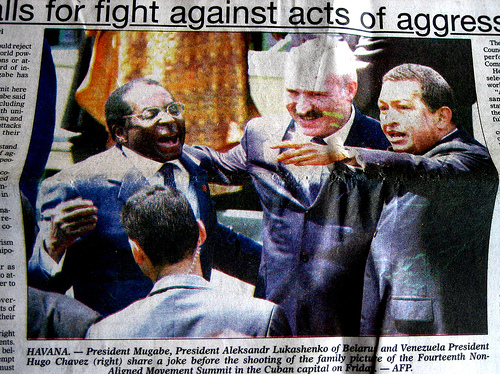
“Detail from the Sunday Mail in Zimbabwe - Mugabe, Lukashenko and Chavez share a laugh at the summit of non-aligned nations.”
Via Ethan Zukerman
Highly recommended – The Ludicrous Nature of Politics from Russell Roberts
Related
Demonization at the UN
President blasts ‘stupid democracy’ (Zimbabwe)
Stopping the dictator- a game from an Egyptian blogger
Maldives
The President addresses UN General Assembly in Dhivehi
This is how the Mr. Gayoom was welcomed in the country
September 22, 2006
FasTracKids in China
By Paul

Chinese society is truly changing;
“Gao Ruxi of Shanghai Jiao Tong University conducted research in 2003 that showed that 15.4 percent of the city’s 17 million people — about 2.6 million — were rich enough to own a house and a vehicle.Another report, from a Chinese research group called Horizon, estimated that in 2003 there were 569,000 families or individuals in Shanghai with liquid assets of at least $62,500.
FasTracKids, which started in Shanghai in 2004, has since opened two more outlets here and another in Guangzhou, and it is planning a fifth in Hangzhou.
The private program’s after-school sessions are held in brightly decorated classrooms, where fewer than a dozen children, typically 4 or 5 years old, are taught by as many as three teachers. The program emphasizes scientific learning, problem solving and, most attractively for many parents, assertiveness.
“Parents like myself are worrying about China becoming a steadily more competitive society,” said Zhong Yu, 36, a manufacturing supervisor whose wife is a senior accountant with an international firm and whose son 7-year-old son has been enrolled in the junior M.B.A. classes. “Every day we see stories in the newspapers about graduates unable to find good jobs. Education in China is already good in the core subjects, but I want my son to have more creative thinking, because basic knowledge isn’t sufficient anymore.” ….
“Americans respect people who came from nothing and made something of themselves, and they also respect rich people,” Mr. Wang added. “In China, people generally don’t respect rich people, because there is a strong feeling that they are lacking in ethics. These new rich not only want money, they want people to respect them in the future.”
Indeed, some of the newly well-to-do have broadened their quest for respectability, enlisting their children in charity activities at the same time as they push them into classes aimed at getting them ahead.Shan Lei, 31, a homemaker and former investment specialist whose husband is a shipping executive, said the family had invested $100,000 in a golf-club membership and had introduced her daughter to the sport, along with piano and skating lessons. They also manage to squeeze in charity work with AIDS orphans.
“Golf is played by the upper classes, but I want her to recognize there is social diversity,” said Ms. Lei, who is not related to Rose Lei. “I want her to care for others in the society.”...

Phantoms in the Brain
By Paul
An interesting study- Brain electrodes conjure up ghostly visions;
“Simple stimulation of the brain can cause the mind to play complex and creepy tricks on itself, neurologists have discovered. They found that, by inserting electrodes into a specific part of the brain, they could induce a patient to sense that an illusory 'shadow person' was lurking behind her and mimicking her movements.
Doctors treating the patient, a 22-year-old woman with epilepsy, found that when they stimulated a brain region called the left temporoparietal junction, the patient sensed the presence of a sinister figure behind her who copied her actions. They suspect that the effect is due to the mind projecting its own movements onto a phantom figure conjured up by the brain, an effect that is seen in some patients with serious psychiatric conditions….”
Via Mind Hacks
Related;
Mind Games; What neuroeconomics tells us about money and the brain.
Multimedia;
In the Family - A Journey through Madness
The Dancing Mind
Death; An exploration of the cultural construction of death: the way it's changed in English-based society from rich Victorian ceremony to the simple ritual of today; the difference in response from culture to culture, i.e. Mexico, Ireland and Australia.
The dream debate
Chris Turney on Time, author of Bones, Rocks and Stars: The Science of When Things Happened
Martin Feldstein on time consistency in fiscal policy
By Paul
“When I look at the current fiscal situation, in contrast to what we experienced in the '80s when the fiscal deficits were larger and rising, and debt-to-GDP ratios were rising, we're currently at a relatively comfortable level. The federal deficit-to-GDP ratio this year will be under 3 percent, probably low enough that the debt-to-GDP ratio will actually come down.
The problems are not that very far into the future, though, with increases in Social Security and Medicare costs relative to the tax revenue that comes in. The markets seem to be ignoring that, which is a puzzle, but there's nothing about long-term interest rates that suggests that the markets are afraid that Social Security and Medicare are really going to create large fiscal deficits. Now maybe they're right. And maybe the political process will raise taxes or cut benefits. What has to be done is to reform those programs. I wouldn't set my goal in terms of the fiscal deficit. I'd set it in terms of limiting the tax levels that are going to be needed to support them.”
- Interview with Martin S. Feldstein- latest Region magazine
The Region also has review of Martin Wolf’s Why Globalisation Works
See also this book review-Development's Discontents
Related;
The Nation's Long-Term Fiscal Outlook: September 2006 Update
Budgetblog
A Visual Representation of the US Federal Budget
Maldives to set up Bollywood Studio
By Paul

“The government plans to open the country’s first professional film studio, officials have announced.
The studio will be located in one of the new resorts currently being constructed in the country. The government hopes the studio will attract the Bollywood film industry to shoot more of their motion pictures in the Maldives.
“We will devote a resort island to the studios so that film units can use it as a single stop for their work. That will spread the good word about Maldives,” said Hussain Shihab, Minister of State for Arts..”
From Minivan News.
Recent economic news;
Opposition Criticises New Tourism Tax
Board of directors sell STO tea plantation
Podcasts –Heavy Weight Economics
By Paul
 Steven Levitt and Malcolm Gladwell at TED
Economics of Paternalism- Edward Gleaser (at Econ Talk)
John Quiggin at Business Matters
The greatest gift
Donating your body, or the body of a child, to medical research is a great gift to mankind. Most of you can be recycled: your eyes, your skin, your bone or even a little piece of your heart. Now they want to grind your bones for surgical putty. Then, your dead bits will be helping a biotech company's bottomline too. Can altruism and commerce live side-by-side when it comes to giving "the greatest gift of all"?
Dr. Diane Coyle discusses with James Reese several of her books and her recent research on mobile phones in Africa. Books include Paradoxes of Prosperity, The Weightless World and her bestseller Sex, Drugs and Economics. The Soulful Science will be published by Princeton University Press in spring 2007. Listen to the podcast.
See also her book recommendations
Perspectives on Thailand coup
By Paul

The Economist worries;
“But the bigger danger lies farther south. Indonesia and Thailand were partners in the democratic experiment of the late 1990s. Thailand's democracy constitution of 1997 preceded by a year the downfall of Suharto. And Thailand's apparent success in taming its soldiers has been a model for Indonesia in transforming a deeply repressive society into one of Asia's most vibrant and open. So far, Indonesia's generals have behaved pretty impeccably, despite the many problems of that vast archipelago. It would be a tragedy if the dangerous events in Thailand gave them other ideas.”
“Mr Thaksin graduated from Class 10 (a sort of fraternity) of the Armed Forces Academies' Preparatory School and went on to become a police colonel, and then a hugely rich businessman, before entering politics. He has continued to foster links with his former Class 10 comrades and, in recent months, has been accused of trying to land them top military jobs. In this he was pitted against the alumni of Class 6, principally General Sonthi and the commanding officers of the navy, air force and national police. All four of these men are members of the junta that has removed Mr Thaksin from office.”
Barry Bosworth, a senior fellow at the Brookings Institution, talks with Bloomberg's Tom Keene from Washington about the characteristics of Thailand's economy, the outlook for economies in Southeast Asia and trade relations between the U.S. and Asia. Listen to the podcast.
'More tank festival than coup'
From Harry Clarke;
"On a nostalgic note, I was living in Bangkok when the 1985 coup happened and was most surprised at how unruffled the local population were by it. My housemaid just laughed when I expressed my concern. ‘Oh Mister, This always happen’. So the next day I got the bus from my home on the Superhighway out to my workplace about 40 km north of the city. We got stopped by army officers holding automatic weapons somewhere around the airport. When the officers got on the bus the young Thai girls on the bus giggled at the soldiers loudly. I remember being petrified with fear but the soldiers just got off the bus and we were on our way – the girls still giggling and me remaining very, very quiet. Later I was told that the giggling was an Asian way of handling a tense situation – maybe."
Book recommendations from Hugo Chavez
By Paul
“During his two-hour rant on Bush's satanic identity, the communist leader took time to plug Noam Chomsky's "Hegemony or Survival: America's Quest for Global Domination" recommending that all Americans read it, and it looks like they might. Despite his supposed hatred of capitalism, Chavez's impassioned endorsement has jolted sales of the linguist's 2003 book from relative obscurity to Amazon's top 5 in less than 36 hours.”
Via OFF/beat
Related;
Watch the YouTube of the comment
Bush's Use of 'Evil' Comes Home to Roost
Simon Bolivar: The Liberator
“Hugo Chavez describes himself as a 'Bolivarian Revolutionary' and has renamed his country, 'The Bolivarian Republic of Venezuela'. But who was Simon Bolivar, and would he approve of the uses contemporary politicians in Latin America are putting him to?”- (discussion starts at the end of the podcast)
September 21, 2006
Best Lie I've Read Today
By Kevin
 Via Fark:
[Wal-Mart executive vice president Bill Simon] said Wal-Mart is working with drugmakers to help them be more efficient, but added, "We are working with them as partners. We are not pressuring them to reduce prices."
I understand people actually like generic drug producers, so WM doesn't want to look like it's punishing them, but why work with generic producers to reduce cost unless you also want to reduce prices?
See also: Marketplace
Iranian Economy
By Paul
 All’s not well with the Iranian economy;
“But not all the developments since 2003 have strengthened Iran. Despite the oil price bonanza, Iran's economy is in poor shape. With roughly the same population, its GDP is half that of Turkey. Even the official unemployment figures have risen to 12.4 percent (a massive understatement) under Ahmadinejad and what few jobs have been created are in the public sector. The Tehran stock market lost 25 percent of its value last year and another 12 percent so far this year.
In June, 50 of the country's leading economists wrote an open letter saying that Ahmadinejad's economic policies lacked "expertise and scientific basis." Inflation is officially running at 12 percent, but most economists reckon it to be close to double that level. There are credible reports of large-scale capital flight to Dubai and elsewhere, fueled by Ahmadinejad's fatuous decree to state and private banks to cut their interest rates, whose main impact has been to dry up bank lending.”
Related:
United States, Iran Trade Barbs at UN
The George and Mahmoud show
Iranian minister urges World Bank to back nuclear energy investment
Iranian Economy- Crony Capitalism in Islamist Garb
Recent publications from IMF
Inside Iran
Iran in Maps
Thomas Schelling on the Iran nuclear issue;
“I don’t think the U.S. has a convincing argument against this Iranian charge of nuclear apartheid — especially since we’ve been allies of Israel for many decades knowing they have nuclear weapons. Although, the Iranians should recognize clearly the limits on Israel — even when it had the perfect target for tactical nuclear weapons of Egyptian troops as sitting ducks out in the Sinai desert in 1973, Golda Meir didn’t use them.I don’t know if there is any way to stop the Iranians from acquiring nuclear weapons. If they do, we should try to persuade them to declare — as the Indians and Pakistanis have done — that they are for deterrence and defense, not for offensive use.
Further, we should assist the Iranians in making sure custody of their weapons are secure in any time of disruption. In the case of a riot in the streets, will the weapons be safe? Who might grab them in case of civil war?
It is important for the Iranians to understand — and have access to — technology like we have in the U.S. that disables bombs if they get into the wrong hands. U.S. weapons, for example, have “permissive action links”— a radio signal code that arms weapons but that will also automatically disarm them it if launched at an unauthorized target.
This will be a big dilemma for the U.S. If the Iranians get weapons, will we be willing to share the technology to ensure the security of their use? That is where the debate is heading.”
Should the State have a monopoly over security and violence?
By Paul
 In the capital of Maldives, Male’, citizens have been making arrests of criminals;
“A group of civilians from the area where Maaveyo Magu and Buruzu Magu intersect have recently formed a group, and have gone out searching for drug offenders and turning them over to the Police along with the evidence they find. A member of this group has said that they had so far handed over at least 20 drug offenders to the Police.”
In other news;
“A new non-violent democracy group, calling itself Gaumataka, marked Evan Naseem Day on Tuesday by delivering flowers to the police and representatives of the government.The human rights activists delivered white lilies and roses to the police headquarters in Male’, the Maldivian High Commission in London and to the head office of President Gayoom’s public relations company, Hill & Knowlton.
Gaumataka said the flowers were “delivered as a symbol to urge the police to stop all brutality and to join hands with the people to bring about a just and democratic Maldives.”…
Tim Fallon of Hill & Knowlton, President Gayoom’s London-based spin-doctor, was less enthusiastic to discuss torture and human rights abuses, however.
“We went into the Hill & Knowlton office and asked if we could see Tim Fallon to present him with the flowers. The flowers are in memory of those people that Fallon’s client has murdered, tortured and abused over the past 28 years. However, Fallon would not meet us. First we were told that he was not in the building, then we were told he is “too busy” to see us,” said Sara Mahir.
Pocket Guide to Asian Think Tanks
By Paul
From Asian Development Bank Institute;
“This is a handy guide to the leading Asia-Pacific think tanks working on development and economics. Each entry
- provides web links to the think tank and its research staff,
- describes the current research program,
- lists if visiting researcher or internship programs are offered, and
- states whether online publications are freely available."
Related; Think Tanks and Policy Advice in Countries in Transition
Trying hard to be a darling of IMF/World Bank
By Paul
News from Sri Lanka;
“Sri Lanka said Tuesday it was moving towards eliminating oil subsidies that are threatening to blow a hole in the nation’s budget and asked lenders for financial help to tide over oil shocks.Public Administration minister Sarath Amunugama said the government “has responded appropriately to the sustained sharp rise in oil prices,” by adjusting domestic prices and moving towards oil futures to hedge future risks.
“Oil subsidies, which had been an enormous burden on the budget, have been eliminated,” he told delegates during the IMF World Bank annual meetings here.
Sri Lanka consumes around 30 million barrels of oil a year, buying 2.2 million metric tones oil light crude from Iran, Saudi Arabia and Malaysia.
The country’s oil bill is expected to climb to about 2.0 billion dollars this year, up from 1.6 billion dollars in 2005, due to surging global fuel prices.
“We reiterate our call for the creation of a special medium term oil facility to assist countries that have been adversely affected by the sharp increases in oil prices,” he said in an appeal to some of the world’s biggest financial backers…”
Related;
World Bank hates Philippines
Sri Lanka to lead South Asian initiative to study impact of oil prices
The boom in bank deposits (India)
Port Infrastructure, High Costs Seen Hampering India's Progress
South Asia conference to address sanitation
Weathering the Storm So Far: The Impact of the 2003-05 Oil Shock on Low-Income Countries
September 20, 2006
Events, Interviews, Discussions- Making Globalization Work
By Paul
Making Globalization Work; Lee C. Bollinger, Tina Rosenberg, Nancy Birdsall, George Soros, and Joseph E. Stiglitz discuss solutions for some of the world's most pressing problems, such as debt, unfair trade, the "resource curse", the need to curb harmful emissions and world poverty at Columbia University.
Clinton Global Initiative 2006
IMF-World Bank Program of Seminars at annual meeting –Singapore (not yet online)
New Foundations of Cost-Benefit Analysis (not yet online)
How Nations Prosper: Economic Freedom and Doing Business in 2007 (tomorrow)
James Galbraith, an economist at the University of Texas, talks on the outlook for the U.S. economy (podcast)
Related;
Discussions about the IMF-World Bank annual meetings issues at PSD Blog;
Private sector public goods
Business takes on the poverty penalty
Can the World Bank fight corruption?
Economists debate financial sector in India and China
Reforming collateral laws
Roubini has a couple of posts on the IMF-World Bank annual meeting
FT special coverage of Clinton Summit
The latest Foreign Exchange show;
“The World Bank and the IMF are getting together for their annual meeting in Singapore. This year it's not just talk of exchange rates and balance of payments - the United States is pushing hard to give greater weight to Asian and other emerging market economies. To help us understand the dynamics at play, we're joined by Zanny Minton-Beddoes, Washington Economics Editor from The Economist.”
Science Podcasts
By Paul
A Brief History of Infinity: Space and the Universe
A Brief History of Infinity: Mathematics
The Communications Revolution;
The global effects of communication
Technology in life of people with disabilities
Communications Technology and Influence
Communications Technology and Communities
Harry Messel's life in science;This week is the 50th anniversary of SILLIAC, the first automatic computer to be built in an Australian university and tonight's guest is the man who made it happen. In his 35-year career as head of the School of Physics at Sydney University, Harry Messel taught thousands of students and used his entrepreneurial skills to raise vast funds to support scientific research. Now in his 80s, he's lost none of his enthusiasm and interest in the world of science
Jess Adkins has a lab full of cucumbers made of stone. They are, in fact, drill cores of corals from all over the world. He analyses these with surprising results, getting a remarkably accurate story of past climates going back thousands of years. This young professor from Caltech (the California Institute of Technology) has some amazing stories to tell of adventure and exploration
Why watch birds?;Author and birdy Sue Taylor from Melbourne has written a book called 'Why watch birds?', a beginner's guide to bird watching.
Top 100 Music Videos on YouTube
By Paul
Compliments of Stylus magazine-“With that in mind, we here at Stylus have democratically selected our humble and largely unofficial picks for the 100 best videos ever made, and are presenting them here, fully equipped with YouTube links for your viewing pleasure”
Via Pienso
Angry Arab on Thailand coup
By Paul

“There was a coup in Thailand. I am jealous. Very jealous. When was the last time we had a coup in the Arab world? Wait. We had one in Mauritania and it was pretty lousy. Never mind. Just day dreaming.”
IMF Statement on the Thai coup;
"We are following the situation closely. Thailand's economy is fundamentally strong and financial market reactions have been limited. Regional financial markets have also been little affected thus far."On the whole, Asian economies are resilient to external shocks, having strengthened their macroeconomic frameworks, increased exchange rate flexibility, and reduced external vulnerabilities in recent years."
Related;
Thailand in crisis
Like Old Times in Bangkok
Thai coup leader unveils PM plans
Thai king 'endorses coup leader'
Q&A: Thailand's coup impact
Multimedia
Postcard: Thailand Coup (podcast)
Politics of economic reform in Thailand- Tarrin Nimmanahaeminda, Chairman of Siam Pithiwat and former Thai Minister of Finance
Photo of the Day- Aurora Borealis
By Paul

“In 1620, a Frenchman, Pierre Gassendi, saw the northern lights and named them after the Roman goddess, Aurora. He also added the word 'borealis' for the Roman god of the north wind, Boreas. From that point onwards the lights became known to scientists as the aurora borealis.
Aurora was a Roman deity, counterpart of the Greek mythological Titan goddess of the dawn Eos. Eos would rise from her home at the edge of Oceanus, the sea that surrounded the world, to open the gates for her brother Helios to ride his chariot across the sky each day. Aurora's sister was Selene, the moon. and she had many husbands and one of her sons was Boreas, the north wind. The literal translation of Aurora Borealis is therefore "Dawn of the North wind."
From the website of photographer.
See more pictures at Photographer of the Year 2006 -BBC
See also NYT has a nice collection of photos from Ethiopia’s Christian heritage.
Belgian court fines Google
By Paul
“Google has been told by a Belgian court that its news service is in breach of the copyright of a group of local newspapers, in a surprise ruling that goes against existing global practice. The verdict meant that Google was forced to remove links to articles in French-language newspapers in Belgium over the weekend to avoid a €1 million (£675,000) daily fine.The court decided that the way in which Google News operates “causes the publishers of the daily press to lose control of their websites and their contents”. However, Google said that it intended to appeal against what it described as “flawed” decision that would force it to close its news service if it was repeated elsewhere. It said that the Belgian legal action caught it unawares…”
Via AEI-Brookings’ Daily Reg-Report
Related;
Here is the actual ruling
Google's Belgium Fight: Show Me The Money, Not The Opt-Out, Say Publishers
Google could face Brazil lawsuit
Bipolar Disorder Guide
By Paul
 BBC has published a guide on bipolar disorder;
“It takes a detailed look at the symptoms and diagnosis of bipolar disorder, medical treatments and how to self-manage the condition successfully.”
Related:
A Psychiatrist Is Slain, and a Sad Debate Deepens
Psychiatrist Is Among Five Chosen for Medical Award
Multimedia
The Secret Life of the Manic Depressive
In the Family - A Journey through Madness
“This week, a candid family story of life inside. Inside psychiatric hospitals, inside schizophrenia, and inside a remarkable journey towards compassion, activism and understanding. Penelope and Lloyd met and married after years of cycling in and out of Perth's psychiatric institutions. Penelope's 19-year-old daughter, Tynx, reveals a wisdom beyond her years about the impact of growing up with a parent with mental illness. They join Natasha Mitchell in conversation with a story that is sure to move you.” Listen to the podcast.
The dream debate-'The nature of dreams has long fascinated philosophers and of course it lies close to the heart of Freudian psychoanalysis. This week, in the year of Freud's 150th anniversary, we hear a debate on the subject between a psychoanalyst and a professor of psychiatry'
Ageing to Sage-ing;"We now live longer, but it need not be a prolonged denial of the ageing process. Embrace your age, your wisdom, and your elder status and become a mentor to the younger generations. Turn ageing into sage-ing. Reb Zalman Schachter-Shalomi teaches people how to be spiritual elders, not only for their sake but for the sake of the planet. And while Dementia can spell the end of wisdom for many people, for Christine Bryden it was a journey to self understanding and spiritual growth." Listen to the podcast.
How to Make Money – from War
By Paul
The Guardian reports;
“Armor Group International, the security firm that makes most of its profits in Iraq, reported a drop in earnings for the first half of the year because of increased competition for business and the loss of a major training contract in Iraq.The London-based company reported a 30% rise in sales to $134.4m in the six months to June 30. Armor generated more than half of its revenues from business in Iraq - $70.3m - although its non-Iraq business grew by 57%.
However, pre-tax profits slipped to $3.7m from $4.7m for the same period a year ago. Analysts had expected profits to be only 10% lower than last year's.
Armor is chaired by Sir Malcolm Rifkind, the former Conservative foreign and defence secretary. It is one of the UK's leading providers of private security for reconstruction workers in Iraq.
"The group has achieved strong revenue growth over the first half, and we are encouraged by the significant growth outside Iraq," said Dave Seaton, the chief excecutive officer.
The main hit to sales was from the loss of a $7.8m contract with the United States for training staff at the ministry of justice in Iraq, the company told Reuters. "It was a one-off programme funded by the US," Mr Seaton said. "The Iraqi government does not have the funding for its own training needs."
Armor is diversifying and has new or extended contracts providing security at the World Bank headquarters in Kabul, Afghanistan; clearing land mines in southern Sudan, and doing security work for oil and gas companies.”
I wouldn't be worried so much as Failed States in the world seems to be increasing according to this World Bank report.
Related;
World Bank Lists Failing Nations That Can Breed Global Terrorism;
“The number of weak and poorly governed nations that can provide a breeding ground for global terrorism has grown sharply over the past three years, despite increased Western efforts to improve conditions in such states, according to a new World Bank report."Fragile" countries, whose deepening poverty puts them at risk from terrorism, armed conflict and epidemic disease, have jumped to 26 from 17 since the report was last issued in 2003. Five states graduated off the list, but 14 made new appearances, including Nigeria and seven other African countries, Kosovo, Cambodia, East Timor, and the West Bank and Gaza. Twelve states, including Afghanistan, Somalia and Sudan, made both lists.”
September 19, 2006
Hungarians not happy with their leader
By Paul

Hungarian Prime Minister admits he lied during the election campaign in a private conversation- at least he’s honest;
“You cannot mention any significant government measures that we can be proud of, apart from the fact that in the end we managed to get governance out of the shit. Nothing. If we have to give an account to the country of what we have done in four years, what are we going to say? …Divine providence, the abundance of cash in the world economy, and hundreds of tricks, which you do not have to be aware of publicly, have helped us to survive this. This cannot go on. Cannot. And of course we can ponder for a long time, and a shitload of analyses can be carried out as to how each social group will be affected, this is what I can say to you. ….
Even if we work ourselves into the ground. We are doing a great and decent job among ourselves. We must do it. I am not talking about the New Hungary, developments, Hungarians beyond the border, relationship with churches, or another thousand things because these are not the most important things compared to the big picture…I will only repeat this once at most: it is fantastic to be in politics. Fantastic. It is fantastic to run a country. Personally, I have been able to go through the past 18 months because one thing has inspired and fuelled me: to give back its faith to the left, that it can do it and it can win. That the left does not have to lower its head in this bloody country. That it does not have to shit its pants from Viktor Orban [chairman of opposition Fidesz - Hungarian Civic Alliance] or the right, and it should learn to measure itself against the world, rather than them...
I know that this is easy for me to say. I know. Do not keep bringing it up against me. But this is the only reason it is worth doing it. I almost perished because I had to pretend for 18 months that we were governing...Instead, we lied morning, noon and night. I do not want to carry on with this. Either we do it and have the personnel for it, or others will do it. I will never give an interview at the end of which we part with each other in argument. Never. I will never hurt the Hungarian left. Never.”
Related;
Google News coverage
Timeline: Hungary
Does transition make you happy?
Colbert Episode on Hungarian Bridge-hilarious
What is effective aid?
By Paul
A working paper by Charles Kenny, “What is effective aid? How would donors allocate It?”
"Abstract: There are significant weaknesses in some of the traditional justifications for assuming that aid will foster development. This paper looks at what the cross-country aid effectiveness literature and World Bank Operations Evaluation Department reviews have suggested about effective aid, first in terms of promoting income growth, and then for promoting other goals. This review forms the basis for a discussion of recommendations to improve aid effectiveness and a discussion of effective aid allocation. Given the multiple potential objectives for aid, there is no one right answer. However, it appears that there are a number of reforms to aid practices and distribution that might help to deliver a more significant return to aid resources. We should provide aid where institutions are already strong, where they can be strengthened with the help of donor resources, or where they can be bypassed with limited damage to existing institutional capacity. The importance of institutions to aid outcomes, as well as the fungibility of aid flows, suggests that programmatic aid should be expanded in countries with strong institutions, while project aid should be supported based on its ability to transfer knowledge and test new practices and support global public good provision rather than (merely) as a tool of financial resource transfer. The importance of institutions also suggests that we should be cautious in our expectations regarding the results of increased aid flows."
Related;
Aid: Can It Work?
Owen’s posts on aid
Your Guide to Getting an Electric Shock
By Paul
Editor of the Philadelphia Weekly and mental health campaigner Liz Spikol, is you-tubeing about her experiences with mental health. (via Mind Hacks)
The statistics are quite alarming;
“A recent survey estimated that nearly half of all Americans will suffer a mental illness during their lifetimes. Harvard Medical School professor of health policy Ronald Kessler headed the two-year study, which polled 9,000 adults across the country, varying in age, education level, and marital status. Researchers conducted home-based, face-to-face interviews, using the World Health Organization’s (WHO) diagnostic mental-health survey. They found that 29 percent of people experience some form of anxiety disorder, closely followed by impulse-control disorders (25 percent) and mood disorders (20 percent). Most cases begin in adolescence or early adulthood, and often, more than one disorder will strike simultaneously.”
Related;
Two recent podcasts from the Health Report;
Only one in two patients receives the healthcare they should receive according to the evidence. One in ten patients receives care that isn't recommended and which is potentially harmful. In the first part of this series about getting health professionals to practice with evidence, Associate Professor Alex Barratt takes a close look at the catastrophic errors that have occurred when evidence has been ignored, and why evidence based practice is still not being implemented in consultation rooms near you. Listen to the podcast.
In part two of Facing the Evidence patient advocates argue that we all have a role in supporting the change to evidence based health care, so we get the care we need and we don't get treatment that's useless or dangerous. Patient advocates explain how to ask your doctor or health professional for evidence about your proposed treatment.
Ideological Amplification
By Paul
From Cass Sunstein, an interesting study;
“A few years ago, I was involved in some studies that uncovered a funny fact: When Republican-appointed judges sit on three-judge panels with other Republican appointees, they show unusually conservative voting patterns. So too, Democratic-appointed judges on three-judge panels show especially liberal voting patterns when sitting with fellow Democratic appointees. In short, like-minded judges show a pattern if "ideological amplification."The presence of even one Republican appointee often makes Democratic appointees much more moderate. Republican appointees often become much more moderate when even a single Democratic appointee is there.
We now know that ideological amplification is pervasive on federal courts--that it can be found in numerous areas, including sex discrimination, affirmative action, campaign finance law, disability discrimination, environmental law, labor law, and voting rights.
It turns out that ideological amplification occurs in many domains. It helps to explain "political correctness" on college campuses--and within the Bush administration. In a recent study, we find that liberals in Colorado, after talking to one another, move significantly to the left on affirmative action, global warming, and civil unions for same-sex couples. On those same three issues, conservatives, after talking to each other, move significantly to the right.
It's unclear whether anything can be done about ideological amplification. But it's entirely clear that when private organizations and governments blunder, ideological amplification is often the culprit.”
Related;
Watch his book presentation at AEI-Brookings; Infotopia: How Many Minds Produce Knowledge
Deliberation and Infotopia
Ideological amplification
Religion in America
By Paul

“God told me to strike at al Qaida and I struck them, and then he instructed me to strike at Saddam, which I did, and now I am determined to solve the problem in the Middle East.”
- President Bush according Palestinian President Mahmoud Abbas
“Education on world religions for all our children, in public and private schools, and home schooling.”
-Daniel C. Dennett’s policy proposal (see TED speech below)
The Economist reviews a recent survey of religious attitudes in US;
“WHEN Homer Simpson opted out of church once, staying home to watch football and eat waffle-batter, he dreamed that God peeled off the roof of his house and appeared, furious, in the TV room. According to a new survey, 31% of Americans see God that way. He (always he) is wrathful and ever-watchful; He wants his followers to stop sinning, and thinks government should be promoting Him. In the South, 44% of people go in fear of His lightning bolts.The survey, by Baylor University's Institute for Studies of Religion in Waco, Texas, via Gallup, found four broad views of God in America. Homer's Authoritarian God is the most popular. There then follow, in descending order of intrusiveness, Benevolent God (23%, rising to 29% in the Midwest), who still gives orders but will forgive, rather than smite; Critical God (16%, but 21% in the relativist East), who watches the world but does not intervene; and lastly Distant God (24%), a cosmic force without interest in human matters. This God is especially popular in the wide open West, with its huge views of the stars…”
Related;
Jesus Camp
ABC news report on the documentary
The Anti-Christ Part 1, Part 2, Part 3, Part 4 (History Channel)
See also Rick Warren speech and Daniel Dennet’s response
Podcasts from Center of Inquiry
Death Threats and Game Theory
By Paul
South Asia correspondent to UK Telegraph writes in his blog about a recent incident involving a death threat to Maldivian dissident in UK;
“British police traced the foul-mouthed email to an address belonging to Husna Latheef, who is the wife of the Maldives Chief of Police, Adam Zahir. Mrs Latheef copped the caution but Mr Moosa (and I’ve no idea if he’s right or not) is convinced Mr Zahir is behind the threat.The text of the threat is worth repeating for those who missed it, simply because it is so Neanderthal and unpleasant and tells you a fair bit about the people who run the Maldives once they are out of the clutches of their slick UK PR agency, Hill and Knowlton, whose top man once span for Tony Blair.
Try spinning this: “if i ever see u, i will f***ing kill you, you better watch ur f***ing back, id like to see you try and reply back to me u dumb motherf***er. who the f*** do u thnk [sic] you are. i know where u live so u better not go far from ur house in london cos i will f***ing shoot u.”…
Read the rest of the post for his speculation on the strategic reasons for British government sponsoring talks between the government and the opposition in the Maldives and using a bit of game theory he suggests;
“If Gayoom’s regime reads the Brit moves the same way Indian intelligence apparently does, and the Brits are seen to have an ulterior motive, then they might find Gayoom digs his toes in and the whole plan backfires.”
Related;
Zahir's Wife Received UK Police Caution
UK police warn wife of Maldives policeman over threat
Adam Zahir Cautioned By British Police
“The British police were able to act on the email because it was sent from a ‘blueyonder’ account, which was traced to Zahir’s London property. The email account was registered in Adam Zahir's wife's name, Husna Latheef.”
British Government Calls For Peaceful Evan Naseem Day
September 18, 2006
Nest - $80,000 to 90,000
By Paul

The Economist runs an article on the booming Indian art market;
“IT IS not just Indian software and “business-process outsourcing” firms that are benefiting from the rise of the internet. Indian modern art is also on an upward spiral, driven by the aspirations of newly rich Indians, especially those living abroad, who use the internet to spot paintings and track prices at hundreds of gallery and auction websites. Prices have risen around 20-fold since 2000, particularly for prized names such as Tyeb Mehta and F.N. Souza.There would have been “no chance” of that happening so fast without the internet, says Arun Vadehra, who runs a gallery in Delhi and is an adviser to Christie's, an international auction house. He expects worldwide sales of Indian art, worth $200m last year, to double in 2006. It is still a tiny fraction of the $30 billion global art market, but is sizeable for an emerging market.
For newly rich—often very rich—non-resident Indians, expensive art is a badge of success in a foreign land. “Who you are, and what you have, are on your walls,” says Lavesh Jagasia, an art dealer in Mumbai. Indian art may also beat other forms of investment. A painting by Mr Mehta that fetched $1.58m last September would have gone for little more than $100,000 just four years ago. And a $22m art-investment fund launched in July by Osian's, a big Indian auction house, has grown by 4.1% in its first two months.
Scant attention was paid to modern Indian art until the end of the 1990s. Then wealthy Indians, particularly those living abroad, began to take an interest. Dinesh Vazirani, who runs Saffronart, a leading Indian auction site, says 60% of his sales go to buyers overseas.
The focus now is on six auctions this month. Two took place in India last week; work by younger artists such as Surendran Nair and Shibu Natesan beat estimates by more than 70%. Sotheby's and Christie's have auctions in New York next week, each with a Tyeb Mehta that is expected to fetch more than $1m. The real question is the fate of other works, including some by Mr Souza with estimates of up to $600,000. If they do well, it will demonstrate that there is strong demand and will pull up prices across the board. This looks like a market with a long way to run.”
* Above drawing by Anju Dodiya

Related;
Sepia Mutiny- art posts
Marginal Revolution- art posts
Indian painter agrees $21m deal
Wonders of Sikh Spirituality Come Alive
Donald Pittenger on Illustration
Donald Pittenger on Flair in Art, Part One
Donald Pittenger on Flair, Part 2
In the Land of Beautiful People, an Artist Without a Face
Banksy shop-drops 500 remixed Paris Hilton CDs
Un-Atlantic Economic History from Brad de Long
By Paul
Brad de Long is running a list of useful economic history books which are not biased towards North America;
Fernand Braudel, The Structure of Everyday Life (Civilization and Capitalism: 15th-18th Century)
Janet Abu-Lughod, Before European Hegemony: The World System A.D. 1250-1350
K.N. Chaudhuri, Trade and Civilisation in the Indian Ocean: An Economic History from the Rise of Islam to 1750
Tirthankar Roy, The Economic History of India 1857-1947
Some books commentators added;
Brook, Timothy. (1998) The Confusions of Pleasure: Commerce and Culture in Ming China. Berkeley: University of California Press.
Ian Brown, "Economic Change in South-East Asia, c.1830-1980." (1997, Kuala Lumpur: Oxford UP)
Reid, Anthony ed. Slavery, Bondage and Dependency in Southeast Asia. 1983.
Adas, Michael. The Burma Delta: Economic Development and Social Change on an Asian Rice. Frontier, 1852-1941. Madison: University of Wisconsin Press. 1974. .
The Eastern Origins of Western Civilisation By John M. Hobson
The Great Divergence: China, Europe, and the Making of the Modern World Economy
By Kenneth Pomeranz
China Transformed: Historical Change and the Limits of European Experience By Roy Bin Wong
Nils Jacobsen 'Mirages of Transition: the Peruvian Altiplano 1780-1940' (Berkeley: University of California Press)
Anand Yang's _Bazaar India: Markets, Society, and the Colonial State in Gangetic Bihar._ (Berkeley, Los Angeles, London: University of California Press, 1998; New Delhi:
Victor Lieberman (2003) Strange Parallels: Southeast Asia in Global Context, c. 800-1830,
Abu-Lughod, Janet L., editor Sociology for the Twenty-first Century: Continuities and Cutting Edges
The Human Web: A Bird's-Eye View of World History
T'Ang China: The Rise of the East in World Historyby Samuel Adrian M. Adshead
An Ottoman Tragedy: History and Historiography at Play
By Gabriel Piterberg
See also;
Why China Stagnated -- Economic History As Lesson
Why Europe and the West? Why Not China?
The World's First Corporations
History of the World in Seven Minutes
Blogs- Book Pundit, Civilisation Pundit,
World Economic Outlook- podcasts
By Paul

Saul Estrin, professor of management and head of the department of management at the London School of Economics and Political Science, talks with Bloomberg's Tom Keene from London about the study of economics and its impact on managers, the outlook for emerging-market economies, and the differences in productivity and lifestyles between the U.S. and Europe. Listen to the podcast.
Lord Meghnad Desai, a professor of economics at the London School of Economics, talks with Bloomberg's Tom Keene in London about the outlook for the Group of Seven nations, the impact of globalization on the world's economy and U.S. foreign policy in the Middle East. Listen to the podcast
A discussion with Pam Woodall, Asian Economics Editor of The Economist;“World growth, world inflation, world interest rates, wages, profits, oil prices and even house prices are all now being influenced by China, India and other developing economies”
World Economic Outlook press conference -webcast
or read the transcript of a Press Conference on the World Economic Outlook Report (Singapore, September 14, 2006)
Karl P. Sauvant discusses with James Reese "World Investment Prospects to 2010: Boom or Backlash?" a joint report from the Economist Intelligence Unit and the Columbia Program on International Investment
Can the IMF Avert a Global Meltdown?- Keneth Rogoff
See also Economonitor blog. Also Nouriel Roubini's Blog- has a couple of recent posts on the IMF annual meetings in Singapore
More readings on the world economic outlook
Google Special- Banned Books
By Paul
Explore Banned Books with Google.
Related;
Banned Books Week
Google Scholarships
Google goes Bollywood
Google's For-Profit Philanthropy
Philanthropy Google’s Way: Not the Usual
Ancient Prejudices?
By Paul
Karen Armstrong weighs in on the Pope controversy;
“In the 12th century, Peter the Venerable, Abbot of Cluny, initiated a dialogue with the Islamic world. "I approach you not with arms, but with words," he wrote to the Muslims whom he imagined reading his book, "not with force, but with reason, not with hatred, but with love." Yet his treatise was entitled Summary of the Whole Heresy of the Diabolical Sect of the Saracens and segued repeatedly into spluttering intransigence. Words failed Peter when he contemplated the "bestial cruelty" of Islam, which, he claimed, had established itself by the sword. Was Muhammad a true prophet? "I shall be worse than a donkey if I agree," he expostulated, "worse than cattle if I assent!"Peter was writing at the time of the Crusades. Even when Christians were trying to be fair, their entrenched loathing of Islam made it impossible for them to approach it objectively. For Peter, Islam was so self-evidently evil that it did not seem to occur to him that the Muslims he approached with such "love" might be offended by his remarks. This medieval cast of mind is still alive and well.
Last week, Pope Benedict XVI quoted, without qualification and with apparent approval, the words of the 14th-century Byzantine emperor Manuel II: "Show me just what Muhammad brought that was new, and there you will find things only evil and inhuman, such as his command to spread by the sword the faith he preached." The Vatican seemed bemused by the Muslim outrage occasioned by the Pope's words, claiming that the Holy Father had simply intended "to cultivate an attitude of respect and dialogue toward the other religions and cultures, and obviously also towards Islam".
But the Pope's good intentions seem far from obvious. Hatred of Islam is so ubiquitous and so deeply rooted in western culture that it brings together people who are usually at daggers drawn. Neither the Danish cartoonists, who published the offensive caricatures of the Prophet Muhammad last February, nor the Christian fundamentalists who have called him a paedophile and a terrorist, would ordinarily make common cause with the Pope; yet on the subject of Islam they are in full agreement.
Our Islamophobia dates back to the time of the Crusades, and is entwined with our chronic anti-semitism. Some of the first Crusaders began their journey to the Holy Land by massacring the Jewish communities along the Rhine valley; the Crusaders ended their campaign in 1099 by slaughtering some 30,000 Muslims and Jews in Jerusalem. It is always difficult to forgive people we know we have wronged. Thenceforth Jews and Muslims became the shadow-self of Christendom, the mirror image of everything that we hoped we were not - or feared that we were…."
Related;
Pope apology fails to end anger
Al-Qaida in Iraq warns Pope
Political error or calculated move?
Pope: Manuel II's Views of Muhammad are not My Own
The History of the Decline and Fall of the Roman Empire
Medieval Sourcebook
Doing Business in Iraq
By Paul
A US website maintains an FAQ on doing business in Iraq (last updated 18 May 2005). Some questions and answers below;
“How can a small business pursue business opportunities in Iraq? Prime contractors of the first round of contracts issued under the $18.4 billion U.S. reconstruction funds are required by their contracts to allocate 10 percent and are encouraged through incentives to fulfill 23 percent of a contract to U.S. small, disadvantaged, or minority businesses. Small businesses interested in pursuing business opportunities in Iraq should demonstrate relevant experience, financial capability, capacity to proceed quickly and the aptitude to navigate a complex business environment, in addition to meeting specific contract criteria. The best way to ensure consideration as subcontractors or suppliers on reconstruction contracts is to directly contact the contractors, who are entirely responsible for choosing their own business partners. A listing of prime contractors’ representatives responsible for small business/subcontractor business development is available at http://www.export.gov/iraq/pdf/small_business_reps.pdf (PDF only). Businesses are encouraged to first consult the websites of these prime contractors because most require businesses to register on their websites. For Iraqi Ministries, private sector, and other business opportunities, businesses should monitor Iraqi newspapers www.onlinenewspapers.com/iraq.htm.
Are Iraqi banks participating in commercial transactions? On October 28, 2003, the Central Bank of Iraq authorized Iraq’s private banks to process international payments, remittances and foreign currency letters of credit. All Iraqi private banks participate in the daily currency auctions in U.S. Dollars and Iraqi Dinars conducted by the Central Bank of Iraq. A list of private and public Iraqi banks can be found on The Central Bank of Iraq’s website at: http://www.cbiraq.org/cbs4.htm. The National Bank of Kuwait, the Arab Banking Corporation, HSBC and Standard Chartered Bank have been licensed to commence banking operations in Iraq. Export & Finance Bank of Jordan is acquiring a minority share of the National Bank of Iraq. All these banks will be capable of wiring money into Iraq in the near future. Wiring money to Iraq can be done with any international bank with a correspondent relationship with an Iraqi bank. One bank, the Credit Bank of Iraq has opened an account with National Bank of Kuwait in New York City. Thus, funds can be transferred to Iraq by wiring funds to the Credit Bank's account in New York City. The Credit Bank will receive confirmation of the deposit and can immediately credit an account in Baghdad. Using this method, a prime contractor can wire funds to the Credit Bank of Iraq’s New York City account, upon confirmation the deposit will be credited to its account in Baghdad. In turn, the prime contract can deposit these funds into an Iraqi subcontractor’s account at the Credit Bank of Iraq where the subcontractor can then draw down its funds as required. Iraq’s creditors preclude banks, Rafidain and Rasheed, from international transactions because their offshore assets are subject to attachment.”
Related;
The Unique Situation of the Iraqi Dinar
A backgrounder on the Iraqi dinar, including details on why the Iraqi dinar is positioned for a huge rise in value.
Doing Business Iraq- World Bank
Iraq Business Related Laws
Civil war or not, Iraq's economy faces vast challenge
Jordan expected to sign free trade agreement with Iraq
Iraq's economy is weaker than at any point since the US invasion in 2003
“Rumsfeld’s fake news flop in Iraq”
Some have dictatorship thrust upon them
Documentary slams corporate profits in Iraq war- ‘Iraq for Sale’
September 17, 2006
Podcasts of the Day
By Paul
Radical Islam in Pakistan; For years there has been debate over Pakistan's role in international terrorism. What is the link between Islamic extremism and Pakistan and when and how did it emerge? Guests include Hussain Haqqani, Associate Professor of International Relations, Boston University, Samina Yasmeen, Senior Lecturer in Political Science and International Relations,University of Western Australia and Ahmed Rashid, Correspondent with The Far Eastern Economic Review
Islam in the Renaissance; Between the 15th and 16th centuries, the European Renaissance generated scientific breakthroughs including the discovery by Copernicus that the Earth revolves around the Sun. The progress in scientific thought has been attributed in part to the translation of Arabic texts into Latin. However, Professor George Saliba argues that crucial information was contained in texts that were not translated, so how did Copernicus know about them? Guest on the show George Saliba, Professor of Arabic and Islamic Science at Columbia University in New York.
The history of scientific discoveries
Peace by Artful Means
In societies fractured by violence, family conflict and global threats of terrorism, how do we encounter 'the other' in ways which build sustainable peace? From the growing practice of mediation to the global art of hip hop, this Encounter explores the role of creativity in transforming conflict
Regaining confidence in western culture
All the podcasts from Radio National’s shows.
Deepak Lal on the World Bank
By Paul
 “The major benefit the developing countries derive from the operations of a number of the multilateral aid institutions, such as the World Bank, is the technical assistance built into the process of transferring the aid money to the recipient countries. Though often sound on general economic grounds, their advice is nevertheless resented for political or emotional reasons. In many instances it would not even have been heard, let alone acted upon, had these institutions been unable to provide the recipient governments with a sweetener in the form of financial resources on more favourable terms than were on offer in commercial financial markets. The grant element in the capital transfers classified as official development assistance seems a derisory sum to pay for the opportunity to carry on this form of international dialogue with those responsible for the design and execution of public policies in the Third World. When heeded, the advice has done some good, at the very least in changing the perceptions of bureaucrats and politicians; in some instances it may have had an appreciable effect in making public policies more economically rational.”
-The Poverty of Development Economics, by Deepak Lal, p.108, (the book is online at Institute of Economic Affairs)
Via Catallaxy
Related;
Reviews of some of Lal’s books- at Stumbling and Mumbling, and at Social Affairs Unit
Culture, Democracy, and Development
Multimedia
A Classical Liberal Defends Globalization- interview with Lal
Two Views on Global Development: Revive the Invisible Hand or Strengthen a "Society of States"?- Featuring Deepak Lal, University of California at Los Angeles, Author, Reviving the Invisible Hand: The Case for Classical Liberalism in the Twenty-first Century (Princeton University Press, 2006), and Ethan Kapstein, Center for Global Development, Author, Economic Justice in an Unfair World: Toward a Level Playing Field (Princeton University Press, 2006).
The current era of globalization is only a partial return to a liberal economic order. Renowned development economist Deepak Lal will explain why minimal government intervention, free trade, free capital flows, and the abolition of international organizations such as the World Bank offer the best path for growth and healthy international relations. In his view, attempts to ameliorate the impact of the market threaten global economic progress and stability. Ethan Kapstein believes that countries will shape their own destinies only in an international system that emphasizes the central role of states and the diverse social contracts they represent. Can these two views be reconciled?
Reinventing Indian Tourism
By Paul

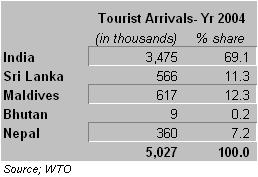
The Financial Express has an article looking at India’s attempt to create a more niche market in tourism;
“As if we needed the Conde Nast Traveller magazine’s recent survey to tell us that we are the fourth most preferred destination among travellers from 134 countries in the world. Just look at the numbers: Last year, 13.2% more international travellers came to India, bringing in more than Rs 8,274 crore. Tourism today is the third largest foreign exchange earner in India, accounting for 2.5% of the GDP. In 2006, a total of 1.28 million tourists came to India as compared to the 1.14 million in 2005…But this heady feeling is marred by a host of problems that plague the industry. Critics say that before we pitch India as the next big world destination, we need to set our own house in order first. From an acute shortage of hotel rooms, which eventually translates into skyrocketing tariffs, to non-existent roads to a skewed mindset towards foreigners, it’s a tough task. Says Rajji Rai, vice-president of the Travel Agents Association of India: “The truth is that there is still a lot that needs to be done. Look at our airports. Take our roads… Every time a tourist lands in India, there is a look of disbelief on his face. Tourists have dollars to burn, we need to grab the maximum share of that money.” Agrees Ravi Wadhwani, a Delhi- based businessman and frequent traveller: “Culturally we may be the richest country in the world. But do we have anything else to boast of? Most successful tourist models today are going in for high-end tourism that has the least impact on the local resources. We, on the other hand, we are going in for mass tourism. We need to learn from the successes of small countries like Maldives, Bhutan, or Chile.” Wadhwani adds: “Look at our connectivity. In foreign countries, you have private planes to ferry tourists. In India, it takes two days to reach the Kanha Wildlife reserve from Delhi. Nobody has so much time to spare.”
Related;
Incredible India
World Tourism Barometer
September 16, 2006
Pope says Sorry
By Paul
 I’ve to admit that I haven’t read the entire speech of Pope when I commented earlier. Kevin summarizes the gist of the speech in the comments. It’s irresponsible on the part of the advisers of Pope to have included such a comment.
At the same Muslim anger and reaction seems vastly disproportional to the broad issues raised by the Pope (even in secular countries like Turkey-see the pic). Muslims in countries like Pakistan have more things to worry than cartoons and speeches. We have to accept that certain segments of Islamic societies are not willing to accept reasoned dialogue to deal with society’s issues. I don’t think we could have reasoned with the Saudi hijackers who blew up the World Trade Center – their worldview had become too narrow.
Now that Pope has said sorry, overzealous Muslims may calm down.
Juan Cole summarizes some of the factual errors in Pope’s speech;
“He notes that the text he discusses, a polemic against Islam by a Byzantine emperor, cites Qur'an 2:256: "There is no compulsion in religion." Benedict maintains that this is an early verse, when Muhammad was without power.His allegation is incorrect. Surah 2 is a Medinan surah revealed when Muhammad was already established as the leader of the city of Yathrib (later known as Medina or "the city" of the Prophet). The pope imagines that a young Muhammad in Mecca before 622 (lacking power) permitted freedom of conscience, but later in life ordered that his religion be spread by the sword. But since Surah 2 is in fact from the Medina period when Muhammad was in power, that theory does not hold water.
In fact, the Qur'an at no point urges that religious faith be imposed on anyone by force. This is what it says about the religions:
' [2:62] Those who believe (in the Qur'an), and those who follow the Jewish (scriptures), and the Christians and the Sabians-- any who believe in God and the Last Day, and work righteousness, shall have their reward with their Lord; on them shall be no fear, nor shall they grieve. ' …
The idea of holy war or jihad (which is about defending the community or at most about establishing rule by Muslims, not about imposing the faith on individuals by force) is also not a Quranic doctrine. The doctrine was elaborated much later, on the Umayyad-Byzantine frontier, long after the Prophet's death. In fact, in early Islam it was hard to join, and Christians who asked to become Muslim were routinely turned away. The tyrannical governor of Iraq, al-Hajjaj, was notorious for this rejection of applicants, because he got higher taxes on non-Muslims. Arab Muslims had conquered Iraq, which was then largely pagan, Zoroastrian, Christian and Jewish. But they weren't seeking converts and certainly weren't imposing their religion.The pope was trying to make the point that coercion of conscience is incompatible with genuine, reasoned faith. He used Islam as a symbol of the coercive demand for unreasoned faith.
But he has been misled by the medieval polemic on which he depended.
In fact, the Quran also urges reasoned faith and also forbids coercion in religion. The only violence urged in the Quran is in self-defense of the Muslim community against the attempts of the pagan Meccans to wipe it out.
The pope says that in Islam, God is so transcendant that he is beyond reason and therefore cannot be expected to act reasonably. He contrasts this conception of God with that of the Gospel of John, where God is the Logos, the Reason inherent in the universe.
But there have been many schools of Islamic theology and philosophy. The Mu'tazilite school maintained exactly what the Pope is saying, that God must act in accordance with reason and the good as humans know them. The Mu'tazilite approach is still popular in Zaidism and in Twelver Shiism of the Iraqi and Iranian sort. The Ash'ari school, in contrast, insisted that God was beyond human reason and therefore could not be judged rationally. (I think the Pope would find that Tertullian and perhaps also John Calvin would be more sympathetic to this view within Christianity than he is).
As for the Quran, it constantly appeals to reason in knowing God, and in refuting idolatry and paganism, and asks, "do you not reason?" "do you not understand?" (a fala ta`qilun?)
Of course, Christianity itself has a long history of imposing coerced faith on people, including on pagans in the late Roman Empire, who were forcibly converted. And then there were the episodes of the Crusades.
Another irony is that reasoned, scholastic Christianity has an important heritage drom Islam itself. In the 10th century, there was little scholasticism in Christian theology. The influence of Muslim thinkers such as Averroes (Ibn Rushd) and Avicenna (Ibn Sina) reemphasized the use of Aristotle and Plato in Christian theology. Indeed, there was a point where Christian theologians in Paris had divided into partisans of Averroes or of Avicenna, and they conducted vigorous polemics with one another.
Finally, that Byzantine emperor that the Pope quoted, Manuel II? The Byzantines had been weakened by Latin predations during the fourth Crusade, so it was in a way Rome that had sought coercion first. And, he ended his days as a vassal of the Ottoman Empire.
The Pope was wrong on the facts. He should apologize to the Muslims and get better advisers on Christian-Muslim relations.”
The greatest irony I find is that I had to quote Juan Cole, a Christian to defend the position of Islam- even the statement made by the Organization of Islamic Countries doesn’t come close to above. One of the best things that Muslim scholars living in the west could do is to start a dialogue with the youth in Islamic countries- blogs are one effective mean. Akbar Ahmed, Sayyid Hussain Nasr, Hamza Yousuf, Jeffrey Lang, Tariq Ramadan, Yousuf Islam , Murad Hoffman and Timur Kuran are you listening. Minaret of Freedom has a blog coverage of news items but not much analysis.
Related;
Pope's Trip to Turkey in Doubt
Iraq calls for calm after Pope's remarks
Mixed feelings over Khatami visit
Pope and Islam: 'Non Mea Culpa'
How Pakistan's rape reform ran aground
Losing the war on Afghan drugs
'Rottweiler' bares teeth- “First, he has done it before. At Auschwitz, in May, he appalled many Jews by passing up what they saw as a historic opportunity for a German pope to apologise for the Roman Catholic Church's conduct in World War II. The second factor is that the Pope has indicated he favours a tougher line in his church's dealings with Islam.”
Multimedia
Doha Debate
Best of the Spiritual Classics;Highlights from our Spiritual Classics series, with sacred writings from Buddhism, Hinduism and Judaism, through Christianity and Islam, to the wisdom texts of Confucius and the holy book of the Sikhs
The Adolescent Brain and Social Policies
By Paul

“A decade ago, the prevailing notion was that brain growth ended at about the age of 2 years. Since then, we have learned that brain growth continues well into adolescence (between ages 10 and 19) and into young adulthood (see the figure below). During this period the brain undergoes a series of changes, and parts of the brain associated with social skills, problem solving, and identifying emotions mature only by the early twenties. However, this process of brain development cannot entirely explain adolescent decision making and behavior. Nor does it override the effect of the environment—parents, schools, communities—in which young people live.
Brain development: arborization and pruning
The brain is made up of nerve cells—about 10 billion of them—connected by branches or dendrites. These branches move information from one cell to another, but these connections are not soldered together; rather, there are spaces between the branch of one cell and the body of another. These spaces are called synapses, and information moves from cell to cell across these spaces by releasing tiny packets of chemicals. When there are abnormalities in the chemicals in the synapses, a variety of clinical conditions result, such as depression and attention-deficit and hyperactivity disorders.
Different parts of the brain handle different activities—that much is well-known. What is new is the finding that during adolescence certain areas of the brain grow in size and other regions become more efficient. For example, the area of the brain responsible for language more than doubles in size between ages 8 and 14. Consequently, language acquisition is optimal at those ages. So, too, connections grow and strengthen between the brain stem and the spinal cord, increasing the connections between the emotions and what the body feels. Throughout childhood and adolescence, more and more nerve cells grow sheaths around them called white matter or myelin. This is like building a superhighway, allowing information to be interpreted and recalled much faster than was ever possible as a young child.
These structural changes are only some of the brain’s alterations during adolescence. Another major change is called “pruning.” Throughout early childhood, the number of connections between cells increase, and because the process is much like the growth of branches on a tree, it is called arborization. It allows a child’s brain to be very excitable—which is why children seem to be perpetual motion machines. In adolescence, many of those branches die—through pruning. The brain is less excitable but also more efficient in carrying information.
The pruning follows a consistent pattern throughout adolescence and young adulthood starting at the back of the brain and ending at the prefrontal cortex. The prefrontal cortex regulates impulses, risk taking, planning, decision making, empathy, and insight. Research also shows that the cerebellum, recently discovered to be important for mathematics, music, decision making, social skills, and understanding
humor, continues to grow through adolescence and well into emerging adulthood. The last structure of the brain to stop growing, it develops until the mid-twenties.
Implications for social policies
What does this new brain research mean for understanding adolescent decision making and behavior? Although much more research is needed before defi nitive policies can be recommended based on the new brain research, it suggests some interesting policy considerations:
• The loss of neuronal excitation in adolescence is associated with a rise in depression, especially among adolescent females, suggesting a biological basis for the epidemiological finding that gender differences in depression start around the time of puberty. These biological changes combine with external sources of stress to increase the risk of suicide for youth in many countries of the world.
• As the brain matures during adolescence, alternations in the synaptic chemicals may influence learning (drugs for attention-deficit disorders improve information transfer at the level of the neuronal synapse). For example, antidepressive drugs may allow for certain excitatory neurotransmitters to stay in the space between two brain cells longer than otherwise.
• Learning and teaching strategies should be timed to increase neurodevelopmental capacities. Because neurodevelopmental maturation occurs at different chronological ages for different people, their inability to grasp a concept at one age does not mean that they are unable to learn the material. This speaks to the risk of educational “tracking” based on comprehension or performance examinations at a young age.
• Without a fully mature prefrontal cortex, adolescents may be more impulsive than adults and perhaps more susceptible to peer influences. This impulsiveness—especially in reactive decision making, as when faced with a situation or threatened to make an immediate decision—suggests the value of second chance programs.
It is, however, too early in the research to draw definitive conclusions about brain development and behavior. Also, physical development interacts with the social environments to determine behaviors and outcomes. So parental behaviors and expectations, effective schools, communities that are youth oriented and supportive, all make a difference in determining young people’s behavior and how well they learn complex decision-making skills.”
Source- World Development Report 2007, Box 2.9 ‘Brain development among youth: Neuroscience meets social science’, p.61 (emphasis mine)
Related;
Eye gaze and cognition in children
Glazed looks sharpen the mind
Universities: A social duty
Into the Mystery of the Adolescent Mind
A Study of Interactions: Emerging Issues in the Science of Adolescence Workshop Summary
The 7 Habits of Highly Effective Teens
World Development Report 2007 links;
Graphs from the report
Video and Audio
Violence is not sexy
By Paul
BBC reports;
“Wives and girlfriends of gang members in one of Colombia's most violent cities have called a sex ban in a bid to get their men to give up the gun.Dozens of women are said to be taking part in what is being called the "strike of crossed legs", a move backed by the mayor of Pereira…”
Wolfowitz’s Second War
By Paul
NYT reviews Wolfowtiz’s focus on corruption at the World Bank;
“In his first 15 months as president of the World Bank, Paul D. Wolfowitz has made the fight against corruption in poor countries a hallmark issue, waging an aggressive campaign that has led to the suspension of hundreds of millions of dollars in loans and contracts to nations including India, Chad, Kenya, Congo, Ethiopia and Bangladesh.It is a new incarnation for Mr. Wolfowitz, a neoconservative intellectual who was a primary architect of the Iraq war during four years as deputy secretary of defense…..
“Anticorruption efforts are an essential part of development finance,” said Roberto Dañino, a senior vice president of the bank until early this year. “But getting rid of corruption is not a silver bullet. The bank should not overemphasize its anticorruption agenda at the expense of other policies required for development.”….
He has begun firing back at the critics at internal meetings and in public statements. He notes, for example, that the bank’s lending under his leadership actually rose slightly last year, to nearly $23 billion.
Mr. Wolfowitz says he has tried to rebut what he calls the myth that combating fraud is “somehow at odds with development or becomes an excuse not to provide assistance.” While no one knows how much of the bank’s resources have been improperly diverted, informal estimates range from 10 percent to the 25 percent that Mr. Wolfowitz says went to corrupt cronies and family members of Indonesia’s leadership in the 1990’s…..
The doubts center on Mr. Wolfowitz’s role as a leading advocate of the American invasion of Iraq, with many critics contending that his zeal on corruption reminds them of what they say was his messianic but unrealistic faith that installing democracy by force in Iraq, and by other means through the Middle East, would bring stability to the region.
The criticism has been especially sharp among Europeans at the bank, where many officials say that judgments about what constitutes “good governance” could rupture the bank’s delicate relationships with aid recipients, especially if the judgments are based on information gathered from dissidents and other critics in those countries…
Several longtime bank officials say they cannot remember when board members wrangled over the wording of a policy paper with a bank president. At recent meetings, directors demanded that Mr. Wolfowitz agree to a greater role for the board in any future decisions on cutting off aid.In addition, members forced the deletion of language suggesting that the United Nations’ goal of reducing world poverty 50 percent by 2015 would have to take second place to the bank’s drive against corruption…
“I think some of the board members,” Mr. Wolfowitz said, “are legitimately afraid that as soon as you start criticizing, the next thing you’re going to do is wag your finger and say, ‘You’re not going to get money unless you behave.’ That’s not our objective. Our objective is to make the lending go up.”…
Mr. Wolfowitz’s management style also grates on some bank officials, with a number of them complaining that he has relied on a small coterie of loyal aides. “He presumes,” said Mr. Dañino, the former bank senior vice president and once prime minister of Peru, “that anyone who opposes him is either incompetent or corrupt.”
In his first 15 months as president of the World Bank, Paul D. Wolfowitz has made the fight against corruption in poor countries a hallmark issue, waging an aggressive campaign that has led to the suspension of hundreds of millions of dollars in loans and contracts to nations including India, Chad, Kenya, Congo, Ethiopia and Bangladesh.….”
Wolfowitz’s focus on corruption should be lauded, it is one of the biggest impediments to the poverty reduction agenda. However pompous releases of reports, (see the latest release of governance indicators ) doesn’t help the poor person on the street. IFIs need to take a broader view of corruption.
Related;
Strengthening Bank Group Work in Governance and Anticorruption
World Bank Releases Largest Available Governance Data Source
Uses and Abuses of Governance Indicators
Rescuing the World Bank
Tackling Corruption is Essential in Making Poverty History
UK withholds World Bank donation
Discussing Doing Business
By Paul
 World Bank is running an online discussion of its recent report Doing Business 2007, via PSD Blog. The discussion questions are interesting particularly the second one. I’ve tried to link to various local news coverage of the report – among the media there seems to be some fundamental misunderstanding of the purpose of the report it seems. World Bank should be doing more for media to understand its publications.
-Of the 10 topics in the Doing Business report, where do you think reforms can most significantly improve the investment climate? -A country's ranking in the Doing Business report has become a well-known indicator. Are countries beginning to "game" the ranking by reforming only those areas of business regulation covered by the report’s methodology? -What are good reform strategies for administrations which have left the "reform window" of the first 15 months? -Have you read earlier Doing Business reports and how would you evaluate this one in comparison to the others? -The next report may address topics like the quality of business infrastructure and the cost of corruption. With this addition to the indicators, what research questions would you like to see in future Doing Business reports?
Some news coverage of the report;
Doing business is still very tough
"How free is India's economy after 15 years of liberalisation? Not very, say two reports released last week. Economic Freedom of the World 2006, published by the Fraser Institute and Cato Institute in North America, ranks India 53rd out of 130 countries in its Freedom of the World Index.
Not too bad. But Doing Business 2007, a World Bank report on how difficult it is to conduct business, ranks India 134th out of 175 countries, deep in the bottom half. The indicators used in the two reports are different."
Chasing the dragon
There is no point belabouring comparisons with China that attracts nine times more foreign direct investment (FDI) than India gets every year.
Time for step two
"Investment Minister Mahmoud Mohieddin was not a happy man. Speaking at the opening of this year's 11th annual Euromoney conference in Cairo, the minister directed his anger at the International Finance Corporation's (IFC) 2006 Doing Business report, which ranked Egypt at 165th worldwide in terms of countries that had improved business regulations and cut red tape. Mohieddin said the experts who put together the report did not appear to "have a full understanding of our economy". The 16 firms that the IFC -- the World Bank's private sector arm -- chose to examine for its report, he said, were not a very representative sample."
Business Scene-GEORGIAN AMBASSADOR Lasha Zhvania is happily circulating a World Bank and International Finance Corporation report that lists Georgia as the top reformer in the Commonwealth of Independent States (CIS). According to the report, Georgia also led the global top 10 reformer rankings on the ease of doing business in 2005-2006.
World Bank says: work 24/7 with no rights;"A new World Bank report calls for the wholesale elimination of workers' rights. The 2007 edition of the ‘Doing Business’ report has declared the Marshall Islands to be the world’s “Best Performer” for its almost total absence of labour regulation, displacing last year’s champion, Palau. According to the International Confederation of Free Trade Unions (ICFTU), both Marshall Islands and Palau have in common that they are tiny Pacific island nations that have no labour code and are not members of the International Labour Organisation. The World Bank’s online Doing Business database explains that it has given top ranking for labour market regulations to these countries because, among other exemplary features, both allow workers to be forced to work up to 24 hours per day and up to seven days per week and require no vacations or advance notice for dismissal."
India, top reformer in South Asia, says World Bank report
China is ranked top ten in reforming business practices
GHANA AMONG TOP TEN BUSINESS REFORMERS
World Bank praises Romanian reforms
Cameroon: Harsh Taxes Impede Business - World Bank
Consultant reiterates obstacles persist for doing business in Dominican Republic
World Bank rectifies report on Dominican business standing
Bettering business environment with ‘iron hands’
Tanzania and Rwanda Lead in Regional Economic Reforms
Hungary slips 6 places on World Bank's “Doing Business" ranking
World Bank's 2007 Doing Business Report ranks Saudi Arabia #1 in the MENA region
Africa is performing better than Latin America
World Bank: CR no. 52
"The CR dropped two spots year on year. Of the 10 indicators of the overall business environment tracked in the study, the Czech Republic had improved only in two categories: starting a business (74), the time period for which shortened to nine months, and the dealing with licenses (110) category, which relates to already-existing business operations. The country fared best in the getting credit category (21) and worst in closing a business (113), that is bankruptcy procedures — which can still take up to nine years, compared to the average 3.5 years in European and Central Asian regions. Creditors receive 18 hellers for each Kč 1 of debt, again less than half the regional average."
Morocco is top reformer in the Middle East and North Africa
World Bank hails Kenya’s success in tax reforms
"THE World Bank (WB) and the International Finance Corporation (IFC) have praised the Kenyan government for introducing the electronic data interface system in the Customs department. Consequently, Kenya is ranked among Africa’s top nations striving to create an enabling atmosphere to do business"
World Bank reports rank Tanzania among top reformers
Nigeria: World Bank Ranks Nigeria's Economic Climate Low
"We know Nigeria is making efforts to ease the process of doing business" but advised that "there is still room for improvement". She said reforms need to address the whole process, including business registration. She noted there still exists, some complex regulations as against other countries."
The World Bank said early this week that the impact of reforms instituted by the current administration led by President Olusegun Obasa-njo was rather slow.
Dominican Customs is Latin America's 2nd best;Argentina is better than Brazil and Mexico when it comes to customs procedures. And Haiti is generally among the worst in the region.
Cameroon: Harsh Taxes Impede Business - World Bank
Why reform has become a dirty word;“Reform” has been hijacked, even by the World Bank, which should know better, to mean reducing the “burden” on corporations. Te Bank’s index, which has become quite influential and is widely used by governments around the world to set their policies, specifically excludes things like infrastructure, institutions and security, i.e. these pesky things usually provided by good governments and paid by taxes and “forgotten” by businesses when they complain about governmental interference (but not when they choose where to invest, as attests France’s almost permanent presence in the top five favorite destinations for FDI alongside China and the USA). That such issues can be mindlessly excluded from public discourse on this topic via a 3 line disclaimer in their report is profoundly dishonest.
If the logic was to facilitate wealth creation by companies with a later focus on redistribution of that wealth, that might make a little bit of sense, but the goal seems only to be wealth capture by corporations per se, whether out of actual creation of wealth or, increasingly, from the shifting of costs from their P&L to the public purse. Where that wealth goes is obviously no longer a worry of the World Bank, something I find frankly disquieting. Even more, as taxes are seen as a negative thing, any redistributive policy is explicitly considered an obstacle to “reform”. Thus we end up in situations where economies appear to be growing strongly and yet median income (as opposed to average income) is stagnant or even declining, a sure sign of growing inequality rather than growing prosperity."
Malawi drops 14 steps on business ease index
Reforms in Charter to make RP business-friendly, says AdCom
The Philippines' dismal ranking in the latest World Bank (WB) economy rankings of countries worldwide should serve as a wake-up call that the local business environment is not too encouraging to foreign investors.
Pace of business reforms slows-"UGANDA has lagged behind Kenya on the pace of reforms to ease doing business, but a report notes that her effort to ease registration requirements made it easy for companies to operate in the formal sector. Uganda was ranked 107 compared to Kenya’s 83rd position, while Tanzania trailed at 142, a study on tracking reforms done by the World Bank and the International Finance Corporation (IFC) shows. However, Uganda was cited as one of the countries that undertook reforms that eased the burden of doing business in the country"
World Bank study laments red tape in the Philippines
African Countries Emerge as Regulation Reformers, Report Says; World Bank views a push by donor countries as a contributing factor
"China, Number 93 a year ago, moved up 15 places. Like Georgia, Mexico, Tanzania and Ghana, China is among the World Bank’s “top 10 reformers.” Its government has sped up the business-starting process, increased investor protections, reduced red tape in trade, and established a credit-information registry for consumer loans that provides credit histories of 340 million citizens, according to the report.
A separate report on foreign direct investment, released by Columbia University and The Economist publishing group, predicts that until 2010 China will be the top emerging market for business investment inflows, but Africa will not receive much investment any time soon.
Karl Sauvant, director of the Columbia Program on International Investment, which released the investment report, said China will attract $87 billion from U.S. businesses alone in 2006, while sub-Saharan Africa, with 10 percent of the world’s population, gets less than 1 percent of total foreign direct investment flows."
Fiji ranks 31 in World Bank report
"FIJI has dropped back two rankings to 31 on the 2007 World Bank's Doing Business report after being ranked 29 this year.
The drop in ranking comes amid concerns from the bank about some aspects of doing business in Fiji even though it has improved a lot from its previous ranking in previous years."
Bangladesh 3rd best business place in S Asia
"Bangladesh is the third easiest country in which to do business in South Asia, although as a whole is lagging behind other parts of the world when it comes to reforms that could enhance business activity, says a World Bank-IFC (International Finance Corporation) report. The top ranked countries in the region are the Maldives (53) and Pakistan (74), followed by Bangladesh (88), Sri Lanka (89) and Nepal (100). India comes in at 134, Bhutan at 138 and Afghanistan at 162."
Mozambique says to cut red tape in 2007
Mozambique will shake up its ineffective judiciary in a series of radical measures aimed at cutting red-tape and increasing business confidence in its resurgent economy
World Bank: Indonesia Losing Appeal As Invest Destination
Less Foreign Direct Investment forecasted for 2007;In a global context of weaker foreign direct investment, FDI, in emerging markets because of “structural weaknesses”, Latinamerica is also set to suffer, according to a report from the University of Columbia in New York and The Economist group. ..
However another report but from the International Finance Corporation, IFC, the private sector arm of the World Bank shows that doing business became easier worldwide in 2005/06. Two hundred and thirteen regulatory reforms—in 112 economies— reduced the time, cost, and hassle for businesses to comply with legal and administrative requirements.
Meeting with private sector to clarify delivery system..He said Malaysia’s 25th ranking in the recent World Bank’s report on Doing Business 2007 needed to be improved.
Taiwan climbs a spot to become 24th-freest economy; Taiwan is the world's 24th freest economy among 130 nations, one spot up from last year, according to a report released on Thursday by the Fraser Institute, an independent public policy organization in Canada
According to a recent report released by the World Bank and the International Finance Corp, Taiwan ranked No. 47 in ease of doing business, down from 43rd last year.
In what do we trust?The language of business is peppered with the word trust. Trust deed, deed of trust, unit trust, trust account, investment trust, trust fund are just a few of the plethora of trust terms in the commercial world.
That's no coincidence. Without trust, much business activity could not be carried out. There has to be an underlying belief that the other party to a transaction will fulfill his/her obligations. Two reports that came out recently give a seemingly contradictory view of the state of trust in contemporary China.
WB Increases Azerbaijan’s Rating on Favorable Business Environment
Israel 26th business-friendly country
Malaysia Is More Business Friendly Than That Rated By World Bank, Says MB
Caribbean Way Behind as Business Destination
Slovakia offers best business conditions of V4 states
Britain overtaken by Hong Kong in table of best places to do business
Zambian investment environment worsening
ARMENIA LEADER IN CIS AS A COUNTRY WITH TROUBLE-FREE CONDITIONS FOR RUNNING A BUSINESS
Sri Lanka lags reforming nations in South Asia
''The Easiest Place To Do Business In South Asia''-“The Maldives remains ‘the easiest place to do business’ in South Asia, but it is only the best of a bad bunch, according to an influential World Bank report….
The report found that the South Asia region ranks behind all others on the pace of reforms, with only a quarter of countries, making at least one reform that improved the Doing Business indicators.
However, the World Bank’s methodology is fiercely skewed towards liberalization and privatization regardless of context. It does not track variables such as market size, macroeconomic policy, quality of infrastructure, currency volatility, investor perceptions, or crime rates.
The Maldives was therefore criticized in this year’s report for introducing some measure of labour protection. The World Bank condemned the new mandatory two-month notice period before workers can be dismissed, saying it was ‘a move that may especially discourage small business and the hiring of poor, low-skilled, and young workers’.
The Maldives’ high regional ranking reflects its exceptionally laissez-faire attitude to tax and employment protection. It ranked first out of all 175 countries on ‘paying taxes’ – businesses pay back an average of just 9.3% of profit to the state, in comparison to a regional average of 45.1% and a developed world average of 47.8%...”
Australia eighth in easy business survey
Australia has moved up one spot into eighth place in the World Bank's latest ranking of the easiest markets to do business, overtaking Norway.
NZ knocked from top business spot
"New Zealand has been knocked off its perch, at the top of world rankings for ease of doing business….Australia's significant reforms of the last year have helped it improve to 8th place"
How Nations Prosper: Economic Freedom and Doing Business in 2007- an event coming up at Cato later in the month.
Earliers posts- The Road Less Traveled of Business Regulatory Reform, Excessive Anti-Corruption Drive Hurting the Economy?
September 15, 2006
History Podcasts
By Paul
Harvard historian Niall Ferguson discusses his book "The War of the World: 20th Century Conflict and the Descent of the West"- (Sep 12, 2006 at Vanderbilt University). Listen to the podcast.
Some article by Niall- ‘The Next War of the World’, The origins of the Great War of 2007 - and how it could have been prevented, Tomorrow's world war today. See also SHORTER NIALL FERGUSON: IF WE DON'T ATTACK IRAN, THERE'LL BE NUCLEAR WAR
A panel discussion of the recent and historical conflict between Israel and Hezbollah, its effects on Lebanon and its implications for U.S. policy. Featuring Fawaz A. Gerges, professor of International and Middle Eastern Studies, Sarah Lawrence College, Michael Eisenstadt, The Washington Institute for Near East Policy, moderated by Larry P. Goodson, professor of Middle East studies, United States Army War College. Listen to the podcast.
The Wonga Coup
For more detail see this post at Pienso.
Sri Lanka; With violence once again erupting in Sri Lanka, Rear Vision traces the historical roots of the conflict. Guests include Jonathan Spencer, Professor of Anthropology of South Asia , University of Edinburgh, Dr. Jayadeva Uyangoda, Professor and Head, Department of Political Science and Public Policy, University of Colombo and Dr. Paikiasothy Saravanamuttu, Executive Director of the Centre for Policy Alternatives, an independent, nonpartisan, public policy centre with a focus on peace and governance, Colombo
Keeping the peace: the U.N. Security Council; The United Nations Security Council has finally brokered a cease-fire in Lebanon. On Rear Vision this week, a history of the UN's most powerful body.
Guests include Rosemary Righter, Associate Editor, The Times, Ian Williams, UN correspondent , The Nation, Colin Keating, Executive Director, Security Council Report, Former New Zealand UN Ambassador
See also ‘Security Council Report’ will publish, on a regular monthly basis, independent and objective information and analysis about the United Nations Security Council and the issues on its existing and future agendas.
See also this debate from BBC-to mark the end of Radio 4's This Sceptred Isle: Empire series, some of this country's best-known historians will be examining how Britain and other countries around the world have been changed by their experience of empire. They'll be discussing whether Britain should apologise and make reparation for its imperial past or glory in it, and asking whether the twenty-first century will see the birth of new empires. Eric Hobsbawm, Niall Ferguson, Robert Beckford, Linda Colley and Priya Gopal. (the program is available online)
The Hammer Against Witches
By Paul

Kevin in a comment to an earlier post mentioned that ‘No bigot I have ever known was as scientistic or as vicious as the writer of this article in EB,’. I think the following book Malleus Maleficarum (1486), written as a guide to witch hunting beats the Negro definition from the Encyclopedia Britannica. The book was second only to Bible in popularity when it was published (watched the History Channel video). Some excerpts from the chapter titled; “Concerning Witches who copulate with Devils. Why is it that Women are chiefly addicted to Evil superstitions”-
“…For S. Jerome in his Contra Iouinianum says: This Socrates had two wives, whom he endured with much patience, but could not be rid of their contumelies and clamorous vituperations. So one day when they were complaining against him, he went out of the house to escape their plaguing, and sat down before the house; and the women then threw filthy water over him. But the philosopher was not disturbed by this, saying, “I knew the rain would come after the thunder.”There is also a story of a man whose wife was drowned in a river, who, when he was searching for the body to take it out of the water, walked up the stream. And when he was asked why, since heavy bodies do not rise but fall, he was searching against the current of the river, he answered: “When that woman was alive she always, both in word and deed, went contrary to my commands; therefore I am searching in the contrary direction in case even now she is dead she may preserve her contrary disposition.”
And indeed, just as through the first defect in their intelligence that are more prone to abjure the faith; so through their second defect of inordinate affections and passions they search for, brood over, and inflict various vengeances, either by witchcraft, or by some other means. Wherefore it is no wonder that so great a number of witches exist in this sex.
Women also have weak memories; and it is a natural vice in them not to be disciplined, but to follow their own impulses without any sense of what is due; this is her whole study, and all that she keeps in her memory. So Theophrastus says: If you hand over the whole management of the house to her, but reserve some minute detail to your own judgement, she will think that you are displaying a great want of faith in her, and will stir up a strife; and unless you quickly take counsel, she will prepare poison for you, and consult seers and soothsayers; and will become a witch.
But as to domination by women, hear what Cicero says in the Paradoxes. Can he be called a free man whose wife governs him, imposes laws on him, orders him, and forbids him to do what he wishes, so that he cannot and dare not deny her anything that she asks? I should call him not only a slave, but the vilest of slaves, even if he comes from the noblest family. And Seneca, in the character of the raging Medea, says: Why do you cease to follow your happy impulse; how great is that part of vengeance in which you rejoice? Where he adduces many proofs that a woman will not be governed, but will follow her own impulse even to her own destruction. In the same way we read of many woman who have killed themselves either for love or sorrow because they were unable to work their vengeance.S. Jerome, writing of Daniel, tells a story of Laodice, wife of Antiochus king of Syria; how, being jealous lest he should love his other wife, Berenice, more than her, she first caused Berenice and her daughter by Antiochus to be slain, and then poisoned herself. And why? Because she would not be governed, and would follow her own impulse. Therefore, S. John Chrysostom says not without reason: O evil worse than all evil, a wicked woman, whether she be poor or rich. For if she be the wife of a rich man, she does not cease night and day to excite her husband with hot words, to use evil blandishments and violent importunations. And if she have a poor husband she does not cease to stir him also to anger and strife. And if she be a widow, she takes it upon herself everywhere to look down on everybody, and is inflamed to all boldness by the spirit of pride.
If we inquire, we find that nearly all the kingdoms of the world have been overthrown by women. Troy, which was a prosperous kingdom, was, for the rape of one woman, Helen, destroyed, and many thousands of Greeks slain. The kingdom of the Jews suffered much misfortune and destruction through the accursed Jezebel, and her daughter Athaliah, queen of Judah, who caused her son's sons to be killed, that on their death she might reign herself; yet each of them was slain. The kingdom of the Romans endured much evil through Cleopatra, Queen of Egypt, that worst of women. And so with others. Therefore it is no wonder if the world now suffers through the malice of women.
And now let us examine the carnal desires of the body itself, whence has arise unconscionable harm to human life. Justly we may say with Cato of Utica: If the world could be rid of women, we should not be without God in our intercourse. For truly, without the wickedness of women, to say nothing of witchcraft, the world would still remain proof against innumerable dangers. Hear what Valerius said to Rufinus: You do not know that woman is the Chimaera, but it is good that you should know it; for that monster was of three forms; its face was that of a radiant and noble lion, it had the filthy belly of a goat, and it was armed with the virulent tail of a viper. And he means that a woman is beautiful to look upon, contaminating to the touch, and deadly to keep.
Let us consider another property of hers, the voice. For as she is a liar by nature, so in her speech she stings while she delights us. Wherefore her voice is like the song of the Sirens, who with their sweet melody entice the passers-by and kill them. For they kill them by emptying their purses, consuming their strength, and causing them to forsake God. Again Valerius says to Rufinus: When she speaks it is a delight which flavours the sin; the flower of love is a rose, because under its blossom there are hidden many thorns. See Proverbs v, 3-4: Her mouth is smoother than oil; that is, her speech is afterwards as bitter as absinthium. [Her throat is smoother than oil. But her end is as bitter as wormwood.]
Let us consider also her gait, posture, and habit, in which is vanity of vanities. There is no man in the world who studies so hard to please the good God as even an ordinary woman studies by her vanities to please men. An example of this is to be found in the life of Pelagia, a worldly woman who was wont to go about Antioch tired and adorned most extravagantly. A holy father, named Nonnus, saw her and began to weep, saying to his companions, that never in all his life had he used such diligence to please God; and much more he added to this effect, which is preserved in his orations.
It is this which is lamented in Ecclesiastes vii, and which the Church even now laments on account of the great multitude of witches. And I have found a woman more bitter than death, who is the hunter's snare, and her heart is a net, and her hands are bands. He that pleaseth God shall escape from her; but he that is a sinner shall be caught by her. More bitter than death, that is, than the devil: Apocalypse vi, 8, His name was Death. For though the devil tempted Eve to sin, yet Eve seduced Adam. And as the sin of Eve would not have brought death to our soul and body unless the sin had afterwards passed on to Adam, to which he was tempted by Eve, not by the devil, therefore she is more bitter than death.
More bitter than death, again, because that is natural and destroys only the body; but the sin which arose from woman destroys the soul by depriving it of grace, and delivers the body up to the punishment of sin.
More bitter than death, again, because bodily death is an open and terrible enemy, but woman is a wheedling and secret enemy.
And that she is more perilous than a snare does not speak of the snare of hunters, but of devils. For men are caught not only trough their carnal desires, when they see and hear women: for S. Bernard says: Their face is a burning wind, and their voice the hissing of serpents: but they also cast wicked spells on countless men and animals. And when it is said that her heart is a net, it speaks of the inscrutable malice which reigns in their hearts. And her hands are as bands for binding; for when they place their hands on a creature to bewitch it, then with the help of the devil, they perform their design.
To conclude. All witchcraft comes from carnal lust, which is in women insatiable. See Proverbs xxx: There are three things that are never satisfied, yea, a fourth thing which says not, It is enough; that is, the mouth of the womb. Wherefore for the sake of fulfilling their lusts they consort even with devils. More such reasons could be brought forward, but to the understanding it is sufficiently clear that it is no matter for wonder that there are more women than men found infected with the heresy of witchcraft. And in consequence of this, it is better called the heresy of witches than of wizards, since the name is taken from the more powerful party. And blessed be the Highest Who has so far preserved the male sex from so great a crime: for since He was willing to be born and to suffer for us, therefore He has granted to men the privilege.”
Related;
Sexy Devils;What really lay behind the massive witch hunts of the Middle Ages?
Witchcraft Collection- Cornell University
The massa marittima mural / the malleus maleficarum
Images of Circe and Discourses of Witchcraft, 1480-1580
History of Witchcraft - Research Guide
Multimedia;
WITCHCRAFT- BBC
"Why did practices that had been tolerated for centuries suddenly become such a threat? What brought the prosecutions of witchcraft to an end, and was there anything ever in Europe that could be truly termed as a witch?"
Listen to Helen Fisher for an intelligent discussion for some real differences between the sexes (very highly recommended).
September 14, 2006
The coming clash of China and India
By Paul
China has been recently courting the countries of South Asia;
“According to a report this year by Dr. Mohan Malik, professor at the Asia-Pacific Center for Security Studies in Hawaii, ‘Beijing is skillfully employing economic and military means to draw Bhutan, Bangladesh, Nepal, Maldives and Sri Lanka into China's orbit.’‘Beijing's main objectives are said to be access to raw materials, commodities, natural resources and access to South Asian markets for Chinese goods and to expand China's influence in the region. However, China's support for India's smaller neighbours suggests that gaining access to markets and natural resources is not the only reason behind Beijing's South Asia policy: Beijing also wants to make a point on the limits of Indian power,’ he adds.
''In fact, aiding "India-wary" countries in South Asia to "concircle" (contain and encircle) India has long been an integral part of China's strategic calculus. As a rising maritime trading power, Beijing is also seeking once again to project force into the Indian Ocean in the manner of the fleets sent out under the command of Admiral Zheng He nearly 600 years ago during the Ming Dynasty,'' Malik concludes.”
Related;
China's top advisor meets Maldivian president
American and Yugoslav to be deported
Work to commence on new museum funded by the Chinese
A recent episode Foreign Exchange;
“China is modernizing economically; that no one denies. But there is a great debate about whether that economic modernization is leading to political change. Is China reforming its political system? To discuss this issue we’re joined by Hongying Wang, who is a Fellow at the Woodrow Wilson International Center and also at the Maxwell School at Syracuse University. Let me ask you; a statistic that is often bandied about, 87,000 protests in China last year compared with 10,000 ten years ago--what does this mean? Is it the sign of political unrest that some are reading it to be?”
The Commonwealth on World Bank
By Paul
The annual meeting of finance ministers of the Commonwealth countries were recently held in Colombo. Their views on the World Bank and IMF from the final communiqué;
- recognised the need to increase the voice and representation of developing and poor countries in the IMF and World Bank, and urged a time-bound conclusion to a process of fundamental reform in a way that would increase the institutions’ credibility and legitimacy;- welcomed and encouraged rapid further progress in the joint efforts of the Bank and Fund to identify opportunities for significant scaling up in assistance and reforms to help countries meet the MDGs;
- recognised the importance of good governance for development and encouraged the Bank and Fund to support moves to strengthen the various dimensions of governance as an aspect of their support for countries’ development. Emphasised that the current focus on governance should not obscure the Bank’s core focus on poverty elimination. In this context, Ministers stressed the pre-eminent role of states in promoting good governance; the need for the development community to help build countries’ own capacity and to find ways to engage with poor countries even where governance is weak; and the mutual responsibilities of industrial countries to ensure responsible behaviour in this context by their citizens and companies;- welcomed the Bank’s current emphasis on infrastructure development.
- looked forward to the conclusions of the current external review of Bank-Fund collaboration and called for continued efforts to strengthen this collaboration and to increase the combined efficiency and effectiveness of the two institutions in their support for low and middle income countries;
- stressed the importance of sustaining the Fund’s financial resources so as not to compromise its role, including its role in low-income countries;
- welcomed the creation of the Fund’s new Exogenous Shocks Facility and encouraged flexibility in its scope and use to facilitate timely disbursement of concessional finance;
- welcomed the World Bank’s proposals to become more responsive to the needs of its middle-income country clients, including MDG related needs; to provide more customised and flexible financial and advisory services such as through blending; and to accelerate moves to use country systems and to find other ways to reduce the costs to member countries of doing business with the Bank; and welcomed the Bank’s work on the Clean Energy Investment Framework and urged its rapid implementation, working with other IFIs.
-Urged the parties involved, including the African Development Bank and World Bank, to accelerate progress in implementing the recently established African Consortium for infrastructure development.
Related;
India asks Commonwealth finance ministers to make united push for reform at IMF
Deputy Secretary-General Urges World Bank to Create Youth Investment Fund
Commonwealth Finance Ministers seek new answers to old questions
Some of the papers from the agenda;
Current World Economic Situation and Prospects
Review of IMF and World Bank Issues
An Agenda for Growth and Livelihoods: Public-Private Partnerships for Infrastructure
Toward and Outward Oriented Development Strategy for Small States: Issues Opportunities and Resilience Building
Promoting Investment into Economies with "Endowed" Handicaps: Progress Report
Reform of the International Aid Architecture: A Role for the Commonwealth?
Silliest thing I heard today
By Paul
Organization of Islamic Conference is urging Muslim tycoons to buy stakes in global media outlets to help change anti-Muslim attitudes around the world;.
"Muslim investors must invest in the large media institutions of the world, which generally make considerable profits, so that they have the ability to affect their policies via their administrative boards," OIC chief Ekmeleddin Ihsanoglu told the gathering in the Saudi city of Jeddah."This would benefit in terms of correcting the image of Islam worldwide," he said, calling on Muslim countries to set up more channels in widely-spoken foreign languages.
Muslim stakes in Western media are minimal. Billionaire Saudi Prince Alwaleed bin Talal owns 5.46 percent of media conglomerate News Corp., the Rupert Murdoch-run group behind the Fox News Channel. The U.S. channel is generally seen as right-wing and no friend of Arab or Muslim interests.”
If that is the best alternative that ministers from Islamic countries can come up with, than ….
Related;
The War with al-Qaeda
Opium Threats in Afghanistan, Iran
Pakistan’s Troubled Leader
First Deputy Chief of Russian Central Bank shot
By Paul
Russia has yet to become a normal country;
“For many in Moscow, the murder of first deputy Central Bank chief Andrei Kozlov has brought back memories of the 1990s, when commercial disputes often ended in gunfights and car bombings."I don't think the situation has changed at all since then," said Viktor Ilyukhin, a member of the State Duma's Security Committee. "Organized crime, in association with big capital, can do whatever it wants, and the government is helpless."
Ilyukhin, formerly a senior prosecutor, said the country was in for a new wave of contract hits on government officials. "We are on the eve of a big brawl," he said.
Igor Pushkaryov, a member of the Federation Council's Budget Committee, said the killing was particularly unexpected given the country's current political and economic stability.
"It seemed that the lawlessness of the 1990s was a thing of the past, but what has happened sends us right back to those chaotic days," Pushkaryov told Interfax.”
A Concept Map of Microsoft Office 2007
By Paul
A cool concept map of MS Office 2007 resources by MS Office evangelist, Don Campbell.
“My God is bigger than yours” Dept.
By Paul
Pope Benedict XVI quoted criticisms of the Mohammed by a 14th Century Byzantine Christian emperor, Manuel II Paleologus in a recent speech in Germany;
“Show me just what Mohammed brought that was new, and there you will find things only evil and inhuman, such as his command to spread by the sword the faith he preached".
For a different approach at dialogue listen (browse down the page) to Robert Thurman.
Related;
Muslim Leaders Assail Pope’s Tough Speech on Islam
Pope hits out at Islam
Google News coverage
September 13, 2006
Comments Offline Back Online!
By Kevin
Due to excessive spam attempts causing repeated server crashes, comments were offline for 6 days while I figured out how to implement strict security protocols.
All commenters must now enter a 6 digit code to validate their comments. Please let me know if you have any trouble!
Recent Publications from IMF
By Paul
Some recent publications from the IMF which are well worth a read;
Global Financial Stability Report- Market Developments and Issues
World Economic Outlook-Financial Systems and Economic Cycles
(analytical chapters)
Doha Development Agenda and Aid for Trade; “This paper summarizes recent developments in the Doha Round negotiations, and aid for trade. As requested by the Development Committee last September, it reviews existing mechanisms for cross-country and regional aid for trade needs. It proposes possible options to overcome the coordination and capacity problems affecting regional cooperation.”
Corruption and Technology-Induced Private Sector Development; “This paper asks whether corruption might be the outcome of a lack of outside options for public officials or civil servants. We propose an occupational choice model embedded in an agency framework to address the issue. We show that technology-induced private sector expansion leads to a decline in publicly supplied corruption as it provides outside options to public officials who might otherwise engage in corruption. We provide empirical evidence that strongly shows that technology-induced private sector development is associated with a decline in aggregate corruption. This suggests that the decline in publicly supplied corruption outweighs the potential increase in privately supplied corruption that could result from private sector expansion.”
Insuring Public Finances Against Natural Disasters--A Survey of Options and Recent Initiatives; “Natural disasters can put severe strain on public finances, in particular in developing and small countries. But catastrophe insurance markets increasingly offer opportunities for the transfer of such risks. Thus far, developing countries have only tepidly begun to tap these opportunities. More frequent and intensive use of insurance markets may be desirable because it could help introduce an important element of predictability in the post-disaster public finances of disaster-prone developing countries. Against this background, the paper surveys the various available insurance modalities and reviews recent initiatives in developing and emerging market countries. It also identifies some key challenges for the insurance community, donors, and international financial institutions (IFIs).”
Prospects for the World Economy-address By Rodrigo de Rato
Economic Policies and Global Prosperity: Challenges for Asia and the IMF- address by John Lipsky
Latest IMF survey
For comment; Why can’t the international financial institutions release a joint economic outlook? IMF deserves credit for putting online most of its publication unlike the OECD, World Bank, or the ADB.
Related;
Chief Economist Jean-Philippe Cotis, OECD on their recent assessment of economic outlook (podcast)
Asian Development Outlook 2006 Update
Labor Markets in Asia: Issues and Perspectives, recent publication of ADB-not available on the web.
Some Podcasts
By Paul
The history of scientific discoveries; The author of a book called 'Who Discovered What When', David Ellyard, discusses the history of discoveries in science
TCS podcasts- the latest is with Dierdre McCloskey
Regaining confidence in western culture
Facing the evidence - part one; Only one in two patients receives the healthcare they should receive according to the evidence. One in ten patients receives care that isn't recommended and which is potentially harmful. In the first part of this series about getting health professionals to practice with evidence, Associate Professor Alex Barratt takes a close look at the catastrophic errors that have occurred when evidence has been ignored, and why evidence based practice is still not being implemented in consultation rooms near you. Read the transcript.
Drug-driving; why Australia is the world's leader when it comes to random saliva drug testing for drivers
Free Gardeners, Odd Fellows and Druids: a history of health insurance in Australia
Celebrating 50 years of television
Gaia and accelerating climate change; It was in the late 1960s that James Lovelock first suggested the Earth acted as a single organism. He named his observation, Gaia. He was ridiculed and the idea was ignored for decades. It wasn't until the end of the 90s that a new branch of science grew out of his theory; that of Earth System Science. Now, as the effects of climate change have become obvious for all to see, James Lovelock has taken his theory further in a book, The Revenge of Gaia. Lovelock claims we've passed the point of no return with climate change.
Peter Singer, Professor of Bioethics at Princeton University, debates his views on life and death with a panel of experts
How can we resolve the tensions between the different communities in Europe in the light of the growing threat from Islamic extremists, sometimes dubbed the 'Enemy Within'? Hisham Hellyer is a policy analyst, academic and commentator, based at the University of Warwick as an Associate Fellow, the American University in Cairo as a Visiting Professor and Trinity College in Dublin as a Senior Research Fellow. His research interests include European Muslim communities, the interplay between Islam and modernity, European social policy and political philosophy. In his latest book on European Muslims (due to be published by IB Tauris in March 2007 under the title of ''Islam in Europe: Multiculturalism and the European 'Other'), he argues that Europe must come to terms with all of her history, past and present, and that Muslim communities should work to be integral to, rather than simply 'integrated' parts of, Europe.
History of Israel-Palestine conflict
September 12, 2006
Globalization’s Assassin
By Paul
A discussion with senior World Bank economist, Branko Milanovic, who says there are growing fears in both rich and poor countries about the impact of globalisation. He shifts the focus from economics to migration - from the movement of goods and services to the movement of people. The real hot-spot, he says, is Europe, where the fear of job losses to low-pay countries, coupled with ethnic and cultural dilution from immigration, will rock Europe's welfare state economy to its foundations. Listen to the podcast from Late Night Live, Radio National.
related;
Branko Milanovic's posts
Why Globalization Is in Trouble, Part 1 and Part 2
Worlds Apart: Book Discussion
THE THREE CONCEPTS OF INEQUALITY DEFINED
Branko Milanovic columns at Project Syndicate
What Can Foreign Aid Do For the World’s Poor?
Martin Wolf’s Forum on Globalisation
Income Distribution and Trade Policy
General and Conceptual Discussions of Poverty, Inequality & Globalization
Explaining the Gains from Globalization
Inequality around the world
Fighting Corruption the Celtel Way
By Paul

Mohamed Ibrahim, Founder and Chairman, Celtel International writes in the latest Development Outreach;
"Any international business operating in Sub Sahara Africa needs to face the issue of corruption. From the beginning Celtel adopted a very strict set of six values, the first of which is: “We are open, honest and transparent.” We applied these values at all levels: from the shareholders and the Board to a handbook for every employee.When searching for shareholders we sought institutions who could contribute expertise and guidance as well as money. Early examples included the Commonwealth Development Corporation (now Actis), the British Government’s development finance arm and the International Finance Corporation —part of the World Bank Group. Both had many years of experience investing in Africa and were rigorous in ensuring that every Celtel investment and local partner passed their transparency scrutiny.
Right from the start Celtel was run as a Western institutionalized company (it is based in the Netherlands). We believe good governance starts at home. So we formed a very talented and experienced Board of Directors, with shareholder representatives and strong independent directors from the worlds of politics and business such as Lord Prior, formerly a UK Cabinet minister, Dr Salim Salim, the African statesman and a former Prime Minister of Tanzania and Sir Gerry Whent, the original founder of Vodafone.
Some might regard such a heavyweight Board as restrictive to a start up company. But for Celtel this has helped navigate some of the complex political currents. We made it clear that any requests for political donations and the like would be referred to the main Board and discussed by the representatives of major donor nations. It showed everybody that we were serious about our anti-corruption stance and it was a great protection.
It also brought recognition to Celtel: when giving the inaugural IFC Client Leadership award, Peter Woicke, former IFC Executive VP, said Celtel is “a company that sets the gold standard for its peers anywhere in the world, a company that is a role model for others, regardless of sector, region or country.”
I don’t know whether every company can afford a corruption repellant board of directors especially when honest people are an endangered species in a lot of poor countries.
Related;
Business and the Millennium Development Goals: An Active Role for Globally Responsible Companies
See also Mohamed Ibrahim’s presentation at the PSD Forum
Measuring Corruption: Myths and realities
Corruption and prosperity don't go together in the Solomons
Fighting Corruption: Business as a Partner
The Seduction of Culture in German History
By Paul


During the Allied bombing of German cities, Hitler was more concerned by the loss of cultural treasures than he was by human casualties. At the time, his propagandists broadcast the fact, believing it would impress the German public by revealing Hitler's cultural sensitivity: the artist's spirit inside the military uniform. Wolf Lepenies argues that this incident is part of the long German tradition of valuing cultural achievement above all else, including politics - a tradition which he believes has had a catastrophic consequences for his country. Listen to the podcast from Radio National (starts at the end of the program).
Here is the Introduction of the book;
“This book examines the German attitude of regarding culture as a substitute for politics and of vilifying politics, understood above all as parliamentary politics, as nothing but an arena of narrow-minded, interest-group bargaining and compromise. But this work is not a debate on the Sonderweg (special path) in disguise, asserting that the aversion to politics and the idealist and romantic veneration of culture were the main reason why Germany departed from the "normal" Western course of development and steered into the disaster of Nazism. I do not describe an attitude that is a uniquely German phenomenon. Still, I argue that an overestimation of cultural achievements and a "strange indifference to politics" (G.P. Gooch) nowhere played a greater role than in Germany and have nowhere else survived to the same degree. Seeing culture as a substitute for politics has remained a prevailing attitude throughout German history--from the glorious days of eighteenth- and nineteenth-century Weimar through, though now in considerably weaker form, the reunification of the two Germanys after the fall of communism. Peter Gay, Georg Mosse, Fritz Ringer, Fritz Stern, Peter Viereck, and others have explored this specific German attitude toward culture and politics. I am revisiting their arguments and try to offer new insights into an old problem. “
Also recommended;
The Wages of Destruction: The Making and the Breaking of the Nazi Economy by Adam Tooze. See reviews at Financial Times and The Guardian. Brad de Long also recommends the book.
The Myth of a Tragic Past
By Paul
Andrei Lankov, debunks the myth that Korea has a monopoly over a tragic history;
“Well, let’s have a look at the Choson Dynasty period, from 1392 to 1910. The last four decades of these five centuries were turbulent indeed, but what about earlier times? Even a cursory look demonstrates that it was hardly a time of troubles. Throughout 1392-1865, Korea fought three wars against foreign invaders, not including some minor border skirmishes with nomads in the north, and Japanese pirates on the coasts. In one case, the war with Japan from 1592-1598, known as Hideyoshi’s invasion in the West, and as the Imjin War in Korea, was disastrous and the entire country was devastated. As you know, the medieval armies, all those knights in shining armor, were not too nice when they encountered the civilian population. The two other conflicts, of 1627 and of 1636, were of much smaller scale _ essentially, two blitzkriegs brilliantly executed by Manchu generals whose cavalry units broke through Korean defenses, approached Seoul, and forced the Korean government to agree to an unfavorable peace.Let’s compare this with the fate of more or less every European country. Throughout the same period of 1392-1865, almost every country in Europe fought a much greater number of conflicts, and suffered much greater casualties. Let’s have a look at German history. The period under consideration is marked by at least four major military conflicts, each lasting for one or several decades, and resulting in mass death and destruction: the Reformation Wars, the Thirty Years War (1618-1648), the Prussian campaigns of the mid-18th century and the Napoleonic wars. And these are only large-scale wars, each being as significant and bloody as Korea’s war with Japan in 1592-1598 (in all probability, all these conflicts were more destructive than the Hideyoshi invasion). Apart from these, there were a number of smaller conflicts, many of which were not small at all like the War of the Spanish Succession (1701-1714), or the chain of conflicts that accompanied German unification in the 1850s and 1860s. And, of course, there were countless quarrels between the mini-states which formed the Germany of the era, each such quarrel being a military conflict on its own right, far exceeding Korea’s occasional skirmishes with Japanese raiders.
Is Germany an exception? By no means. This is the fairly typical history of any European country, and against such a background Korean history appears rather quiet. Rather than being a country with a uniquely turbulent history, Korea actually was a country, which enjoyed stability undreamed of in most other parts of the world!”
September 10, 2006
“Ignorance Is Bliss”
By Paul
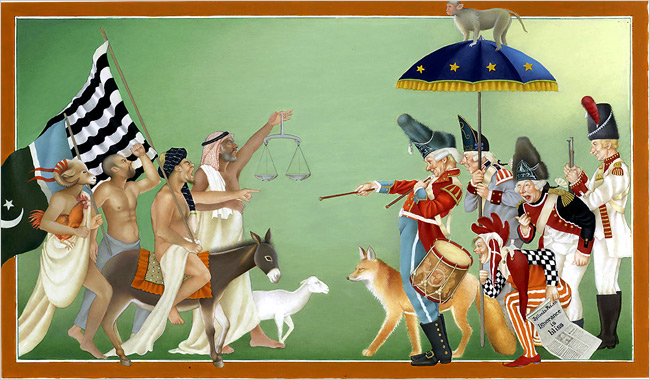
“Ignorance Is Bliss” by Saira Wasim
“With a tip of the hat to Norman Rockwell, “Ignorance is Bliss” illustrates a recent conflict between Western Europe and the Islamic world involving religious freedom and artistic expression”
Related;
A Mélange of Asian Roots and Shifting Identities
Blair confronts art close to home
Will Internet bring democracy to the Arabs?
By Paul

Kuwait’s Annus Mirabilis, an interesting article on Kuwaiti political developments;
“Like the orange-clad protesters, candidates sent reams of text messages, using lists of cell phone numbers generated from records of attendees asked to sign in at events. Some messages, featuring rumor and gossip, were campaign tricks designed to make another candidate look bad. Most focused on thanking the recipient for his or her support and offered information about the candidate’s next event.Blogs were a more important innovation. Voters could read some of the more sensational blog postings in daily newspapers. The Orange Movement leadership maintains a blog originating in the United States, managed jointly by overseas Kuwaiti students and one of the Orange organizers. This blog, KuwaitJunior, provided running news and commentary during the emiri transition in January 2006. During the campaign, it brought electoral corruption into the public eye thanks to a posting by a woman who recounted how two men in Rula Dashti’s district had attempted to buy her vote with the promise of a Chanel handbag. Although she did not mention the candidate’s name, it soon became public knowledge that she was speaking of Jamal al-‘Umar. The Orange leadership investigated this allegation by dispatching an undercover member, armed with a small video camera, to negotiate with the vote buyers. The camera failed, but the agent managed to capture pictures and voices on her cell phone. Then four young men who were not Orange organizers decided to challenge al-‘Umar during an event at his tent in Jabriyya southeast of Kuwait City. They asked him to explain why people were buying votes on his behalf if he was innocent of corruption as he claimed. The youths were roughed up and thrown out by the candidate’s assistants and, adding insult to injury, the Jabriyya police refused to accept their assault complaint. The worst part of the story came at the end, when al-‘Umar came in second, thereby winning a seat in the 2006 parliament….
All of which brings us back to democracy and Kuwait’s year full of miracles. As political scientist Eleanor Doumato has observed, women’s rights in the Arab Gulf states are the gift of monarchs, not parliaments. This is certainly the case in Kuwait, where opinion polls taken before the electoral law was changed in May 2005 showed a discouraging lack of support for female candidates, although more for female voters. The role of democracy in the 2006 election should be considered in broader terms than that, however. That there was an election at all was even more indicative of expectations that a democratic process should -- and did -- exist in Kuwait. The demonstrations that helped bring down the government were non-violent, as was virtually all of the official response to them. The new emir may have acted precipitously in canceling the parliamentary session and calling a new election -- and the speaker of the parliament later excoriated this decision publicly as unnecessarily confrontational. Yet only 20 years ago, a Kuwaiti emir dissolved a parliament and did not call for a new election until invasion, war and liberation made it impossible for him to continue resisting demands for the restoration of constitutional life.These demands came from Kuwaitis, through a long and occasionally frightening period when street demonstrations were met with more than the possibly accidental injury of one person by a policeman’s baton. The pro-democracy movement of 1989-1990 saw more widespread beating of demonstrators, along with the desecration of a mosque by tear gas and police dogs, and the arrest of more than a dozen prominent dissidents. Demands for reform came from outside, too, not only from exiles abroad during the Iraqi occupation, but also from countries that, having sent troops to liberate Kuwait, expected its leaders to behave better than the ousted invader. Despite clerical and even popular criticism, after liberation foreign ambassadors and NGOs pressed for women’s rights, protection for stateless persons, better treatment of maids and other foreign workers, and structural changes to open Kuwait’s economy and political system. That each of these causes was also advocated by Kuwaitis does not diminish the usefulness of external support from those whose good opinion Kuwaiti leaders value. Such external advocacy is not only an additional check on backsliding toward a more authoritarian past, but is also evidence that other governments support democratization in the Middle East.
Jamie Meyerfeld, writing in support of the International Criminal Court, emphasizes the role of external checks to support democracy. “Like Ulysses tied to the mast…democracies steel themselves against future unwise temptations…. It is astonishing that [102] countries have voluntarily agreed to make their own leaders vulnerable to prosecution and punishment before an international court.” Similarly, international observers add to the checks exercised by national constituents of governments. These national watchers are more important, of course, but a little encouragement from outside can reinforce their efforts to build democratic institutions, and discourage governments impatient with the noisy demands of democratic politics from shutting those institutions down. If the international community were serious about democratization, no pillar of authoritarianism would fall without an attentive audience listening for the crash.”
Via Abu Aardvark
Related;
Young Kuwaitis turn ‘Orange’
Kuwaiti women one step away from their political rights
Kuwait and democracy in the Gulf;
“Kuwait is hardly a model of democracy either—at least, not yet. Its head of state is hereditary, and he appoints the 15-person cabinet. Typically, half its ministers are members of the ruling Al Sabah family. All have voting rights in the parliament. This raises the number of legislators from the 50 elected MPs to 65, and raises the bar for winning a vote against the government. Yet the parliament does have the right to embarrass ministers with tricky questions. It can rely on the Arab world's freest press to air grievances, too, though in this small, hyper-rich state with barely 1m citizens among its 2.3m residents, word of scandal gets around anyway. In January, it won greater legitimacy when it endorsed the removal of the ailing crown prince, only a few weeks after the death of the previous emir, and his replacement by an abler man.”
Can Iraq Make It?
Why America gives Israel its unconditional support
Moody's warns of risk for Gulf banks
Multimedia;
Illusion and Reality in the Middle East-A Discussion of American Strategy Regarding Iran, Syria, and the Greater Middle East (podcast from New America Foundation)
Is Dubai the new model for the Middle-East?
Obituary: Egyptian Nobel Laureate writer Naguib Mahfouz
Balancing freedom against security
By Paul

Dahlia Lithwick reviews Posner’s new book;
“That is why Judge Richard Posner is such a welcome voice in the national conversation about balancing freedom against security. Posner, the brilliant and prolific federal appeals court judge, is renowned—and not always in a good way—for putting a price tag on everything. But whatever quibbles liberals may have with his law-and-economics approach to anything from rape to unwanted babies, they should celebrate the intellectual rigor he brings to the problem of civil liberties in wartime. In his new book, Not a Suicide Pact: The Constitution in a Time of National Emergency, Judge Posner approaches the wartime civil-liberties problem in precisely the manner the Bush administration will not: with a meticulous, usually dispassionate, weighing of what is gained against what is lost each time the government engages in data-mining, indefinite detentions, or the suppression of free speech…What Posner offers is the suggestion that careful balancing of liberties lost against security gained is a better alternative than the current regime that recognizes no cost to freedoms lost and no accountability for security achieved. By virtue of this careful balancing, Posner even criticizes a few Bush administration decisions. He questions, for instance, the decision to suspend the right to habeas corpus of U.S. citizens or foreign terrorists captured in the United States because he deems the cost of indefinite detention to exceed the gain in public safety.”
Related;
The Constitution is not a suicide pact
The Glenn & Helen Show: Richard Posner on Terrorism and the Constitution
Judge Posner interview Charlies Rose
Economics of Duty Free Shops
By Paul
Just re-watched Seinfeld’s The Airport episode;
Kramer: If anything, we'll probably get there early. I'll have a chance to
go to the Duty Free shop.
George: The Duty Free Shop? Duty Free is the biggest sucker deal in retail.
Do you know how much duty is?
Kramer: Duty.
George: Yeah, "duty". Do you know how much duty is?
Kramer: No, I dunno how much duty is.
George: Duty is *nothing*. It's like sales tax...
Kramer: I still like to stop at the duty free shop.
George: I like to stop at the duty free shop.
Related;
Seinfeld Classic Kramer & George – clip from The Airport
The Economics of Duty-Free Shopping
Duty Free at Baghdad International Airport
A Dilemma for Duty Free Shops
Podcast of the Day- Freud the philosopher
By Paul

Sigmund Freud was born 150 years ago this year. He was, of course, the father of psychoanalysis, but was he in any sense a philosopher? Listen to the podcast from Radio National.
Related;
In Freudian Slips Lisa Appignanesi revisits five of Freud’s major works for their centenary- BBC Science radio series.
Science and the Theft of Humanity
Blogs Philosophy related; A collection of blogs by David Chalmer, Marginal Revolution philosophy archive, Crooked Timber philosophy archive, Antimeta, Leiter Reports, The Fly Bottle, Show-Me the Argument, Plato’s beard, the web of belief, Thoughts Arguments and Rants,Crescat Sententia
Mark Steel lectures on Freud, Aristotle, Descartes - they have now been removed from Google Video
Some British Humor for the weekend
By Paul
Part of a British comedy show featuring Mark Steel- Part One, Part Two.
Have a nice weekend.
War on Sex Toys
By Paul
Plastic sex toys are bad for your health says Greenpeace;
“A new report released today by our Dutch office reveals that the plastics used to construct a wide range of sex toys contain very high concentrations of hazardous phlalates, toxic chemical softeners used in PVC to make it soft and flexible.Greenpeace Netherlands asked research organization TNO to test eight different sex toys, including dildos and vibrators, for phthalates. Worryingly, seven out of eight contained phthalates in concentrations varying from 24 to 51 percent. Remember, these are chemicals which do not easily biodegrade and can be dangerous - even in small amounts.
The research was commissioned after Durex's 2005 Global Sex Survey revealed that three million Dutch people admit to owning a sex toy. Over a million are sold there every year, making the market worth 22 million Euros.”
The solution according to Greenpeace is more legislation.
September 9, 2006
Iraq Chaos
By Paul

Juan Cole has a commentary in Salon on the divisions between the Shiite community in Iraq;
“Sadly, not even the man once considered the Shiites' great peacemaker has been able to stop the violence. The decline in influence of Grand Ayatollah Ali Sistani, once a revered voice of calm and unity, underlines the fragmentation of the Shiite south. When his call to stop a Shiite-on-Shiite skirmish in mid-August went unheeded, Sistani was reportedly so discouraged that he was said to be contemplating a complete withdrawal from politics. Sistani had earlier been a key architect of Shiite unity, cobbling the various religious parties into the United Iraqi Alliance, which has more or less won both parliamentary elections. But his influence has waned as he has continued to preach social harmony and avoidance of reprisals against Sunnis, a message the Shiite masses no longer want to hear.The military position of the United States and Britain in Iraq is already fragile. Coalition forces seem barely able to keep a lid on the Sunni Arab guerrilla movement in Ramadi, Samarra, Mosul and even Baghdad. The Pentagon admitted in its recent quarterly report that violence was up 15 percent in May through July over the previous quarter. July was the most violent month in terms of civilian fatalities since the fall of Saddam. Some 90 percent of the dead are simply found in the street - bullet in the brain, hands tied, signs of torture. For the most part such violence has been a dirty war conducted by Sunni and Shiite militias against one another. If Shiite-on-Shiite violence spreads, at a time when even Grand Ayatollah Sistani has been helpless to intervene, it is difficult to see how the American and British militaries can remain viable in Iraq.”
Related:
Iraq Country Analysis- Energy Information Administration
Cordesman: Civil War Can Break Out Anytime In Iraq
Iraq, Terrorism, and U.S. Politics
Fact Sheet: The President's National Strategy for Combating Terrorism
Saddam 'had no link to al-Qaeda' ; Senate's Intelligence Committee report
The Official Website of the Multi-National Force in Iraq
After the Guns of August- Saad Eddin Ibrahim;
"President George W. Bush has been short on neither initiatives nor catchy slogans and acronyms. Recent years are littered with them: “Global War on Terror” (GWOT), “Road Map,” “Middle East Partnership Initiative “ (MEPI), “Broader Middle East and North Africa” (BMENA) – originally “Greater Middle East Initiative (GMEI) – Democracy Assisted Dialogue (DAD), and so on. His latest reverie, envisioned in the thick of the recent fighting between Israel and Hezbollah, was the New Middle East (NME), with US clients Israel, Egypt, Jordan, and Saudi Arabia serving as the pillars of regional order."
Watchdog criticises US-run Radio Sawa, Alhurra TV; The Government Accountability Office (GAO) also found that Sawa and the Alhurra satellite television network were falling short in measuring the quality of their programmes, which the stations say reach nearly 36 million people.
Measuring Security and Stability in Iraq- Quarterly Reports
The Iraqi Conflict- miscellaneous links on Iragi history
Talking to Terrorists (podcast)
"This is a conversation with Rick Welch, a lawyer from McConnelsville, Ohio, who is also a Lieutenant Colonel in the US Army reserve. For 18 months, from late 2003 until the middle of last year, Rick was the civil-military advisor to the commander of the 1st Cavalry Division, Taskforce Baghdad, and a major part of his job was to sit down with key figures in the insurgency"
Thought of the Day- Political Dresses
By Paul

Source- The Good magazine
Related;
Open Secrets- your guide to money in politics
Decision '06
Singapore keep up to its reputation
By Paul
IMF/ World Bank released a statement rebuking Singapore government of refusing entry of certain NGOs for the annual meetings of the multilateral banks;
“In the interest of good governance, transparency and accountability, we urge the Government of Singapore to allow all properly accredited civil society representatives to attend our meetings. We have consistently opposed any restrictions on full participation and peaceful expression of views. Open dialogue with civil society is also important for the effective operation of our institutions.The Singapore Government has informed us of their objection to the accreditation of a number of these civil society representatives, and has stated their intention to block those individuals' access to the Annual Meetings. These individuals have been cleared to attend the Annual Meetings by their respective governments and we have accredited them according to our standard procedure.”
Financial Times notes;
“Some NGOs alleged that the IMF/World Bank, which holds its annual meetings outside Washington every three years, had selected Singapore as the venue for this year's meeting because of its authoritarian reputation. Previous IMF/World Bank meetings have been marred by violent protests.
Among those banned by Singapore were representatives from the UK-based World Development Movement, Thailand's Focus on the Global South, the Freedom from Debt Coalition in the Philippines and the Forum on Indonesian Development (Infid)”
Podcast of the Day- Diplomats and Parking fine corruption
By Paul
The Case of the Unpaid Parking Ticket- podcast of the Tim Harford article in Slate.
Or listen to a Tim’s interview discussing the issue online;
“There's a depressing conclusion and there's an optimistic conclusion. The depressing conclusion is there's nothing you can do about corruption because, well, you know, these guys from Chad and Bangladesh, they're just corrupt. That's what a lot of people, I think, have read this paper and thought that. But I take a different view. Because there's a kicker right at the end of the paper, which is what happened when the law changed. There was the Clinton-Schumer Amendment in 2002. It meant that, OK, you couldn't fine people for committing parking violations. But you could, and you would, tow their cars. And you would actually deduct the parking fines from each country's allocation of foreign aid. So they really started to take a stand on this.And guess what? Personal morality matters, but enforcing the law matters, too. Because when the amendment was passed, all of these parking violations, by all of these ambassadors, immediately fell by 90 percent. So there is hope for improving the world and stamping out corruption after all.”
There was an interesting letter in this week’s The Economist;
“SIR – In international events bronze medallists usually get little attention (“A ticket for corruption”, August 12th). However, when describing a new corruption ranking based on parking violations by UN diplomats you singled out Chad, the third-highest offender, and ignored Kuwait, the gold winner, which had twice as many infractions. I take solace in finding that my country's diplomats committed zero violations. Manuel Navas, Bogotá, Colombia”
Related;
“A study* by Raymond Fisman and Edward Miguel, economists at Columbia University and the University of California, Berkeley, gives a rare picture of how people from different cultures perform under new cultural norms. For instance, between 1997 and 2002 diplomats from Chad averaged 124 unpaid parking violations; diplomats from Canada and the United Kingdom had none. The results from 146 countries were strikingly similar to the Transparency International corruption index, which rates countries by their level of perceived sleaze. In the case of parking violations, diplomats from countries with low levels of corruption behaved well, even when they could get away with breaking the rules. The culture of their home country was imported to New York, and they acted accordingly.
The same applied to high-corruption countries. Their diplomats became increasingly comfortable with parking where they liked; as they spent more time in New York, their number of violations increased by 8-18%. Overall, diplomats accumulated 150,000 unpaid parking tickets during the five years under review.
Yet any moral superiority New Yorkers may feel should be tempered by the behaviour of the American embassy in London. Last year, embassy staff stopped paying the congestion charge—now £8, or over $15—for bringing cars into central London. The growing pile of unpaid charges now stands at $716,000.”
Blogs discussing the above paper; PSD blog, Marginal Revolution, Healthcare Economist
How Did Suharto Steal $35 Billion?
UN Diplomats Owe $18 Million in Parking Tickets
In The Economist this Week: Katrina, FEMA, and Corruption
Adventures in Cheating-A guide to buying term papers online
Some recent columns of Tim Harford;
Explaining the huge rise in teen oral sex
'Product sabotage' helps consumers
Overpaid, underworked and in charge
September 8, 2006
Why do people go on the Internet?
By Paul

It seems many Danes click online for government information, while the Swiss use the net more for job hunting, in UK more for games and music;
“Intensive computer game players are relatively few in number: usually male, aged 15-28, playing more than 20 hours per week. Mass-market consumers, on the other end of the scale, prefer playing games that are easy to learn and last a short time. Meanwhile, the market continues to evolve as players get older and tend to have higher incomes. Also, more and more women are starting to play multiplayer games online. In fact, although in most OECD countries men are more likely than women to use the Internet, significantly more women than men use it in the US.”
Why do you think it’s the case?
Related;
OECD STI Scoreboard
Internet World Statistics
Poll Shows More U.S. Adults Are Going Online at Home
A Web Journal Studying How Technology Affects Society
Digitial divide still separates white and minority students
Top 15 Online Populations by Country
Internet Activities
Free Reads from The Economist
By Paul

Free reads from latest edition of The Economist;
Climate change- The heat is on; The uncertainty surrounding climate change argues for action, not inaction. America should lead the way. Editorial on a survey of the topic.
A discussion with Emma Duncan, Deputy Editor of The Economist; “We need to think about climate change maybe as individuals think about insuring their houses: you spend maybe 1% of your annual income insuring your house not because you think it's going to burn down, but because if by any chance it did burn down, the consequences for you would be disastrous.” Listen to the podcast
Doing business; Singapore took first prize as the easiest place to do business in the World Bank's “Doing Business 2007” report. The Democratic Republic of Congo is the hardest place. Reform was the theme and Georgia the quickest reformer, leaping to 37th place in the rankings from 112th last year. China became one of the top-ten reformers by improving investor protection, cutting red tape and establishing credit history for loans
India's rupee- A disappointment for those hoping capital controls might ease soon; “THE chapter on the Fall of the Rupee you may omit,” counselled Oscar Wilde's prudish governess in “The Importance of Being Earnest”. “It is somewhat too sensational.” A new work on the rupee, in contrast, has set few pulses racing. A report by a committee set up in March by the Reserve Bank, India's central bank, to “revisit” the question of full convertibility of the currency recommends only slow change—too slow, for two of the committee's members, who have dissented from some of its cautious conclusions.
Business in Africa-Once again, Africa is listed as the most difficult place in the world to do business. So why are some businessmen happy to be there?; Foreign investors are governed by trust. India and China also rank relatively poorly in the World Bank survey, but are nonetheless investment magnets. Mr Klein argues this is because investors are confident that these countries are going in the right direction and they want to tap into their large markets early. Africa will have to prove itself through years of good performance and sustained reform before it can gain such confidence. But if it does, those who are already betting on the continent will be miles ahead.
Globalisation- Joe has another go; But if the writing is crisp, the arguments are a little soggy. Mr Stiglitz assumes the worst of markets, the best of governments—except, of course, his own. Too often, he wants to have it both ways: his distaste for the IMF has made him suspicious of all technocratic bodies, even to the point where he questions the case for independent central banks. But at the same time he wants to set up international tribunals to rule on unfair tax competition, for example, or health standards. He says that debt relief for the poorest countries is “simply a matter of accounting”, because they could not repay anyway. But he also wants to argue that the burden of red ink has crippled them.
Dismal science, dismal sentence-The efficient markets hypothesis can land you in jail
Can America's farmers be weaned from their government money?
Mexico's presidential election
Japan- The imperial imperative
Qatar-A bouncy bantam
The French presidency
Charlemagne-Europe's tentative reformers; In Germany it has long been customary for the government, in the interests of consensus politics and social stability, to give “the social partners”—the catch-all name for employers' associations, trade unions and other interest groups—special privileges when writing new laws. On occasion, governments have even asked specific groups to draft legislation. But in drawing up health-care and tax reforms, Angela Merkel's grand coalition has tried to shut health insurers and other lobby groups out of the decision-making process, refused to listen to mere objections and demanded that, if a lobby group has a criticism, it must come up with an alternative way of meeting the government's aim (one reason why the lobbies have turned on the government with offended fury). At the same time, two members of parliament who are also heads of employers' federations (and thus personify Germany's close ties between lobbies and government) have had to choose between their business jobs and their parliamentary seats. Oh, the indignity.
Bagehot-The sands run out ; Labour MPs may come to regret their attempt to force Tony Blair from office
Steve Irwin, crocodile hunter, died on September 4th, aged 44
Economic forecasts-The panel now expects America's GDP growth to slow to 2.5% in 2007, compared with August's prediction of 2.7%. The soothsayers think that the euro area will grow by 2.3% this year (up from 2.2% in August), then slow to 1.8% next year. Germany's growth in 2006 has been revised up from 1.7% to 2.0%. But Japan is now tipped to grow by 2.8%, down from August's prediction of 3.0%. The biggest upward revision is in Sweden's growth this year: it is now forecast to be 4.1%, the fastest of all the economies in the table
Cancer genetics-Variations on a theme; There are a lot more cancer genes around than were previously known
An explanation of how the Atkins diet works
A promising new artificial heart wins regulatory approval
Pluto fights back
Europe's financial sector is ill prepared for a coming upheaval
A row breaks out over the future of Japan's consumer finance
Banks in developing countries
The global housing market
Business Section; Mobile phones on planes / Pharmaceuticals / Drug patents / Viacom / Corporate corruption in Germany / Japan's basic industries / Mobile telecoms
Alan Mulally jumps from Boeing to rescue America's troubled carmaker
Translation, Please
By Kevin
At T&B, we don't get many foreign language Google Ads:

Can anyone provide a translation?
By following the link, one finds a news magazine with a number of strange accidental photo contrasts.
Ah, yes, the infamous Paris Hilton / Osama Bin Laden connection...
.
Iraqi Dinar Discussion: September 8, 2006 - December 14, 2006...
By Kevin
Comments on this post are closed. Go HERE for comments as of December 14, 2006.
Comments are working, but all commenters must now enter a six digit code to have their comments posted. However, you may now post up to five links in one post -- instead of three.
Here are all the posts in sequence:
1) June 16, 2004 - June 27, 2004
2) June 27, 2004 - November 6, 2004
3) November 6, 2004 - April 11, 2005
4) April 11, 2005 - June 22, 2005
5) June 22, 2005 - July 22, 2005
6) July 22, 2005 - April 30, 2006
7) April 30, 2006 - July 13, 2006
8) July 13, 2006 - September 8, 2006
9) September 8, 2006 - December 14, 2006
10) December 14, 2006 -
If you guys & gals encounter any problems, email me at kevin-at-truckandbarter.com.
Reader email has been pivotal to the administration of this site. Thanks for your patronage.
September 7, 2006
Good Inaugurals
By Paul
The John Curtin Institute of Public Policy has just established the journal Public Policy.
Via Andrew Leigh
Good Magazine- your subscription money goes to a charity of your choosing. See Jeffrey Sachs article and their blog.
Via Pienso
Asia's Economic Success- Perspiration or Inspiration?
By Paul
“For China and India, where the typical citizen is still a farmer and not an assembly line worker or a call center employee, continued productivity growth will come from the shift out of agriculture, but because a substantial portion of the population will still be employed in agriculture in these poor Asian economies for some time, an important objective of policy should be to improve agricultural productivity. For the richer Asian countries, the typical worker will increasingly be a stockbroker or a shop assistant, not a manufacturing worker. The focus there should be on improving service sector productivity. The problem here is service sector productivity has been trending downwards. Again, while governments should create an enabling environment for productivity growth by providing citizens broad-based access to education and finance as well as securing private property, they should also open to agriculture and services, especially open these to foreign competition as well as to domestic competition, so that these sectors have the same chance to generate the strong productivity growth that manufacturing has done in much of Asia.”
- Raghuram Rajan, Economic Counselor and Director of Research,IMF
Press Briefing on the Analytic Chapters of the World Economic Outlook
The Road Less Traveled of Business Regulatory Reform
By Paul
 According to the World Bank's Doing Business 2007, the four steps to successful business regulatory reform;
• Start simple and consider administrative reforms that don’t need legislative changes.
• Cut unnecessary procedures, reducing the number of bureaucrats entrepreneurs interact with.
• Introduce standard application forms and publish as much regulatory information as possible.
• And remember: many of the frustrations for businesses come from how regulations are administered. The internet alleviates these frustrations without changing the spirit of the regulation
More on the report from the preface;
“Regulations affecting 10 areas of everyday business are measured: starting a business, dealing with licenses, employing workers, registering property, getting credit, protecting investors, paying taxes, trading across borders, enforcing contracts and closing a business. The indicators are used to analyze economic outcomes and identify what reforms have worked, where and why.The methodology has limitations. Other areas important to business—such as a country’s proximity to large markets, quality of infrastructure services (other than services related to trading across borders), the security of property from theft and looting, the transparency of government procurement, macroeconomic conditions or the underlying strength of institutions—are not studied directly by Doing Business. To make the data comparable across countries, the indicators refer to a specific type of business—generally a limited liability company operating in the largest business city.
The methodology for 4 of the Doing Business topics changed in this edition. For paying taxes, the total tax rate now includes all labor contributions paid by the employer and excludes consumption taxes. For enforcing contracts, the case study was revised to reflect a typical contractual dispute over the quality of goods rather than a simple debt default. For trading across borders, Doing Business now reports the cost associated with exporting and importing cargo in addition to the time and number of documents required. And for employing workers, nonwage labor costs are no longer included in the calculation of the ease of employing workers. For these reasons— as well as the addition of 20 new economies—last year’s rankings on the ease of doing business are recalculated using the new methodology and reported in the Overview.”
Singapore is the number one in the rankings- coincidently the World Bank-IMF annual meetings are also being held in Singapore this month. It is interesting that Singapore (not a democratic country according to Acemoglu) beat more deomcratic countries like Australia in the rankings.
As for a lot of the other poor countries, there is a sense in these countries that a lot of the wealth has been generated through either corruption or unfair competition. May be one need to take a hard look at some of the local partners of the Doing Business survey for their independence.
Quick Links;
The Doing Business Law Library
Create their own custom dataset of main indices
Local Partners
Economy Rankings
Explore Economies
Economy Characteristics
Related;
Blog coverage of the report- PSD Blog, New Economist, Greg Mankiw, Econlog, Pienso.
Doing Business and Poverty Reduction
Measuring Labor Market Flexibility
Doing Business in 2006: Creating Jobs-online discussion
How Should States Encourage Entrepreneurship?
"At the heart of this public policy issue are two competing views of how to facilitate entrepreneurship. For some policymakers encouraging entrepreneurship involves improving the entrepreneurial climate through the lowering of tax and regulatory burdens. This view is consistent with a large body of academic literature showing that a good way to encourage entrepreneurship is to provide individuals with the freedom to pursue their dreams. Other policymakers focus on the financial constraints facing would-be entrepreneurs and how public policy can mitigate the financial hurdles to entrepreneurship. State financing of venture capital firms is consistent with this view."
Multimedia
Podcast of news from the World Bank on the Doing Business 2007
The Mystery of Capital: Why Capitalism Triumphs in the West and Fails Everywhere Else; I would also highly recommed de Soto's book, 'The Other Path'
How to Reform the Business Environment ; highly recommended especially comments by Egyptian minister.
Doing Business in 2006: Creating Jobs- Book Event at Cato
Doing Business in India Today: McDonalds Experience Entering the Indian Market
Related Bank Publications
Doing business in 2006 - creating jobs
Doing Business in 2005
Doing business in 2004 : understanding regulation
Doing business in South Asia in 2005
Doing business in 2005: comparing the Cambodian business environment with the world
Doing business in 2005 : India regional profile
Ukraine - Cost of doing business survey, 2002
Latvia : self-assessment report on administrative barriers to doing business
Perceived obstacles to doing business: worldwide survey results
Doing better business through effective public consultation and disclosure : a good practice manual
Doing business in Brazil
Doing business in Mexico
Despite many reforms, doing business is still not easy in Vietnam
Institutional obstacles to doing business : region-by-region results from a worldwide survey of the private sector
*updated 8th September, 2006
September 6, 2006
A New Map of the Middle East?
By Paul

An article in Armed Forces Journal suggests we need to revise the map of the of the Middle East;
“A just alignment in the region would leave Iraq's three Sunni-majority provinces as a truncated state that might eventually choose to unify with a Syria that loses its littoral to a Mediterranean-oriented Greater Lebanon: Phoenecia reborn. The Shia south of old Iraq would form the basis of an Arab Shia State rimming much of the Persian Gulf. Jordan would retain its current territory, with some southward expansion at Saudi expense. For its part, the unnatural state of Saudi Arabia would suffer as great a dismantling as Pakistan.A root cause of the broad stagnation in the Muslim world is the Saudi royal family's treatment of Mecca and Medina as their fiefdom. With Islam's holiest shrines under the police-state control of one of the world's most bigoted and oppressive regimes — a regime that commands vast, unearned oil wealth — the Saudis have been able to project their Wahhabi vision of a disciplinarian, intolerant faith far beyond their borders. The rise of the Saudis to wealth and, consequently, influence has been the worst thing to happen to the Muslim world as a whole since the time of the Prophet, and the worst thing to happen to Arabs since the Ottoman (if not the Mongol) conquest.
While non-Muslims could not effect a change in the control of Islam's holy cities, imagine how much healthier the Muslim world might become were Mecca and Medina ruled by a rotating council representative of the world's major Muslim schools and movements in an Islamic Sacred State — a sort of Muslim super-Vatican — where the future of a great faith might be debated rather than merely decreed. True justice — which we might not like — would also give Saudi Arabia's coastal oil fields to the Shia Arabs who populate that subregion, while a southeastern quadrant would go to Yemen. Confined to a rump Saudi Homelands Independent Territory around Riyadh, the House of Saud would be capable of far less mischief toward Islam and the world.
Iran, a state with madcap boundaries, would lose a great deal of territory to Unified Azerbaijan, Free Kurdistan, the Arab Shia State and Free Baluchistan, but would gain the provinces around Herat in today's Afghanistan — a region with a historical and linguistic affinity for Persia. Iran would, in effect, become an ethnic Persian state again, with the most difficult question being whether or not it should keep the port of Bandar Abbas or surrender it to the Arab Shia State.What Afghanistan would lose to Persia in the west, it would gain in the east, as Pakistan's Northwest Frontier tribes would be reunited with their Afghan brethren (the point of this exercise is not to draw maps as we would like them but as local populations would prefer them). Pakistan, another unnatural state, would also lose its Baluch territory to Free Baluchistan. The remaining "natural" Pakistan would lie entirely east of the Indus, except for a westward spur near Karachi.”
Via Cartography blog.
*I do not share the views of the author
Podcasts Carnival
By Paul
Dr Karl Sauvant - World Investment Prospects to 2010: Boom or Backlash? (Radio Economics). Here is special edition of the report
Jospeh Stiglitz: making globalisation work; Nobel Prize winning economist Joseph Stiglitz has written a follow-up to his best-selling book "Globalisation and it Discontents" which looks at the current problems with globalisation and the forces of reform at work. Related posts by Tyler Cowen on Making Globalization Work, or Joe Stiglitz watch, part II and Joe Stiglitz watch
Sri Lanka; With violence once again erupting in Sri Lanka, Rear Vision traces the historical roots of the conflict. Guests include Jonathan Spencer, Professor of Anthropology of South Asia , University of Edinburgh, Dr. Jayadeva Uyangoda,Professor and Head, Department of Political Science and Public Policy, University of Colombo, Dr. Paikiasothy Saravanamuttu, Executive Director of the Centre for Policy Alternatives, an independent, nonpartisan, public policy centre with a focus on peace and governance, Colombo
Books That Shook the World - Plato's Republic
Anthony Arnove; The Logic of Withdrawal
Christopher Scanlon on The Joint Strike Fighter
Australia and the nuclear renaissance; Nuclear is back. Australia, with its abundant ore and 'good guy' status could become a key member of the uranium enricher's club. But what would the neighbours think? And how would the twin threats of weapons proliferation and waste disposal be addressed?
John Mortimer (Edinburgh International Book Festival)
Polash Larsen's review of Londonstani, by Gautam Malkani
Engineering wonders: tunnels and bridges
Over-fished or over-regulated?; According to marine biologist Dr Walter Starck, Australia has the most over-managed, heavily restricted and least productive fishery industry in the world. He'll be speaking at the upcoming Australian Environment Foundation inaugural conference. We're also joined by chair of the foundation, Don Burke, to hear why Australia needs another environment group.
Australia On The Map Part One: The Siren South; This is the first program in the Australia On The Map series, exploring early Dutch exploration of the Australian coastline. This year marks the 400th Anniversary of the first mapping of our northern coastline by Dutchman Jan Lodewijkszoon van Rosingeyn and the crew of the Duyfken
Jess Adkins has a lab full of cucumbers made of stone. They are, in fact, drill cores of corals from all over the world. He analyses these with surprising results, getting a remarkably accurate story of past climates going back thousands of years. This young professor from Caltech (the California Institute of Technology) has some amazing stories to tell of adventure and exploration
Jane Goodall is one of the best-known observers of animal behaviour. She revolutionised the field in the 1960s by watching chimpanzees in the wild. What now does she make of their relationship with humans? And what are their prospects? Will they really become extinct outside zoos within a generation?
Lee Edwards; BP now stands for Beyond Petroleum. The company says it is proud of its diversification from fossil fuels. But will solar be enough to make a difference? Dr Lee Edwards runs BP's solar research from his base in Chicago and he foresees cities which are self-reliant through the sun and alternative sources rather than through a dependence on oil. But will BP withstand competition from less green rivals?
Western Democracies and Voter Cynicism
Derek Denton: The Dawning of Consciousness
Teachers and Performance Pay
featuring Andrew Leigh, Economist,Australian National University Co-author of "How and Why has Teacher Quality Changed in Australia?"
Anyone who had a heart would know their own language; Another chance to hear virtuoso grammarian Geoff Pullum on the logic of standard English usage...as described in The Cambridge Grammar of the English Language.
Cliches: are they worthless? The poet Chris Wallace Crabbe on the brass razoos in the currency of conversation.
Climate change; Dr Barrie Pittock of the CSIRO talks about climate change and risk management and what to do about climate change
The David Hicks Case; Former attorney-general Kep Enderby QC looks at the imprisonment of David Hicks at Guantanamo Bay
Tea with Glen Matlock; The confessions of a middle aged Sex Pistol.
Michael Whelan, S.M.; He helped found Spirituality in the Pub, a network of groups across Australia that meet to discuss all kinds of spiritual issues with the aim of deepening faith and transforming lives. For Michael Whelan, a priest in the Society of Mary congregation, conversation is a vital instrument of change, and he talks about his own spiritual development away from moralism and toward mysticism
Bad Hair day: principles and politics in international cricket
Africa's struggle for political evolution
Middlebury "Symposium on Terror and Mass Media" sessisions;
Douglas Birch, Baltimore Sun Correspondent on The Politics of Terror
The Media's Role in Promoting or Fighting Terrorism
Ahmed Abdella, Senior producer and reporter for Al- Arabiyya Television
Is Terrorism Challenging Press Freedom?
Pierre-François Mourrier, director of research for the Office of the French President
Non-proliferation of Weapons of Mass Destruction
Hans Blix, Chairman of the WMDC (Weapons of Mass Destruction Commission) addresses a conference at the Fletcher School, Tufts University
James Madison and the Spirit of Republicanism
Colleen Sheehan, Villanova University
Schiavo and the Shibboleth of Privacy
Daniel N. Robinson, Oxford University; Georgetown University
John Marshall and the Myth of Marbury
Robert Lowry Clinton, Southern Illinois University-Carbondale
Lessons from the Lincoln Administration for the War on Terror
Michael Stokes Paulsen, University of Minnesota Law School, on "The Emancipation Proclamation and the Commander-in-Chief Power: Lessons from the Lincoln Administration for the War on Terror
Media Coverage of Climate Science: Broader Lessons for Science Journalism? (VIDEO)
Nature podcasts; Male infertility, Bird flu's structural secrets and silent spread, cryptic Martian spots explained, the ethics of egg donation, Warmth-seeking bees, Poincaré unpickled and more
National Geographic Podcasts, National Geographic World Talk
Scientific American podcasts, Science Talk episodes
Google News Corporation
By Paul
Google has started a new feature- News Archive Search. I tried searching for Maldives news items- some interesting things came up (slight spelling corrections made below);
“Holland Evening Sentinel - NewspaperArchive - Jul 7, 1952, THE BENIGHTED MALDIVES LACK CIVILIZED WOES; Now that the Maldive islands, in the Indian ocean, have adopted a republican form of government, it is obvious that something ought to be done to bring the benefits twentieth century civilization to the inhabitants. The MALDIVES, known chiefly to stamp collectors, seem to be singularly backward. They have no relations to speak of with other nations, and hence no cold war tensions. They have no television, and only a few automobiles, limited to one' of the inhabited islands. They have no crime and no jails. The islanders never need aspirin or pheno-barbital. The people, it seems, spend most of their time fishing, fashoning lacquer work, making rope and collecting. They've never learned to get stirred up over things. When the time comes to change their government, they don't make a lot of fuss and speeches; they simply tell some- ody to sit under a palm tree and up a constitution. It's something of a mystery why these benighted people have not tried before this to improve their sorry lot and learn how to enjoy he boons we civilized people take or granted. There's a possible answer which we hate to consider, .faybe they're smarter than we.”Native Revolt In Maldives Is Disclosed; LONDON, Jan. 8 1959 (AP)--Angry mobs swarming from a canoe armada have wrecked and burned offices of the native Government on a remote ...
Reno Evening Gazette - NewspaperArchive - Dec 7, 1934, Maldive Islands lack a sultan Until recently this Indian ocean archipelago had a ruler, Sultan Shamsudeen Iskander, who paid tribute to the British government of Ceylon. Caught trying to substitute an absolute monarchy for the established representative government of the MALDIVES, he has just been dethroned by King George V. "Dreamers who long for an Idyllic Island existence would find their dreams punctured by a visit to the Maldive Islands says a bulletin from the Washington, D C headquarters of the NATIONAL Geogiaphic Society.…Tourists are warned against sleeping on the islands, as they, even more than natives, fall prey to strange complaints…; climate more than anything else, has hindered the development of these islands, especially their foreign intercom se "Only seventeen of the two thousand Islands are inhabitable, …But even agriculture In the MALDIVES has its drawbacks. Natives have to fight armies of rats which menace their cocoanut crops. All the rice consumed must be imported, and is so expensive that only the wealthy can afloid It …..So frequent are wrecks on this and other Maldive Islands that the governor of Ceylon, in granting Ceylon's, and therefore Britain's protection to the MALDIVES, stipulated that, In return, the islanders must aid all Europeans wrecked on their atolls. "In spite of bad climate, bad water, and other obstacles that would discourage most people, the eighty thousand Maldive Islanders live fairly comfortably. Most of them are short, dark copper in color, Intelligent and Industrious They weave their own cloth, and their own boats and nautical Instruments They are skilled navigators and spend much time on the water fishing for bonito. Several of the islands maintain training schools for sailors Maldivans are Mohammedans and occasionally make pilgrim voyages to the Red Sea …
"Native products are peddled among the Islands in native boats, but all trading with foreign countries is done from Male Island, capital of the group. Male, or Sultan’s Island, Is one of the nine inhabited islands ol a group of fifty which compiise Male atoll. On its small surface, less than one square mile In extent, aie crowded trees, houses along sandy streets, foits, the Sultans tomb, and the dethroned sultan's wall-enclosed palace One thousand of Its approximate five thousand Inhabitants are soldiers. "Coral patches and tide lips make one side of Male Island inaccessible, but the harbor on Its east side, protected by a rough breakwater is good. Once a month, two-masted sailing vessels leave for Colombo, Ceylon, with mail, reaching there in three days If the monsoon winds are favorable, sometimes not for thirty days, If they are unfavorable. In August 01 September boats leave for Ceylon, and Calcutta India, carrying principally coir yarn Male Island reaches its peak of activity and excitement when the annual foreign tiaclers call in March. Natives who have brought their product from other atolls gather on the shore to hall ijith delight ships from Ceylon, Sumatia, and Chittagong, India. Duty, consisting of bags of rice, red handkerchiefs, and other commodities such as onions coriander seed and cummin seed, was formerly presented to the Sultan and his government officials "To watch Maldivians do their equivalent of Christmas shopping is to witness a colorful sight. Foreign traders purchase from them large quantities of bonito, which is in great demand in Sumatra and Ceylon. They also buy tortoise shells, coconuts, coir yam, woven glass mats, and cowrie shells used as currency by some Asiatics. In return, the islanders receive rice, dates, salt, curry- stuff, leaf tobacco and betel nuts. They prize red and white checkered handkerchiefs, coarse white cloth, and colored waist cloths. Chinaware and Indian pottery go over big. Although they make a kind of sugar from cocoanuts, they are glad to get coarse brown sugar. They will also trade their cowrie shells for small quantities of steel, thread and brass."
‘There is no compulsion in religion’
By Paul
Juan Cole reminds us that;
“Al-Sharq al-Awsat reports that the Grand Sheikh of al-Azhar Seminary in Cairo, perhaps the foremost Sunni Arab authority, has issued a statement that jihad or "holy war" was legislated in Islam for the defense of the persons and honor of Muslims, and is not to be used as a threat or a form of aggression against the innocent.”
We shouldn’t forget religious practices are not monolithic;
“In Senegal, I found local Muslims irate at the condescending attitudes of Saudi emissaries who condemned their practices as contrary to Islam. With their long-established Muslim brotherhoods and their beloved marabouts, the Senegalese responded, "We were Islamic scholars when the Saudis were living in tents."From West Africa to Indonesia, an unnoted defense against Islamist extremism is the loyalty Muslims have to the local versions of their faith. No one much likes to be told that he and his ancestors have gotten it all wrong for the last five centuries. Foolish Westerners who insist that Islam is a unified religion of believers plotting as one to subjugate the West refuse to see that the fiercest enemy of Salafist fundamentalism is the affection Muslims have for their local ways. Islamist terrorists are all about globalization, while the hope for peace lies in the grip of local custom.
Uninterested in political correctness, a Muslim from Côte d'Ivoire remarked to me, "You can change the African's dress, you can educate him and change his table manners, but you cannot change the African inside him." He might have said the same of the Russian, the German, or the Chinese. By refusing to acknowledge, much less attempting to understand, the indestructible differences between human collectives, the 20th-century intelligentsia smoothed the path to genocide in Rwanda, Bosnia, and Sudan, as well as to the age of globalized terror. Denied differences only fester; ignored long enough, the infection kills.
Our insistence that human beings will grow ever more alike defies the historical evidence, as well as practical and spiritual needs. Paradoxically, we make a great fuss of celebrating diversity, yet claim that human values are converging. We, too, have our superstitions and taboos.”
Related;
Sheikh of Al-Azhar : Jihad initiated for self-defense and not for threat or attack
Young U.S. Muslims Strive for Harmony
For Conservative Muslims, Goal of Isolation a Challenge
Iran's liberal lecturers targeted
Creation of "Islamic" Bogeyman
World Conference of Religions for Peace
Fair play and civility in interreligious relations
Multimedia;
Dr Gary Bouma, Professor of Sociology, Monash University on the World Conference on Religions for Peace
Weird Babel of Tongues; One hundred years ago an old building on Azusa Street in the industrial part of Los Angeles held religious meetings that started with people 'breathing strange utterances and mouthing a creed...no sane mortal could understand.' It was the beginning of the modern Pentecostal movement, which remains a thriving church tradition mainly within Protestantism
Creating a Sacred Space; The City of Greater Dandenong is one of Australia's two most diversely populated municipalities and its local hospital, a large acute care hospital, has substituted a multi-faith 'sacred space' in the place of its old chapel. Members of the hospital staff and the City of Greater Dandenong's Interfaith Network, and the Dandenong Historical Society tell about the creation of the sacred space
The Dawning of Consciousness; Emeritus Professor, Derek Denton, is internationally recognised for his work on instinctive behaviours. Professor Denton is 82 but remains involved in various research projects around the globe. His most recent venture is the most ambitous to date - it aims to demonstrate the role of evolution in the emergence of animal and human consciousness
Chinese philosophy; To anybody schooled in Western philosophy, Chinese philosophy doesn't look much like philosophy at all: there seems to be no argument, no analysis, just a lot of proverbs and stories. But this is real philosophy and Dr Karyn Lai gives us an overview. And Chin-Ning Chu, author, motivator and strategist explains what relevance the oldest military treatise in the world has in today's boardroom
September 5, 2006
Equality of opportunity among states
By Paul
Robert H. Wad reviews Economic Justice in an Unfair World: Toward a Level Playing Field by Ethan B. Kapstein;
“Focusing on poverty is inadequate, Kapstein argues, because it does not put relations between states front and center. "It is governments," he writes, "that sign treaties and agreements, impose sanctions and boycotts, and make war and peace, and it is governments that -- for good or for bad -- are ultimately accountable for their actions at home and abroad." In other words, a theory of global distributive justice must emphasize relations between states and the kinds of economic arrangements states subscribe to. Individuals are not the only moral agents; states are also moral agents, with duties and responsibilities to one another as well as to their citizens.Kapstein's goal is to present an alternative framework of global justice, one that centers on equality of opportunity among states. He refers to this framework as "liberal internationalism" and calls for an international economic system that is "inclusive, participatory, and welfare-enhancing for all." This order, Kapstein writes, "would give the smallest and poorest states greater voice in the system than they have at present," including in the governance of international organizations.
Building on the work of the political theorist Charles Beitz, Kapstein distinguishes two different social compacts: the domestic one between a state and its citizens, which expresses a society's basic principles of economic justice, and an international one among states, which determines the context in which countries pursue their domestic compacts. Some theorists of international relations hold that relative power, especially military power, shapes the international compact entirely. But Kapstein points out that powerful states do not always operate with a bit-better-than-the-law-of-the-jungle morality. In fact, they often forgo immediate relative gains in the interest of building a system of interactions that all participants view as reasonably fair. The resulting stability of expectations brings benefits for powerful states while increasing the common good. By way of evidence, Kapstein cites studies of the Tokyo and Uruguay Rounds of trade negotiations finding that the most powerful countries did not press their full advantages. Steered by the goal of promoting greater market access for all countries, they gave up more than they got.The social arrangement that, in Kapstein's view, guarantees inclusiveness and participation and is "welfare-enhancing for all participants" is a global regime of free trade. In other words, free trade is the social arrangement that has the potential to best achieve justice in interstate relations and to fulfill each state's domestic social compact.
Kapstein believes that free trade can generate the highest attainable economic growth -- because it maximizes the scope of opportunity and equalizes opportunities for all potential participants -- and that high economic growth is good for the poor as well as the nonpoor. But he is also aware that despite the expansion of free trade, the growth rates of poor countries have not converged with those of rich countries, as free-trade advocates had predicted they would (the experiences of East Asia and, more recently, South Asia notwithstanding). Some of the continuing disparity -- owing to persistent low growth in a majority of poorer countries -- results from domestic politics and policies and from geography. But a good part, Kapstein argues, is due to the fact that rich countries have rigged the trade regime; far from being a level playing field, it is distinctly tilted against producers in poor countries…”
Via Peinso- a cool new development issues blog.
Watch or listen book event featuring Kasptein and Deepak Lal at Cato.
Related;
Excerpt from the Book, and Chapter 1 of the book
Daniel Dreszner’s short review of the book
Interesting papers by Ethan B. Kapstein;
The Economics of Young Democracies: Policies and Performance
Behavioral Foundations of Democracy and Development
The Political Economy of International Cooperation: A View From Fairness Economics
A Global Third Way Social Justice and the World Economy
Models of International Economic Justice
The Case for Open Industrial Policy- webcast of an event featuring Robert Wade
The Truth about Globalization and Inequality
Mean Republicans and Median Democrats
By Paul
The latest column of John Allen Paulos’, “Who’s Counting:It's Mean to Ignore the Median”;
“Believe it or not, the difference in the way the Democrats and Republicans react to the performance of the U.S. economy is clarified by a mathematical distinction studied in elementary school. The distinction is between the mean, which the Republicans emphasize, while the Democrats prefer the median. Before turning to the economy, let me review a little fourth-grade arithmetic….The relevance of this distinction is apparent in the just-released figures on the U.S. economy for 2004, the latest year for which there is complete data. The Republicans chortle that the economy grew at a healthy rate of 4.2 percent. (It's slowed since then.) The Democrats point to data from the Census Bureau for the same year (and earlier as well), indicating that the real median family income fell and that poverty increased…
Still, this lopsidedness is neither necessary nor inevitable, and it bodes ill for civil society. Almost 2,400 years ago Aristotle, seeing the discord between ancient Greece's rich and poor, applied his idea of the golden mean to call for an equitable (but not equal) income distribution. For purposes of stability, he favored establishing a strong middle class and government policies to assist in this establishment.
A little game from the field of behavioral finance illustrates the class resentment Aristotle described. The so-called "ultimatum game" generally involves two players: One is given a certain amount of money, say $100, by an experimenter, and the other is given a kind of veto. The first player may offer any nonzero fraction of the $100 to the second player, who can either accept or reject it. If he accepts it, he is given whatever amount the first player has offered, and the first player keeps the balance. If he rejects it, the experimenter takes the money back…”
Smoker’s International Airways
By Paul
It’s about time you had an airline for smokers;
“With a growing number of countries choosing to ban smoking in public places, it is an idea that might seem inopportune. But Mr. Schoppmann, a German entrepreneur, is hoping to take advantage of smokers’ resentment at efforts to further curb where they can smoke by giving them their own airline, Smoker’s International Airways.As the name suggests, the airline, known as Smintair, will probably not be for the faint of lung. The carrier, expected to begin luxury service with business and first-class seats early next year, plans daily flights between Mr. Schoppmann’s hometown of Düsseldorf and Tokyo — a 12-hour journey that, for some smokers, is simply not worth the nicotine-withdrawal headache.
“Many people simply don’t travel long distances anymore because they can’t smoke,” said Mr. Schoppmann, 55, who smokes 30 cigarettes a day in addition to the occasional cigar. “That has to be why they invented videoconferencing.”…
According to the International Air Transport Association, more than a million passengers traveled between Japan and Germany in 2004, a figure that is expected to increase by an average of 3.6 percent a year through 2009. While the majority of Japanese visitors to Germany are tourists, fully half of Germans traveling to Japan are there on business.
What’s more, about one-quarter of Germans smoke, while in Japan, 49 percent of men and 14 percent of women do, according to government surveys…”
Related;
Thank You for Smoking
Stephen Colbert - Civil Lights
One of the SMINTAIR Philosophies;
“Allowing our guests to smoke is one of the freedoms we are happily prepared to grant. Non-smokers will find the cabin air more refreshing than on any other flight with any other airline, as SMINTAIR adds fresh outside air to the conditioning system! This is more expensive, as it burns more fuel, but it is seen as an additional service to our guests.”
Arundhati Roy’s Question
By Paul
It is now 4 days to the Dropping Knowledge forum.
Arundhati Roy’s questions about the future of non-violent resistance and armed struggle. “What is effective?,” she wonders. “What is the right thing to do?”.Here is the video.
Related;
Civic Power and the People’s Rights: Nonviolent Action for a New World, Speech by Jack DuVall, President, International Center on Nonviolent Conflict
Barter your Old Books with BookMooch
By Paul
BookMooch- a barter system for books (via Boing Boing)
Here is their economics section.
September 4, 2006
Markets in Everything-Selling Dreams
By Paul

"Anyone who can't sell a bag of air with a dream inside it doesn't deserve to call himself an American, much less an art dealer." -David Hickey
Podcast of the Day-Crisis of Abundance
By Paul
Crisis of Abundance: Rethinking How We Pay for Health Care- Arnold Kling’s book presentation at Cato;
“If you follow the video or audio all the way through to the Q&A, you will hear a Congressional aide's rant against economic analysis of health care. I chose not to respond, and I think that was the right choice. The book explains why health care is an economic issue, and I would leave it at that. Frankly, I thought that the audience Q&A did not add much. Just as with comments on blog posts, the first one often sets the tone, so that it's important to get a good question first.”
Listen to the podcast. Here is a discussion of the book at Tech Central Station. Also a Cato interview Arnold Kling.
Related:
Podcasts; Cogan on Improving the Health Care System, The Economics of Medical Malpractice
Sylvia Allegretto, an economist at the Economic Policy Institute and author of "The State of Working America," talks with Bloomberg's Tom Keene from Washington about her analysis of the U.S. labor market. Listen to the podcast.
Dead Meat is a 25 minute short film which shows the reality of health care under Canada's socialized medical system
Economics of Obesity
In praise of US health care
Unhealthy America
Charlie Rose interview with New York City Commissioner for Health & Mental Hygiene, Thomas Frieden
Economics of Health Care posts at Econlog, Economist’s View, Café Hayek, Marginal Revolution
Healthcare Economist blog
Health Courts: Exploring the Concept
The Health Report- podcasts from Radio National.
Voluntary C-Sections Result in More Baby Deaths
Health Care Costs
Health Financing Revisited: A Practitioner's Guide
Health Insurance in Francophone Africa
GAO reports;
Hispanic Access to Health Care: Significant Gaps Exist
Preventive Health Care for Children: Experience From Selected Foreign Countries
Canadian Health Insurance: Lessons for the United States
Health Care Spending Control: The Experience of France, Germany, and Japan
Health Insurance: Bibliography of Studies on Health Benefits for the Uninsured
India - Five-year roadmap to fuller rupee convertibility
By Paul

The Hindu reports;
“The Reserve Bank of India (RBI) Committee, headed by S. S. Tarapore, on Fuller Capital Account Convertibility has recommended that the scheme should be implemented in a five-year period in three phases and at the end of the five-year period ending in 2010-11, "there would be a comprehensive review to chalk out the future plan of action".The committee, whose report was submitted to the RBI on July 31 and which was made public on Friday, recommended that the annual limit of remittance by individuals to open foreign currency accounts overseas be raised to $50,000 in phase one from the current level of $25,000 and further raised to $100,000 in phase two and $200,000 in phase three. Difficulties in operating this scheme should be reviewed, it observed. Since this facility straddles the current and capital accounts, the Committee recommended that "where current account transactions are restricted, that is, gifts, donations and travel, these should be raised to an overall ceiling of $25,000 without any sub-limit".
"All individual non-residents should be allowed to invest in the Indian stock market through SEBI registered entities including mutual funds and portfolio management Schemes who will be responsible for meeting Know-Your-Customer norms and the money should come through bank accounts in India". It recommended allowing non-resident corporates also to invest in Indian stock markets in the same manner the RBI allowed non-resident individuals...”
Related;
Fuller Capital Account Convertibility Report. See also the ‘Dissent’ piece by Surjit Bhalla in the report.
Ajay Shah's blog- has a roundup of the report
A Monetary Policymaker's Passage to India
India's RBI to Consult Government on Rupee Conversion
The rupee; fear of freedom
Are free capital movements a good idea?
India: Selected Issues- IMF February 2006
India Development Policy Review 2006
India: Country in Brief
Should India go for Capital Account Convertibility?
India-Research Publications from World Bank
How to solve the RBI problem
Subsidizing inefficiency
Doing Business India-Dealing with Licenses-The steps, time, and costs of complying with licensing and permit requirements for ongoing operations in India- It takes 20 steps and 270 days to complete the process, and costs 678.5% of income per capita.
Recent edition of Foreign Exchange TV show with focus on India- Arvind Panagariya interviewed in the show.
Time for India to reduce inequality
Economic and Political Weekly
Mukherji, Joydeep. "Economic Growth and India's Future."
New Economist posts on India
The Norwegian Model
By Paul
Avoiding Dutch Disease and investing ethically- Norway shows the way;
“The central bank administers the country's pension fund, which is financed mainly by Norway's booming oil and natural gas industries. As the world's third-largest oil exporter, the fund has a king's ransom at its disposal. The last time the the books were balanced, the fund disposed of €196 billion ($250 billion) in assets. Analysts predict it will grow this year to become the second-largest pension fund in the world.Roughly four percent of the fund's financial resources have gone into the state budget every year since 2001. The money is used to cover shortages and finance projects that benefit the well-being of country's citizens. Most of the remaining sums are invested for future generations -- for the time when Norway's oil and natural gas reserves will have been used up.
The fund is responsible for no less than 0.3 percent of all the stocks traded worldwide, it holds shares in more than 3,200 corporations and its portfolio reads like a "Who's Who" guide to the world of international investment. It includes Blue Chip corporations such as Accor, Adidas, BASF, Porsche, Siemens, Volvo and Zürich Financial. Norway has shown great acumen with its portfolio -- in 2005, it had a return on investment of 11.1 percent, or about €20 billion ($26 billion)….
In November 2004, the government established ethical guidelines for the investment policy of its pension fund. Since then, an Ethical Council has overseen the various investments and separated the good from the bad. Seven corporations -- among them BAE Systems, Boeing and Honeywell -- were recently removed from the portfolio. Norwegian stocks worth 3.3 million Norwegian krona or €420 million ($535 million) have been sold as part of the ethical clean-up effort.
The corporations were blacklisted because of their involvement in arms production -- for producing components that go into the production of nuclear weapons that clash with the "fundamental humanitarian principles" of the Norwegian codex. Overall, 17 arms corporations have been declared off limits by Norway's ethics guardians.
In order to avoid similar investments in the future, Norges Bank has armed itself with a strong condex and team of ethicists. "We want to combine economic and ethical interests," investment director Knut Kjaer says. "We are powerful and we can invest in ethical values."
Related;
A Policymakers' Guide to Dutch Disease
Dutch Disease: Too much wealth managed unwisely
Initiatives; EITI, Revenue Watch, Publish What You Pay
The devil's excrement-Is oil wealth a blessing or a curse?;Tricky as this problem is, oil economies such as Norway and Alaska have come up with a clever (though still imperfect) solution: they hive off much of the oil income into “stabilisation” funds, disbursing “dividends” to citizens slowly—directly in Alaska, via social spending in Norway—so that the economy does not overheat. Chile, one of the world's more successful developing countries, has a similar fund for its copper revenues
Fuelling poverty - Oil, war and corruption
Aid, Cost Inflation and 'Dutch Disease': Effects and Implications
Links on Oil, Environment and Human Rights
How to Invest $200 Billion ... Ethically
Norwegian Government Pension Fund Dumps Wal-Mart and Freeport on Ethical Exclusions
Ethical Guidelines; Norwegian Government Pension Fund - Global
Paradise re-arranged; The recent conference in Singapore — CSR in the Travel, Tourism and Hospitality Industries 25-26 July 2006, has sparked some debate about commitment to CSR between one of the speakers — Tricia Barnett, representing Tourism Concern (a UK based NGO that works with communities in destination countries to reduce social and environmental problems and with the out-going tourism industry in the UK) and Hilton International, specifically Hilton operations in the Maldives.
Books, publishers and blogs
By Paul
Frederic Sautet at The Austrian Economists notes that Routledge announced that 100 of their (successful) books will be published in paperback.
Related;
Blogs of publishers; Oxford University Press, MIT Press, Penn Press Log, Uni. Of California Press blog, The Chicago blog, Yale Press blog, University of Nebraska blog, Harvard Press
Miscellaneous; The Future of the Book, NPR Books, Bookslut, Searchblog, Copyfight
Afghanistan- on the road to a narco-state?
By Paul

"If this thing gets out of hand, you could move from a narco-economy to a narco-state," - Doug Wankel, director, US drugs control office
Things are going good for poppy cultivators in Afghanistan;
"Opium cultivation in Afghanistan rose 59 percent in 2006, largely due to a dramatic increase in the troubled southern provinces, the United Nations Office on Drugs and Crime (UNODC) said on Saturday…The Afghan Government, the Parliament and partner nations have made it clear that legalizing cultivation or buying up the opium crop for medical purposes is not an option under current circumstances. The price differential between the legal market, where opium costs about $20-30 per kilo, and the illegal one, where the price is $100, would lead to even greater cultivation and the massive diversion of supplies to the black market..."
NYT also reports on the report;
“He said the increase in cultivation was significantly fueled by the resurgence of Taliban rebels in the south, the country’s prime opium growing region. As the insurgents have stepped up attacks, they have also encouraged and profited from the drug trade, promising protection to growers if they expanded their opium operations. “This year’s harvest will be around 6,100 metric tons of opium — a staggering 92 percent of total world supply. It exceeds global consumption by 30 percent,” Mr. Costa said at a news briefing…He said the harvest increased by 49 percent from the year before, and it drastically outpaced the previous record of 4,600 metric tons, set in 1999 while the Taliban governed the country. The area cultivated increased by 59 percent, with more than 400,000 acres planted with poppies in 2006 compared with less than 260,000 in 2005….
Afghanistan is already the world’s largest producer of opium, and 35 percent of its gross domestic product is estimated to come from the narcotics trade..”
Related;
Colombia's 'Drugs and Thugs'
Deconstructing Afghanistan
Afghanistan Reconstruction
Afghanistan's Uncertain Transition from Turmoil to Normalcy
South Asia Monitor: The Reconstruction of Afghanistan: A Fight for Survival
Afghanistan; Country in Brief – World Bank
Afghanistan's opium output: what problem?
Afghanistan’s Other War
Life in Afghanistan
Afghanistan-It's rough up north; "In Juma Bazaar, near Maimana, a commander called Rahmatullah Rais, loyal to General Dostum's Jumbesh party, rules the roost. Locals claim that, like most commanders, Mr Rais levies a produce tax, which he calls zakat, after the Muslim tithe to feed the poor, according to his whim. They also say he grabs their water, which after four droughts in five years is a precious resource, and accuse him of the murder of six men in the town earlier this year. Mr Rais denies involvement in the killings and says he hasn't levied zakat for a decade."
Afghanistan: a country on the move
World Drug Report 2006
September 1, 2006
Hail the Google Books!
By Paul
“In the 1970s, the Khmer Rouge regime in Cambodia decimated cultural institutions throughout the country. Khmer Rouge fighters took over the National Library, throwing books into the street and burning them, while using the empty stacks as a pigsty. Less than 20 percent of the library-home for Cambodia’s rich cultural heritage- survived.”
- University of Michigan President Mary Sue Coleman
A new feature of the Google’s Book Search makes out-of-copyright works available for downloading and printing.
Juan Cole raises a couple of problems with Google Book project;
“One problem: I am already finding poorly done books, where every other page is blurred beyond reading. This is very bad because I don't know when it would ever be corrected, and no one would have an incentive to carry out this sort of project once Google has…A second, general problem with Google is that on the whole it is no good at searching by date. Why is that so hard to put in a search engine? Is it that programmers just don't appreciate the desirability of being able to study instances of the word "liberte" in France, 1700-1789? You can put dates in the searches, but in my experience that doesn't return satisfactory results. If Google wants the project to have maximum impact, they need to address this problem. (It would be nice to address it in their general web search engine, too. Have you ever tried to find a document put up on the Web in 1998, where you don't remember whole search strings?) Otherwise, I see a business opportunity for a historian who has good programming skills…”
Related;
Google, the Khmer Rouge and the Public Good; Mary Sue Coleman’s speech- highly recommended, gives also a history of JSTORE.
Overselling the Web: Development and the Internet- a new book that is coming up, published by a World Bank economist, Charles Kenny.
Best Search Words I Read Today
By Paul
Going through the site meter of T&B, I came across the following search words from a Pakistani visitor;
‘how would u warn irresponsible employees to work positively with reference to Holy Quran’
Some related and not so related links-most of them podcasts;
Tyler Cowen asks 'If I were a Muslim, would I be a Shiite or a Sunni?'
The looming conflict between Shi'ites and Sunnis; If the war in Lebanon appears to have dramatically increased the prestige of shi'ite Hezbollah in the hopeless Middle East, Robert McCulloch, an Australian Columban priest who has been living and working in Pakistan for twenty eight years, says we should not allow ourselves to be distracted - throughout the whole of the Middle East the big looming furture conflict could well be the conflict between Shi'ites and Sunnis
Best of the Spiritual Classics
On Garbage; This week we're rummaging through the philosophy of garbage. John Scanlan's book, On Garbage shows how western progress always has cleared away and discarded what went before; not only material waste but also knowledge. He believes that by examining our garbage we can gain useful insight into the condition of contemporary life
Books That Shook the World - The Qur'an, perspective by Bruce Lawrence
An Exploration of the Baha'i Faith
Lady Wisdom, the Desert and the Shell; Encounter explores the story of the good wife in the Book of Proverbs who represents Lady Wisdom in this Biblical text
Heaven Doesn't Speak;Confucius said that we should learn to be human, and that by doing so we'll create harmony in the cosmos. What he didn't say was that God was necessarily part of this equation, but that hasn't stopped his brand of practical ethics being given a transcendental spin
Nazi New Religions; Part 1, Part 2; Germany in the 1920s was rife with new religious movements which contributed significantly to Nazi ideology. The cult of the hero for example, popularised in German literature, borrowed from Nordic and Eastern mythology, and formed the basis of a 'master race' ideology. And Anti-Semitism and anti-Christianity were persistent features of the new religions. Karla Poewe examines the rise of the new religions in Nazi Germany
Christian Relics and the Historical Jesus
Jerome Kagan - The Father of Temperament
The Nature of Belief : Australian Science Festival Debate
Breast-Feeding haves and have-nots
By Paul
“I feel like I had to choose between feeding my baby the best food and earning a living,” said Jennifer Munoz, a former cashier at Resorts Atlantic City Casino.
NYT reports on a new inequality that has been breeding;
“When a new mother returns to Starbucks’ corporate headquarters in Seattle after maternity leave, she learns what is behind the doors mysteriously marked “Lactation Room.”Whenever she likes, she can slip away from her desk and behind those doors, sit in a plush recliner and behind curtains, and leaf through InStyle magazine as she holds a company-supplied pump to her chest, depositing her breast milk in bottles to be toted home later.
But if the mothers who staff the chain’s counters want to do the same, they must barricade themselves in small restrooms intended for customers, counting the minutes left in their breaks.
“Breast milk is supposed to be the best milk, I read it constantly when I was pregnant,” said Brittany Moore, who works at a Starbucks in Manhattan and feeds her 9-month old daughter formula. “I felt bad, I want the best for my child,” she said. “None of the moms here that I know actually breast-feed.”
Doctors firmly believe that breast milk is something of a magic elixir for babies, sharply reducing the rate of infection, and quite possibly reducing the risk of allergies, obesity, and chronic disease later in life.
But as pressure to breast-feed increases, a two-class system is emerging for working mothers. For those with autonomy in their jobs — generally, well-paid professionals — breast-feeding, and the pumping it requires, is a matter of choice. It is usually an inconvenience, and it may be an embarrassing comedy of manners, involving leaky bottles tucked into briefcases and brown paper bags in the office refrigerator. But for lower-income mothers — including many who work in restaurants, factories, call centers and the military — pumping at work is close to impossible, causing many women to decline to breast-feed at all, and others to quit after a short time…
In corporate America, lactation support can be a highly touted benefit, consisting of free or subsidized breast pumps, access to lactation consultants, and special rooms with telephones and Internet connections for employees who want to work as they pump, and CD players and reading material for those who do not. According to the nonprofit Families and Work Institute, a third of large corporations have lactation rooms……73 percent of mothers now breast-feed their newborns, according to the Centers for Disease Control and Prevention. But after six months, the number falls to 53 percent of college graduates, and 29 percent of mothers whose formal education ended with high school. In a study of Oklahoma mothers who declined to breast-feed, nearly a third named work as the primary reason…”
Related;
States promote nursing, protect moms
The Case for Breastfeeding
Breastfeeding Legislation in the U.S.
Grey Market in Breast Milk