May 31, 2006
Even Angels Ask! Corruption of Public Discourse in Islamic Countries
By Paul
Most often commentary on the problems of reforming Islamic societies are led by lawyers, theologians, orientalists and philosophers- only rarely you hear from economists. I would recommend reading Timur Kuran and Albert Hirschman.
In the following quote Kuran tries to explain one of causes of the problem (Islam and Mammon, by Timur Kuran, p.143-144);
“The relevant mechanisms are developed in my book Private Truths, Public Lies, though within a general context rather than the particular one of Islamic civilization. It shows how inefficient social structures can survive indefinitely when people privately supportive of change refrain from publicizing their dispositions. The motivation for such preference falsification is the desire to avoid the punishments that commonly fall on individuals who enunciate unpopular public positions. One of its by-products is the corruption of public disclosure. This is because of individuals choosing to misrepresent their personal wishes will also, to keep others from seeing through the falsification, conceal their perceptions and knowledge pointing to the desirability of change. It follows that unpopular structures sustained through preference falsification might, if the conditions last long enough, achieve increasingly genuine acceptance. The transformation would occur partly through population renewal: in the absence of criticisms of the status quo, the society’s new members would fail to discover why change might be beneficial. The argument applies to both the privileged and the underprivileged. If public disclosure treats a social structure as optimal, even its victims may fail to see how its destruction would improve their lives.”
So the real issue becomes how do we move away from the vicious equilibrium caused by the bandwagon effect under which preferences and ideas inimical to the status quo remain unexpressed? Edmund Burke was right after all- the only thing necessary for evil to flourish is for good men to do nothing.
Related Podcasts;
Spiritual Classics: Islam- The Qur'an is the holy text of Islam, revealed to the Prophet Muhammad, and taught by his Companions and Successors. Contemporary interpreters like Abdullah Saeed see signs of flexibility in the Qur'an itself and believe its ethico-legal content should be interpreted within a modern context. From New York, Reza Aslan discusses key concepts in the historical development of Islam. And Canadian author Irshad Manji looks to 8th century Islam for a liberal precedent. Abdualla Saeed is a Maldivian national.
What is Enlightenment? In 18th century Europe, the Enlightenment was a great movement of thought valuing freedom of expression and the pursuit of knowledge. But was it, in fact, rather narrow? Did it close off as many possibilities as it opened? This week we hear from an enemy of the Enlightenment, the Australian philosopher James Franklin
The Land of War and Opium
By Paul

"I like growing eggplants because it is not against Islam and it means I don't have to depend on those people," one farmer said. "But to be honest, I do not have much hope that things will change. This little field is the only place you see vegetables. If you go a little farther, you will see that all the other villages are nothing but poppy."
- In Afghan Poppy Heartland, New Crops, Growing Danger
Last year, farmers in Afghanistan harvested more than 4500 tons of opium -- nearly 90-percent of the world's market. For more see the latest edition of Foreign Exchange show.
Jeffrey Alan Miron talks about lessons from Afghanistan for the war on drugs
Some Facts on Iraqi Debt
By Paul
From the Global Development Finance report;
- In November 2004, the Paris Club agreement with Iraq considered $37 billion in debt, canceling $30 billion (80 percent) and rescheduling the rest.
- Aid to Iraq rose from an average of only $90 million in 2000–2 to $3.2 billion in 2003–4, making it the largest recipient of ODA.
- Commercial Debt Restructuring in Iraq; In October 2005, Iraq concluded a two phase commercial debt restructuring with small creditors holding $35 million or less of debt incurred under Saddam Hussein’s reign. Of about $1.6 billion in eligible claims, it is estimated that 71 percent of creditors accepted the deal and only 8 percent of creditors elected to reject. In January 2006, the government of Iraq completed a debt exchange operation with commercial creditors holding more than $35 million of debt incurred under Saddam Hussein’s reign, swapping about $14 billion in defaulted debt for a new Eurobond issue worth bout $2.7 billion. In accordance with a December 2005 agreement, the holder of each $100 of tendered claims received a new bond with a $20 face value, carrying a coupon of 5.8 percent and amortizing between 2020 and 2028. Some creditors received a floating rate note paying 50 basis points over Libor in lieu of the new bond. Further notes up to an additional $800 million may be issued for other eligible outstanding claims on the same terms.
Redemption from Original Sin
By Paul

The latest Global Development Finance report from the World Bank indicates net private capital flows to developing countries reached a record high of $491 billion in 2005.
One factor for the rapid growth might be the taming of the so called ‘Original Sin’;
"When a country is hit by a piece of bad news or a bout of political uncertainty - as Brazil was recently - investors sell off their assets and the currency plummets. If this were all that happened, the main effect would be more competitive exports and the crisis would solve itself. But since so much of emerging-market debt is denominated in foreign currency, this produces a massive increase in debt-servicing costs. Fears of payment difficulties create a vicious circle.The core of this phenomenon is that countries cannot borrow abroad in their own currency: external debt is overwhelmingly denominated in foreign currency. In the period 1999-2001 developing countries accounted for 8 per cent of the debt but less than 1 per cent of the currency denomination.
Some would say this is so because the policies and institutions of many countries lack credibility. But this phenomenon is not peculiar to developing countries with weak policies and institutions. It affects virtually all countries except the issuers of the five main currencies. It affects countries with low inflation, balanced budgets and a reliable rule of law. Since it is not clear what countries have done to bring this problem upon themselves, it is referred to as "original sin".
More on the report by Pablo and a podcast discussing the report.
See also the virtual book tour with Ricardo Hausmann on Other People's Money: Debt Denomination and Financial Instability in Emerging Market Economies
May 30, 2006
Fake News from Iraq
By Paul
The Independent reports the following;
“Federal authorities are actively investigating dozens of American television stations for broadcasting items produced by the Bush administration and major corporations, and passing them off as normal news. Some of the fake news segments talked up success in the war in Iraq, or promoted the companies' products.Investigators from the Federal Communications Commission (FCC) are seeking information about stations across the country after a report produced by a campaign group detailed the extraordinary extent of the use of such items.
The report, by the non-profit group Centre for Media and Democracy, found that over a 10-month period at least 77 television stations were making use of the faux news broadcasts, known as Video News Releases (VNRs). Not one told viewers who had produced the items.”
Other Links; not related to above.
More on the Haditha massacre and the news report- podcast and video.
Baghdad is broken-water runs only an hour a day, power is on for 4 hours, and sewage runs in the streets
Did you see the broken light?
By Paul
 “Three decades ago, a group of students were shown a short movie in which two cars were in an accident. Then the students were divided into two groups where the first group was asked "Did you see the broken light?" and the second was asked "Did you see a broken light?" Switching one single word, the or a, in the otherwise identical question changed responses by an astonishing 31 percent.
A body of literature has shown that there are many ways to influence respondents, too often too subtle to be recognized. You can probably guess that using the word "financial incentives" or "subsidies" will elicit different results. But would you think that the order in which different alternatives are presented to the respondent might influence his or her response? Probably not, but in reality it does.
Irrespective of how the question is worded, survey methods that could influence the data collected, such as using or not a public official as interviewer or reading the questions to the respondents instead of showing them written questions are known as survey fixed effects. Not taking such effects into account can bias the results, says Iarossi.”
- A review of the book, The Power of Survey Design: A User's Guide for Managing Surveys, Interpreting Results, and Influencing Respondents by by Giuseppe Iarossi
The book is a must read for anyone interested in anything to do with surveys.
Some other book reviews in the latest F&D.
Economist as Crusader
By Paul

The latest Finance and Development Magazine is out;
“Jagdish Bhagwati tells the story of Krugman's first summer job as his research assistant at MIT. "I was in the middle of a paper on international migration. I gave Paul an outline of my thoughts—when he came back, he already had a finished paper, and I could not change even a comma! So I gave him the lead authorship." Princeton's Avinash Dixit has said that if Krugman were not so valuable to academics, "we should appoint him to a permanent position as the translator of economic journals into English."Indeed, Krugman is perhaps without peer among economists in the clarity and sharpness of his prose. Commenting on the changing rationale for the tax cuts of the Bush administration, he called them "an obsession in search of a justification." His recipe for the Japanese deflation of the early 2000s was aggressive monetary expansion, and he called upon the ultraorthodox Bank of Japan to "credibly commit itself to being irresponsible."
Keynes's famous remark "In the long run we are all dead" is more widely quoted than understood. Here is how Krugman explains it: "What he meant was recessions may eventually cure themselves. But that's no more a reason to ignore policies that can end them quickly than the fact of eventual mortality is a reason to give up on living."
He raised questions about the plausibility of real business cycle theory by asking, "If recessions are a rational response to temporary shocks in productivity, was the Great Depression really just an extended, voluntary holiday?"
The focus of the issue is on Asian Economies.
May 29, 2006
Why we Misestimate Probabilities
By Paul
Professor Simon Gandevia, a neurologist from the Prince of Wales Medical Research Institute explains in this podcast why we often literally 'jump' to the wrong conclusion;
“Suppose there was a stabbing outside a nightclub. In court, the one eyewitness testifies that the assailant fled in a silver-coloured taxi. On the night of the offence, it is known that only 15% of taxis on the road were silver. Furthermore, when the crime scene is recreated, it is established that the witness is 80% accurate at picking silver from non-silver taxis. You are the judge. What is the probability that the taxi involved in the crime was silver? Initially, it might seem, given the eyewitness is 80% accurate, that the probability the taxi was silver, as claimed, is also 80%. But this ignores the error the witness makes when observing the much more common, non-silver taxis. In fact, to work out the correct probability, we need to invoke a theorem devised by the Reverend Thomas Bayes, published in 1763, two years after his death. This theorem allows probabilities to be calculated accurately on the basis of full knowledge of all initial possibilities. When this non-intuitive, but mathematically simple, theorem is applied, the true probability that the taxi at the crime was silver is found to be only 41%; less than a one in two chance. In the Australian tradition, you should therefore bet that the taxi at the crime was actually not silver. We jump to the wrong conclusion unless the Reverend Bayes’ approach is applied.What is happening here? The fact is that we are all victims of cognitive illusions. They are potent and almost impossible to ‘unlearn’, just like visual illusions, such as the ones in which two parallel lines with different cross hatchings seem not to be parallel, or two identical parallel lines with differently pointing arrowheads suddenly seem different in length. Just as these sensor y illusions expose the unconscious brain processes involved in perception, so cognitive illusions reveal the brain processes involved in thinking.
Why do these illusions exist? In the evolutionary world of predator and prey, snap decisions are quite literally vital. It has been argued that because we need time to evaluate probabilities before making a decision, a default system has evolved that rapidly evaluates choices. The Nobel laureate, Francis Crick, is well known for his discoveries about the double helix of our genes, but he later worked in the field of neuroscience. He and his colleagues postulated that humans needed to develop what he termed ‘zombie thinking’ in order to deal efficiently with the massive sensory input we continuously receive about the external world. This mode of thinking is thus necessary to allow us to react rapidly to external events, so that these cognitive illusions are ‘built in’ to us, almost certainly for evolutionary reasons. None of us is immune to them, not even those trained as scientists or judges. Our capacity for rational thinking is limited. Propagandists and advertisers are all too well aware of this.”
Related Podcasts;
Sigmund Freud - doctor, philosopher, therapist and writer was born 150 years ago near Vienna in the Austro-Hungarian Empire. His ideas on the significance of dreams, childhood sexuality and female libido had a profound impact on 20th Century intellectual life. Yet Freud was a hugely controversial figure, admired, idolised and vilified. Even today, his name still raises passions. Sharon Carleton takes a look at the legacy of this remarkable physician
Terrorism: What's Morality Got To Do With It? Recent terrorist acts such as 9/11 and the Bali bombing have been justified using moral and religious language, as has the West's response through its 'war on terror'. Political moral philosopher Thomas Pogge examines these justifications and whether they represent a moral framework that either side genuinely holds to.
The latest 4 shows from the Radio National’s Philosopher’s Zone; What is Enlightenment?, The question of consciousness, Do Animals Think?, Philosophy 101.
These podcasts are available for only limited time, so download now.
Borders in a Flat World
By Paul
Moisés Naím writes that we might need to rethink traditional notion of borders (via Foreign Policy blog);
“Where is the real U.S. border, for example, when U.S. customs agents check containers in the port of Amsterdam? Where should national borders be marked when drug traffickers launder money through illegal financial transactions that crisscross the globe electronically, violating multiple jurisdictions? How would border checkpoints help record companies that discover pirated copies of their latest offering for sale in cyberspace -- long before the legitimate product even reaches stores? And when U.S. health officials fan out across Asia seeking to contain a disease outbreak, where do national lines truly lie?Governments and citizens are used to thinking of a border as a real, physical place: a fence, a shoreline, a desert or a mountain pass. But while geography still matters, today's borders are being redefined and redrawn in unexpected ways. They are fluid, constantly remade by technology, new laws and institutions, and the realities of international commerce -- illicit as well as legitimate. They are also increasingly intangible, living in a virtual and electronic space.”
But is geography and nation state not relevant in this age of globalization? Some like Marxist historian Eric Hobsbawn sees in the erosion of borders as evidence that the nation state is merely a phase of development that most developed countries are now close to the end of. Just recently we saw the creation of another state in the Balkans.
The idea of erosion of borders is important to the theses that Moises points out in his book, Illicit- How Smugglers, Traffickers and Copycats are Hijacking the Global Economy;
It took 400 years to import 12 million African slaves to the New World. In just the past 10 years 30 million people have been trafficked in SE Asia alone. The “people trade” affects at least 4 million humans valued at $10 billion a year.
Related Links;
Moises Naim at the World Bank, with Fareed Zakaria, discussing his book at Council on Foreign Relations.
How Much Do National Borders Matter? By John F. Helliwell; a professor at the University of British Columbia, has made a thorough study of trade across the Canadian-American border.He found that a Canadian province in 1996 was 12 times more likely to trade merchandise and 40 times more likely to trade services with another Canadian province than with an American state of similar size and distance. Interprovincial immigration was 100 times more likely, after adjusting for income difference and population sizes. Mr Helliwell’s research showed that the Free Trade Act, which came into effect in 1989, did have an impact: the ratio for traded goods had fallen from about 20:1 to 12:1 by 1993. But the level has held steady since. Although the figures are less reliable, Mr Helliwell also estimates that “trade densities” within countries in the European Union are around six times greater than those between members of the EU.
Good fences; In a recent edition of Foreign Affairs, Peter Drucker pointed to the long list of people—Immanuel Kant, the liberals of Austro-Hungary and Mikhail Gorbachev—who have argued that economic interdependence would prove stronger than nationalist passions. In many cases, right was on their side. “But whenever in the last 200 years political passions and nation-state politics have collided with economic rationality, political passions and the nation state have won.” New nationalisms may yet develop; but at the moment the nationalism bound up with states still survives. For a nation to mean something normally means it needs a state, or a share in one. And for a state to mean something it needs a border.
Some references for researching on borders;
The Issue Correlates of War (ICOW) Project; project is a research project that is attempting to collect systematic data on contentious issues in world politics. More detail on the project's goals and theoretical underpinnings may be found in the papers generated by the project
International Boundaries Research Unit
Borderbase (see the Border Crossing Hitlist)
Time Management Advice from Economists
By Paul

“A national chain of hamburger restaurants takes its name from Wimpy, Popeye’s portly friend with a voracious appetite but small exchequer, who made famous the line, “I’ll gladly pay you Tuesday for a hamburger today.” Wimpy nicely exemplifies the problems of “intertemporal choice” that intrigue behavioral economists like David Laibson. “There’s a fundamental tension, in humans and other animals, between seizing available rewards in the present, and being patient for rewards in the future,” he says. “It’s radically important. People very robustly want instant gratification right now, and want to be patient in the future. If you ask people, ‘Which do you want right now, fruit or chocolate?’ they say, ‘Chocolate!’ But if you ask, ‘Which one a week from now?’ they will say, ‘Fruit.’ Now we want chocolate, cigarettes, and a trashy movie. In the future, we want to eat fruit, to quit smoking, and to watch Bergman films.” …
Luckily, Odysseus also confronts the problem posed by Wimpy—and Homer’s hero solves the dilemma. The goddess Circe informs Odysseus that his ship will pass the island of the Sirens, whose irresistible singing can lure sailors to steer toward them and onto rocks. The Sirens are a marvelous metaphor for human appetite, both in its seductions and its pitfalls. Circe advises Odysseus to prepare for temptations to come: he must order his crew to stopper their ears with wax, so they cannot hear the Sirens’ songs, but he may hear the Sirens’ beautiful voices without risk if he has his sailors lash him to a mast, and commands them to ignore his pleas for release until they have passed beyond danger. “Odysseus pre-commits himself by doing this,” Laibson explains. “Binding himself to the mast prevents his future self from countermanding the decision made by his present self.”
- Source: The Marketplace of Perceptions
“My wife would tell you that my life works only because I am a workaholic. But I don't think of myself as a workaholic, and I don't feel like I am working hard. I just really enjoy what I do.”
- Greg Mankiw
“First, the best way to avoid a piled-up in tray is to deal with jobs immediately, either by doing them, or by deciding never to do them. This won’t work for every kind of job, but the more types of jobs you can handle in this way, the better. So to implement this tip you need a way of classifying jobs. One way is by the time they are likely to take (see tip #2). IF you take this approach you can decide to do all 5-minute jobs immediately, or not at all. I prefer to focus on discretionary jobs where an immediate decision not to take the job is feasible. For an academic, refereeing for journals is like this. I try to deal with requests for referee reports in the same week I get them. If I have free time, and the job looks straightforward on a first reading, I try to do it within two days. Editors who are used to waiting for months really love a quick turnaround like this, and I live in hope that it will build up good karma for my own submissions. If I can’t manage a report within a week then, unless the paper looks to be very important, or I am obligated to the journal in question, I reply immediately that I’m not available. Editors usually don’t mind this, especially if I can suggest someone else.”
- John Quggin
“There is always time to do more, most people, even the productive, have a day that is at least forty percent slack.
Do the most important things first in the day and don't let anybody stop you. Estimate "most important" using a zero discount rate. Don't make exceptions. The hours from 7 to 12 are your time to build for the future before the world descends on you.
Some tasks (drawing up outlines?) expand or contract to fill the time you give them. Shove all these into times when you are pressed to do something else very soon.
Each day stop writing just a bit before you have said everything you want to. Better to approach your next writing day "hungry" than to feel "written out." Your biggest enemy is a day spent not writing, not a day spent writing too little.
Blogging builds up good work habits; the deadline is always "now."
- Tyler Cowen’s 5 tips
I would also recommend to read Getting Things Done by David Allen. It’s been more than a year since I started reading the book, still haven’t managed to complete it! As David says managing commitments well requires the implementation of some basic activities and behaviors:
"First of all, if it's on your mind, your mind isn't clear. Anything you consider unfinished in any way must be captured in a trusted system outside your mind, or what I call a collection bucket, that you know you'll come back to regularly and sort through.Second, you must clarify exactly what your commitment is and decide what you have to do, if anything, to make progress toward fulfilling it.
Third, once you've decided on all the actions you need to take, you must keep reminders of them organized in a system you review regularly."
Related:
Dave Pollard has been attempting to implement the ‘Getting Things Done’ system.
43 Folders have more.
Or you might want to try Rumsfeld’s system of information retrieval.

May 28, 2006
One million dollars or all the world's knowledge of economics?
By Paul

A friend asked about videos available on the internet useful for teaching Econ 101. Here is my list.
On top would be the Video Economics and Brad De long’s Morning Coffee Videocasts.
University of Munich has a great series of video lectures including this debate between James Buchanan and Richard Musgrave.
World Bank and IMF have a series of webcasts; their book presentations and special lecture series like the Global Seminar Series are quite good.
The UN also a series of videos like U-Thant lecture series, WIDER Annual Lecture, and Global Seminar Series.
Various events at places like Cato and AEI are great. Here’s just a sample; Undercover Economist, Moral Consequences of Economic Growth, How Economics Can Help Courts Devise Legal Standards for Dismissing Claims and Summary Judgment, Myths, Lies and Downright Stupidity.
University events are another source of material; start with University Channel, Princeton University webcasts, Harvard’s JFK School of Government’s video archive, MIT’s OpenCourseWare also has some of its lectures in video like this course in Differential Equations. Remember to visit MIT World™ ; free and open site that provides on-demand video of significant public events at MIT.
University of California Television is another great source; see under Teacher's Pet On-Demand Programs which includes Principles of Economics section. I didn’t quite understand why they included Jared Diamond’s presentation on Collapse under the ‘Principles of American Democracy’ category.
On world development themes there’re various events and series on the web; World Bank is best starting point, OECD has some webcasts (it’s not easy to find it on their website, they don’t even have an index on the website), World Economic Forum.
Miscellaneous; Some Economic principles books come with videos nowadays like Krugman’s, Hoover’s Uncommon Knowledge series, PBS programs like the Beautiful Mind, Foreign Exchange TV, A World Connected.
In case you need to convince students to study economics here’s initiative started by a UK group; “we challenged groups of students around the country (and beyond!) to make short films about what economics means to them, and to show us a glimpse of university life.”
One short film asks the question in the title; what would be your reaction? Would welcome comments, additions and thoughts.
Maldives Update
By Paul
Finally some internationally coverage of the events in the Maldives. BBC reports from the country;
“Police in full riot gear quelled the demonstrators outside the court, reports the BBC's Dumeetha Luthra at the scene.At one point they suddenly turned on one of the BBC's team members.
Without provocation they squirted pepper spray into his face, and threatened him with violence and prison…”
EU also released a press release;
“Over the last months, the Maldivian security forces have repeatedly cracked down on peaceful gatherings in Male. The EU is very concerned over recent numerous arrests of peaceful demonstrators by security forces. These arrests create an atmosphere of fear and intimidation among the civilian population and go against the spirit of the Government’s Road Map for the Reform Agenda published in March 2006.The EU considers freedom of expression and freedom of association fundamental democratic rights which only serve a purpose if the people can exert these rights free from fear and intimidation.
The activities of the Maldivian Government’s security forces cast serious doubts on a full commitment to the reform process.
The EU calls upon the Maldivian Government to act in the spirit of its Road Map for the Reform Agenda and to create a favourable atmosphere for the political reforms it has committed itself to.
The EU considers it important for the government at this stage clearly to show the people of the Maldives a more accommodating approach to political opposition. As it does for the opposition to engage constructively in return.”
More coverage at Minivannews and Dhivehiobserver.
May 27, 2006
Evolution of a Fuzzy Statistic
By Paul

How many Chinese engineers are there? It depends on who you ask.
"Last year more than 600,000 engineers graduated from institutions of higher education in China," the report stated. "In India the figure was 350,000. In America, it was about 70,000." To dramatize the seriousness of the issue, the academies titled the 543-page report "Rising Above the Gathering Storm," an allusion to Winston Churchill's book "The Gathering Storm," about events leading up to World War II.”
As Gerald W. Bracey continues in a recent column in the Washington Post;
“Statistics that end up as conventional wisdom even when they're wrong usually become popular by being presented as fact in a highly visible and respected source -- such as a cover story in Fortune or a National Academies report.
Once a statistic has attained the status of something we all "know," it takes on a charmed life. It is hardly surprising that the National Academies report gave rise to many citations…”
Even when they are proved wrong, they’re unrepentant. That's why bloggers are important to spread the word for we cannot rely on Thomas Friedmans of the world to tell us the truth.
Related Links:
Outsourcing Report from the Duke University
Rising Above The Gathering Storm: Energizing and Employing America for a Brighter Economic Future
Top Advisory Panel Warns of an Erosion of the U.S. Competitive Edge in Science
Juan Cole on Iraqi Dinar
By Paul
Juan Cole posts some comments on the Iraqi dinar from some readers;
“My comment that I thought Amir Taheri was wrong to praise the stability of the Iraqi dinar, because the dinar is a managed currency and does not float freely, brought a rebuke from someone more knowledgeable about currency issues than I. Collier Lounsbury maintained that the stability was genuine and owing in some part to Iraq's petroleum. (Exporting a pricey primary commodity does wonders to harden your currency). Now I have another reaction from someone who knows something serious about financial matters. Me, I know about ayatollahs. So I'm posting this interesting response for those to whom it may mean something. And also because it supports my deep-seated suspicion that the argument for "good news" on the Iraqi currency front is problematic…”
Related Links:
May 26, 2006
Let them Hate as long as they Fear
By Paul

What kind of a sick mind would commit an atrocity on a harmless group of poor islanders? The kind that believes in the motto of Caligula, ‘Let them hate as long as they fear’. Here is the video.
Asian Centre for Human Rights had the following piece recently on the trial of the opposition leader in the country;
“…The trial is not so much about Nasheed who has been accused of “sedition and terror” but in reality, it is a trial of President Gayoom and his false proclamation about the democratic reforms. President Gayoom and his seasoned advisers should know that conviction will not make Nasheed a terrorist but will expose the State terrorism in Maldives where President is the judge and jury. The conviction will expose that President Gayoom, the longest serving dictator in South Asia, has no plans to give up power and much vaunted “Roadmap for the Reform Agenda” announced on 27 March 2006 is nothing but a ploy to buy time and to pave the way for convicting Nasheed….
First, President Gayoom and his cronies should be taken to Bangladesh, India, Nepal and Pakistan where sit-in-protests and clashes (more violent than in Maldives) with police is a common place and part of the democracy irrespective of how illiberal the countries might be. The best place at the moment is Delhi where hundreds of medical students have been holding protests against anti-reservation and there have been many violent clashes…”
Related News;
Courts Use Summary Justice To Convict Demonstrators
Does Gayoom Believe That Fear Can Wipe Out The Freedom Movement?
Four Year-Old Girl Arrested For Unlawful Assembly
Call for Action Against ‘Drug Kings’; Lobster catchers found 1,697 plastic bags packed with cannabis (hashish) in Maavuru lagoon near Alifu Alifu atoll- 1.6 tonnes of hashish in a lagoon!
Counterfeit Notes Found in the Safe of a Government Company; Over Rf. 1,000,000 (US$78,000) of counterfeit notes were discovered last month in a MIFCO vault in Gaaf Alif, Kooddoo, where MIFCO operates a fish freezing facility.
Dhidhdhoo Fishermen Dump Tonnes of Tuna in Atoll Office
Tiny islands, big intrigue; Concerned about China's growing interest in the Indian Ocean, a body of water and region that New Delhi considers to be its own sphere of influence, India is strengthening its already close military cooperation with Maldives, a nation of 1,192 tiny, low-lying coral islands strategically located about 300 miles off subcontinent's southeast coast. (Asia Times)
May 25, 2006
In the Beginning was the Sound
By Paul
Economics poetry by David Rossie;
To attempt a PhD, or not to attempt a PhD:
That's a really good question.
Whether 'tis advisable to tackle the math
And statistics from outrageous curricula,
Or to accept a lucrative job offer,
And by avoiding those rigours,
Make a good income? To play, to relax:
No more; and by finishing to say we end
The fatigue and social-isolation
That an industrius student is heir to, 'tis a relief
An object of our lust.
Mr Romer compared the building of economic models to writing poetry. But what has mathematics to do with music. The latest BBC series, ‘In Our Time’ talks about Mathematics and Music;
The seventeenth century philosopher Gottfried Leibniz wrote: 'Music is the pleasure the human mind experiences from counting without being aware that it is counting'. Mathematical structures have always provided the bare bones around which musicians compose music and have been vital to the very practical considerations of performance such as fingering and tempo.
But there is a more complex area in the relationship between maths and music which is to do with the physics of sound: how pitch is determined by force or weight; how the complex arrangement of notes in relation to each other produces a scale; and how frequency determines the harmonics of sound.
How were mathematical formulations used to create early music? Why do we in the West hear twelve notes in the octave when the Chinese hear fifty-three? What is the mathematical sequence that produces the so-called 'golden section'? And why was there a resurgence of the use of mathematics in composition in the twentieth century?
Contributors include Marcus du Sautoy, Professor of Mathematics at the University of Oxford, Robin Wilson, Professor of Pure Mathematics at the Open University and Ruth Tatlow, Lecturer in Music Theory at the University of Stockholm.
Related;
This year's Reith Lecturer is the distinguished musician Daniel Barenboim. A child prodigy as a pianist, Barenboim has since branched out into conducting and matured to become one of the foremost musical figures of his age. The lectures are ongoing.
Formal Economic Theory; Beautiful but Useless?
How Economists Use Literature and Drama by Michael Watts, author of The Literary Book of Economics
European Engine is Sputtering
By Paul

“The pressures from intensified global competition were mainly felt in two interconnected macroeconomic areas: output growth and unemployment. Output growth in the core of Europe, the Euro-area, has been well below that of the U.S. and Asia for some time now, including on a per-capita basis. This reflects especially slow growth in domestic demand where neither household consumption nor fixed investment have made a significant recovery. The flip-side of this weak growth, of course, has been high unemployment—in the 8-percent range in recent years, with only moderate improvement in sight. The picture looks even dimmer when one considers the related but more economically relevant concept of labor utilization, where the core of Europe is showing a steady decline in the number of hours worked per person, both in absolute terms and relative to the other two engines of world growth—the U.S. and Asia.
And there is some concern that Europe may respond to these pressures in the wrong way. Protectionism is an ever-present threat that comes in many guises. European agricultural and trade policies have not opened up sufficiently rapidly to the rest of the world, and the tribulations in the Doha round do not promise a significant turnaround in this respect. Stubborn restrictions on the free movement of labor is another example. Indeed, despite recent progress, the free movement of labor is not yet present throughout the European Community itself. This is clearly evident in the very difficult and protracted special arrangements remaining for workers from the new Eastern European member states. The fact, however, is that protectionism eventually is a self-defeating policy. In the case of labor protection, the more Europe is successful at preventing competitive labor from coming in, the more successful it will also be in motivating expensive capital to move out. Capital is increasingly mobile and will go where markets are most dynamic and where labor is relatively inexpensive. By erecting barriers in various ways (this could be for labor, goods, or services), domestic investment will remain weak and output growth will remain low.”
Takatoshi Kato, Deputy Managing Director of the International Monetary Fund at the 36th St. Gallen Symposium: Inspiring Europe
Related Links:
The podcasts from the symposium.
Radioeconomics interview with Francesco Daveri, Professor of Economics, University of Parma (Italy), onthe causes of productivity growth across industries in countries in Italy and Western Europe ($ required).
Europe's future; What is wrong with Europe? The main answer is, as it has been for some years, the economy. Especially but not only in the core euro countries of Germany, France and Italy, growth has been sluggish, at best. In many countries unemployment seems both high and stuck. The morosity that underlay the French and Dutch noes was primarily about growth and jobs.
Two working papers on intergenerational mobility-
American Exceptionalism in a new light: a comparison of intergenerational earnings mobility in the Nordic countries, the UK and the US and Nonlinearities in Intergenerational Earnings Mobility: consequences for cross-country comparisons; New research led by economists at the University of Warwick reveals that many Western societies that pride themselves on being lands of opportunity are anything but. The reality is that most countries show a strong connection between a father and son's earnings and this factor is more important in the United States than in any of the other country studied. Yet the curious thing is that European society—at least in the Nordic countries—is far less stable than America's. Two new research papers confirm that, if one compares the incomes of children with those of their parents, or considers how long people in one income group stay there, Nordic countries emerge as far more mobile than America. Britain shows more class stability than its northern neighbours, but it is still a lot closer to them than it is to America
Is the European Union Constitution Dead? Gianfranco Pasquino, professor of political science, University of Bologna
Russia’s Baby Bust
By Paul

"I want to talk about the family, about the most acute problem facing our country today – the demographic problem.
The economic and social development issues our country faces today are closely interlinked to one simple question: who we are doing this all for? You know that our country’s population is declining by an average of almost 700,000 people a year. We have raised this issue on many occasions but have for the most part done very little to address it. Resolving this problem requires us to take the following steps.
First, we need to lower the death rate. Second, we need an effective migration policy. And third, we need to increase the birth rate."
-President Putin, 10 May 2006
The latest edition of the Foreign Exchange show is focused on Russia; it’s politics, Putin, demography and economic prospects.
Several incentives are being considered to increase the birth rate;
- increasing government subsidies for children up to 18 months of age to about $53 a month for a first child and about $107 for a second child. Mothers currently receive about $25 per month for a child up to 18 months old.
- maternity leaves as long as 18 months that would pay a mother at least 40 percent of her salary, and compensation for part of the average cost of day care, worth 20 percent of that cost for a first child, 50 percent for a second child and 70 percent for a third.
- For mothers of at least two children who opt not to return to work, an one-time subsidy of about $8,900 upon the birth of a second child and subsidies for adoptive parents as well.
According to this economist, there's another health issue that Russia should be worried about;
"By 2050, said Feshbach, Russia's current population of 144 million could fall to 101 million or as low as 77 million if factoring in the AIDS epidemic. If current trends continue, by 2020, 5-14 million Russians will be living with HIV and 250,000-650,000 will die from AIDS annually."
The average life expectancy of a Russian male has also dropped to just 59 years--compared with 74 in the United States.
Related Links;
Islam in Russia: Evolution in action?
Putin Addresses Shrinking Russia
Democracy and Growth Reconsidered: Why Economic Performance of New Democracies Is Not Encouraging, Vladimir Popov, Academy of the National Economy, Moscow (webcast)
Putin's Russia – 2005; podcasts from BBC, Part 1 and Part 2
A cool tool from Census Bureau which shows dynamic change of population pyramids across time.
May 24, 2006
The Great Andalusian Stamp Scandal
By Paul
The Financial Times recently had an editorial warning everyone about pyramid schemes as is illustrated by the recent stamp scandal in Spain;
“Two stamp companies have been accused by public prosecutors of embezzling money in a fraud involving 343,000 investors. Those investors were guaranteed high returns on their investments in what were said to be rare stamps, although experts believe the stamps have a low market value.The Spanish companies have denied wrongdoing, but if the prosecutors are right, the stamp scandal is a Ponzi scheme in which the promised returns are paid to early customers using the cash from new ones. Such schemes efficiently channel money away from the many to the few and the majority lose everything. Stamps have a history in this regard: in 1920 Charles Ponzi promised impossible returns based on arbitrage of international postal reply coupons, initially from Spain.
It is hard not to feel sorry for the frightened investors. They should have realised that high returns cannot be guaranteed, but many have swallowed that old story before. Albania was consumed by pyramid schemes in 1997, after two-thirds of the population sought returns of 30 per cent a month.”
Spanish police had earlier issued the following statement;
"Potential investors were offered high returns from the purchase and management of a stamp fund, which was apparently made up of overvalued - or even fake - stamps and whose returns did not apparently come [from the fund] but from money received from new clients,"
Related Links;
- An earlier post about Pyramid Scheme Warning
- Stamps to Become a Marketing Vehicle;The U.S. Postal Service is allowing companies to create their own branded stamps for first-class mail. Instead of flags, you can expect to see a company logo; instead of photos of famous Americans, you might see pictures of your local real estate agent
Intellectual Trespassing and Socratic Humility
By Paul

Pablo points out that David Ellerman has published a new book; Helping People Help Themselves; From the World Bank to an Alternative Philosophy of Development Assistance.
In the forward Albert Hirschman writes;
“It is important to note the difference between help and perverse, dependency-creating alternatives to self-help. The task is to find forms of help that enable self-reliance and autonomy to come forward. It is time for deep organization experimentation in the ways of development assistance. This can be done by reflecting on the ideas and proposals of the following people:
• Saul Alinsky, with regard to the community organization and the community;
• Paulo Freire, with regard to the relation of the educator and the peasant (or urban poor) community;
• John Dewey, with regard to the relation between teachers and learners;
• Douglas McGregor, with regard to the relation between managers and workers;
• Carl Rogers, with regard to the relation between therapists and clients;
• Søren Kierkegaard, with regard to the relation between teachers and learners;
• E. F. Schumacher, with regard to the relation between the development agency and the country; and
• my own work with regard to the relation between the development advisor and the government.”
In the following piece Ellerman gives advice to the World Bank; Mixing Truth and Power; Implications for a Knowledge Organization ( discusses the issue of World Bank and its dealings with internal critics including the Easterly saga);
“On observing these exits, outside critics might compare the Bank more to the Catholic Church at the time of the Spanish Inquisition than to an open learning organization dedicated to the promotion of learning about development. Sophisticated insiders, however, point to the positive contrast with the IMF, where none of the above apostates would have gotten a foot in the door in the first place. Compared to the IMF, the Bank is a raucous debating society, and, in their view, the exits were unnecessary—particularly if the transgressors had shown a little more decorum and restraint….
Finally, on the complex questions of development where intelligent and knowledgeable people differ, alternative approaches should be allowed to compete and to be implemented within the confines of the same open learning organization. There is no royal road to learning, no road that bypasses real competition and local experimentation—even within the organization itself. One of today’s preeminent thinkers on development, Albert Hirschman of the Institute for Advanced Study, has often ridiculed the “rage to conclude” that tends “to cut short that ‘long confrontation between man and a situation’ (Camus) so fruitful for the achievement of genuine progress in problem-solving.”Those in power in the organization should harken to the admission and admonition of John Maynard Keynes (the principal founder of the World Bank): “But we all hate criticism. Nothing but rooted principle will cause us willingly to expose ourselves to it.” Instead of aspiring to Official Truths, the organization should aspire to a self-critical falliblism or Socratic humility of knowing that one does not know, and then on the basis of “rooted principle” to promote the knowledge processes shown to be “so fruitful for the achievement of genuine progress in problem-solving.”
Related;
Helping people help themselves - toward a theory of autonomy-compatible help- a working paper by Ellerman
David Warsh discusses the book
-The cartoon is by this well known Kenyan Cartoonist
May 23, 2006
A Lot of Noise from an Ex World Banker
By Paul

"Is it time for a financial sector assessment? And, if so, will she be able to keep Basel out of her hair? "
Per Kurowski, a former Executive Director at the World Bank was kind enough to post a lot of interesting comments on a couple of our posts. I haven’t seen his book referred to by any World Bank bloggers- I wonder what might be the reason. I’ve collected some of them below;
“For a start it is not and cannot ever be the role of World Bank to take upon its shoulder the responsibility for fighting dictatorships, whenever and wherever they are. That responsibility has to be shared by many more, preferably all. There are thousands of way you can get rid of a dictator, including extravagant one as offering 5 million visas to all people in Turkmenistan so that they are all able to go and live elsewhere and the dictator dies of loneliness but, to serve a useful purpose, they should all first be able to answer the question of what to do after the dictator is gone? Build a nation? Outsource the government? Send them all to universities, so that they can be taxi drivers in New York?
It is a very delicate matter to get involved in trying to change other peoples or other countries life, and pure good intentions are not enough. That said and reading the description of the Father of the Turkmen People he sounds like a very insecure person with a tremendous inferiority complex and in need of asserting his importance anyway, anywhere, anytime, something that is frequently quite useful for profiling dictators in general. If this is right, one way to do it, a peaceful alternative, would be to rob from him all his mantles of respectability, laughing and scorning him out of power. Careful though, don’t confuse the target, you do not want to scorn the belief and the blind faith in their leader that many locals might already have developed. If this is the chosen strategy, it would then be clearly contra productive to have a technician from the World Bank go and have a serious talk with him…among technicians. By the way since so many governments keep themselves elevated only by means of the lot of hot air they inflate themselves with, we should not underestimate the risk of a catastrophic domino effect.
But, do not think for a moment that my comments are in jest. No, it is way too important for the world to find a mechanism to get rid of the rogues, in the name of that overriding sovereign right we have as citizens of a very small and interrelated planet. We cannot and should not allow for too many too infectious diseases to poison our planets future."
Fighting Poverty with the Espresso Book Machine
"This machine is best for that odd or old special book that it would be to expensive to have in the inventory. As you would have to ship the machine, the paper, the inks and what have you plus arrange for the university in Mozambique to duly pay the royalties to the author I seriously doubt it would work for our friend of Mozambique. But you know the saddest part of it all? That is that in his desperate plea for a book in microeconomics, he might actually get a really bad one. A book that got printed just because the author was the friend of someone, or in cahoots with someone. "
Don’t Worry, Everybody will get a chance to be rich
“Don’t Worry, Everybody will get a chance to be rich” YES!... And perhaps even the rich will get their chance of being a little bit poorer. Whatever, it is clear that we do not have the tools for measuring where we really want and should be heading.
For instance, the GNP figures, currently just the result of adding, could perhaps explain more if we also did some subtractions; like of the cost for consuming more than your world equitable share of energy; the cost of developing an energy addiction; and perhaps even the cost of the time wasted daily answering automated phone calls from computers that want to get more intimate with your family’s finances."
Budget Support – Another Passing Fad in the Development Community?
"I find absolutely nothing rhetoric about the need of country ownership but indeed much abusive and self-serving interpretations of what it really means and, foremost, on how its existence is evidenced. In a country where there exists a generalized commitment for taking the next step up the ladder of development, almost any help in any way will do some good. Where this national sense of responsibility and a real we want, we can, and we will do it attitude does not exist, almost any help, in any way, would do little good and could even be harmful. Now these are the facts, and their recognition is a must, even though of course that does not make the life of a developing institution any easier… but, then again why should their life be easy?"
Advice to Mr. Wolfowitz on Fighting Corruption
"In relation to the World Bank’s fight against corruption I have no doubts whatsoever that the most important first step it needs to take is to make perfectly clear what it cannot be expected to do. For the World Bank to help create the impression that certain risks of corruption are effectively taken cared off, would be collaborating and camouflaging for corruption.
For this I would recommend that all projects include in their documentation, a very simple one page Public Notice that lays out the most important risks of corruption in the operation, making clear what the World Bank is doing to diminish them but, much more importantly, what is not in their hands to do. That page should then surf transparently the web in order to enlist the civil civilians in the fight.
As an institution the World Bank is always well served by a good dose of humility and should always fight the corruptive arrogance of believing it can do it all on its own. The world needs, more than ever, a World Bank that needs the world."
Mr. Metaphor and the First Law of Petropolitics
Now go and read his book, Voice and Noise.
The Future of the Internet
By Paul
Jonathan Zittrain proposes a theory about what lies around the corner for the Internet, how to avoid it, and how to study and affect the future of the internet using the distributed power of the network itself, using privacy as a signal example.
“From 1968 to 1998 the network's underlying protocols and addressing system were co-ordinated largely by an engineer named Jon Postel (whom techies referred to as “God”), acting under the aegis of America's Defence Department, which paid for the net's creation. Since 1998, the task has fallen to an international, self-regulating industry group called the Internet Corporation for Assigned Names and Numbers (ICANN), operating under the benign oversight of the American government. It manages things such as .com addresses and routing numbers that machines use online.”
-The Economist
Related:
May 22, 2006
A Couple of Book Reviews
By Paul

From the Economist, a review of Warsh’s book;
“A fascinating new book, “Knowledge and the Wealth of Nations” by David Warsh, tells the story of the rebel economics of increasing returns. A veteran observer of dismal scientists at work, first at the Boston Globe and now in an online column called Economic Principals, Mr Warsh has written the best book of its kind since Peter Bernstein's “Capital Ideas”.
Diminishing returns ensure that firms cannot grow too big, preserving competition between them. This, in turn, allows the invisible hand of the market to perform its magic. But, as Mr Warsh makes clear, the fealty economists show to this principle is as much mathematical as philosophical. The topology of diminishing returns is easy for economists to navigate: a landscape of declining gradients and single peaks, free of the treacherous craters and crevasses that might otherwise entrap them.”
Review of Easterly’s recent book by David Ignatius and Amartya Sen
The Rich and Everyone Else- a couple of books on inequality and class
The US in Peril? The test of an industrialized nation is whether it can maintain a balance between community and private interests. To what extent is America doomed to decline as a result of the policies imposed by the Bush administration and its allies that favor the rich and powerful? This is the unspoken issue that hovers over Phillips's book. For all its dramatic and useful emphasis on oil, evangelism, and debt, it remains too narrow in its approach to fully engage the large threats we face.
Recent reviews by Warsh; When Auction Theory Was Put to Work and Stuff, Fluff and Tristram Shandy
Multimedia
The Wal-Mart Effect; Author Charles Fishman calls the giant US retailer Wal-Mart the world's most powerful company. He argues that it has had a profound effect on America - it has transformed its economy, its working life and the way it sees the world
Myths, Lies and Downright Stupidity
Hidden history of the Oxford English Dictionary
The Da Vinci Code Controversies; How did a pulp fiction bestseller become a headache for the Vatican and a fascinating alternative for a public that has little connection to the Church?
Who's Who in the Time of Jesus; Was Mary Magdalene a prostitute? Why was James the Brother of Jesus airbrushed out of history? And was Honi, a healer-magician from Galilee, a model for Jesus? Geza Vermes, described by The Times as 'the greatest Jesus scholar of his generation', has compiled a handy guide for readers who want to fill in the historical picture of Jesus in his time
How Corrupt is the United Nations?
By Paul

- Of $100-billion-plus worth of transactions, $1.8 billion diverted as illicit payments
- More than 2,200 companies were involved
- Illicit kickbacks came from companies and individuals from 66 countries
- Illicit surcharges were paid by companies from or registered in around 40 countries
Source: Global Economy- Governance and Corruption, World Bank Global Seminar Series 2006
Related:
May 21, 2006
China overtakes US in Book Production
By Paul
Bowker (the world’s leading provider of bibliographic information) is projecting that U.S. title output in 2005 decreased by more than 18,000 to 172,000 new titles and editions. This is the first decline in U.S. title output since 1999, and only the 10th downturn recorded in the last 50 years. It follows the record increase of more than 19,000 new books in 2004. Great Britain, long the world’s per capita leader in the publication of new books in any language, now replaces the United States as the publisher of most new books in English. 206,000 new books were published in the U.K. in 2005, representing an increase of some 45,000 (28%) over 2004.
Prices; In 2005, the average suggested retail price for adult hardcovers released by the largest general trade houses increased 3 cents to $27.55; adult fiction hardcovers decreased 7 cents to $25.01; and adult non-fiction hardcovers increased 3 cents to $28.52. Adult trade paperbacks increased 1 cent to $15.77; adult fiction trade paperbacks decreased 2 cents to $14.76; adult non- fiction trade paperbacks increased 10 cents to $16.26; and adult mass-market paperbacks increased 7 cents to $7.42. The average list price for juvenile hardcovers decreased 1 cent to $16.08. In all, the largest general trade publishers released 345 more titles as adult trade paperbacks and 301 fewer as adult hardcovers.
The latest Foreign Policy magazine ($ required) notes that China is the world’s top publisher, where textbooks account for nearly 1 in 5 books published and almost half of all purchases at the country’s 72,000 bookshops. In per capita, Britain is on top. Though overall more books are being written than ever before, people are spending more time watching television or surfing the web.
Quote unquote
By Paul
“I’ve seen the figures from the U.S. Government Accounting Office. Something like 30 percent of the U.S. reconstruction budget goes to security. I’d say that another 30 percent goes to layering. That is, they use subcontractors—which are necessary given the procurement policies—whose costs may be too high for Iraq. So I’d say that 60 percent, maybe even 70 percent, of reconstruction aid goes into nonproductive expenditures.
The U.S. taxpayer is paying $20 billion to support Iraq and we are getting something like $6 or $7 billion in actual hard assets. There is also the issue of the ongoing management of these projects and the operations and maintenance. This frequently costs quite a lot; it can sometimes cost as much as 20 percent of the capital cost. On the Iraqi side, I think the cost effectiveness ratio is much better. [As of late 2005], our investment budget [was] the equivalent of something like $6 billion, and the grant assistance program and loans [were] about the same. So the effect of foreign assistance is very high in terms of reconstruction. I believe that is going to go back down drastically by 2007, because by then, the United States will have committed all of its funds and dispersed them. Therefore, we will have to either rely on international aid agencies or bilateral aid. And it won’t be on that scale that it is now.”
Ali Allawi is the Iraqi minister of finance in January 2006
May 20, 2006
All You Need is Mill!
By Paul
 “The object of this Essay is to assert one very simple principle, as entitled to govern absolutely the dealings of society with the individual in the way of compulsion and control, whether the means used be physical force in the form of legal penalties, or the moral coercion of public opinion. That principle is, that the sole end for which mankind are warranted, individually or collectively, in interfering with the liberty of action of any of their number, is self-protection. That the only purpose for which power can be rightfully exercised over any member of a civilized community, against his will, is to prevent harm to others. His own good, either physical or moral, is not a sufficient warrant. He cannot rightfully be compelled to do or forbear because it will be better for him to do so, because it will make him happier, because, in the opinions of others, to do so would be wise, or even right. These are good reasons for remonstrating with him, or reasoning with him, or persuading him, or entreating him, but not for compelling him, or visiting him with any evil in case he do otherwise. To justify that, the conduct from which it is desired to deter him, must be calculated to produce evil to some one else. The only part of the conduct of any one, for which he is amenable to society, is that which concerns others. In the part which merely concerns himself, his independence is, of right, absolute. Over himself, over his own body and mind, the individual is sovereign.”
John Stuart Mill, On Liberty
The Catallarchy is running Mill-Fest, on his 200th birthday anniversary.
Mill was the Thomas Friedman of the nineteenth century in his ability to coin a telling phrase;
“He was an early master of the soundbite: "Better to be a human being dissatisfied than a pig satisfied; better to be Socrates dissatisfied than a fool satisfied"; "There remain no legal slaves except the mistress of every house"; England is "the ballast of Europe, France its sail"; and, of course, "I never meant to say that the Conservatives are generally stupid. I meant to say that stupid people are generally Conservative” ….
How did he come to acquire this status? Like most public intellectuals, he had one breakthrough book that brought him to wide attention. He did not expect his "scholastic" System of Logic, published in 1843, to sell very well. In fact, it sold out within a few weeks, becoming the standard text at both Oxford and Cambridge and retaining canonical status for most of the rest of the century. Mill's success rested on three factors. First, he wrote clearly and attractively. Second, he managed to attract liberal opinion without provoking too much opposition from the church, by simply putting to one side questions of supernatural power. Third, he appealed to the Romantics by giving poetry and art a vital role in establishing many of the goals for human improvement while remaining firmly on the side of reason and science against "intuitionism"—the idea that certain truths are known a priori without any need for experimental proof.
Mill used his new status as the brain of liberal Britain to beat away at the complacency of the ruling class in the face of the tragedy of the Irish famine. In 1846 he wrote 52 newspaper articles—39 of them headed "The Condition of Ireland." For Mill, the Irish situation was "the most unqualified instance of signal failure which the practical genius of the English people has exhibited." He tore into schemes to promote emigration, compensate landlords, or offer paltry amounts of poor relief to starving peasants. Redistribution of common land was the only solution to Ireland's problems. And he boiled over at Victoria's proclamation of a day of devout fasting as a "piece of empty mummery… on the occasion of a public calamity."
For someone who never went to university but devoting his life to self-education while working at India Office, he’s a remarkable gentleman.
Related Links:
Blogs covering Mill’s birthday; Stumbling and Mumbling, Mathew Mullins, Joseph Miller, Mises Economic Blog
Editorials at WSJ and Prospect Magazine
Briefs on Libertarian Theories of Law and Utilitarianism
Contributions of James Mill (JS Mill’s father); podcast of Rothbard
Earlier post on JS Mill
The True Philosophy is the Marriage of Poetry and Logic
By Paul
The latest ‘In Our Time’ podcast is about John Stuart Mill;
”He was one of the first thinkers to argue that a social theory must engage with ideas of culture and the internal life. He used Wordsworth to inform his social theory, he was a proto feminist and his treatise On Liberty is one of the sacred texts of liberalism.
J S Mill believed that action was the natural articulation of thought. He battled throughout his life for social reform and individual freedom and was hugely influential in the extension of the vote. Few modern discussions on race, birth control, the state and human rights have not been influenced by Mill's theories.
…When he was about 16 or 17, he got caught distributing leaflets on birth control in the working class area he walked through on his way to work. Birth control was a completely unspeakable subject (this was about 1822). The leaflets were considered obscene publications. The only reason in the end that Mill was not prosecuted and sent to jail was not because he was a minor, but because it was deemed that as the families he was distributing to were working class they would not be able to read!”..
How did Mill's utilitarian background shape his political ideas? Why did he think Romantic literature was significant to the rational structure of society? On what grounds did he argue for women's equality? And how did his notions of the individual become central to modern social theory?
Contributors include A C Grayling, Professor of Philosophy at Birkbeck, University of London, Janet Radcliffe Richards, Reader in Bioethics at University College London and Alan Ryan, Professor of Politics at Oxford University
Related Links;
Mill on Happiness; “Those only are happy, who have their minds fixed on some object other than their own happiness; on the happiness of others, on the improvement of mankind, even on some art or pursuit, followed not as a means, but as itself an ideal end. Aiming thus at something else, they find happiness by the way.”
Principles of Political Economy with some of their Applications to Social Philosophy
The Case for Drug legalization
Getting High in Paradise; an earlier post where Mill was referred
Noble Employee Myth
By Paul

Kevin’s post about Dr. E. L. Kersten reminded me that in an earlier podcast carnival I linked to an interview with Dr. Kersten- the podcast is now expired. In the interview he talks about his book, ‘The Art of Demotivation’;
“The noble employee myth is the very simple idea that if people are unhappy at work that there must be some sort of problem with the organisation and therefore the employees contribute nothing to the problem. But I do believe that oftentimes employees are unhappy simply because they expect too much from the organisations they work for, and if you expect too much and you don't get it, then naturally you're going to be unhappy…
…I make the analogy to Rousseau, and his idea was that by participating in civil institutions, it tended to corrupt people, whereas in their natural state they were happy. And the noble employee myth...the idea that the average worker is just desirous to be honest and hardworking and do as much for the company as possible, but when they go to work for an organisation they encounter bureaucracy and bad management and so forth and so consequently they tend to do things which are dysfunctional and counterproductive, but the source of all that is always rooted in the company according to the noble employee myth….”
He also talks about how this myth originated;
“Well, I think a lot of it started in the early 1900s with the rise of behaviourism in social psychology, and if you're familiar with behaviourism, the idea is to look for what sort of environmental influences impact human behaviour and happiness and so forth. So because of the scientific method and because of the rise of behaviourism in psychology, this gave rise to the discipline of organisational behaviour. Given the just fundamental assumptions about life and how life works, organisational behaviourists are always looking for external variables that impact human beings, and so there's this constant paradigmatic emphasis on the environment. So I think that's where a lot of this began, is just the rise of the discipline, the growth of behaviouristic psychology and a desire to look for something external to the employee that supposedly causes employee behaviour.”
Links with the motivational speaker movement (one in a hundred books now sold in the UK is motivational, there are 20,000 motivational speakers in America alone and the industry is a $5 billion industry in the US);
“Actually I think that's partly...that contributes to it, but I think the root of that is in the humanistic psychology, and many people are familiar, for example, with Abraham Maslow and his hierarchy of need, but around the turn of the century there was a real growth in humanistic psychology, and there was this idea that we all needed to be unfettered by the constraints of the environment so that our creative self, our true self could emerge. And there is a certain strain of organisational behaviourists that became enamoured with these ideas as well, and I think what happened in the popular culture is these two ideas became wedded together, so consequently now what many employees have been taught to look for is an organisation, an external environment, which will help them grow and become all that they can be. Clearly the motivational speakers and the human potential movement and all of that is an outgrowth of this humanistic psychology that really got started in the mid part of the 1900s.”
Are expectations outstripping the reality?
“I agree with the analogy there of looking for the perfect mate because many people, if they're looking for 'the one' who will meet all of their needs, they end up being very, very disappointed whenever they do find someone because whoever they find is going to be imperfect and they're going to recognise that they themselves are imperfect and the relationship is not going to be perfect, even though it might be satisfying and it might be a good relationship. People who expect perfection, they tend to make the other person miserable in a romantic relationship. I think the same thing happens in organisations; they've got this organisational ideal and they enter the organisation, they expect it to meet their needs for meaning and significance and satisfaction and money and all kinds of things, and if it doesn't meet all those needs they (for some reason) get bitter and they begin to blame the organisation for many of the life problems that the organisation has not necessarily signed up for. Having said that, some organisations do make those promises because they've been taught that's what they need to do, but I think that tends to produce more misery than anything else”
Related;
Try their screensaver, watch the short film More, Spin videos, look inside the book, BitterSweets, The Pessimist’s Mug and posters about Demotivators.
May 19, 2006
President Al Gore Addresses the Nation
By Paul

President Al Gore addresses the Nation from Saturday Night Live (via Oliver Willis)
Despair, Inc.
By Kevin
On ZDnet's '"at-the-whiteboard" section, three straight-faced spoof videos of Dr. E. L. Kersten of Despair, Inc.:
1. An honest org chart (salary-adjusted to show how irrelevant VP's are compared to a CEO)
2. Signs of a demotivated workforce (Despair seeks to demotivate its employees).
3. Developing a compensation plan ("broadbanding" into wage earners, managers without exec. potential, managers w/ exec. potential, executives)
Mr. Metaphor and the First Law of Petropolitics
By Paul

Thomas Friedman does it again and this time he talks about the First Law of Petropolitics;
“So, what you basically see in these countries is when oil is $20 a barrel, Iran is calling for a “dialogue of civilizations” under President Khatami. Magazines and journals are opening Iran. Iran is opening itself up to trade and interaction with the world. Reformers are getting elected. When oil is $70 a barrel, the president of Iran is calling for the destruction of Israel. When oil is $20 a barrel, the President of Venezuela is a little pussycat. When oil is $70 a barrel, he’s telling George Bush and Tony Blair – just about everybody else – to go to hell. When oil was $20-$30, George Bush looked in Vladimir Putin’s soul and saw a good man. When oil is $70 a barrel, you look in Vladimir Putin’s soul and you’ll see Gazprom, you’ll see a bunch of other newspapers and independent institutions that the Russian president has swallowed.
So it seemed just intuitively right to me that there was an inverse relationship between the price of oil and the pace of freedom. And so with Moisés help and his team, what we did was actually create a graph with the price of oil on one axis and we used the Freedom House graphs of their freedom index and just overlaid it. And what you basically see is this relationship where as the price of oil goes down the pace of freedom goes up in countries like Nigeria, Iran and Russia, and as the price of oil goes up the pace of freedom goes down, and the lines actually cross in all of these graphs.
Now, just to sum up, we have a – we know in our history the motto of the American Revolution was no taxation without representation. And the motto of petrolist states is no representation without taxation. If I don’t have to tax you – because all I have to do is drill an oil well, never drill my people – then I don’t have to represent you. And there is a real logic to this. Obviously these petrolist states, what happens is when they get this huge windfall, what happens is these regimes use it to buy off opponents, to insulate themselves from foreign pressures, to never have to construct a society where they have to maximize their openness to the world in order to extract the most energy entrepreneurship, creativity and intelligence from their people. They use this money so they can continue to rule by tapping an oil well and never tapping their people.
And hence, I argue the first law of petropolitics: As the pace of freedom declines, the price of oil goes up; as the price of oil goes down, the pace of freedom increases…
We have moved basically from a bipolar world in the Cold War to a unipolar world in the post-Cold War into a multipolar world into the post-post-Cold War, which is the world of petrolist states. And these new poles – these new poles are not getting powerful, they are not getting rich by making microchips; they’re still making potato chips actually, but they’re getting rich because they have struck it rich on oil and therefore a new multipolar world is emerging with a whole new group of poles fueled, funded and financed by $70 a barrel oil. And for those reasons, I would argue, this is not your parents’ energy crisis.”
Related Links:
Running on Empty? How Economic Freedom Affects Oil Supplies; A large part of the world's oil reserves are outside the easy reach of free markets, with their incentives and disciplines. Oil prices are rising—not because the world is running out of oil but because the bulk of reserves are in countries where market incentives cannot work fully or in the hands of monopolists who may be exercising their power by restraining investment
Iraq Oil Output Lowest Since Invasion; In 2005, Iraq's exports averaged just 1.4 million barrels a day, which earned the country about $26 billion. This winter proved disastrous, with January exports failing to reach even 1 million barrels a day, said George Orwel, an analyst with Petroleum Intelligence Weekly (who’s writing a book about Iraq oil sector)
Geopolitical Oil Map of the World
The Crude Oils and Their Key Characteristics
Fareed Zakaria reflects on the Power of Oil
Budget Support -Does US use it to buy votes at UN?
By Paul
Recently there has been much talk about the UN reform, but how do you restructure UN so that powerful nations are not able to bribe poorer countries to vote? A paper at Kiel Institute alleges that US aid buys voting compliance in the UN;
“This paper empirically investigated whether US aid has had an influence on voting patterns in the UN General Assembly over the period 1973-2002. Compared to other bilateral donors, notably the Netherlands and Scandinavian countries, the United States is widely believed to be less altruistic in allocating aid for humanitarian and developmental reasons. Apart from pursuing economic self-interests, US aid is supposed to be used to buy political support from recipient countries. The hypothesis that aid is applied as an instrument to induce recipients voting in line with the United States in the UN General Assembly is based on two observations: (i) various UN members are susceptible to bilateral pressure, and (ii) UN voting is considered relevant by the United States in defining bilateral relationships and foreign policy. As the main innovation of this paper, we used disaggregated aid data in order to assess whether aid was “effective” in inducing recipients to vote in line with the United States in the UN General Assembly. Different forms of aid may differ in their ability to induce political support by recipients. In particular, program aid (notably in the form of general budget support), grants, and untied aid are most likely to shape UN voting behavior. These links have been ignored in the previous literature.Accounting for the potential endogeneity of aid, our results provide strong evidence that US aid has indeed bought voting compliance. More specifically, the results suggest that general budget support and untied grants are the major aid categories with which recipients have been induced to vote in line with the United States. When replicating the results for the other G7 countries, however, we did not find a similar pattern.”
Related;
UN Fact File – at Telegraph UK
The Oil-for-Food Scam: What Did Kofi Annan Know, and When Did He Know It?
An earlier post about Budget Support
May 18, 2006
Ouch
By Ian
Via Newmark the Elder, I read this rather pointed review of the late John Kenneth Galbraith.
Exerpts:
In one of countless well-turned pronouncements, he said, "Economics is extremely useful as a form of employment for economists." He disdained the scientific pretensions and formal apparatus of modern economics -- all that math and numbers-crunching -- believing that it missed the point. This view did not spring from mastery of the techniques: Galbraith disdained them from the outset, which saved time.
...
During the Second World War, Galbraith worked at the Office of Price Administration, fixing prices as part of that era's semiplanned economy. Unlike every other former central planner I have ever come across, in person or in print -- whether it be from India's old Planning Commission (which Galbraith once advised), the Soviet Union's pre-perestroika Gosplan and its East European equivalents, Africa's agricultural marketing boards, Britain's assorted pre-1979 prices and incomes boards, you name it -- Galbraith brought from that experience the view that there was much to be said for having bureaucrats fix prices. The experience seemed to dismay everybody else and to convert them to the view that markets do the job better. Galbraith thought, no, he had done pretty well.
The author, Clive Crook, goes on to discuss the affinity the political left has for JKG. I would only add that, as we can see in the dramatic rise in spending, it seems that people on both sides of the spectrum seem to be attracted to the notion that centralized control is useful, if only it's "done correctly." Maybe that makes more sense when you get to set your own bar for "correctly".
May 17, 2006
Linguistics and Cultural Roots of Innumeracy
By Paul

Via Arts Daily comes the interesting story Pirahas tribe in Brazil who’s culture and language is brewing a storm among academic linguists and cognitive psychologists;
“Since 1977, the British ethnologist at the University of Manchester spent a total of seven years living with the Pirahãs -- and he's committed his career to researching their puzzling language.
The reaction came exactly as the researcher had expected. The small hunting and gathering tribe, with a population of only 310 to 350, has become the center of a raging debate between linguists, anthropologists and cognitive researchers. Even Noam Chomsky of the Massachusetts Institute of Technology and Steven Pinker of Harvard University, two of the most influential theorists on the subject, are still arguing over what it means for the study of human language that the Pirahãs don't use subordinate clauses….
Indeed, the debate over the people of the Maici River goes straight to the core of the riddle of how homo sapiens managed to develop vocal communication. Although bees dance, birds sing and humpback whales even sing with syntax, human language is unique. If for no other reason than for the fact that it enables humans to piece together never before constructed thoughts with ceaseless creativity -- think of Shakespeare and his plays or Einstein and his theory of relativity…
Linguistics generally focuses on what idioms across the world have in common. But the Pirahã language -- and this is what makes it so significant -- departs from what were long thought to be essential features of all languages.
The language is incredibly spare. The Pirahã use only three pronouns. They hardly use any words associated with time and past tense verb conjugations don't exist. Apparently colors aren't very important to the Pirahãs, either -- they don't describe any of them in their language. But of all the curiosities, the one that bugs linguists the most is that Pirahã is likely the only language in the world that doesn't use subordinate clauses. Instead of saying, "When I have finished eating, I would like to speak with you," the Pirahãs say, "I finish eating, I speak with you."
Equally perplexing: In their everyday lives, the Pirahãs appear to have no need for numbers. During the time he spent with them, Everett never once heard words like "all," "every," and "more" from the Pirahãs. There is one word, "hói," which does come close to the numeral 1. But it can also mean "small" or describe a relatively small amount -- like two small fish as opposed to one big fish, for example. And they don't even appear to count without language, on their fingers for example, in order to determine how many pieces of meat they have to grill for the villagers, how many days of meat they have left from the anteaters they've hunted or how much they demand from Brazilian traders for their six baskets of Brazil nuts.
The results, published in Science magazine, were astonishing. The Pirahãs simply don't get the concept of numbers. His study, Gordon says, shows that "a people without terms for numbers doesn't develop the ability to determine exact numbers."
His findings have brought new life to a controversial theory by linguist Benjamin Whorf, who died in 1914. Under Whorf's theory, people are only capable of constructing thoughts for which they possess actual words. In other words: Because they have no words for numbers, they can't even begin to understand the concept of numbers and arithmetic.“
Some Thoughts and Links;
At Language Log there is an interesting discussion of the issue with author pointing out may be Gordon is pushing it a little too much with his Whorfian spin. Dan Everett’s email response is also illuminating.
I listened to this song of the the Piraha people (the people do not call themselves Pirahã, which is not even a word of their language), it didn’t sound that strange to me. I really don’t how much you could generalize from the culture and language of a very small tribe in the Amazon. What was more surprising to me was that they had no concept of art or drawing in their culture- look at the drawing of the cat above.
Language from Yanyuwa Country; a tribe of Australian aboriginal people. Hear is podcast discussing their culture. Diwurruwurru - The Message Stick; the Piraha people should have a website like this
Maldives: The Dhivehi language and Thana Script, A Dhivehi-English Dictonary, Historical and Linguistic Survey of Dhivehi
Exploring the Mathematical Brain / The Mathematic Brain- a brief introductory podcast /A Cerebral Basis For Number Sense /
Economics of Witch Hunting; an earlier post on a related field.
Sexonomics- Women Sell, Men Buy
By Paul
John Allen Paulos in his latest ‘Who’s Counting’ column reviews this paper, ‘A Theory of Prostitution’ which tries to answer the puzzle: Why is it that prostitution is so relatively well-paid?
“Developing the consequences of their mathematical model, Edlund and Korn argue that the primary reason for the income differential is not the risk sometimes associated with the practice of prostitution but rather that prostitutes greatly diminish their chances for marriage by virtue of their occupation. Men generally don't want to marry (ex)prostitutes, and so women must be relatively well-compensated in order to forgo the opportunity to marry….the authors also conclude that prostitution generally declines as men's incomes increase…Wives and prostitutes are competing "commodities" (in the reductionist view of economists, that is), but wives are distinctly superior in that they can produce children that are socially recognized as coming from the father. ..Thus, if men have more money, they tend to buy the superior good and, at least when wives and prostitutes come from the same pool of women, tend to buy (rent) the cheaper good less frequently….Putting these two tendencies together suggests that if one wishes to reduce prostitution, increasing the incomes of both men and women is likely to be more effective than imposing legal penalties.”
Abstract of the paper;
"Prostitution is a profession that is low-skill, labor intensive, female, and well paid. This paper proposes the following explanation. A woman can be either wife or prostitute, but not both. If marriage is a source of income for women, then the prostitute has to be compensated for foregone marriage market opportunities. Hence, prostitution must be better remunerated than other low skill occupations. Furthermore, we discuss the link between income and prostitution, and show that prostitution may decrease not only in female income but also in male income, suggesting one reason why prostitution has seen a secular decline in developed countries. We point to the role of male sex ratios, and males in transit, in sustaining high levels of prostitution, and discuss possible reasons for its low reputation. Finally, we argue that recognition of prostitution as a female strategy may add to the understanding of the evolution of marriage patterns."
Related:
- Thinking about prostitution
- See earlier post Cost of Safe Sex
The Cost of Safe Sex
By Paul
To reduce AIDS transmission, it is important that ‘commercial sex workers’ practice safe sex. In this study authors estimate the compensating differential for condom use among sex workers in Calcutta. To identify the relationship between condom use and the average price per sex act, they follow an instrumental variable approach, exploiting an intervention program focused on providing information about the AIDS virus and about safe sex practices. Using this method, they found that sex workers who always use condoms face a loss of 79 percent in the average earnings per sex act;
“In many ways the market for sex work is simply another labor market. Sex workers in the red light area of Sonagachi in Calcutta who are the focus of this paper are almost always part of a brothel under the ownership of a madam or pimp. They are required to pay fifty per cent of their earnings as rent and "protection" to the person controlling the brothel. The market is quite competitive with over 4,000 sex workers working in 3 70 brothels servicing about 20,000 clients a day. Calcutta is one of the world's largest cities with an estimated population 13 million of which 31 per cent are migrants. This results in a male dominated sex ratio with 0.83 females for every male in the population that in turn causes the demand for sex work to be consistent and high. Sonagachi is the oldest and best established red-light area in Calcutta and has been in existence at least for 150 years. It is located close to Calcutta University which provides a steady source of clients, and like many other older Calcutta neighborhoods consists of a dense network of narrow, winding streets lined by two and three story buildings. The brothels are supported by a number of restaurants, teashops, bars and other businesses that serve sex workers and their clients in the area…..While rates are to some extent determined by negotiation, the market is large and competitive and there is a good sense of the "correct" wage or price with differences arising from the sex workers age, physical attributes and her level of education.”
Some Policy implications;
“Some thought may also be given to the fact that sex workers may suffer large economic losses during the initial years of the intervention. This could be circumvented either by direct compensation or by a large scale program which results in a quick increase in condom use so that competition between sex workers does not drive down the price of safe sex.”
For Comment: Could such a compensation scheme have an effect that is not intended?
Related: The Independent goes RED
A Very British Dossier on Trade and Poverty
By Paul
DFID has released a dossier on why trade really matters in the fight against world poverty. Some quotes from the report;
- The EU, for example, underwrites its fishing industry by about £500 million a year, more than a quarter of which goes to support 850 vessels to fish outside EU waters, threatening African fisheries. African countries can get income from allowing European boats to fish African waters, but deals are often badly negotiated, sometimes netting a royalty of less than 1% of the catch value.
- If EU and US cotton subsidies were removed, cotton exports from sub-Saharan Africa could increase by up to 75%.A pound of cotton can be produced for 12 pence in Burkina Faso compared with 42 pence in the US.
- For example, fruit and nuts imported into the US can have a tax of 200% slapped on them, and for meat brought into the EU this can be as much as 300%. People in Japan or Korea buying imported rice may pay a tax of 10 times the original price of the rice.
- Trade may be the single most potent tool in the fight against poverty, but it won’t work in isolation. The Commission for Africa estimated that we need to provide up to £12 billion a year to get developing countries on the road to becoming global trading partners
Some thing not in the report; African Union estimates that corruption costs Africa 148 billion dollars a year.
Advice to a would be Mexican Immigrant
By Paul
“The way it works is like this,” says Ewa, a graphic designer. “You start off in a bar or restaurant. You get to know the customers and find out what they do. When you find one who has the kind of work that you like and can do, you make friends with them and try to get introduced to their boss. Then you persuade him to try you out for a week, even unpaid. And because you are Polish and have good skills and work hard, you will get a job. Maybe even your new friend's job,” she laughs.
That’s from a recent survey of Poland in The Economist. See the author's blog for details;
“The numbers working abroad are huge, even for a country with nearly 40m people. Since 2004, some 200,000 Poles have gone to Ireland, and probably over half a million to Britain. The main reason is that there are few jobs at home, especially for the young and the unskilled. General unemployment is running at 18% and youth unemployment at a shameful 40%, partly because of a demographic bulge, but also because Poland's hefty pension and social charges make its labour expensive. For a couple with two children, this tax “wedge” is 42%, the third-highest in the industrialised world. Only half the working-age population is active in the labour market.”
May 16, 2006
Corruption of Legitimacy
By Paul

“The debate on corruption is truly difficult and complicated. Even though we should be pleased that such an index exists, I am worried that the mere fact that we are trying to reduce corruption to terms of a measurable dimension may lead us to oversimplify the problem dangerously.
The index, in principle, only measures the perception of corruption in general terms. This is defined in ample terms as “the abuse of public office for private gain.” In this sense, and because of the nature of the problem, I am sure that when using the term “gain” we are referring mostly to a monetary benefit. This avoids measuring other aspects of corruption that could be just as important or more.
For instance, I believe that the appointment of someone to public office for reasons other than his or her capacity or professional integrity is a corruption that is even more pernicious and costly to the country than the sum of all monetary corruption put together.”
Per Kurowski, former World Bank Executive Director, in his book, “Voice and Noise”, pp.98-9.
By focusing too much on the economic measurement of corruption, we might be forgetting the real cause of corruption in the first place; ruling elite may not have any popular legitimacy in the first place.
Related;
- Mr. Githongo goes to Washington
- Excessive Anti-Corruption Drive Hurting the Economy?
Note: the photo I stole from this post at Mahalanobis
May 15, 2006
Does China Manipulate it’s Currency?
By Paul
Recent bloomberg pocast interviewed William Cline, fellow at IIE and CGD on the above question and also about his paper on The Case for New Plaza Agreement.
World Bank recently released Quarterly update on the Chinese economy;
“The change in the exchange rate system and the accompanying revaluation may further slow domestic demand. The impact on the trade balance is likely to be limited, but some of the capital flows associated with an expected revaluation could moderate in the months ahead, and therefore give the authorities more independence in conducting monetary policy. Development of forward markets to allow for hedging of trade and investment related capital flows is now a priority, as is close monitoring of short-term capital flows and exposure of domestic institutions to foreign exchange rate risk. Over time, more clarity on how the authorities will use their increased autonomy in monetary policy will become desirable….
While macroeconomic policymakers should remain alert to the possibility that risks materialize, for now the focus could be more on the structural issue of rebalancing growth. The rebalancing would be away from the relatively volatile export and investment-based growth to more stable consumption-based growth. Measures in social security and shifting government spending away from investment towards health, education, and social safety could help increase consumption's share in GDP, policies that would also help in redressing the surpluses on the current account. To maintain growth and employment creation as consumption increases, however, more efficient investment as well as a shift of investment to services is needed. Financial sector reforms, better corporate governance, and a dividend policy for state enterprises could be measures towards that goal.”
Related;
- For the answer to the question in the title see this post Econbrowser.
- The latest ADB Review has the following two articles which are worth a read; Development Lessons for Asia from Non-Asian Countries by Dani Rodrik and Asia’s Current Account Surplus: Savings Glut or Investment Drought?
Is there such thing as an Australian Model?
By Paul

Via Economist’s View comes a recent column at FT on the Australian economic success;
“It is a developed country that enjoyed faster economic growth than the US over the past decade. Yet it also offers universal healthcare and other social welfare benefits that the US does not. Unemployment is similar to America’s, but without the glaring income disparities that characterise US growth. It is a country that seems to have achieved a sweet spot, combining the vigour of American capitalism with the humanity of European welfare, yet suffering the drawbacks of neither. And it manages this while keeping a consistent budget surplus. That country, rolling into its 16th year of uninterrupted growth, is Australia.
“In the last decade of the twentieth century, Australia became a model for other OECD countries,” wrote the 30-nation club of rich economies in its latest annual assessment of the country. Australia, which started life as a dump for Britain’s criminal effluent, was such an unlikely candidate to be any sort of economic role model that it should give hope to others. Australia’s economic development in the twentieth century seemed to be arrested at the quarry-and-farm phase. And when the founder of modern Singapore, Lee Kuan Yew, forecast in the 1980s that Australians were destined to become “the poor white trash of Asia”, he seemed to know what he was talking about. In 1970, Australian per-capita incomes were the fourth highest in the world. In the 20 years that followed, its ranking fell inexorably. By 1991, Australia was placed 19th. Other countries surged. Australia stagnated.”
Australian has another lesson for the US; the so called Pacific Solution.
Related; Harry Clarke has interesting comments on the Australia’s savings rates. The major obstacles to growth may be from the supply side; so the need for more immigration.
Recommended; the most recent monetray policy statement from RBA, espcially the bit about the Capital Gains and Measures of Household Savings;
“The most frequently-cited measure of household saving is the net saving rate, which is measured as a residual by subtracting consumption and depreciation from household disposable income. On this measure, the saving rate of Australian households has been declining, and in recent years has been negative (Graph D1). This is lower than in many other developed countries, though not dissimilar to developments in the US. Adding back the amount deducted for depreciation (most of which is on housing) lifts the saving rate, though the position of Australia and the US remains below average. These conventional measures of saving are calculated from the household income account in the national accounts and do not include in income (and therefore saving) that part of the return on investments that comes in the form of capital gains. In the case of equity investments, for example, only the return that is in the form of dividends is included as income even though historically this has accounted for only about one-third of the overall return on equities.
In countries such as Australia where the composition of household investments has shifted from bank deposits and fixed income to equity holdings, this measure of saving has increasingly understated the true extent of household saving. In such countries a more meaningful measure of household saving is the change in household net financial wealth, defined as household financial assets (bank deposits, bonds, equities and unit trusts) less non-housing debt. This measure, which can be directly measured using fi nancial data, focuses only on financial wealth and abstracts from wealth in the form of dwellings and the household debt used to fund that investment in dwellings. To the extent that households borrow against dwellings to buy fi nancial assets (i.e. engage in housing equity withdrawal) the measure of financial wealth used here would be overstated, but on average over the 1990s the impact of this has not been very significant…”
Of Beauty Contests
By Paul

The first Miss Maldives
beauty pageant was held in the country in 1953 (the person who organized it, the first president of the country Mr. Amin Didi was overthrown and died eventually of the injuries inflicted). In early this year the government’s Information Ministry gave permission to hold a beauty contest in the country but later its Home Affairs Ministry released a press release stating:
…“whoever was organizing the beauty contest not to go ahead with it.”
Is this a typical case of one arm of the government not knowing the decisions another arm of the government was taking?
Adam said that Hairline will go ahead with the beauty contest but not under the name “Miss Maldives” contest.
“We will carry it out as a normal fashion show,” he said, adding that two much had been spent already on the event."
So the event was eventually held as a fashion show. For some religiously inclined people just changing the name is sufficient to appease them. What did you think of the rebranding of the ‘War on Terror’ to ‘Struggle Against Violent Extremism’. Here a blogger takes a Taoist interpretation of importance of words in the war of terror. It will always be difficult to win a war declared on a technique.
Above pale into insignifance what the people have to go through to bring about a genuine democracy and basic freedoms in the country.
Related; Celebrating Miss Pakistan- definitely the world is more complex than it appears.
Should you ever buy rental car insurance?
By Paul
Tim Harford asks that question in his recent column at Slate discussing the prevalence of overpriced insurance;
“Matthew Rabin and Richard Thaler pointed out in 2001, in a paper that surprised even their fellow economists, that anyone who pays even slightly more than the fair premium to escape from a risk on a $90 phone or a $900 insurance deductible must be making a mistake. The stakes are too tiny: In the context of a $1 million lifetime income, even $900 is a small enough risk to swallow. We should turn down these offers of insurance and save the money in a contingency fund to pay for the occasional loss. The odds would be well in our favor and the petty uncertainty shouldn't cause us a single sleepless night.”
Related Blog; Decision Science News
May 14, 2006
Poscasts Central Station
By Paul
Nine Lies about Global Warming. A related discussion at TCS; Are Global Warming and Katrina Linked?
Do Animals Think? is the title of Dr Clive Wynne's book in which he sets out his views on anthropomorphism and animal consciousness. Are they conscious in the way we are conscious? And, if not, what does consciousness mean for an animal?
The Trouble With Oil:The first in a two part series looks at the Oil Crisis of 1973, when OPEC's demand for a better return for its valuable resource combined with the Arab Oil Embargo to quadruple the price. Part 2
The Selfish Gene 30 years on; This year is the 30th anniversary of the publication of Richard Dawkins' book, The Selfish Gene, and to mark the occasion the London School of Economics hosted an event chaired by writer and broadcaster Melvyn Bragg. The speakers were Daniel Dennett, Sir John Krebs, Matt Ridley, Ian McEwan, and the guest of honour, Richard Dawkins.
Supposing God was a Lion; Well known as an Oxford don, C.S. Lewis was also a scholar of Medieval and Renaissance Literature at Cambridge University. He was a popular Christian writer whose works included books for children. The Lion, the Witch and the Wardrobe, now a film, is the first of the Narnian Chronicles which convey a strong Christian message. But are they evangelistic? And how reliable is the theology? Guests include Lewis' step-son Douglas Gresham, co-producer of the film version of Lewis' classic tale.
Happy birthday to the box ; Author Marc Levinson wants to celebrate an anniversary. It's 50 years since the first shipping container left port from Newark, USA. He tells us how this mundane item made the world smaller and the world economy bigger. A related post on the topic at Go Figure and Globalisation Institute. An interview with the author of the book
The Art of Healing Trauma; we know instinctively that we need to talk through unpleasant experiences, but the latest neuroscience can now explain why telling our story is a naturally curative process which actually reorganizes our brain after traumatic events
Poor health in China; Privatisation of health care in China has failed, and Beijing knows there may be social and political unrest as a result. The rich can buy good care - but for others the biggest concerns are incompetence, frayed services, and misery. In the case of a viral pandemic, weaknesses in the health system in China could affect the whole world.
TCS interview with Tyler Cowen, Alvin Toffler, Charles Murray, Tim Harford and Dan Yergin.
Chinese Brother of Christ; Hong Xiuquan (1814-64) believed he was the younger brother of Christ. He founded a mutual protection society and promoted the view that the Manchu Qing Dynasty were demons and idolaters. By 1850 Hong had around 20,000 Chinese followers gearing up for a rebellion. The Taiping Rebellion resulted in millions dead and, although deeply influenced by Christian beliefs, is seen today as a prototype for Mao's People's Revolution.
Socially Responsible Business; Australian economy has never been stronger, but how deeply do we think about the way we do business - about companies being socially responsible? How worried are we, for instance, about ensuring our overseas mining operations don't adversely impact on the locals? So, is business really becoming more sensitive to social issues - or is it just good for the public image?
Inhaling the Mahatma with Christopher Kremmer; Foreign correspondent, journalist and best-selling author of The Carpet Wars, Christopher Kremmer speaks about his latest opus, Inhaling the Mahatma. Described as 'a sprawling portrait of India at the crossroads', the book charts India's progress from Gandhian socialism to cyber economy, via religion, democracy and the occasional outbreak of violence, and also shares the author's life as part of a Hindu family of Old Delhi.
Greek politicians plan to restore Athens mosque and other stories
Thinking about think tanks ; The Centre for Independent Studies is marking its 30th anniversary this month. Political commentator with the The Australian, Paul Kelly, and executive director of the CIS, Greg Lindsay, reflect on the history and role of the organisation
Taxploitation? Sinclair Davidson, Professor of Institutional Economics at RMIT, and Peter Saunders from the Centre for Independent Studies say it's time for real income tax reform
The Australian Miracle ; Is Australia really the clever country? What if we're not quite as original as we think we are - and our real strengths lie in imitation, in the clever use of technology and in our ability to profit from other people's creativity? Author Thomas Barlow busts some myths about science, innovation and our national identity.
Happiness; Australia has everything: jobs, education, fair weather, and a multi-million dollar happiness industry dedicated to making us feel good about ourselves. But 'everything' also includes a high national rate of depression and teen suicide. So why aren't we happier?
Ballets Russes; When Russian impresario Serge Diaghilev took his legendary Ballet Russes dance company to Paris in 1909, they transformed the art of ballet.
'Cracking the century' - Healthy ageing and the search for an elixir of youth,
Torn Curtain - The Secret History of the Cold War; The cold war was both a geo-political contest and an ideological struggle. The contest of ideas was fought out within societies as vigorously - sometimes as viciously - as it was between east and west.
Interview with Alan Harvey; He doesn’t transplant whole brains, only bits of them. It’s safer. But Professor Alan Harvey at the University of Western Australia has often enjoyed wilder headlines. He is one of the pioneers of a field that hopes to improve the recovery of the victims of head injury and even to repair the torn nervous systems of paraplegics. His present quest, a life long passion, is to understand the neurological basis of music.
Is Freud's Legend and Analysis in Decline?; The impact that Sigmund Freud has had on twentieth century thinking and ideas has been immense. Even people who have never read a word written by Freud quite often refer to his terms in their everyday communication: the ego, penis envy, the unconscious, repressed memories and of course, Freudian slips. In the 1990s, a culmination of things resulted in a massive debate that threatened to undermine the foundations of psychoanalysis, not least the proliferation of new books published which attacked Freud, his method of psychoanalysis, his lack of evidence and scientific blunders.
The toddler who escaped from the child-care centre; The case of the two-year-old who escaped from the child- care centre and the $200 fine that went all the way to the Victorian Supreme Court. Who was to blame; the child- care workers or their employer?
Intellectually disabled, sex and consent; We look at an issue rarely discussed - sex and consent for people with an intellectual disability. A man with Down syndrome is persuaded to have group sex with his three male friends - all have an intellectual disability. His parents believe all four men are victims of a failure to teach proper sexual behaviour. They ask - what is the duty of care for managers and staff of supported accommodation?
How useful is FOI legislation for an opposition looking for ammunition? Astralian Example
So what makes a good GP? Do you want a bedside manner or someone with a passion for cutting edge medicine? Are doctors too focussed on sickness rather than preventative health care?
How the Bible became a Book; The role of writing in establishing the authority of the Hebrew Bible: Semitic linguist Shelly Harrison on William M. Schniedewind's book, How the Bible became a Book: The Textualisation of Ancient Israel. What does it contribute to scholarly debate over when the Hebrew Bible was first set down in writing?
Delivering Crime Prevention; The Director of the Bureau of Crime Statistics, Don Weatherburn points out the importance of evidence- based research in preventing crime.
The Israel–Palestine conflict part 1: elections and Part 2 -territory and the right to exist
Beijing Faces; Journalist Elise Potaka is learning Mandarin, and last year she lived in Beijing for six months. Beijing is impossible to really understand from any single perspective; it is a city in continual flux, a city of 24-hour building sites where in a matter of weeks, whole streetscapes can change as multi- story apartment buildings rise on the ruins of demolished neighbourhoods. Beijing is also a city of migrants, with millions of people from every province of China pouring into the city, pursuing the age-old promises of the city: jobs, a new start, the possibility of making it big.
Catholics and condoms; International responses to Cardinal Carlo Maria Martini: a Jesuit,and one of the intellectual heavyweights in the College of Cardinals, who has come out in support of using condoms in the fight against HIV and AIDS.
Lemon juice and AIDS and other science stories; Since 2002 Professor Roger Short has been promoting lemon juice as a safe, cheap and effective microbicide for use in HIV-AIDS prevention and as a spermicide. However, claims were made at a recent conference that lemon juice causes lesions in the uterus, although Professor Short's research with monkeys has not shown these results.
From Stardom to Sufism: Diane Cilento; Born in Queensland, Diane Cilento made it big in the movies in the 1950s and 60s, being nominated for an Oscar for her role as the seductive Molly in Tom Jones in 1963. She married 'James Bond', Sean Connery, but later turned her back on stardom to embark on a life of spiritual discovery. It's been a journey that included a pilgrimage to Mecca in 2005. From Gurdjieff to Sufism, Diane's awakening has been profound.
Globalisation and Sport; Globalisation now describes just about everything, from the way we do business to the way we watch football. So what are the implications for sport in a world where global is rapidly replacing local?
Going totally Dutch; The Australian Socceroos are off to the World Cup with a secret weapon in their Dutch coach Guus Hiddink, who was a part of one of football's great innovations, the Dutch idea of 'total football'.
China, Africa, and Oil; Rising global energy demands have caused China to turn to Africa as a major supplier of oil. This cfr.org podcast looks at the extent of China's African ties
Iraq; Press freedom - a grand struggle of ideasl Just back from Iraq, Fairfax journalist Paul McGeough says the war on terror is being used as an excuse to attack press freedom, undermining one of the pillars of society.
The Battle for Babylon and Iraq conflict; a 2 part documentary from BBC
Economic Perspectives on the Iraq War; webcast at AEI
Steven Englander; chief currency strategist for the Americas at Barclays Capital Inc., talks with Bloomberg's Tom Keene about global currencies, the impact of the U.S. dollar on global economies, and the March U.S. trade deficit, which narrowed for a second month in March to $62 billion, according to the Commerce Department
Ohio losing faith with President ;President George W Bush's reshuffling of his White House team is part of an attempt to salvage a reputation which seems to be sinking fast. But Justin Webb in Washington says it is too late to be tinkering with the staff: most Americans have already consigned President Bush to history.
Why the United States Has No National Health Insurance; Sociologist Jill Quadagno talks about the political, economic and historical reasons behind America's lack of a national health insurance program
Promoting Democracy: Fourteen Points for the 21st Century;Former Secretary of State Madeleine Albright considers U.S. policy in Iraq
A New Era at the Federal Reserve:Some Challenges and Opportunities for Change
The Rise of the Corporate State in Russia; Featuring Andrei Illarionov, former Economic Adviser to President Vladimir Putin.
Business and Development; Development doesn’t just take place in World Bank projects around the world. It also relies on a network of government, private business, and non-governmental organizations, or NGOs. Cooperation between these sectors has become increasingly important to development, as it becomes more clear that the problem of global poverty must be fought on many levels and in many different areas. To explore the problem of these partnerships, the World Bank Institute sponsored an April 2006 conference on “Business, NGOs, and Government: Strategic Engagement to Meet the Millenium Development Goals.”
Introducing some new and old blogs
By Paul
Robert Reich has started a blog; I wish he started podcasting, he’s always interesting to listen to like in this podcast with the title How Unequal Can America Get Before We Snap?
The Aussie Econ Bloggers; You all know John Quiggin; I once tried following his ‘what am I reading’ posts, I came to conclusion he must be speed reading champion economist. Other Aussie bloggers worth visiting regularly Harry Clarke, Andrew Leigh, Joshua Gans and group blog Catallaxy.
Environmental bloggers; Oikos (an Aussie), Ecological Economics and Environmental Economics.
Health related; Healthcare Economist, Food Policy blog
Libertarians; Jeffrey Alan Miron and Mike Munger
Information Visualization; Assemble Me
Econ 101; Aplia Econ Blog, Beat the Press
Others; Risk Markets and Politics, Organizations and Markets
Development and Governance Blogs; Hans Rossling (founder of Gapminder), The Nata Village Blog, Development Researcher, Development Bank Research Bulletin, Next Billion, Our Word is Our Weapon, Adam Smithee, Go Figure, Talk About Corruption, Governance Focus.
David Warsh- blog discussing his book Knowledge and the Wealth of Nations
May 13, 2006
Pyramids and Currency Boards
By Paul

Some of you might have heard of the first European pyramids being excavated in Bosnia. It is a country with a rich history and more recently seen as a successful model of post-conflict reconstruction.
It’s in a way very true; the Clinton administration effectively wrote their constitution. Sebastian Mallaby notes in ‘The World’s Banker’, the economic parts of the constitution was written by a team led by a World Bank staff Christine Wallich. Mallaby suggests that if not for the financial aid promised by the World Bank, the peace deal at Dayton would never have come about.
There constitution is really unique, parts relating to the Central Bank are quoted below;
"1.The Central Bank's responsibilities will be determined by the Parliamentary Assembly. For the first six years after the entry into force of this Constitution, however, it may not extend credit by creating money, operating in this respect as a currency board; thereafter, the Parliamentary Assembly may give it that authority.
2.The first Governing Board of the Central Bank shall consist of a Governor appointed by the International Monetary Fund, after consultation with the Presidency, and three members appointed by the Presidency, two from the Federation (one Bosniac, one Croat, who shall share one vote) and one from the Republika Srpska, all of whom shall serve a six-year term. The Governor, who shall not be a citizen of Bosnia and Herzegovina or any neighboring state, may cast tie-breaking votes on the Governing Board."
For Comment; Could the Bosnian approach (Clinton administration using the World Bank and other development agencies as a tool of enlightened foreign policy) have worked in the case of Iraq?
Related:
- Bosnia and Herzegovina, Post-Conflict Reconstruction; Country Case Study Series
- Are Currency Boards a Cure for All Monetary Problems?
- Ten years after the Dayton accords ($ subscription required)
Budget Support – Another Passing Fad in the Development Community?
By Paul

OECD has made an ‘independent’ evaluation of development aid delivered in the form of ‘budget support’ (currently some $5 billion or 5 % of all aid)- as opposed to project aid;
“The evaluation points out that when a developing country’s government has the political will to reduce poverty, budget support can be an effective way for donors to deliver aid. Overall, it has helped to strengthen the relationship between donors and developing country governments, and encouraged better coordination between different donors. It has helped to strengthen planning and budget systems, making them more transparent and therefore accountable. It has also helped to prioritise areas of expenditure that target the poor like health and education.
The team of evaluators found no clear evidence that budget support funds were, in practice, more affected by corruption than other forms of aid.
They noted however, that donors should be prepared to better analyse political risks and gauge support for poverty reduction by a government. In some cases, the evaluation found that political risks had been under-estimated by donors.
While there were increases in expenditure in areas such as health and education, any increase in the incomes of the very poor is not yet evident.”
My Take; Every now and then development practitioners need compelled to reinvent themselves and delivering aid through ‘budget support’ may be fashionable way to fight poverty with the rhetoric of country ownership and predictability of aid. My worry is that this might be pushed too far without realizing that budget support is not a panacea to the deep rooted problems of the developing world. People in international institutions will find justification for anything their bosses tell them with fancy equations and econometric jargon. Look at this publication- Budget Support As More Effective Aid?. This book reminded me of Steven Pinker’s book Words and Rules- where he looks at irregular verbs from every imaginable angle of scholarship. The publication looks at budget support from every imaginable angle available to an economist. Then there is also the issue of fungibility which will always remain in the closet.
Related Links;
- Owen has a related post at CGD
- Managing Volatility and Crises: A Practitioner's Guide
- Are donors to Mozambique promoting corruption?
- Earlier related posts; World Bank and Dictators, Fighting Poverty with the Espresso Book Machine, From the Coffee House to the World Bank - Institutions and Development, ‘Fearful Pig’ is resigning as the President
See what the world is watching
By Paul
Google has started a new feature- Google Trends;
Sex; top 4 regions, Pakistan, Egypt, Vietnam, Iran, top city is Cairo
Money Supply; top 4 regions, Pakistan, Malaysia, Philippines, Hong Kong
Milton Friedman; top 4 regions, Colombia, Mexico, Peru, Hong Kong
Bin Laden- Why’s Norway and Argentina on top.
Have fun with it.
May 12, 2006
Economics of Witch Hunting
By Paul

I used to think black magic and mysticism were unique to small isolated communities. It seems that magic is something unique to human culture all over the world. One of the best such documentaries I’ve seen is the award wining National Geographic film, ‘The Great Indian Witch Hunt’. Apparently in the Indian state of Jharkand government had to enact a law banning witch hunting;
“In the interiors of states like Bihar and West Bengal, ‘witches’ or ‘dains’ and their children are still hunted and killed. Witch-hunting is one of the least talked-about acts of violence. The murder of individuals and entire families accused of witchcraft is common in other states too, such as Assam, Madhya Pradesh, Gujarat, Rajasthan, Andhra Pradesh and Maharashtra. From 1991 to 2000, over 522 cases of witch-hunting have been registered in Bihar alone”.
The following is an official version of the trial of a black magician who was sentenced to death in the Maldives;
“The black magician's trial was held at the Civilization Club on Tuesday 7 April 1953; "The judge conducted a very broad and generous investigation, and the jury found that Huvadhu atoll chief Veeru Ali Didi had been murdered. He was given a mixture of brewed tea and poisonous fish. The tea had been prepared by Nilandhoo Hakeem Didi and Viligili Anees (who died before the trial). Acting under instructions, Anees had written an evil spell on very poisonous fish and boiled it in water. The water was then used to make the tea.
The truth of this incident was clearly proven to the jurors when Hakeem Didi repeatedly confessed without any hesitation. He said he had told Anees all about the black magic and how to do it. He knew the poisonous fish could kill a person, and that if a black magic spell was written on it and then the fish was boiled, the person drinking it would surely die."
Most intriguingly the puffer fish is also used by blacked magicians in Haiti and is associated with zombie magic. The poison found in the fish is said to cause progressive limb paralysis while maintaining consciousness- which has the potential to be used for future space travel!.
In Africa even the high profile believe in the power of witchcraft;
“A recent presidential commission on “satanism” in Kenya, headed by an Anglican archbishop, blamed the country’s floods and droughts on devil worship. Your correspondent once interviewed a defector from Jonas Savimbi’s UNITA movement in Angola. Having delivered a credibly detailed factual account of human- rights abuses by Mr Savimbi, this well-educated man declared that he now feared for his life because Mr Savimbi turned into an owl every night and was then able to fly anywhere in the world.”
The latest edition of the BBC series, ‘In Our Time’ discusses the role of fairies and magic in western culture; In what way have fairies changed in guise and purpose throughout history? How did ancient fairy lore sit with the Christianity of the Middle Ages? How were fairies appropriated for the purpose of the 16th century witchcraft trials? And why did fairies obsess so many Victorian artists and writers?
Related Links;
- Poverty is related to witch killings in Tanzania; The victims are typically elderly women and the killers are often relatives. Predictably enough, Edward Miquel finds that there are more witch killings when extreme weather conditions cause poverty. After all, witches are believed to cause bad weather. In Tanzania, witches are also suspected to cause disease, but an increase in disease does not seem to increase the number of witch killings. This raises the possibility that the women are not scapegoats. Instead, when times are tough, some women are being murdered to avoid the costs of supporting them.
- Some of the Horrors of Pre-Modern Society- a post by Tom Palmer
- A shocking video of an exorcism in the Maldives, it comes with the following warning;
“what you are about witness is real, horrific and a controversial video. This video should not be abused and must be used solely for educational and research purpose. It has been claimed that this is an authentic video of an exorcist practicing exorcism on a subject who has been a victim of an evil spirit. Heart patients should avoid this at all costs.” (browse down on the right side until you come to the post titled Exorcism Purification ).
- Poscast interview with Wade Davis, a noted anthropologist and ethnobotanist; it’s the most insightful podcast I’ve listened to, talks about such topics as how literacy can be a bad thing in tribal societies, the links between caffeine and industrial revolution, looks at American society and politics from an anthological lens and his comments on the drug war almost sounds like that of an economist.
- In the blogosphere I could find only two blogs that border on anthropology and economics; This Blog Sits at the and Social-Political Culture of the Muslim World. Comments welcome.
May 11, 2006
Can Progressives Move Beyond the Middle Ages?
By Paul
Dean Baker new book is online- The Conservative Nanny State: How the Wealthy Use the Government to Stay Rich and Get Richer;
”The book takes issue with the prevailing political metaphor in U.S. politics: that liberals want the government to intervene to promote fairness and equity, while conservatives want to leave outcomes to the market. The book argues that conservatives (or at least those in power) support a wide range of government interventions that have the effect of distributing income upward. This list includes a trade and immigration policy that places less-skilled workers in direct competition with workers in developing countries, while protecting highly paid professionals from the same sort of competition. Another item on the list is Federal Reserve Board policies that deliberately weaken the bargaining power of less-skilled workers in order to keep inflation under control.
A third set of policies involves the use of patents and copyrights – government enforced monopolies – that lead to large economic distortions, and incidentally also allow some people to get very rich. Even corporations themselves owe their existence to the government – there are only individuals out there in strict free market land.
The book is intended to force a rethinking of the relationship between the government and the economy. The current framing -- that liberals like government and conservatives like the market -- works well for those who support the economic policies of the last quarter century. Those who think that we can do better need a new framework.”
Related post: Going to Harvard Can Lead to Rising Inequality
Quote of the Day- Economists are not boring
By Paul
“Incentives do matter, although the obsession of many economists with this idea can become tedious. It is important to stop short of the barmy extremes of some Chicago economists – who would get married to derive economies of scale in household production and commit suicide when the net present value of future utility becomes non-positive (after allowance for the value of future options to commit suicide, calculated using the Black-Scholes formula). They discredit the profession as much as the “up and down” economists do. The ordinary business of life must keep some room for love and soul.”
-John Kay, of whom I commented in this post- Armchair Economics Reading List
Incredible India
By Paul

India has got a lot more challenges that we thought as a recent World Bank report on malnutrition highlights (I can’t guarantee the World Bank link will work, they don’t seem to be able to get their website to work properly);
“The prevalence of underweight among children in India is amongst the highest in the world, and nearly double that of Sub-Saharan Africa. In 1998/99, 47 percent of children under three were underweight or severely underweight, and a further 26 percent were mildly underweight such that, in total, underweight afflicted almost three-quarters of Indian children. Levels of malnutrition have declined modestly, with the prevalence of underweight among children under three falling by 11 percent between 1992/93 and 1998/99. However, this lags far behind that achieved by countries with similar economic growth rates.
Undernutrition, both protein-energy malnutrition and micronutrient deficiencies, directly affects many aspects of children’s development. In particular, it retards their physical and cognitive growth and increases susceptibility to infection, further increasing the probability of malnutrition. Child malnutrition is responsible for 22 percent of India’s burden of disease. Undernutrition also undermines educational attainment, and productivity, with adverse implications for income and economic growth.
Disaggregation of underweight statistics by socioeconomic and demographic characteristics reveals which groups are most at risk of malnutrition. Most growth retardation occurs by the age of two, and is largely irreversible. Underweight prevalence is higher in rural areas (50 percent) than in urban areas (38 percent); higher among girls (48.9 percent) than among boys (45.5 percent); higher among scheduled castes (53.2 percent) and scheduled tribes (56.2 percent) than among other castes (44.1 percent); and, althoughunderweight is pervasive throughout the wealth distribution, the prevalence of underweight reaches as high as 60 percent in the lowest wealth quintile. Moreover, during the 1990s, urban-rural, inter-caste, male-female and inter-quintile inequalities in nutritional status widened….
Micronutrient deficiencies are also widespread in India. More than 75 percent of preschool children suffer from iron deficiency anemia (IDA) and 57 percent of preschool children have sub-clinical Vitamin A deficiency (VAD). Iodine deficiency is endemic in 85 percent of districts. Progress in reducing the prevalence of micronutrient deficiencies in India has been slow. As with underweight, the prevalence of different micronutrient deficiencies varies widely across states.”
A related post at Spontaneous Order.
Jane Jacobs and other free reads from the latest Economist
By Paul

This week’s sample of free reads from The Economist.
A Profile of Telstra’s new boss- Mr Trujillo, a Mexican-American
“He argues that Australia risks emulating the “parasitic competition” that prevailed in America in the mid-1990s when the Baby Bells (such as US West) were forced to open their local networks to newer carriers. The result, he argues, was that nobody invested and America lost its global lead in broadband deployment. America, however, saw its mistake, recognised the need for scale in the telecoms industry and is now allowing mergers that amount to a recreation of the old AT&T.” Related: John Quiggin has been critical of Telstra privatization and more on ‘Aussie Miracle’
A discussion with Edward Lucas, central and eastern Europe correspondent of The Economist on a Survey of Poland;“For the first time in Poland's history there is really no reason why the country can't thrive and prosper”. See also his blog.
Evolutionary psychology- Women can read men like books
A GROUP of scientists has discovered that women are attracted to men who are fond of children. In years gone by, that announcement might have qualified for one of the late Senator William Proxmire's Golden Fleece awards for pointless scientific research—except that what this particular group of scientists has shown is that women can tell who is and is not fond of children just by looking at their faces…
Google- Fuzzy maths
These two interlocking “engines”—the search algorithms coupled with the advertising algorithms—are the motor that powers Google's growth in revenues ($6.1 billion last year) and profits ($1.5 billion), as well as its $117 billion market capitalisation. Its horsepower is the reason why Andy Bechtolsheim, Google's first investor (as well as a co-founder of Sun Microsystems, a big computer-maker) still holds on to all his shares in the firm. It's all about advertisers “bidding up the keywords” in Google's auctions, he says. “How far this thing could go, nobody can say.” Related; See John Batella's blog
Caste, creed and community; AMARTYA SEN is just the person to write about the politics of identity and its dangers.…When Mr Sen says that identities are rarely simple, he himself is a walking example. Hindu by background, he is secular in outlook. Though Indian, he has worked mainly at British or American universities. He was born in 1933 in Bengal, whose eastern half has since changed nationality twice: in 1947, it became part of Pakistan and in 1971 it split off as Bangladesh, both times amid terrible communal violence. Professionally Mr Sen is also hard to pigeonhole. A Nobel-prize-winning economist, he believes in the free market but also that inequality is a problem. In argument, he credits his opponents with their best next moves, like a chess player. Yet his indignation, when he wants, can be savage. A related post on the Amartya Sen’s new book.
Singapore's election; The People's Action Party shows that it remains one of the world's most successful political machines. In a letter a reader comments, “Singapore's minister mentor, Lee Kuan Yew, seemed to imply that Singaporeans are trading their freedom of expression for a stronger nation when he referred to the recent political upheavals in Thailand and the Philippines in a riposte to a suggestion (from a participant in a TV debate) that a little more such freedom might actually help the city state (“A rational choice”, April 22nd). To think that Singapore would lose any of its hard-won economic development if its citizens enjoyed more freedom of expression is fallacious.” Professor Acemoglu doesn’t think Singapore is democratic.
IKEA; Forget about the Gates Foundation. The world's biggest charity owns IKEA—and is devoted to interior design.
Economics focus column- Baby boom and bust; Will share prices crash as baby-boomers sell their assets to pay for retirement? MICHAEL MILKEN will celebrate his 60th birthday on July 4th. The former “junk-bond king” is still going strong, having seen off prostate cancer, and remains as controversial as ever. The debate over whether Mr Milken deserved his jail term for manipulating the high-yield bond market he largely created rumbles on nearly 20 years later, most recently during the Enron trial, where Mr Milken's genius was championed by none other than Kenneth Lay (as the saying goes, with friends like that...). ..Jeremy Siegel turned 60 last November. The Wharton business school economist, whose book “Stocks for the Long Run” was the bulls' bible during the last bubble, is going strong too, trim and fit, with his mind as lively as ever—despite being called “demented” at last weekend's Berkshire Hathaway annual meeting by one of the firm's bosses, Charlie Munger. (“He's a very nice guy,” retorted the other boss, Warren Buffett.). Related debate at Milken Institute.
Aid to the Palestinians; Seeking a bypass, as the money runs out
The Mississippi Delta; Renaissance deferred
"According to the Southern Growth Policies Board, a think-tank based in North Carolina, the drop-out rate in 2001 among high-school students in the Delta was 5.5%, compared with 4.4% nationally. The March of Dimes, a children's charity, reported in 2002 that infant mortality was nearly 10%, compared with 7% nationally. In 2003, income per head was $20,484; the national average was $31,472."
Anti-dumping; A country that sells its goods abroad for less than they cost to produce, or for less than they fetch at home, might expect gratitude from its trading partners. More often, it is accused of “dumping”. China faced 33 such allegations between July and December 2005, according to the World Trade Organisation (WTO), far more than any other country. Not all of these investigations will result in retaliation, but some will. WTO members slapped 22 anti-dumping duties on China's products in the second half of 2005, for example.
South America; The diminishing of Brazil
Brazil's Lula da Silva has been humiliated by Venezuela's Hugo Chávez...On taking office in January 2003, Lula proclaimed regional integration to be his top foreign-policy priority. Yet Mercosur, the putative customs union established by Brazil with Argentina, Paraguay and Uruguay in 1994, has never been in greater disarray. “Brazil went for a dream of South American unity before strengthening and deepening Mercosur,” says Alfredo Valladão of Sciences-Po, a French university
Russian nationalism; Alarmist rhetoric from President Vladimir Putin; skinhead violence on Russian streets. Is there a connection?
Axis of feeble- George Bush and Tony Blair
British Politics; Gordon Brown may huff and puff, but Tony Blair will not be booted from office like Margaret Thatcher
Web 2.0; The enzyme that won
Economic forecasts; The panel has raised its forecast for America's growth this year to 3.4%, up from 3.3% predicted in April. It expects Britain to grow slightly faster this year (2.4%, up from 2.3%) and next (2.5%, compared with a forecast of 2.4% in April). The soothsayers remain divided about the prospects in Japan and Germany. The most optimistic among them think Japan might grow by as much as 3.9% next year, and Germany might grow by 2.0%. Others think growth might be as low as 1.5% in Japan and 0.3% in Germany
GENERAL MOTORS at last got some good news on May 8th. The Securities and Exchange Commission approved some accounting tweaks that turned a $323m first-quarter loss into a rare $445m profit. But GM's losses on its North American automotive operations, although halved, were still a painful $462m. And there is more bad news in the offing. A looming strike at Delphi, a bankrupt parts supplier, could have disastrous knock-on effects for GM.
Private spaceflight; Rocket renaissance.
Jane Jacobs, anatomiser of cities, died on April 24th, aged 89
“To Mrs Jacobs cities were living beings, functioning much like a body in which the streets were arteries and veins. They grew organically, as one sort of work differentiated into others, and the constant flow of innovation kept them alive and expanding. Bluntly (for she had a tart tongue, lubricated with cigarettes and beer), she dismissed “the primacy of agriculture” in human history. Cities had come first, as the natural eco-system of human beings, and only once the web of work and trade had reached a certain size was there any need for the help of the static, primitive and muddy countryside.” A related post by Boettke.
Fareed Zakaria on John Kenneth Galbraith
By Paul
“I met John Kenneth Galbraith once. About 20 years ago, the legendary economist who died last week agreed to have dinner with a group of graduate students to discuss economics and international relations. What was meant to be an academic seminar soon turned into a riotous evening filled with wine and merriment.
Galbraith regaled us with tales of his exploits from gate-crashing the Potsdam Peace Conference as a young soldier to escorting Jackie Kennedy when she arrived in India. Galbraith was probably the most famous intellectual of his generation, a brilliant writer, towering personality, and a genuine wit but his ideas have not worn so well. Massive poverty programs, large-scale government regulation and extremely high tax rates have been rejected by American voters and reversed in some measure by almost every industrialized country.
It is not Kenneth Galbraith but his archrival and contemporary, Milton Friedman, who reigns supreme… at least that is what the judgment of history looks like today.”
Fareed Zakaria, on his TV show’s latest edition.
I agree with Michael Stastny and Lord Desai;
“He seemed a good man, in that he was honest and well-intentioned, and here I'm sure he has left a fine legacy for his friends and family. But his legacy to economics, is virtually non-existant. Big firms are generally weak, advertizing increases competition, depressions are not caused by excessive speculation, and conventional wisdom has always been for greater government regulation and redistribution.”
Related; Affluence and Its Discontents
The Role of Government in Reducing Poverty
By Paul
Video Economics has an interview with Diana Furchtgott-Roth, Director, Center for Employment Policy, Hundson Institute on the role of government in social policy and the rising inequality.
Related:
- De Long also has a couple of video’s on his class blog.
- Bloomberg Podcast; interview Michael Darda, chief economist at MKM Partners LP, about gold prices, currency valuations and the outlook for the U.S. economy, interest rates and the housing industry. Gold rose to $700 an ounce in New York for the first time since October 1980, as tensions increased over Iran's nuclear-research program
- The Trouble with Oil;the first in a two part series looks at the Oil Crisis of 1973, when OPEC's demand for a better return for its valuable resource combined with the Arab Oil Embargo to quadruple the price
Iraqis are Chicken
By Paul

“This is because Iraqis are like chicken and nobody cares about the killing of a chicken, but the British are the lords of this world”- an Iraqi cleric commenting on the daily toll of life in Iraq and world’s reaction to the London bombings
SmartEconomist (registration required) has a summary of the recent paper by Stiglitz on the cost of Iraq war;
"The costs of the Iraq war are officially estimated around $500 billion, a sum which may be compared to the one spent in the Korea and Vietnam wars. However, this is likely to be less than half of the war’s real economic cost. If proper accounting principles are adopted, reasonable estimates lie between $750 and $1,269 billion - or between 6% and 10% of America’s GDP. Taking other economic costs into account, such as the medical costs borne by seriously injured soldiers, the loss of income produced by reservists on duty, and increases in oil price and greater uncertainty, adds $380 to $1,400 billion in present value terms….This analysis of the costs of the Iraq war allows the authors to outline a useful novel methodology and a new conceptual framework for implementing a rational cost-benefit analysis for any war. While this may seem a gruesome exercise considering the monetary evaluation of casualties and injuries, it is in fact a valuable tool for supporting rational policy decisions….”
As Stiglitz says in a recent event at Columbia;
”Our study also goes beyond the budget of the federal government to estimate the war's cost to the economy and our society. It includes, for instance, the true economic costs of injury and death. For example, if an individual is killed in an auto or work-related accident, his family will typically receive compensation for lost earnings. Standard government estimates of the lifetime economic cost of a death are about $6 million. But the military pays out far less -- about $500,000. Another cost to the economy comes from the fact that 40 percent of our troops are taken from the National Guard and Reserve units. These troops often earn lower wages than in their civilian jobs. Finally, there are macroeconomic costs such as the effect of higher oil prices -- partly a result of the instability in Iraq.”
One question that would remain unanswered for all eternity would be;
“One cannot help but wonder: were there alternative ways of spending a fraction of the war’s $1-$2 trillion in costs that would have better strengthened security, boosted prosperity, and promoted democracy?”
Alan Kruger brings some sense to the ongoing debate;
“Credible estimation of counterfactual outcomes of alternative policies for cost-benefit comparisons has been a hallmark of modern economics. When it comes to judging whether war is worth it, however, cost-benefit analysis is little more than educated guessing by other means. But at least it provides a framework for where to put the guesses.”
I don’t how in their estimates, the value of an Iraqi life is captures and as a recent UN report on Iraq showed chronic malnutrition is on the rise;
“According to the report, a full 25 percent of Iraqi children between six months and five years old suffer from either acute or chronic malnutrition. A 2004 Living Conditions Survey indicated a decrease in mortality rates among children under five years old since 1999. However, the results of a September 2005 Food Security and Vulnerability Analysis – commissioned by Iraq's Central Organisation for Statistics and Information Technology, the World Food Programme and UNICEF – showed worsening conditions since the April 2003 US-led invasion of the country”
Related Links:
Paying for Iraq- The Economist article
IRAQ: The war's price tag Q&A at CFR
The Economic Costs of the War in Iraq by Scott Wallsten, Katrina Kosec. (see also their blog)
Is the value of a British person's life greater than the value of an Iraqi person's life? Tim Harford writes.
Interactive Cost Estimate at AEI Brooking
Iraq--Whether, When and How to Disengage - a webcast lecture by Barry R. Posen
May 10, 2006
Advice to Mr. Wolfowitz on Fighting Corruption
By Paul
This time from Ruth Levine at CGD;
“Evaluating the impact of anti-corruption programs may seem far-fetched. How, after all, could one measure the prevalence or cost of corrupt practices, which by definition are hidden from view? Moreover, how could the effects of specific programs be assessed? While not easy, such evaluation is indeed possible. For instance, in path-breaking research completed last year, Ben Olken of Harvard University compared the impact of audits and grass-roots participation on “missing funds” in a road-building project in Indonesia using a randomized field experiment. Earlier work by Harvard’s Rafael di Tella and others estimated the cost of kick-backs for procuring medical supplies by comparing variation across public hospitals in Latin America…The U.S. and other countries that own the World Bank have a rare opportunity to fix this problem. As corruption-fighting programs are put into place, donor and recipient countries can request and fund careful, credible and independent third party evaluation of Bank and other agencies’ programs. Collect information about starting conditions, roll out programs so that sensible comparisons can be made, conduct rigorous evaluations and, when the results are in, publish them regardless of whether or not they make the funders and implementers look good. If Mr. Wolfowitz and his friends really want honesty and transparency, they could start by closing the evaluation gap.”
Related:
- Measuring Corruption in Road Building Projects in Indonesia
- Business Against Corruption – Case Stories and Examples ( recent UN publication via CIPE Development Blog )
May 9, 2006
Size of Iraq’s Shadow Economy
By Paul
 One brave soul attempts to estimate the size of the informal economy in Iraq;
“Most importantly, the analysis confirmed that Iraq’s informal economy was around 35% of GDP in the year 2000. Substituting Iraq’s values for the three independent variables in the regression equation resulted in a prediction of 35.86% of GNP for the size of the country’s shadow economy The high standardized coefficient associated with control of corruption (0.842) as opposed to 0.193 and 0.206 for Greater Middle East member country and banking and finance development respectively suggests that this is the dominant element in explaining the relative size of the informal economy across countries.
Finally, Schneider and Enste have calculated the likely shadow labor force in a group of developing countries for 1998. They present values of the shadow economy labor force in absolute terms, and as a percentage of the official labor force under the assumption that the shadow economy is rural areas is at leas as high as in the cities (where the original surveys were taken). While Iraq does not appear in their sample, there is a close relationship between the size of the shadow economy and its associated labor force. Using the 35 percent of GNP figure for Iraq ’s shadow economy derived above produces an estimate of a shadow labor force in Iraq at this time (1998) of 68.3 percent of the total labor force. This is equivalent to a shadow labor force of 32.2 percent of the total population.”
Given that the data on the Iraqi economy is scant it’s probably anybody’s guess. As the medium term National Development Strategy published last year suggest there is widespread unemployment, in particular among young men whose unemployment rate reaches an astonishing 37%. The employment situation is complicated by the fact that Iraq has an estimated 192 State-owned enterprises that together employ 500,000 people.
I was surprised to learn that Iraqi budget includes war reparations of $1 billion in 2005, $1.3 billion in 2006 and $1.46 billion in 2007. According to a UN Security Council Resolution, war reparations should constitute 5% of the revenues from oil exports. Another Iraqi is worried that mediocre goods of all kinds are flooding Iraq.
Related;
- Links to Iraqi Government Agencies
- Doing Business in Iraq
- Iraq Living Conditions Survey 2004
- More news from Iraq
May 8, 2006
The Seven Podcasts for the Coming Week
By Paul
John Kenneth Galbraith; one of the towering figures of the 20th century, died last week at the age of 97. This program is a replay of a conversation Phillip had with Galbraith at his home in Cambridge, Massachusetts, in 1999.
Sex in Hinduism; The lingam and the yoni are two of the sacred symbols of Hinduism. The Kamasutra is a multi-volume work on sex, passion, eroticism and the arts. And Gods become Goddesses and vice versa in Hindu myth. What do all these prevalent sexual themes mean? And is the appearance of bi-sexuality in Hindu myths an endorsement of gay sex? Wendy Doniger, from the University of Chicago, is an expert in Hindu religion and mythology and she tells us about sex in Hinduism.
Mind your Mind – Alzheimer’s Disease; There are 25 million people in the world suffering from Alzheimer’s Disease and the figure is forecast to double every 20 years. It’s now believed that the changes in our brains that lead to the disease may begin decades before the symptoms appear. What are the early signs and how can you distinguish them from natural memory loss, which comes with aging? We also hear from a woman who cares for her husband with Alzheimer’s and an Australian scientist who’s developing a promising new drug that may stop the disease from progressing.
The Future of Religion; Reports of the death of religion have been greatly exaggerated. We look at the prognosis for religion, from world-wide surveys of religious observance to creative expressions of spirituality, and declare it - alive!
Philosophy 101; Yes, but what is it that philosophers do exactly? Do they ask hard questions or come up with hard answers or both? Does what they do differ from what scientists do, and why don’t scientists care about philosophy? This week, we ask three philosophers what they do and why they do it.
Interview with Kwame Owino, an economist with the Institute of Economic Affairs in Nairobi, Kenya. They discuss topics such as the future of telecoms and call centres in Africa, how coffee farmers have switched production, and how open source software can boost access to ICT in education. Related; Picasso and Africa
A New Axis of Power ; While the US looks east, the countries in its own backyard are forging new internal alliances and external ties that could have deep repercussions for both US and world politics. Emilio San Pedro examines the left-wing populism currently sweeping Latin America in this two-part series; Part 1 and Part 2.
Please note that a lot of these podcasts are time sensitive, so download now.
May 7, 2006
Iraq's Trade Unions and other Free Reads from the latest Economist
By Paul
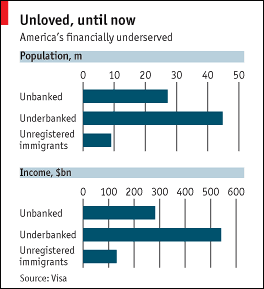 At university one professor cautioned me not to quote so much from The Economist and another professor advised me to keep on reading The Economist. I chose to take the advice of the latter. It’s quite remarkable the number of posts in the bloggersphere that comments about either The Economist or links to its articles. Here’s a sample; Economist Advertising Tactic, Why The Economist is so successful, Cross-Country Relationship Between Wage and Price Inflation, How to Save The Economist and The Journal from Irrelevance, The Design Evolution of The Economist, Facts from the Economist, Lunch with Finance Editor, Burgernomics- a favourite of bloggers, academics and radio stations. Former staff turned bloggers- Chris Anderson and Keith Hart.
Keith Hart, an anthropologist credited three years at The Economist for for teaching him to not only talk about economics as if he knew what he was talking about, but also to do so with unwavering confidence and assurance. Be sure to check The Economist’s style guide.
Iraq's trade unions;According to the Iraqi Workers' Federation (IWF), more than 2,000 of its members have been killed as a direct result of the economic scorched-earth policy waged by the insurgency.
Galbraith Obituary; A decade ago, Mr Galbraith lamented that old age brought an annoying affliction he called the “Still Syndrome”. People would constantly note that he was “still” doing things: still “interested in politics” when he showed up at a meeting, “still imbibing” when he had a drink and “still that way” when his eyes lit up on seeing a beautiful woman. The Still Syndrome lasted an immodestly long time. Its passing has left America poorer
Health in America and Britain; Americans spend far more on health care than the inhabitants of other rich countries, but their life expectancy is below the wealthy world's average. Annual medical costs, measured by the Organisation for Economic Co-operation and Development using purchasing-power parities, which take account of price differences, amount to $5,635 per person in America compared with $2,231 in Britain. Yet an American's life expectancy at birth is 77.2 years compared with 78.5 for a Brit
Iran and the Bomb; He has been greatly helped by the rise in oil prices—propelled, in part, by the worries about Iran. The country's oil revenues for the Iranian year that ended in March were in the region of $50 billion, nearly twice the figure of two years earlier.
Petrol Prices; Many Americans are furious at high petrol prices, but low taxes mean that they get a better deal at the pump than motorists do in most other countries. High taxes make Turkey the most expensive place to fill up, followed by Norway and Britain. The IMF says that higher gasoline taxes in America, which consumes a quarter of the world's oil, would help to curb excessive consumption
Metal prices continue to soar. Copper, nickel, zinc and platinum have all hit record levels. Copper has risen by 60% so far this year; nickel by 45%. Gold is at a 25-year high; silver, a 23-year high
Alternative energy; The notion of American farmers defying the tide of capitalism to grow their own fuel is a glorious delusion. But Mr Schweitzer is right that Congress has some big decisions to make about biofuels. To what extent, if any, should government subsidise this nascent industry? Already it has received plenty of help. Ethanol producers get a tax credit worth 51 cents a gallon, much to the delight of industry powerhouses such as Archer Daniels Midland. There is also a 54 cents-a-gallon tariff on imports of ethanol from Brazil
Japanese toys; Toys that help people to relax have also boosted sales. Primo Puel, a cuddly doll version of a five-year old boy, is fitted with sensors and five levels of happiness, can talk a bit and needs care. It has been a big hit with women over 40, whose own children have left home. “Little Jammer”, a toy jazz band, is also a hit—this time with men. Hidamari no tami (sunshine people), plastic dolls with simple smiley faces, are hot, not just in Japan but in America too. Other local successes include Sega's Homestar Planetarium, which brings the wonders of the night sky into the living room
Flight 93; The film has stirred an angry debate. Isn't Hollywood hijacking the hijacking for its own money-grubbing purposes? Isn't life hard enough without watching people hurtle to their death in a metal tube? And—the most insistent question of all—isn't it too soon for America to relive the horror of September 11th? Trailers for the film were greeted with boos in New York and Los Angeles, and were subsequently pulled. Fully 60% of people tell pollsters that they will not see the film.
Microsoft; The business and regulatory challenges facing Microsoft are related, because the firm needs to be free to compete against rivals in nascent markets on the one hand, yet almost anything it does will invite antitrust concerns on the other. Microsoft's Internet Explorer holds roughly 85% of the market, while the rival Firefox browser boasts 10-15%. But Microsoft lags behind in search. Worldwide, Google has around 50% market share, Yahoo 28% and Microsoft's MSN 13%. The stakes are huge: online advertising in America, today estimated to be worth $12.5 billion, is expected to double by 2010.
Americans Without Bank Accounts; In America at least 12m households have no bank account—are “unbanked”, in the industry's ugly jargon. Once unnaturalised immigrants and the “underbanked”—an even uglier term for those with a low credit score or none—are added, some estimates exceed 40m.
Quantum Computing; Quantum theory allows subatomic particles to exist in more than one state simultaneously, a phenomenon known as superposition. An electron, for example, has a property called spin that can be “up” or “down”—or a bizarre combination of the two. Using the spin of an electron to represent a bit of data would allow it to be both up and down (ie, zero and one) at the same time. Instead of being a bit it is, in the jargon, a qubit
Current Account Balances; Spain's current-account deficit is bigger than America's, relative to the size of the Spanish economy, and it is deteriorating faster. But Spain is in no danger of suffering a run on its currency, which it shares with 11 other countries. Switzerland's current-account surplus, of more than $50 billion, reflects depressed investment rates in the country. Swiss savers are pursuing more lucrative opportunities abroad
Canadian Economy; On April 27th, Mr Harper announced a surprise settlement of a protracted trade war with the United States over softwood lumber….In 2002, for the fourth time since 1982, the United States levied countervailing duties on exports of wood from Canada, its partner in the North American Free Trade Agreement (NAFTA). The American government has mainly failed to persuade NAFTA (and other) panels of its case that Canada subsidises lumber. …But Mr Harper is eager to improve relations with George Bush's government. After a week of talks, both sides agreed a draft deal which in essence returns to the previous regime of managed trade. The Americans will drop the sanctions, and return $4 billion of the $5 billion they have collected in duties. Canada accepted that its share of the American market be capped at 34%. It agreed to impose export taxes and limit shipments if prices in the United States fall much below their current—unusually high—levels. ….Philip Cross, the chief economist of Statistics Canada, reckons that while Americans are paying over 70% more for gasoline than three years ago, prices in Canada are up by only about a third.
French Corruption; The story orginates in a judicial investigation, launched in 2001, into kickbacks, linked to the 1991 sale of six French frigates to Taiwan, that were allegedly channelled through Clearstream accounts.
City of London’s History; AT THE end of the 19th century, an intrepid social scientist visited Stockwell, in south London. He was involved in an ambitious project, led by the shipping magnate Charles Booth, to colour-code every street in the capital according to its social make-up. In general, the area struck him as comfortable. But just east of Stockwell Road he found a pocket of filth and squalor, with rowdy residents and broken windows. It was, he believed, “far the worst place in the division”.
MUSIC company bosses always get a terrible rap…In contrast to many fellow execs, Mr Iovine has musical talent. And although he works for Universal Music Group, the biggest music firm in the world, which is in turn owned by Vivendi, a French conglomerate, artists regard him as much more than just another “suit”. Rappers have even incorporated Jimmy Iovine approvingly into their lyrics. Mr Iovine has street credibility. And—ironically enough—that may be the key to his success as a businessman.
A discussion with Andreas Kluth, Technology Correspondent of The Economist;
“In the participatory era, media will no longer be delivered one way from a media company to an audience...but by audience members to other audience members. The distinction between content creators and consuming audiences first gets blurry and then disappears completely...Instead of media being delivered as a sermon or lecture, it becomes a conversation among the people in the audience”
Lawmakers tell FTC to Define Price Gouging
By Paul
What would the Congress be up to next;
“In a measure passed overwhelmingly by the House this week, lawmakers proposed penalties for price gouging -- to $150 million for wholesalers, $2 million for retailers and two years in jail for either -- and ordered the Federal Trade Commission to put a stop to it. The House measure also called for the FTC to define price gouging...."Many economists cringe when they hear politicians talk about price gouging," said N. Gregory Mankiw, an economics professor at Harvard University and former chairman of President Bush's Council of Economic Advisers. "To economists, the price system is central to how market economies allocate resources. Sometimes prices need to rise to balance supply and demand, even if that outcome is politically unpopular."...
"Beyond this, all is the fog of bad and devious legislation," said William D. Nordhaus, a professor of economics at Yale University. He said that for the FTC to come up with a price gouging definition "will presumably involve rule-making, which will require all kinds of cost and benefit inquiries, and will not emerge until after the election, or even after gas prices have declined."
This might fit the criterion for ‘Bad Economics’, a book idea David Friedman is contemplating;
“I have an idea for a book, although I'm not sure if I will write it. The title is "Bad Economics." To write it, I make a large collection of examples of economic errors--get rich quick schemes, news stories, political speeches, et. al. Then explain why they are wrong and in the process teach the relevant principles.Any opinions on whether it would work? If you like the idea, feel free to contribute examples of bad economics, either as comments to this post or as emails to me. And if you happen to find bits of good economics by non-economists with good economic intuition, send them in too--I'm thinking of a short bit at the end of each chapter labelled "Diamonds from the Dungheap."
Debate between Solow, Bhagwati and Krugman on Globalization
By Paul
“Right now we’re engaged in a veritable orgy of regressive re-distribution of income… we have an administration whole-heartedly dedicated toward giving more power to the powerful and more wealth to the wealthy..” - Robert Solow
There is great webcast of a recent discussion between Bhagwati, Solow and Krugman on the globalization and the human cost of trade liberalization.
Sylvia Nasar introduced the professors and commented a little bit on the history of globalization; this lecture by Anne Krueger can be said to be an expanded version of Nasar’s comments.
Solow focused more on the distributional aspect of globalization;
"The scenario begins with the discovery of a giant pool of labor -- much like the discovery of a natural resource -- in a foreign country. This discovery, Solow said, is probably good for the world and even for the United States, where consumers will enjoy lower prices. But it might not benefit all Americans, he noted. Unskilled workers could find themselves without even low-paying jobs. Of course, the country could redistribute the wealth from those who benefit to those who don’t. “The normal answer given by economists is that there will be winners and losers, but the winners will be able to compensate the losers,” he explained."
Bhagwati pointed out that these days every trader all over the world is worried about competition from overseas; even as far as in Ghana they’re are worried about cheap Chinese texttile imports. Bhagwati doubts we could deal with the issue through distribution alone.
Krugman admitting being a “tortured soul” on the subject of globalization and talked about different experiences of trade liberalization outcome in Latin America and East Asia; ‘in Mexico trade liberalization has been associated with increased inequality’.
During the discussion period, one student questioned given the “race to the bottom” that occurs when countries try to produce goods at the lowest possible cost, “I fail to understand why some degree of protectionism is a bad thing”.
Well even in the US the experience is very mixed as Bradford Plumer points out;
“According to a 1999 report, the vast majority of garment shops in San Francisco, despite being mostly non-unionized, still manage to pay the city minimum of $8.15 an hour and comply with labor laws, while in New York unionized workers were making under $5.15 an hour and repeatedly subject to wage and hour violations. The United States, meanwhile, imports billions of dollars of clothes from Northern Italy each year, where garment workers make two or three times what their counterparts in New York make. So it's not clear that globalization always has to create a race to the bottom.”
An earlier related post; Going to Harvard Can Lead to Rising Inequality
May 6, 2006
British Empire and Astronomy
By Paul
From the latest ‘In Our Time’, BBC podcast series;
“The 18th century explorer and astronomer James Cook wrote: 'Ambition leads me not only farther than any other man has been before me, but as far as I think it possible for man to go'. Cook's ambition took him to the far reaches of the Pacific and led to astronomical observations which measured the distance of Venus to the Sun with unprecedented accuracy.
Cook's ambition was not just personal and astronomical. It represented the colonial ambition of the British Empire which was linked inextricably with science and trade. The Transit of Venus discoveries on Cook's voyage to Tahiti marked the beginning of a period of expansion by the British which relied on maritime navigation based on astronomical knowledge.
How had ancient trade routes set a precedent for colonial expansion? What was the link between astronomy and surveying? What tools did the 18th and 19th century astronomers have at their disposal? And how did the British justify their colonial ambition and scientific superiority?”
Contributors; Simon Schaffer, Professor in History and Philosophy of Science at the University of Cambridge, Kristen Lippincott, former Director of the Royal Observatory, Greenwich, Allan Chapman, Historian of Science at the History Faculty at Oxford University.
A related webcast; ‘Science at Oxford in the 17th Century- Boyle, Hooke and others’ by Allan Chapman.
May 5, 2006
Broadway Diplomacy- Will it work between Cuba and US?
By Paul

A great country
exists in North America
Where I’ll get,
looking for my ideal world
What a great nation,
behind our immense sea
Where I am sure
my life will change
And I will triumph
My talent and luck will be my tools
Cause I will fight and the opportunity
In America will lie
Above might be one reason why last year alone some close to 3,000 Cubans were intercepted on the high seas by the US Coast Gourd Service. The lyrics are from a musical that premiered recently – The Havana Carnival. It’s the brainchild of U.S. director and playwright Tony Giordano and Italian Massimo Mastruzzi (in case you’re wondering the Mastruzzi of “Kaufmann, Kraay, and Mastruzzi’ Governance Indicators”); they hope the musical will contribute to "reducing the tensions" between the two countries.
In the musical , lead character Marianne chooses to live in Cuba;
“The plot of Giordano's musical revolves around the romance between Miguel, a Cuban singer, and Marianne, a dancer from the United States who comes to Havana for advanced training. It also addresses the difficulties the young couple have to face because their parents are completely opposed to their engagement…."I'm not taking sides," said the playwright and director, who said he was "not influenced by any stereotypes whatsoever." He was, however, aware that his play may be misinterpreted by either side in the conflict.
That is "because, although my writing is not politicised," his play addresses "the rights of individuals" and their freedom "to become self-realised persons. Individuality is the most political issue one can struggle for in life," he said.
Will the people here in this ‘great free country’ of USA be able to see the ‘Havana Carnival’;
"…the producer of "Havana Carnival" has not managed to find his way to staging his musical on Broadway. "I would love to have it play in my country, but I don't know how that could happen," he said. "Now that it's going so well, I think people in the United States would like to see it."
May be US and Cuba may learn a bit from India and Pakistan.
Related Links;
- The script of the musical
- Cuban Art
- The Cuban Cigar Mystery
- Broadcasting in Cuba
- Broadway comes to Havana
May 4, 2006
The Right to Tell
By Paul

“There has never been a famine in any country that has been a democracy with a relatively free press.”- Amartya Sen
Today is the World Press Freedom Day. Pablo has a set of links on their blog. I would add the World Bank publication ‘The Right to Tell’ to the list.
In Maldives the day was celebrated with;
“…riot police assaulted three international press freedom monitors on Wednesday evening, following a government crackdown on World Press Freedom Day celebrations in Male’.
At least six people were also arrested including Minivan sub-editor Nazim Sattar, who was detained while translating for the foreign delegation as they spoke with ‘Star Force’ police.
Vincent Brossel from Reporters Without Borders, Thomas Hughes from International Media Support and Sadaf Arshad from the South Asia Press Commission are part of an international delegation currently in Maldives to assess the state of the media.”
There is large gap between rhetoric and reality when it comes to press freedom in a lot of places across the world.
Carnival of Carnivals
By Paul
Why is that in the most advanced country on the planet, more than 2 million parents insist that education ought to be the delivered by the parents; US Department of Education figure is around 1 million. As the Economist reports;
“The market for teaching materials and supplies for home-schoolers is worth at least $850m a year. More than three-quarters of universities now have policies for dealing with home-schooled children. Support networks have sprung up in hundreds of towns and cities across the country to allow parents to do everything from establishing science labs to forming sports teams and defending their rights and reputation. When J.C. Penney started selling a T-shirt in 2001 that featured “Home Skooled” with a picture of a trailer home, the store faced so many complaints that it withdrew the item from sale.”
For more see Carnival of Home Schooling.
Other latest editions of Carnivals; Carnival Of Education, Carnival of Tomorrow, Medical Carnival, Carnival of Personal Finance, Carnival of NFL, Carnival of Godless, Carnival of Marketing, Carnival of Recipes, Carnival of Capitalists, Carnival of Entrepreneurship
May 3, 2006
Disintegration of the Fear Barriers in the Middle East
By Paul

Tom Palmer writes in the Reason magazine on Iraq;
“There is a chance that things will turn out well in Iraq, or at least not badly. Whatever the outcome, libertarians should be eager to assist the Iraqis in creating a free society. That’s why my Arab friends and I have established the Lamp of Liberty (misbahalhurriyya.org) to bring the message of liberty to both Iraqis and the wider Arab world. I am working with Iraqi libertarians who are trying to do the best they can under very difficult circumstances to combat fanaticism, terrorism, and statism. It’s a hard slog, but we have no choice.”
Egyptian sociologist and democracy activist, Saad Eddin Ibrahim is also hopeful about the prospects for democracy in Iraq, pointing out the positives the country has got - a sizeable middleclass, relatively literate population, rich in resources and ethnic diversity – all of which bode well for the development of a liberal democracy.
Related Links:
- Iraq; Rebuilding Iraq: economic reform and transition- World Bank Report
- Reviving Mideastern Democracy- Saad Eddin Ibrahim.
I would highly recommend Professor Ibrahim’s speech above for anyone interested in understanding the current politics of middle east. He talks about the 7 candles of hope in the middle east (the increase in the number of Arab elections, the rinsing role of women and youth in the electoral process, expansion of public space through internet, blogs and Al-Jazeera, proliferation of printed media and the disintegration of the fear barriers, Kifaya or Enough movements).
May 1, 2006
Politician Proof Policy
By Paul

Given the nonsense that you often hear in the development circles, the following paper by James Robinson is a breath of fresh air.
“In this paper I discuss the nature of the political constraints that the World Bank faces in delivering basic services to the poor. The main problem arises because the Bank has to work through domestic governments which have political aims different from helping the poor. The conceptual approach attractive to economists and central to the WDR 2004 is the notion of politician proofing. Given that political incentives derail good policies, how can those policies be politician-proofed? I argue that evidence and theory suggests that such an approach is ultimately futile, basically because we simply do not understand the relevant political incentives. I discuss alternative policy strategies and conclude that what is required is a much more fundamental assessment of what type of political equilibria deliver services to the poor. As I illustrate with the case of Botswana, once the political equilibrium is right, everything goes right and politician proofing is redundant.”
As Robinson says;
"It's basically all a matter of politics, which is something that most economists can't see. There's a tradition in economics of thinking of politics as a kind of irritation, which is fundamentally misleading as a vision of society. You can't have a politics-free economics. Of course, political scientists would like to have an economics-free political science, which is not very interesting either."
Robinson has co-authored a book with Daron Acemoglu, ‘ECONOMIC ORIGINS OF DICTATORSHIP AND DEMOCRACY: Economic and Political Origins’ in which they argue;
“..democracies often collapse in highly polarized societies in which a pronounced gap exists between rich and poor. When the wealthy control the government, they enact policies that perpetuate their own dominance, but when the poor gain power they tend to put extremely radical programs in place such as land reform or income redistribution, arousing violent resistance on the part of opposition groups.The United States avoided this problem because there was egalitarian access to land and economic opportunity, and thus less incentive for one group to try to monopolize political power. But in Robinson's view, the stability of the American government was achieved as the result of a trade-off, rather than through any superior moral qualities….The United States solved some of the problems that Latin America faced by disenfranchising African Americans, who had almost no political power in the South until the Voting Rights Act of 1965,"
Unlike in Botswana, look at what’s happening to the neighbor Zimbabwe where an ageing dictator is bringing the country down the drain; inflation is now close to 1000 percent and 80 % unemployment. Imagine politician proofing policy in Zimbabwe.
Related; Acemoglu talk discussing institutions and development.
Nickel for your thoughts
By Ian
According to this, the cost of producing a penny is now more than the value of the penny itself. If both the article's and the US Mint's numbers are relatively accurate, that means we're losing about $1.8 million a day on these things. Not quite a budget-saver, but I'm sure it could go to something nicer, like more gas for the fleet of SUVs congressmen desperately need to get around in while they stump about high gas prices.
Getting rid of the penny could solve this money-losing prospect. While Illinois may complain, I certainly think I could do without a pocketful of pennies. (Interesting question: just how much value is effectively taken out of circulation by all the pennies that sit around in people's change jars, piggy banks, couch cushions, etc., and what would happen if we all went to spend it at once?). Sure, the Mint says that the penny is the widest circulating denomination, but I'd bet that's just an artifact of their production. After all, it's not like pennies work on a just-in-time production schedule. The Mint's demand schedule for them is likely heavily distorted by the amount that get lost, get socked away, or end up rattling around laundromat washing machines because people forgot to empty their pockets.
The article mentions that pennies were once made from steel, when World War II-demands required copper. I'd be willing to bet that happens before the penny is totally phased out, if only because I can see someone one Capitol Hill claiming that buying steel for pennies would solve the domestic steel-industry problems.